126 books match the query 'Friends and associates' and 9 start with d
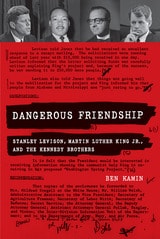
cover of Dangerous Friendship: Stanley Levison, Martin Luther King Jr., and the Kennedy Brothers

Dangerous Friendship

Stanley Levison, Martin Luther King Jr., and the Kennedy Brothers

Ben Kamin

Michigan State University Press, 2014
The product of long-concealed FBI surveillance documents, Dangerous Friendship chronicles a history of Martin Luther King Jr. that the government kept secret from the public for years. The book reveals the story of Stanley Levison, a well-known figure in the Communist Party–USA, who became one of King’s closest friends and, effectively, his most trusted adviser. Levison, a Jewish attorney and businessman, became King’s pro bono ghostwriter, accountant, fundraiser, and legal adviser. This friendship, however, created many complications for both men. Because of Levison’s former ties to the Communist Party, FBI director J. Edgar Hoover launched an obsessive campaign, wiretapping, tracking, and photographing Levison relentlessly. By association, King was labeled as “a Communist and subversive,” prompting then–attorney general Robert F. Kennedy to authorize secret surveillance of the civil rights leader. It was this effort that revealed King’s sexual philandering and furthered a breakdown of trust between King, Robert F. Kennedy, and eventually President John F. Kennedy. With stunning revelations, this book exposes both the general attitude of the U.S. government toward the privacy rights of American citizens during those difficult years as well as the extent to which King, Levison, and many other freedom workers were hounded by people at the very top of the U.S. security establishment.
[more]
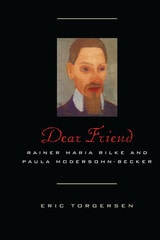
cover of Dear Friend: Rainer Maria Rilke and Paula Modersohn-Becker

Dear Friend

Rainer Maria Rilke and Paula Modersohn-Becker

Eric Torgersen

Northwestern University Press, 2000
Waterlings are the mysterious beings at the center of Veno Taufer's collection of poems. Employing his trademark concise language with hypercondensed imagery and rhythmic drive, Taufer presents a world that at once invokes shamanistic rituals and children's games and riddles. Lyric poetry has long been the most celebrated branch of literature in Slovenia, and Taufer is considered one of the strongest poets of his generation.
[more]
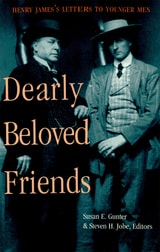
cover of Dearly Beloved Friends: Henry James's Letters to Younger Men

Dearly Beloved Friends

Henry James's Letters to Younger Men

Susan E. Gunter and Steven H. Jobe, Editors

University of Michigan Press, 2004
While the novelist Henry James never formed a permanent relationship with a single individual, in the last decades of his life he increasingly formed passionate attachments to younger men of diverse talents and traits. Dearly Beloved Friends collects carefully edited texts of an ample selection of the writer's personal and often intimate letters -- many of them long withheld from publication -- to four of those men: the sculptor Hendrik Andersen (1872-1940), the dilettante Dudley Jocelyn Persse (1873-1943), and the writers Howard Overing Sturgis (1855-1920) and Sir Hugh Walpole (1884-1941). These letters reveal the humourous, warm side of the literary "Master," and document as never before the depth and eroticism of his love for a number of his friends. Witty, poignant, and passionate, the letters reveal a man in full control of both his rhetoric and his relationships.
[more]
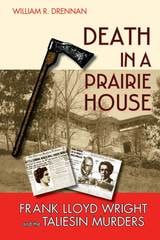
cover of Death in a Prairie House: Frank Lloyd Wright and the Taliesin Murders

Death in a Prairie House

Frank Lloyd Wright and the Taliesin Murders

Drennan

University of Wisconsin Press, 2008

     The most pivotal and yet least understood event of Frank Lloyd Wright’s celebrated life involves the brutal murders in 1914 of seven adults and children dear to the architect and the destruction by fire of Taliesin, his landmark residence, near Spring Green, Wisconsin. Unaccountably, the details of that shocking crime have been largely ignored by Wright’s legion of biographers—a historical and cultural gap that is finally addressed in William Drennan’s exhaustively researched Death in a Prairie House: Frank Lloyd Wright and the Taliesin Murders.
     In response to the scandal generated by his open affair with the proto-feminist and free love advocate Mamah Borthwick Cheney, Wright had begun to build Taliesin as a refuge and "love cottage" for himself and his mistress (both married at the time to others).
      Conceived as the apotheosis of Wright’s prairie house style, the original Taliesin would stand in all its isolated glory for only a few months before the bloody slayings that rocked the nation and reduced the structure itself to a smoking hull.
     Supplying both a gripping mystery story and an authoritative portrait of the artist as a young man, Drennan wades through the myths surrounding Wright and the massacre, casting fresh light on the formulation of Wright’s architectural ideology and the cataclysmic effects that the Taliesin murders exerted on the fabled architect and on his subsequent designs.
 
Best Books for General Audiences, selected by the American Association of School Librarians, and Outstanding Book, selected by the Public Library Association
[more]
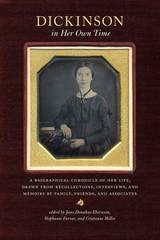
cover of Dickinson in Her Own Time: A Biographical Chronicle of Her Life, Drawn from Recollections, Interviews, and Memoirs by Family, Friends, and Associates

Dickinson in Her Own Time

A Biographical Chronicle of Her Life, Drawn from Recollections, Interviews, and Memoirs by Family, Friends, and Associates

Jane Donahue Eberwein, Stephanie Farrar, and Cristanne Miller

University of Iowa Press, 2015

Even before the first books of her poems were published in the 1890s, friends, neighbors, and even apparently strangers knew Emily Dickinson was a writer of remarkable verses. Featuring both well-known documents and material printed or collected here for the first time, this book offers a broad range of writings that convey impressions of Dickinson in her own time and for the first decades following the publication of her poems. It all begins with her school days and continues to the centennial of her birth in 1930.

In addition, promotional items, reviews, and correspondence relating to early publications are included, as well as some later documents that reveal the changing assessments of Dickinson’s poetry in response to evolving critical standards. These documents provide evidence that counters many popular conceptions of her life and reception, such as the belief that the writer best known for poems focused on loss, death, and immortality was herself a morose soul. In fact, those who knew her found her humorous, playful, and interested in other people.

Dickinson maintained literary and personal correspondence with major representatives of the national literary scene, developing a reputation as a remarkable writer even as she maintained extreme levels of privacy. Evidence compiled here also demonstrates that she herself made considerable provision for the survival of her poems and laid the groundwork for their eventual publication. Dickinson in Her Own Time reveals the poet as her contemporaries knew her, before her legend took hold.
[more]
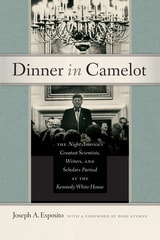
cover of Dinner in Camelot: The Night America's Greatest Scientists, Writers, and Scholars Partied at the Kennedy White House

Dinner in Camelot

The Night America's Greatest Scientists, Writers, and Scholars Partied at the Kennedy White House

Joseph A. Esposito

University Press of New England, 2018
In April 1962, President and Mrs. John F. Kennedy hosted forty-nine Nobel Prize winners—along with many other prominent scientists, artists, and writers—at a famed White House dinner. Among the guests were J. Robert Oppenheimer, who was officially welcomed back to Washington after a stint in the political wilderness; Linus Pauling, who had picketed the White House that very afternoon; William and Rose Styron, who began a fifty-year friendship with the Kennedy family that night; James Baldwin, who would later discuss civil rights with Attorney General Robert Kennedy; Mary Welsh Hemingway, Ernest Hemingway’s widow, who sat next to the president and grilled him on Cuba policy; John Glenn, who had recently orbited the earth aboard Friendship 7; historian Arthur M. Schlesinger, Jr., who argued with Ava Pauling at dinner; and many others. Actor Frederic March gave a public recitation after the meal, including some unpublished work of Hemingway’s that later became part of Islands in the Stream. Held at the height of the Cold War, the dinner symbolizes a time when intellectuals were esteemed, divergent viewpoints could be respectfully discussed at the highest level, and the great minds of an age might all dine together in the rarefied glamour of “the people’s house.”
[more]
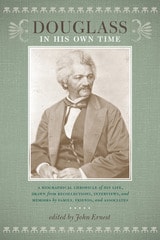
cover of Douglass in His Own Time: A Biographical Chronicle of His Life, Drawn from Recollections, Interviews, and Memoirs by Family, Friends, and Associates

Douglass in His Own Time

A Biographical Chronicle of His Life, Drawn from Recollections, Interviews, and Memoirs by Family, Friends, and Associates

John Ernest

University of Iowa Press, 2014

One of the most incredible stories in American history is that of Frederick Douglass, the man who escaped from slavery and rose to become one of the most celebrated and eloquent orators, writers, and public figures in the world. He first committed his story to writing in his 1845 autobiography Narrative of the Life of Frederick Douglass, an American Slave. Over the course of his life, he would expand on his story considerably, writing two other autobiographies, My Bondage and My Freedom and Life and Times of Frederick Douglass, as well as innumerable newspaper articles and editorials and orations.

As valuable as these writings are in illuminating the man, the story Douglass told in 1845 has become rather too easy to tell, obscuring as much as it reveals. Less a living presence than an inspiring tale, Frederick Douglass remains relatively unknown even to many of those who celebrate his achievements. Douglass in His Own Time offers an introduction to Douglass the man by those who knew him. The book includes a broad range of writings, some intended for public viewing and some private correspondence, all of which contend with the force of Douglass’s tremendous power over the written and spoken word, his amazing presence before crowds, his ability to improvise, to entertain, to instruct, to inspire—indeed, to change lives through his eloquent appeals to righteous self-awareness and social justice. In approaching Douglass through the biographical sketches, memoirs, letters, editorials, and other articles about him, readers will encounter the complexity of a life lived on a very public stage, the story of an extraordinary black man in an insistently white world.
[more]
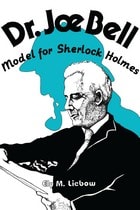
cover of Dr. Joe Bell: Model for Sherlock Holmes

Dr. Joe Bell

Model for Sherlock Holmes

Ely M. Liebow

University of Wisconsin Press, 1982

     A distinguished physician and professor of medicine at Edinburgh University, and a forensic expert for the British Crown, Joseph Bell was well known for his remarkable powers of observation and deduction. In what would become true Sherlockian fashion, he had the ability to deduce facts about his patients from otherwise unremarkable details. In one instance recounted by Arthur Conan Doyle himself—and similar to Sherlock Holmes's own observations in "The Greek Interpreter"—Bell took little time to determine that one of his patients had recently served in the army, a non-commissioned officer discharged from his Highland regiment stationed in Barbados:

“The man was a respectful man, but did not remove his hat. They do not in the army, but he would have learned civilian ways had he been long discharged. He has an air of authority and he is obviously Scottish. As to Barbados, his complaint is elephantitis, which is West Indian and not British.”

     Based on extensive research into the life of Bell and including tantalizing accounts of the connections between Bell and Conan Doyle, this biography is required reading for anyone interested in Victorian medicine, in the history of detective fiction, and in Sherlock Holmes and Dr. Watson.
[more]
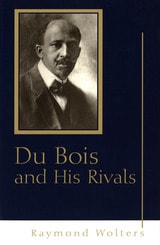
cover of Du Bois and His Rivals

Du Bois and His Rivals

Raymond Wolters

University of Missouri Press, 2002

W. E. B. Du Bois was the preeminent black scholar of his era. He was also a principal founder and for twenty-eight years an executive officer of the nation’s most effective civil rights organization, the National Association for the Advancement of Colored People (NAACP). Even though Du Bois was best known for his lifelong stance against racial oppression, he represented much more. He condemned the racism of the white world but also criticized African Americans for mistakes of their own. He opposed segregation but had reservations about integration. Today he would be known as a pluralist.

In Du Bois and His Rivals, Raymond Wolters provides a distinctive biography of this great pioneer of the American civil rights movement. Readers are able to follow the outline of Du Bois’s life, but the book’s main emphasis is on discrete scenes in his life, especially the controversies that pitted Du Bois against his principal black rivals. He challenged Booker T. Washington because he could not abide Washington’s conciliatory approach toward powerful whites. At the same time, Du Bois’s pluralism led him to oppose the leading separatists and integrationists of his day. He berated Marcus Garvey for giving up on America and urging blacks to pursue a separate destiny. He also rejected Walter White’s insistence that integration was the best way to promote the advancement of black people.

Du Bois felt that American blacks should be full-fledged Americans, with all the rights of other American citizens. However, he believed that they should also preserve and develop enough racial distinctiveness to enable them to maintain and foster a sense of racial identity, community, and pride. Du Bois and His Rivals shows that Du Bois stood for much more than protest against racial oppression. He was also committed to pluralism, and his pluralism emphasized the importance of traditional standards and of internal cooperation within the black community. Anyone interested in the civil rights movement, black history, or the history of the United States during the early twentieth century will find this book valuable.
[more]