Results by title
522 books match the query 'Gender' and 25 start with d
Dance, Sex, and Gender
Signs of Identity, Dominance, Defiance, and DesireJudith Lynne Hanna
University of Chicago Press, 1988
Dancing Odissi
Paratopic Performances of Gender and StateAnurima Banerji
Seagull Books, 2018

Dangerous Gifts
Gender and Exchange in Ancient GreeceBy Deborah Lyons
University of Texas Press, 2012
Deianeira sends her husband Herakles a poisoned robe. Eriphyle trades the life of her husband Amphiaraos for a golden necklace. Atreus’s wife Aerope gives away the token of his sovereignty, a lamb with a golden fleece, to his brother Thyestes, who has seduced her. Gifts and exchanges always involve a certain risk in any culture, but in the ancient Greek imagination, women and gifts appear to be a particularly deadly combination.
This book explores the role of gender in exchange as represented in ancient Greek culture, including Homeric epic and tragedy, non-literary texts, and iconographic and historical evidence of various kinds. Using extensive insights from anthropological work on marriage, kinship, and exchange, as well as ethnographic parallels from other traditional societies, Deborah Lyons probes the gendered division of labor among both gods and mortals, the role of marriage (and its failure) in transforming women from objects to agents of exchange, the equivocal nature of women as exchange-partners, and the importance of the sister-brother bond in understanding the economic and social place of women in ancient Greece. Her findings not only enlarge our understanding of social attitudes and practices in Greek antiquity but also demonstrate the applicability of ethnographic techniques and anthropological theory to the study of ancient societies.

Dangerous Liaisons
Gender, Nation, and Postcolonial PerspectivesAnne Mcclintock
University of Minnesota Press, 1997
Debating Women
Gender, Education, and Spaces for Argument, 1835-1945Carly S. Woods
Michigan State University Press, 2018

Deconstructing the American Mosque
Space, Gender, and AestheticsBy Akel Ismail Kahera
University of Texas Press, 2002
From the avant-garde design of the Islamic Cultural Center in New York City to the simplicity of the Dar al-Islam Mosque in Abiquiu, New Mexico, the American mosque takes many forms of visual and architectural expression. The absence of a single, authoritative model and the plurality of design nuances reflect the heterogeneity of the American Muslim community itself, which embodies a whole spectrum of ethnic origins, traditions, and religious practices.
In this book, Akel Ismail Kahera explores the history and theory of Muslim religious aesthetics in the United States since 1950. Using a notion of deconstruction based on the concepts of "jamal" (beauty), "subject," and "object" found in the writings of Ibn Arabi (d. 1240), he interprets the forms and meanings of several American mosques from across the country. His analysis contributes to three debates within the formulation of a Muslim aesthetics in North America—first, over the meaning, purpose, and function of visual religious expression; second, over the spatial and visual affinities between American and non-American mosques, including the Prophet's mosque at Madinah, Arabia; and third, over the relevance of culture, place, and identity to the making of contemporary religious expression in North America.
Designing for Diversity
Gender, Race, and Ethnicity in the Architectural ProfessionKathryn H. Anthony
University of Illinois Press, 2000
A powerful statement about the repercussions of discrimination and the benefits of diversity in architecture
Providing hard data for trends that many perceive only vaguely and some deny altogether, Designing for Diversity reveals a profession rife with gender and racial discrimination and examines the aspects of architectural practice that hinder or support the full participation of women and persons of color.
Drawing on interviews and surveys of hundreds of architects, Kathryn H. Anthony outlines some of the forms of discrimination that recur most frequently in architecture: being offered added responsibility without a commensurate rise in position, salary, or credit; not being allowed to engage in client contact, field experience, or construction supervision; and being confined to certain kinds of positions, typically interior design for women, government work for African Americans, and computer-aided design for Asian American architects.
Anthony discusses the profession's attitude toward flexible schedules, part-time contracts, and the demands of family and identifies strategies that have helped underrepresented individuals advance in the profession, especially establishing a strong relationship with a mentor. She also observes a strong tendency for underrepresented architects to leave mainstream practice, either establishing their own firms, going into government or corporate work, or abandoning the field altogether.
Given the traditional mismatch between diverse consumers and predominantly white male producers of the built environment, plus the shifting population balance toward communities of color, Anthony contends that the architectural profession staves off true diversity at its own peril. Designing for Diversity argues convincingly that improving the climate for nontraditional architects will do much to strengthen architecture as a profession. Practicing architects, managers of firms, and educators will learn how to create conditions more welcoming to a diversity of users as well as designers of the built environment.

Desired States
Sex, Gender, and Political Culture in ChileLessie Jo Frazier
Rutgers University Press, 2020
Developing Partnerships
Gender, Sexuality, and the Reformed World BankKate Bedford
University of Minnesota Press, 2009
A nuanced critique of how the World Bank encourages gender norms through its policies, Developing Partnerships argues that financial institutions are key players in the global enforcement of gender and family expectations.
By combining analysis of documents produced and sponsored by the World Bank with interviews of World Bank staffers and case studies, Kate Bedford presents a detailed examination of gender and sexuality in the policies of the world's largest and most influential development institution. Looking concurrently at economic and gender policy, Bedford connects reform of markets to reform of masculinities, loan agreements for export promotion to pamphlets for indigenous adolescents advising daily genital bathing, and attempts to strengthen institutions after the Washington Consensus to efforts to promote loving couplehood in response to economic crisis. In doing so, she reveals the shifting relationships between development and sexuality and the ways in which gender policy impacts debates about the future of neoliberalism.
Providing a multilayered account of how gender-aware policies are conceived and implemented by the World Bank, Developing Partnerships demonstrates as well how institutional practices shape development.

Dido's Daughters
Literacy, Gender, and Empire in Early Modern England and FranceMargaret W. Ferguson
University of Chicago Press, 2003
Our common definition of literacy is the ability to read and write in one language. But as Margaret Ferguson reveals in Dido's Daughters, this description is inadequate, because it fails to help us understand heated conflicts over literacy during the emergence of print culture. The fifteenth through seventeenth centuries, she shows, were a contentious era of transition from Latin and other clerical modes of literacy toward more vernacular forms of speech and writing.
Fegurson's aim in this long-awaited work is twofold: to show that what counted as more valuable among these competing literacies had much to do with notions of gender, and to demonstrate how debates about female literacy were critical to the emergence of imperial nations. Looking at writers whom she dubs the figurative daughters of the mythological figure Dido—builder of an empire that threatened to rival Rome—Ferguson traces debates about literacy and empire in the works of Marguerite de Navarre, Christine de Pizan, Elizabeth Cary, and Aphra Behn, as well as male writers such as Shakespeare, Rabelais, and Wyatt. The result is a study that sheds new light on the crucial roles that gender and women played in the modernization of England and France.

Disability Disruptions
Gender, Family, and Care in Post-1989 PolandNatalia Pamula
University of Illinois Press, 2026
Polish politicians regularly idealize the family. But, as Pamula illustrates such rhetoric coerces people into a state of violent intimacy that forces the burden of care onto family members bound by love, dependence, and responsibility. As the narratives show, disability destabilizes national myths, challenges heteronormative and patriarchal family ideals, and exposes continuities between socialist and capitalist regimes in their treatment of disabled citizens.
A rich blend of activism and analysis, Disability Disruptions ventures outside Anglophone notions of disability to highlight how Poland’s disabled people and caregivers overcome lack of recognition, resist social death, and rewrite public memory.

Disappearing Acts
Spectacles of Gender and Nationalism in Argentina's "Dirty War"Diana Taylor
Duke University Press, 1997
Taylor uses performance theory to explore how public spectacle both builds and dismantles a sense of national and gender identity. Here, nation is understood as a product of communal "imaginings" that are rehearsed, written, and staged—and spectacle is the desiring machine at work in those imaginings. Taylor argues that the founding scenario of Argentineness stages the struggle for national identity as a battle between men—fought on, over, and through the feminine body of the Motherland. She shows how the military’s representations of itself as the model of national authenticity established the parameters of the conflict in the 70s and 80s, feminized the enemy, and positioned the public—limiting its ability to respond. Those who challenged the dictatorship, from the Mothers of the Plaza de Mayo to progressive theater practitioners, found themselves in what Taylor describes as "bad scripts." Describing the images, myths, performances, and explanatory narratives that have informed Argentina’s national drama, Disappearing Acts offers a telling analysis of the aesthetics of violence and the disappearance of civil society during Argentina’s spectacle of terror.
Disappearing Acts
Spectacles of Gender and Nationalism in Argentina's "Dirty War"Diana Taylor
Duke University Press, 0
Taylor uses performance theory to explore how public spectacle both builds and dismantles a sense of national and gender identity. Here, nation is understood as a product of communal "imaginings" that are rehearsed, written, and staged—and spectacle is the desiring machine at work in those imaginings. Taylor argues that the founding scenario of Argentineness stages the struggle for national identity as a battle between men—fought on, over, and through the feminine body of the Motherland. She shows how the military’s representations of itself as the model of national authenticity established the parameters of the conflict in the 70s and 80s, feminized the enemy, and positioned the public—limiting its ability to respond. Those who challenged the dictatorship, from the Mothers of the Plaza de Mayo to progressive theater practitioners, found themselves in what Taylor describes as "bad scripts." Describing the images, myths, performances, and explanatory narratives that have informed Argentina’s national drama, Disappearing Acts offers a telling analysis of the aesthetics of violence and the disappearance of civil society during Argentina’s spectacle of terror.
Disorders Of Desire Rev
Sexuality And Gender In Modern American SexologyJanice Irvine
Temple University Press, 2005
This revised and expanded edition features new chapters addressing:
•The diagnosis of "sex addiction"in the 1970s and its social and political implications.
•New developments within the field of sexology, including the "Viagra Revolution" that began in the 1990s.
•The pharmaceutical industry's role in the development of sexual enhancements and the search for the female equivalent of Viagra.
Dissenting Through Dance
Folk Dance, Gender, and Political Protest in TurkeySevi Bayraktar
University of Michigan Press, 2026
Dissenting Through Dance examines how femme activists in contemporary Turkey deploy folk dance as a powerful tool of political resistance and collective solidarity. Drawing on extensive ethnographic fieldwork, choreographic analysis, and archival research, the book examines how traditional dances, particularly those rooted in marginalized cultures such as Kurdish, Roma, Alevi, Laz, and Hemşin communities, are reimagined to contest misogyny, cultural erasure, and oppressive gender politics. Sevi Bayraktar brings to life the stories of feminist, LGBTQ+, and grassroots activists occupying public spaces with dance as a form of protest when conventional forms of assembly are suppressed or criminalized in Turkey.
Working outward from these femmes’ stories, protests, and dances, Bayraktar argues that by reconfiguring Turkey’s folk-dance heritage for their contemporary political aims, dissenting femmes rechoreograph national space in opposition to the state as a way to reclaim the public sphere for pluralist democracy and to subvert hegemonic discourses about Turkish national identity, neoliberal economic development, and female and ethnic bodies. By moving together, activists subvert patriarchal norms, embody new visions of community, and create moments of hope, joy, and resistance even under conditions of surveillance and fear.
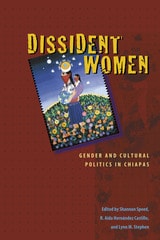
Dissident Women
Gender and Cultural Politics in ChiapasEdited by Shannon Speed, R. Aída Hernández Castillo, and Lynn M. Stephen
University of Texas Press, 2006
Yielding pivotal new perspectives on the indigenous women of Mexico, Dissident Women: Gender and Cultural Politics in Chiapas presents a diverse collection of voices exploring the human rights and gender issues that gained international attention after the first public appearance of the Zapatista National Liberation Army (EZLN) in 1994.
Drawing from studies on topics ranging from the daily life of Zapatista women to the effect of transnational indigenous women in tipping geopolitical scales, the contributors explore both the personal and global implications of indigenous women's activism. The Zapatista movement and the Women's Revolutionary Law, a charter that came to have tremendous symbolic importance for thousands of indigenous women, created the potential for renegotiating gender roles in Zapatista communities. Drawing on the original research of scholars with long-term field experience in a range of Mayan communities in Chiapas and featuring several key documents written by indigenous women articulating their vision, Dissident Women brings fresh insight to the revolutionary crossroads at which Chiapas stands—and to the worldwide implications of this economic and political microcosm.
Diversifying STEM
Multidisciplinary Perspectives on Race and GenderEbony O. McGee
Rutgers University Press, 2020
Research frequently neglects the important ways that race and gender intersect within the complex structural dynamics of STEM. Diversifying STEM fills this void, bringing together a wide array of perspectives and the voices of a number of multidisciplinary scholars. The essays cover three main areas: the widely-held ideology that science and mathematics are “value-free,” which promotes pedagogies of colorblindness in the classroom as well as an avoidance of discussions around using mathematics and science to promote social justice; how male and female students of color experience the intersection of racist and sexist structures that lead to general underrepresentation and marginalization; and recognizing that although there are no quick fixes, there exists evidence-based research suggesting concrete ways of doing a better job of including individuals of color in STEM. As a whole this volume will allow practitioners, teachers, students, faculty, and professionals to reimagine STEM across a variety of educational paradigms, perspectives, and disciplines, which is critical in finding solutions that broaden the participation of historically underrepresented groups within the STEM disciplines.

Diversity
Gender, Color, and CulturePhilomena Essed
University of Massachusetts Press, 1996
Essed examines these problems in a series of interrelated essays, urging us throughout the book to create a society in which diversity is accepted, encouraged, and made central to everyday life.

Do Babies Matter?
Gender and Family in the Ivory TowerMason, Mary Ann
Rutgers University Press, 2013
Do Babies Matter? is the first comprehensive examination of the relationship between family formation and the academic careers of men and women. The book begins with graduate students and postdoctoral fellows, moves on to early and mid-career years, and ends with retirement. Individual chapters examine graduate school, how recent PhD recipients get into the academic game, the tenure process, and life after tenure. The authors explore the family sacrifices women often have to make to get ahead in academia and consider how gender and family interact to affect promotion to full professor, salaries, and retirement. Concrete strategies are suggested for transforming the university into a family-friendly environment at every career stage.
The book draws on over a decade of research using unprecedented data resources, including the Survey of Doctorate Recipients, a nationally representative panel survey of PhDs in America, and multiple surveys of faculty and graduate students at the ten-campus University of California system..

Doing Comparable Worth
Gender, Class, and Pay EquityJoan Acker
Temple University Press, 1991
Doing Comparable Worth is the first empirical study of the actual process of attempting to translate into reality the idea of equal pay for work of equal value. This political ethnography documents a large project undertaken by the state of Oregon to evaluate 35,000 jobs of state employees, identify gender-based pay inequities, and remedy these inequities. The book details both the technical and political processes, showing how the technical was always political, how management manipulated and unions resisted wage redistribution, and how initial defeat was turned into partial victory for pay equity by labor union women and women's movement activists.
As a member of the legislative task force that was responsible for implementing the legislation requiring a pay equity study in Oregon, Joan Acker gives an insider's view of how job evaluation, job classification, and the formulation of an equity plan were carried out. She reveals many of the political and technical problems in doing comparable worth that are not evident to outsiders. She also places comparable worth within a feminist theoretical perspective.
In the series Women in the Political Economy, edited by Ronnie J. Steinberg.
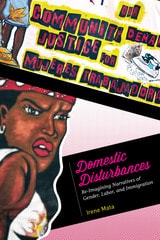
Domestic Disturbances
Re-Imagining Narratives of Gender, Labor, and ImmigrationBy Irene Mata
University of Texas Press, 2014
The issue of immigration is one of the most hotly debated topics in the national arena, with everyone from right-wing pundits like Sarah Palin to alternative rockers like Zack de la Rocha offering their opinion. The traditional immigrant narrative that gained popularity in the nineteenth and twentieth centuries continues to be used today in describing the process of the “Americanization” of immigrants. Yet rather than acting as an accurate representation of immigrant experiences, this common narrative of the “American Dream” attempts to ideologically contain those experiences within a story line that promotes the idea of achieving success through hard work and perseverance.
In Domestic Disturbances, Irene Mata dispels the myth of the “shining city on the hill” and reveals the central truth of hidden exploitation that underlies the great majority of Chicana/Latina immigrant stories. Influenced by the works of Latina cultural producers and the growing interdisciplinary field of scholarship on gender, immigration, and labor, Domestic Disturbances suggests a new framework for looking at these immigrant and migrant stories, not as a continuation of a literary tradition, but instead as a specific Latina genealogy of immigrant narratives that more closely engage with the contemporary conditions of immigration. Through examination of multiple genres including film, theatre, and art, as well as current civil rights movements such as the mobilization around the DREAM Act, Mata illustrates the prevalence of the immigrant narrative in popular culture and the oppositional possibilities of alternative stories.

Domestic Frontiers
Gender, Reform, and American Interventions in the Ottoman Balkans and the Near EastBarbara Reeves-Ellington
University of Massachusetts Press, 2013
During the nineteenth and early twentieth centuries, American Protestant missionaries attempted to export their religious beliefs and cultural ideals to the Ottoman Empire. Seeking to attract Orthodox Christians and even Muslims to their faith, they promoted the paradigm of the “Christian home” as the foundation of national progress. Yet the missionaries' efforts not only failed to win many converts but also produced some unexpected results.
Drawing on a broad range of sources—Ottoman, Bulgarian, Russian, French, and English—Barbara Reeves-Ellington tracks the transnational history of this little-known episode of American cultural expansion. She shows how issues of gender and race influenced the missionaries' efforts as well as the complex responses of Ottoman subjects to American intrusions into their everyday lives. Women missionaries—married and single—employed the language of Christian domesticity and female moral authority to challenge the male-dominated hierarchy of missionary society and to forge bonds of feminist internationalism. At the same time, Orthodox Christians adapted the missionaries' ideology to their own purposes in developing a new strain of nationalism that undermined Ottoman efforts to stem growing sectarianism within their empire. By the beginning of the twentieth century, as some missionaries began to promote international understanding rather than Protestantism, they also paved the way for future expansion of American political and commercial interests.

Domestic Negotiations
Gender, Nation, and Self-Fashioning in US Mexicana and Chicana Literature and ArtMcMahon, Marci R
Rutgers University Press, 2013
This interdisciplinary study explores how US Mexicana and Chicana authors and artists across different historical periods and regions use domestic space to actively claim their own histories. Through “negotiation”—a concept that accounts for artistic practices outside the duality of resistance/accommodation—and “self-fashioning,” Marci R. McMahon demonstrates how the very sites of domesticity are used to engage the many political and recurring debates about race, gender, and immigration affecting Mexicanas and Chicanas from the early twentieth century to today.
Domestic Negotiations covers a range of archival sources and cultural productions, including the self-fashioning of the “chili queens” of San Antonio, Texas, Jovita González’s romance novel Caballero, the home economics career and cookbooks of Fabiola Cabeza de Baca, Sandra Cisneros’s “purple house controversy” and her acclaimed text The House on Mango Street, Patssi Valdez’s self-fashioning and performance of domestic space in Asco and as a solo artist, Diane Rodríguez’s performance of domesticity in Hollywood television and direction of domestic roles in theater, and Alma López’s digital prints of domestic labor in Los Angeles. With intimate close readings, McMahon shows how Mexicanas and Chicanas shape domestic space to construct identities outside of gendered, racialized, and xenophobic rhetoric.

Dominatrix
Gender, Eroticism, and Control in the DungeonDanielle J. Lindemann
University of Chicago Press, 2012

Double Crossover
Gender, Media, and Politics in Global BasketballCourtney M. Cox
University of Illinois Press, 2025
As they compete in leagues around the world, elite women’s basketball players continually adjust to new cultures, rules, and contracts.
Courtney M. Cox follows athletes, coaches, journalists, and advocates of women’s basketball as they pursue careers within the sport. Despite all attempts to contain them or prevent forward momentum, they circumvent expectations and open new possibilities within and outside of the game. Throughout the book, Cox explores the intersection of race and gender against the backdrop of the WNBA, NCAA, and other leagues within the United States and around the world. Blending interviews and participant observation with content analysis, she charts how athletes and advocates of women’s hoops illuminate new forms of navigating the global sports-media complex.
Timely and original, Double Crossover takes readers into the lived world of women’s basketball to shed light on the struggles, triumphs, and contributions of today’s players and those around them.