Results by title
679 books match the query 'Historiography' and 30 start with d
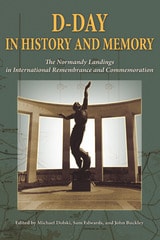
D-Day in History and Memory
The Normandy Landings in International Remembrance and CommemorationMichael Dolski
University of North Texas Press, 2014

D. Michael Quinn
Mormon HistorianGary Topping
Signature Books, 2022

Dale L. Morgan
Mormon and Western Histories in TransitionRichard L. Saunders
University of Utah Press, 2023
This is the first biography of Dale L. Morgan, preeminent Western historian of the fur trade, historic trails, and the Latter Day Saint movement. The book explores how, despite personal struggles, Morgan committed his life to tracking down sources and interpreting the past on the strength of documentary evidence. Connecting Morgan’s life with some of the broad cultural changes that shaped his experiences, this book engages with methodological shifts in the historical profession, the mid-twentieth-century collision of interpretations within Latter Day Saint history, and the development of a descriptive, scholarly approach to that history.
Morgan’s body of work and commitment to serious scholarship signaled the start of new ways of understanding, studying, and retelling history, and he motivated a generation of historians from the 1930s to the 1970s to transform their historical approaches. Sounding board, mentor, and close friend to Nels Anderson, Fawn Brodie, Juanita Brooks, Bernard DeVoto, Wallace Stegner, and Leonard Arrington, Dale Morgan is the common factor linking this influential generation of mid-twentieth-century historians of western America.

Dangerous Intimacies
Toward a Sapphic History of the British NovelLisa L. Moore
Duke University Press, 1997
Moore demonstrates that intimacy between women was vividly imagined in the British eighteenth century as not only chaste and virtuous, but also insistently and inevitably sexual. She looks at instances of sapphism in such novels as Millenium Hall, Memoirs of a Woman of Pleasure, Belinda, and Emma and analyzes how the new literary form of the novel made the bourgeois heroine’s successful negotiation of female friendship central to the establishment of her virtue. Moore also examines representations of sapphism through the sweeping economic and political changes of the period and claims that middle-class readers’ identifications with the heroine’s virtue helped the novel’s bourgeois audience justify the violent bases of their new prosperity, including slavery, colonialism, and bloody national rivalry.
In revealing the struggle over sapphism at the heart of these novels of female friendship—and at the heart of England’s national identity—Moore shows how feminine sexual agency emerged as an important cultural force in post-Enlightenment England
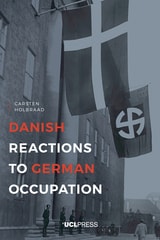
Danish Reactions to German Occupation
History and HistoriographyCarsten Holbraad
University College London, 2017
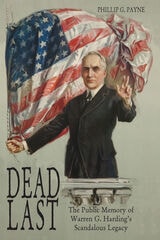
Dead Last
The Public Memory of Warren G. Harding’s Scandalous LegacyPhillip G. Payne
Ohio University Press, 2008
If George Washington and Abraham Lincoln are the saints in America’s civil religion, then the twenty-ninth president, Warren G. Harding, is our sinner. Prior to the Nixon administration, the Harding scandals were the most infamous of the twentieth century. Harding is consistently judged a failure, ranking dead last among his peers.
By examining the public memory of Harding, Phillip G. Payne offers the first significant reinterpretation of his presidency in a generation. Rather than repeating the old stories, Payne examines the contexts and continued meaning of the Harding scandals for various constituencies. Payne explores such topics as Harding’s importance as a midwestern small-town booster, his rumored black ancestry, the role of various biographers in shaping his early image, the tension between public memory and academic history, and, finally, his status as an icon of presidential failure in contemporary political debates. Harding was a popular president and was widely mourned when he died in office in 1923; but with his death began the construction of his public memory and his fall from political grace.
In Dead Last, Payne explores how Harding’s name became synonymous with corruption, cronyism, and incompetence and how it is used to this day as an example of what a president should not be.

Death of a Nation
American Culture and the End of ExceptionalismDavid W. Noble
University of Minnesota Press, 2002
A trenchant examination of epic shifts in American thought by a major scholar in the field.
In the 1940s, American thought experienced a cataclysmic paradigm shift. Before then, national ideology was shaped by American exceptionalism and bourgeois nationalism: elites saw themselves as the children of a homogeneous nation standing outside the history and culture of the Old World. This view repressed the cultures of those who did not fit the elite vision: people of color, Catholics, Jews, and immigrants. David W. Noble, a preeminent figure in American studies, inherited this ideology. However, like many who entered the field in the 1940s, he rejected the ideals of his intellectual predecessors and sought a new, multicultural, postnational scholarship. Throughout his career, Noble has examined this rupture in American intellectual life. In Death of a Nation, he presents the culmination of decades of thought in a sweeping treatise on the shaping of contemporary American studies and an eloquent summation of his distinguished career.
Exploring the roots of American exceptionalism, Noble demonstrates that it was a doomed ideology. Capitalists who believed in a bounded nationalism also depended on a boundless, international marketplace. This contradiction was inherently unstable, and the belief in a unified national landscape exploded in World War II. The rupture provided an opening for alternative narratives as class, ethnicity, race, and region were reclaimed as part of the nation’s history. Noble traces the effects of this shift among scholars and artists, and shows how even today they struggle to imagine an alternative postnational narrative and seek the meaning of local and national cultures in an increasingly transnational world. While Noble illustrates the challenges that the paradigm shift created, he also suggests solutions that will help scholars avoid romanticized and reductive approaches toward the study of American culture in the future.
Debating the End of History
The Marketplace, Utopia, and the Fragmentation of Intellectual LifeDavid W. Noble
University of Minnesota Press, 2012
Why do modern people assume that there will be perpetual economic growth? Because, David W. Noble tells us in this provocative study of cultural criticism, such a utopian conviction is the necessary foundation for bourgeois culture. One can imagine the existence of modern middle classes only as long as the capitalist marketplace is expanding. For Noble, the related—and relevant—question is, how can the middle classes believe that a finite earth is an environment in which infinite growth is possible? The answer, which Noble so painstakingly charts, is nothing less than a genealogy of the uses and abuses of knowledge that lie at the heart of so many of our political problems today.
As far back as Plato and as recently as Alan Greenspan, Noble finds proponents of the idea of a world of independent, rational individuals living in timeless simplicity, escaping from an old world of interdependence and generations. Such notions, although in sync with Newtonian science, have come up against the subsequent conclusions of geology, biology, and the physics of Einstein. In a survey of the responses to this quandary of historians, economists, literary critics, and ecologists, Noble reveals how this confrontation, and its implications for a single global marketplace, has forced certain academic disciplines into unnatural—and untenable—positions.
David Noble’s work exposes the cost—not academic at all—of the segregation of the physical sciences from the humanities and social sciences, even as it demonstrates the required movement of the humanities toward the ecological vision of a single, interconnected world.
Debating the Past
Modern Bulgarian Historiography—From Stambolov to ZhivkovRoumen Daskalov
Central European University Press, 2011
Decolonizing “Prehistory”
Deep Time and Indigenous Knowledges in North AmericaEdited by Gesa Mackenthun and Christen Mucher
University of Arizona Press, 2021
Constructions of America’s ancient past—or the invention of American “prehistory”—occur in national and international political frameworks, which are characterized by struggles over racial and ethnic identities, access to resources and environmental stewardship, the commodification of culture for touristic purposes, and the exploitation of Indigenous knowledges and histories by industries ranging from education to film and fashion. The past’s ongoing appeal reveals the relevance of these narratives to current-day concerns about individual and collective identities and pursuits of sovereignty and self-determination, as well as to questions of the origin—and destiny—of humanity. Decolonizing “Prehistory” critically examines and challenges the paradoxical role that modern scholarship plays in adding legitimacy to, but also delegitimizing, contemporary colonialist practices.
Contributors: Rick Budhwa, Keith Thor Carlson, Kirsten Matoy Carlson, Jessica Christie, Philip J. Deloria, Melissa Gniadek, Annette Kolodny, Gesa Mackenthun, Christen Mucher, Naxaxalhts’i (aka Sonny McHalsie), Jeff Oliver, Mathieu Picas, Daniel Lord Smail, Coll Thrush
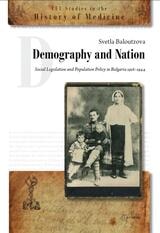
Demography and Nation
Social Legislation and Population Policy in BulgariaSvetla Baloutzova
Central European University Press, 2011
Demon of the Lost Cause
Sherman and Civil War HistoryWesley Moody
University of Missouri Press, 2011
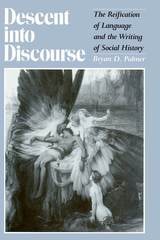
Descent Into Discourse
The Reification of Language and the Writing of Social HistoryBryan Palmer
Temple University Press, 1990
"Critical theory is no substitute for historical materialism; language is not life." With this statement, Bryan Palmer enters the debate that is now transforming and disrupting a number of academic disciplines, including political science, women’s studies, and history. Focusing on the ways in which literary or critical theory is being promoted within the field of social history, he argues forcefully that the current reliance on poststructuralism—with its reification of discourse and avoidance of the structures of oppression and struggles of resistance—obscures the origins, meanings, and consequences of historical events and processes.
Palmer is concerned with the emergence of "language" as a central focus of intellectual work in the twentieth century. He locates the implosion of theory that moved structuralism in the direction of poststructuralism and deconstruction in what he calls the descent into discourse. Few historians who champion poststructuralist thought, according to Palmer, appreciate historical materialism’s capacity to address discourse meaningfully. Nor do many of the advocates of language within the field of social history have an adequate grounding in the theoretical making of the project they champion so ardently. Palmer roots his polemical challenge in an effort to "introduce historians more fully to the theoretical writing that many are alluding to and drawing from rather cavalierly."
Descent into Discourse counters current intellectual fashion with an eloquent argument for the necessity to analyze and appreciate lived experience and the structures of subordination and power in any quest for historical meaning.

Desert Water
The Future of Utah's Water ResourcesHal Crimmel
University of Utah Press, 2014

Deuteronomy-Kings as Emerging Authoritative Books
A ConversationDiana V. Edelman
SBL Press, 2014
Explore how the past came to address the present and the future and why it became important for emerging Jewish identity.
Experts explore the themes and topics that made Deuteronomy and the Former Prophets appealing to ancient readers leading ultimately to those texts becoming authoritative for Persian and Hellenistic readers. This unique collection of essays focuses on what larger impact these texts might have had on primary and secondary audiences as part of emerging Torah. Contributors include Klaus-Peter Adam, Yairah Amit, Thomas M. Bolin, Philip R. Davies, Serge Frolov, Susanne Gilmayr-Bucher, E. Axel Knauf, Christoph Levin, James R. Linville, and Thomas Römer, and Diana V. Edelman.
Features:
- Essays focused on why texts became authoritative instead of when they were written or their historicity
- Two scholars examine each book providing a range of views
- Coverage of the socio-religious function of emerging Torah in the Persian and early Hellenistic periods
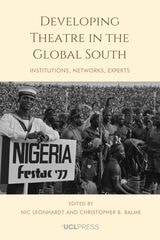
Developing Theatre in the Global South
Institutions, Networks, ExpertsEdited by Nic Leonhardt and Christopher B. Balme
University College London, 2024
This collection presents innovative institutional approaches to the theatre historiography of the Global South, proposing a fundamental reexamination of the historiography of theater in emerging countries since 1945. Covering perspectives from Africa, Asia, the Middle East, Latin America, and Eastern Europe, the chapters explore how US philanthropy, international organizations, and pan-African festivals all contributed to the globalization and institutionalization of the performing arts in the Global South.
During the Cultural Cold War, the Global North intervened in and promoted forms of cultural infrastructure that were deemed adaptable to any environment. This form of politics impacted the construction of national theaters, the introduction of new pedagogical tools, and the invention of the workshop as a format. The networks of experts responsible for this foreground seminal figures, both celebrated (Augusto Boal, Efua Sutherland) but also lesser-known (Albert Botbol, Severino Montano, Metin And), who contributed to the worldwide theatrical epistemic community of the postwar years.
Developing Theatre in the Global South investigates the institutional factors that led to the emergence of professional theatre in the postwar period throughout the decolonizing world. The book’s institutional and transnational approach enables theatre studies to overcome its commonly strong national and local focus on plays and productions and to connect it to current discourses in transnational and global history.
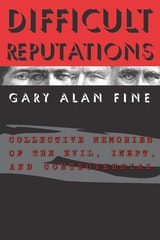
Difficult Reputations
Collective Memories of the Evil, Inept, and ControversialGary Alan Fine
University of Chicago Press, 2001
Presenting essays on America's most reviled traitor, its worst president, and its most controversial literary ingénue (Benedict Arnold, Warren G. Harding, and Lolita), among others, sociologist Gary Alan Fine analyzes negative, contested, and subcultural reputations. Difficult Reputations offers eight compelling historical case studies as well as a theoretical introduction situating the complex roles in culture and history that negative reputations play.
Arguing the need for understanding real conditions that lead to proposed interpretations, as well as how reputations are given meaning over time, this book marks an important contribution to the sociologies of culture and knowledge.
Digital Samaritans
Rhetorical Delivery and Engagement in the Digital HumanitiesJim Ridolfo
University of Michigan Press, 2015
Diné Perspectives
Revitalizing and Reclaiming Navajo ThoughtEdited by Lloyd L. Lee; Foreword by Gregory Cajete
University of Arizona Press, 2014
All of the contributors are coming to personal terms with a phrase that underpins the matrix of Diné culture: Sa’ah Naagháí Bik’eh Hózhóón. Often referred to simply as SNBH, the phrase can be translated in many ways but is generally understood to mean “one’s journey of striving to live a long, harmonious life.” The book offers a variety of perspectives of Diné men and women on the Diné cultural paradigm that is embedded in SNBH. Their writings represent embodied knowledge grounded in a way of knowing that connects thought, speech, experience, history, tradition, and land. Some of the contributors are scholars. Some are Diné who are fighting for justice and prosperity for the Navajo Nation. Some are poets and artists. They are united in working to preserve both intellectual and cultural sovereignty for Diné peoples. And their contributions exemplify how Indigenous peoples are creatively applying tools of decolonization and critical research to re-create Indigenous thought and culture in a present day that rarely resembles the days of their ancestors.
More than 300,000 people self-identify as Diné today. Every one must grapple with how to make a life that acknowledges Sa’ah Naagháí Bik’eh Hózhóón. Diné Perspectives is unique in bringing such personal journeys to the public eye.
Discourses on Livy
Niccolò Machiavelli
University of Chicago Press, 1998
"[Machiavelli] found in Livy the means to inspire scholars for five centuries. Within the Discourses, often hidden and sometimes unintended by their author, lie the seeds of modern political thought. . . . [Mansfield and Tarcov's] translation is careful and idiomatic."—Peter Stothard, The Times
"Translated with painstaking accuracy—but also great readability."—Weekly Standard
"A model of contemporary scholarship and a brave effort at Machiavelli translation that allows the great Florentine to speak in his own voice."—Choice
Disforming The American Canon
African-Arabic Slave Narratives and the VernacularRonald A.T. Judy
University of Minnesota Press, 1993
Dismembering the Whole
Composition and Purpose of Judges 19-21Cynthia Edenburg
SBL Press, 2016
A fresh literary analysis of political polemic in the Bible
The Book of Judges ends with a bizarre narrative of sex and violence that starts with a domestic tiff and ends with the decimation of a tribe that is restored by means of abduction and rape. Cynthia Edenburg applies a fresh literary analysis, recent understandings of historical linguistics, and historical geography in her exploration of the origin of the anti-Benjamin polemic found in Judges 19–21, the growth and provenance of the book of Judges, and the shape of the Deuteronomistic History. Her study exposes how Judges 19–21 function as political polemic reflecting not the pre-monarchic period but instead the historical realities of the settlement of Benjamin during the Babylonian and Persian period.
Features:
- Methodological discussions that open each chapter
- Charts and tables
- Engagement with current research produced by scholars from around the world
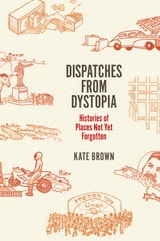
Dispatches from Dystopia
Histories of Places Not Yet ForgottenKate Brown
University of Chicago Press, 2015
In Dispatches from Dystopia, Brown wanders the Chernobyl Zone of Alienation, first on the Internet and then in person, to figure out which version—the real or the virtual—is the actual forgery. She also takes us to the basement of a hotel in Seattle to examine the personal possessions left in storage by Japanese-Americans on their way to internment camps in 1942. In Uman, Ukraine, we hide with Brown in a tree in order to witness the annual male-only Rosh Hashanah celebration of Hasidic Jews. In the Russian southern Urals, she speaks with the citizens of the small city of Kyshtym, where invisible radioactive pollutants have mysteriously blighted lives. Finally, Brown returns home to Elgin, Illinois, in the midwestern industrial rust belt to investigate the rise of “rustalgia” and the ways her formative experiences have inspired her obsession with modernist wastelands.
Dispatches from Dystopia powerfully and movingly narrates the histories of locales that have been silenced, broken, or contaminated. In telling these previously unknown stories, Brown examines the making and unmaking of place, and the lives of the people who remain in the fragile landscapes that are left behind.
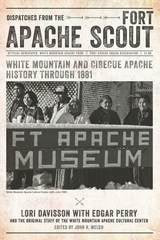
Dispatches from the Fort Apache Scout
White Mountain and Cibecue Apache History Through 1881Lori Davisson with Edgar Perry and the Original Staff of the White Mountain Apache Cultural Center; Edited by John R. Welch
University of Arizona Press, 2016
The book showcases and annotates dispatches published between June 1973 and October 1977, in the tribe’s Fort Apache Scout newspaper. This twenty-eight-part series of articles shared Western Apache culture and history through 1881 and the Battle of Cibecue, emphasizing early encounters with Spanish, Mexican, and American outsiders. Along the way, rich descriptions of Ndee ties to the land, subsistance, leadership, and values emerge. The articles were the result of the dogged work of journalist, librarian, and historian Lori Davisson along with Edgar Perry, a charismatic leader of White Mountain Apache culture and history programs, and his staff who prepared these summaries of historical information for the local readership of the Scout.
Davisson helped to pioneer a mutually beneficial partnership with the White Mountain Apache Tribe. Pursuing the same goal, Welch’s edited book of the dispatches stakes out common ground for understanding the earliest relations between the groups contesting Southwest lands, powerfully illustrating how, as elder Cline Griggs, Sr., writes in the prologue, “the past is present.”
Dispatches from the Fort Apache Scout is both a tribute to and continuation of Davisson’s and her colleagues’ work to share the broad outlines and unique details of the early history of Ndee and Ndee lands.
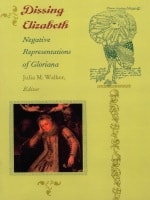
Dissing Elizabeth
Negative Representations of GlorianaJulia M. Walker, ed.
Duke University Press, 1998
As editor Julia M. Walker suggests, the breadth of dissent considered in this collection points to a dark side of the Cult of Elizabeth. Reevaluating neglected texts that had not previously been perceived as critical of the queen or worthy of critical appraisal, contributors consider dissent in a variety of forms, including artwork representing (and mocking) the queen, erotic and pornographic metaphors for Elizabeth in the popular press, sermons subtly critiquing her actions, and even the hostility encoded in her epitaph and in the placement of her tomb. Other chapters discuss gossip about Elizabeth, effigies of the queen, polemics against her marriage to the Duke of Alençon, common verbal slander, violence against emblems of her authority, and the criticism embedded in the riddles, satires, and literature of the period.
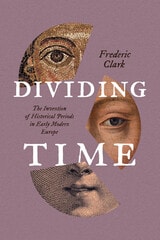
Dividing Time
The Invention of Historical Periods in Early Modern EuropeFrederic Clark
University of Chicago Press, 2027
A bold reconstruction of the origins of the “ancient, medieval, modern” trope used to define historical eras and the transitions between them.
We are used to dividing time, indicating the beginning or end of an era based on a year, a month, or even a specific day, after which (supposedly) “nothing was the same.” In this book, historian and classicist Frederic Clark looks at a particularly enduring form of dividing time—the tripartite distinction between antiquity, the Middle Ages, and modernity—in order to analyze the history of this division, how it has been constructed and deployed, and what its past and present implications are.
Clark argues that the study of the past has always depended on subdividing it into multiple parts, which tend to underpin any attempt to articulate a system of culture or value. After all, certain eras, ages, and epochs are celebrated as having ushered in a new, better time, whereas others are depicted as extended periods of decay and darkness. Clark provides an ingenious critique of the foundational assumptions underlying our narratives of periodization and the complex and messy process by which historical schemas develop, from the Renaissance through the early modern period to the Enlightenment and beyond. The result is an engaging and erudite tour through time and its many contested divisions, imagined and reimagined across history.
Dreaming and Historical Consciousness in Island Greece
Charles Stewart
University of Chicago Press, 2017
Charles Stewart tells the story of the inhabitants of Kóronos, on the Greek island of Naxos, who, in the 1830s, began experiencing dreams in which the Virgin Mary instructed them to search for buried Christian icons nearby and build a church to house the ones they found. Miraculously, they dug and found several icons and human remains, and at night the ancient owners of them would speak to them in dreams. The inhabitants built the church and in the years since have experienced further waves of dreams and startling prophesies that shaped their understanding of the past and future and often put them at odds with state authorities. Today, Kóronos is the site of one of the largest annual pilgrimages in the Mediterranean. Telling this fascinating story, Stewart draws on his long-term fieldwork and original historical sources to explore dreaming as a mediator of historical change, while widening the understanding of historical consciousness and history itself.
Dreams of Archives Unfolded
Absence and Caribbean Life WritingJocelyn Fenton Stitt
Rutgers University Press, 2021
Duress
Imperial Durabilities in Our TimesAnn Laura Stoler
Duke University Press, 2016
Dust Bowl, USA
Depression America and the Ecological Imagination, 1929–1941Brad D. Lookingbill
Ohio University Press, 2001
Whether romantic or tragic, accounts of the dramatic events surrounding the North American Dust Bowl of the “dirty thirties” unearthed anxieties buried deep in America’s ecological imagination. Moreover, the images of a landscape of fear remain embedded in the national consciousness today. In vivid form, the aesthetic of suffering captured in Dorothea Lange’s photographs and Woody Guthrie’s folk songs created the myths and memories of the Depression generation.
Dust Bowl, USA is a critical examination of the stories that grew out of the Dust Bowl experience. Across the nation, newspapers, magazines, books, films, and songs produced imagery of blight for local and mass audiences. As new technology, irrigation innovations, and conservation programs were introduced on a wide scale during the 1930s, the saga of the frontier continued to unfold through accounts of dust, drought, and desertification.
In piercing the myths brought forth in legends, lore, allegories, and anecdotes, Brad Lookingbill provides a revelatory insight into the history of the cultural narratives that have come to define an era.