Results by title
645 books match the query 'Judaism' and 20 start with d
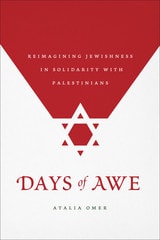
Days of Awe
Reimagining Jewishness in Solidarity with PalestiniansAtalia Omer
University of Chicago Press, 2019
In Days of Awe, Atalia Omer examines this shift through interviews with a new generation of Jewish activists, rigorous data analysis, and fieldwork within a progressive synagogue community. She highlights people politically inspired by social justice campaigns including the Black Lives Matter movement and protests against anti-immigration policies. These activists, she shows, discover that their ethical outrage at US policies extends to Israel’s treatment of Palestinians. For these American Jews, the Jewish history of dispossession and diaspora compels a search for solidarity with liberation movements. This shift produces innovations within Jewish tradition, including multi-racial and intersectional conceptions of Jewishness and movements to reclaim prophetic Judaism. Charting the rise of such religious innovation, Omer points toward the possible futures of post-Zionist Judaism.
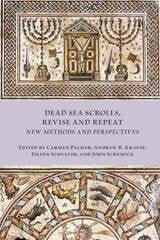
Dead Sea Scrolls, Revise and Repeat
New Methods and PerspectivesCarmen Palmer
SBL Press, 2020
A reexamination of the people and movements associated with Qumran, their outlook on the world, and what bound them together
Dead Sea Scrolls, Revise and Repeat examines the identity of the Qumran movement by reassessing former conclusions and bringing new methodologies to the study of the Dead Sea Scrolls. The collection as a whole addresses questions of identity as they relate to law, language, and literary formation; considerations of time and space; and demarcations of the body. The thirteen essays in this volume reassess the categorization of rule texts, the reuse of scripture, the significance of angelic fellowship, the varieties of calendrical use, and celibacy within the Qumran movement. Contributors consider identity in the Dead Sea Scrolls from new interdisciplinary perspectives, including spatial theory, legal theory, historical linguistics, ethnicity theory, cognitive literary theory, monster theory, and masculinity theory.
Features
- Essays that draw on new theoretical frameworks and recent advances in Qumran studies
- A tribute to the late Peter Flint, whose scholarship helped to shape Qumran studies
Defender of the Faithful
The Life and Thought of Rabbi Levi Yitshak of BerdychivArthur Green
Brandeis University Press, 2022
Defender of the Faithful explores the life and thought of Levi Yitshak of Berdychiv (1740–1809), one of the most fascinating and colorful Hasidic leaders of his time. This is an intellectual and religious biography, a reading of the development of his thought and career. Featuring examples of Levi Yitshak’s extraordinary texts alongside insightful analysis by scholar and theologian Arthur Green, Defender of the Faithful is a compelling study of both Levi Yitshak’s theology and broader philosophy.
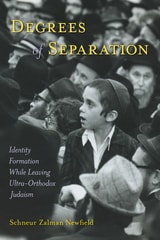
Degrees of Separation
Identity Formation While Leaving Ultra-Orthodox JudaismSchneur Zalman Newfield
Temple University Press, 2020
Those who exit a religion—particularly one they were born and raised in—often find themselves at sea in their efforts to transition to life beyond their community. In Degrees of Separation, Schneur Zalman Newfield, who went through this process himself, interviews seventy-four Lubavitch and Satmar ultra-Orthodox Hasidic Jews who left their communities.He presents their motivations for leaving as well as how they make sense of their experiences and their processes of exiting, detailing their attitudes and opinions regarding their religious upbringing. Newfield also examines how these exiters forge new ways of being that their upbringing had not prepared them for, while also considering what these particular individuals lose and retain in the exit process.
Degrees of Separation presents a comprehensive portrait of the prolonged state of being “in-between” that characterizes transition out of a totalizing worldview. What Newfield discovers is that exiters experience both a sense of independence and a persistent connection; they are not completely dislocated from their roots once they “arrive” at their new destination. Moreover, Degrees of Separation shows that this process of transitioning identity has implications beyond religion.
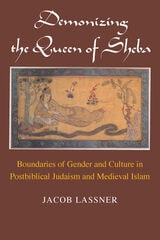
Demonizing the Queen of Sheba
Boundaries of Gender and Culture in Postbiblical Judaism and Medieval IslamJacob Lassner
University of Chicago Press, 1993
The Bible presents the Queen of Sheba's encounter with King Solomon as a diplomatic mission: the queen comes "to test him with hard questions," all of which he answers to her satisfaction; she then praises him and, after an exchange of gifts, returns to her own land. By the Middle Ages, Lassner demonstrates, the focus of the queen's visit had shifted from international to sexual politics. The queen was now portrayed as acting in open defiance of nature's equilibrium and God's design. In these retellings, the authors humbled the queen and thereby restored the world to its proper condition.
Lassner also examines the Islamization of Jewish themes, using the dramatic accounts of Solomon and his female antagonist as a test case of how Jewish lore penetrated the literary imagination of Muslims. Demonizing the Queen of Sheba thus addresses not only specialists in Jewish and Islamic studies, but also those concerned with issues of cultural transmission and the role of gender in history.
Devotion
Three Inquiries in Religion, Literature, and Political ImaginationConstance M. Furey, Sarah Hammerschlag, and Amy Hollywood
University of Chicago Press, 2021
We are living in a time of radical uncertainty, faced with serious political, ecological, economic, epidemiological, and social problems. Scholars of religion Constance M. Furey, Sarah Hammerschlag, and Amy Hollywood come together in this volume with a shared conviction that what and how we read opens new ways of imagining our political futures and our lives.
Each essay in this book suggests different ways to characterize the object of devotion and the stance of the devout subject before it. Furey writes about devotion in terms of vivification, energy, and artifice; Hammerschlag in terms of commentary, mimicry, and fetishism; and Hollywood in terms of anarchy, antinomianism, and atopia. They are interested in literature not as providing models for ethical, political, or religious life, but as creating the site in which the possible—and the impossible—transport the reader, enabling new forms of thought, habits of mind, and ways of life. Ranging from German theologian Martin Luther to French-Jewish philosopher Sarah Kofman to American poet Susan Howe, this volume is not just a reflection on forms of devotion and their critical and creative import but also a powerful enactment of devotion itself.
Dialogue against the Jews
Petrus Alfonsi
Catholic University of America Press, 2006
Dialogue with Trypho (Selections from the Fathers of the Church, Volume 3)
Saint Justin Martyr
Catholic University of America Press, 2003
Didymus the Blind and the Alexandrian Christian Reception of Philo
Justin M. Rogers
SBL Press, 2017
Explore the Jewish traditions preserved in the commentaries of a largely neglected Alexandrian Christian exegete
Justin M. Rogers surveys commentaries on Genesis, Job, Psalms, Ecclesiastes, and Zechariah by Didymus the Blind (ca. 313–398 CE), who was regarded by his students as one of the greatest Christian exegetes of the fourth century. Rogers highlights Didymus’s Jewish sources, zeroing in on traditions of Philo of Alexandria, whose treatises were directly accessible to Didymus while he was authoring his exegetical works. Philonic material in Didymus is covered by extensive commentary, demonstrating that Philo was among the principle sources for the exegetical works of Didymus the Blind. Rogers also explores the mediating influence of the Alexandrian Christian tradition, focusing especially on the roles of Clement and Origen.
Features
- Fresh insights into the Alexandrian Christian reception of Philo
- A thorough discussion of Didymus’s exegetical method, particularly in the Commentary on Genesis
- Examination of the use and importance of Jewish and Christian sources in Late Antique Christian commentaries
Dionysus, Christ, and the Death of God, Volume 1
The Great Mediations of the Classical WorldGiuseppe Fornari
Michigan State University Press, 2020
Dionysus, Christ, and the Death of God, Volume 2
Christianity and ModernityGiuseppe Fornari
Michigan State University Press, 2020
Dirshuni
Contemporary Women’s MidrashEdited by Tamar Biala
Brandeis University Press, 2022
Dirshuni: Contemporary Women’s Midrash, is the first-ever English edition of a historic collection of midrashim composed by Israeli women, which has been long-anticipated by multiple American audiences, including synagogues, rabbinical seminaries, adult learning programs, Jewish educators, and scholars of gender and religion. Using the classical forms developed by the ancient rabbis, the contributors express their religious and moral thought and experience through innovative interpretations of scripture. The women writers, from all denominations and beyond, of all political stripes and ethnic backgrounds, contribute their Torah to fill the missing half of the sacred Jewish bookshelf. This book reflects dramatic changes in the agency of women in the world of religious writings. The volume features a comprehensive introduction to Midrash for the uninitiated reader by the distinguished scholar Tamar Kadari and extensive annotation and commentary by Tamar Biala.
Discourses against Judaizing Christians
Saint John Chrysostom
Catholic University of America Press, 1979
Divination, Politics, and Ancient Near Eastern Empires
Alan Lenzi
SBL Press, 2014
Advance your understanding of divination’s role in supporting or undermining imperial aspirations in the ancient Near East
This collection examines the ways that divinatory texts in the Hebrew Bible and the ancient Near East undermined and upheld the empires in which the texts were composed, edited, and read. Nine essays and an introduction engage biblical scholarship on the Prophets, Assyriology, the Dead Sea Scrolls, and the critical study of Ancient Empires.
Features:
- Interdisciplinary approaches include propaganda studies
- Essays examine how biblical and other ancient Near Eastern texts were shaped by political and theological empires
- Index of ancient sources

Dixie Diaspora
An Anthology of Southern Jewish HistoryMark K. Bauman
University of Alabama Press, 2006
Don Isaac Abravanel
An Intellectual BiographyCedric Cohen-Skalli
Brandeis University Press, 2020
Don Isaac Abravanel (1437–1508) was one of the great inventors of Jewish modernity. A merchant, banker, and court financier, a scholar versed in both Jewish and Christian writings, a preacher and exegete, a prominent political actor in royal entourages and Jewish communities, Abravanel was one of the greatest leaders and thinkers of Iberian Jewry in the aftermath of the expulsion of 1492. This book, the first new intellectual biography of Abravanel in twenty years, depicts his life in three cultural milieus—Portugal, Castile, and post-expulsion Italy—and analyzes his major literary accomplishments in each period. Abravanel was a traditionalist with innovative ideas, a man with one foot in the Middle Ages and the other in the Renaissance. An erudite scholar, author of a monumental exegetical opus that is still studied today, and an avid book collector, he was a transitional figure, defined by an age of contradictions. Yet, it is these very contradictions that make him such an important personality for understanding the dawn of Jewish modernity.
Doubly Chosen
Jewish Identity, the Soviet Intelligentsia, and the Russian Orthodox ChurchJudith Deutsch Kornblatt
University of Wisconsin Press, 2004
Doubly Chosen provides the first detailed study of a unique cultural and religious phenomenon in post-Stalinist Russia—the conversion of thousands of Russian Jewish intellectuals to Orthodox Christianity, first in the 1960s and later in the 1980s. These time periods correspond to the decades before and after the great exodus of Jews from the Soviet Union. Judith Deutsch Kornblatt contends that the choice of baptism into the Church was an act of moral courage in the face of Soviet persecution, motivated by solidarity with the values espoused by Russian Christian dissidents and intellectuals. Oddly, as Kornblatt shows, these converts to Russian Orthodoxy began to experience their Jewishness in a new and positive way.
Working primarily from oral interviews conducted in Russia, Israel, and the United States, Kornblatt underscores the conditions of Soviet life that spurred these conversions: the virtual elimination of Judaism as a viable, widely practiced religion; the transformation of Jews from a religious community to an ethnic one; a longing for spiritual values; the role of the Russian Orthodox Church as a symbol of Russian national culture; and the forging of a new Jewish identity within the context of the Soviet dissident movement.
Drudgery Divine
On the Comparison of Early Christianities and the Religions of Late AntiquityJonathan Z. Smith
University of Chicago Press, 1990
"An important book, and certainly one of the most significant in the career of Jonathan Z. Smith, whom one may venture to call the greatest pathologist in the history of religions. As in many precedent cases, Smith follows a standard procedure: he carefully selects his victim, and then dissects with artistic finesse and unequaled acumen. The operation is always necessary, and a deconstructor of Smith's caliber is hard to find."—Ioan P. Coulianu, Journal of Religion
Durkheim and the Jews of France
Ivan Strenski
University of Chicago Press, 1997
Strenski begins each chapter by weighing particular claims (some anti-Semitic, some not) for the Jewishness of Durkheim's work. In each case Strenski overturns the claim while showing that it can nonetheless open up a fruitful inquiry into the relation of Durkheim to French Jewry. For example, Strenski shows that Durkheim's celebration of ritual had no innately Jewish source but derived crucially from work on Hinduism by the Jewish Indologist Sylvain Lévi, whose influence on Durkheim and his followers has never before been acknowledged.
Dynamic Repetition
History and Messianism in Modern Jewish ThoughtGilad Sharvit
Brandeis University Press, 2022
Dynamic Repetition proposes a new understanding of modern Jewish theories of messianism across the disciplines of history, theology, and philosophy. The book explores how ideals of repetition, return, and the cyclical occasioned a new messianic impulse across an important swath of late nineteenth- and early twentieth-century German Jewish thought. To grasp the complexities of Jewish messianism in modernity, the book focuses on diverse notions of “dynamic repetition” in the works of Franz Rosenzweig, Walter Benjamin, Franz Kafka, and Sigmund Freud, and their interrelations with basic trajectories of twentieth-century philosophy and critical thought.