Results by title
184 books match the query 'Murder' and 8 start with d
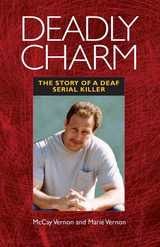
Deadly Charm
The Story of a Deaf Serial KillerMcCay Vernon
Gallaudet University Press, 2010
From the day he was born, Patrick McCullough faced hardships and reacted with untempered anger. His mother, a soon-to-be-divorced military wife, was late to realize that he was deaf and never learned how to handle his outbursts. Eventually, she abandoned him by petitioning for him to be a ward of the state. Stints in mental institutions and dismissals from several schools punctuated the rest of McCullough’s early years. Despite this severe childhood, no one could have predicted the outcome of his life described in Deadly Charm: The Story of a Deaf Serial Killer.
Authors McCay and Marie Vernon present a compelling story about McCullough, a strikingly handsome man with a winning personality. His charm was endearing, but his incendiary temper resulted in increasing aggression and abuse. Eventually, he was convicted for the murder of two men. Yet, McCullough ingratiated himself with the court and served only seven years in prison. Once free again, he resumed his pattern of sweetness and mayhem. He beguiled sympathetic women whom he then abused and stalked. Finally, his rage culminated in a crescendo of destruction. Deadly Charm depicts a deaf serial killer driven by frustration and violence and leaves much to consider. Did McCullough’s deafness exacerbate his lethally violent nature? Perhaps his vicious impulses could have been constrained if his time in mental institutions had been more productive than his time in prison.
Death Casts a Shadow
Patricia Skalka
University of Wisconsin Press, 2022
The scene bears all the characteristics of an accidental fall, not unheard of for a person of her age, but something is not adding up. Later that week, an explosion in an ice fishing shack on the frozen bay leads to the discovery of another body, burned beyond recognition. Was this the widow’s missing handyman? Could the two deaths be related? With what has become a hallmark for books in the series, past and present collide as Cubiak’s search for answers uncovers the sad legacy of loneliness and the disquieting links between wealth and poverty on the peninsula.
Death Washes Ashore
Patricia Skalka
University of Wisconsin Press, 2023
Chasing leads, the sheriff learns the victim directed a troupe of live-action role players living in an ersatz Camelot. In a setting where pretense in the norm, Cubiak must determine if suspects are who they say they are or if their made-up identities conceal a ruthless killer. As tensions escalate among neighbors unhappy about the noise and commotion, the sheriff discovers that more than one person on the peninsula has a motive for murder.
Death and Dissymmetry
The Politics of Coherence in the Book of JudgesMieke Bal
University of Chicago Press, 1988
Counter to standard readings of Judges, Bal's interpretation demonstrates that the book has a political and ideological coherence in which the treatment of women plays a pivotal role. Bal concentrates here not on the assassinations and battles that rage through Judges but on the violence in the domestic lives of individual characters, particularly sexual violence directed at women. Her skillful reading reveals that murder, in this text, relates to gender and reflects a social structure that is inherently contradictory. By foregrounding the stories of women and subjecting them to subtle narrative analysis, she is able to expose a set of preoccupations that are essential to the sense of these stories but are not articulated in them. Bal thereby develops a "countercoherence" in conflict with the apparent emphases of Judges—the politics, wars, and historiography that have been the constant focus of commentators on the book.
Death and Dissymmetry makes an important contribution to the development of a feminist method of interpreting ancient texts, with consequences for religious studies, ancient history, literary theory, and gender studies.
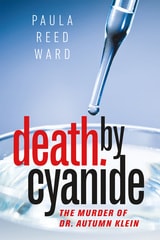
Death by Cyanide
The Murder of Dr. Autumn KleinPaula Reed Ward
Dartmouth College Press, 2016
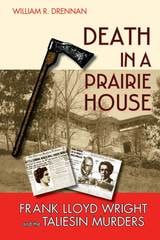
Death in a Prairie House
Frank Lloyd Wright and the Taliesin MurdersDrennan
University of Wisconsin Press, 2008
In response to the scandal generated by his open affair with the proto-feminist and free love advocate Mamah Borthwick Cheney, Wright had begun to build Taliesin as a refuge and "love cottage" for himself and his mistress (both married at the time to others).
Conceived as the apotheosis of Wright’s prairie house style, the original Taliesin would stand in all its isolated glory for only a few months before the bloody slayings that rocked the nation and reduced the structure itself to a smoking hull.
Supplying both a gripping mystery story and an authoritative portrait of the artist as a young man, Drennan wades through the myths surrounding Wright and the massacre, casting fresh light on the formulation of Wright’s architectural ideology and the cataclysmic effects that the Taliesin murders exerted on the fabled architect and on his subsequent designs.
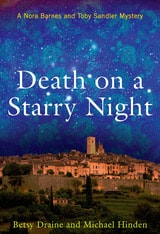
Death on a Starry Night
Betsy Draine and Michael Hinden
University of Wisconsin Press, 2016
During a week of academic squabbling, dining, romance, and suspense, the quirky conference members, one by one, fall under police suspicion and the amused gaze of Nora’s husband, Toby Sandler. But someone wants to stop Nora and Toby’s amateur sleuthing, and what happens next is no joke.
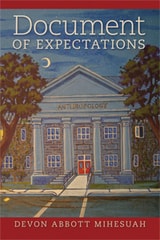
Document of Expectations
Devon Abbott Mihesuah
Michigan State University Press, 2011
When Hopi/White Mountain Apache anthropologist Tony M. Smokerise is found murdered in his office at Central Highlands University, the task of solving the crime falls to jaded Choctaw detective Monique Blue Hawk and her partner Charles T. Clarke. A seemingly tolerant and amicable office of higher education, the university, Monique soon learns, harbors parties determined to destroy the careers of Tony and his best friend, the volatile Oglala anthropologist Roxanne Badger. In the course of her investigation, Monique discovers that the scholars who control Tony’s department are also overseeing the excavation of a centuries-old tribal burial site that was uncovered during the construction of a freeway. Tony’s role in the project, she realizes, might be the key to identifying his murderer. This virtuosic mystery novel explores, in engrossing detail, the complex motives for a killing within the sometimes furtive and hermetic setting of academia.