Results by title
208 books match the query 'Nation' and 12 start with d
DETECTING THE NATION
FICTIONS OF DETECTION AND THE IMPERIAL VENTURECaroline Reitz
The Ohio State University Press, 2004
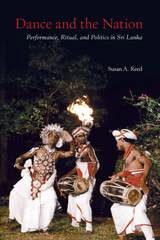
Dance and the Nation
Performance, Ritual, and Politics in Sri LankaSusan A. Reed
University of Wisconsin Press, 2010
As the national dance of Sri Lanka, Kandyan dance is identified with the majority Sinhala ethnic group and heavily supported by the state. Derived from the kohomba kankariya—an elaborate village ritual performed by men of the hereditary drummer caste—the dance was adopted by the state as a symbol of traditional Sinhala culture in the post-independence period. When state officials introduced the dance into the school curriculum, it was opened to individuals of all castes, and high-caste women have emerged as prominent teachers and performers. Reed’s evocative account traces the history and consequences of this transition from ritual to stage, situating the dance in relation to postcolonial nationalism and ethnic politics and emphasizing the voices and perspectives of the hereditary dancers and of women performers.
Although Kandyan dance is related to other south Asian dance forms, it is unique, distinguished by an elegant, energetic style, and lively displays of acrobatics and agility. The companion DVD includes unparalleled footage of this vibrant dance in ritual, stage, and training contexts, and features the most esteemed performers of the Kandyan region.
Dancing from Past to Present
Nation, Culture, IdentitiesEdited by Theresa Jill Buckland
University of Wisconsin Press, 2007
Dangerous Liaisons
Gender, Nation, and Postcolonial PerspectivesAnne Mcclintock
University of Minnesota Press, 1997
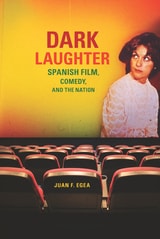
Dark Laughter
Spanish Film, Comedy, and the NationJuan F. Egea
University of Wisconsin Press, 2013
Egea begins his analysis with General Franco's dictatorship in the 1960s—a regime that opened the country to new economic forces while maintaining its repressive nature—exploring key works by Luis García Berlanga, Marco Ferreri, Fernando Fernán-Gómez, and Luis Buñuel. Dark Laughter then moves to the first films of Pedro Almodóvar in the early 1980s during the Spanish political transition to democracy before examining Alex de la Iglesia and the new dark comedies of the 1990s. Analyzing this younger generation of filmmakers, Egea traces dark comedy to Spain's displays of ultramodernity such as the Universal Exposition in Seville and the Barcelona Olympic Games.
At its core, Dark Laughter is a substantial inquiry into the epistemology of comedy, the intricacies of visual modernity, and the relationship between cinema and a wider framework of representational practices.

Death of a Nation
American Culture and the End of ExceptionalismDavid W. Noble
University of Minnesota Press, 2002
A trenchant examination of epic shifts in American thought by a major scholar in the field.
In the 1940s, American thought experienced a cataclysmic paradigm shift. Before then, national ideology was shaped by American exceptionalism and bourgeois nationalism: elites saw themselves as the children of a homogeneous nation standing outside the history and culture of the Old World. This view repressed the cultures of those who did not fit the elite vision: people of color, Catholics, Jews, and immigrants. David W. Noble, a preeminent figure in American studies, inherited this ideology. However, like many who entered the field in the 1940s, he rejected the ideals of his intellectual predecessors and sought a new, multicultural, postnational scholarship. Throughout his career, Noble has examined this rupture in American intellectual life. In Death of a Nation, he presents the culmination of decades of thought in a sweeping treatise on the shaping of contemporary American studies and an eloquent summation of his distinguished career.
Exploring the roots of American exceptionalism, Noble demonstrates that it was a doomed ideology. Capitalists who believed in a bounded nationalism also depended on a boundless, international marketplace. This contradiction was inherently unstable, and the belief in a unified national landscape exploded in World War II. The rupture provided an opening for alternative narratives as class, ethnicity, race, and region were reclaimed as part of the nation’s history. Noble traces the effects of this shift among scholars and artists, and shows how even today they struggle to imagine an alternative postnational narrative and seek the meaning of local and national cultures in an increasingly transnational world. While Noble illustrates the challenges that the paradigm shift created, he also suggests solutions that will help scholars avoid romanticized and reductive approaches toward the study of American culture in the future.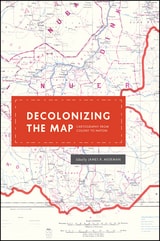
Decolonizing the Map
Cartography from Colony to NationEdited by James R. Akerman
University of Chicago Press, 2017
These essays, originally delivered as the 2010 Kenneth Nebenzahl, Jr., Lectures in the History of Cartography at the Newberry Library, encompass more than two centuries and three continents—Latin America, Africa, and Asia. Ranging from the late eighteenth century through the mid-twentieth, contributors study topics from mapping and national identity in late colonial Mexico to the enduring complications created by the partition of British India and the racialized organization of space in apartheid and post-apartheid South Africa. A vital contribution to studies of both colonization and cartography, Decolonizing the Map is the first book to systematically and comprehensively examine the engagement of mapping in the long—and clearly unfinished—parallel processes of decolonization and nation building in the modern world.
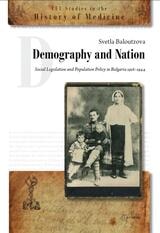
Demography and Nation
Social Legislation and Population Policy in BulgariaSvetla Baloutzova
Central European University Press, 2011

Disarming the Nation
Women's Writing and the American Civil WarElizabeth Young
University of Chicago Press, 1999
Combining literary analysis, cultural history, and feminist theory, Disarming the Nation argues that the Civil War functioned in women's writings to connect female bodies with the body politic. Women writers used the idea of "civil war" as a metaphor to represent struggles between and within women—including struggles against the cultural prescriptions of "civility." At the same time, these writers also reimagined the nation itself, foregrounding women in their visions of America at war and in peace. In a substantial afterword, Young shows how contemporary black and white women—including those who crossdress in Civil War reenactments—continue to reshape the meanings of the war in ways startlingly similar to their nineteenth-century counterparts.
Learned, witty, and accessible, Disarming the Nation provides fresh and compelling perspectives on the Civil War, women's writing, and the many unresolved "civil wars" within American culture today.
Dismantling the Nation
Contemporary Art in ChileEdited by Florencia San Martín, Carla Macchiavello Cornejo, and Paula Solimano
Amherst College Press, 2023
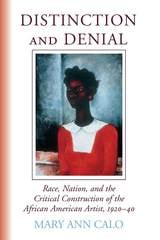
Distinction and Denial
Race, Nation, and the Critical Construction of the African American Artist, 1920-40Mary Ann Calo
University of Michigan Press, 2007
Distinctionand Denial challenges conventional theories of race and art by examining the role early twentieth-century art critics played in marginalizing African American artists. Mary Ann Calo dispels the myth of a unified African American artistic tradition through an engaging study of the germinal writing of Alain Locke and other significant critics of the era, who argued that African American artists were both a diverse group and a constituent element of America’s cultural center. By documenting the effects of the “Negro aesthetic” on African American artists working in the interwar years, Distinctionand Denial shows that black artistic production existed between the claims of a distinctly African American tradition and full inclusion into American modernist culture—never fully inside or outside the mainstream.
“A major contribution to the scholarship of African American artists in the inter-war period. With scrupulous research and probing analyses, Calo’s study enables scholars, students, and those interested in the Harlem Renaissance to grasp the intellectual debates, institutional support, and art world promotion that advanced an emerging cohort of African American artists.”
—Patricia Hills, Boston University
“A careful, thorough, historically grounded study that builds a new and significant argument challenging conventional histories of African American art. Sure to become indispensable to any scholarly discussion of American art or African American cultural studies.”
—Helen Langa, American University
Mary Ann Calo is Professor of Art History and Director of the Institute for the Creative and Performing Arts at Colgate University. She is author of Bernard Berenson and the Twentieth Century and editor of Critical Issues in American Art: A Book of Readings.
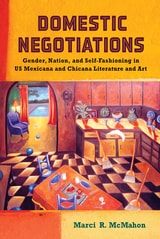
Domestic Negotiations
Gender, Nation, and Self-Fashioning in US Mexicana and Chicana Literature and ArtMcMahon, Marci R
Rutgers University Press, 2013
This interdisciplinary study explores how US Mexicana and Chicana authors and artists across different historical periods and regions use domestic space to actively claim their own histories. Through “negotiation”—a concept that accounts for artistic practices outside the duality of resistance/accommodation—and “self-fashioning,” Marci R. McMahon demonstrates how the very sites of domesticity are used to engage the many political and recurring debates about race, gender, and immigration affecting Mexicanas and Chicanas from the early twentieth century to today.
Domestic Negotiations covers a range of archival sources and cultural productions, including the self-fashioning of the “chili queens” of San Antonio, Texas, Jovita González’s romance novel Caballero, the home economics career and cookbooks of Fabiola Cabeza de Baca, Sandra Cisneros’s “purple house controversy” and her acclaimed text The House on Mango Street, Patssi Valdez’s self-fashioning and performance of domestic space in Asco and as a solo artist, Diane Rodríguez’s performance of domesticity in Hollywood television and direction of domestic roles in theater, and Alma López’s digital prints of domestic labor in Los Angeles. With intimate close readings, McMahon shows how Mexicanas and Chicanas shape domestic space to construct identities outside of gendered, racialized, and xenophobic rhetoric.