Results by title
151 books match the query 'Radicalism' and 8 start with d
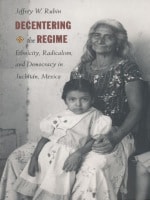
Decentering the Regime
Ethnicity, Radicalism, and Democracy in Juchitán, MexicoJeffrey W. Rubin
Duke University Press, 1997
Employing an interdisciplinary approach, Rubin shows that the Juchitecos’ ability to organize and sustain a radical political movement grew out of a century-long history of negotiation of political rule. He argues that factors outside the realm of formal politics—such as ethnicity, language, gender, and religion—play an important part in the dynamics of regional political struggles and relationships of power. While offering a detailed view of the Zapotec community and its interactions, Rubin reconceptualizes democracy by considering the question of how meaningful autonomy, self-government, cultural expression, and material well-being can be forged out of violence and repression.
Defending the Homeland
Historical Perspectives on Radicalism, Terrorism, and State ResponsesMELINDA M. HICKS
West Virginia University Press, 2007
Terrorism and national security have been in the foreground of the nation’s political landscape since the uncertain times brought on by the attacks of September 11, 2001. This collection of scholarly essays provides a chance to learn from the past by offering an analytic—and sometimes provocative—look at the inseparability of security and history. This work is divided into separate elements depicting security on the national and international levels. "Part One–The US and National Security," focuses on topics such as “Rank-And-File Rednecks: Radicalism and Union Leadership in the West Virginia Mine Wars,” among others. "Part Two–International Terrorism," looks at violence overseas, such as “Beyond Victims and Perpetrators: Women Terrorists and Their Own Stories.”

Delirium and Resistance
Activist Art and the Crisis of CapitalismGregory Sholette
Pluto Press, 2017
In this follow-up to his influential 2010 book, Dark Matter: Art and Politics in the Age of Enterprise Culture, Sholette engages in critical dialogue with artists’ collectives, counter-institutions, and activist groups to offer an insightful firsthand account of the relationship between politics and art in neoliberal society. Sholette lays out clear examples of art’s deep involvement in capitalism: the dizzying prices achieved by artists who pander to the financial elite, the proliferation of museums that contribute to global competition between cities in order to attract capital, and the strange relationship between art and rampant gentrification that restructures the urban landscape.
With a preface by noted author Lucy R. Lippard and an introduction by theorist Kim Charnley, Delirium and Resistance draws on over thirty years of critical debates and practices both in and beyond the art world to historicize and advocate for the art activist tradition that radically—and, at times, deliriously—entangles the visual arts with political struggles.
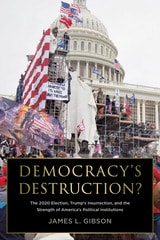
Democracy’s Destruction? Changing Perceptions of the Supreme Court, the Presidency, and the Senate after the 2020 Election
Changing Perceptions of the Supreme Court, the Presidency, and the Senate after the 2020 ElectionJames L. Gibson
Russell Sage Foundation, 2024
Focusing on the U.S. Supreme Court, the presidency, and the U.S. Senate, Gibson reveals that how people assessed the election, the insurrection, and even the second Trump impeachment has little connection to their willingness to view American political institutions as legitimate. Instead, legitimacy is grounded in more general commitments to democratic values and support for the rule of law. On most issues of institutional legitimacy, those who denied the election results and supported the insurrection were not more likely to be alienated from political institutions and to consider them illegitimate.
Gibson also investigates whether Black people might have responded differently to the events of the 2020 election and its aftermath. He finds that in comparison to the White majority, Black Americans were less supportive of America’s democratic institutions and of democratic values, such as reverence for the rule of law, because they often have directly experienced unfair treatment by legal authorities. But he emphasizes that the actions of Trump and his followers are not the cause of those weaker commitments.
Democracy’s Destruction? offers rigorous analysis of the effect of the Trump insurrection on the state of U.S. democracy today. While cautioning that Trump and many Republicans may be devising schemes to subvert the next presidential election more effectively, the book attests to the remarkable endurance of American political institutions.
Democratic Discourses
The Radical Abolition Movement and Antebellum American LiteratureBennett, Michael
Rutgers University Press, 2005
Ever since the hallowed statement, "All men are created equal," was penned in the Declaration of Independence, it has become a historical tenet that freedom and equality were brought to American shores by the so-called Founding Fathers.
In this path-breaking study, Michael Bennett departs from tradition to argue that the democratic ideal of equality and the actual ways in which it has been practiced are grounded less in the fledgling government documents written by a handful of white men than in the actions and writings of the radical abolitionists of the nineteenth century. Bringing together key texts of both African American and European American authors, Democratic Discourses shows the important ways that abolitionist writing shaped a powerful counterculture within a slave-holding society. Bennett offers fresh new analysis through unusual pairings of authors, including Frederick Douglass with Henry David Thoreau, Frances Ellen Watkins Harper with Walt Whitman, and Margaret Fuller with Sojourner Truth. These rereadings avoid the tendency to view antebellum writing as a product primarily of either European American or African American influences and, instead, illustrate the interconnections of white and black literature in the creation and practice of democracy.
Drawing on discourses about race, the body, gender, economics, and aesthetics, this unique study encourages readers to reconsider the reality and roots of freedoms experienced in the United States today.
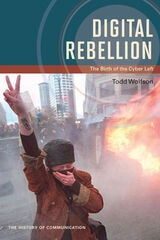
Digital Rebellion
The Birth of the Cyber LeftTodd Wolfson
University of Illinois Press, 2014
Todd Wolfson reveals how aspects of the mid-1990s Zapatistas movement--network organizational structure, participatory democratic governance, and the use of communication tools as a binding agent--became essential parts of Indymedia and other Cyber Left organizations. From there he uses oral interviews and other rich ethnographic data to chart the media-based think tanks and experiments that continued the Cyber Left's evolution through the Independent Media Center's birth around the 1999 WTO protests in Seattle.
Melding virtual and traditional ethnographic practice to explore the Cyber Left's cultural logic, Wolfson maps the social, spatial and communicative structure of the Indymedia network and details its operations on the local, national and global level. He looks at the participatory democracy that governs global social movements and the ways democracy and decentralization have come into tension, and how "the switchboard of struggle" conducts stories from the hyper-local and disperses them worldwide. As he shows, understanding the intersection of Indymedia and the Global Social Justice Movement illuminates their foundational role in the Occupy struggle and other emergent movements that have re-energized radical politics.

Direct Action
Radical Pacifism from the Union Eight to the Chicago SevenJames Tracy
University of Chicago Press, 1996
Taking us through the Vietnam war protests, this detailed treatment of radical pacifism reveals the strengths and limitations of American individualism in the modern era.
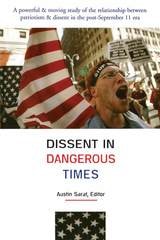
Dissent in Dangerous Times
Austin Sarat, Editor
University of Michigan Press, 2004
While dissent has played a central role in our national history and in the American cultural imagination, it is usually dangerous to those who practice it, and always unpalatable to its targets. War does not encourage the tolerance of opposition at home any more than it does on the front: if the War on Terror is to be a permanent war, then the consequences for American political freedoms cannot be overestimated.
"Dissent in Dangerous Times examines the nature of political repression in liberal societies, and the political and legal implications of living in an environment of fear. This profound, incisive, at times even moving volume calls upon readers to think about, and beyond, September 11, reminding us of both the fragility and enduring power of freedom."
--Nadine Strossen, President, American Civil Liberties Union, and Professor of Law, New York Law School.
Contributors to this volume
Lauren Berlant
Wendy Brown
David Cole
Hugh Gusterson
Nancy L. Rosenblum
Austin Sarat