Results by title
1095 books match the query 'Rhetoric' and 51 start with d
Dangerous Frames
How Ideas about Race and Gender Shape Public OpinionNicholas J. G. Winter
University of Chicago Press, 2008
Dangerous Writing
Understanding the Political Economy of CompositionTony Scott
Utah State University Press, 2009
Since the 1980s and the “social turn” in composition studies and other disciplines, scholars in this field have conceived writing in college as explicitly embedded in socio-rhetorical situations beyond the classroom. From this conviction develops a commitment to teach writing with an emphasis on analyzing the social and political dimensions of rhetoric.
Ironically, though a leftist himself, Tony Scott’s analysis finds the academic left complicit with the forces in American culture that tend, in his view, to compromise education. By focusing on the structures of labor and of institutions that enforce those structures, Scott finds teachers and administrators are too easily swept along with the inertia of a hyper-commodified society in which students---especially working class students---are often positioned as commodities, themselves. Dangerous Writing, then, is a critique of the field as much as it is a critique of capitalism. Ultimately, Scott’s eye is on the institution and its structures, and it is these that he finds most in need of transformation.
Daniel Webster and the Oratory of Civil Religion
Craig R. Smith
University of Missouri Press, 2005
Deaf Empowerment
Emergence, Struggle, and RhetoricKathy Jankowski
Gallaudet University Press, 1997
Central to Deaf Empowerment is the struggle between the dominant hearing society and Deaf people over the best means of communication, with the educational setting as the constant battleground. This evocative work first tracks the history of interaction between these two factions, highlighting the speaking majority’s desire to compel Deaf people to conform to “the human sciences” conventionality by learning speech. Then, it sharply focuses on the development of the Deaf social movement's ideology to seek general recognition of sign language as a valid cultural variation. Also, the influence of social movements of the 60s and 70s is examined in relation to the changing context and perception of the Deaf movement, as well as to its rhetorical refinement.
Deaf Empowerment delineates the apex of effective Deaf rhetoric in describing the success of the Deaf President Now! protest at Gallaudet University in 1988, its aftermath, and ensuing strategies. It concludes with an assessment of the goal of a multicultural society and offers suggestions for community building through a new humanitarianism. Scholars of social movements and Deaf studies will find it to be a uniquely provocative addition to their libraries and classrooms.
Debating Women
Gender, Education, and Spaces for Argument, 1835-1945Carly S. Woods
Michigan State University Press, 2018
Decisions, Agency, and Advising
Key Issues in the Placement of Multilingual Writers into First-Year Composition CoursesTanita Saenkhum
Utah State University Press, 2016
Tanita Saenkhum follows eleven multilingual students who made their decisions about placement into first-year composition courses during one academic year at a large public university. She identifies the need for the process of making placement decisions to be understood more clearly, describes how to use that knowledge to improve placement practices for these students—particularly in advising—and offers hands-on recommendations for writing programs.
Decisions, Agency, and Advising is a significant contribution to the field and particularly valuable to writing program administrators, academic advisors, writing teachers, researchers investigating second language writing and writing program administration, composition and second language writing scholars, and graduate students.
Decoding Abortion Rhetoric
Communicating Social ChangeCeleste Michelle Condit
University of Illinois Press, 1990
Decoding the Digital Church
Evangelical Storytelling and the Election of Donald J. TrumpStephanie A. Martin
University of Alabama Press, 2021
"This investigation tries to understand why many Evangelical pastors were blamed for endorsing Trump when, in fact, most did not. This book joins other attempts by scholars and journalists to analyze the relationship between Trump and Evangelicals. Recommended.” —CHOICE
Tracing the digital narratives that shaped evangelical identity in a pivotal political moment.
As a political constituency, white conservative evangelicals are generally portrayed as easy to dupe, disposed to vote against their own interests, and prone to intolerance and knee-jerk reactions. In Decoding the Digital Church: Evangelical Storytelling and the Election of Donald J. Trump, Stephanie A. Martin challenges this assumption and moves beyond these overused stereotypes to develop a refined explanation for this constituency’s voting behavior.
This volume offers a fresh perspective on the study of religion and politics and stems from the author’s personal interest in the ways her experiences with believers differ from how scholars often frame this group’s rationale and behaviors. To address this disparity, Martin examines sermons, drawing on her expertise in rhetoric and communication studies with the benefits of ethnographic research in an innovative hybrid approach she terms a “digital rhetorical ethnography.” Martin’s thorough research surveys more than 150 online sermons from America’s largest evangelical megachurches in 37 different states. Through listening closely to the words of the pastors who lead these conservative congregations, Martin describes a gentler discourse less obsessed with issues like abortion or marriage equality than stereotypes of evangelicals might suggest. Instead, the politicaleconomic sermons and stories from pastors encourage true believers
to remember the exceptional nature of the nation’s founding while also deemphasizing how much American citizenship really means.
Martin grapples with and pays serious, scholarly attention to a seeming contradiction: while the large majority of white conservative evangelicals voted in 2016 for Donald J. Trump, Martin shows that many of their pastors were deeply concerned about the candidate, the divisive nature of the campaign, and the potential effect of the race on their congregants’ devotion to democratic process itself. In-depth chapters provide a fuller analysis of our current political climate, recapping previous scholarship on the history of this growing divide and establishing the groundwork to set up the dissonance between the political commitments of evangelicals and their faith that the rhetorical ethnography addresses.
Decolonial Conversations in Posthuman and New Material Rhetorics
Edited by Jennifer Clary-Lemon and David M. Grant
The Ohio State University Press, 2022

Decorative Games
Ornament, Rhetoric, and Noble Culture in the Work of Gilles-Marie Oppenord (1672-1742)Jean-François Bédard
University of Delaware Press, 2011
This book features an extraordinary album of ornament designs by the French architect Gilles-Marie Oppenord (1672-1742). In charge of the buildings and grounds of Philippe, duke of Orléans, regent of France during the minority of Louis XV, Oppenord was at the center of the architectural practice of his time. As made evident by this album, his consummate draftsmanship, praised by his contemporaries and coveted by collectors, exceeded by far the practical demands usually required of architects.
On a copy of the first French edition of Cesare Ripa’s Iconologia, published by Jean Baudoin in 1636 with engravings by Jacques de Bié, Oppenord drew vignettes, head and tail pieces, borders and other ornamental motifs. For the first time, this publication reproduces Oppenord’s album in its initial state. Today’s reassembled and rebound album of sixty sheets bears little resemblance to Oppenord’s original copy. A bibliographic analysis of the Ripa-Baudoin book, based on a copy kept at the Bibliothèque nationale de France, and confirmed by a previously unnoticed numbering by Oppenord, guided this first reconstitution. In lieu of a haphazard succession of sketches, it reveals Oppenord’s fascinating interplay between text, engraved and drawn images.
Published by University of Delaware Press. Distributed worldwide by Rutgers University Press.
Deeds Done in Words
Presidential Rhetoric and the Genres of GovernanceKarlyn Kohrs Campbell and Kathleen Hall Jamieson
University of Chicago Press, 1990
"Deeds Done in Words is a thoughtful survey of how a democracy uses language to transact its business. Based on an enlivened understanding of genre theory and on numerous pieces of original criticism, Campbell and Jamieson vividly show how central public discourse has become the lifeblood of the American polity."—Roderick Hart, author of The Sound of Leadership
"The rhetoric that issues from the White House is becoming an ever more salient part of what the presidency means and does. This acute inquiry provides a great many insights into the forms, meanings, and functions of presidential discourse. It is an enlightening contribution to our understanding of American politics."—Murray Edelman, author of Constructing the Political Spectacle
Deep Rhetoric
Philosophy, Reason, Violence, Justice, WisdomJames Crosswhite
University of Chicago Press, 2013
Chapter by chapter, Deep Rhetoric develops an understanding of rhetoric not only in its philosophical dimension but also as a means of guiding and conducting conflicts, achieving justice, and understanding the human condition. Along the way, Crosswhite restores the traditional dignity and importance of the discipline and illuminates the twentieth-century resurgence of rhetoric among philosophers, as well as the role that rhetoric can play in future discussions of ontology, epistemology, and ethics. At a time when the fields of philosophy and rhetoric have diverged, Crosswhite returns them to their common moorings and shows us an invigorating new way forward.
Defining Reality
Definitions and the Politics of MeaningEdward Schiappa
Southern Illinois University Press, 2003
In Defining Reality, Edward Schiappa argues that definitional disputes should be treated less as philosophical questions of “is”and more as sociopolitical questions of “ought.” Instead of asking “What is X?” he advocates that definitions be considered as proposals for shared knowledge and institutional norms, as in “What should count as X in context Y, given our needs and interests?”
Covering a broad scope of argument in rhetorical theory, as well as in legal, medical, scientific, and environmental debates, Schiappa shows the act of defining to be a specialized and learned behavior, and therefore one that can be studied and improved. In response to theories that deem discourse to be persuasive, the author asserts that all discourse is definitive discourse that contributes to our construction of a shared reality.
Defining Reality sheds light on our methods of creating common truths through language and argumentation and forces us to reconsider the contexts, limitations, and adaptability of our definitions. Hinging on a synthesis of arguments regarding the significance of definitional practices, the book is bolstered by a series of case studies of debates about rape, euthanasia, abortion, and political and environmental issues. These case studies ground Schiappa’s concepts in reality and delineate the power of public discourse within legal contexts. Ranging widely among disciplines from philosophy and classical philology to constitutional law and cognitive psychology, this study substantially contributes to the scholarship of rhetoric and argumentation, particularly as they function in the realm of public discourse.
Deflective Whiteness
Co-Opting Black and Latinx Identity PoliticsHannah Noel
The Ohio State University Press, 2022
White deflection offers a script for how social justice rhetoric and the emotions of victimization are appropriated to conjure a hegemonic White identity. Using derivative language, deflection claims Whiteness as the aggrieved social status. Through case studies of cultural moments and archives including Twitter, country music, the Black Lives Matter movement, and more, Deflective Whiteness exposes the various forms of tacit White supremacy that operate under the alibi of injury and that ultimately serve to deepen racial inequities. By understanding how, where, and why White deflection is used, Noel argues, scholars and social justice advocates can trace, tag, and deconstruct covert White supremacy at its rhetorical foundations.
Deliberate Conflict
Argument, Political Theory, and Composition ClassesPatricia Roberts-Miller
Southern Illinois University Press, 2004
In Deliberate Conflict: Argument, Political Theory, and Composition Classes, Patricia Roberts-Miller argues that much current discourse about argument pedagogy is hampered by fundamental unspoken disagreements over what democratic public discourse should look like. The book’s pivotal question is, In what kind of public discourse do we want our students to engage? To answer this, the text provides a taxonomy, discussion, and evaluation of political theories that underpin democratic discourse, highlighting the relationship between various models of the public sphere and rhetorical theory.
Deliberate Conflict cogently advocates reintegrating instruction in argumentation with the composition curriculum. By linking effective argumentation in the public sphere with the ability to effect social change, Roberts-Miller pushes compositionists beyond a simplistic Aristotelian conception of how argumentation works and offers a means by which to prepare students for active participation in public discourse.
Deliberating Ghana
Postcolonial Rhetorics, Culture, and DemocracyStephen Kwame Dadugblor
Michigan State University Press, 2025
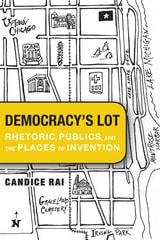
Democracy's Lot
Rhetoric, Publics, and the Places of InventionCandice Rai
University of Alabama Press, 2016
Candice Rai’s Democracy’s Lot is an incisive exploration of the limitations and possibilities of democratic discourse for resolving conflicts in urban communities. Rai roots her study of democratic politics and publics in a range of urban case studies focused on public art, community policing, and urban development. These studies examine the issues that erupted within an ethnically and economically diverse Chicago neighborhood over conflicting visions for a vacant lot called Wilson Yard. Tracing how residents with disparate agendas organized factions and deployed language, symbols, and other rhetorical devices in the struggle over Wilson Yard’s redevelopment and other contested public spaces, Rai demonstrates that rhetoric is not solely a tool of elite communicators, but rather a framework for understanding the agile communication strategies that are improvised in the rough-and-tumble work of democratic life.
Wilson Yard, a lot eight blocks north of Wrigley Field in Chicago’s gentrifying Uptown neighborhood, is a diverse enclave of residents enlivened by recent immigrants from Guatemala, Mexico, Vietnam, Ethiopia, and elsewhere. The neighborhood’s North Broadway Street witnesses a daily multilingual hubbub of people from a wide spectrum of income levels, religions, sexual identifications, and interest groups. When a fire left the lot vacant, this divided community projected on Wilson Yard disparate and conflicting aspirations, the resolution of which not only determined the fate of this particular urban space, but also revealed the lot of democracy itself as a process of complex problem-solving. Rai’s detailed study of one block in an iconic American city brings into vivid focus the remarkable challenges that beset democratic urban populations anywhere on the globe—and how rhetoric supplies a framework to understand and resolve those challenges.
Based on exhaustive field work, Rai uses rhetorical ethnography to study competing publics, citizenship, and rhetoric in action, exploring “rhetorical invention,” the discovery or development by individuals of the resources or methods of engaging with and persuading others. She builds a case for democratic processes and behaviors based not on reflexive idealism but rather on the hard work and practice of democracy, which must address apathy, passion, conflict, and ambivalence.
Demosthenes' "On the Crown"
Rhetorical PerspectivesEdited by James J. Murphy
Southern Illinois University Press, 2016
The volume includes biographical and historical background on Demosthenes and his political situation; a structural analysis of On the Crown; and an abstract of Aeschines’ speech Against Ctesiphon to which Demosthenes was responding. Four essays by contributors analyze Demosthenes’ speech using key elements of rhetoric defined by Aristotle: ēthos, the speaker’s character or authority; pathos, or emotional appeals; logos, or logical appeals; and lexis, a speaker’s style. An introduction and an epilogue by Murphy frame the speech and the rhetorical analysis of it.
By bringing together contextual material about Demosthenes and his speech with a translation and astute rhetorical analyses, Demosthenes’“On the Crown”:Rhetorical Perspectives highlights the oratorical artistry of Demosthenes and provides scholars and students with fresh insights into a landmark speech.
Descartes and the Resilience of Rhetoric
Varieties of Cartesian Rhetorical TheoryThomas M. Carr, Jr.
Southern Illinois University Press, 2009
A careful analysis of the rhetorical thought of René Descartes and of a distinguished group of post-Cartesians. Covering a unique range of authors, including Bernard Lamy and Nicolas Malebranche, Carr attacks the idea, which has become commonplace in contemporary criticism, that the Cartesian system is incompatible with rhetoric.
Carr analyzes the writings of Balzac, the Port-Royalists Arnauld and Nicole, Malebranche, and Lamy, exploring the evolution of Descartes’ thought into their different theories of rhetoric. He constructs his arguments, probing each author’s writings on rhetoric, persuasion, and attention, to demonstrate the basis for rhetorical thought present in Descartes’ theory of persuasion when it is combined with his psychophysiology of attention.
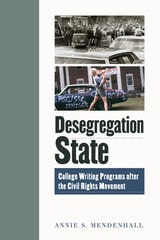
Desegregation State
College Writing Programs after the Civil Rights MovementAnnie S. Mendenhall
Utah State University Press, 2021
Formerly segregated state university systems crafted desegregation plans that gave them more control over policies for admissions, remediation, and retention. These plans created literacy requirements—admissions and graduation tests, remedial classes, and even writing centers and writing across the curriculum programs—that reshaped the landscape of college writing instruction and denied the demands of Black students, civil rights activists, and historically Black colleges and universities for major changes to university systems. This history details the profound influence of desegregation—and resistance to desegregation—on the ways that writing is taught and assessed in colleges today.
Desegregation State provides WPAs and writing teachers with a disciplinary history for understanding racism in writing assessment and writing programs. Mendenhall brings emerging scholarship on the racialization of institutions into the field, showing why writing studies must pay more attention to how writing programs have institutionalized racist literacy ideologies through arguments about student placement, individualized writing instruction, and writing assessment.
Designing Multilingual Experiences in Technical Communication
Laura Gonzales
Utah State University Press, 2022
Through grounded case studies of multilingual technical communication projects in the US, Mexico, and Nepal, Laura Gonzales illustrates the multiple tensions at play in transnational research and demonstrates how technical communicators can leverage contemporary translation practices and methodologies to engage in research with multilingual communities that is justice-driven, participatory, and reciprocal.
Designing Multilingual Experiences in Technical Communication is of value to researchers and students across fields who are interested in designing projects alongside multilingual communities from historically marginalized backgrounds.
Desiring the Bomb
Communication, Psychoanalysis, and the Atomic AgeCalum L. Matheson
University of Alabama Press, 2019
Every culture throughout history has obsessed over various “end of the world” scenarios. The dawn of the Atomic Age marked a new twist in this tale. For the first time, our species became aware of its capacity to deliberately destroy itself. Since that time the Bomb has served as an organizing metaphor, a symbol of human annihilation, a stand-in for the unspeakable void of extinction, and a discursive construct that challenges the limits of communication itself. The parallel fascination with and abhorrence of nuclear weapons has metastasized into a host of other end-of-the-world scenarios, from global pandemics and climate change to zombie uprisings and asteroid collisions.
Desiring the Bomb: Communication, Psychoanalysis, and the Atomic Age explores these world-ending fantasies through the lens of psychoanalysis to reveal their implications for both contemporary apocalyptic culture and the operations of language itself. What accounts for the enduring power of the Bomb as a symbol? What does the prospect of annihilation suggest about language and its limits? Thoroughly researched and accessibly written, this study expands on the theories of Kenneth Burke, Jacques Lacan, Sigmund Freud, and many others from a variety of disciplines to arrive at some answers to these questions.
Calum L. Matheson undertakes a series of case studies—including the Trinity test site, nuclear war games, urban shelter schemes, and contemporary survivalism—and argues that contending with the anxieties (individual, social, cultural, and political) born of the Atomic Age depends on rhetorical conceptions of the “real,” an order of experience that cannot be easily negotiated in language. Using aspects of media studies, rhetorical theory, and psychoanalysis, the author deftly engages the topics of Atomic Age survival, extinction, religion, and fantasy, along with their enduring cultural legacies, to develop an account of the Bomb as a signifier and to explore why some Americans have become fascinated with fantasies of nuclear warfare and narratives of postapocalyptic rebirth.
Developing Writers in Higher Education
A Longitudinal StudyAnne Ruggles Gere, editor
University of Michigan Press, 2019
This volume draws on an in-depth study of the writing and experiences of 169 University of Michigan undergraduates, using statistical analysis of 322 surveys, qualitative analysis of 131 interviews, use of corpus linguistics on 94 electronic portfolios and 2,406 pieces of student writing, and case studies of individual students to trace the multiple paths taken by student writers. Topics include student writers’ interaction with feedback; perceptions of genre; the role of disciplinary writing; generality and certainty in student writing; students’ concepts of voice and style; students’ understanding of multimodal and digital writing; high school’s influence on college writers; and writing development after college. The digital edition offers samples of student writing, electronic portfolios produced by student writers, transcripts of interviews with students, and explanations of some of the analysis conducted by the contributors.
This is an important book for researchers and graduate students in multiple fields. Those in writing studies get an overview of other longitudinal studies as well as key questions currently circulating. For linguists, it demonstrates how corpus linguistics can inform writing studies. Scholars in higher education will gain a new perspective on college student development. The book also adds to current understandings of sociocultural theories of literacy and offers prospective teachers insights into how students learn to write. Finally, for high school teachers, this volume will answer questions about college writing.
Companion Website
Click here to access the Developing Writers project and its findings at the interactive companion website.
Project Data
Access the data from the project through this tutorial.
Dialectical Rhetoric
Bruce Mccomiskey
Utah State University Press, 2015
In Dialectical Rhetoric, Bruce McComiskey argues that the historical conflict between rhetoric and dialectic can be overcome in ways useful to both composition theory and the composition classroom.
Historically, dialectic has taken two forms in relation to rhetoric. First, it has been the logical development of linear propositions leading to necessary conclusions, a one-dimensional form that was the counterpart of rhetorics in which philosophical, metaphysical, and scientific truths were conveyed with as little cognitive interference from language as possible. Second, dialectic has been the topical development of opposed arguments on controversial issues and the judgment of their relative strengths and weaknesses, usually in political and legal contexts, a two-dimensional form that was the counterpart of rhetorics in which verbal battles over competing probabilities in public institutions revealed distinct winners and losers.
The discipline of writing studies is on the brink of developing a new relationship between dialectic and rhetoric, one in which dialectics and rhetorics mediate and negotiate different arguments and orientations that are engaged in any rhetorical situation. This new relationship consists of a three-dimensional hybrid art called “dialectical rhetoric,” whose method is based on five topoi: deconstruction, dialogue, identification, critique, and juxtaposition. Three-dimensional dialectical rhetorics function effectively in a wide variety of discursive contexts, including digital environments, since they can invoke contrasts in stagnant contexts and promote associations in chaotic contexts. Dialectical Rhetoric focuses more attention on three-dimensional rhetorics from the rhetoric and composition community.
Dialogic Confession
Bonhoeffer's Rhetoric of ResponsibilityRonald C. Arnett. Foreword by Clifford Christians
Southern Illinois University Press, 2005
In this landmark volume of contemporary communication theory, Ronald C. Arnett applies the metaphor of dialogic confession—which enables historical moments to be addressed from a confessed standpoint and through a communicative lens—to the works of German theologian Dietrich Bonhoeffer, who pointed to an era of postmodern difference with his notion of "a world come of age." Arnett’s interpretations of Bonhoeffer’s life and scholarship in contention with Nazi dominance offer implications for a dialogic confession that engages the complexity of postmodern narrative contention.
Rooted in classical theory, the field of communication ethics is abstract and arguably outmoded. In Dialogic Confession: Bonhoeffer’s Rhetoric of Responsibility, Arnett locates cross-cultural and comparative anchors that not only bring legitimacy and relevance to the field but also develop a conceptual framework that will advance and inspire future scholarship.
Dialogue, Dialectic and Conversation
A Social Perspective on the Function of WritingGregory Clark. Foreword by Robert J. Connors
Southern Illinois University Press, 1990
This book articulates an ethics for reading that places primary responsibility for the social influences of a text on the response of its readers.
We write and read as participants in a process through which we negotiate with others whom we must live or work with and with whom we share values, beliefs, and actions. Clark draws on current literary theory, rhetoric, philosophy, communication theory, and composition studies as he builds on this argument.
Because reading and writing are public actions that address and direct matters of shared belief, values, and action, reading and writing should be taught as public discourse. We should teach not writing or reading so much as the larger practice of public discourse—a discourse that sustains the many important communities of which students are and will be active members.
Digital Detroit
Rhetoric and Space in the Age of the NetworkJeff Rice
Southern Illinois University Press, 2012
Since the 1967 riots that ripped apart the city, Detroit has traditionally been viewed either as a place in ruins or a metropolis on the verge of rejuvenation. In Digital Detroit: Rhetoric and Space in the Age of the Network, author Jeff Rice goes beyond the notion of Detroit as simply a city of two ideas. Instead he explores the city as a web of multiple meanings which, in the digital age, come together in the city’s spaces to form a network that shapes the writing, the activity, and the very thinking of those around it.
Rice focuses his study on four of Detroit’s most iconic places—Woodward Avenue, the Maccabees Building, Michigan Central Station, and 8 Mile—covering each in a separate chapter. Each of these chapters explains one of the four features of network rhetoric: folksono(me), the affective interface, response, and decision making. As these rhetorical features connect, they form the overall network called Digital Detroit. Rice demonstrates how new media, such as podcasts, wikis, blogs, interactive maps, and the Internet in general, knit together Detroit into a digital network whose identity is fluid and ever-changing. In telling Detroit’s spatial story, Rice deftly illustrates how this new media, as a rhetorical practice, ultimately shapes understandings of space in ways that computer applications and city planning often cannot. The result is a model for a new way of thinking and interacting with space and the imagination, and for a better understanding of the challenges network rhetorics pose for writing.
Digital Griots
African American Rhetoric in a Multimedia AgeAdam J. Banks
Southern Illinois University Press, 2011
DJs are models of rhetorical excellence; canon makers; time binders who link past, present, and future in the groove and mix; and intellectuals continuously interpreting the history and current realities of their communities in real time. Banks uses the DJ's practices of the mix, remix, and mixtape as tropes for reimagining writing instruction and the study of rhetoric. He combines many of the debates and tensions that mark black rhetorical traditions and points to ways for scholars and students to embrace those tensions rather than minimize them. This commitment to both honoring traditions and embracing futuristic visions makes this text unique, as do the sites of study included in the examination: mixtape culture, black theology as an activist movement, everyday narratives, and discussions of community engagement. Banks makes explicit these connections, rarely found in African American rhetoric scholarship, to illustrate how competing ideologies, vernacular and academic writing, sacred and secular texts, and oral, print, and digital literacies all must be brought together in the study of African American rhetoric and in the teaching of culturally relevant writing.
A remarkable addition to the study of African American rhetorical theory and composition studies, Digital Griots: African American Rhetoric in a Multimedia Age will compel scholars and students alike to think about what they know of African American rhetoric in fresh and useful ways.
Digital Rhetoric
Theory, Method, PracticeDouglas Eyman
University of Michigan Press, 2015
Dirty Words
The Rhetoric of Public Sex Education, 1870-1924Robin E. Jensen
University of Illinois Press, 2010
Disabled Upon Arrival
Eugenics, Immigration, and the Construction of Race and DisabilityJay Timothy Dolmage
The Ohio State University Press, 2018
Through careful archival research and consideration of the larger ideologies of racialization and xenophobia, Disabled Upon Arrival links anti-immigration rhetoric to eugenics—the flawed “science” of controlling human population based on racist and ableist ideas about bodily values. Dolmage casts an enlightening perspective on immigration restriction, showing how eugenic ideas about the value of bodies have never really gone away and revealing how such ideas and attitudes continue to cast groups and individuals as disabled upon arrival.
Discord And Direction
The Postmodern Writing Program Administratoredited by Sharon James McGee & Carolyn Handa
Utah State University Press, 2005
Postmodernism's central moves include questioning hierarchy, valuing paratactic associations, and rejecting grand narratives, and the work of a Writing Program Administrator, most days, includes those moves as well. The argument of this collection is that the cultural and intellectual legacies of postmodernism impinge, significantly and daily, on the practice of the Writing Program Administrator. WPAs work in spaces where they must assume responsibility for a multifaceted program, a diverse curriculum, instructors with varying pedagogies and technological expertise—and where they must position their program in relation to a university with its own conflicted mission, and a state with its unpredictable views of accountability and assessment.
The collection further argues that postmodernism offers a useful lens through which to understand the work of WPAs and to examine the discordant cultural and institutional issues that shape their work. Each chapter tackles a problem local to its author's writing program or experience as a WPA, and each responds to existing discord in creative ways that move toward rebuilding and redirection.
It is a given that accepting the role of WPA will land you squarely in the bind between modernism and postmodernism: while composition studies as a field arguably still reflects a modernist ethos, the WPA must grapple daily with postmodern habits of thought and ways of being. The effort to live in this role may or may not mean that a WPA will adopt a postmodern stance; it does mean, however, that being a WPA requires dealing with the postmodern.
Discourse and Defiance under Nazi Occupation
Guernsey, Channel Islands, 1940–1945Cheryl R. Jorgensen-Earp
Michigan State University Press, 2013
Captured by German forces shortly after Dunkirk, and not relinquished until May of 1945, nearly a year after the Normandy invasion, the British Channel Islands (Guernsey, Jersey, Alderney, Sark, and Herm) were characterized during their occupation by severe deprivation and powerlessness. The Islanders, with few resources to stage an armed resistance, constructed a rhetorical resistance based upon the manipulation of discourse, construction of new symbols, and defiance of German restrictions on information. Though much of modern history has focused on the possibility that Islanders may have collaborated with the Germans, this eye-opening history turns to secret war diaries kept in Guernsey. A close reading of these private accounts, written at great risk to the diarists, allows those who actually experienced the Occupation to reclaim their voice and reveals new understandings of Island resistance. What emerges is a stirring account of the unquenchable spirit and deft improvisation of otherwise ordinary people in extraordinary circumstances. Under the most dangerous of conditions, Guernsey civilians used imaginative methods in reacting to their position as a subjugated population, devising a covert resistance of nuance and sustainability. Violence, this book and the people of Guernsey demonstrate, is not at all the only means with which to confront evil.
Discursive Ideologies
Reading Western RhetoricC. H. Knoblauch
Utah State University Press, 2014
In Discursive Ideologies, C. H. Knoblauch argues that European rhetorical theory comprises several distinct and fundamentally opposed traditions of discourse. Writing accessibly for the upper division student, Knoblauch resists the conventional narrative of a unified Western rhetorical tradition. He identifies deep ideological and epistemological differences that exist among strands of Western thought and that are based in divergent "grounds of meaningfulness.” These conflicts underlie and influence current discourse about vital public issues.
Knoblauch considers six "stories” about the meaning of meaning in an attempt to answer the question, what encourages us to believe that language acts are meaningful? Six distinctive ideologies of Western rhetoric emerge: magical rhetoric, ontological rhetoric, objectivist rhetoric, expressivist rhetoric, sociological rhetoric, and deconstructive rhetoric. He explores the nature of language and the important role these rhetorics play in the discourses that matter most to people, such as religion, education, public policy, science, law, and history.
Disgustatory!
A Gothic Rhetoric of ConsumptionJeremy Tirrell and Kate Maddalena
University of Alabama Press, 2026
A critical exploration of how Gothic tropes infiltrate wellness discourse, revealing the rhetorical forces behind our cultural obsession with food, health, and bodily control.
Disgustatory! A Gothic Rhetoric of Consumption unearths the darkness behind modern obsessions with food, health, and bodily optimization. In this provocative and richly interdisciplinary work, Jeremy Tirrell and Kate Maddalena argue that contemporary discourses around food, medicine, and the body are steeped in Gothic rhetoric—where the promise of purity and control is shadowed by monstrosity, abjection, and the uncanny.
From Soylent and nootropics to probiotics and lab-grown meat, Tirrell and Maddalena show how wellness discourse is haunted by Gothic tropes: body horror, hybridity, and existential dread. Wellness culture, they argue, is not merely pseudoscience or fraud but a complex, persuasive rhetoric that blurs science and myth, purity and decay, medicine and mysticism.
Disgustatory! offers a fresh framework: a “Gothic rhetoric of consumption” that explains why we are drawn to weird diets, digital detoxes, and miracle cures. Through case studies of strange substances and stranger practices—Reddit fasting rituals, magic dirt supplements, fecal transplants— Tirrell and Maddalena reveal how fear, fascination, and the fantasy of bodily control animate our health choices. Each chapter explores a rhetorical element—quantification, hybridity, abjection, optimization, and regulation—to show how food becomes a site of cultural anxiety and existential longing. This book will appeal to rhetoricians, scholars of science and technology studies, cultural theorists, and anyone interested in the strange intersections of health, horror, and persuasion.
Disobedient Aesthetics
Surveillance, Bodies, ControlAnthony Stagliano
University of Alabama Press, 2024
A compelling inquiry into the rhetorical and aesthetic techniques that subvert contemporary regimes of digital surveillance, embodiment, and control.
The contemporary world bristles with tools of observation and manipulation. Security cameras, social media, data mining, biometric scans, and other instruments ensnare the individual in a web of surveillance. In Disobedient Aesthetics, Anthony Stagliano exposes the use of human lives as sites of data exploitation and outlines paths of resistance. From the thermal-vision systems used on military drones, which use human body heat itself as a media object, to facial recognition platforms that use human faces as data mines, and from law enforcement tools of DNA analysis to data-driven urban governance, the realm of algorithmic surveillance and control is wide and subtle.
Disobedient Aesthetics outlines interventions into the technical systems subtending data-driven surveillance and control. Stagliano maps not only the surveillant regimes afforded by recent networked technologies, but also the inventive, artistic research into ways of undermining, upending, or redirecting such technologies. The concluding chapter examines creative, critical, and collective efforts to democratize access to the technology that undergirds such scrutiny and enables ways to detect and contest its power.
In a fascinating epilogue, Stagliano revisits current theories of control and offers an alternative reading of Gilles Deleuze’s oft-cited thesis on control societies: namely that it is not a matter of “finding new weapons” to undermine control but developing new techniques, new designs, new prototypes, and new modes of creative escape.
Disorder in the Court
Morality, Myth, and the Insanity DefenseAndrea L. Alden
University of Alabama Press, 2018
The first book-length rhetorical history and analysis of the legal and moral questions behind the insanity defense.
The insanity defense is considered one of the most controversial, most misunderstood, and least straightforward subjects in the American legal system. Disorder in the Court: Morality, Myth, and the Insanity Defense traces the US legal standards for the insanity defense as they have evolved from 1843, when they were first codified in England, to 1984, when the US government attempted to revise them through the Insanity Defense Reform Act. Throughout this period “insanity” existed primarily as a legal term rather than a medical one; yet the testimony of psychiatric experts is required in cases in which an insanity defense is raised.
The adjudication of such cases by courtroom practice is caught between two different but overlapping discourses, the legal and the medical, both of which have historically sought to assert and maintain firm disciplinary boundaries. Both expert and lay audiences have struggled to understand and apply commonplace definitions of sanity, and the portrayal of the insanity defense in popular culture has only served to further frustrate such understandings.
Andrea L. Alden argues that the problems with understanding the insanity defense are, at their foundation, rhetorical. The legal concept of what constitutes insanity and, therefore, an abdication of responsibility for one’s actions does not map neatly onto the mental health professions’ understandings of mental illness and how that affects an individual’s ability to understand or control his or her actions. Additionally, there are multiple layers of persuasion involved in any effort to convince a judge, jury—or a public, for that matter—that a defendant is or is not responsible for his or her actions at a particular moment in time.
Alden examines landmark court cases such as the trial of Daniel McNaughtan, Durham v. United States, and the trial of John Hinckley Jr. that signal the major shifts in the legal definitions of the insanity defense. Combining archival, textual, and rhetorical analysis, Alden offers a close reading of texts including trial transcripts, appellate court opinions, and relevant medical literature from the time period. She contextualizes these analyses through popular texts—for example, newspaper articles and editorials—showing that while all societies have maintained some version of mental illness as a mitigating factor in their penal systems, the insanity defense has always been fraught with controversy.
Disrupting Narrative Rhetoric
Experimental Fictionality on Digital PlatformsStefan Iversen
The Ohio State University Press, 2026
Disrupting the Center
A Partnership Approach to Writing Across the UniversityRebecca Hallman Martini
Utah State University Press, 2021
Using on-site research and critical ethnographic study from one university writing center, Rebecca Hallman Martini establishes an innovative, cross-disciplinary partnership approach to writing instruction in which peer tutoring plays an integral curricular role. Case studies detail three partnerships that respond directly to existing or potential disruptive innovations in higher education and showcase important concepts: mapping mutual benefit and stakeholder engagement in an online studio/hybrid first-year writing program partnership in response to online education, creating negotiated space to work through ethical issues involved when working with a public-private partnership to develop a required extracurricular portfolio project in a business school, and building transformational partnerships through establishing a writing-in-the-professions curriculum in the College of Engineering in response to career readiness initiatives.
Disrupting the Center uses interviews, observations, focus groups, analysis of consultations, meetings, and shared documents such as annual reports, budgets, assessment data, assignments, and syllabi to generate a wide view of how systems work. Writing centers are flexible university-wide service spaces where students go for one-on-one and group writing support that can become dynamic spaces for writing pedagogy by disrupting, revitalizing, and reinventing the epistemic foundations of current rhetoric and composition landscapes and traditional approaches to writing.
Disruptive Stories
Amplifying Voices from the Writing Center MarginsElizabeth Kleinfeld
Utah State University Press, 2024
While US tenure-track writing center administrators (WCAs) do not make up the majority of those who hold WCA positions in writing centers, they are more likely to be the storytellers of the writing center grand narrative. They publish more, present more conference papers, edit more journals, and participate more in organizational leadership. This collection complicates that narrative by adding marginalized voices and experiences in three thematic categories: structural marginalization, globalization and marginalization, and embodied marginalization.
Disruptive Stories spurs further conversations about ways to improve the review process in writing center scholarship so that it more accurately reflects the growing diversity of its administrators and practitioners.
Dissing Elizabeth
Negative Representations of GlorianaJulia M. Walker, ed.
Duke University Press, 1998
As editor Julia M. Walker suggests, the breadth of dissent considered in this collection points to a dark side of the Cult of Elizabeth. Reevaluating neglected texts that had not previously been perceived as critical of the queen or worthy of critical appraisal, contributors consider dissent in a variety of forms, including artwork representing (and mocking) the queen, erotic and pornographic metaphors for Elizabeth in the popular press, sermons subtly critiquing her actions, and even the hostility encoded in her epitaph and in the placement of her tomb. Other chapters discuss gossip about Elizabeth, effigies of the queen, polemics against her marriage to the Duke of Alençon, common verbal slander, violence against emblems of her authority, and the criticism embedded in the riddles, satires, and literature of the period.
Distant Readings of Disciplinarity
Knowing and Doing in Composition/Rhetoric Dissertationsby Benjamin Miller
Utah State University Press, 2022
Writing studies has long been marked by a multitude of methods and interlocking purposes, partaking of not just humanities approaches but also social scientific ones, with data drawn from interviews and surveys alongside historical and philosophical arguments and with corpus analytics in large-scale collections jostling against small-scale case studies of individuals. These areas of study aren’t always cleanly separable; shifting modes mark the discipline as open and welcoming to many different angles of research. The field needs to embrace that vantage point and generate new degrees of familiarity with methods beyond those of any individual scholar.
Not only a training genre and not only a knowledge-making genre, the dissertation is also a discipline-producing genre. Illustrating what the field has been studying, and how, Distant Readings of Disciplinarity supports more fruitful collaborations within and across research areas and methods.
Diverse Approaches to Teaching, Learning, and Writing Across the Curriculum
IWAC at 25Lesley Erin Bartlett
University Press of Colorado, 2020
Doing Difference Differently
Chinese International Students’ Literacy Practices and AffordancesZhaozhe Wang
Utah State University Press, 2024
Doing Difference Differently provides an in-depth, nuanced understanding of the multifaceted literate lives of this often-marginalized cultural group, highlighting their diverse aspirations, personas, communities, challenges, and strategies. The book reconceptualizes the linguistic and cultural differences of Chinese international students as active processes of embracing, performing, resisting, negotiating, and redefining the identities that institutions impose on them through everyday literacy practices. Wang offers an analytical heuristic for researchers and educators to better understand these students’ backgrounds and to more effectively and ethically support and advocate for them. This case study critically engages broad and interconnected concepts that are essential to educators’ collective understanding of Generation Z students brought up in cultural and educational contexts outside of the European-American sphere.
This book appeals to scholars, researchers, teachers, and administrators working in North American higher education and English-speaking countries, particularly those in the fields of writing studies, second language studies, applied linguistics, multilingual education, literacy studies, and international education. Educators across disciplines seeking to better understand the growing population of Chinese international students in North America will likewise benefit.
Doing Time, Writing Lives
Refiguring Literacy and Higher Education in PrisonPatrick W. Berry
Southern Illinois University Press, 2018
Doing Time, Writing Lives offers a much-needed analysis of the teaching of college writing in U.S. prisons, a racialized space that—despite housing more than 2 million people—remains nearly invisible to the general public. Through the examination of a college-in-prison program that promotes the belief that higher education in prison can reduce recidivism and improve life prospects for the incarcerated and their families, author Patrick W. Berry exposes not only incarcerated students’ hopes and dreams for their futures but also their anxieties about whether education will help them.
Combining case studies and interviews with the author’s own personal experience of teaching writing in prison, this book chronicles the attempts of incarcerated students to write themselves back into a society that has erased their lived histories. It challenges polarizing rhetoric often used to describe what literacy can and cannot deliver, suggesting more nuanced and ethical ways of understanding literacy and possibility in an age of mass incarceration.

Doing What Comes Naturally
Change, Rhetoric, and the Practice of Theory in Literary & Legal StudiesStanley Fish
Duke University Press, 1989
Domestic Occupations
Spatial Rhetorics and Women’s WorkJessica Enoch
Southern Illinois University Press, 2019
Enoch explores how three different groups of women workers—teachers, domestic scientists, and World War II factory employees—contended with the physical and ideological space of the home, examining how this everyday yet powerful space thwarted or enabled their financial and familial security as well as their intellectual engagements and work-related opportunities.
Domestic Occupations demonstrates a multimodal and multigenre research method for conducting spatio-rhetorical analysis that serves as a model for new kinds of thinking and new kinds of scholarship. This study adds historical depth and exigency to an important contemporary conversation in the public sphere about how women’s ties to the home inflect their access to work and professional advancement.
Dreamer Nation
Immigration, Activism, and NeoliberalismAna Milena Ribero
University of Alabama Press, 2023
Dreamer Nation tells the story of how Dreamers in the Obama era creatively confronted a complex sociopolitical landscape to advocate for immigrant rights and empower undocumented youth to proudly represent their lives and identities, all while under the ever-present threat of detention and deportation. Contributing to rhetorical studies of social movements, immigration, and minoritized rhetorics, Ribero argues that even though Dreamer rhetorics were reflective of the discursive limits of the neoliberal milieu, they also worked to disrupt neoliberal constraints through activism that troubled the primacy of the nation-state and citizenship, refused to adhere to respectability politics, forwarded embodied identity and transnational belonging, and looked for liberation in community—not solely in legislative action.
Each chapter presents a different rhetorical situation within the US “crisis” of immigration and the rhetoric that Dreamers used to respond to it. Organized chronologically, the chapters document Dreamer activism during the Obama presidency, from the 2010 hunger strikes advocating for the DREAM Act to undocuqueer “artivism” responding to Trump’s presidential campaign. The author draws not only on the methods and theories of rhetorical studies but also on women of color feminisms, ethnic studies, critical theory, and queer theory. In this way, the book looks across disciplines to illustrate the rhetorical savvy of one of the most important US social movements of our time.
Drilled to Write
Becoming a Cadet Writer at a Senior Military Collegeby J. Michael Rifenburg
Utah State University Press, 2022
Drilled to Write offers a rich account of US Army cadets navigating the unique demands of Army writing at a senior military college. In this longitudinal case study, J. Michael Rifenburg follows one cadet, Logan Blackwell, for four years and traces how he conceptualizes Army writing and Army genres through immersion in military science classes, tactical exercises in the Appalachian Mountains, and specialized programs like Airborne School.
Drawing from research on rhetorical genre studies, writing transfer, and materiality, Drilled to Write speaks to scholars in writing studies committed to capturing how students understand their own writing development. Collectively, these chapters articulate four ways Blackwell leveraged resources through ROTC to become a cadet writer at this military college. Each chapter is dedicated to one year of his undergraduate experience with focus on curricular writing for his business management major and military science classes as well as his extracurricular writing, like his Ballroom Dance Club bylaws and a three-thousand-word short story.
In Drilled to Write, Rifenburg invites readers to see how cadets are positioned between civilian and military life—a curiously liminal space where they develop as writers. Using Army ROTC as an entry into genre theory and larger conversations about the role higher education plays in developing Army officers, he shows how writing students develop genre awareness and flexibility while forging a personal identity.

Drone Warfare and Lawfare in a Post-Heroic Age
Marouf Hasian Jr.
University of Alabama Press, 2016
With a growing fleet of more than 7,500 drones, these emblems of what one commentary has dubbed “push-button, bloodless wars” comprise as much as a third of the US aircraft force. Their use is hotly debated, some championing air power that doesn’t risk the lives of pilots, others arguing that drone strikes encourage cycles of violence against the United States, its allies, and interests.
In this landmark study, Hasian illuminates both the discursive and visual argumentative strategies that drone supporters and critics both rely on. He comprehensively reviews how advocates and detractors parse and re-contextualize drone images, casualty figures, governmental “white papers,” NGO reports, documentaries, and blogs to support their points of view. He unpacks the ideological reflexes and assumptions behind these legal, ethical, and military arguments.
Visiting both formal legal language used by legislators, political leaders, and policy makers as well as public, vernacular commentaries about drones, Drone Warfare and Lawfare in a Post-Heroic Age dispassionately illuminates the emotive, cognitive, and behavioral strategies partisans use to influence public and official opinion.