200 books match the query 'Second Edition' and 7 start with d

cover of DEATH OF CONTRACT: SECOND EDITION

DEATH OF CONTRACT

SECOND EDITION

Grant Gilmore / Edited by Ronald K. L. Collins

The Ohio State University Press, 1995

The Death of Contract is a masterful commentary on the common law, especially the law of promissory obligation known as contracts. In this slim and lively book, the late Yale law professor Grant Gilmore examines the birth, development, death, and even the resurrection of a body of American law. It is both a modern-day reply to and a funeral oration for an American legal classic—Oliver Wendell Holmes’s The Common Law. Gilmore argues that the rigid, formalistic approach of classical contract law fails to reflect the realities of modern contractual relationships. He traces the historical development of contract law, highlighting its origins in the nineteenth century and its subsequent decline as courts increasingly recognized the limitations of strict adherence to formal rules, and analyzes how contract law has been absorbed into tort law. He contends that the boundaries between contract and tort have blurred, leading to a more flexible, equitable approach to enforcing promises. This shift reflects broader changes in societal values and the legal system's adaptation to these changes.

The second edition, with an instructive and timely foreword by Ronald K. L. Collins, challenges anyone interested in the life of the law to think about where it has come from and where it is trending. A new bibliography of early reviews and contemporary responses reveals how considerable the interest was, and continues to be, in this modern anti-classic.

[more]
cover of Day of the Dead in the USA, Second Edition: The Migration and Transformation of a Cultural Phenomenon

Day of the Dead in the USA, Second Edition

The Migration and Transformation of a Cultural Phenomenon

Regina M Marchi

Rutgers University Press, 2022

Honoring relatives by tending graves, building altars, and cooking festive meals has been a major tradition among Latin Americans for centuries. The tribute, "El Día de los Muertos," has enjoyed renewed popularity since the 1970s when Latinx activists and artists in the United States began expanding "Day of the Dead" north of the border with celebrations of performance art, Aztec danza, art exhibits, and other public expressions.
 
Focusing on the power of public ritual to serve as a communication medium, this revised and updated edition combines a mix of ethnography, historical research, oral history, and critical cultural analysis to explore the manifold and unexpected transformations that occur when the tradition is embraced by the mainstream. A testament to the complex role of media and commercial forces in constructions of ethnic identity, Day of the Dead in the USA provides insight into the power of art and ritual to create community, transmit oppositional messages, and advance educational, political, and economic goals.
 
Today Chicano-style Day of the Dead events take place in all fifty states. This revised edition provides new information about:
  • The increase in events across the US, incorporating media coverage and financial aspects,
  • Recent political movements expressed in contemporary Day of the Dead celebrations, including #BlackLivesMatter and #MeToo
  • Greater media coverage and online presence of the celebration in blogs, websites, and streaming video
  • Día de los Muertos themes and iconography in video games and films 
  • The proliferation of commercialized merchandise such as home goods, apparel, face paints and jewelry at mainstream big box and web retailers, as well as the widespread proliferation of calavera-themed decorations and costumes for Halloween
  • 24 new full color illustrations

 
[more]
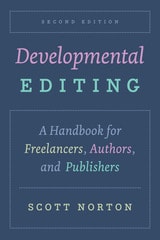
cover of Developmental Editing, Second Edition: A Handbook for Freelancers, Authors, and Publishers

Developmental Editing, Second Edition

A Handbook for Freelancers, Authors, and Publishers

Scott Norton

University of Chicago Press, 2023

The only guide dedicated solely to developmental editing, now revised and updated with new exercises and a chapter on fiction.

Developmental editing—transforming a manuscript into a book that edifies, inspires, and sells—is a special skill, and Scott Norton is one of the best at it. With more than three decades of experience in the field, Norton offers his expert advice on how to approach the task of diagnosing and fixing structural problems with book manuscripts in consultation with authors and publishers. He illustrates these principles through a series of detailed case studies featuring before-and-after tables of contents, samples of edited text, and other materials to make an otherwise invisible process tangible.
 
This revised edition for the first time includes exercises that allow readers to edit sample materials and compare their work with that of an experienced professional as well as a new chapter on the unique challenges of editing fiction. In addition, it features expanded coverage of freelance business arrangements, self-published authors, e-books, content marketing, and more.
 
Whether you are an aspiring or experienced developmental editor or an author who works alongside one, you will benefit from Norton’s accessible, collaborative, and realistic approach and guidance. This handbook offers the concrete and essential tools it takes to help books to find their voice and their audience. 
 
[more]
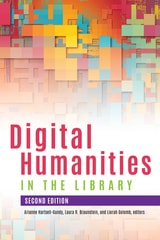
cover of Digital Humanities in the Library, Second Edition

Digital Humanities in the Library, Second Edition

Arianne Hartsell-Gundy

Assoc of College & Research Libraries, 2024

The field of digital humanities—and the way in which libraries and library workers support and engage with it—continues to expand and evolve with technological innovations and global and national events that have had a large-scale impact on the world. There are productive new ways to interrogate and expand the meaning of digital humanities and the contributions of subject specialists, digital scholarship center directors, user experience experts, special collections librarians, and technical specialists.
 
This revised and expanded edition of 2015’s Digital Humanities in the Library includes key reprints from the first edition and new chapters that explore digital humanities and diversity, inclusion, and equity; issues of labor, precarity, and infrastructure; scholarly communication and taxonomies of credit; long-term sustainability; and library digital humanities in the age of institutional austerity.
 
Divided into sections on theory and practice, chapter authors work in a variety of institution types in many different roles and offer ideas and strategies for cross-institutional collaborations and new approaches to the digital humanities work being done. As Paige Morgan says in the foreword, “Any digital humanist who can enthuse about data can also tell you that computers alone cannot do the work—you need the thoughtfulness of a human expert to find the way forward. This collection can help us do that.”
[more]
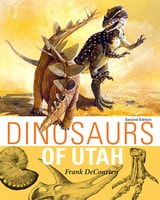
cover of Dinosaurs Of Utah: Second Edition

Dinosaurs Of Utah

Second Edition

Frank DeCourten

University of Utah Press, 2013

Since the late 1800s, when professional fossil hunters vied with each other to bring the largest and most complete specimens to the museum market, Utah has been one of the most fertile grounds for dinosaur discovery. Because rock from the Mesozoic era covers more than 25,000 square miles in Utah, the state is a natural museum of the great age of dinosaurs. The presence of sites such as Dinosaur National Park and the Cleveland- Lloyd Dinosaur Quarry underline Utah’s ongoing paleontological significance. There are probably more paleontologists residing and working in Utah now than at any time in the past, and the state even has an official dinosaur, the Allosaurus.

Dinosaurs of Utah is an ambitious book bridging the gap between the voluminous technical literature on Utah’s Mesozoic era and the numerous publications that describe dinosaurs at the elementary level. “Utah” dinosaurs are presented here as part of the Mesozoic terrestrial ecosystems that evolved in the Colorado Plateau region and are discussed in the context of the changing landscapes, environments, and biota recorded in the geological record.

More than one hundred of author Frank DeCourten’s meticulous line drawings illustrate fossil remains and various features of dinosaur anatomy, as do five stunning paintings by Carel Brest van Kempen. More than forty color landscape photographs by John Telford and Frank DeCourten show modern geologic contexts in most parts of the state and emphasize the dynamic nature of the region’s geologic history. There is also a series of detailed maps, including several new to this edition, that show the tremendous topographical shifts that occurred within the Mesozoic era from the early Triassic to the late Cretaceous periods, a span of over 175 million years.

This second edition of Dinosaurs of Utah enlivens our understanding of these amazing vanished creatures by explaining them and their world to us. It moves beyond the often superficial representations that have been so prevalent and more accurately portrays the variety of dinosaurs that once roamed the region now known as Utah.

[more]
cover of Discover Colorado, Second Edition

Discover Colorado, Second Edition

Matthey Downey

University Press of Colorado, 2015

An interactive text that engages students through activities, questions, color photographs, maps, and drawings, Discover Colorado presents the state’s fascinating people, places, and times from the Paleo-Indians to the present. Addressing the disciplinary perspectives of geography, history, economics, and government and citizenship and emphasizing civic participation, decision making, and historical and geographic thinking, this comprehensive book will involve and engage students in learning about Colorado’s exciting history.
[more]
cover of Discover Colorado, Second Edition

Discover Colorado, Second Edition

Matthey Downey

University Press of Colorado, 2016

[more]