Results by title
262 books match the query 'Sex role' and 16 start with d
Dangerous Frames
How Ideas about Race and Gender Shape Public OpinionNicholas J. G. Winter
University of Chicago Press, 2008

Dangerous Gifts
Gender and Exchange in Ancient GreeceBy Deborah Lyons
University of Texas Press, 2012
Deianeira sends her husband Herakles a poisoned robe. Eriphyle trades the life of her husband Amphiaraos for a golden necklace. Atreus’s wife Aerope gives away the token of his sovereignty, a lamb with a golden fleece, to his brother Thyestes, who has seduced her. Gifts and exchanges always involve a certain risk in any culture, but in the ancient Greek imagination, women and gifts appear to be a particularly deadly combination.
This book explores the role of gender in exchange as represented in ancient Greek culture, including Homeric epic and tragedy, non-literary texts, and iconographic and historical evidence of various kinds. Using extensive insights from anthropological work on marriage, kinship, and exchange, as well as ethnographic parallels from other traditional societies, Deborah Lyons probes the gendered division of labor among both gods and mortals, the role of marriage (and its failure) in transforming women from objects to agents of exchange, the equivocal nature of women as exchange-partners, and the importance of the sister-brother bond in understanding the economic and social place of women in ancient Greece. Her findings not only enlarge our understanding of social attitudes and practices in Greek antiquity but also demonstrate the applicability of ethnographic techniques and anthropological theory to the study of ancient societies.
Dangerous Liaisons
Gender, Nation, and Postcolonial PerspectivesAnne Mcclintock
University of Minnesota Press, 1997
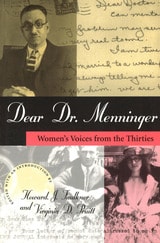
Dear Dr. Menninger
Women's Voices from the ThirtiesHoward J. Faulkner and Virginia D. Pruitt, eds.
University of Missouri Press, 1997
In 1930 Dr. Karl A. Menninger, one of America's most distinguished psychiatrists, was asked by the editor of Ladies' Home Journal to write a monthly column that would address mental health issues and answer questions from readers. The result was the widely popular column "Mental Hygiene in the Home," which ran for eighteen months at a time when the American public was just beginning to popularize the idea of mental hygiene and psychotherapy.
Of the thousands of letters Dr. Menninger received, only a small number were printed in the Journal. However, he wrote personal responses to all of them, over two thousand of which have been preserved. For this book, Howard J. Faulkner and Virginia D. Pruitt have selected more than eighty exchanges that provide intimate glimpses into the personal lives of women from across the country.
Most notable in this fascinating collection is the precision and clarity of the women's voices, as well as Dr. Menninger's incisive, analytical, and elegantly phrased replies. The topics that were of major concern to these women included their own sexuality, cheating husbands, problem children, and interfering in-lawsþin other words, the same issues that many women still face today. Although Dr. Menninger's advice may sometimes be questionable by modern standards, these letters provide a useful look at the social assumptions of the 1930s.
Included in the book is an excellent introduction by the editors that traces America's affection for advice columns, chronicles Dr. Menninger's life and work, and provides an overview of the development of psychotherapy. Entertaining as well as informative, these letters not only offer a valuable reflection of women's issues during the Depression era but also invite comparison and contrast with contemporary problems, attitudes, and values.

Decolonial Care
Reimagining Caregiving in the French CaribbeanJennifer Boum Make
Rutgers University Press, 2025

Desired States
Sex, Gender, and Political Culture in ChileLessie Jo Frazier
Rutgers University Press, 2020
Developing Partnerships
Gender, Sexuality, and the Reformed World BankKate Bedford
University of Minnesota Press, 2009
A nuanced critique of how the World Bank encourages gender norms through its policies, Developing Partnerships argues that financial institutions are key players in the global enforcement of gender and family expectations.
By combining analysis of documents produced and sponsored by the World Bank with interviews of World Bank staffers and case studies, Kate Bedford presents a detailed examination of gender and sexuality in the policies of the world's largest and most influential development institution. Looking concurrently at economic and gender policy, Bedford connects reform of markets to reform of masculinities, loan agreements for export promotion to pamphlets for indigenous adolescents advising daily genital bathing, and attempts to strengthen institutions after the Washington Consensus to efforts to promote loving couplehood in response to economic crisis. In doing so, she reveals the shifting relationships between development and sexuality and the ways in which gender policy impacts debates about the future of neoliberalism.
Providing a multilayered account of how gender-aware policies are conceived and implemented by the World Bank, Developing Partnerships demonstrates as well how institutional practices shape development.
Deviant and Useful Citizens
The Cultural Production of the Female Body in Eighteenth-Century PeruMariselle Melendez
Vanderbilt University Press, 2011
The book focuses on the different ways male authorities, as well as female subjects, conceived the female body as deeply connected to notions of what constituted a useful or deviant citizen within the Viceroyalty. Using eighteenth-century legal documents, illustrated chronicles, religious texts, and newspapers, Meléndez explores in depth the representation of the female body in periods of political, economic, and religious transformation to determine how it was conceived within certain contexts.
Deviant and Useful Citizens presents a highly complex society that relied on representations of utility and productivity to understand the female body, as it reveals the surprisingly large stake that colonial authorities had in defining the status of women during a crucial time in South American history.
Disciplining Gender
Rhetorics of Sex Identity in Contemporary U.S. CultureJohn M. Sloop
University of Massachusetts Press, 2004
An expert on the rhetoric of the mass media, John M. Sloop has written several books on how the spoken and written word can influence political and cultural debate. In Disciplining Gender, he turns his attention to a topic that has attracted widespread public discussion—the treatment of gender ambiguity in American culture. He offers critical readings of five cases, showing the extent to which, in each instance, public discourse and media representations have served to reinforce dominant norms and constrain or “discipline” any behavior that blurs or subverts conventional gender boundaries.
The five cases include John/Joan or David Reimer, Brandon Teena, k.d. lang, Janet Reno, and Barry Winchell/Calpernia Addams. Sloop draws on queer theory and research in the field of critical rhetoric to examine representations of “gender trouble” in these much-publicized stories. In each case, he provides a comprehensive analysis of the public discussions of their significance. In short, rather than simply study the people and circumstances involved in each case, he examines the public meanings attached to them and the implications of those meanings for how contemporary culture comes to understand what “man” and “woman” mean and which sexual behaviors are appropriate and inappropriate.
In highlighting the ideological constraints imposed by our society, Sloop also suggests the ways that these constraints might be loosened and understandings of gender and sexuality diversified.
Discriminating Sex
White Leisure and the Making of the American "Oriental"Amy Sueyoshi
University of Illinois Press, 2018
Amy Sueyoshi draws on everything from newspapers to felony case files to oral histories in order to examine how whites' pursuit of gender and sexual fulfillment gave rise to racial caricatures. As she reveals, white reporters, writers, artists, and others conflated Chinese and Japanese, previously seen as two races, into one. There emerged the Oriental—a single pan-Asian American stereotype weighted with sexual and gender meaning. Sueyoshi bridges feminist, queer, and ethnic studies to show how the white quest to forge new frontiers in gender and sexual freedom reinforced—and spawned—racial inequality through the ever evolving Oriental.
Informed and fascinating, Discriminating Sex reconsiders the origins and expression of racial stereotyping in an American city.
Disobedience, Slander, Seduction, and Assault
Women and Men in Cajamarca, Peru, 1862-1900By Tanja Christiansen
University of Texas Press, 2004
Though the law and courts of nineteenth-century Peru were institutions created by and for the ruling elite, women of all classes used the system to negotiate the complexities of property rights, childrearing, and marriage, and often to defend their very definitions of honor. Drawing on the trial transcripts of Cajamarca, a northern Peruvian province, from more than a century ago, this book shares eye-opening details about life among this community, in which reputation could determine a woman's chances of survival.
Exploring the processes of courtship, seduction, and familial duties revealed in these court records, historian Tanja Christiansen has unearthed a compelling panorama that includes marital strife, slander, disobedience, street brawls, and spousal abuse alongside documents that give evidence of affection and devotion. Her research also yields much new information about the protocols for conflict and cooperation among nineteenth-century Peruvian women from all social strata, and the prevalence of informal unions in an economy driven in large part by migratory male labor. Reviving a little-known aspect of Latin American history, Christiansen's book simultaneously brings to light an important microcosm of women's history during the nineteenth century.

Disruptive Acts
The New Woman in Fin-de-Siecle FranceMary Louise Roberts
University of Chicago Press, 2002
Mary Louise Roberts examines a constellation of famous new women active in journalism and the theater, including Marguerite Durand, founder of the women's newspaper La Fronde; the journalists Séverine and Gyp; and the actress Sarah Bernhardt. Roberts demonstrates how the tolerance for playacting in both these arenas allowed new women to stage acts that profoundly disrupted accepted gender roles. The existence of La Fronde itself was such an act, because it demonstrated that women could write just as well about the same subjects as men—even about the volatile Dreyfus Affair. When female reporters for La Fronde put on disguises to get a scoop or wrote under a pseudonym, and when actresses played men on stage, they demonstrated that gender identities were not fixed or natural, but inherently unstable. Thanks to the adventures of new women like these, conventional domestic femininity was exposed as a choice, not a destiny.
Lively, sophisticated, and persuasive, Disruptive Acts will be a major work not just for historians, but also for scholars of cultural studies, gender studies, and the theater.
Domestic Frontiers
Gender, Reform, and American Interventions in the Ottoman Balkans and the Near EastBarbara Reeves-Ellington
University of Massachusetts Press, 2013
During the nineteenth and early twentieth centuries, American Protestant missionaries attempted to export their religious beliefs and cultural ideals to the Ottoman Empire. Seeking to attract Orthodox Christians and even Muslims to their faith, they promoted the paradigm of the “Christian home” as the foundation of national progress. Yet the missionaries' efforts not only failed to win many converts but also produced some unexpected results.
Drawing on a broad range of sources—Ottoman, Bulgarian, Russian, French, and English—Barbara Reeves-Ellington tracks the transnational history of this little-known episode of American cultural expansion. She shows how issues of gender and race influenced the missionaries' efforts as well as the complex responses of Ottoman subjects to American intrusions into their everyday lives. Women missionaries—married and single—employed the language of Christian domesticity and female moral authority to challenge the male-dominated hierarchy of missionary society and to forge bonds of feminist internationalism. At the same time, Orthodox Christians adapted the missionaries' ideology to their own purposes in developing a new strain of nationalism that undermined Ottoman efforts to stem growing sectarianism within their empire. By the beginning of the twentieth century, as some missionaries began to promote international understanding rather than Protestantism, they also paved the way for future expansion of American political and commercial interests.
Domestic Occupations
Spatial Rhetorics and Women’s WorkJessica Enoch
Southern Illinois University Press, 2019
Enoch explores how three different groups of women workers—teachers, domestic scientists, and World War II factory employees—contended with the physical and ideological space of the home, examining how this everyday yet powerful space thwarted or enabled their financial and familial security as well as their intellectual engagements and work-related opportunities.
Domestic Occupations demonstrates a multimodal and multigenre research method for conducting spatio-rhetorical analysis that serves as a model for new kinds of thinking and new kinds of scholarship. This study adds historical depth and exigency to an important contemporary conversation in the public sphere about how women’s ties to the home inflect their access to work and professional advancement.
Drag Queens at the 801 Cabaret
Leila J. Rupp and Verta Taylor
University of Chicago Press, 2003
In this lively book, Leila J. Rupp and Verta Taylor take us on an entertaining tour through one of America's most overlooked subcultures: the world of the drag queen. They offer a penetrating glimpse into the lives of the 801 Girls, the troupe of queens who perform nightly at the 801 Cabaret for tourists and locals. Weaving together their fascinating life stories, their lavish costumes and eclectic music, their flamboyance and bitchiness, and their bawdy exchanges with one another and their audiences, the authors explore how drag queens smash the boundaries between gay and straight, man and woman, to make people think more deeply and realistically about sex and gender in America today. They also consider how the queens create a space that encourages camaraderie and acceptance among everyday people, no matter what their sexual preferences might be.
Based on countless interviews with more than a dozen drag queens, more than three years of attendance at their outrageous performances, and even the authors' participation in the shows themselves, Drag Queens at the 801 Cabaret is a witty and poignant portrait of gay life and culture. When they said life is a cabaret, they clearly meant the 801.

Dreadful Desires
The Uses of Love in Neoliberal ChinaCharlie Yi Zhang
Duke University Press, 2022