Results by title
3027 books match the query 'Sociology' and 132 start with d

DC Sports
The Nation's Capital at PlayChris Elzey
University of Arkansas Press, 2015
A southern city at heart, Washington drew a strong color line in every facet of people’s lives. Race informed how sport was played, written about, and watched in the city. In 1962, the Redskins became the final National Football League team to integrate. That same year, a race riot marred the city’s high-school championship game in football. A generation later, race as an issue resurfaced after Georgetown’s African American head coach John Thompson Jr. led the Hoyas to national prominence in basketball.
DC Sports takes a hard look at how sports in one city has shaped culture and history, and how culture and history inform sports. This informative and engaging collection will appeal to fans and students of sports and those interested in the rich history of the nation’s capital.
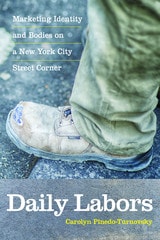
Daily Labors
Marketing Identity and Bodies on a New York City Street CornerCarolyn Pinedo-Turnovsky
Temple University Press, 2019
On street corners throughout the country, men stand or sit together patiently while they wait for someone looking to hire un buen trabajador (a good worker). These day laborers are visible symbols of the changing nature of work—and the demographics of workers—in the United States.
Carolyn Pinedo-Turnovsky spent nearly three years visiting with African American men and Latino immigrant men who looked for work as day laborers at a Brooklyn street intersection. Her fascinating ethnography, Daily Labors, considers these immigrants and citizens as active participants in their social and economic life. They not only work for wages but also labor daily to institute change, create knowledge, and contribute new meanings to shape their social world.
Daily Labors reveals how ideologies about race, gender, nation, and legal status operate on the corner and the vulnerabilities, discrimination, and exploitation workers face in this labor market. Pinedo-Turnovsky shows how workers market themselves to conform to employers’ preconceptions of a “good worker” and how this performance paradoxically leads to a more precarious workplace experience. Ultimately, she sheds light on belonging, community, and what a “good day laborer” for these workers really is.
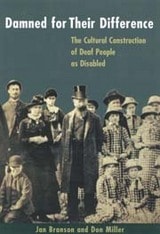
Damned for Their Difference
The Cultural Construction of Deaf People as DisabledJan Branson
Gallaudet University Press, 2002
Until the recent recognition of Deaf culture and the legitimacy of signed languages, majority societies around the world have classified Deaf people as “disabled,” a term that separates all persons so designated from the mainstream in a disparaging way. Damned for Their Difference offers a well-founded explanation of how this discrimination came to be through a discursive exploration of the cultural, social, and historical contexts of these attitudes and behavior toward deaf people, especially in Great Britain.
Authors Jan Branson and Don Miller examine the orientation toward and treatment of deaf people as it developed from the 17th century through the 20th century. Their wide-ranging study explores the varied constructions of the definition of “disabled,” a term whose meaning hinges upon constant negotiation between parties, ensuring that no finite meaning is ever established. Damned for Their Difference provides a sociological understanding of disabling practices in a way that has never been seen before.

Dance Cadaverous
Antiblackness of the Social World and Social TheoryMoon-Kie Jung and João H. Costa Vargas
Duke University Press, 2027

Dance for Me When I Die
Cristian Alarcón
Duke University Press, 2019
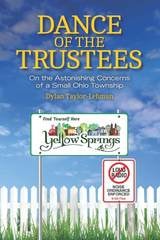
Dance of the Trustees
On the Astonishing Concerns of a Small Ohio TownshipDylan Taylor-Lehman
The Ohio State University Press, 2018
This quaint debate represents just one of many fascinating problems the trustees deal with on a daily basis. While Miami Township is small, the concerns are myriad—from cemeteries filled with unknown remains to a fire department to oversee to legal action required against properties clogged with junk. The responsibilities are doubly impressive considering no trustees have backgrounds in public office.
This book combines entertaining nonfiction vignettes with well-researched township history—including a history of religious cults and the possibility that Lee Harvey Oswald was once in town—and elucidates the processes behind an entire civic division. Dance of the Trustees documents twenty-first-century small-town life with humor, warmth, and erudition.
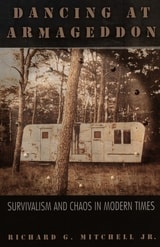
Dancing at Armageddon
Survivalism and Chaos in Modern TimesRichard G. Mitchell Jr.
University of Chicago Press, 2001
Richard G. Mitchell Jr. spent more than a dozen years among survivalists at public conferences, private meetings, and clandestine training camps across America. He takes us inside a compelling, hidden world more connected to the chaos of modern life many of us experience than the label "separatist" suggests. In survivalism Mitchell found a profound and meaningful critique of contemporary industrial society, a subculture in which the real evil is not repressive government but the far more insidious influence of a "Planet Microsoft" mentality with its abundance of empty choices. Survivalists, Mitchell shows us, are seeking resistance, not struggling against it; they are looking for ways to define themselves and test their talents in a society that is becoming devitalized and formless.
Dancing in Spite of Myself
Essays on Popular CultureLawrence Grossberg
Duke University Press, 1997
In the course of conducting this exploration into the meaning of "popularity," he investigates the nature of fandom, the social effects of rock music and youth culture, and the possibilities for understanding the history of popular texts and practices. Describing what he calls "the postmodernity of everyday life," Grossberg offers important insights into the relation of pop music to issues of postmodernity and inton the growing power of the new cultural conservatism and its relationship to "the popular." Exploring the limits of existing theories of hegemony in cultural studies, Grossberg reveals the ways in which popular culture is being mobilized in the service of economic and political struggles. In articulating his own critical practice, Grossberg surveys and challenges some of the major assumptions of popular culture studies, including notions of domination and resistance, mainstream and marginality, and authenticity and incorporation.
Dancing in Spite of Myself provides an introduction to contemporary theories of popular culture and a clear statement of relationships among theories of the nature of rock music, postmodernity, and conservative hegemony.

Dangerous Exits
Escaping Abusive Relationships in Rural AmericaDeKeseredy, Walter
Rutgers University Press, 2009
Strikingly, scant attention has focused on the victimization of women who want to leave their hostile partners. This groundbreaking work challenges the perception that rural communities are safe havens from the brutality of urban living. Identifying hidden crimes of economic blackmail and psychological mistreatment, and the complex relationship between patriarchy and abuse, Walter S. DeKeseredy and Martin D. Schwartz propose concrete and effective solutions, giving voice to women who have often suffered in silence.

Dangerous Fun
The Social Lives of Big Wave SurfersUgo Corte
University of Chicago Press, 2022
Straight from the beaches of Hawaii comes an exciting new ethnography of a community of big-wave surfers. Oahu’s Waimea Bay attracts the world’s best big wave surfers—men and women who come to test their physical strength, courage, style, knowledge of the water, and love of the ocean. Sociologist Ugo Corte sees their fun as the outcome of social interaction within a community. Both as participant and observer, he examines how mentors, novices, and peers interact to create episodes of collective fun in a dangerous setting; how they push one another’s limits, nourish a lifestyle, advance the sport and, in some cases, make a living based on their passion for the sport.
In Dangerous Fun, Corte traces how surfers earn and maintain a reputation within the field, and how, as innovations are introduced, and as they progress, establish themselves and age, they modify their strategies for maximizing performance and limiting chances of failure.
Corte argues that fun is a social phenomenon, a pathway to solidarity rooted in the delight in actualizing the self within a social world. It is a form of group cohesion achieved through shared participation in risky interactions with uncertain outcomes. Ultimately, Corte provides an understanding of collective effervescence, emotional energy, and the interaction rituals leading to fateful moments—moments of decision that, once made, transform one’s self-concept irrevocably.
Dardanelle and the Bottoms
Environment, Agriculture, and Economy in an Arkansas River Community, 1819-1970Mildred D. Gleason
University of Arkansas Press, 2017
A reciprocal relationship between the town and the Bottoms formed the economic backbone on which the area’s well-being was balanced. The country people came to town on Saturdays to buy their groceries and supplies, to shop and take in a movie or visit the pool halls or barbershops. Merchants relied heavily on this country trade and had a long history of extending credit, keeping prices reasonable, and offering respect and appreciation to their customers.
This interdependence, stable for decades, began to unravel in the late 1940s with changes in farming, particularly the cotton industry. In Dardanelle and the Bottoms, Mildred Diane Gleason explores this complex rural/town dichotomy, revealing and analyzing key components of each area, including aspects of race, education, the cotton economy and its demise, the devastation of floods and droughts, leisure, crime, and the impact of the Great Depression.
Dark Governance
Illegal Organizations and State PowerJavier Auyero
University of Chicago Press, 2027
A revelatory account of the ways covert, nefarious relationships between state officials and criminal groups shape daily life for all.
Far too often, the line between legal and illegal action is crossed by actors and organizations on both sides of the law. From the old Chicago Machine getting rich off criminal activity to Mexican drug cartels placing politicians in office, these relationships between criminals and the government coordinate forms of power in ways that affect where people live, what opportunities they can pursue, how they spend money, and how they treat one another. In Dark Governance, sociologist Javier Auyero describes how this kind of governance works and what it means for civic life.
Auyero analyzes instances of dark governance, including gangs in Ecuador and paramilitaries in Colombia who exert territorial control through violent specialists and government actors. He then turns to the less-studied case of the “colectivos” in Venezuela to show the scope of political work clandestine connections can achieve by thwarting grassroots organizations. In El Salvador and Honduras, the ties between gang members on the one hand, and politicians and elected officials on the other, serve to illustrate the impact dark governance has on urban spatial arrangements and on electoral campaigns. Dark Governance also offers an in-depth study of police-trafficker collusion in Argentina, which allows Auyero to identify the ways covert connections between state actors and drug traffickers operate in marginalized communities, affecting interpersonal violence. In addition to these examples in Latin America, Auyero also shares case studies in the United States and China. Dark governance can be seen in US organizations that patrol the borders and assert their control over migrants through their illicit connections with state authorities. In China, land expropriation and development projects are sometimes delayed when some households refuse to leave their properties. Enter the thugs-for-hire frequently contracted by local governments across the country to coerce residents into complying with government orders.
Demonstrating the very real effects of dark governance, Auyero argues that though the organizations involved in these dark arrangements differ, their collaboration results in a singular effect: the ability to control populations. But when these relationships come out of the shadows, collective action can bring them down.
Dark Matters
On the Surveillance of BlacknessSimone Browne
Duke University Press, 2015

Data Dating
Love, Technology, DesireEdited by Ania Malinowska and Valentina Peri
Intellect Books, 2021
Data Dating is a collection of eleven academic essays accompanied by eleven works of media art that provide a comprehensive insight into the construction of love and its practices in the time of digitally mediated relationships. The essays come from recognized researchers in the field of media and cultural studies.

Data-Centric Biology
A Philosophical StudySabina Leonelli
University of Chicago Press, 2016
Leonelli is the first scholar to use a study of contemporary data-intensive science to provide a philosophical analysis of the epistemology of data. In analyzing the rise, internal dynamics, and potential impact of data-centric biology, she draws on scholarship across diverse fields of science and the humanities—as well as her own original empirical material—to pinpoint the conditions under which digitally available data can further our understanding of life. Bridging the divide between historians, sociologists, and philosophers of science, Data-Centric Biology offers a nuanced account of an issue that is of fundamental importance to our understanding of contemporary scientific practices.

Days of Awe
Reimagining Jewishness in Solidarity with PalestiniansAtalia Omer
University of Chicago Press, 2019
In Days of Awe, Atalia Omer examines this shift through interviews with a new generation of Jewish activists, rigorous data analysis, and fieldwork within a progressive synagogue community. She highlights people politically inspired by social justice campaigns including the Black Lives Matter movement and protests against anti-immigration policies. These activists, she shows, discover that their ethical outrage at US policies extends to Israel’s treatment of Palestinians. For these American Jews, the Jewish history of dispossession and diaspora compels a search for solidarity with liberation movements. This shift produces innovations within Jewish tradition, including multi-racial and intersectional conceptions of Jewishness and movements to reclaim prophetic Judaism. Charting the rise of such religious innovation, Omer points toward the possible futures of post-Zionist Judaism.
Dead Reckoning
Air Traffic Control, System Effects, and RiskDiane Vaughan
University of Chicago Press, 2021
When two airplanes were flown into the World Trade Center towers on September 11, 2001, Americans watched in uncomprehending shock as first responders struggled to react to the situation on the ground. Congruently, another remarkable and heroic feat was taking place in the air: more than six hundred and fifty air traffic control facilities across the country coordinated their efforts to ground four thousand flights in just two hours—an achievement all the more impressive considering the unprecedented nature of the task.
In Dead Reckoning, Diane Vaughan explores the complex work of air traffic controllers, work that is built upon a close relationship between human organizational systems and technology and is remarkably safe given the high level of risk. Vaughan observed the distinct skill sets of air traffic controllers and the ways their workplaces changed to adapt to technological developments and public and political pressures. She chronicles the ways these forces affected their jobs, from their relationships with one another and the layouts of their workspace to their understanding of their job and its place in society. The result is a nuanced and engaging look at an essential role that demands great coordination, collaboration, and focus—a role that technology will likely never be able to replace. Even as the book conveys warnings about complex systems and the liabilities of technological and organizational innovation, it shows the kinds of problem-solving solutions that evolved over time and the importance of people.
Deadly Biocultures
The Ethics of Life-makingNadine Ehlers
University of Minnesota Press, 2019
A trenchant analysis of the dark side of regulatory life-making today
In their seemingly relentless pursuit of life, do contemporary U.S. “biocultures”—where biomedicine extends beyond the formal institutions of the clinic, hospital, and lab to everyday cultural practices—also engage in a deadly endeavor? Challenging us to question their implications, Deadly Biocultures shows that efforts to “make live” are accompanied by the twin operation of “let die”: they validate and enhance lives seen as economically viable, self-sustaining, productive, and oriented toward the future and optimism while reinforcing inequitable distributions of life based on race, class, gender, and dis/ability. Affirming life can obscure death, create deadly conditions, and even kill.
Deadly Biocultures examines the affirmation to hope, target, thrive, secure, and green in the respective biocultures of cancer, race-based health, fatness, aging, and the afterlife. Its chapters focus on specific practices, technologies, or techniques that ostensibly affirm life and suggest life’s inextricable links to capital but that also engender a politics of death and erasure. The authors ultimately ask: what alternative social forms and individual practices might be mapped onto or intersect with biomedicine for more equitable biofutures?
Deaf Empowerment
Emergence, Struggle, and RhetoricKathy Jankowski
Gallaudet University Press, 1997
Central to Deaf Empowerment is the struggle between the dominant hearing society and Deaf people over the best means of communication, with the educational setting as the constant battleground. This evocative work first tracks the history of interaction between these two factions, highlighting the speaking majority’s desire to compel Deaf people to conform to “the human sciences” conventionality by learning speech. Then, it sharply focuses on the development of the Deaf social movement's ideology to seek general recognition of sign language as a valid cultural variation. Also, the influence of social movements of the 60s and 70s is examined in relation to the changing context and perception of the Deaf movement, as well as to its rhetorical refinement.
Deaf Empowerment delineates the apex of effective Deaf rhetoric in describing the success of the Deaf President Now! protest at Gallaudet University in 1988, its aftermath, and ensuing strategies. It concludes with an assessment of the goal of a multicultural society and offers suggestions for community building through a new humanitarianism. Scholars of social movements and Deaf studies will find it to be a uniquely provocative addition to their libraries and classrooms.
Dealing in Virtue
International Commercial Arbitration and the Construction of a Transnational Legal OrderYves Dezalay and Bryant G. Garth
University of Chicago Press, 1996
Building on Pierre Bourdieu's structural approach, the authors show how an informal, settlement-oriented system became formalized and litigious. Integral to this new legal field is the intense personal competition among arbitrators to gain a reputation for virtue, hoping to be selected for arbitration panels. Since arbitration fees have skyrocketed, this is a high-stakes game.
Using multiple examples, Yves Dezalay and Bryant G. Garth explore how international developments can transform domestic methods for handling disputes and analyze the changing prospects for international business dispute resolution given the growing presence of such international market and regulatory institutions as the EEC, the WTO, and NAFTA.
Death and Dying in Central Appalachia
Changing Attitudes and PracticesJames K. Crissman
University of Illinois Press, 1994
Written for both scholarly and general audiences, the book contains sections on the death watch, body preparation, selection or construction of a coffin or casket, digging the grave by hand, the wake, the funeral, and other topics. Crissman then demonstrates how technology and the encroachment of American society have turned these vital traditions into the disappearing practices of the past.

Deciding To Be Legal
A Maya Community in HoustonJacqueline Hagan
Temple University Press, 1994
Decolonizing Ethnography
Undocumented Immigrants and New Directions in Social ScienceCarolina Alonso-Bejarano, Lucia López Juárez, Mirian A. Mijangos García, and Daniel M. Goldstein
Duke University Press, 2019
Decolonizing the University
Edited by Gurminder K. Bhambra, Kerem Nisancioglu and Dalia Gebrial
Pluto Press, 2018
In 2015, students at the University of Cape Town demanded the removal of a statue of Cecil Rhodes, the imperialist, racist business magnate, from their campus. Their battle cry, #RhodesMustFall, sparked an international movement calling for the decolonization of universities all over the world.
Today, as the movement develops beyond the picket line, how might it go on to radically transform the terms upon which universities exist? In this book, students, activists, and scholars discuss the possibilities and the pitfalls of doing decolonial work in the heart of the establishment. Subverting curricula, demanding diversity, and destroying old boundaries, this is a radical call for a new era of education. Chapters include:
*Rhodes Must Fall: Oxford and Movements for Change (Dalia Febrial)
*Race and the Neoliberal University ((John Holmwood)
*Black/Academia (Robbie Shilliam)
*The Challenge for Black Studies in the Neoliberal University (Kehinde Andrews)
*Open Initiatives for Decolonising the Curriculum (Pat Lockley)
*Decolonising Education: A Pedagogic Intervention (Carol Azumah Dennis)
*Understanding Eurocentrism as a Structural Problem of Undone Science (William Jamal Richardson)
As the book’s insightful Introduction states, "Taking colonialism as a global project as a starting point, it becomes difficult to turn away from the Western university as a key site through which colonialism—and colonial knowledge in particular—is produced, consecrated, institutionalized and naturalized." Offering resources for students and academics to challenge and resist colonialism inside and outside the classroom, Decolonizing the University provides the tools for radical change in educational disciplines, pedagogies, and institutions.
Deconstructing Communication
Representation, Subject, and Economies of ExchangeBriankle Chang
University of Minnesota Press, 1996
A philosophical critique of modern communication theories.
Situated at the intersection of current debates regarding meaning and representation, Deconstructing Communication casts doubt on the seeming innocence of the activity of communication. Using poststructuralist literary theory and philosophy, Briankle G. Chang argues that modern communication theories fail to provide an adequate explanation for how communication is possible.
Through a detailed examination of the basis of the idea of communication-with its semantic core of “commonality” or the transcendence of difference-Chang argues against the tendency of theorists to value understanding over misunderstanding, clarity over ambiguity, order over disorder. To this end the author revisits the thought of Derrida and considers deconstruction in general. Specifically, he uses the critique of the phenomenological tradition emerging from poststructuralism to clarify the commitments and assumptions inherent in models of communication. Chang then discusses the contributions of Husserl, particularly regarding the interconnections between concepts, metaphors, and rhetoric. He develops the strategy of deconstruction through a comparative analysis of Heidegger and Derrida, ultimately linking communication theory to the general question of philosophical reason. Chang concludes with a set of key questions about theory formation in the field, questions that elucidate the future direction for critical reflection in the philosophy of communication. A seminal work in communication theory, Deconstructing Communication will serve as the guiding framework for a constructive debate about the future direction of the field.
Deconstructing the High Line
Postindustrial Urbanism and the Rise of the Elevated ParkLindner, Christoph
Rutgers University Press, 2017
The High Line, an innovative promenade created on a disused elevated railway in Manhattan, is one of the world’s most iconic new urban landmarks. Since the opening of its first section in 2009, this unique greenway has exceeded all expectations in terms of attracting visitors, investment, and property development to Manhattan’s West Side. Frequently celebrated as a monument to community-led activism, adaptive re-use of urban infrastructure, and innovative ecological design, the High Line is being used as a model for numerous urban redevelopment plans proliferating worldwide.
Deconstructing the High Line is the first book to analyze the High Line from multiple perspectives, critically assessing its aesthetic, economic, ecological, symbolic, and social impacts. Including several essays by planners and architects directly involved in the High Line’s design, this volume also brings together a diverse range of scholars from the fields of urban studies, geography, anthropology, sociology, and cultural studies. Together, they offer insights into the project’s remarkable success, while also giving serious consideration to the critical charge that the High Line is “Disney World on the Hudson,” a project that has merely greened, sanitized, and gentrified an urban neighborhood while displacing longstanding residents and businesses.
Deconstructing the High Line is not just for New Yorkers, but for anyone interested in larger issues of public space, neoliberal redevelopment, creative design practice, and urban renewal.
Defending Community
The Struggle for Alternative Redevelopment in Cedar-RiversideRandy Stoecker
Temple University Press, 1994
Randy Stoecker's intimate biography of Cedar-Riverside, nationally known for a period as "the Haight-Ashbury of the Mid-West," contains important lessons about the conflicts between the needs of capitalism and the needs of community. While attending graduate school at the University of Minnesota, the author moved to Cedar-Riverside, a Minneapolis neighborhood known for its determination to enact values of peace, justice, wholeness, participation, and community in its truest sense. There he experienced first-hand the clashes between a radical community and state-backed urban developers.
His narrative tells the story of a community that overcame the odds against its own survival. Slated for total demolition, the neighborhood was saved by a powerful grass-roots movement. Citizens stopped a state-capital coalition from entombing the community in concrete and went on to create one of the largest community controlled urban redevelopment projects in the country After more than twenty years of struggle, Cedar-Riverside continues to experience citizen-controlled urban redevelopment on its own terms, setting an example for other communities, urban planners, and policymakers.
In the series Conflicts in Urban and Regional Development, edited by John R. Logan and Todd Swanstrom.
Defining the Delta
Multidisciplinary Perspectives on the Lower Mississippi River DeltaJanelle Collins
University of Arkansas Press, 2015
Here are essays examining the Delta’s physical properties, boundaries, and climate from a geologist, archeologist, and environmental historian. The Delta is also viewed through the lens of the social sciences and humanities—historians, folklorists, and others studying the connection between the land and its people, in particular the importance of agriculture and the culture of the area, especially music, literature, and food.
Every turn of the page reveals another way of seeing the seven-state region that is bisected by and dependent on the Mississippi River, suggesting ultimately that there are myriad ways of looking at, and defining, the Delta.
Deflecting Immigration
Networks, Markets, and Regulation in Los AngelesIvan Light
Russell Sage Foundation, 2006
Degraded Work
The Struggle at the Bottom of the Labor MarketMarc Doussard
University of Minnesota Press, 2013
Critics on the left and the right typically agree that globalization, the loss of manufacturing jobs, and the expansion of the service sector have led to income inequality and rising numbers of low-paying jobs with poor working conditions.
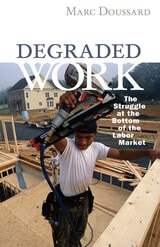
In Degraded Work, Marc Doussard demonstrates that this decline in wages and working conditions is anything but the unavoidable result of competitive economic forces. Rather, he makes the case that service sector and other local-serving employers have boosted profit with innovative practices to exploit workers, demeaning their jobs in new ways—denying safety equipment, fining workers for taking scheduled breaks, requiring unpaid overtime—that go far beyond wage cuts. Doussard asserts that the degradation of service work is a choice rather than an inevitability, and he outlines concrete steps that can be taken to help establish a fairer postindustrial labor market.
Drawing on fieldwork in Chicago, Degraded Work examines changes in two industries in which inferior job quality is assumed to be intrinsic: residential construction and food retail. In both cases, Doussard shows how employers degraded working conditions as part of a successful and intricate strategy to increase profits. Arguing that a growing service sector does not have to mean growing inequality, Doussard proposes creative policy and organizing opportunities that workers and advocates can use to improve job quality despite the overwhelming barriers to national political action.
Degrees of Risk
Navigating Insecurity and Inequality in Public Higher EducationBlake R. Silver
University of Chicago Press, 2024
Institutions of higher education are often described as “ivory towers,” places of privilege where students exist in a “campus bubble,” insulated from the trials of the outside world. These metaphors reveal a widespread belief that college provides young people with stability and keeps insecurity at bay. But for many students, that’s simply not the case.
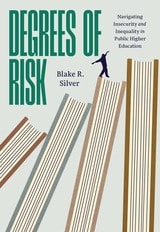
Degrees of Risk reveals how insecurity permeates every facet of college life for students at public universities. Sociologist Blake Silver dissects how these institutions play a direct role in perpetuating uncertainty, instability, individualism, and anxiety about the future. Silver examined interviews with more than one hundred students who described the risks that surrounded every decision: which major to choose, whether to take online classes, and how to find funding. He expertly identified the ways the college experience played out differently for students from different backgrounds. For students from financially secure families with knowledge of how college works, all the choices and flexibility of college felt like an adventure or a wealth of opportunities. But for many others, especially low-income, first-generation students, their personal and family circumstances meant that that flexibility felt like murkiness and precarity. In addition, he discovered that students managed insecurity in very different ways, intensifying inequality at the intersections of socioeconomic status, race, gender, and other sociodemographic dimensions. Drawing from these firsthand accounts, Degrees of Risk presents a model for a better university, one that fosters success and confidence for a diverse range of students.
Degrees of Risk
Navigating Insecurity and Inequality in Public Higher EducationBlake R. Silver
University of Chicago Press, 2024
An ethnographic analysis of how insecurity is at the heart of contemporary higher education.
Institutions of higher education are often described as “ivory towers,” places of privilege where students exist in a “campus bubble,” insulated from the trials of the outside world. These metaphors reveal a widespread belief that college provides young people with stability and keeps insecurity at bay. But for many students, that’s simply not the case.
Degrees of Risk reveals how insecurity permeates every facet of college life for students at public universities. Sociologist Blake Silver dissects how these institutions play a direct role in perpetuating uncertainty, instability, individualism, and anxiety about the future. Silver examined interviews with more than one hundred students who described the risks that surrounded every decision: which major to choose, whether to take online classes, and how to find funding. He expertly identified the ways the college experience played out differently for students from different backgrounds. For students from financially secure families with knowledge of how college works, all the choices and flexibility of college felt like an adventure or a wealth of opportunities. But for many others, especially low-income, first-generation students, their personal and family circumstances meant that that flexibility felt like murkiness and precarity. In addition, he discovered that students managed insecurity in very different ways, intensifying inequality at the intersections of socioeconomic status, race, gender, and other sociodemographic dimensions. Drawing from these firsthand accounts, Degrees of Risk presents a model for a better university, one that fosters success and confidence for a diverse range of students.
Demanding Medical Excellence
Doctors and Accountability in the Information AgeMichael L. Millenson
University of Chicago Press, 2000
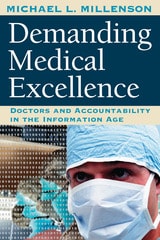
"If you read only one book this year, read Demanding Medical Excellence. It's that good, and the revolution it describes is that important."—Health Affairs
"Millenson has done yeoman's work in amassing and understanding that avalanche of data that lies beneath most of the managed-care headlines. . . . What he finds is both important and well-explained: inconsistency, overlap, and inattention to quality measures in medical treatment cost more and are more dangerous than most cost-cutting measures. . . . [This book] elevates the healthcare debate to a new level and deserves a wide readership."—Library Journal
"An involving, human narrative explaining how we got to where we are today and what lies ahead."—Mark Taylor, Philadelphia Inquirer
"Read this book. It will entertain you, challenge, and strengthen you in your quest for better accountability in health care."—Alex R. Rodriguez, M.D., American Journal of Medical Quality
"Finally, a health-care book that doesn't wring its hands over the decline of medicine at the hands of money-grubbing corporations. . . . This is a readable account of what Millenson calls a 'quiet revolution' in health care, and his optimism makes for a refreshing change."—Publishers Weekly
"With meticulous detail, historical accuracy, and an uncommon understanding of the clinical field, Millenson documents our struggle to reach accountability."—Saty Satya-Murti, M.D., Journal of the American Medical Association
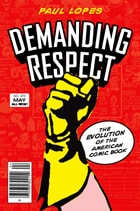
Demanding Respect
The Evolution of the American Comic BookPaul Lopes
Temple University Press, 2009
How is it that comic books—the once-reviled form of lowbrow popular culture—are now the rage for Hollywood blockbusters, the basis for bestselling video games, and the inspiration for literary graphic novels? In Demanding Respect, Paul Lopes immerses himself in the discourse and practices of this art and subculture to provide a social history of the American comic book over the last 75 years.
Lopes analyzes the cultural production, reception, and consumption of American comic books throughout history. He charts the rise of superheroes, the proliferation of serials, and the emergence of graphic novels. Demanding Respect explores how comic books born in the 1930s were perceived as a "menace" in the 1950s, only to later become collectors’ items and eventually "hip" fiction in the 1980s through today.
Using a theoretical framework to examine the construction of comic book culture—the artists, publishers, readers and fans— Lopes explains how and why comic books have captured the public's imagination and gained a fanatic cult following.

Dementia Caregivers Share Their Stories
A Support Group in a BookLynda A. Markut
Vanderbilt University Press, 2005
Highlighting the ingenuity and resourcefulness of caregivers, the book brims with inspirational stories, practical advice, and creative approaches to problem-solving. Among the issues addressed are:
Becoming a caregiver, whether for a spouse or parent
Dealing with the personality changes caused by dementia, from anxiety and paranoia to hallucinations and impulsive behavior
Keeping dementia sufferers meaningfully involved in life
Handling the emotions and stresses of caregiving
Seeking help through support groups and other sources, including medical professionals, clergy, and other family members The authors, who have both been caregivers themselves, augment their interviewees' stories with connective commentary and their own personal stories. A useful resource section is included to refer readers to associations and help-lines.
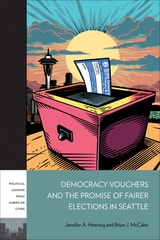
Democracy Vouchers and the Promise of Fairer Elections in Seattle
Jennifer A. Heerwig and Brian J. McCabe
Temple University Press, 2024
Democracy Vouchers and the Promise of Fairer Elections in Seattle critically evaluates the success and impact of this program. Jennifer Heerwig and Brian J. McCabe emphasize how local elections now attract a much wider and more diverse field of both donors and candidates. They also consider external threats to the program, from litigation about the constitutionality of a voucher program to the rise of independent expenditures.
Offering important lessons on how other cities can adopt a similar program, this compelling case study also highlights the obstacles that will likely arise in its implementation.

Democracy and Regulation
How the Public Can Govern Essential ServicesGreg Palast, Theo MacGregor, and Jerrold Oppenheim
Pluto Press, 2002
Democracy and the Left
Social Policy and Inequality in Latin AmericaEvelyne Huber and John D. Stephens
University of Chicago Press, 2012
Although inequality in Latin America ranks among the worst in the world, it has notably declined over the last decade, offset by improvements in health care and education, enhanced programs for social assistance, and increases in the minimum wage.
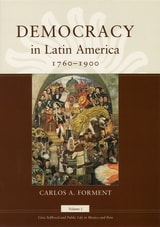
Democracy in Latin America, 1760-1900
Volume 1, Civic Selfhood and Public Life in Mexico and PeruCarlos A. Forment
University of Chicago Press, 2003
This first volume of Democracy in Latin America considers the development of democratic life in Mexico and Peru from independence to the late 1890s. Forment traces the emergence of hundreds of political, economic, and civic associations run by citizens in both nations and shows how these organizations became models of and for democracy in the face of dictatorship and immense economic hardship. His is the first book to show the presence in Latin America of civic democracy, something that gave men and women in that region an alternative to market- and state-centered forms of life.
In looking beneath institutions of government to uncover local and civil organizations in public life, Forment ultimately uncovers a tradition of edification and inculcation that shaped democratic practices in Latin America profoundly. This tradition, he reveals, was stronger in Mexico than in Peru, but its basic outlines were similar in both nations and included a unique form of what Forment calls Civic Catholicism in order to distinguish itself from civic republicanism, the dominant political model throughout the rest of the Western world.
Democracy's Hidden Heroes
Fitting Policy to People and PlaceDavid C. Campbell
Temple University Press, 2024
David Campbell recounts compelling stories of the workarounds, sidesteps, informal agreements, and grantor–grantee negotiations that help policy initiatives succeed as intended. The settings include schools, human services departments, workforce development agencies, and community-based organizations. He explains why it is difficult, though necessary, to translate locally attuned implementation dynamics into accountability metrics for distant funders.
Drawing on 2,000 interviews, Democracy’s Hidden Heroes is the culmination of decades spent talking to people who must reconcile bureaucratic and community cultures. Campbell’s grounded approach and balanced perspective bring fresh insights to the analysis of policy implementation, public management, and results accountability, while offering both cautionary advice and a hopeful prognosis.
Democracy's Lot
Rhetoric, Publics, and the Places of InventionCandice Rai
University of Alabama Press, 2016
Candice Rai’s Democracy’s Lot is an incisive exploration of the limitations and possibilities of democratic discourse for resolving conflicts in urban communities. Rai roots her study of democratic politics and publics in a range of urban case studies focused on public art, community policing, and urban development. These studies examine the issues that erupted within an ethnically and economically diverse Chicago neighborhood over conflicting visions for a vacant lot called Wilson Yard. Tracing how residents with disparate agendas organized factions and deployed language, symbols, and other rhetorical devices in the struggle over Wilson Yard’s redevelopment and other contested public spaces, Rai demonstrates that rhetoric is not solely a tool of elite communicators, but rather a framework for understanding the agile communication strategies that are improvised in the rough-and-tumble work of democratic life.
Wilson Yard, a lot eight blocks north of Wrigley Field in Chicago’s gentrifying Uptown neighborhood, is a diverse enclave of residents enlivened by recent immigrants from Guatemala, Mexico, Vietnam, Ethiopia, and elsewhere. The neighborhood’s North Broadway Street witnesses a daily multilingual hubbub of people from a wide spectrum of income levels, religions, sexual identifications, and interest groups. When a fire left the lot vacant, this divided community projected on Wilson Yard disparate and conflicting aspirations, the resolution of which not only determined the fate of this particular urban space, but also revealed the lot of democracy itself as a process of complex problem-solving. Rai’s detailed study of one block in an iconic American city brings into vivid focus the remarkable challenges that beset democratic urban populations anywhere on the globe—and how rhetoric supplies a framework to understand and resolve those challenges.
Based on exhaustive field work, Rai uses rhetorical ethnography to study competing publics, citizenship, and rhetoric in action, exploring “rhetorical invention,” the discovery or development by individuals of the resources or methods of engaging with and persuading others. She builds a case for democratic processes and behaviors based not on reflexive idealism but rather on the hard work and practice of democracy, which must address apathy, passion, conflict, and ambivalence.
Democratizing Urban Development
Community Organizations for Housing across the United States and BrazilMaureen M. Donaghy
Temple University Press, 2018
Rising housing costs put secure and decent housing in central urban neighborhoods in peril. How do civil society organizations (CSOs) effectively demand accountability from the state to address the needs of low-income residents? In her groundbreaking book, Democratizing Urban Development, Maureen Donaghy charts the constraints and potential opportunities facing these community organizations. She assesses the various strategies CSOs engage to influence officials and ensure access to affordable housing through policies, programs, and institutions.
Democratizing Urban Development presents efforts by CSOs in four cities across the hemispheric divide: Rio de Janeiro, São Paulo, Washington, DC, and Atlanta. Donaghy studies the impact and outcomes that ensue from these efforts, noting that CSOs must sometimes shift their own ideology or adapt to the political environment in which they operate to ensure access to housing and support the goals of an inclusive city.

Demography and Nation
Social Legislation and Population Policy in BulgariaSvetla Baloutzova
Central European University Press, 2011
Demolition Means Progress
Flint, Michigan, and the Fate of the American MetropolisAndrew R. Highsmith
University of Chicago Press, 2015
In one of the most comprehensive works yet written on the history of inequality and metropolitan development in modern America, Andrew R. Highsmith uses the case of Flint to explain how the perennial quest for urban renewal—even more than white flight, corporate abandonment, and other forces—contributed to mass suburbanization, racial and economic division, deindustrialization, and political fragmentation. Challenging much of the conventional wisdom about structural inequality and the roots of the nation’s “urban crisis,” Demolition Means Progress shows in vivid detail how public policies and programs designed to revitalize the Flint area ultimately led to the hardening of social divisions.

Department and Discipline
Chicago Sociology at One HundredAndrew Abbott
University of Chicago Press, 1999
Abbott analyzes the shifts in social scientific inquiry and discloses the intellectual rivalry and faculty politics that characterized different stages of the Chicago School. Along the way, he traces the rich history of the discipline's main journal, the American Journal of Sociology.
Embedded in this analysis of the school and its practices is a broader theoretical argument, which Abbott uses to redefine social objects as a sequence of interconnected events rather than as fixed entities. Abbott's theories grow directly out of the Chicago School's insistence that social life be located in time and place, a tradition that has been at the heart of the school since its founding one hundred years ago.
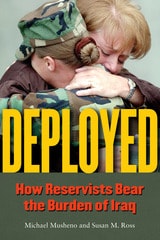
Deployed
How Reservists Bear the Burden of IraqMichael Musheno and Susan M. Ross
University of Michigan Press, 2008
"Deployed is an important and deeply moving book. Here, in this story, the heroic tradition of the American citizen-soldier lives on."
---Andrew J. Bacevich, Professor, Boston University, and author of The New American Militarism: How Americans Are Seduced by War
"Whatever your feelings about Iraq, Deployed is an important and compelling work that illuminates the real human cost of the war, and gives voice to those compelled to fight it."
---Ken Wells, Senior Editor, Condé Nast Portfolio
"Currently, there are few to no books dealing with the sociology of Iraq, and even fewer have empirical data on the experiences of American soldiers. More important, this work provides a strong and needed voice for soldiers---their words are compelling, rich, and moving."
---Morten Ender, Professor of Sociology, United States Military Academy at West Point
"This is a unique book that weaves historical, ethnographic, and organizational approaches for a study of Iraq-War military reservists. . . . the authors' findings challenge the pervading wisdom on reservists' motivations for service; the chemistry between family, reserve duty, and relations with regular military; and the effect that service in Iraq had on them."
---Jerry Lembcke, Associate Professor of Sociology, Holy Cross College
What is it like to be one of the citizen-soldiers summoned to duty in Iraq and Afghanistan? The events of 9/11 were a call to arms for many reservists, as shock, anger, and fear propelled large numbers to volunteer for the opportunity to serve their country in the Middle East. Even the most patriotic, however, had not expected that the wars would last so long or that the Army Reserve would supply so much of the manpower.
Using the soldiers' own voices, Deployed draws upon the life stories of members of an Army Reserve MP Company, who were called to extraordinary service after September 11. The book explores how and why they joined the Army Reserve, how they dealt with the seismic changes in their lives during and after deployment, the evolution of their relationships inside and outside their military unit, and their perspectives on the U.S. Army.
Musheno and Ross uncover five pathways that led these citizens to join the reserves, showing how basic needs and cultural idioms combined to stimulate enlistments. Whatever path led to enlistment, the authors find that citizen-soldiers fall into three distinct categories: adaptive reservists who adjust quickly to the huge changes in their lives abroad and at home, struggling reservists whose troubles are more a product of homegrown circumstances than experiences specific to serving in a war zone, and reservists who are dismissive of military life while they live it and oppose the war even as they fight it. Perhaps most important, Deployed challenges the prevailing stereotype of returning soldiers as war-damaged citizens.
Jacket photograph: AP Photo/Hutchinson News, Travis Morisse.

Deported Americans
Life after Deportation to MexicoBeth Caldwell
Duke University Press, 2019
Deregulating Desire
Flight Attendant Activism, Family Politics, and Workplace JusticeRyan Patrick Murphy
Temple University Press, 2016
In 1975, National Airlines was shut down for 127 days when flight attendants went on strike to protest long hours and low pay. Activists at National and many other U.S. airlines sought to win political power and material resources for people who live beyond the boundary of the traditional family. In Deregulating Desire, Ryan Patrick Murphy, a former flight attendant himself, chronicles the efforts of single women, unmarried parents, lesbians and gay men, as well as same-sex couples to make the airline industry a crucible for social change in the decades after 1970.
Murphy situates the flight attendant union movement in the history of debates about family and work. Each chapter offers an economic and a cultural analysis to show how the workplace has been the primary venue to enact feminist and LGBTQ politics.
From the political economic consequences of activism to the dynamics that facilitated the rise of what Murphy calls the “family values economy” to the Airline Deregulation Act of 1978, Deregulating Desire emphasizes the enduring importance of social justice for flight attendants in the twenty-first century.
Derivatives and the Wealth of Societies
Edited by Benjamin Lee and Randy Martin
University of Chicago Press, 2016
To answer that question, the contributors to this book draw upon their deep backgrounds in finance, social science, art, and the humanities to create a new way of understanding derivative finance that does justice to its social and cultural dimensions. They offer a two-pronged analysis. First, they develop a social understanding of the derivative that casts it in the light of anthropological concepts such as the gift, ritual, play, dividuality, and performativity. Second, they develop a derivative understanding of the social, using financial concepts such as risk, hedging, optionality, and arbitrage to uncover new dimensions of contemporary social reality. In doing so, they construct a necessary, renewed vision of derivative finance as a deeply embedded aspect not just of our economics but our culture.
Deserted
Life Without Local News in Rural AmericaNick Mathews
University of Illinois Press, 2026
The devastation of local news organizations has left rural areas of the US marooned in information deserts. Nick Mathews offers a boots-on-the-ground examination of the human toll of local news’s erosion by the winds of de-localization and corporate indifference.
It is no secret that ownership transfers, corporate mergers, and hedge fund takeovers have relentlessly consolidated and closed local news organizations. Mathews exposes the impact of that process on journalism, journalists, and news consumers hungry for outlets that tell their stories. A fundamental breakdown within journalism itself, the abandonment of community news has left disgruntled and disconnected locals to piece together news and information themselves. Mathews draws on the personal experiences of news gatherers and consumers to illuminate why local news cannot be scaled. Mass-produced content inevitably severs ties to communities while distant ownership is indifferent to local concerns.
Nuanced and sympathetic, <i>Deserted</i> provides a vivid portrait of the people and places forsaken by journalism’s corporate owners.