Results by title
67 books match the query 'Technology Studies' and 6 start with d
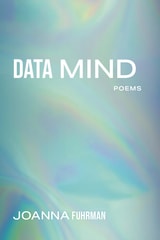
Data Mind
PoemsJoanna Fuhrman
Northwestern University Press, 2025
Wrestling with the experience of living online as a non-digital native
Joanna Fuhrman didn’t grow up online. Her generation entered the digital age as adults, with optimism about the possibilities it would bring for community building. In the alien landscape of the internet, they indeed found moments of joy and connection, but they also watched in anguish as what had been sold as a utopian space instead magnified the anti-democratic demons of necrocapitalism. In this darkly comic and surreal collection, Fuhrman lets herself fall into the internet wormhole of these conflicting realities. With titles ranging from “You Won’t Believe How Your Favorite Childhood Star Looks Now” to “We’ll Burn That Algorithm When We Get to It,” the feminist prose poems in Data Mind remix the tropes of digital life with the puckishness and embodied urgency for which Fuhrman is celebrated.
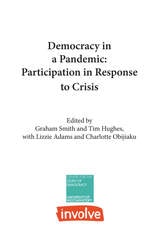
Democracy in a Pandemic
Participation in Response to CrisisGraham Smith, Tim Hughes, Lizzie Adams and Charlotte Obijiaku
University of Westminster Press, 2021
Covid-19 has highlighted limitations in our democratic politics – but also lessons for how to deepen our democracy and more effectively respond to future crises. In the face of an emergency, the working assumption all too often is that only a centralised, top-down response is possible. This book exposes the weakness of this assumption, making the case for deeper participation and deliberation in times of crises. During the pandemic, mutual aid and self-help groups have realised unmet needs. And forward-thinking organisations have shown that listening to and working with diverse social groups leads to more inclusive outcomes.
Participation and deliberation are not just possible in an emergency. They are valuable, perhaps even indispensable.
This book draws together a diverse range of voices of activists, practitioners, policy makers, researchers and writers. Together they make visible the critical role played by participation and deliberation during the pandemic and make the case for enhanced engagement during and beyond emergency contexts.
Another, more democratic world can be realised in the face of a crisis. The contributors to this book offer us meaningful insights into what this could look like.
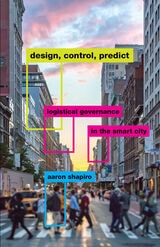
Design, Control, Predict
Logistical Governance in the Smart CityAaron Shapiro
University of Minnesota Press, 2020
An in-depth look at life in the “smart” city
Technology has fundamentally transformed urban life. But today’s “smart” cities look little like what experts had predicted. Aaron Shapiro shows us the true face of the revolution in urban technology, taking the reader on a tour of today’s smart city. Along the way, he develops a new lens for interpreting urban technologies—logistical governance—to critique an urban future based on extraction and rationalization.
Through ethnographic research, journalistic interviews, and his own hands-on experience, Shapiro helps us peer through cracks in the smart city’s facade. He investigates the true price New Yorkers pay for “free,” ad-funded WiFi, finding that it ultimately serves the ends of commercial media. He also builds on his experience as a bike courier for a food delivery startup to examine how promises of “flexible employment” in the gig economy in fact pave the way for strict managerial control. And he turns his eye toward hot-button debates around police violence and new patrol technologies, asking whether algorithms are really the answer to reforming our cities’ ongoing crises of criminal justice.
Through these gripping accounts of the new technological urbanism, Design, Control, Predict makes vital contributions to conversations around data privacy and algorithmic governance. Shapiro brings much-needed empirical research to a field that has often relied on “10,000-foot views.” Timely, important, and expertly researched, Design, Control, Predict doesn’t just help us comprehend urbanism today—it advances strategies for critiquing and resisting a dystopian future that can seem inevitable.

Digital Exhaustion
Burnout, Fatigue and Overload in the Age of Constant ConnectivityEdited by A.R.E. Taylor
Intellect Books, 2026
Unpacking the affective toll of constant connectivity, this book reframes digital exhaustion as a defining experience of our times.
Overflowing inboxes. Back-to-back Zoom meetings. Nonstop notifications.
Daily life in digital culture can be exhausting.
This timely and urgent edited collection introduces ‘digital exhaustion’ as a conceptual lens to critically examine the ever-expanding presence of digital technologies in our personal and professional lives. Drawing on interdisciplinary perspectives, this book explores how digital exhaustion is experienced, felt, and articulated in our hyper-connected culture – through burnout, brain rot, binge-watching, data extraction, energy consumption, and social media compulsion. Digital exhaustion emerges as a key structure of feeling in an era of constant connectivity and algorithmic demands.
Accessible yet theoretically grounded, this collection is an essential resource for scholars in cultural and technology studies, while also speaking to broader debates in anthropology, psychology, digital geography, urban studies, and consumer research. Responsive to the urgent need to engage in sustained dialogue about digital futures, this book offers fresh insights into how we might understand – and rethink – digital wellbeing, social media addiction, and the growing demand for a right to disconnect.
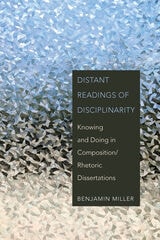
Distant Readings of Disciplinarity
Knowing and Doing in Composition/Rhetoric Dissertationsby Benjamin Miller
Utah State University Press, 2022
Writing studies has long been marked by a multitude of methods and interlocking purposes, partaking of not just humanities approaches but also social scientific ones, with data drawn from interviews and surveys alongside historical and philosophical arguments and with corpus analytics in large-scale collections jostling against small-scale case studies of individuals. These areas of study aren’t always cleanly separable; shifting modes mark the discipline as open and welcoming to many different angles of research. The field needs to embrace that vantage point and generate new degrees of familiarity with methods beyond those of any individual scholar.
Not only a training genre and not only a knowledge-making genre, the dissertation is also a discipline-producing genre. Illustrating what the field has been studying, and how, Distant Readings of Disciplinarity supports more fruitful collaborations within and across research areas and methods.
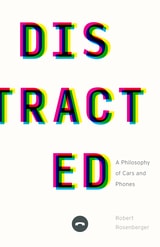
Distracted
A Philosophy of Cars and PhonesRobert Rosenberger
University of Minnesota Press, 2024
Applying insights from philosophy and cognitive science to address the urgent issue of smartphone-induced distracted driving
Although the dangers of texting while driving are widely known, many people resist the idea that phone usage will impair their driving. And connectivity features in new cars have only made using technology behind the wheel more tempting. What will it take to change people’s minds and behavior? Robert Rosenberger contends that a better understanding of why this combination of technologies is so dangerous could effectively adjust both habits and laws.
Rosenberger brings together ideas from philosophy and cognitive science to leverage a postphenomenological perspective that reveals how our smartphones make us such bad drivers. Reviewing decades of empirical studies in cognitive science, he shows that we have developed habits of perception regarding our compulsive technology use—habits that may wrest our attention away from the road.
Distracted develops innovative concepts for understanding technology-related habits and the ways that our relationships to our devices influence how we perceive the world. In turn, these ideas can help drivers be more cognizant of the effect that smartphone usage has on their perceptions, better inform efforts to enact stricter regulations, and help us all to be more reflective about the technologies that shape our lives.