Results by title
967 books match the query 'Theater' and 28 start with d
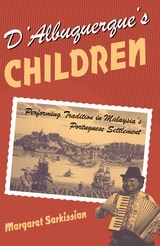
D'Albuquerque's Children
Performing Tradition in Malaysia's Portuguese SettlementMargaret Sarkissian
University of Chicago Press, 2000
Using historical and ethnographic data, Margaret Sarkissian reveals that this music and dance draws on an eclectic array of influences that span the Portuguese diaspora (one song conjures up images of Lucille Ball impersonating Carmen Miranda on "I Love Lucy"). Ironically, she shows, what began as a literate tradition in the 1950s has now become an oral one so deeply rooted in Settlement life that the younger generation, like the tourists, now see it as an unbroken heritage stretching back almost 500 years. A fascinating case of "orientalism in reverse," D'Albuquerque's Children illuminates the creative ways in which one community has adapted to life in a postcolonial world.
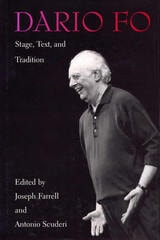
Dario Fo
Stage, Text, and TraditionEdited by Joseph Farrell and Antonio Scuderi
Southern Illinois University Press, 2000
Joseph Farrell and Antonio Scuderi present an international collection of essays reevaluating the multifaceted performance art of Nobel laureate Dario Fo.
The contributors, all of whom either have previously published on Fo or have worked with him, are the major Dario Fo scholars of three continents. Going beyond the Marxist criticism of the 1970s and 1980s, the editors and contributors try to establish an appropriate language in which to debate Fo’s theater. They seek to identify the core of Fo’s work, the material that will be of lasting value. This involves locating Fo in history, examining the nature of his development through successive phases, incorporating his politics into a wider framework of radical dissent, and setting his theatrical achievements in a context and a tradition.
The essays cover every aspect of Dario Fo: as actor, playwright, performer, and songwriter. They also provide the historical background of Fo’s theater, as well as an in-depth analyses of specific works and the contribution of Franca Rame.
Dark Matter
Invisibility in Drama, Theater, and PerformanceAndrew Sofer
University of Michigan Press, 2013
Dark Mattermaps the invisible dimension of theater whose effects are felt everywhere in performance. Examining phenomena such as hallucination, offstage character, offstage action, sexuality, masking, technology, and trauma, Andrew Sofer engagingly illuminates the invisible in different periods of postclassical western theater and drama. He reveals how the invisible continually structures and focuses an audience’s theatrical experience, whether it’s black magic in Doctor Faustus, offstage sex in A Midsummer Night’s Dream, masked women in The Rover, self-consuming bodies in Suddenly Last Summer, or surveillance technology in The Archbishop’s Ceiling. Each discussion pinpoints new and striking facets of drama and performance that escape sight. Taken together, Sofer’s lively case studies illuminate how dark matter is woven into the very fabric of theatrical representation. Written in an accessible style and grounded in theater studies but interdisciplinary by design, Dark Matter will appeal to theater and performance scholars, literary critics, students, and theater practitioners, particularly playwrights and directors.
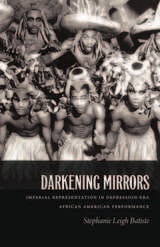
Darkening Mirrors
Imperial Representation in Depression-Era African American PerformanceStephanie Leigh Batiste
Duke University Press, 2012
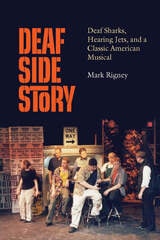
Deaf Side Story
Deaf Sharks, Hearing Jets, and a Classic American MusicalMark Rigney
Gallaudet University Press, 2003
The 1957 classic American musical West Side Story has been staged by countless community and school theater groups, but none more ambitious than the 2000 production by MacMurray College, a small school in Jacksonville, Illinois. Diane Brewer, the new drama head at the college, determined to add an extra element to the usual demands of putting on a show by having deaf students perform half of the parts. Deaf Side Story presents a fascinating narrative of Brewer and the cast’s efforts to mount this challenging play.
Brewer turned to the Illinois School for the Deaf (ISD) to cast the Sharks, the Puerto Rican gang at odds with the Anglo Jets in this musical version of Romeo and Juliet set in the slums of New York. Hearing performers auditioned to be the Jets, and once Brewer had cast her hearing Tony and deaf Maria, then came the challenge of teaching them all to sing/sign and dance the riveting show numbers for which the musical is renowned. She also had to manage a series of sensitive issues, from ensuring the seamless incorporation of American Sign Language into the play to reassuring ISD administrators and students that the production would not be symbolic of any conflict between Deaf and hearing people.
Author Mark Rigney portrays superbly the progress of the production, including the frustrations and triumphs of the leads, the labyrinthine campus and community politics, and the inevitable clashes between the deaf high school cast members and their hearing college counterparts. His representations of the many individuals involved are real and distinguished. The ultimate success of the MacMurray production reverberates in Deaf Side Story as a keen depiction of how several distinct individuals from as many cultures could cooperate to perform a classic American art form brilliantly together.

Death by Drama and Other Medieval Urban Legends
Jody Enders
University of Chicago Press, 2002
Was a convicted criminal executed on stage during a beheading scene? Was an unfortunate actor driven insane while playing a madman? Did a theatrical enactment of a crucifixion result in a real one? Did an androgynous young man seduce a priest when portraying a female saint? Enders answers these and other questions while presenting a treasure trove of tales that have long seemed true but are actually medieval urban legends. On topics ranging through politics, religion, marriage, class, and law, these tales, Enders argues, do the cultural work of all urban legends: they disclose the hopes, fears, and anxieties of their tellers. Each one represents a medieval meditation created or dramatized by the theater with its power to blur the line between fiction and reality, engaging anyone who watches, performs, or is represented by it. Each one also raises pressing questions about the medieval and modern world on the eve of the Reformation, when Europe had never engaged more anxiously and fervently in the great debate about what was real, what was pretend, and what was pretense.
Written with elegance and flair, and meticulously researched, Death by Drama and Other Medieval Urban Legends will interest scholars of medieval and Renaissance literature, history, theater, performance studies, and anyone curious about urban legends.
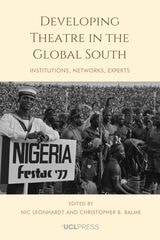
Developing Theatre in the Global South
Institutions, Networks, ExpertsEdited by Nic Leonhardt and Christopher B. Balme
University College London, 2024
This collection presents innovative institutional approaches to the theatre historiography of the Global South, proposing a fundamental reexamination of the historiography of theater in emerging countries since 1945. Covering perspectives from Africa, Asia, the Middle East, Latin America, and Eastern Europe, the chapters explore how US philanthropy, international organizations, and pan-African festivals all contributed to the globalization and institutionalization of the performing arts in the Global South.
During the Cultural Cold War, the Global North intervened in and promoted forms of cultural infrastructure that were deemed adaptable to any environment. This form of politics impacted the construction of national theaters, the introduction of new pedagogical tools, and the invention of the workshop as a format. The networks of experts responsible for this foreground seminal figures, both celebrated (Augusto Boal, Efua Sutherland) but also lesser-known (Albert Botbol, Severino Montano, Metin And), who contributed to the worldwide theatrical epistemic community of the postwar years.
Developing Theatre in the Global South investigates the institutional factors that led to the emergence of professional theatre in the postwar period throughout the decolonizing world. The book’s institutional and transnational approach enables theatre studies to overcome its commonly strong national and local focus on plays and productions and to connect it to current discourses in transnational and global history.
Directing Beckett
Lois Oppenheim
University of Michigan Press, 1997
In exploring this key figure in the history of theater, Oppenheim's interviews--with such directors as JoAnne Akalaitis, Edward Albee, Herbert Blau, Joseph Chaikin, and Carey Perloff--also address many of the complexities of the director's role, such as the meaning of directorial integrity and fidelity to the playwright's vision--an issue of particular relevance to a playwright whose exactitude, with respect to stage directions, is well documented. Additional highlights include photographs from many of the productions; the unpublished text of a lecture by the late Alan Schneider, Beckett's most accomplished American director; and an interview with the late Roger Blin, the very first director of Beckett's work.
"Directing Beckett is a rare thing--a book both pleasant to read and useful to have . . . it is like listening to the ideal panel, everyone who should be there there and all at their articulate best." --Toby Silverman Zinman, Theatre Journal
"Anyone intending to direct or act in a work by Beckett, or to write about his work, must read this book." --Choice
Lois Oppenheim is Professor of French, Montclair State University
Directing Postmodern Theater
Shaping Signification in PerformanceJon Whitmore
University of Michigan Press, 1994

Directing Shakespeare
A Scholar OnstageSidney Homan
Ohio University Press, 2004
An impossible question from a Chinese actor—“Why is Shakespeare eternal?”—drove Sidney Homan after fifty years in the theater to ponder just what makes Shakespeare…well, Shakespeare. The result, Directing Shakespeare, reflects the two worlds in which Homan operates—as a scholar and teacher on campus, and as a director and actor in professional and university theaters. His concern is the entire process, beginning in the lonely period when the director develops a concept, and moving into increasingly larger realms: interaction with stage designers; rehearsals; and performances in which the audience’s response further shapes the play.
Homan recounts the experience of staging King Lear accompanied by a musical score for piano, violin, and cello played live onstage. He discusses the challenge of making and trying to justify cuts in Hamlet. A casual remark from an actress leads to a feminist production of A Midsummer Night’s Dream. He describes the delicate collaboration between director and performer as he works with actors preparing for The Merchant of Venice, King Lear, and Hamlet. Other chapters treat a set designer’s bold red drapes that influenced the director’s concept for Julius Caesar, and the cross-influence of back-to-back runs of Stoppard’s Rosencrantz and Guildenstsern Are Dead and Hamlet.
In a highly personal concluding chapter, Homan tells of joyously working with a spontaneous young actor playing Puck and with an audience of unruly teenagers who wept at a performance of Lear.
Delightfully written, and filled with practical insights, Directing Shakespeare draws together scholars, critics, and those who work in the theater to bring the written word to life.

Directors & Designers
Edited by Christine White
Intellect Books, 2009
Directors and Designers explores the practice of scenography—the creation of perspective in the design and painting of stage scenery—and offers new insight into the working relationships of the people responsible for these theatrical transformations. With contributions from leading practitioners and theorists, editor Christine White describes the way in which the roles of director and designer have developed over time. Featuring chapters on theater and site-specific performance, theatrical communication and aesthetics, and the cognitive reception of design by the audience, this volume provides a valuable resource on current approaches to scenography for professionals and students.
Directors
From Stage to Screen and Back AgainSusan Beth Lehman
Intellect Books, 2013
Disabled Theater
Edited by Sandra Umathum and Benjamin Wihstutz
Diaphanes, 2015
Disappearing Acts
Spectacles of Gender and Nationalism in Argentina's "Dirty War"Diana Taylor
Duke University Press, 1997
Taylor uses performance theory to explore how public spectacle both builds and dismantles a sense of national and gender identity. Here, nation is understood as a product of communal "imaginings" that are rehearsed, written, and staged—and spectacle is the desiring machine at work in those imaginings. Taylor argues that the founding scenario of Argentineness stages the struggle for national identity as a battle between men—fought on, over, and through the feminine body of the Motherland. She shows how the military’s representations of itself as the model of national authenticity established the parameters of the conflict in the 70s and 80s, feminized the enemy, and positioned the public—limiting its ability to respond. Those who challenged the dictatorship, from the Mothers of the Plaza de Mayo to progressive theater practitioners, found themselves in what Taylor describes as "bad scripts." Describing the images, myths, performances, and explanatory narratives that have informed Argentina’s national drama, Disappearing Acts offers a telling analysis of the aesthetics of violence and the disappearance of civil society during Argentina’s spectacle of terror.
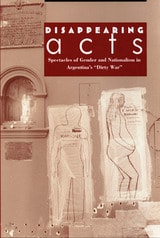
Disappearing Acts
Spectacles of Gender and Nationalism in Argentina's "Dirty War"Diana Taylor
Duke University Press, 0
Taylor uses performance theory to explore how public spectacle both builds and dismantles a sense of national and gender identity. Here, nation is understood as a product of communal "imaginings" that are rehearsed, written, and staged—and spectacle is the desiring machine at work in those imaginings. Taylor argues that the founding scenario of Argentineness stages the struggle for national identity as a battle between men—fought on, over, and through the feminine body of the Motherland. She shows how the military’s representations of itself as the model of national authenticity established the parameters of the conflict in the 70s and 80s, feminized the enemy, and positioned the public—limiting its ability to respond. Those who challenged the dictatorship, from the Mothers of the Plaza de Mayo to progressive theater practitioners, found themselves in what Taylor describes as "bad scripts." Describing the images, myths, performances, and explanatory narratives that have informed Argentina’s national drama, Disappearing Acts offers a telling analysis of the aesthetics of violence and the disappearance of civil society during Argentina’s spectacle of terror.
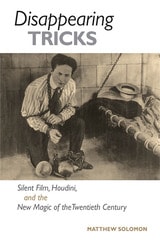
Disappearing Tricks
Silent Film, Houdini, and the New Magic of the Twentieth CenturyMatthew Solomon
University of Illinois Press, 2010
Disappearing Tricks revisits the golden age of theatrical magic and silent film to reveal how professional magicians shaped the early history of cinema. Where others have called upon magic as merely an evocative metaphor for the wonders of cinema, Matthew Solomon focuses on the work of the professional illusionists who actually made magic with moving pictures between 1895 and 1929.
The first to reveal fully how powerfully magic impacted the development of cinema, the book combines film and theater history to uncover new evidence of the exchanges between magic and filmmaking in the United States and France during the silent period. Chapters detailing the stage and screen work of Harry Houdini and Georges Méliès show how each transformed theatrical magic to create innovative cinematic effects and thrilling new exploits for twentieth-century mass audiences. The book also considers the previously overlooked roles of anti-spiritualism and presentational performance in silent film.
Highlighting early cinema's relationship to the performing body, visual deception, storytelling, and the occult, Solomon treats cinema and stage magic as overlapping practices that together revise our understanding of the origins of motion pictures and cinematic spectacle.
Disaster Capitalism
Or Money Can't Buy You Love - Three PlaysRick Mitchell
Intellect Books, 2011
Disaster capitalism is an increasingly popular critical paradigm for contextualizing and understanding life in the twenty-first century. This book includes three full-length plays by award-winning dramatist Rick Mitchell: Shadow Anthropology, a dark comedy about the US occupation of Afghanistan; Through the Roof, a Faustian trip through the social history of natural disaster in New Orleans; and Celestial Flesh, a sacrilegious romp through the 1980s sanctuary movement. Placing the plays in historical and thematic context, the author introduces the collection with an essay examining catastrophe, capitalism, and what he calls “Apocalypse Theater for the Twenty-First Century.”
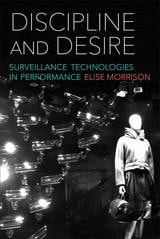
Discipline and Desire
Surveillance Technologies in PerformanceElise Morrison
University of Michigan Press, 2016
While the subject of surveillance continues to provoke fascination and debate in mainstream media and academia, opportunities to critically reflect upon and, more importantly, to imagine alternative, creative responses to living in a rapidly expanding surveillance society have been harder to find. Author Elise Morrison argues that such opportunities are being created through the growing genre of “surveillance art and performance,” defined as works that centrally employ technologies and techniques of surveillance to create theater, installation, and performance art. Introducing readers to a broad range of surveillance art works, including the work of artists and activists such as Surveillance Camera Players, Jill Magid, Steve Mann, Hasan Elahi, Wafaa Bilal, Blast Theory, Electronic Disturbance Theater, George Brant, Janet Cardiff, Mona Hatoum, and Zach Blas, Discipline and Desire provides a practical and analytical framework that can aid the diverse pursuits of new media-arts practitioners, performance scholars, activists, and hobbyists interested in critical and creative uses of surveillance technologies.
Documentary Trial Plays in Contemporary American Theater
Jacqueline O’Connor
Southern Illinois University Press, 2013
From the Chicago Conspiracy Trial and the O. J. Simpson trial to the Clarence Thomas/Anita Hill congressional hearings, legal and legislative proceedings in the latter part of the twentieth-century kept Americans spellbound. Situated on the shifting border between imagination and the law, trial plays edit, arrange, and reproduce court records, media coverage, and first-person interviews, transforming these elements into a performance. In this first book-length critical study of contemporary American documentary theater, Jacqueline O’Connor examines in depth ten such plays, all written and staged since 1970, and considers the role of the genre in re-creating and revising narratives of significant conflicts in contemporary history.
Documentary theater, she shows, is a particularly appropriate and widely utilized theatrical form for engaging in debate about tensions between civil rights and institutional power, the inconsistency of justice, and challenges to gender norms. For each of the plays discussed, including The Trial of the Catonsville Nine, Unquestioned Integrity: The Hill/Thomas Hearings, and The Laramie Project, O'Connor provides historical context and a brief production history before considering the trial the play focuses on. Grouping plays historically and thematically, she demonstrates how dramatic representation advances our understanding of the law's power while revealing the complexities that hinder society's pursuit of justice.

Doomed by Hope
Essays on Arab TheatreEdited by Eyad Houssami and Elias Khoury
Pluto Press, 2012
Doomed by Hope is a beautifully presented collection of essays by writers and artists which traces the history of contemporary Arab theatre and its relationship to social change.
With contributors from Syria, Egypt, Lebanon, Palestine, Kuwait and Yemen, this book includes both academic discussions and personal narratives, alongside a number of specially commissioned portraits of contemporary Arab theatre artists. The essays revolve around the legacy of the late Syrian dramatist Saadallah Wannous, whose monumental plays incited audiences to rise up against tyranny decades ago.
This unique book is one of the first English language volumes on Arab theatre. In a highly topical manner following the Arab Spring, it explores cultural practices – from reading plays in a classroom to performing in a security state and directing in theatres, prisons, and international festivals – in times of revolt.
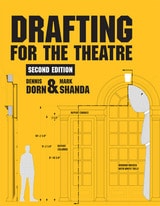
Drafting for the Theatre
Dennis Dorn and Mark Shanda
Southern Illinois University Press, 2012
Early chapters focus on the basics of geometric constructions, orthographic techniques, soft-line sketching applications, lettering, and dimensioning. Later chapters discuss real-life applications of production drawing and ancillary skills such as time and material estimation and shop-drawing nomenclature. Two chapters detail a series of design and shop drawings required to mount a specific design project, providing a guided path through both phases of the design/construction process. Most chapters conclude with one or more worksheets or problems that provide readers with an opportunity to test their understanding of the material presented.
The authors' discussion of universal CAD principles throughout the manuscript provides a valuable foundation that can be used in any computer-based design, regardless of the software. Dorn and Shanda treat the computer as another drawing tool, like the pencil or T-square, but one that can help a knowledgeable drafter potentially increase personal productivity and accuracy when compared to traditional hand-drafting techniques.
Drafting for the Theatre, second edition assembles in one book all the principal types of drawings, techniques, and conventional wisdom necessary for the production of scenic drafting, design, and shop drawings. It is richly illustrated with numerous production examples and is fully indexed to assist students and technicians in finding important information. It is structured to support a college-level course in drafting, but will also serve as a handy reference for the working theatre professional.
Drama, Play, and Game
English Festive Culture in the Medieval and Early Modern PeriodLawrence M. Clopper
University of Chicago Press, 2001
Drama, Play, and Game demonstrates that the theatrum repudiated by medieval clerics was not "theater" as we understand the term today. Clopper contends that critics have misrepresented Western stage history because they have assumed that theatrum designates a place where drama is performed. While theatrum was thought of as a site of spectacle during the Middle Ages, the term was more closely connected with immodest behavior and lurid forms of festive culture. Clerics were not opposed to liturgical representations in churches, but they strove ardently to suppress May games, ludi, festivals, and liturgical parodies. Medieval drama, then, stemmed from a more vernacular tradition than previously acknowledged-one developed by England's laity outside the boundaries of clerical rule.
Dramatists in Revolt
The New Latin American TheaterEdited by Leon F. Lyday and George W. Woodyard
University of Texas Press, 1976
Dramatists in Revolt, through studies of the major playwrights, explores significant movements in Latin American theater. Playwrights discussed are those who have made outstanding contributions to Latin American theater during the post–World War II period and who have been particularly sensitive to world currents in literature and drama, while being acutely responsive to the problems of their own areas. They express concern about communication, isolation, and solitude. On a more basic level, they concern themselves with the political and socioeconomic problems that figure importantly in the Third World.
The fifteen essays deal with the playwrights Antón Arrufat and José Triana (Cuba); Emilio Carballido and Luisa Josefina Hernández (Mexico); Agustín Cuzzani, Osvaldo Dragún, Griselda Gambaro, and Carlos Gorostiza (Argentina); Jorge Díaz, Egon Wolff, and Luis Alberto Heiremans (Chile); René Marqués (Puerto Rico); and Jorge Andrade, Alfredo Dias Gomes, and Plínio Marcos (Brazil). These are dramatists in revolt, sometimes in a thematic sense, not only in protesting the indignities that various systems impose on modern man, but also in a dramatic configuration. They dare to experiment with techniques in the constant search for viable theatrical forms.
Each essay is written by a specialist familiar with the works of the playwright under consideration. In addition to the essays, the book includes a listing of source materials on Latin American theater.
Dramaturgy in Motion
At Work on Dance and Movement PerformanceKatherine Profeta
University of Wisconsin Press, 2015
Profeta explores five arenas for the dramaturg’s attention—text and language, research, audience, movement, and interculturalism. Drawing on her extended collaboration with choreographer and visual artist Ralph Lemon, she grounds her thinking in actual rehearsal-room examples and situates practice within theoretical discourse about contemporary dramaturgy. Moving between theory and practice, word and movement, question and answer until these distinctions blur, she develops the foundational concept of dramaturgical labor as a quality of motion.
Dramaturgy in Motion will be invaluable to practitioners and scholars interested in the processes of creating contemporary dance and movement performance—particularly artists wondering what it might be like to collaborate with a dramaturg and dramaturgs wondering what it might be like to collaborate on movement performance. The book will also appeal to those intrigued by the work of Lemon and his collaborators, to which Profeta turns repeatedly to unfold the thorny questions and rich benefits of dramaturgical labor.
Dramaturgy
An IntroductionCock Dieleman
Amsterdam University Press, 2021
'Dramaturgy. An Introduction' provides a broad overview of the concept of dramaturgy and the profession of the dramaturg. It is intended for students and teachers of theatre and performance studies, but also for directors, scenographers, actors and for all lovers of theatre.
Dreaming America
Popular Front Ideals and Aesthetics in Children's Plays of the Federal Theatre ProjectLeslie Elaine Frost
The Ohio State University Press, 2013

Drop Dead
Performance in Crisis, 1970s New YorkHillary Miller
Northwestern University Press, 2016
Winner, 2017 American Theater and Drama Society John W. Frick Book Award
Winner, 2017 ASTR Barnard Hewitt Award for Outstanding Research in Theater History
Hillary Miller’s Drop Dead: Performance in Crisis, 1970s New York offers a fascinating and comprehensive exploration of how the city’s financial crisis shaped theater and performance practices in this turbulent decade and beyond.
New York City’s performing arts community suffered greatly from a severe reduction in grants in the mid-1970s. A scholar and playwright, Miller skillfully synthesizes economics, urban planning, tourism, and immigration to create a map of the interconnected urban landscape and to contextualize the struggle for resources. She reviews how numerous theater professionals, including Ellen Stewart of La MaMa E.T.C. and Julie Bovasso, Vinnette Carroll, and Joseph Papp of The Public Theater, developed innovative responses to survive the crisis.
Combining theater history and close readings of productions, each of Miller’s chapters is a case study focusing on a company, a production, or an element of New York’s theater infrastructure. Her expansive survey visits Broadway, Off-, Off-Off-, Coney Island, the Brooklyn Academy of Music, community theater, and other locations to bring into focus the large-scale changes wrought by the financial realignments of the day.
Nuanced, multifaceted, and engaging, Miller’s lively account of the financial crisis and resulting transformation of the performing arts community offers an essential chronicle of the decade and demonstrates its importance in understanding our present moment.
Dubious Spectacle
Extremities of Theater, 1976-2000Herbert Blau
University of Minnesota Press, 2002
Spanning a quarter of a century, the essays in this book rehearse, in the movement of memory and cross-reflection, an extensive career in theater. The work of Herbert Blau-his directing, writing, and criticism-has been a determining force during this period as theater encounters theory.
Blau’s struggle to bring a critical intelligence to the American stage goes back half a century, to the quiescent postwar years (which he has eloquently described in The Impossible Theater: A Manifesto). His innovations in performance began with early productions of now-canonical plays that were hardly known at that time (works by Brecht, Beckett, Genet, Pinter, Duerrenmatt, and others). His experience is as distinctive as his versatile habits of mind and conceptual urgency of style.
If the impossible takes a little time (as the title of one essay states), Blau’s struggle now continues in a theoretical vein. Performance-and his own compelling writing- has moved across other genres and disciplines into fashion, politics, sexuality, and theory. His diversity of thought is demonstrated here in commentaries about the newer modes of performance (including conceptual and body art), various American playwrights, Renaissance drama, new music and theater, voice, the senses and the baroque, and the photographic image. As the essays reflect upon each other, a kind of cultural history, with inflections of autobiography, develops-which is what readers of Blau’s previous books have come to expect.