Results by title
28164 books match the query 'History' and 908 start with d
Disaffected
The Cultural Politics of Unfeeling in Nineteenth-Century AmericaXine Yao
Duke University Press, 2021
Duke University Press Scholars of Color First Book Award recipient
Disalienation
Politics, Philosophy, and Radical Psychiatry in Postwar FranceCamille Robcis
University of Chicago Press, 2021
In Disalienation, Camille Robcis grapples with the historical, intellectual, and psychiatric meaning of the ethics articulated at Saint-Alban by exploring the movement’s key thinkers, including François Tosquelles, Frantz Fanon, Félix Guattari, and Michel Foucault. Anchored in the history of one hospital, Robcis's study draws on a wide geographic context—revolutionary Spain, occupied France, colonial Algeria, and beyond—and charts the movement's place within a broad political-economic landscape, from fascism to Stalinism to postwar capitalism.

Disappearing Acts
Spectacles of Gender and Nationalism in Argentina's "Dirty War"Diana Taylor
Duke University Press, 1997
Taylor uses performance theory to explore how public spectacle both builds and dismantles a sense of national and gender identity. Here, nation is understood as a product of communal "imaginings" that are rehearsed, written, and staged—and spectacle is the desiring machine at work in those imaginings. Taylor argues that the founding scenario of Argentineness stages the struggle for national identity as a battle between men—fought on, over, and through the feminine body of the Motherland. She shows how the military’s representations of itself as the model of national authenticity established the parameters of the conflict in the 70s and 80s, feminized the enemy, and positioned the public—limiting its ability to respond. Those who challenged the dictatorship, from the Mothers of the Plaza de Mayo to progressive theater practitioners, found themselves in what Taylor describes as "bad scripts." Describing the images, myths, performances, and explanatory narratives that have informed Argentina’s national drama, Disappearing Acts offers a telling analysis of the aesthetics of violence and the disappearance of civil society during Argentina’s spectacle of terror.
Disappearing Acts
Spectacles of Gender and Nationalism in Argentina's "Dirty War"Diana Taylor
Duke University Press, 0
Taylor uses performance theory to explore how public spectacle both builds and dismantles a sense of national and gender identity. Here, nation is understood as a product of communal "imaginings" that are rehearsed, written, and staged—and spectacle is the desiring machine at work in those imaginings. Taylor argues that the founding scenario of Argentineness stages the struggle for national identity as a battle between men—fought on, over, and through the feminine body of the Motherland. She shows how the military’s representations of itself as the model of national authenticity established the parameters of the conflict in the 70s and 80s, feminized the enemy, and positioned the public—limiting its ability to respond. Those who challenged the dictatorship, from the Mothers of the Plaza de Mayo to progressive theater practitioners, found themselves in what Taylor describes as "bad scripts." Describing the images, myths, performances, and explanatory narratives that have informed Argentina’s national drama, Disappearing Acts offers a telling analysis of the aesthetics of violence and the disappearance of civil society during Argentina’s spectacle of terror.
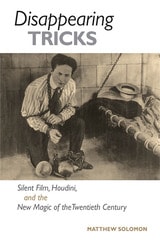
Disappearing Tricks
Silent Film, Houdini, and the New Magic of the Twentieth CenturyMatthew Solomon
University of Illinois Press, 2010
Disappearing Tricks revisits the golden age of theatrical magic and silent film to reveal how professional magicians shaped the early history of cinema. Where others have called upon magic as merely an evocative metaphor for the wonders of cinema, Matthew Solomon focuses on the work of the professional illusionists who actually made magic with moving pictures between 1895 and 1929.
The first to reveal fully how powerfully magic impacted the development of cinema, the book combines film and theater history to uncover new evidence of the exchanges between magic and filmmaking in the United States and France during the silent period. Chapters detailing the stage and screen work of Harry Houdini and Georges Méliès show how each transformed theatrical magic to create innovative cinematic effects and thrilling new exploits for twentieth-century mass audiences. The book also considers the previously overlooked roles of anti-spiritualism and presentational performance in silent film.
Highlighting early cinema's relationship to the performing body, visual deception, storytelling, and the occult, Solomon treats cinema and stage magic as overlapping practices that together revise our understanding of the origins of motion pictures and cinematic spectacle.
Disarming Doomsday
The Human Impact of Nuclear Weapons since HiroshimaBecky Alexis-Martin
Pluto Press, 2019

Disarming the Nation
Women's Writing and the American Civil WarElizabeth Young
University of Chicago Press, 1999
Combining literary analysis, cultural history, and feminist theory, Disarming the Nation argues that the Civil War functioned in women's writings to connect female bodies with the body politic. Women writers used the idea of "civil war" as a metaphor to represent struggles between and within women—including struggles against the cultural prescriptions of "civility." At the same time, these writers also reimagined the nation itself, foregrounding women in their visions of America at war and in peace. In a substantial afterword, Young shows how contemporary black and white women—including those who crossdress in Civil War reenactments—continue to reshape the meanings of the war in ways startlingly similar to their nineteenth-century counterparts.
Learned, witty, and accessible, Disarming the Nation provides fresh and compelling perspectives on the Civil War, women's writing, and the many unresolved "civil wars" within American culture today.
Disaster At The Colorado
Charles W. Baley
Utah State University Press, 2002
Across north-central New Mexico and Arizona, along the line of Route 66, now Interstate 40, there first ran a little-known wagon trail called Beale's Wagon Road, after Edward F. Beale, who surveyed it for the War Department in 1857. This survey became famous for employing camels. Not so well known is the fate of the first emigrants who the next year attempted to follow its tracks. The government considered the 1857 exploration a success and the road it opened a promising alternative route to California but expected such things as military posts and developed water supplies to be needed before it was ready for regular travel. Army representatives in New Mexico were more enthusiastic.
In 1858 there was a need for an alternative. Emigrants avoided the main California Trail because of a U.S. Army expedition to subdue Mormons in Utah. The Southern Route ran through Apache territory, was difficult for the army to guard, and was long. When a party of Missouri and Iowa emigrants known as the Rose-Baley wagon train arrived in Albuquerque, they were encouraged to be the first to try the new Beale road. Their journey became a rolling disaster. Beale's trail was more difficult to follow than expected; water sources and feed for livestock harder to find. Indians along the way had been described as peaceful, but the Hualapais persistently harassed the emigrants and shot their stock, and when the wagon train finally reached the Colorado River, a large party of Mojaves attacked them. Several of the emigrants were killed, and the remainder began a difficult retreat to Albuquerque. Their flight, with wounded companions and reduced supplies, became ever more arduous. Along the way they met other emigrant parties and convinced them to join the increasingly disorderly and distressed return journey.
Charles Baley tells this dramatic story and discusses its aftermath, for the emigrants, for Beale's Wagon Road, and for the Mojaves, against whom some of the emigrants pressed legal claims with the federal government.
Disaster Citizenship
Survivors, Solidarity, and Power in the Progressive EraJacob Remes
University of Illinois Press, 2015
In Disaster Citizenship, Jacob A. C. Remes draws on histories of the Salem and Halifax events to explore the institutions--both formal and informal--that ordinary people relied upon in times of crisis. He explores patterns and traditions of self-help, informal order, and solidarity and details how people adapted these traditions when necessary. Yet, as he shows, these methods--though often quick and effective--remained illegible to reformers. Indeed, soldiers, social workers, and reformers wielding extraordinary emergency powers challenged these grassroots practices to impose progressive "solutions" on what they wrongly imagined to be a fractured social landscape.
Disaster Nationalism
Tsunami and Civil War in Sri LankaVivian Y. Choi
Duke University Press, 2025
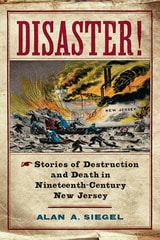
Disaster!
Stories of Destruction and Death in Nineteenth-Century New JerseySiegel, Alan A
Rutgers University Press, 2014
By every measure, Hurricane Sandy was a disaster of epic proportions. The deadliest storm to strike the East Coast since Hurricane Diane in 1955, Sandy killed thirty-seven people and caused more than $30 billion in damages in 2012 to New Jersey alone. But earlier centuries experienced their own catastrophes.
In Disaster!, Alan A. Siegel brings readers face-to-face with twenty-eight of the deadliest natural and human-caused calamities to strike New Jersey between 1821 and 1906, ranging from horrific transportation accidents to uncontrolled fires of a kind rarely seen today. As Siegel writes in his introduction, “None of the stories end well—there are dead and injured by the thousands as well as millions in property lost.” Accounts of these fires, steamboat explosions, shipwrecks, train wrecks, and storms are told in the words of the people who experienced the events firsthand, lending a sense of immediacy to each story.
Disasters bring out the worst as well as the best in people. Siegel focuses on the bravest individuals, including harbor pilot Thomas Freeborn who drowned while attempting to save fifty passengers and crew of a ship foundering on the Jersey Shore, and Warwicke Greene, a fourteen-year-old schoolboy who rescued the injured “like the hero of an epic poem” after a train wreck in the Hackensack Meadows. These and many other stories of forgotten acts of courage in the face of danger will make Disaster! an unforgettable read.

Discarded, Discovered, Collected
The University of Michigan Papyrus CollectionArthur Verhoogt
University of Michigan Press, 2017
Discerning Experts
The Practices of Scientific Assessment for Environmental PolicyMichael Oppenheimer, Naomi Oreskes, Dale Jamieson, Keynyn Brysse, Jessica O’Reilly, Matthew Shindell, and Milena Wazeck
University of Chicago Press, 2019
Discerning Experts uncovers factors that can generate systematic bias and error, and recommends how the process can be improved. As the first study of the internal workings of large environmental assessments, this book reveals their strengths and weaknesses, and explains what assessments can—and cannot—be expected to contribute to public policy and the common good.
Discerning The Subject
Paul Smith
University of Minnesota Press, 1988
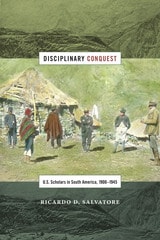
Disciplinary Conquest
U.S. Scholars in South America, 1900–1945Ricardo D. Salvatore
Duke University Press, 2016
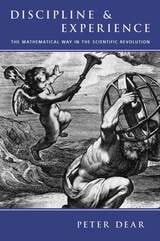
Discipline and Experience
The Mathematical Way in the Scientific RevolutionPeter Dear
University of Chicago Press, 1995
Peter Dear investigates the nature of the change that occurred during this period, focusing particular attention on evolving notions of experience and how these developed into the experimental work that is at the center of modern science. He examines seventeenth-century mathematical sciences—astronomy, optics, and mechanics—not as abstract ideas, but as vital enterprises that involved practices related to both experience and experiment. Dear illuminates how mathematicians and natural philosophers of the period—Mersenne, Descartes, Pascal, Barrow, Newton, Boyle, and the Jesuits—used experience in their argumentation, and how and why these approaches changed over the course of a century. Drawing on mathematical texts and works of natural philosophy from all over Europe, he describes a process of change that was gradual, halting, sometimes contradictory—far from the sharp break with intellectual tradition implied by the term "revolution."

Discipline and History
Political Science in the United StatesJames Farr and Raymond Seidelman, Editors
University of Michigan Press, 1993
James Farr and Raymond Seidelman bring new historical reflection to the "state of the discipline" debate in political science. This anthology offers a panorama of views about the state of the discipline that have been sketched by leading political scientists and disciplinary historians from the late nineteenth century to the past.
The essays in this volume explore four distinct periods in the development of the discipline, with special emphasis on the subfields of American politics and political theory, revealing that the identity of the discipline is constituted not so much by agreements over fundamental principles as by the history of debates about the meaning of politics, the methods of science, the theories of behavioralism and the state, and the responsibilities of public professionals and civic educators.
Contributors are Terence Ball, Charles A. Beard, John W. Burgess, Robert A. Dahl, David Easton, John G. Gunnell, Norman Jacobson, Harold D. Lasswell, Francis Lieber, Charles E. Merriam, David M. Ricci, William H. Riker, Dorothy Ross, Helene Silverberg, Leonard D. White, Woodrow Wilson, and W.W. Willoughby.
Its unprecedented treatment of the history of political science makes Discipline and History essential reading for political scientists and their students. Historians of the social sciences will also find much to consider.
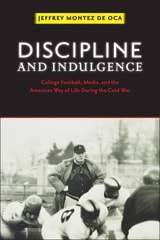
Discipline and Indulgence
College Football, Media, and the American Way of Life during the Cold WarMontez de Oca, Jeffrey
Rutgers University Press, 2013
The early Cold War (1947–1964) was a time of optimism in America. Flushed with confidence by the Second World War, many heralded the American Century and saw postwar affluence as proof that capitalism would solve want and poverty. Yet this period also filled people with anxiety. Beyond the specter of nuclear annihilation, the consumerism and affluence of capitalism’s success were seen as turning the sons of pioneers into couch potatoes.
In Discipline and Indulgence, Jeffrey Montez de Oca demonstrates how popular culture, especially college football, addressed capitalism’s contradictions by integrating men into the economy of the Cold War as workers, warriors, and consumers. In the dawning television age, college football provided a ritual and spectacle of the American way of life that anyone could participate in from the comfort of his own home. College football formed an ethical space of patriotic pageantry where men could produce themselves as citizens of the Cold War state. Based on a theoretically sophisticated analysis of Cold War media, Discipline and Indulgence assesses the period’s institutional linkage of sport, higher education, media, and militarism and finds the connections of contemporary sport media to today’s War on Terror.
Disciplining Statistics
Demography and Vital Statistics in France and England, 1830–1885Libby Schweber
Duke University Press, 2006
Tracing the introduction and promotion of vital statistics and demography, Schweber identifies the institutional conditions that account for the contrasting styles of reasoning. She shows that the different reactions to statistics stemmed from different criteria for what counted as scientific knowledge. The French wanted certain knowledge, a one-to-one correspondence between observations and numbers. The English adopted an instrumental approach, using the numbers to influence public opinion and evaluate and justify legislation.
Schweber recounts numerous attempts by vital statisticians and demographers to have their work recognized as legitimate scientific pursuits. While the British scientists had greater access to government policy makers, and were able to influence policy in a way that their French counterparts were not, ultimately neither the vital statisticians nor the demographers were able to institutionalize their endeavors. By 1885, both fields had been superseded by new forms of knowledge. Disciplining Statistics highlights how the development of “scientific” knowledge was shaped by interrelated epistemological, political, and institutional considerations.
Disconnected
Call Center Workers Fight for Good Jobs in the Digital AgeDebbie J. Goldman
University of Illinois Press, 2024
Call center employees once blended skill and emotional intelligence to solve customer problems while the workplace itself encouraged camaraderie and job satisfaction. Ten years after telecom industry deregulation, management had isolated the largely female workforce in cubicles, imposed quotas to sell products, and installed surveillance systems that tracked every call and keystroke.
Debbie J. Goldman explores how call center employees and their union fought for good, humane jobs in the face of degraded working conditions and lowered wages. As the workforce coalesced to resist the changes, it demanded the Communications Workers of America (CWA) fight for safe and secure good-paying jobs. But trends in technology, capitalism, and corporate governance--combined with the decline of unions--narrowed the negotiating options for workers. Goldman describes how the actions of workers, management, and policymakers shaped the social impact of the new digital technologies and gave new form to the telecommunications industry in a time of momentous change.
Perceptive and nuanced, Disconnected tells an overlooked story of service workers in a time of change.
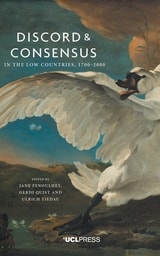
Discord and Consensus in the Low Countries, 1700-2000
Edited by Jane Fenoulhet, Gerdi Quist, and Ulrich Tiedau
University College London, 2016
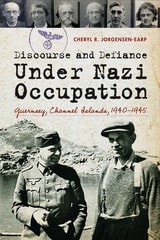
Discourse and Defiance under Nazi Occupation
Guernsey, Channel Islands, 1940–1945Cheryl R. Jorgensen-Earp
Michigan State University Press, 2013
Captured by German forces shortly after Dunkirk, and not relinquished until May of 1945, nearly a year after the Normandy invasion, the British Channel Islands (Guernsey, Jersey, Alderney, Sark, and Herm) were characterized during their occupation by severe deprivation and powerlessness. The Islanders, with few resources to stage an armed resistance, constructed a rhetorical resistance based upon the manipulation of discourse, construction of new symbols, and defiance of German restrictions on information. Though much of modern history has focused on the possibility that Islanders may have collaborated with the Germans, this eye-opening history turns to secret war diaries kept in Guernsey. A close reading of these private accounts, written at great risk to the diarists, allows those who actually experienced the Occupation to reclaim their voice and reveals new understandings of Island resistance. What emerges is a stirring account of the unquenchable spirit and deft improvisation of otherwise ordinary people in extraordinary circumstances. Under the most dangerous of conditions, Guernsey civilians used imaginative methods in reacting to their position as a subjugated population, devising a covert resistance of nuance and sustainability. Violence, this book and the people of Guernsey demonstrate, is not at all the only means with which to confront evil.
Discourse and the Other
The Production of the Afro-American TextW. Lawrence Hogue
Duke University Press, 1986
Hogue presents an illuminating discussion of the publication and review history of "major" and neglected texts. He illustrates the acceptance of texts as exotica, as sociological documents, or as carriers of sufficient literary conventions to receive approbation. Although the sixties movement allowed the text to move to the periphery of the dominant ideology, providing some new myths about the Afro-American historical past, this marginal position was subsequently sabotaged, co-opted, or appropriated (Afros became a fad; presidents gave the soul handshake; the hip-talking black was dressing one style and talking another.)
This study includes extended discussion of four works; Ernest J. Gaines's The Autobiography of Miss Jane Pittman, Alice Walker's The Third Life of Grange Copeland, Albert Murray's Train Whistle Guitar, and Toni Morrison's Sula. Hogue assesses the informing worldviews of each and the extent and nature of their acceptance by the dominant American cultural apparatus.
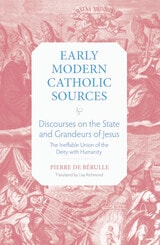
Discourse on the State and Grandeurs of Jesus
The Ineffable Union of the Diety with HumanityPierre de Bérulle
Catholic University of America Press, 2023
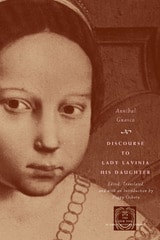
Discourse to Lady Lavinia His Daughter
Annibal Guasco
University of Chicago Press, 2003
The Discourse displays an incredibly far-sighted view of women's education. Annibal thought gifted young girls should develop their talents and apply them to careers outside the home. In the Discourse, he details the unique and extremely rigorous educational program to which he had subjected Lavinia almost from the cradle with this end in mind. To complete Lavinia's education, Annibal filled the Discourse with advice on spirituality and morality, health and beauty, and how to behave at court—everything a well-bred lady-in-waiting would need to know. This edition also includes an appendix that traces the later events of Lavinia's life through excerpts from her father's letters.
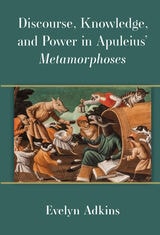
Discourse, Knowledge, and Power in Apuleius’ Metamorphoses
Evelyn Adkins
University of Michigan Press, 2022
In ancient Rome, where literacy was limited and speech was the main medium used to communicate status and identity face-to-face in daily life, an education in rhetoric was a valuable form of cultural capital and a key signifier of elite male identity. To lose the ability to speak would have caused one to be viewed as no longer elite, no longer a man, and perhaps even no longer human. We see such a fantasy horror story played out in the Metamorphoses or The Golden Ass, written by Roman North African author, orator, and philosopher Apuleius of Madauros—the only novel in Latin to survive in its entirety from antiquity. In the novel’s first-person narrative as well as its famous inset tales such as the Tale of Cupid and Psyche, the Metamorphoses is invested in questions of power and powerlessness, truth and knowledge, and communication and interpretation within the pluralistic but hierarchical world of the High Roman Empire (ca. 100–200 CE).
Discourse, Knowledge, and Power presents a new approach to the Metamorphoses: it is the first in-depth investigation of the use of speech and discourse as tools of characterization in Apuleius’ novel. It argues that discourse, broadly defined to include speech, silence, written text, and nonverbal communication, is the primary tool for negotiating identity, status, and power in the Metamorphoses. Although it takes as its starting point the role of discourse in the characterization of literary figures, it contends that the process we see in the Metamorphoses reflects the real world of the second century CE Roman Empire. Previous scholarship on Apuleius’ novel has read it as either a literary puzzle or a source-text for social, philosophical, or religious history. In contrast, this book uses a framework of discourse analysis, an umbrella term for various methods of studying the social political functions of discourse, to bring Latin literary studies into dialogue with Roman rhetoric, social and cultural history, religion, and philosophy as well as approaches to language and power from the fields of sociology, linguistics, and linguistic anthropology. Discourse, Knowledge, and Power argues that a fictional account of a man who becomes an animal has much to tell us not only about ancient Roman society and culture, but also about the dynamics of human and gendered communication, the anxieties of the privileged, and their implications for swiftly shifting configurations of status and power whether in the second or twenty-first centuries.
Discourses of Weakness and Resource Regimes
Trajectories of a New Research ProgramEdited by Iwo Amelung, Hartmut Leppin and Christian A. Müller
Campus Verlag, 2018
Discourses of Weakness in Modern China
Historical Diagnoses of the "Sick Man of East Asia"Edited by Iwo Amelung
Campus Verlag, 2018
Discourses on Livy
Niccolò Machiavelli
University of Chicago Press, 1998
"[Machiavelli] found in Livy the means to inspire scholars for five centuries. Within the Discourses, often hidden and sometimes unintended by their author, lie the seeds of modern political thought. . . . [Mansfield and Tarcov's] translation is careful and idiomatic."—Peter Stothard, The Times
"Translated with painstaking accuracy—but also great readability."—Weekly Standard
"A model of contemporary scholarship and a brave effort at Machiavelli translation that allows the great Florentine to speak in his own voice."—Choice
Discourses on Livy
Niccolò Machiavelli
University of Chicago Press, 1996
"[Machiavelli] found in Livy the means to inspire scholars for five centuries. Within the Discourses, often hidden and sometimes unintended by their author, lie the seeds of modern political thought. . . . [Mansfield and Tarcov's] translation is careful and idiomatic."—Peter Stothard, The Times
"Translated with painstaking accuracy—but also great readability."—Weekly Standard
"A model of contemporary scholarship and a brave effort at Machiavelli translation that allows the great Florentine to speak in his own voice."—Choice

Discover Colorado, Second Edition
Matthey Downey
University Press of Colorado, 2015
Discover Romanian
An Introduction to the Language and CultureRodica Bo?oman
The Ohio State University Press, 1995
This comprehensive introduction to Romanian for English-speaking students emphasizes communication with a complete treatment of grammar, an extensive vocabulary, and a focus on the four major language skills—listening, speaking, reading, and writing. Cultural information, an integral part of the textbook, is presented both formally, in sections on culture and civilization, and informally, as the setting for dialogues and exercises. Tables of verb conjugations and a glossary round out the book's primary materials.
Straightforward and accessible, Discover Romanian is an essential textbook for all those teaching and learning the language and provides important information for those seeking to understand Romanian culture.
Discover the Hidden New Jersey
Roberts, Russell
Rutgers University Press, 1995
Did you know—
—that a New Jerseyan was the first president of the United States?
—that New Jersey was the site of the first organized college football game?
—that New Jersey was the location of one of the most devastating espionage attacks of World War I?
—that the heroics of a New Jersey woman saved thousands of people from dying of yellow fever?
These and other fascinating stores can be found in Discover the Hidden New Jersey, a treasury of New Jersey stories that celebrate the unique heritage and importance of the Garden State. Russell Roberts has scoured New Jersey, from High Point to Cape May, to bring readers a delightful potpourri of facts, essays, lists, photos, stories, and legends about New Jersey. Readers will learn how New Jersey used to be the center of the motion picture universe, the origin of the Jersey Devil and other popular tall tales, where Norman Mailer and Abbot & Costello were born, where Aaron Burr and Leo, the M-G-M lion, lie buried, and much more. Learn about the geology of New Jersey, find out about the state’s ever-changing weather, and hear about some of the best places to go for the day. All this and more is in Discover the Hidden New Jersey, the ultimate New Jersey book.
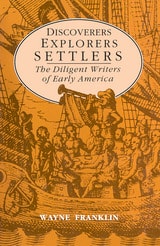
Discoverers, Explorers, Settlers
The Diligent Writers of Early AmericaWayne Franklin
University of Chicago Press, 1979

Discovering Mars
A History of Observation and Exploration of the Red PlanetWilliam Sheehan and Jim Bell
University of Arizona Press, 2021
Historian William Sheehan and astronomer and planetary scientist Jim Bell combine their talents to tell a unique story of what we’ve learned by studying Mars through evolving technologies. What the eye sees as a mysterious red dot wandering through the sky becomes a blurry mirage of apparent seas, continents, and canals as viewed through Earth-based telescopes. Beginning with the Mariner and Viking missions of the 1960s and 1970s, space-based instruments and monitoring systems have flooded scientists with data on Mars’s meteorology and geology, and have even sought evidence of possible existence of life-forms on or beneath the surface. This knowledge has transformed our perception of the Red Planet and has provided clues for better understanding our own blue world.
Discovering Mars vividly conveys the way our understanding of this other planet has grown from earliest times to the present. The story is epic in scope—an Iliad or Odyssey for our time, at least so far largely without the folly, greed, lust, and tragedy of those ancient stories. Instead, the narrative of our quest for the Red Planet has showcased some of our species’ most hopeful attributes: curiosity, cooperation, exploration, and the restless drive to understand our place in the larger universe. Sheehan and Bell have written an ambitious first draft of that narrative even as the latest chapters continue to be added both by researchers on Earth and our robotic emissaries on and around Mars, including the latest: the Perseverance rover and its Ingenuity helicopter drone, which set down in Mars’s Jezero Crater in February 2021.
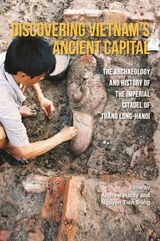
Discovering Vietnam’s Ancient Capital
The Archaeology and History of the Imperial Citadel of Thang Long-HanoiEdited by Andrew Hardy and Tien Ðông Nguyen
National University of Singapore Press, 2023
As Vietnam entered the twenty-first century it began to prepare for the 1000th anniversary of the founding of its capital Thang Long, now Hanoi. In the heart of the city, a rescue excavation was launched on land earmarked for the construction of a new National Assembly building. Archaeologists unearthed thirteen centuries of vestiges of the ancient city of Thang Long, yielding a richer record than anyone had dared to hope for. Construction plans were shelved, excavations widened, and at the city's millennial celebrations in 2010, UNESCO announced its inscription of the Imperial Citadel of Thang Long on its World Heritage List.
This archaeological discovery has two histories. The first, told here by the archaeologists involved, is the story of the dig, which brought to light the bricks, tiles, pillars, sculptures, and ceramics of countless ancient temples and palaces. The second is the history of the citadel itself, in its early years as an outpost of the Chinese empire, in its heyday as the Forbidden City of Vietnam’s emperors, and in its downgrading and eventual destruction at the hands of the Nguyen dynasty and French colonial rulers. Bringing together history, urban history, and a fascinating story of the interplay of influences from China and Southeast Asia, this is also a fascinating case of an Asian capital city coming to understand its history and deciding how to preserve its archaeological remains.
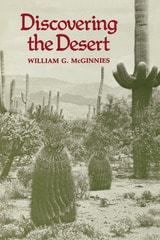
Discovering the Desert
The Legacy of the Carnegie Desert Botanical LaboratoryWilliam G. McGinnies
University of Arizona Press, 1981
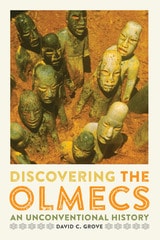
Discovering the Olmecs
An Unconventional HistoryBy David C. Grove
University of Texas Press, 2014
The Olmecs are renowned for their massive carved stone heads and other sculptures, the first stone monuments produced in Mesoamerica. Seven decades of archaeological research have given us many insights into the lifeways of the Olmecs, who inhabited parts of the modern Mexican states of Veracruz and Tabasco from around 1150 to 400 BC, and there are several good books that summarize the current interpretations of Olmec prehistory. But these formal studies don’t describe the field experiences of the archaeologists who made the discoveries. What was it like to endure the Olmec region’s heat, humidity, mosquitoes, and ticks to bring that ancient society to light? How did unforeseen events and luck alter carefully planned research programs and the conclusions drawn from them? And, importantly, how did local communities and individuals react to the research projects and discoveries in their territories?
In this engaging book, a leading expert on the Olmecs tells those stories from his own experiences and those of his predecessors, colleagues, and students. Beginning with the first modern explorations in the 1920s, David Grove recounts how generations of archaeologists and local residents have uncovered the Olmec past and pieced together a portrait of this ancient civilization that left no written records. The stories are full of fortuitous discoveries and frustrating disappointments, helpful collaborations and deceitful shenanigans. What emerges is an unconventional history of Olmec archaeology, a lively introduction to archaeological fieldwork, and an exceptional overview of all that we currently know about the Olmecs.

Discovering the Scottish Revolution 1692-1746
Neil Davidson
Pluto Press, 2003
Davidson explores the political and economic changes of these years, revealing how social and economic power was transferred from one class to another. He describes how Scotland was transformed from a backward and feudal economy to a new centre of emergent capitalism. He traces the economic and social crisis that led to Scotland's incorporation into the Union in 1707, but argues that the Union did not lead to the transformation of Scottish society. The decisive period was instead the aftermath of the last Jacobite revolt in 1746, whose failure was integral to the survival and consolidation of British, and ultimately global capitalism.
'His opinions are bound to cause controversy and discussion ... a good thing as Scottish history desperately needs the airing and voicing of new approaches.'
John R Young, Albion.
‘What is so good about Neil Davidson’s brave study is that he brings a Marxist perspective to bear on Scottish history in very clear and readable prose. Quotations and statistics drawn from uncannily wide reading will make this book of great value even to those who disagree with it.’
Angus Calder, author of Revolutionary Empire and Revolving Culture: Notes from the Scottish Republic

Discrepant Histories
Vincente Rafael
Temple University Press, 1995
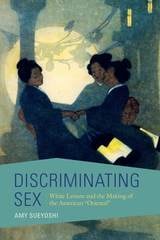
Discriminating Sex
White Leisure and the Making of the American "Oriental"Amy Sueyoshi
University of Illinois Press, 2018
Amy Sueyoshi draws on everything from newspapers to felony case files to oral histories in order to examine how whites' pursuit of gender and sexual fulfillment gave rise to racial caricatures. As she reveals, white reporters, writers, artists, and others conflated Chinese and Japanese, previously seen as two races, into one. There emerged the Oriental—a single pan-Asian American stereotype weighted with sexual and gender meaning. Sueyoshi bridges feminist, queer, and ethnic studies to show how the white quest to forge new frontiers in gender and sexual freedom reinforced—and spawned—racial inequality through the ever evolving Oriental.
Informed and fascinating, Discriminating Sex reconsiders the origins and expression of racial stereotyping in an American city.
Discriminating Taste
How Class Anxiety Created the American Food RevolutionFinn, S. Margot
Rutgers University Press, 2017
For the past four decades, increasing numbers of Americans have started paying greater attention to the food they eat, buying organic vegetables, drinking fine wines, and seeking out exotic cuisines. Yet they are often equally passionate about the items they refuse to eat: processed foods, generic brands, high-carb meals. While they may care deeply about issues like nutrition and sustainable agriculture, these discriminating diners also seek to differentiate themselves from the unrefined eater, the common person who lives on junk food.
Discriminating Taste argues that the rise of gourmet, ethnic, diet, and organic foods must be understood in tandem with the ever-widening income inequality gap. Offering an illuminating historical perspective on our current food trends, S. Margot Finn draws numerous parallels with the Gilded Age of the late nineteenth century, an era infamous for its class divisions, when gourmet dinners, international cuisines, slimming diets, and pure foods first became fads.
Examining a diverse set of cultural touchstones ranging from Ratatouille to The Biggest Loser, Finn identifies the key ways that “good food” has become conflated with high status. She also considers how these taste hierarchies serve as a distraction, leading middle-class professionals to focus on small acts of glamorous and virtuous consumption while ignoring their class’s larger economic stagnation. A provocative look at the ideology of contemporary food culture, Discriminating Taste teaches us to question the maxim that you are what you eat.
Discrimination, Jobs, and Politics
The Struggle for Equal Employment Opportunity in the United States since the New DealPaul Burstein
University of Chicago Press, 1985
"This is an important, well-researched book. . . . Burstein has had the courage to break through narrow specializations within sociology . . . and even to address the types of acceptable questions usually associated with three different disciplines (political science, sociology, and economics). . . . This book should be read by all professionals interested in political sociology and social movements."—Donald Tomaskovic-Devey, Social Forces
"Discrimination, Jobs and Politics [is] satisfying because it tells a more complete story . . . than does most sociological research. . . . I find myself returning to it when I'm studying the U.S. women's movement and recommending it to students struggling to do coherent research."—Rachel Rosenfeld, Contemporary Sociology
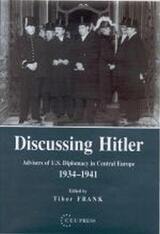
Discussing Hitler
Advisers of U.S. Diplomacy in Central Europe, 1934-41Tibor Frank
Central European University Press, 2003
Disease And Medical Care In The Mountain West
Essays On Region, History, And PracticeMartha L. Hildreth
University of Nevada Press, 1998
This collection of eight essays examines the health, disease, and medical care of the American West—an area flanked by the Rocky Mountains, Sierra Nevada, and Cascade Mountains. Topics include Mormons and the Thomsonian Movement in the nineteenth century, the silicosis epidemic in hardrock mining, Native American health, frontier nursing, and Chinese medicine.
Disease Maps
Epidemics on the GroundTom Koch
University of Chicago Press, 2011
In the seventeenth century, a map of the plague suggested a radical idea—that the disease was carried and spread by humans. In the nineteenth century, maps of cholera cases were used to prove its waterborne nature. More recently, maps charting the swine flu pandemic caused worldwide panic and sent shockwaves through the medical community. In Disease Maps, Tom Koch contends that to understand epidemics and their history we need to think about maps of varying scale, from the individual body to shared symptoms evidenced across cities, nations, and the world.
Disease Maps begins with a brief review of epidemic mapping today and a detailed example of its power. Koch then traces the early history of medical cartography, including pandemics such as European plague and yellow fever, and the advancements in anatomy, printing, and world atlases that paved the way for their mapping. Moving on to the scourge of the nineteenth century—cholera—Koch considers the many choleras argued into existence by the maps of the day, including a new perspective on John Snow’s science and legacy. Finally, Koch addresses contemporary outbreaks such as AIDS, cancer, and H1N1, and reaches into the future, toward the coming epidemics. Ultimately, Disease Maps redefines conventional medical history with new surgical precision, revealing that only in maps do patterns emerge that allow disease theories to be proposed, hypotheses tested, and treatments advanced.
Disease Prevention as Social Change
The State, Society, and Public Health in the United States, France, Great Britain, and CanadaConstance A. Nathanson
Russell Sage Foundation, 2007

Disease and Class
Tuberculosis and the Shaping of Modern North American SocietyGeorgina D. Feldberg
Rutgers University Press, 1995
Disease and Diplomacy
Weaponizing Medical Aid to Syrian Refugees in JordanSigrid Lupieri
University of Michigan Press, 2026
When millions of Syrians fled civil war after 2011, international donors and humanitarian organizations mobilized to provide assistance to neighboring countries. Focusing on Jordan—one of the world’s largest refugee hosting states—Disease and Diplomacy investigates how medical aid to refugees operates as an instrument of diplomacy and control within the global refugee system. It argues that health, far from being an apolitical humanitarian good, is a bargaining tool that states commodify to extract resources and concessions.
Drawing on years of field research, interviews, and policy analysis, the book shows how the Jordanian government, international donors, and humanitarian agencies turned healthcare for refugees into a tool for negotiating power, resources, and responsibility. In these cases, refugees, caught within these negotiations, often found their access to care determined not by medical need, but by political calculation. Developing the concept of the weaponization of medical aid, the book extends theories of migration diplomacy and refugee rentierism to show how global power dynamics shape who receives healthcare. The analysis identifies a self-reinforcing “crisis loop” that privileges short-term, highly visible responses while neglecting chronic and long-term needs. Disease and Diplomacy advances an interdisciplinary framework for understanding how humanitarian practices reinforce global inequalities and argues for more equitable approaches to refugee health and responsibility-sharing in the international system.
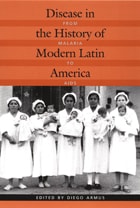
Disease in the History of Modern Latin America
From Malaria to AIDSDiego Armus, ed.
Duke University Press, 2003
Based on the idea that the meanings of sickness—and health—are contestable and subject to controversy, Disease in the History of Modern Latin America displays the richness of an interdisciplinary approach to social and cultural history. Examining diseases in Mexico, Brazil, Argentina, Colombia, Peru, and Bolivia, the contributors explore the production of scientific knowledge, literary metaphors for illness, domestic public health efforts, and initiatives shaped by the agendas of international agencies. They also analyze the connections between ideas of sexuality, disease, nation, and modernity; the instrumental role of certain illnesses in state-building processes; welfare efforts sponsored by the state and led by the medical professions; and the boundaries between individual and state responsibilities regarding sickness and health. Diego Armus’s introduction contextualizes the essays within the history of medicine, the history of public health, and the sociocultural history of disease.
Contributors. Diego Armus, Anne-Emanuelle Birn, Kathleen Elaine Bliss, Ann S. Blum, Marilia Coutinho, Marcus Cueto, Patrick Larvie, Gabriela Nouzeilles, Diana Obregón, Nancy Lays Stepan, Ann Zulawski