Results by title
28167 books match the query 'History' and 909 start with d
Dominican Crossroads
H. C. C. Astwood and the Moral Politics of Race-Making in the Age of EmancipationChristina Cecelia Davidson
Duke University Press, 2024
Domitian’s Rome and the Augustan Legacy
Edited by Raymond Marks and Marcello Mogetta
University of Michigan Press, 2021
The legacy of the Roman emperor Augustus and the culture of his age was profound and immediately evident after his death in 14 CE. His first four successors based their claims to rule on kinship with him, thus establishing the Julio-Claudian dynasty (14–68 CE), and plied an evolving form of the Principate, the political arrangement Augustus carved out for himself. His building and restoration programs gave the city an “Augustan” appearance that remained relatively unchanged throughout subsequent reigns. And, among literary luminaries of his age, figures such as Horace and Ovid left an indelible mark on the poetic practices of future generations while Virgil insinuated himself still more deeply into the Roman psyche. But it was after the reigns of Augustus’ own descendants, oddly enough, that we witness the most spirited and thoroughgoing engagement with the Augustan past; during the reign of the emperor Domitian, the third and last ruler of the subsequent Flavian dynasty (81–96 CE), there was a veritable Augustan renaissance.
This volume represents the first book-length treatment of the reception of Augustus and his age during the reign of Domitian. Its thirteen chapters, authored by an international group of scholars, offer readers a glimpse into the fascinating history and culture of Domitian’s Rome and its multifaceted engagement with the Augustan past. Combining material and literary cultural approaches and covering a diverse range of topics—art, architecture, literature, history, law—the studies in this volume capture the rich complexity of the Augustan legacy in Domitian’s Rome while also revising our understanding of Domitian’s own legacy. Far from being the cruel tyrant history has made him out to be, Domitian emerges as a studious, thoughtful cultivator of the Augustan past who helped shape an age that not only took inspiration from that past, but managed to rival it.
Don Isaac Abravanel
An Intellectual BiographyCedric Cohen-Skalli
Brandeis University Press, 2020
Don Isaac Abravanel (1437–1508) was one of the great inventors of Jewish modernity. A merchant, banker, and court financier, a scholar versed in both Jewish and Christian writings, a preacher and exegete, a prominent political actor in royal entourages and Jewish communities, Abravanel was one of the greatest leaders and thinkers of Iberian Jewry in the aftermath of the expulsion of 1492. This book, the first new intellectual biography of Abravanel in twenty years, depicts his life in three cultural milieus—Portugal, Castile, and post-expulsion Italy—and analyzes his major literary accomplishments in each period. Abravanel was a traditionalist with innovative ideas, a man with one foot in the Middle Ages and the other in the Renaissance. An erudite scholar, author of a monumental exegetical opus that is still studied today, and an avid book collector, he was a transitional figure, defined by an age of contradictions. Yet, it is these very contradictions that make him such an important personality for understanding the dawn of Jewish modernity.
Don't Act, Just Dance
The Metapolitics of Cold War CultureCatherine Gunther Kodat
Rutgers University Press, 2014

Don't Give Up the Ship!
Myths of the War of 1812Donald R. Hickey
University of Illinois Press, 2006
No longer willing to accept naval blockades, the impressment of American seamen, and seizures of American ships and cargos, the United States declared war on Great Britain. The aim was to frighten Britain into concessions and, if that failed, to bring the war to a swift conclusion with a quick strike at Canada. But the British refused to cave in to American demands, the Canadian campaign ended in disaster, and the U.S. government had to flee Washington, D.C., when it was invaded and burned by a British army.
By all objective measures, the War of 1812 was a debacle for the young republic, and yet it was celebrated as a great military triumph. The American people believed they had won the war and expelled the invader. Oliver H. Perry became a military hero, Francis Scott Key composed what became the national anthem and commenced a national reverence for the flag, and the U.S.S. Constitution, "Old Ironsides," became a symbol of American invincibility. Every aspect of the war, from its causes to its conclusion, was refashioned to heighten the successes, obscure the mistakes, and blur embarrassing distinctions, long before there were mass media or public relations officers in the Pentagon.
In this entertaining and meticulously researched book by America's leading authority on the War of 1812, Donald R. Hickey dispels the many misconcep-tions that distort our view of America's second war with Great Britain. Embracing military, naval, political, economic, and diplomatic analyses, Hickey looks carefully at how the war was fought between 1812 and 1815, and how it was remembered thereafter. Was the original declaration of war a bluff? What were the real roles of Canadian traitor Joseph Willcocks, Mohawk leader John Norton, pirate Jean Laffite, and American naval hero Lucy Baker? Who killed the Shawnee chief Tecumseh and who shot the British general Isaac Brock? Who actually won the war, and what is its lasting legacy? Hickey peels away fantasies and embellishments to explore why cer-tain myths gained currency and how they contributed to the way that the United States and Canada view themselves and each other.
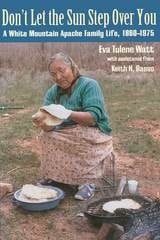
Don't Let the Sun Step Over You
A White Mountain Apache Family Life, 1860–1975Eva Tulene Watt with Assistance from Keith Basso
University of Arizona Press, 2004
In a voice that is spare, factual, and unflinchingly direct, Mrs. Watt reveals how the Western Apaches carried on in the face of poverty, hardship, and disease. Her interpretation of her people’s past is a diverse assemblage of recounted events, biographical sketches, and cultural descriptions that bring to life a vanished time and the men and women who lived it to the fullest. We share her and her family’s travels and troubles. We learn how the Apache people struggled daily to find work, shelter, food, health, laughter, solace, and everything else that people in any community seek.
Richly illustrated with more than 50 photographs, Don’t Let the Sun Step Over You is a rare and remarkable book that affords a view of the past that few have seen before—a wholly Apache view, unsettling yet uplifting, which weighs upon the mind and educates the heart.

Don't Look Away
Art, Nonviolence, and Preventive Publics in Contemporary EuropeBrianne Cohen
Duke University Press, 2023
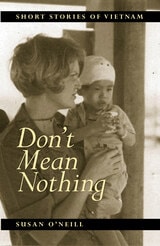
Don't Mean Nothing
Short Stories of VietnamSusan O'Neill
University of Massachusetts Press, 2004
For American nurses in Vietnam, and the men among whom they worked and lived, a common defense against the steady onslaught of dead and dying, wounded and maimed, was a feigned indifference—the irony of the powerless. With the assistance of alcohol, drugs, and casual sex, "Don't mean nothing" became their mantra, a means of coping with the other war—the war against total mental breakdown.
Each or these tales offers new and profound insight into the ways the war in Vietnam forever changed the lives of everyone who served there.
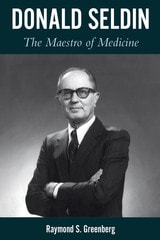
Donald Seldin
The Maestro of MedicineBy Raymond S. Greenberg
University of Texas Press, 2020
No one would have blamed Donald Seldin for running away. When he arrived at Southwestern Medical College in 1951, it was a collection of hastily repurposed military shacks creaking in the wind. On practically day one he became chair of the department of medicine—when the only other full-time professors departed.
By the time he stepped down thirty-six years later, Seldin had transformed a sleepy medical college into the University of Texas Southwestern Medical Center—a powerhouse of research and patient care and an anchor of the city of Dallas. Raymond Greenberg, a physician-scholar, tells Seldin's story of perseverance and intellectual triumph. Drawing on interviews with Seldin's trainees and colleagues—and on Seldin's own words—Greenberg chronicles the life of the Brooklyn boy who became one of Texas's foremost citizens and taught decades of men and women to heal. A pioneering nephrologist, Seldin devoted his career to developing the specialty; educating students, residents, and fellows; caring for patients; and nurturing basic research.
Seldin was a wildcatter in the best sense. He declined the comfortable prestige of Harvard and Yale and instead embraced a worthy challenge with an unflagging sense of mission. Graceful and richly detailed, The Maestro of Medicine captures an inspiring life of achievement and service.

Done in a Day
Telex from the Fall of SaigonElisa Tamarkin
University of Chicago Press, 2026
Named one of Lit Hub's most anticipated books of the year.
A searing reflection on the last day of the Vietnam War and the beginning of the end of foreign reporting in the nation’s daily newspapers.
Done in a Day turns on a single event: the April 30, 1975, departure of the last helicopter evacuating civilians from the rooftop of the US embassy in Saigon. Elisa Tamarkin’s interest in that helicopter begins with the fact that her stepfather, the Saigon bureau chief for the Chicago Daily News, was on it—the last American correspondent to leave Saigon as it fell. His report was filed from a naval ship on the South China Sea at a time when no other telexes were going through.
Now, more than fifty years later, Tamarkin offers a social and cultural autopsy of that moment, based in personal history but vividly unfolding amid the vast documentation of America’s obvious defeat, which never seemed to register even as it got out, in the writings of journalists and essayists, in the backchannel cables between US ambassador Graham Martin and Henry Kissinger, in congressional hearings, and in photographs of the war’s end. The story is also set against the imminent disappearance of war coverage in city newspapers—and of the newspapers themselves—once proud, in the words of the Chicago Daily News, of bringing readers the “literature of the day” that was “done in a day.”
Done in a Day braids history, criticism, and memoir to tell the paired stories of Saigon’s liberation and the demise of the news. The result is a haunting essay about all that ended in a day—and about what it means to recognize and to write about endings even as we live through them.
Don’t Come Back
Lina María Ferreira Cabeza-Vanegas
The Ohio State University Press, 2017
Don’t Come Back intermixes translations of Spanish adages and adaptations of major Colombian myths with personal essays about growing up amidst violence, magic, and an unyielding Andean sun. Home is place and time and people and language and history, and none of these are ever set in stone. Attempting to reconcile the irreconcilable and translate the untranslatable—to move smoothly and cohesively between culture, language, and place—Ferreira Cabeza-Vanegas is torn between spaces, between the aunt who begs her to return to Colombia and the mother who tells her, “There’s nothing here for you, Lina. Don’t come back.” Don’t Come Back is an exploration of home and identity that constantly asks, “If you really could go back, would you?”

Don’t Kill Your Baby
Public Health and the Decline of Breastfeeding in the Nineteenth and Twentieth CenturiesJacqueline H. Wolf
The Ohio State University Press, 2001
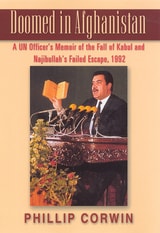
Doomed in Afghanistan
A U.N. Officer's Memoir of the Fall of Kabul and Najibullah's Failed Escape, 1992Corwin, Phillip
Rutgers University Press, 2002
To understand more deeply the tragic events of September 11, 2001, it is critical to know Afghanistan’s recent and turbulent past. Doomed inAfghanistan provides a first-hand account of how failed diplomacy led to an Islamic fundamentalist victory in a war-torn country, and subsequently, to a Taliban takeover and a home for Osama bin Laden’s Al Qaeda terrorist network.
In April of 1992, Phillip Corwin was part of a United Nations team in Afghanistan whose mission was to help ensure the transfer of power from the Soviet-installed communist regime of President Najibullah to an interim government (that would prepare for elections). Without the support of the Soviet Union, Najibullah’s regime crumbled, and he was convinced to resign in favor of a national unity government, with the understanding that he would be evacuated to a neutral country (India). Due to a series of miscalculations and machinations, the U.N.’s diplomatic mission failed. Kabul fell to groups of mujahiddin before Najibullah could be evacuated. The inability of the various mujahiddin factions to unite led to their eventual defeat by the Taliban, who four years later routed Najibullah from his safe haven at the U.N. compound, and executed him.
Corwin gives a vivid account of the seminal event of Najibullah’s failed evacuation and the frenzied negotiations that were unable to forestall the anarchy and chaos that followed.

Door County's Emerald Treasure
A History of Peninsula State ParkWilliam H. Tishler
University of Wisconsin Press, 2006
With its magnificent forests, bluffs, and shoreline and its breathtaking views of Green Bay and Lake Michigan, Door County’s Peninsula State Park is one of the Midwest’s most popular attractions. Established in 1909, it was Wisconsin’s second state park and a key to pioneering efforts to build a state park system that would be the envy of the nation.
Door County’s Emerald Treasure explores the rich history of the park land, from its importance to Native Americans and early European settlers through the twentieth century. Bill Tishler engagingly relates the role of conservationists and progressives in establishing the state park, its growing popularity for tourism and recreation, and efforts to protect the park’s resources from a variety of threats. Tishler also tells a larger story of Americans’ intimate relationship with the land around them and the challenge to create accessible public spaces that preserve the natural environment.
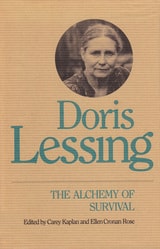
Doris Lessing
The Alchemy of SurvivalCarey Kaplan
Ohio University Press, 1988
Long neglected by the academic world because of her rejection of belletristic values and resistance to convenient literary taxonomy, Doris Lessing has nonetheless built an international following of serious, dedicated readers. Acknowledging the difficulties posed by the multiple dimensions of Lessing’s work, Kaplan and Rose have gathered eleven essays that address her artistic, philosophical, political, and psychological complexity, and so provide a welcome introduction to the extraordinary depth and diversity of this important contemporary novelist.
Lessing has been described as an “alchemical” writer, in that her work is directed toward changing people’s lives and perceptions rather than simply recording experience. Accordingly, the contributors examine her various postures and tactics for the purpose of discovering how the alchemical elements inform her various personae. Frederick C. Stern discusses Lessing’s commitment to radical humanist thought, while Carey Kaplan examines how Lessing’s imperialist past has shaped her futuristic fiction. Elizabeth Abel offers a feminist interpretation of the pattern of brother-sister incest in Lessing’s work, showing how Lessing has established Antigone as a female alternative to the Oedipal myth of male incest. Particularly insightful is Eve Bertelsen’s report of her interview with Lessing, demonstrating how Lessing’s often evasive style of adversarial dialogue works in concert with her refusal to be conveniently pigeonholed by academic analysis.
For those readers new to her work, Doris Lessing: The Alchemy of Survival will serve as a useful introduction to Lessing’s concerns and techniques. Those who have long admired her writing will find in this collection new keys to understanding Lessing’s philosophical, political, and psychological complexity.
Doris Lessing
The Poetics of ChangeGayle Greene
University of Michigan Press, 1997
Doris Lessing has been a chronicler of our age for nearly half a century, and a study of her writing career does not yield easy generalizations. Difficult though she is to categorize, she is always concerned with change, with a search for "something new" against "the nightmare repetition" of history. The feminist quest she articulated in The Children of Violence and The Golden Notebook entered the culture with the force of a new myth: these books changed lives. The Golden Notebook--together with such works as The Second Sex and The Feminine Mystique--raised the consciousness of a generation of women readers and played a major part in making the second wave of feminism. It is the power of Lessing's novels to change people's lives, the effect she had raising the consciousness of a generation of women and the effect she continues to have on young readers, that is the subject of this book.
Gayle Greene employs an eclectic range of approaches (psychoanalytic, Marxist, biographical, historical, intertextual, formalist, feminist) to shed new light on Lessing's remarkable achievement. She sees Lessing as a feminist writer, not in offering strong female role models who climb top the top of existing social structures, but in envisioning, and indeed helping to bring about, a transformation of those structures. Lessing critiques Western values of individualism, competition, and materialism in terms similar to those developed by feminism; and, in getting us to view our culture from without, in teaching us to read cultural constructs as systems, her novels perform the deconstructing and demystifying work of feminism.

Doris Salcedo
Edited by Julie Rodrigues Widholm and Madeleine Grynsztejn
University of Chicago Press, 2015
Published to accompany Salcedo’s first retrospective exhibition and the American debut of her major work Plegaria muda, Doris Salcedo is the most comprehensive survey of her sculptures and installations to date. In addition to featuring new contributions by respected scholars and curators, the book includes over one hundred color illustrations highlighting many pieces from Salcedo’s thirty-year career. Offering fresh perspectives on a vital body of work, Doris Salcedo is a testament to the power of one of today’s most important international artists.
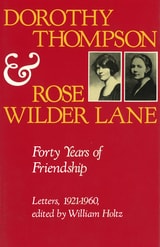
Dorothy Thompson and Rose Wilder Lane
Forty Years of Friendship, Letters, 1921-1960Edited by William Holtz
University of Missouri Press, 1991
The friendship between Dorothy Thompson and Rose Wilder Lane began in 1920 in the publicity office of the American Red Cross in Paris and continued until Thompson’s death in 1961. Although both women are today remembered primarily for their connections with others —Thompson as the wife of Sinclair Lewis, and Lane as the daughter of Laura Ingalls Wilder, author of the “Little House” books —each was remarkable in her own right.
Both women had a vital engagement with life that led them in fearless pursuit of experience. In 1939, Thompson appeared on the cover of Time, which judged her second only to Eleanor Roosevelt among influential women of the day. Typical of Lane were her travels through the mountains of Albania, the deserts of Syria, and Soviet Georgia in the 1920s and her visit as a journalist to Vietnam in 1965 at the age of seventy-eight.
The correspondence of these two talented and articulate women reveals their personal concerns, social ideas, and political/economic philosophies and how they changed over time. Their letters tell the story of the first generation of women to come of age during the twentieth century, as they tried to cope with problems that women still face today. Along with the letters themselves, Holtz has included annotations and footnotes that provide biographical information, as well as explaining personal and topical references.

Dostoevsky's Idiot
Dialogue and the Spiritually Good LifeBruce A. French
Northwestern University Press, 2001
In three chapters, French takes up in turn the narrator and narrative points of view, the author’s use of inserted narratives, and three modes of interaction French calls Monologue, Dialogue, and Dialogical Living.

Double Duty in the Civil War
The Letters of Sailor and Soldier Edward W. BaconEdited by George S. Burkhardt
Southern Illinois University Press, 2009
In 1861 at the age of eighteen, Edward Woolsey Bacon, a Yale student and son of well-known abolitionist minister Leonard Bacon, left his home in New Haven, Connecticut, to fight for the United States. Over the next four years Bacon served in both the Union navy and army, which gave him a sweeping view of the Civil War. His postings included being a captain’s clerk on the USS Iroquois, a hospital clerk in his hometown, a captain in the 29th Connecticut Infantry (Colored), and a major in the 117th U.S. Colored Infantry, and he described these experiences in vibrant letters to his friends and family. Historian George S. Burkhardt has compiled these letters, as well as Bacon’s diary in the impressive Double Duty in the Civil War: The Letters of Sailor and Soldier Edward W. Bacon.
Bacon tells of hunting Confederate commerce raiders on the high seas, enduring the tedium of blockade duty, and taking part in riverine warfare on the Mississippi. He recalls sweating in South Carolina as an infantry officer during drill and picket duty, suffering constant danger in the battlefield trenches of Virginia, marching victoriously on fallen Richmond, and tolerating the boredom of occupation duty in Texas.
His highly entertaining letters shed new light on naval affairs and reveal a close-knit family life. The narrative of his duty with black troops is especially valuable, since few first-hand accounts from white officers of the U.S. Colored Troops exist. Furthermore, his beliefs about race, slavery, and the Union cause were unconventional for the time and stand in contrast to those held by many of his contemporaries.
Double Duty in the Civil War is filled with lively descriptions of the men Bacon met and the events he experienced. With Burkhardt’s careful editing and useful annotations, Bacon’s letters and diary excerpts give rare insight into areas of the Civil War that have been neglected because of a lack of available sources. Given the scarcity of eyewitness testimonies to navy life and life in African American regiments, this book is a rarity indeed.

Double V
The Civil Rights Struggle of the Tuskegee AirmenLawrence P. Scott
Michigan State University Press, 1994
On April 12, 1945, the United States Army Air Force arrested 101 of its African American officers. They were charged with disobeying a direct order from a superior officer—a charge that could carry the death penalty upon conviction. They were accused of refusing to sign an order that would have placed them in segregated housing and recreational facilities. Their plight was virtually ignored by the press at the time, and books written about the subject did not detail the struggle these aviators underwent to win recognition of their civil rights.
The central theme of Double V is the promise held out to African American military personnel that service in World War II would deliver to them a double victory—a "double V"—over tyranny abroad and racial prejudice at home. The book's authors, Lawrence P. Scott and William M. Womack Sr., chronicle for the first time, in detail, one of America's most dramatic failures to deliver on that promise. In the course of their narrative, the authors demonstrate how the Tuskegee airmen suffered as second-class citizens while risking their lives to serve their country. Among the contributions made by this work is a detailed examination of how 101 Tuskegee airmen, by refusing to live in segregated quarters, triggered one of the most significant judicial proceedings in U.S. military history. Double V uses oral accounts and heretofore unused government documents to portray this little-known struggle by one of America's most celebrated flying units.
In addition to providing background material about African American aviators before World War II. the authors also demonstrate how the Tuskegee airmen's struggle foretold dilemmas faced by the civil rights movement in the second half of the 20th century. Double V is destined to become an important contribution in the rapidly growing body of civil rights literature.

Double Visions, Double Fictions
The Doppelgänger in Japanese Film and LiteratureBaryon Tensor Posadas
University of Minnesota Press, 2018
A fresh take on the dopplegänger and its place in Japanese film and literature—past and present
Since its earliest known use in German Romanticism in the late 1700s, the word Doppelgänger (double-walker) can be found throughout a vast array of literature, culture, and media. This motif of doubling can also be seen traversing historical and cultural boundaries. Double Visions, Double Fictions analyzes the myriad manifestations of the doppelgänger in Japanese literary and cinematic texts at two historical junctures: the interwar period of the 1920s and 1930s and the present day.
According to author Baryon Tensor Posadas, the doppelgänger marks the intersection of the historical impact of psychoanalytic theory, the genre of detective fiction in Japan, early Japanese cinema, and the cultural production of Japanese colonialism. He examines the doppelgänger’s appearance in the works of Edogawa Rampo, Tanizaki Jun’ichiro, and Akutagawa Ryunosuke, as well as the films of Tsukamoto Shin’ya and Kurosawa Kiyoshi, not only as a recurrent motif but also as a critical practice of concepts. Following these explorations, Posadas asks: What were the social, political, and material conditions that mobilized the desire for the doppelgänger? And how does the dopplegänger capture social transformations taking place at these historical moments?
Double Visions, Double Fictions ultimately reveals how the doppelgänger motif provides a fascinating new backdrop for understanding the enmeshment of past and present.

Double-Consciousness/Double Bind
Theoretical Issues in Twentieth-Century Black LiteratureSandra Adell
University of Illinois Press, 1994
Doubly Chosen
Jewish Identity, the Soviet Intelligentsia, and the Russian Orthodox ChurchJudith Deutsch Kornblatt
University of Wisconsin Press, 2004
Doubly Chosen provides the first detailed study of a unique cultural and religious phenomenon in post-Stalinist Russia—the conversion of thousands of Russian Jewish intellectuals to Orthodox Christianity, first in the 1960s and later in the 1980s. These time periods correspond to the decades before and after the great exodus of Jews from the Soviet Union. Judith Deutsch Kornblatt contends that the choice of baptism into the Church was an act of moral courage in the face of Soviet persecution, motivated by solidarity with the values espoused by Russian Christian dissidents and intellectuals. Oddly, as Kornblatt shows, these converts to Russian Orthodoxy began to experience their Jewishness in a new and positive way.
Working primarily from oral interviews conducted in Russia, Israel, and the United States, Kornblatt underscores the conditions of Soviet life that spurred these conversions: the virtual elimination of Judaism as a viable, widely practiced religion; the transformation of Jews from a religious community to an ethnic one; a longing for spiritual values; the role of the Russian Orthodox Church as a symbol of Russian national culture; and the forging of a new Jewish identity within the context of the Soviet dissident movement.

Doubt, Atheism, and the Nineteenth-Century Russian Intelligentsia
Victoria Frede
University of Wisconsin Press, 2011
The autocratic rule of both tsar and church in imperial Russia gave rise not only to a revolutionary movement in the nineteenth century but also to a crisis of meaning among members of the intelligentsia. Personal faith became the subject of intense scrutiny as individuals debated the existence of God and the immortality of the soul, debates reflected in the best-known novels of the day. Friendships were formed and broken in exchanges over the status of the eternal. The salvation of the entire country, not just of each individual, seemed to depend on the answers to questions about belief.
Victoria Frede looks at how and why atheism took on such importance among several generations of Russian intellectuals from the 1820s to the 1860s, drawing on meticulous and extensive research of both published and archival documents, including letters, poetry, philosophical tracts, police files, fiction, and literary criticism. She argues that young Russians were less concerned about theology and the Bible than they were about the moral, political, and social status of the individual person. They sought to maintain their integrity against the pressures exerted by an autocratic state and rigidly hierarchical society. As individuals sought to shape their own destinies and searched for truths that would give meaning to their lives, they came to question the legitimacy both of the tsar and of Russia’s highest authority, God.

Down Ballot
How a Local Campaign Became a National Referendum on AbortionPatrick Wohl
University of Illinois Press, 2024
In 1990, a suburban Chicago race for the Republican Party nomination for state representative unexpectedly became a national proxy battle over abortion in the United States. But the hard-fought primary also illustrated the overlooked importance of down-ballot contests in America’s culture wars. Patrick Wohl offers the dramatic account of a rollercoaster campaign that, after attracting political celebrities and a media circus, came down to thirty-one votes, a coin toss to determine the winner, and a recount fight that set a precedent for how to count dimpled chads. As the story unfolds, Wohl provides a rare nuts-and-bolts look at an election for state office from its first days through the Illinois Supreme Court decision that decided the winner--and set the stage for a decisive 1992 rematch.
A compelling political page-turner, Down Ballot takes readers behind the scenes of a legendary Illinois election.

Down The Jersey Shore
Russell Roberts and Rich Youmans
Rutgers University Press, 1993
Summer visitors and year-round residents alike are sure to discover Jersey Shore lore that captures their fancy in this entertaining account of the people, places, and events that have shaped New Jersey’s famous shoreline.
From ghost stories and the comic misadventures of the early Miss America Pageant to the dynamics of the changing coastline and poignant portraits of traditional crafts workers, Russell Roberts and Rich Youmans have chronicled the fascinating history and heritage of the New Jersey Shore. In this book you’ll meet the luminaries who’ve frequented the Shore—from President Ulysses Grant strolling through Long Branch to Grace Kelly learning to surf at Ocean City. You’ll find out why the boardwalk was invented, and also why early ones were removable. Join the authors as they pay tribute to the Shore’s forgotten inventors, including Simon Lake, who some consider the true father of the modern submarine. Relive the Jersey Shore’s role in wartime and learn the story of the mysterious Nazi submarine sunken off of Point Pleasant Beach. Read about Lucy the Margate Elephant, as a well as her two long-gone “cousins.”
Discover all this and more as Roberts and Youmans explore the vast uncharted heritage of the New Jersey Shore.

Down and Dirty Down South
Politics and the Art of RevengeRoger Glasgow
Butler Center for Arkansas Studies, 2016
While pursuing a race for district prosecutor in the 1970s, Glasgow had run afoul of the local political machine. The machine later decided to teach Glasgow a lesson even though he’d lost the race. Down and Dirty Down South is Glasgow’s story of how he attempted to clear his name and also track down the people who had set him up for charges of smuggling illegal drugs into the United States.
Down and Out in America
The Origins of HomelessnessPeter H. Rossi
University of Chicago Press, 1990

Down and Out in the New Economy
How People Find (or Don’t Find) Work TodayIlana Gershon
University of Chicago Press, 2017
Finding a job used to be simple. Now . . . well, it’s complicated. In today’s economy, you can’t just be an employee looking to get hired—you have to market yourself as a business, one that can help another business achieve its goals.
That’s a radical transformation in how we think about work and employment, says Ilana Gershon. And with Down and Out in the New Economy, she digs deep into that change and what it means, not just for job seekers, but for businesses and our very culture. In telling this story, Gershon covers all parts of the employment spectrum: she interviews hiring managers about how they assess candidates; attends personal branding seminars; talks with managers at companies around the United States to suss out regional differences—like how Silicon Valley firms look askance at the lengthier employment tenures of applicants from the Midwest. And she finds that not everything has changed: though the technological trappings may be glitzier, in a lot of cases, who you know remains more important than what you know.
Rich in the voices of people deeply involved with all parts of the employment process, Down and Out in the New Economy offers a snapshot of the quest for work today—and a pointed analysis of its larger meaning.
Down by the Riverside
A South Carolina Slave CommunityCharles Joyner
University of Illinois Press, 2009
Joyner recovers an entire lost society and way of life from the letters, diaries, and memoirs of the plantation whites and their guests, from quantitative analysis of census and probate records, and above all from the folklore and oral history of the enslaved Americans. His classic reconstruction of daily life in All Saints Parish is an inspiring testimony to the ingenuity and solidarity of a people.
This anniversary edition of Joyner's landmark study includes a new introduction in which the author recounts his process of writing the book, reflects on its critical and popular reception, and surveys the past three decades of scholarship on the history of enslaved people in the United States.
Down in the Dumps
Place, Modernity, American DepressionJani Scandura
Duke University Press, 2007
An interpretive bricolage that draws on an unlikely archive of 1930s detritus—office memos, scribbled manuscripts, scrapbooks, ruined photographs, newspaper clippings, glass eyes, incinerated stage sets, pulp novels, and junk washed ashore—Down in the Dumps escorts its readers through Reno’s divorce factory of the 1930s, where couples from across the United States came to quickly dissolve matrimonial bonds; Key West’s multilingual salvage economy and its status as the island that became the center of an ideological tug-of-war between the American New Deal government and a politically fraught Caribbean; post-Renaissance Harlem, in the process of memorializing, remembering, grieving, and rewriting a modernity that had already passed; and Studio-era Hollywood, Nathanael West’s “dump of dreams,” in which the introduction of sound in film and shifts in art direction began to transform how Americans understood place-making and even being itself. A coda on Alcatraz and the Pentagon brings the book into the present, exploring how American Depression comes to bear on post-9/11 America.
Down on Mahans Creek
A History of an Ozarks NeighborhoodBenjamin G. Rader
University of Arkansas Press, 2017
In Down on Mahans Creek, Benjamin Rader provides a fascinating look at a neighborhood in the Missouri Ozarks from the early nineteenth to the mid-twentieth century. He explores the many ways in which Mahans Creek, though remote, was never completely isolated or self-sufficient. The residents were deeply affected by the Civil War, and the arrival of the railroad and the timber boom in the 1890s propelled the community into modern times, creating a more fast-paced and consumer-oriented way of life and a new moral sensibility. During the Great Depression the creek’s residents returned to some of the older values for survival. After World War II, modern technology changed their lives again, causing a movement away from the countryside and to the nearby small towns.
Down on Mahans Creek tells the dynamic story of this distinctive neighborhood navigating the push and pull of the old and new ways of life.

Down on the Killing Floor
Black and White Workers in Chicago's Packinghouses, 1904-54Rick Halpern
University of Illinois Press, 1997

Down the River
or Practical Lessons Under The Code DuelloGeorge W Hooper
University of Alabama Press, 2007

Down to Earth
Satellite Technologies, Industries, and CulturesParks, Lisa
Rutgers University Press, 2012
Down to Earth presents the first comprehensive overview of the geopolitical maneuvers, financial investments, technological innovations, and ideological struggles that take place behind the scenes of the satellite industry. Satellite projects that have not received extensive coverage—microsatellites in China, WorldSpace in South Africa, SiriusXM, the failures of USA 193 and Cosmos 954, and Iridium—are explored. This collection takes readers on a voyage through a truly global industry, from the sites where satellites are launched to the corporate clean rooms where they are designed, and along the orbits and paths that satellites traverse. Combining a practical introduction to the mechanics of the satellite industry, a history of how its practices and technologies have evolved, and a sophisticated theoretical analysis of satellite cultures, Down to Earth opens up a new space for global media studies.
Downriver Detroit
The Working Class, the Environment, and the Bonds of PlaceLisa M. Fine
University of Illinois Press, 2026
Lisa M. Fine examines important moments in the ongoing efforts of the area’s citizens to create a humane and habitable environment. Her analysis shows how people preserved wetlands and the river by working through sportsmen’s organizations, appealing to state agencies, and forming grassroots movements. Fueled by enduring connections to place, local unions fought a proposed nuclear power plant in the 1950s. Years later, steel workers facing the steamroller of deindustrialization tried to preserve their communities by purchasing their own company. The ties that bind gave a unique character to activism in the Downriver region, challenging stereotypes of working-class attitudes toward the environment.
A creative merger of labor and environmental history, Downriver Detroit shows that working people have a right to live in and protect the places they love.

Downtown America
A History of the Place and the People Who Made ItAlison Isenberg
University of Chicago Press, 2005
Downtown America cuts beneath the archetypal story of downtown's rise and fall and offers a dynamic new story of urban development in the United States. Moving beyond conventional narratives, Alison Isenberg shows that downtown's trajectory was not dictated by inevitable free market forces or natural life-and-death cycles. Instead, it was the product of human actors—the contested creation of retailers, developers, government leaders, architects, and planners, as well as political activists, consumers, civic clubs, real estate appraisers, even postcard artists. Throughout the twentieth century, conflicts over downtown's mundane conditions—what it should look like and who should walk its streets—pointed to fundamental disagreements over American values.
Isenberg reveals how the innovative efforts of these participants infused Main Street with its resonant symbolism, while still accounting for pervasive uncertainty and fears of decline. Readers of this work will find anything but a story of inevitability. Even some of the downtown's darkest moments—the Great Depression's collapse in land values, the rioting and looting of the 1960s, or abandonment and vacancy during the 1970s—illuminate how core cultural values have animated and intertwined with economic investment to reinvent the physical form and social experiences of urban commerce. Downtown America—its empty stores, revitalized marketplaces, and romanticized past—will never look quite the same again.
A book that does away with our most clichéd approaches to urban studies, Downtown America will appeal to readers interested in the history of the United States and the mythology surrounding its most cherished institutions.
A Choice Oustanding Academic Title.
Winner of the 2005 Ellis W. Hawley Prize from the Organization of American Historians.
Winner of the 2005 Lewis Mumford Prize for Best Book in American
Planning History.
Winner of the 2005 Historic Preservation Book Price from the University of Mary Washington Center for Historic Preservation.
Named 2005 Honor Book from the New Jersey Council for the Humanities.
Downtown Juárez
Underworlds of Violence and AbuseHoward Campbell
University of Texas Press, 2021
At least 200,000 people have died in Mexico’s so-called drug war, and the worst suffering has been in Ciudad Juárez, across the border from El Paso, Texas. How did it get so bad? After three decades studying that question, Howard Campbell doesn’t believe there is any one answer. Misguided policies, corruption, criminality, and the borderland economy are all factors. But none of these reasons explain how violence in downtown Juárez has become heartbreakingly “normal.”
A rigorous yet moving account, Downtown Juárez is informed by the sex workers, addicts, hustlers, bar owners, human smugglers, migrants, and down-and-out workers struggling to survive in an underworld where horrifying abuses have come to seem like the natural way of things. Even as Juárez’s elite northeast section thrives on the profits of multinational corporations, and law-abiding citizens across the city mobilize against crime and official malfeasance, downtown’s cantinas, barrios, and brothels are tyrannized by misery.
Campbell’s is a chilling perspective, suggesting that, over time, violent acts feed off each other, losing their connection to any specific cause. Downtown Juárez documents this banality of evil—and confronts it—with the stories of those most affected.
Doña María's Story
Life History, Memory, and Political IdentityDaniel James
Duke University Press, 2000
Doña María’s testimony is grounded in both the local context (based on the author’s thirteen years of historical and ethnographic research in Berisso) and a broader national narrative. In this way, it differs from the dominant genre of women’s testimonial literature, and much recent ethnographic work in Latin America, which have often neglected historical and communal contextualization in order to celebrate individual agency and self-construction. James examines in particular the ways that gender influences Doña María’s representation of her story. He is careful to acknowledge that oral history challenges the historian to sort through complicated sets of motivations and desires—the historian’s own wish to uncover “the truth” of an informant’s life and the interviewee’s hope to make sense of her or his past and encode it with myths of the self. This work is thus James’s effort to present his research and his relationship with Doña María with both theoretical sophistication and recognition of their mutual affection.
While written by a historian, Doña María’s Story also engages with concerns drawn from such disciplines as anthropology, cultural studies, and literary criticism. It will be especially appreciated by those involved in oral, Latin American, and working-class history.

Dr Radcliffe's Library
The Story of the Radcliffe Camera in OxfordStephen Hebron
Bodleian Library Publishing, 2014
Drawing on maps, plans, photographs, and drawings, Dr Radcliffe’s Library tells the fascinating story of the building’s creation over more than thirty years. Early designs for the Radcliffe Camera were drawn by the brilliant architect Nicholas Hawksmoor, who conceived the shape so recognizable today: a great rotunda topped by the University of Oxford’s only dome. From there, it would take decades to acquire and clear the site between the University Church of St Mary’s and the Bodleian. After Hawksmoor’s death, the project was taken on by the Scottish architect James Gibbs who refined the design and supervised the library’s construction.
Published to accompany an exhibition opening in November at the Bodleian Library, Dr Radcliffe’s Library tells the fascinating story of the making of this architectural masterpiece.

Dr. America
The Lives of Thomas A. Dooley, 1927-1961James T. Fisher
University of Massachusetts Press, 1997
This book chronicles the life of Tom Dooley, the American doctor whose much-publicized exploits in Vietnam and Laos during the 1950s helped lay the ideological groundwork for the U.S. military intervention a decade later. The scion of an upper-middle-class St. Louis family, Dooley was an enormously complex and fascinating individual. He was a devoutly religious Roman Catholic as well as a self-styled playboy socialite, a devoted physician to the poor and a tireless propagandist for the “Vietnam Lobby,” a shameless self-promoter and a closeted homosexual, a victim of Navy persecution and a beneficiary of CIA support. Dooley first gained notoriety as a young Navy doctor charged with overseeing the evacuation of Catholic refugees from North Vietnam in the wake of the 1954 Geneva Accords. His celebrity grew after his book Deliver Us from Evil, a fervently anticommunist account of his experiences, was serialized in Reader's Digest. By the end of the decade, as his name became associated (albeit mistakenly) with a ballad popularized by the Kingston Trio, he had achieved the status of “America's first pop star saint.” In addition to exposing the roots of the Vietnam War, Dooley's story illuminates a broad range of developments in post-World War II United States culture—from the “Americanization” of Catholicism to the rise of the mass media.
Dr. Benjamin Church, Spy
A Case of Espionage on the Eve of the American RevolutionJohn A. Nagy
Westholme Publishing, 2013
Dr. Calhoun's Mousery
The Strange Tale of a Celebrated Scientist, a Rodent Dystopia, and the Future of HumanityLee Alan Dugatkin
University of Chicago Press, 2024
A bizarre and compelling biography of a scientist and his work, using rodent cities to question the potential catastrophes of human overpopulation.
It was the strangest of experiments. What began as a utopian environment, where mice had sumptuous accommodations, had all the food and water they could want, and were free from disease and predators, turned into a mouse hell. Science writer and animal behaviorist Lee Alan Dugatkin introduces readers to the peculiar work of rodent researcher John Bumpass Calhoun. In this enthralling tale, Dugatkin shows how an ecologist-turned-psychologist-turned-futurist became a science rock star embedded in the culture of the 1960s and 1970s. As interest grew in his rodent cities, Calhoun was courted by city planners and his work was reflected in everything from Tom Wolfe’s hard-hitting writing to the children’s book Mrs. Frisby and the Rats of NIMH. He was invited to meetings with the Royal Society and the pope and taken seriously when he proposed a worldwide cybernetic brain—a decade before others made the internet a reality.
Readers see how Calhoun’s experiments—rodent apartment complexes like “Mouse Universe 25”—led to his concept of “behavioral sinks” with real effects on public policy discussions. Overpopulation in Calhoun’s mouse (and rat) complexes led to the loss of sex drive, the absence of maternal care, and a class of automatons that included “the beautiful ones,” who spent their time grooming themselves while shunning socialization. Calhoun—and those who followed his work—saw the collapse of this mouse population as a harbinger of the ill effects of an overpopulated human world.
Drawing on previously unpublished archival research and interviews with Calhoun’s family and former colleagues, Dugatkin offers a riveting account of an intriguing scientific figure. Considering Dr. Calhoun’s experiments, he explores the changing nature of scientific research and delves into what the study of animal behavior can teach us about ourselves.

Dr. Charles David Spivak
A Jewish Immigrant and the American Tuberculosis MovementJeanne Abrams
University Press of Colorado, 2009
Born in Russia in 1861, Spivak immigrated to the United States in 1882 and received his medical degree from Philadelphia's Jefferson Medical College by 1890. In 1896, his wife's poor health brought them to Colorado. Determined to find a cure, Spivak became one of the most charismatic and well-known leaders in the American Tuberculosis Movement. His role as director of Denver's Jewish Consumptives' Relief Society sanatorium allowed his personal philosophies to strongly influence policies. His unique blend of Yiddishkeit, socialism, and secularism - along with his belief in treating the "whole" patient - became a model for integrating medical, social, and rehabilitation services that was copied across the country.
Not only a national leader in the crusade against tuberculosis but also a luminary in the American Jewish community, Dr. Charles Spivak was a physician, humanitarian, writer, linguist, journalist, administrator, social worker, ethnic broker, and medical, public health, and social crusader. Abrams's biography will be a welcome addition to anyone interested in the history of medicine, Jewish life in America, or Colorado history.

Dr. David Murray
Superintendent of Education in the Empire of Japan, 1873-1879Duke, Benjamin
Rutgers University Press, 2018
Benjamin Duke has compiled this comprehensive biography of David Murray to showcase Murray’s work, both in assisting around 100 samurai students in their studies at Rutgers, and in his unprecedented role in early Japanese-American relations. This fascinating story uncovers a little-known link between Rutgers University and Japan, and it is the only book to conclude that Rutgers made a greater contribution to the development of modern education in the early Meiji Era than any other non-Japanese college or university in the world.
Dr. Harriot Kezia Hunt
Nineteenth-Century Physician and Woman’s Rights AdvocateMyra C. Glenn
University of Massachusetts Press, 2018
Harriot Kezia Hunt was a pioneer in a number of ways. The first woman to establish a successful medical practice in the United States, she began seeing patients in Boston in 1835 and promoted a new method of treatment by listening to women's troubles or their “heart histories.” Her unsuccessful efforts to attend lectures at Harvard's Medical School galvanized her activism in the woman's rights movement. During the 1850s she played a prominent role in the annual woman's rights conventions and was the first woman in Massachusetts to publicly protest the injustice of taxing propertied women while denying them the franchise.
In this first comprehensive, full-length biography of Hunt, Myra C. Glenn shows how this single woman from a working-class Boston home became a successful physician and noted reformer, illuminating the struggle for woman's rights and the fractious and gendered nature of medicine in antebellum America.
Dr. Joe Bell
Model for Sherlock HolmesEly M. Liebow
University of Wisconsin Press, 1982
A distinguished physician and professor of medicine at Edinburgh University, and a forensic expert for the British Crown, Joseph Bell was well known for his remarkable powers of observation and deduction. In what would become true Sherlockian fashion, he had the ability to deduce facts about his patients from otherwise unremarkable details. In one instance recounted by Arthur Conan Doyle himself—and similar to Sherlock Holmes's own observations in "The Greek Interpreter"—Bell took little time to determine that one of his patients had recently served in the army, a non-commissioned officer discharged from his Highland regiment stationed in Barbados:
“The man was a respectful man, but did not remove his hat. They do not in the army, but he would have learned civilian ways had he been long discharged. He has an air of authority and he is obviously Scottish. As to Barbados, his complaint is elephantitis, which is West Indian and not British.”
Based on extensive research into the life of Bell and including tantalizing accounts of the connections between Bell and Conan Doyle, this biography is required reading for anyone interested in Victorian medicine, in the history of detective fiction, and in Sherlock Holmes and Dr. Watson.
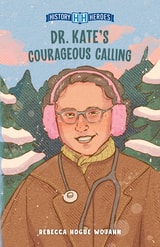
Dr. Kate’s Courageous Calling
Rebecca Hogue Wojahn
Wisconsin Historical Society Press, 2027
Meet the trailblazing doctor whose determination, compassion, and vision helped to save lives and inspired a generation to make history.
As a child in the late 1800s, young Kate Pelham knew she wanted to have a career when she grew up, even though that wasn’t expected of women at the time. After losing her mother and then her fiancée at a young age, she decided to dedicate her life to becoming a doctor—a career path then largely closed to women. But Kate would not be deterred, and before long she was known throughout the Wisconsin Northwoods as, simply, Dr. Kate.
Written for ages 8–11, Dr. Kate’s Courageous Calling shares the remarkable story of a woman who challenged expectations, transformed her community, and inspired thousands through a lifetime of service. Readers will journey alongside Kate Pelham-Newcomb as she traverses snowy back roads—sometimes on snowshoes—to care for patients. They will discover how, as the local health officer, she established community health standards and helped improve water and milk sanitation throughout the Northwoods region.
The story reaches an unforgettable climax with the extraordinary Million Penny Campaign, led by local high school students—many of whom Dr. Kate had delivered as babies—to raise money for a desperately needed hospital. Their efforts attracted contributions from tens of thousands of people around the world, bringing in more than enough to build the Lakeland Memorial Hospital in Woodruff, Wisconsin.
Dr. Kate’s Courageous Calling is a story of perseverance, leadership, sacrifice, and a community that joined together to make a difference. Combining women’s history, local history, and a remarkable true story of civic engagement, this book celebrates a pioneering physician who healed her neighbors and inspired the world.
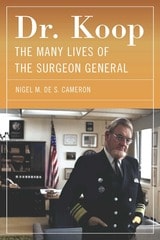
Dr. Koop
The Many Lives of the Surgeon GeneralNigel M. de S. Cameron
University of Massachusetts Press, 2025
The first full biography of Reagan's famous Surgeon General, who put science before politics—cutting smoking by 25%, leading the fight against AIDS, and shocking both liberals and conservatives on abortion.
When Ronald Reagan chose C. Everett Koop to be Surgeon General of the United States in 1981, liberal politicians, women's groups, and even the public health community opposed the nomination because of his conservative social views and strong anti-abortion beliefs. By the time he left office in 1989, the same people who had vilified him as “Dr. Kook” were singing his praises, and many conservative politicians and activists who had championed his nomination were criticizing him as a traitor. He had also become “the only surgeon general [who was] a household name,” according to the Associated Press, because of his ubiquitous media exposure around the HIV/AIDS crisis, his unique look, and his savvy with the press. How had Koop remade himself and this once major government office, which sounded grand but in the 1960s had been stripped to a minor advisory role?
As Nigel M. de S. Cameron shows, Koop was, above all, guided in his decisions by his unwavering physician’s commitment to saving lives. Even in the face of political pressures and what many expected to be his personal beliefs, he focused on science and public health. On smoking, abortion, and AIDS he openly defied Republican politicians and alienated New Right conservatives because his reading of the science did not support their ideologies. It was this adherence to science, health, and office that led him to refuse to campaign on abortion, seek compromise on the disabled “Baby Doe” case, relentlessly go after Big Tobacco, and finally reach out to the gay community as AIDS and fear of AIDS exploded. Both supporters and detractors consistently misjudged him.
This first full biography of Koop draws on thousands of documents and hundreds of interviews with family, friends, and colleagues to tell the story of the precocious boy from Brooklyn who was already the world’s most celebrated pediatric surgeon when he became Surgeon General and one of the most recognizable public figures in late-20th century America. Koop remains a sterling example—to both left and right—of how public officials should conduct themselves.