Results by title
3258 books match the query 'Art' and 125 start with d
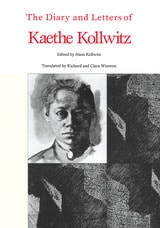
Diary and Letters of Kaethe Kollwitz
Kaethe Kollwitz
Northwestern University Press, 1988
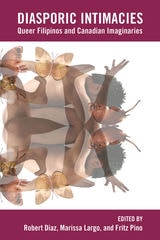
Diasporic Intimacies
Queer Filipinos and Canadian ImaginariesEdited by Robert Diaz, Marissa Largo, and Fritz Pino
Northwestern University Press, 2018
Addressing a wide range of issues beyond the academy, the authors present a rich and under-studied archive of personal reflections, in-depth interviews, creative works, and scholarly essays. Their trandsdisciplinary approach highlights the need for queer, transgressive, and utopian practices that render visible histories of migration, empire building, settler colonialism, and globalization.
Timely, urgent, and fascinating, Diasporic Intimacies offers an accessible entry point for readers who seek to pursue critically engaged community work, arts education, curatorial practice, and socially inflected research on sexuality, gender, and race in this ever-changing world.

Dickey Chapelle Under Fire
Photographs by the First American Female War Correspondent Killed in ActionJohn Garofolo
Wisconsin Historical Society Press, 2026
Striking photographs and stories from more than two decades on the frontlines by a groundbreaking photojournalist—and the first female American war correspondent to be killed in action.
In 1941, twenty-two-year-old Georgette "Dickey" Chapelle sold her first photo essay to Look magazine. A year later, with World War II underway, she was photographing American soldiers in combat training in Panama. By the end of the war, she had captured the devastation at Iwo Jima and Okinawa, and in the ensuing decades, Dickey and her camera were on the scene at many of the world’s hotspots—from Cuba and the Dominican Republic to Algeria and Lebanon to Vietnam and Laos. Dickey Chapelle Under Fire exposes her remarkable story and shares over 150 stunning images from her extraordinary career as a photojournalist.
In the male-dominated world of war journalism, Chapelle fought to be taken seriously. She eventually earned the respect of many of her male colleagues and broke down barriers for future generations of female journalists. She embedded herself with military units on frontlines around the globe, capturing not only the horrors of war but also the camaraderie and everyday routines of service men and women.
Always one to follow the action, Chapelle traveled with Algerian rebels across the North African desert and with Fidel Castro through the jungles of Cuba. She spent two months in a Hungarian prison after being caught smuggling aid to refugees fleeing a Soviet invasion. Beginning in 1961, Chapelle set her lens and viewfinder on Southeast Asia, capturing the growing conflict there, until she was killed while on patrol with marines in Vietnam in April 1965—making her the first female American war correspondent to be killed in action.
For twenty-five years, Chapelle's photographs graced the pages of National Geographic, the National Observer, Life, and other major publications. Despite her tragic end, Chapelle’s tenacity, courage, and compassion shine throughout her work, highlighting the human impact of war while revealing the larger stories beyond the battlefield. Her legacy lives on through this powerful collection.
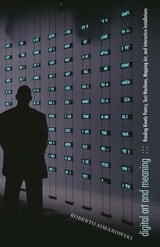
Digital Art and Meaning
Reading Kinetic Poetry, Text Machines, Mapping Art, and Interactive InstallationsRoberto Simanowski
University of Minnesota Press, 2010
Digital Art and Meaning offers close readings of varied examples from genres of digital art such as kinetic concrete poetry, computer-generated text, interactive installation, mapping art, and information sculpture. For instance, Simanowski deciphers the complex meaning of words that not only form an image on a screen but also react to the viewer’s behavior; images that are progressively destroyed by the human gaze; text machines generating nonsense sentences out of a Kafka story; and a light show above Mexico City’s historic square, created by Internet users all over the world.
Simanowski combines these illuminating explanations with a theoretical discussion that employs art philosophy and history to achieve a deeper understanding of each particular example of digital art and, ultimately, of the genre as a whole.
Digital Cinema
Stephen Prince
Rutgers University Press, 2019
Stephen Prince offers a clear, concise account of how digital cinema both extends longstanding traditions of filmmaking and challenges some fundamental assumptions about film. It is essential reading for anyone interested in understanding how movies are shot, produced, distributed, and consumed in the twenty-first century.

Digital Dynamics in Nordic Contemporary Art
Edited by Tanya Toft Ag
Intellect Books, 2018
Offering an in-depth exploration of art’s contingent evolution with technology and digital culture, this book goes far beyond familiar depictions of Nordic aesthetics in art. It explores art’s role and inquiries in response to changing sociopolitical realities in the welfare state and in the wider world. First-hand perspectives of pioneering and pivotal artists form the basis of chapters penned by leading scholars and curators of Nordic art. Digital Dynamics in Nordic Contemporary Art recasts the Nordic art context in an expanding digital condition and reveals horizontal ways to write its histories.
Over the past few decades, the Nordic region has witnessed large shifts in its political, social and international outlook. Meanwhile, its art, commonly described as introverted, contemplative and wild, is also undergoing changes. As technology embeds itself further into the contemporary art scene, there is a renewed need to examine the role of art in society and everyday life, and to consider how the digitalization of art has tackled socio-political realities, locally and in the wider world. Digital Dynamics in Nordic Contemporary Art includes a collection of testimonials from 78 artists, connected to Nordic art, who employ concepts and/or tools relating to the digital in their practice. Their statements form the basis of the essays in Part 2, penned by leading scholars affiliated with the Nordic art context, which inquire into the digital influences on contemporary art, with particular attention paid to the national and international Nordic socio-political context. Landscapes, nature, minimalism, melancholia--this book examines how these traditional Nordic tropes hold up in the growing field of digital contemporary art, and asks: to what extent have digital dynamics been adopted into the imaginaries and practices of Nordic artists?
Chapters by Tanya Toft Ag, Jamie Allen, Laura Beloff, Budhaditya Chattopadhyay, Jonatan Habib Engqvist, Bernhard Garnicnig, Elizabeth Jochum, Ulla Angkjær Jørgensen, Jens Tang Kristensen, Mads Dejbjerg Lind, Björn Norberg, Margrét Elísabet Ólafsdóttir, Jøran Rudi, Lorella Scacco, Morten Søndergaard, Mette-Marie Zacher Sørensen, and Stahl Stenslie.
Tanya Toft Ag (editor) is a curator and scholar specializing in media and digital art and its urban implications.Affected by technology and globalization, the Nordic region is experiencing large shifts in its socio-political conditions and international outlook today. As digital dynamics affect life worlds, contemporary artists are making new inquiries in response to the changing Nordic context. As a result of these ever-evolving circumstances, conditions and motivations for making art change as well. As technology and digital culture become more deeply embedded in the contemporary art scene, there is a renewed need to examine the role of art in society and everyday life, and to consider how the digital inspires artists to evolve and tackle socio-political realities, locally and in the wider world.
Digital Memory and the Archive
Wolfgang Ernst
University of Minnesota Press, 2012
In the popular imagination, archives are remote, largely obsolete institutions: either antiquated, inevitably dusty libraries or sinister repositories of personal secrets maintained by police states. Yet the archive is now a ubiquitous feature of digital life. Rather than being deleted, e-mails and other computer files are archived. Media software and cloud storage allow for the instantaneous cataloging and preservation of data, from music, photographs, and videos to personal information gathered by social media sites.
In this digital landscape, the archival-oriented media theories of Wolfgang Ernst are particularly relevant. Digital Memory and the Archive, the first English-language collection of the German media theorist’s work, brings together essays that present Ernst’s controversial materialist approach to media theory and history. His insights are central to the emerging field of media archaeology, which uncovers the role of specific technologies and mechanisms, rather than content, in shaping contemporary culture and society.
Ernst’s interrelated ideas on the archive, machine time and microtemporality, and the new regimes of memory offer a new perspective on both current digital culture and the infrastructure of media historical knowledge. For Ernst, different forms of media systems—from library catalogs to sound recordings—have influenced the content and understanding of the archive and other institutions of memory. At the same time, digital archiving has become a contested site that is highly resistant to curation, thus complicating the creation and preservation of cultural memory and history.
Digital Music Videos
Shaviro, Steven
Rutgers University Press, 2017
As these videos have proliferated online, they have become more widely accessible than ever before. In Digital Music Videos, Steven Shaviro examines the ways that music videos interact with and change older media like movies and gallery art; the use of technologies like compositing, motion control, morphing software, and other digital special effects in order to create a new organization of time and space; how artists use music videos to project their personas; and how less well known musicians use music videos to extend their range and attract attention.
Surveying a wide range of music videos, Shaviro highlights some of their most striking innovations while illustrating how these videos are creating a whole new digital world for the music industry.
Digital Visual Culture
Theory and PracticeEdited by Anna Bentkowska-Kafel, Trish Cashen, Hazel Gardiner
Intellect Books, 2009
Digital Visual Culture presents the latest research into the relationship between theory and practice across digital media and technology in the visual arts and investigates the challenges of contemporary research and art curation, particularly in regard to new media artworks. The contributors to this volume discuss the impact of technological advances on visual art and the new art practices that are developing as a result. Many aspects of new interdisciplinary and collaborative practices are considered, such as net art and global locative environments, , and installations that are themselves performance, or games that often take place simultaneously online and in reality. Digital Visual Culture is an important addition to the ongoing discussion surrounding postmodern art practice in art and digital media.

Dimensions of the Americas
Art and Social Change in Latin America and the United StatesShifra M. Goldman
University of Chicago Press, 1994
Goldman's extensive introduction provides an up-to-date chronology of modern Latin American art; a history of "social art history" in the United States; and synopses of recent theoretical and historical writings by major scholars from Mexico, Cuba, Brazil, Peru, Uruguay, Chile, and the United States. In her essays, Goldman discusses a vast array of topics including: the influence of the Mexican muralists on the American continent; the political and artistic significance of poster art and printmaking in Cuba, Puerto Rico, and among Chicanos; the role of women artists such as Guatemalan painter Isabel Ruiz; and the increasingly important role of politics and multinational businesses in the art world of the 1970s and 1980s. She explores the reception of Latin American and Latino art in the United States, focusing on major historical exhibits as well as on exhibits by artists such as Chilean Alfredo Jaar and Argentinian Leandro Katz. Finally, she examines the significance of nationalist and ethnic themes in Latin American and Latino art.
Written in a straightforward style equally accessible to specialists, students, and general audiences, this book will become essential reading for anyone interested in understanding the importance of Latin American art and the complex dynamic shaping it.
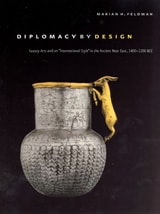
Diplomacy by Design
Luxury Arts and an "International Style" in the Ancient Near East, 1400-1200 BCEMarian H. Feldman
University of Chicago Press, 2006
Marian Feldman's Diplomacy by Design examines the profound connection between art produced during this period and its social context, revealing inanimate objects as catalysts—or even participants—in human dynamics. Feldman's fascinating study shows the ways in which the exchange of these works of art actively mediated and strengthened political relations, intercultural interactions, and economic negotiations. Previous studies of this international style have focused almost exclusively on stylistic attribution at the expense of social contextualization. Written by a specialist in ancient Near Eastern art and archaeology who has excavated and traveled extensively in this area of the world, Diplomacy by Design provides a much broader consideration of the symbolic power of material culture and its centrality in the construction of human relations.
Directing
Virginia Wright Wexman
Rutgers University Press, 2017
The latest volume in the Behind the Silver Screen series, this collection provides the first comprehensive overview of how directing, as both an art and profession, has evolved in tandem with changing film industry practices. Each chapter is written by an expert on a different period of Hollywood, from the silent film era to today’s digital filmmaking, providing in-depth examinations of key trends like the emergence of independent production after World War II and the rise of auteurism in the 1970s. Challenging the myth of the lone director, these studies demonstrate how directors work with a multitude of other talented creative professionals, including actors, writers, producers, editors, and cinematographers.
Directing examines a diverse range of classic and contemporary directors, including Orson Welles, Tim Burton, Cecil B. DeMille, Steven Soderbergh, Spike Lee, and Ida Lupino, offering a rich composite picture of how they have negotiated industry constraints, utilized new technologies, and harnessed the creative contributions of their many collaborators throughout a century of Hollywood filmmaking.
Directors
From Stage to Screen and Back AgainSusan Beth Lehman
Intellect Books, 2013
Directory of World Cinema
AfricaEdited by Blandine Stefanson and Sheila Petty
Intellect Books, 2014
With a film industry divided by linguistic heritage, African directors do not have the luxury of producing comedies, thrillers, horror films, or even love stories, except perhaps as DVDs that do not travel far outside their country of production. Instead, African directors tend to cover serious sociopolitical ground, even under the cover of comedy, in the hopes of finding funds outside Africa. Contributors to this volume draw on filmic representations of the continent to consider the economic role of women, rural exodus, economic migration, refugees, and diasporas, culture, religion, and magic as well as representations of children, music, languages, and symbols.
A survey of national cinemas in one volume, DirectoryofWorldCinema: Africa is a necessary addition to the bookshelf of any cinephile and world traveler.
Directory of World Cinema
American HollywoodEdited by Lincoln Geraghty
Intellect Books, 2011
With its sprawling celebrity homes, the Walk of Fame, and the iconic sign on the hill, Hollywood is truly the land of stars. Glamorous and larger than life, many of the most memorable motion pictures of all time have emanated from its multimillion-dollar film industry, which exports more films per capita than that of any other nation.
Directory of World Cinema: American Hollywood lays out the cinematic history of Tinseltown—the industry, the audiences, and, of course, the stars—highlighting important thematic and cultural elements throughout. Profiles and analyses of many of the industry’s most talented and prolific directors give insights into their impact on Hollywood and beyond. A slate of blockbuster successes—and notable flops—are here discussed, providing insight into the ever-shifting aesthetic of Hollywood’s enormous global audience.
User-friendly and concise yet containing an astonishing amount of information, Directory of World Cinema: American Hollywood shows how truly indispensable the Hollywood film industry is and provides a fascinating account of its cultural and artistic significance as it marks its centennial.
Directory of World Cinema
American Hollywood 2Edited by Lincoln Geraghty
Intellect Books, 2015
Directory of World Cinema
American Independent 3Edited by John Berra
Intellect Books, 2016
Directory of World Cinema
ArgentinaEdited by Beatriz Urraca and Gary M. Kramer
Intellect Books, 2014
Directory of World Cinema
Argentina 2Edited by Beatriz Urraca and Gary M. Kramer
Intellect Books, 2016
Directory of World Cinema
BritainEdited by Emma Bell and Neil Mitchell
Intellect Books, 2012
Directory of World Cinema
Britain 2Edited by Neil Mitchell
Intellect Books, 2014
A complementary edition rather than an update of its predecessor, the book offers essays on war and family films, as well as on LGBT cinema and representations of disability in British films. Contributors consider established British directors such as Ken Loach and Danny Boyle as well as newcomer Ben Wheatley, who directed the fabulously strange A Field in England. This volume also shines the spotlight on the British Film Institute and its role in funding, preservation, and education in relation to British cinema.
A must read for any fan of film, the history of the United Kingdom, or international artistic traditions, Directory of World Cinema: Britain 2 will find an appreciative audience both within and outside academia.
Directory of World Cinema
China 2Edited by Gary Bettinson
Intellect Books, 2014
A survey of a vibrant—and expanding—industry, Directory of World Cinema: China 2 examines, among other themes, China’s desire for success and fulfillment in the United States, as well as the extensive history of representing China—and the Chinese in America—on US movie screens. With contributions from some of the leading academics in the field, this volume will be essential reading for all fans of Chinese film.
Directory of World Cinema
FranceEdited by Tim Palmer and Charlie Michael
Intellect Books, 2013
Artistic, intellectual, and appreciably avant-garde, the French film industry has, perhaps more than any other national cinema, been perennially at the center of international filmmaking. With its vigorous business and wide-ranging film culture, France has also been home historically to some of the most influential filmmakers and movements – and, indeed, the very first motion picture was screened in Paris in 1895.
This volume addresses the great directors and key artistic movements, but also ventures beyond these well-established films and figures, broadening the canon through an examination of many neglected but intriguing French films. Framing essays explore the salient stylistic elements, cultural contexts, and the various conceptions of cinema in France, from avant-gardes to filmmaking by women, from documentary and realism to the Tradition of Quality, as well as genres like comedy, crime film, and horror. Illustrated by screen shots, film reviews by leading international experts offer original approaches to both overlooked titles and acknowledged classics. Readers wishing to explore particular topics in greater depth will be grateful for the book’s reading recommendations and comprehensive filmography.
A visually engaging journey through one of the most dynamic, variegated, and idiosyncratic film industries, Directory of World Cinema: France is a must-have for Francophiles and cinema savants.
Directory of World Cinema
IranEdited by Parviz Jahed
Intellect Books, 2012
Iranian cinema has an extraordinary history that has been marked by religion and ever-shifting political, economic, and social environments. This addition to Intellect’s Directory of World Cinema series turns the spotlight on the award-winning cinema of that nation, with particular attention to the major movements, historical turning points, and prominent figures that have helped shape it. A wide range of genres are presented, including comedy, Film Farsi, new wave, children’s films, art house film, and women’s cinema. For the film studies scholar, students working on alternative or national cinema, or for all those who love Persian cinema and wish to learn more, Directory of World Cinema: Iran will be an essential companion to this prolific and prominent film industry.
Directory of World Cinema
Japan 3Edited by John Berra
Intellect Books, 2015
Though the spotlight is on the filmmakers, this new volume continues to consider a wide range of genres associated with Japanese cinema, including animation, contemporary independent cinema, J-Horror, the New Wave, period drama, science fiction, and yakuza.
Like its predecessors, Directory of World Cinema: Japan 3 endeavors to move scholarly criticism of Japanese film out of the academy and into the hands of cinephiles the world over. This volume will be warmly welcomed by those with an interest in Japanese cinema that extends beyond its established names to equally remarkable filmmakers who have yet to receive such rigorous attention.
Directory of World Cinema
Russia 2Edited by Birgit Beumers
Intellect Books, 2015
Directory of World Cinema
ScotlandEdited by Bob Nowlan and Zach Finch
Intellect Books, 2015
Directory of World Cinema: Scotland provides an introduction to many of Scottish cinema’s most important and influential themes and issues, films, and filmmakers, while adding to the ongoing discussion concerning how to make sense of Scotland’s cinematic traditions and contributions. Chapters on filmmakers range from Murray Grigor to Ken Loach, and Gaelic filmmaking, radical and engaged cinema, production, finance, and documentary are just a few of the topics explored. Film reviews range from popular box office hits such as Braveheart, and Trainspotting to lesser known but equally engaging independent and lower budget productions, such as Shell and Orphans. This book is both a stimulating and accessible resource for a wide range of readers interested in Scottish film.
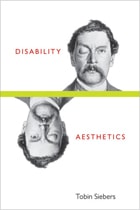
Disability Aesthetics
Tobin Siebers
University of Michigan Press, 2010
"Disability Aesthetics ambitiously redefines both 'disability' and 'aesthetics,' showing us that disability is central not only to modern art but also to the way we apprehend (and interact with) bodies and buildings. Along the way, Tobin Siebers revisits the beautiful and the sublime, 'degenerate' art and 'disqualified' bodies, culture wars and condemned neighborhoods, the art of Marc Quinn and the fiction of Junot Díaz---and much, much more. Disability Aesthetics is a stunning achievement, a must-read for anyone interested in how to understand the world we half create and half perceive."
---Michael Bérubé, Paterno Family Professor in Literature, Pennsylvania State University
"Rich with examples of the disabled body in both historical and modern art, Tobin Siebers's new book explores how disability problematizes commonly accepted ideas about aesthetics and beauty. For Siebers, disability is not a pejorative condition as much as it is a form of embodied difference. He is as comfortable discussing the Venus de Milo as he is discussing Andy Warhol. Disability Aesthetics is a prescient and much-needed contribution to visual & critical studies."
---Joseph Grigely, Professor of Visual and Critical Studies, The School of the Art Institute of Chicago
Disability Aesthetics is the first attempt to theorize the representation of disability in modern art and visual culture. It claims that the modern in art is perceived as disability, and that disability is evolving into an aesthetic value in itself. It argues that the essential arguments at the heart of the American culture wars in the late twentieth century involved the rejection of disability both by targeting certain artworks as "sick" and by characterizing these artworks as representative of a sick culture. The book also tracks the seminal role of National Socialism in perceiving the powerful connection between modern art and disability. It probes a variety of central aesthetic questions, producing a new understanding of art vandalism, an argument about the centrality of wounded bodies to global communication, and a systematic reading of the use put to aesthetics to justify the oppression of disabled people. In this richly illustrated and accessibly written book, Tobin Siebers masterfully demonstrates the crucial roles that the disabled mind and disabled body have played in the evolution of modern aesthetics, unveiling disability as a unique resource discovered by modern art and then embraced by it as a defining concept.
Tobin Siebers is V. L. Parrington Collegiate Professor of English Language and Literature and Art and Design at the University of Michigan. His many books include Disability Theory and The Subject and Other Subjects: On Ethical, Aesthetic, and Political Identity.
A volume in the series Corporealities: Discourses of Disability
Disability Arts and Culture
Methods and ApproachesEdited by Petra Kuppers
Intellect Books, 2019
What does it mean to approach disability-focused cultural production and consumption as generative sites of meaning-making? Disability Arts and Culture seeks the answer to this question and more in an exploration of disability studies within the arts and beyond. In this collection, international scholars and practitioners use ethnographic and participatory action research approaches alongside textual and discourse analysis to discover how disability figures into our contemporary world. Chapters explore deaf theater productions, representations of disability on screen, community engagement projects, disabled bodies in dance, and more, in a comprehensive overview of disability studies that will benefit both practitioner and scholar.
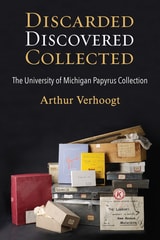
Discarded, Discovered, Collected
The University of Michigan Papyrus CollectionArthur Verhoogt
University of Michigan Press, 2017
Discourse, Figure
lyotard
University of Minnesota Press, 2019
Choice Outstanding Academic Title
Jean-François Lyotard is recognized as one of the most significant French philosophers of the twentieth century. Although nearly all of his major writing has been translated into English, one important work has until now been unavailable. Discourse, Figure is Lyotard’s thesis. Provoked in part by Lacan’s influential seminars in Paris, Discourse, Figure distinguishes between the meaningfulness of linguistic signs and the meaningfulness of plastic arts such as painting and sculpture. Lyotard argues that because rational thought is discursive and works of art are inherently opaque signs, certain aspects of artistic meaning such as symbols and the pictorial richness of painting will always be beyond reason’s grasp.
Discovering Design
Explorations in Design StudiesEdited by Richard Buchanan and Victor Margolin
University of Chicago Press, 1995
The contributors (Gianfranco Zaccai, Albert Borgmann, Richard Buchanan, Augusto Morello, Tufan Orel, Nigel Cross, Victor Margolin, Langdon Winner, Carl Mitcham, Tony Fry, and Ezio Manzini) focus on three broad themes that form a sequence of fundamental issues: how to shape design as a subject matter, how to distinguish the activity of designing in the complex world of action, and how to address the basic questions of value and responsibility that persistently arise in the discussion and practice of design. The editors' introduction provides a useful overview of these questions and offers a multidisciplinary framework for design studies. The essays discuss such topics as the relation of aesthetics to technology, the place of design in social action, the role of the consumer in design decisions, and the need for ethical practice in contemporary design. Manzini's concluding essay shows how the issue of ethics should connect responsible behavior to decisions made every day in the manufacture of objects.
Discrimination by Design
A Feminist Critique of the Man-Made EnvironmentLeslie Kanes Weisman
University of Illinois Press, 1992
-- Women's Review of Books
"A readable account of the force of male dominance in the built environment. . . . Those looking to this book for a clearer vision of the changes that need to be made in the organization and design of housing, work, and public space to foster gender equality will not be disappointed."
-- Journal of Planning Education and Research
"A pioneering work that will pave new territory not only for feminists but all those who are prepared to rethink environmental and societal issues."
-- Choice
Disfiguring
Art, Architecture, ReligionMark C. Taylor
University of Chicago Press, 1992
Dismantling the Nation
Contemporary Art in ChileEdited by Florencia San Martín, Carla Macchiavello Cornejo, and Paula Solimano
Amherst College Press, 2023
Disordering the Establishment
Participatory Art and Institutional Critique in France, 1958–1981Lily Woodruff
Duke University Press, 2020
Display, Distribute, Disrupt
Contemporary Moving Image PracticesEdited by Wolfgang Brückle and Fred Truniger
Diaphanes, 2023
Over the last two decades, the field of audiovisual media has changed dramatically. Until recently, there was only a small number of technologies, distribution channels were few, and moving images were largely limited to cinemas, televisions, galleries, or art museums. Also, both the producers and the audiences of such content clearly identified as human beings. Those days are over.
The digitization of image production and distribution ushered in a massive disruption to the traditional landscape of the moving image that had existed since the advent of the audiovisual industry. Touching on discussions such as child producers, the marketing interests of big corporations, and the origins of new media formats and practices, Display, Distribute, Disrupt maps the new conditions for creative work in the ever-widening sphere of audiovisual media.
Displaying Death and Animating Life
Human-Animal Relations in Art, Science, and Everyday LifeJane C. Desmond
University of Chicago Press, 2016
Desmond, a pioneer in the field of animal studies, builds the book on a number of case studies. She conducts research on-site at major museums, taxidermy conventions, pet cemeteries, and even at a professional conference for writers of obituaries. She goes behind the scenes at zoos, wildlife clinics, and meetings of pet cemetery professionals. We journey with her as she meets Kanzi, the bonobo artist, and a host of other animal-artists—all of whom are preparing their artwork for auction. Throughout, Desmond moves from a consideration of the visual display of unindividuated animals, to mourning for known animals, and finally to the marketing of artwork by individual animals. The first book in the new Animal Lives series, Displaying Death and Animating Life is a landmark study, bridging disciplines and reaching across divisions from the humanities and social sciences to chart new territories of investigation.
Dissensual Subjects
Memory, Human Rights, and Postdictatorship in Argentina, Brazil, and UruguayAndrew C. Rajca
Northwestern University Press, 2018
Through an engaging exploration of the concept of “never again” (nunca más/nunca mais) and close analysis of photography exhibits, audiovisual installations, and other art forms in spaces of cultural memory, the book explores how aesthetic interventions can suggest alternative ways of framing human rights subjectivity beyond the rhetoric of liberal humanitarianism. The book visits sites of memory, two of which functioned as detention and torture centers during dictatorships, to highlight the tensions between the testimonial tenor of permanent exhibits and the aesthetic interventions of temporary installations there. Rajca thus introduces perspectives that both undo common understandings of authoritarian violence and its effects as well as reconfigure who or what are made visible as subjects of memory and human rights in postdictatorship countries.
Dissensual Subjects offers much to those concerned with numerous interlocking fields: memory, human rights, political subjectivity, aesthetics, cultural studies, visual culture, Southern Cone studies, postdictatorship studies, and sites of memory.
Dissident Practices
Brazilian Women Artists, 1960s–2020sClaudia Calirman
Duke University Press, 2023
Dissident Syria
Making Oppositional Arts Officialmiriam cooke
Duke University Press, 2007
A renowned scholar of Arab cultures, cooke spent six months in Syria during the mid-1990s familiarizing herself with the country’s literary scene, particularly its women writers. While she was in Damascus, dissidents told her that to really understand life under Hafiz Asad, she had to speak with playwrights, filmmakers, and, above all, the authors of “prison literature.” She shares what she learned in Dissident Syria. She describes touring a sculptor’s studio, looking at the artist’s subversive work as well as at pieces commissioned by the government. She relates a playwright’s view that theater is unique in its ability to stage protest through innuendo and gesture. Turning to film, she shares filmmakers’ experiences of making movies that are praised abroad but rarely if ever screened at home. Filled with the voices of writers and artists, Dissident Syria reveals a community of conscience within Syria to those beyond its borders.
Distant Early Warning
Marshall McLuhan and the Transformation of the Avant-GardeAlex Kitnick
University of Chicago Press, 2021
Kitnick builds the story of McLuhan’s entanglement with artists by carefully drawing out the connections among McLuhan, his theories, and the artists themselves. The story is packed with big names: Marcel Duchamp, Niki de Saint Phalle, Jasper Johns, Andy Warhol, Nam June Paik, and others. Kitnick masterfully weaves this history with McLuhan’s own words and his provocative ideas about what art is and what artists should do, revealing McLuhan’s influence on the avant-garde through the confluence of art and theory. The illuminating result sheds light on new aspects of McLuhan, showing him not just as a theorist, or an influencer, but as a richly multifaceted figure who, among his many other accolades, affected multiple generations of artists and their works. The book finishes with Kitnick overlaying McLuhan’s ethos onto the state of contemporary and post-internet art. This final channeling of McLuhan is a swift and beautiful analysis, with a personal touch, of art’s recent transgressions and what its future may hold.
Distinction and Denial
Race, Nation, and the Critical Construction of the African American Artist, 1920-40Mary Ann Calo
University of Michigan Press, 2007
Distinctionand Denial challenges conventional theories of race and art by examining the role early twentieth-century art critics played in marginalizing African American artists. Mary Ann Calo dispels the myth of a unified African American artistic tradition through an engaging study of the germinal writing of Alain Locke and other significant critics of the era, who argued that African American artists were both a diverse group and a constituent element of America’s cultural center. By documenting the effects of the “Negro aesthetic” on African American artists working in the interwar years, Distinctionand Denial shows that black artistic production existed between the claims of a distinctly African American tradition and full inclusion into American modernist culture—never fully inside or outside the mainstream.
“A major contribution to the scholarship of African American artists in the inter-war period. With scrupulous research and probing analyses, Calo’s study enables scholars, students, and those interested in the Harlem Renaissance to grasp the intellectual debates, institutional support, and art world promotion that advanced an emerging cohort of African American artists.”
—Patricia Hills, Boston University
“A careful, thorough, historically grounded study that builds a new and significant argument challenging conventional histories of African American art. Sure to become indispensable to any scholarly discussion of American art or African American cultural studies.”
—Helen Langa, American University
Mary Ann Calo is Professor of Art History and Director of the Institute for the Creative and Performing Arts at Colgate University. She is author of Bernard Berenson and the Twentieth Century and editor of Critical Issues in American Art: A Book of Readings.
Diversity
The History of a Wandering ValueLorraine Daston
Central European University Press, 2026

Divine Presence in Spain and Western Europe 1500–1960
Visions, Religious Images and PhotographsWilliam A. Christian Jr.
Central European University Press, 2012
Doing Nothing
James Currie
Duke University Press, 2026
Don Gummer
Don Gummer
The Artist Book Foundation, 2021
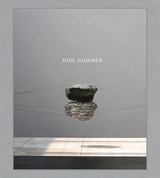
The trajectory of Don Gummer's career as a sculptor began in New York City in the late 1970s with his wall reliefs of painted wood, carefully layered geometric works exhibiting a strong architectural influence. Moving beyond wood to stone, bronze, stainless steel, aluminum, and glass as his primary materials, his artworks evolved into subtly inventive freestanding sculptures, often of monumental scale, that exhibit his unfailing attention to craftsmanship and detail.
In a 2001 interview with Peter Plagens, American artist and art critic, Gummer described his interest in sculpture as "the recontextualization of natural phenomena, of unaltered things brought into aesthetic balance by choosing and placing." Using balance, proportion, and his unique sense of harmony, the artist is able to make durable materials seem almost buoyant. Negative space becomes an intrinsic element in his work, imparting a sense that his exquisite, seemingly permanent forms are ultimately as fleeting as any of nature's creations would be. The Artist Book Foundation is delighted to present Don Gummer, a new monograph on the artist and his highly acclaimed body of work.
Don't Act, Just Dance
The Metapolitics of Cold War CultureCatherine Gunther Kodat
Rutgers University Press, 2014
Don't Look Away
Art, Nonviolence, and Preventive Publics in Contemporary EuropeBrianne Cohen
Duke University Press, 2023
Doris Salcedo
Edited by Julie Rodrigues Widholm and Madeleine Grynsztejn
University of Chicago Press, 2015
Published to accompany Salcedo’s first retrospective exhibition and the American debut of her major work Plegaria muda, Doris Salcedo is the most comprehensive survey of her sculptures and installations to date. In addition to featuring new contributions by respected scholars and curators, the book includes over one hundred color illustrations highlighting many pieces from Salcedo’s thirty-year career. Offering fresh perspectives on a vital body of work, Doris Salcedo is a testament to the power of one of today’s most important international artists.