Results by title
8113 books match the query 'Literary Criticism' and 287 start with d
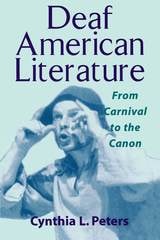
Deaf American Literature
From Carnival to the CanonCynthia Peters
Gallaudet University Press, 2000
“The moment when a society must contend with a powerful language other than its own is a decisive point in its evolution. This moment is occurring now in American society.” Cynthia Peters explains precisely how American Sign Language (ASL) literature achieved this moment by tracing its past and predicting its future in Deaf American Literature: From Carnival to the Canon.
Peters connects ASL literature to the literary canon with the archetypal notion of carnival as “the counterculture of the dominated.” Throughout history, carnivals have been opportunities for the “low,” disenfranchised elements of society to displace their “high” counterparts. Citing the Deaf community’s long tradition of “literary nights” and festivals like the Deaf Way, Peters recognizes similar forces at work in the propagation of ASL literature. The agents of this movement, Deaf artists and ASL performers—“Tricksters,” as Peters calls them—jump between the two cultures and languages. Through this process, they create a synthesis of English literary content reinterpreted in sign language, which raises the profile of ASL as a distinct art form in itself.
In this trailblazing study, Peters applies her analysis to the craft’s landmark works, including Douglas Bullard’s novel Islay and Ben Bahan’s video-recorded narrative Bird of a Different Feather. Deaf American Literature, the only work of its kind, is its own seminal moment in the emerging discipline of ASL literary criticism.

Deaf American Prose, 1830-1930
Jennifer L. Nelson
Gallaudet University Press, 2013
This new anthology showcases the work of Deaf writers during a critical formative period in their history. From 1830 to 1930, these writers conveyed their impressions in autobiographies, travel narratives, romances, non-fiction short stories, editorials, descriptive pieces, and other forms of prose. The quick, often evocative snapshots and observations featured here, many explicitly addressing deafness and sign language, reflect their urgency to record Deaf American life at this pivotal time. Using sensory details, dialogue, characterization, narrative movement, and creative prose, these writers emphasized the capabilities of Deaf people to counter events that threatened their way of life.
The volume opens with “The Orphan Mute,” a sentimental description of the misfortune of deaf people written by John Robertson Burnet in 1835. Less than 50 years later, James Denison, the only Deaf delegate at the 1880 Convention of Instructors of the Deaf in Milan, published his “impressions” that questioned the majority’s passage of a strict oralism agenda. In 1908, Thomas Flowers wrote “I was a little human plant,” a paean to education without irony despite the concurrent policy banning African Americans from attending Gallaudet College. These and a host of other Deaf writers—Laurent Clerc, Kate Farlow, Edmund Booth, Laura Redden Searing, Freda W. Bauman, Vera Gammon, Isaac H. Benedict, James Nack, John Carlin, Joseph Mount and many more—reveal the vitality and resilience of Deaf writers in an era of wrenching change.

Deaf American Prose, 1980–2010
Kristen C. Harmon
Gallaudet University Press, 2012
In Deaf life, the personal narrative holds sway because most Deaf individuals recall their formative years as solitary struggles to understand and to be understood. Few deaf people in the past related their stories in written form, relying instead on a different kind of “oral” tradition, that of American Sign Language. During the last several decades, however, a burgeoning bilingual deaf experience has ignited an explosion of Deaf writing that has pushed the potential of ASL-influenced English to extraordinary creative heights. Deaf American Prose: 1980–2010 presents a diverse cross-section of stories, essays, memoirs, and novel excerpts by a remarkable cadre of Deaf writers that mines this rich, bilingual environment.
The works in Deaf American Prose frame the Deaf narrative in myriad forms: Tom Willard sends up hearing patronization in his wicked satire “What Exactly Am I Supposed to Overcome?” Terry Galloway injects humor in “Words,” her take on the identity issues of being hard of hearing rather than deaf or hearing. Other contributors relate familiar stories about familiar trials, such as Tonya Stremlau’s account of raising twins, and Joseph Santini’s short story of the impact on Deaf and hearing in-laws of the death of a son. The conflicts are well-known and heartfelt, but with wrinkles directly derived from the Deaf perspective.
Several of the contributors expand the Deaf affect through ASL glosses and visual/spatial elements. Sara Stallard emulates ASL on paper through its syntax and glosses, and by eliminating English elements, a technique used in dialogue by Kristen Ringman and others. Deaf American Prose features the work of other well-known contemporary Deaf writers, including co-editor Kristen Harmon, Christopher Jon Heuer, Raymond Luczak, and Willy Conley. The rising Deaf writers presented here further distinguish the first volume in this new series by thinking in terms of what they can bring to English, not what English can bring to them.

Dear Charles Dickens, Love, South LA
Literature, Place, and BelongingJacqueline Jean Barrios
University of Iowa Press, 2026
Jacqueline Jean Barrios confronts the cultural challenges that big canonical books pose to new generations of readers. Instead of erasing the differences between Dickens’s implied audiences and his current ones, Barrios demonstrates how youth can serve as the visionaries who bridge the gap. By placing literature in everyday surroundings, students at any school and in any location can learn from the embodied and the poetic and even question the universalism that masks unexamined reverence for the Western canon.

Dear Friend
Rainer Maria Rilke and Paula Modersohn-BeckerEric Torgersen
Northwestern University Press, 2000
Dear Incomprehension
On American Speculative FictionStéphane Vanderhaeghe
University of Alabama Press, 2024
WINNER OF THE ELIZABETH AGEE PRIZE IN AMERICAN LITERARY STUDIES
A philosophical and formally inventive inquiry into the experimental terrains of American speculative fiction, where meaning emerges through ambiguity, rupture, and critical refusal.
Dear Incomprehension: On American Speculative Fiction is a thought-provoking exploration of the fascinating field of contemporary speculative fiction, a genre that transcends boundaries and encompasses science fiction, fabulist tales, modern fairy tales, and experimental narratives that challenge the very essence of storytelling and reading.
Written as a philosophical essay that mirrors the unorthodox nature of the texts it analyzes, Dear Incomprehension examines American works that defy traditional narrative devices such as plot, character, logic, and even legibility. Drawing on a number of philosophical theories, among them object-oriented ontology and speculative realism, Vanderhaeghe argues that these unconventional works resist the standard tools of criticism, demanding instead a novel perspective and approach.
An in-depth resource for scholars and students of contemporary literature, philosophy, and digital literary studies, Dear Incomprehension offers a fresh framework for analyzing experimental fiction and alternative modes of meaning-making. It is a must-read for those seeking to grasp the complexities and nuances of American experimental and speculative fiction.
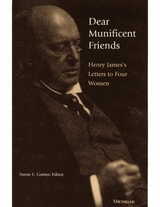
Dear Munificent Friends
Henry James's Letters to Four WomenSusan E. Gunter, Editor
University of Michigan Press, 2000
Dear Science and Other Stories
Katherine McKittrick
Duke University Press, 2021

Dearly Beloved Friends
Henry James's Letters to Younger MenSusan E. Gunter and Steven H. Jobe, Editors
University of Michigan Press, 2004
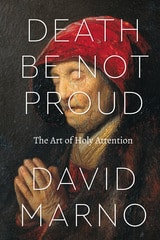
Death Be Not Proud
The Art of Holy AttentionDavid Marno
University of Chicago Press, 2016
If, in Malebranche’s view, attention is a hidden bond between religion and philosophy, devotional poetry is the area where this bond becomes visible. Marno shows that in works like “Death be not proud,” Donne’s most triumphant poem about the resurrection, the goal is to allow the poem’s speaker to experience a given doctrine as his own thought, as an idea occurring to him. But while the thought must feel like an unexpected event for the speaker, the poem itself is a careful preparation for it. And the key to this preparation is attention, the only state in which the speaker can perceive the doctrine as a cognitive gift. Along the way, Marno illuminates why attention is required in Christian devotion in the first place and uncovers a tradition of battling distraction that spans from ascetic thinkers and Church Fathers to Catholic spiritual exercises and Protestant prayer manuals.
Death and the Pearl Maiden
Plague, Poetry, EnglandDavid K. Coley
The Ohio State University Press, 2019
Death and the Pearl Maiden: Plague, Poetry, England asks why one of the singular historical traumas of the later Middle Ages appears to be evoked so fleetingly in fourteenth-century Middle English poetry, a body of work as daring and socially engaged as any in English literary history. By focusing on under-recognized pestilential discourses in Pearl, Cleanness, Patience, and Sir Gawain and the Green Knight—the four poems uniquely preserved British Library MS Cotton Nero A.x —this study resists the idea that the Black Death had only a slight impact on medieval English literature, and it strives to account for the understated shape of England’s literary response to the plague and our contemporary understandings of it.
Death by Philosophy
The Biographical Tradition in the Life and Death of the Archaic Philosophers Empedocles, Heraclitus, and DemocritusAva Chitwood
University of Michigan Press, 2004
How does one die by philosophy? In Diogenes Laertius, philosophers jump into volcanoes, bury themselves in dung, get eaten by dogs, hang themselves, drown, and vanish into thin air -- sometimes all in a single lifetime. But what happens when we look beyond the fantastic and absurd to examine the particular ways that the philosophers' lives and deaths are recounted?
Ava Chitwood's reexamination of Diogenes Laertius's philosophical biographies opens a new window on the intellectual culture and context in which the work of philosophers like Empedocles, Heraclitus, and Democritus was read, received, and transmitted. Chitwood's analysis also suggests a methodology for understanding the interplay between biography and philosophy and for evaluating biographical sources.
While Chitwood's approach combines the disciplines of classical philology and philosophy, Death by Philosophy is not intended solely for the specialist. This investigation offers the modern reader a fascinating, fresh, and entertaining view of the ancient literary and philosophical world.
Ava Chitwood is Assistant Professor of Classics, at the University of South Florida.
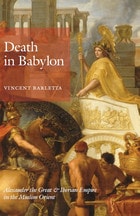
Death in Babylon
Alexander the Great and Iberian Empire in the Muslim OrientVincent Barletta
University of Chicago Press, 2010
Though Alexander the Great lived more than seventeen centuries before the onset of Iberian expansion into Muslim Africa and Asia, he loomed large in the literature of late medieval and early modern Portugal and Spain. Exploring little-studied chronicles, chivalric romances, novels, travelogues, and crypto-Muslim texts, Vincent Barletta shows that the story of Alexander not only sowed the seeds of Iberian empire but foreshadowed the decline of Portuguese and Spanish influence in the centuries to come.
Death in Babylon depicts Alexander as a complex symbol of Western domination, immortality, dissolution, heroism, villainy, and death. But Barletta also shows that texts ostensibly celebrating the conqueror were haunted by failure. Examining literary and historical works in Aljamiado, Castilian, Catalan, Greek, Latin, and Portuguese, Death in Babylon develops a view of empire and modernity informed by the ethical metaphysics of French phenomenologist Emmanuel Levinas. A novel contribution to the literature of empire building, Death in Babylon provides a frame for the deep mortal anxiety that has infused and given shape to the spread of imperial Europe from its very beginning.
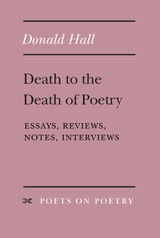
Death to the Death of Poetry
Essays, Reviews, Notes, InterviewsDonald Hall
University of Michigan Press, 1994
Donald Hall believes that American poetry, at the present moment, thrives both in quality and in leadership. In his latest collection of essays, reviews, and interviews, Hall counters the increasingly publicized view that poetry has an ever-diminishing importance in contemporary American culture. He resents the endlessly repeated cliché that finds poetry unpopular and losing popularity. Thus: Death to the Death of Poetry.
Throughout the pages of this latest offering in the Poets on Poetry series, Hall returns again and again to the theme of poetry's health, and offers essays praising contemporary poets, who serve as examples of poetry's thriving condition. In addition, Death to the Death of Poetry collects interviews in which Hall discusses the work of poetry--revisions, standards, the psychology and sociology of the poet's life.
The collection will be warmly received by Donald Hall's large readership, enhanced in 1993 by publication of two exemplary volumes: The Museum of Clear Ideas, his eleventh book of poetry; and his essay Life Work, which brought him both new and returning readers.
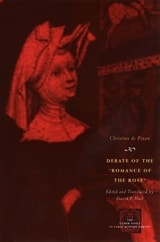
Debate of the Romance of the Rose
Christine de Pizan
University of Chicago Press, 2010
In 1401, Christine de Pizan (1365–1430?), one of the most renowned and prolific woman writers of the Middle Ages, wrote a letter to the provost of Lille criticizing the highly popular and widely read Romance of the Rose for its blatant and unwarranted misogynistic depictions of women. The debate that ensued, over not only the merits of the treatise but also of the place of women in society, started Europe on the long path to gender parity. Pizan’s criticism sparked a continent-wide discussion of issues that is still alive today in disputes about art and morality, especially the civic responsibility of a writer or artist for the works he or she produces.
In Debate of the “Romance of the Rose,” David Hult collects, along with the debate documents themselves, letters, sermons, and excerpts from other works of Pizan, including one from City of Ladies—her major defense of women and their rights—that give context to this debate. Here, Pizan’s supporters and detractors are heard alongside her own formidable, protofeminist voice. The resulting volume affords a rare look at the way people read and thought about literature in the period immediately preceding the era of print.
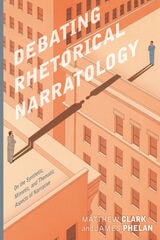
Debating Rhetorical Narratology
On the Synthetic, Mimetic, and Thematic Aspects of NarrativeMatthew Clark and James Phelan
The Ohio State University Press, 2020
Clark and Phelan’s deep dive into the synthetic, mimetic, and thematic leads them to explore many other aspects of narrative and narrative theory: style, audiences, the mimetic illusion, fictionality, and more. Their investigation also leads them into questions about rhetorical narratology’s relation to other projects in narrative theory, especially unnatural narratology, and, indeed, about how to assess the explanatory power of competing theories. Ultimately, their debate is compelling testimony about the power of both narrative theory and narrative itself.

Decadent Style
John Robert Reed
Ohio University Press, 1985
In Decadent Style, John Reed defines “decadent art” broadly enough to encompass literature, music, and the visual arts and precisely enough to examine individual works in detail. Reed focuses on the essential characteristics of this style and distinguishes it from non–esthetic categories of “decadent artists” and “decadent themes.”
Like the natural sciences and psychology, the arts in the late nineteenth century reflect an interest in the process of atomization. Literature and the other arts mirror this interest by developing, or rather elaborating, existing forms to the point of what appears to be dissolution. Instead of these forms dissolving, however, they require their audience’s participation and thus involve a new order. Reed argues that this process of reordering characterizes decadent style, which depends upon sensory provocation resolvable only through negation and is therefore bounded by philosophical and emotional assumptions of inevitable frustration.
Drawing upon the literature, music, and visual arts of England and Europe at the end of the nineteenth century, Reed provides a widely ranging and authoritative overview of decadent style, which relates such artists as Huysmans, Wilde, D’Annunzio, Moreau, Bresdin, Klimt, Klinger, Wagner, and Strauss. He related decadent style to Pre–Raphaelite and Naturalist preoccupation with detail and to aesthetic and Symbolist fascination with sensibility and idealism. Ultimately, Reed argues, decadent style is a late stage of Romanticism, overshadowed by Symbolism but anticipating, in its attempt to yoke incompatibilities and to engender a new cerebral form, some of the main traits of Modernism.
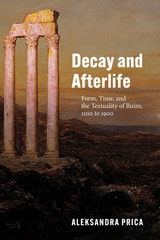
Decay and Afterlife
Form, Time, and the Textuality of Ruins, 1100 to 1900Aleksandra Prica
University of Chicago Press, 2022
Western ruins have long been understood as objects riddled with temporal contradictions, whether they appear in baroque poetry and drama, Romanticism’s nostalgic view of history, eighteenth-century paintings of classical subjects, or even recent photographic histories of the ruins of postindustrial Detroit. Decay and Afterlife pivots away from our immediate, visual fascination with ruins, focusing instead on the textuality of ruins in works about disintegration and survival. Combining an impressive array of literary, philosophical, and historiographical works both canonical and neglected, and encompassing Latin, Italian, French, German, and English sources, Aleksandra Prica addresses ruins as textual forms, examining them in their extraordinary geographical and temporal breadth, highlighting their variability and reflexivity, and uncovering new lines of aesthetic and intellectual affinity. Through close readings, she traverses eight hundred years of intellectual and literary history, from Seneca and Petrarch to Hegel, Goethe, and Georg Simmel. She tracks European discourses on ruins as they metamorphose over time, identifying surprising resemblances and resonances, ignored contrasts and tensions, as well as the shared apprehensions and ideas that come to light in the excavation of these discourses.
Decentering Rushdie
Cosmopolitanism and the Indian Novel in EnglishPranav Jani
The Ohio State University Press, 2010
Interrogating current theories of cosmopolitanism, nationalism, and aesthetics in Postcolonial Studies, Decentering Rushdie offers a new perspective on the Indian novel in English. Since Salman Rushdie’s Midnight’s Children won the Booker Prize in 1981, its postmodern style and postnational politics have dominated discussions of postcolonial literature. As a result, the rich variety of narrative forms and perspectives on the nation that constitute the field have been obscured, if not erased altogether.

Decolonial Care
Reimagining Caregiving in the French CaribbeanJennifer Boum Make
Rutgers University Press, 2025
Decolonial Dreamwork
Africanfuturism and Imagination Beyond DevelopmentJenna Hanchey
The Ohio State University Press, 2027
Incorporates creative writing and analysis of contemporary African speculative fiction to center dreams as a tool for liberation.
In Decolonial Dreamwork, Jenna Hanchey centers dreaming, both waking and sleeping, to examine how Africanfuturism enables futures beyond the “reality” of what developmental imperatives deem possible. Engaging with the speculative fiction of Tade Thompson, Shingai Njeri Kagunda, Yvette Lisa Ndlovu, Tlotlo Tsamaase, Suyi Davies Okungbowa, Sofia Samatar, Moses Ose Utomi, and the Sauúti Collective, Hanchey demonstrates how these works provide a roadmap for decolonial dreaming—imagining beyond the conceptual limits Western paradigms impose. Connecting African and Indigenous thought, Decolonial Dreamwork shows how the labor of imagining beyond coloniality is nonlinear, embodied, emplaced, liquid, and reliant on multiplicities of stories.
As both a scholar and speculative fiction writer, Hanchey blends analysis with examples of her own creative work to demonstrate the importance of not only reading African speculative fiction but joining in and dreaming alongside it. Punctuated with exercises and prompts, Decolonial Dreamwork functions as a participatory workbook for liberation that will be as generative for classrooms and book clubs as it is for theory development. We can all tell stories, Hanchey exhorts readers, that break colonial realities and create space for better worlds.

Decolonial Environmentalisms
Climate Justice and Speculative Futures in Latinx Cultural ProductionDavid J. Vázquez
University of Texas Press, 2025
A critical examination of the environmental movement and the Latinx voices that are shifting how to think about a future shaped by climate change.
In Decolonial Environmentalisms, David Vázquez argues that the mainstream environmental movement is implicated in racial capitalism, not least through its ignorance of environmental justice as it pertains to Latinx people. Through close readings of eco-minded novels, films, visual art, and short stories by Chicanx, Puerto Rican, Dominican, Cuban American, Peruvian, and Central American culture makers, Vázquez surfaces diverse Latinx visions for an equitable and sustainable humanity.
In the creations of Helena María Viramontes, Ester Hernández, Salvador Plascencia, the printmaking collective Dominican York Proyecto GRAFICA, and others, Vázquez locates a bracing critique of racist elisions and assumptions in hegemonic environmentalist thought. At the same time, he shows that the roles of Latinx people in the exploitation of the US West and the ruin of Indigenous communities are ripe for self-examination, in hopes of sparking reform. Indeed, Decolonial Environmentalisms is a work of guarded optimism, finding glimmers of possibility even in dystopic science fiction. The overlooked experiences of Latinx people, Vázquez suggests, can inspire environmental movements capable of transformative advocacy.

Decolonial Topophilia
Nature, Place, and History in Puerto Rican PoetryVíctor Figueroa
Bucknell University Press, 2026
Decolonial Topophilia: Nature, Place, and History in Puerto Rican Poetry examines how four major poets—Luis Lloréns Torres, Luis Palés Matos, Juan Antonio Corretjer, and Julia de Burgos—address the ecological and human consequences of colonial domination in early twentieth-century Puerto Rico. Their poetry raises questions about the capitalist transformation of land through monocultures like sugarcane, the reduction of nature to exploitable resources, and the ties between attachment to place and nationalism. In tracing these connections, this pathbreaking book reveals how poetic visions of place can challenge colonial histories and imagine more reciprocal ways of inhabiting the world.
Published by Bucknell University Press. Distributed worldwide by Rutgers University Press.
Decolonizing Diasporas
Radical Mappings of Afro-Atlantic LiteratureYomaira C. Figueroa-Vásquez
Northwestern University Press, 2021
Winner, MLA Prize in United States Latina and Latino and Chicana and Chicano Literary and Cultural Studies
Mapping literature from Spanish-speaking sub-Saharan African and Afro-Latinx Caribbean diasporas, Decolonizing Diasporas argues that the works of diasporic writers and artists from Equatorial Guinea, Puerto Rico, the Dominican Republic, and Cuba offer new worldviews that unsettle and dismantle the logics of colonial modernity. With women of color feminisms and decolonial theory as frameworks, Yomaira C. Figueroa-Vásquez juxtaposes Afro-Latinx and Afro-Hispanic diasporic artists, analyzing work by Nelly Rosario, Juan Tomás Ávila Laurel, Trifonia Melibea Obono, Donato Ndongo, Junot Díaz, Aracelis Girmay, Loida Maritza Pérez, Ernesto Quiñonez, Christina Olivares, Joaquín Mbomio Bacheng, Ibeyi, Daniel José Older, and María Magdalena Campos-Pons. Figueroa-Vásquez’s study reveals the thematic, conceptual, and liberatory tools these artists offer when read in relation to one another.
Decolonizing Diasporas examines how themes of intimacy, witnessing, dispossession, reparations, and futurities are remapped in these works by tracing interlocking structures of oppression, including public and intimate forms of domination, sexual and structural violence, sociopolitical and racial exclusion, and the haunting remnants of colonial intervention. Figueroa-Vásquez contends that these diasporic literatures reveal violence but also forms of resistance and the radical potential of Afro-futurities.
This study centers the cultural productions of peoples of African descent as Afro-diasporic imaginaries that subvert coloniality and offer new ways to approach questions of home, location, belonging, and justice.
Decolonizing Media Fandom
Disability, Race, and Marvel Superhero FansDivya Garg
University of Iowa Press, 2025
Decolonizing Media Fandom focuses on the globally diverse fan base of a massively popular Western text: the Marvel superhero universe. Drawing on fanworks from Archive of Our Own, a survey spanning sixteen countries, and one-on-one interviews with Marvel fans who identify as non-white and/or having a disability, Divya Garg examines the strengths and limitations of fandom from the perspective of those who are often relegated to the margins.
Decolonizing Memory
Algeria and the Politics of TestimonyJill Jarvis
Duke University Press, 2021

Deconstruction in Context
Literature and PhilosophyEdited by Mark C. Taylor
University of Chicago Press, 1986
"This invaluable philosophical sampler brings together many of the threads out of which deconstruction is woven. taylor's anthology does not make deconstruction easy; much more usefully, it provides a meticulous guide to the sources – and significance – of the difficulties. – Barbara E. Johnson
"The book will be of great value as a set of readings with authoritative explanation for all those interested in the current relations of literature and philosophy. It is the best book of its kind I know. – J. Hillis Miller, Yale University

Deconstruction, Feminist Theology, and the Problem of Difference
Subverting the Race/Gender DivideEllen T. Armour
University of Chicago Press, 1999
Armour shows how the writings of Jacques Derrida and Luce Irigaray can be used to uncover feminism's white presumptions so that race and gender can be thought of differently. In clear, concise terms she explores the possibilities and limitations for feminist theology of Derrida's conception of "woman" and Irigaray's "multiple woman," as well as Derrida's thinking on race and Irigaray's work on religion. Armour then points a way beyond the race/gender divide with the help of African-American theorists such as bell hooks, Hortense Spillers, and Patricia Hill Collins.
Deconstruction
An American InstitutionGregory Jones-Katz
University of Chicago Press, 2021
Deconstruction begins well before Jacques Derrida’s initial American presentation of his deconstructive work in a famed lecture at Johns Hopkins University in 1966 and continues through several decades of theoretic growth and tumult. While much of the subsequent story remains focused, inevitably, on Yale University and the personalities and curriculum that came to be lumped under the “Yale school” umbrella, Deconstruction makes clear how crucial feminism, queer theory, and gender studies also were to the lifeblood of this mode of thought. Ultimately, Jones-Katz shows that deconstruction in the United States—so often caricatured as a French infection—was truly an American phenomenon, rooted in our preexisting political and intellectual tensions, that eventually came to influence unexpected corners of scholarship, politics, and culture.
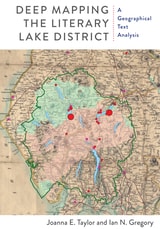
Deep Mapping the Literary Lake District
A Geographical Text AnalysisJoanna E. Taylor
Bucknell University Press, 2022
Deep Refrains
Music, Philosophy, and the IneffableMichael Gallope
University of Chicago Press, 2017
In Deep Refrains, Michael Gallope draws together the writings of Arthur Schopenhauer, Friedrich Nietzsche, Ernst Bloch, Theodor Adorno, Vladimir Jankélévitch, Gilles Deleuze, and Félix Guattari in order to revisit the age-old question of music’s ineffability from a modern perspective. For these nineteenth- and twentieth-century European philosophers, music’s ineffability is a complex phenomenon that engenders an intellectually productive sense of perplexity. Through careful examination of their historical contexts and philosophical orientations, close attention to their use of language, and new interpretations of musical compositions that proved influential for their work, Deep Refrains forges the first panoptic view of their writings on music. Gallope concludes that music’s ineffability is neither a conservative phenomenon nor a pious call to silence. Instead, these philosophers ask us to think through the ways in which music’s stunning force might address, in an ethical fashion, intricate philosophical questions specific to the modern world.
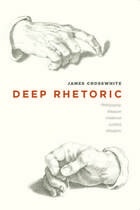
Deep Rhetoric
Philosophy, Reason, Violence, Justice, WisdomJames Crosswhite
University of Chicago Press, 2013
Chapter by chapter, Deep Rhetoric develops an understanding of rhetoric not only in its philosophical dimension but also as a means of guiding and conducting conflicts, achieving justice, and understanding the human condition. Along the way, Crosswhite restores the traditional dignity and importance of the discipline and illuminates the twentieth-century resurgence of rhetoric among philosophers, as well as the role that rhetoric can play in future discussions of ontology, epistemology, and ethics. At a time when the fields of philosophy and rhetoric have diverged, Crosswhite returns them to their common moorings and shows us an invigorating new way forward.
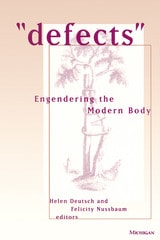
Defects
Engendering the Modern BodyHelen Deutsch and Felicity Nussbaum, Editors
University of Michigan Press, 2000
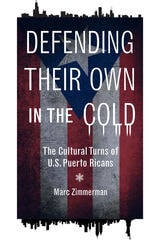
Defending Their Own in the Cold
The Cultural Turns of U.S. Puerto RicansMarc Zimmerman
University of Illinois Press, 2011

Defoe's Britain
jeremy black
St. Augustine's Press, 2023
Defoe was an outsider, a man of many interests whom Black asserts evades too precise a portrait or coherent description of character and career. But he is a traveler, in the literal and imaginative senses, and in his engagement with life and its issues and willingness to associate with 'low-life' prefigures later literary giants like Smollett and Fielding. More than the establishment of genre, Defoe created the writer "whose business is observation." Black's account of this parcel of the British past is impeccable because it is in fact an account that the past, in Defoe, gives of itself. "As a writer, Defoe brought together a reality usually presented as, and endorsed by, history, with the imaginative focus of storytelling, and the direction of, variously, propaganda, analysis, and exemplary tale."

Deformative Fictions
Cruelty and Narrative Ethics in Twentieth-Century Latin American LiteratureAshley Hope Pérez
The Ohio State University Press, 2024
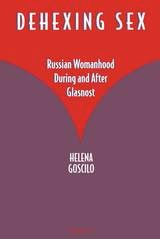
Dehexing Sex
Russian Womanhood During and After GlasnostHelena Goscilo
University of Michigan Press, 1996

Delirious Consumption
Aesthetics and Consumer Capitalism in Mexico and BrazilBy Sergio Delgado Moya
University of Texas Press, 2017
In the decades following World War II, the creation and expansion of massive domestic markets and relatively stable economies allowed for mass consumption on an unprecedented scale, giving rise to the consumer society that exists today. Many avant-garde artists explored the nexus between consumption and aesthetics, questioning how consumerism affects how we perceive the world, place ourselves in it, and make sense of it via perception and emotion.
Delirious Consumption focuses on the two largest cultural economies in Latin America, Mexico and Brazil, and analyzes how their artists and writers both embraced and resisted the spirit of development and progress that defines the consumer moment in late capitalism. Sergio Delgado Moya looks specifically at the work of David Alfaro Siqueiros, the Brazilian concrete poets, Octavio Paz, and Lygia Clark to determine how each of them arrived at forms of aesthetic production balanced between high modernism and consumer culture. He finds in their works a provocative positioning vis-à-vis urban commodity capitalism, an ambivalent position that takes an assured but flexible stance against commodification, alienation, and the politics of domination and inequality that defines market economies. In Delgado Moya’s view, these poets and artists appeal to uselessness, nonutility, and noncommunication—all markers of the aesthetic—while drawing on the terms proper to a world of consumption and consumer culture.

Demands of the Dead
Executions, Storytelling, and Activism in the United StatesKaty Ryan
University of Iowa Press, 2012
The first work to combine literary criticism with other forms of death penalty–abolitionist writing, Demands of the Dead demonstrates the active importance of literature and literary criticism to the struggle for greater justice in the United States. Gathering personal essays, scholarly articles, and creative writings on the death penalty in American culture, this striking collection brings human voices and literary perspectives to a subject that is often overburdened by statistics and angry polemics. Contributors include death-row prisoners, playwrights, poets, activists, and literary scholars.
Highlighting collaborations between writers inside and outside prison, all within the context of the history of state killing laws and foundational concepts that perpetuate a culture of violent death, Demands of the Dead opens with a pamphlet dictated by Willie Francis, a teenager who survived a first execution attempt in Louisiana’s electric chair before he was subsequently killed by the state in 1947.
Writers are a conspicuous part of U.S. death-penalty history, composing a vibrant literary record of resistance to state killing. This multigenre collection both recalls and contributes to this tradition through discussions of such writers as Walt Whitman, Herman Melville, Gertrude Atherton, Ernest Gaines, Sonia Sanchez, Kia Corthron, and Sherman Alexie. A major contribution to literary studies and American prison studies, Demands of the Dead asserts the relevance of storytelling to ethical questions and matters of public policy.

Demarcating the Disciplines
Philosophy, Literature, ArtSamuel Weber, Henry Sussman, and Wlad Godzich, Editors
University of Minnesota Press, 1986
Demarcating the Disciplines was first published in 1986. Minnesota Archive Editions uses digital technology to make long-unavailable books once again accessible, and are published unaltered from the original University of Minnesota Press editions.
With publication of this volume, Glyph begins a new stage in its existence: the move from Johns Hopkins University Press to the University of Minnesota Press is accompanied by a change in focus. In its first incarnation Glyph provided a forum in which established notions of reading, writing, and criticism could be questioned and explored. Since then, the greater currency of such concerns has brought with it new problems and priorities. Setting aside the battles of the past, the new Glyph looks ahead - to confront historical issues and to address the institutional and pedagogical questions emerging from the contemporary critical landscape.
Each volume in the new Glyph series is organized around a specific issue. The essays in this first volume explore the relations between the practice of reading and writing and the operations of the institution. Though their approaches differ from one another, the authors of these essays all recognize that the questions of the institution - most notably the university - points toward a series of constraints that define, albeit negatively, the possibilities for change.
The contributors: Samuel Weber, Jacques Derrida, Tom Conley, Malcolm Evans, Ruth Salvaggio, Robert Young, Henry Sussman, Peter Middleton, David Punter, and Donald Preziosi.
Democratic Criticism
Poetics of Incitement and the Muslim SacredMasood Raja
Lever Press, 2023
After the publication of Salman Rushdie’s The Satanic Verses (1988), the poetics of incitement— found in texts originating in the West containing themes and representations of Islam hurtful to Muslims—became an accepted method of textual production in the West. Production of such texts intensified after the attacks of 9/11. Democratic Criticism: Poetics of Incitement and the Muslim Sacred by Masood Ashraf Raja urges a new mode of reading, one that permits Western readers to transcend local reading practices in order to, as best as one can, read from the point of view of the Other.
Raja argues that the lack of understanding of Muslim responses to the poetics of incitement in the West is the result of a lack of cross-cultural knowledge. He claims metropolitan universities often do not teach the proper social, historical, and religious context required for effectively reading these texts with any form of cultural knowledge. To remedy this, Raja offers and theorizes “democratic reading practices” and new ways for students to engage with texts. A genealogy of the Muslim Sacred is included, thereby giving readers the history and specific knowledge that constitutes an average Muslim reader of these texts, a subject who should be imagined and empathized with when those in the West read works of the poetics of incitement.
Democratic Criticism encourages Western readers to develop a deeper understanding of the meaning-making processes of the Islamic world while at the same time encouraging the Muslim readers to read representations of the Islamic world with a more expansive understanding. It will be a helpful tool in creating reading practices that allow both teachers and students of literature to transcend their mode of reading as universal and to read from the perspective of the Other, and allow readers to engage meaningfully with these texts. Students and scholars of world literature, history, and religious studies will find this book insightful and valuable.
Democratic Discourses
The Radical Abolition Movement and Antebellum American LiteratureBennett, Michael
Rutgers University Press, 2005
Ever since the hallowed statement, "All men are created equal," was penned in the Declaration of Independence, it has become a historical tenet that freedom and equality were brought to American shores by the so-called Founding Fathers.
In this path-breaking study, Michael Bennett departs from tradition to argue that the democratic ideal of equality and the actual ways in which it has been practiced are grounded less in the fledgling government documents written by a handful of white men than in the actions and writings of the radical abolitionists of the nineteenth century. Bringing together key texts of both African American and European American authors, Democratic Discourses shows the important ways that abolitionist writing shaped a powerful counterculture within a slave-holding society. Bennett offers fresh new analysis through unusual pairings of authors, including Frederick Douglass with Henry David Thoreau, Frances Ellen Watkins Harper with Walt Whitman, and Margaret Fuller with Sojourner Truth. These rereadings avoid the tendency to view antebellum writing as a product primarily of either European American or African American influences and, instead, illustrate the interconnections of white and black literature in the creation and practice of democracy.
Drawing on discourses about race, the body, gender, economics, and aesthetics, this unique study encourages readers to reconsider the reality and roots of freedoms experienced in the United States today.
Democratic Education
The Complete Prose Works of Matthew ArnoldMatthew Arnold; Edited by R. H. Super
University of Michigan Press, 1962
Democratic Swarms
Ancient Comedy and the Politics of the PeoplePage duBois
University of Chicago Press, 2022
With Democratic Swarms, Page duBois revisits the role of Greek comedy in ancient politics, considering how it has been overlooked as a political medium by modern theorists and critics. Moving beyond the popular readings of ancient Greece through the lens of tragedy, she calls for a revitalized look at Greek comedy. Rather than revisiting the sufferings of Oedipus and his family or tragedy’s relationship to questions of sovereignty, this book calls for comedy—its laughter, its free speech, its wild swarming animal choruses, and its rebellious women—to inform another model of democracy.
Ancient comedy has been underplayed in the study of Greek drama. Yet, with the irrepressible energy of the comic swarm, it provides a unique perspective on everyday life, gender and sexuality, and the utopian politics of the classical period of Athenian democracy. Using the concepts of swarm intelligence and nomadic theory, duBois augments tragic thought with the resistant, utopian, libidinous, and often joyous communal legacy of comedy, and she connects the lively anti-authoritarianism of the ancient comic chorus with the social justice movements of today.
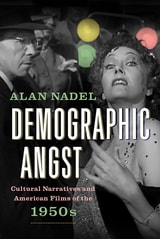
Demographic Angst
Cultural Narratives and American Films of the 1950sNadel, Alan
Rutgers University Press, 2017
Demographic Angst argues that mandated normativity—as a political agenda and a social ethic—precluded explicit expression of the anxiety produced by America’s radically reconfigured postwar population. Alan Nadel explores influential non-fiction books, magazine articles, and public documents in conjunction with films such as Singin’ in the Rain, On the Waterfront, Sunset Boulevard, and Sayonara, to examine how these films worked through fresh anxieties that emerged during the 1950s.
Demonic History
From Goethe to the PresentKirk Wetters
Northwestern University Press, 2014
In this ambitious book, Kirk Wetters traces the genealogy of the demonic in German literature from its imbrications in Goethe to its varying legacies in the work of essential authors, both canonical and less well known, such as Gundolf, Spengler, Benjamin, Lukács, and Doderer. Wetters focuses especially on the philological and metaphorological resonances of the demonic from its core formations through its appropriations in the tumultuous twentieth century.
Propelled by equal parts theoretical and historical acumen, Wetters explores the ways in which the question of the demonic has been employed to multiple theoretical, literary, and historico-political ends. He thereby produces an intellectual history that will be consequential both to scholars of German literature and to comparatists.
Demosthenes, Speeches 18 and 19
Translated by Harvey Yunis
University of Texas Press, 2005
2006 — Soeurette Diehl Fraser Award for Best Translation of a Book, Texas Institute of Letters
This is the ninth volume in the Oratory of Classical Greece. This series presents all of the surviving speeches from the late fifth and fourth centuries BC in new translations prepared by classical scholars who are at the forefront of the discipline. These translations are especially designed for the needs and interests of today's undergraduates, Greekless scholars in other disciplines, and the general public.
Classical oratory is an invaluable resource for the study of ancient Greek life and culture. The speeches offer evidence on Greek moral views, social and economic conditions, political and social ideology, law and legal procedure, and other aspects of Athenian culture that have recently been attracting particular interest: women and family life, slavery, and religion, to name just a few.
Demosthenes is regarded as the greatest orator of classical antiquity. The two speeches translated here grew out of his longtime rivalry with the orator Aeschines. In Speech 19 (On the Dishonest Embassy) delivered in 343 BC, Demosthenes attacks Aeschines for corruption centered around an ultimately disastrous embassy to Philip of Macedon that both men took part in. This speech made Demosthenes the leading politician in Athens for a time. Speech 18 (On the Crown or De Corona), delivered in 330 BC, is Demosthenes' most famous and influential oration. It resulted not only in Demosthenes receiving one of Athens' highest political honors but also in the defeat and disgrace of Aeschines, who retired from public life and left Athens forever.
Demosthenes, Speeches 1–17
Translated by Jeremy Trevett
University of Texas Press, 2011
This is the fourteenth volume in the Oratory of Classical Greece. This series presents all of the surviving speeches from the late fifth and fourth centuries BC in new translations prepared by classical scholars who are at the forefront of the discipline. These translations are especially designed for the needs and interests of today's undergraduates, Greekless scholars in other disciplines, and the general public.
Classical oratory is an invaluable resource for the study of ancient Greek life and culture. The speeches offer evidence on Greek moral views, social and economic conditions, political and social ideology, law and legal procedure, and other aspects of Athenian culture that have recently been attracting particular interest: women and family life, slavery, and religion, to name just a few.
This volume contains translations of all the surviving deliberative speeches of Demosthenes (plus two that are almost certainly not his, although they have been passed down as part of his corpus), as well as the text of a letter from Philip of Macedon to the Athenians. All of the speeches were purportedly written to be delivered to the Athenian assembly and are in fact almost the only examples in Attic oratory of the genre of deliberative oratory. In the Olynthiac and Philippic speeches, Demosthenes identifies the Macedonian king Philip as a major threat to Athens and urges direct action against him. The Philippic speeches later inspired the Roman orator Cicero in his own attacks against Mark Antony, and became one of Demosthenes' claims to fame throughout history.
Demosthenes, Speeches 20-22
Translated by Edward M. Harris
University of Texas Press, 2008
This is the twelfth volume in the Oratory of Classical Greece. This series presents all of the surviving speeches from the late fifth and fourth centuries BC in new translations prepared by classical scholars who are at the forefront of the discipline. These translations are especially designed for the needs and interests of today's undergraduates, Greekless scholars in other disciplines, and the general public.
Classical oratory is an invaluable resource for the study of ancient Greek life and culture. The speeches offer evidence on Greek moral views, social and economic conditions, political and social ideology, law and legal procedure, and other aspects of Athenian culture that have recently been attracting particular interest: women and family life, slavery, and religion, to name just a few.
Demosthenes is regarded as the greatest orator of classical antiquity. This volume contains three important speeches from the earliest years of his political career: Against Leptines, a prosecution brought against a law repealing all exemptions from liturgies; Against Meidias, a prosecution for aggravated insult (hybris) brought against an influential politician; and Against Androtion, an indictment of a decree of honors for the Council of Athens. Edward M. Harris provides contemporary English translations of these speeches, two of which (Leptines and Androtion) have not been translated into English in over sixty years, along with introductions and extensive notes that take account of recent developments in Classical scholarship.
Demosthenes, Speeches 23-26
Translated by Edward M. Harris
University of Texas Press, 2018
This is the fifteenth volume in the Oratory of Classical Greece. This series presents all of the surviving speeches from the late fifth and fourth centuries BC in new translations prepared by classical scholars who are at the forefront of the discipline. These translations are especially designed for the needs and interests of today’s undergraduates, Greekless scholars in other disciplines, and the general public.
Classical oratory is an invaluable resource for the study of ancient Greek life and culture. The speeches offer evidence on Greek moral views, social and economic conditions, political and social ideology, law and legal procedure, and other aspects of Athenian culture that have recently been attracting particular interest: women and family life, slavery, and religion, to name just a few.
This volume provides introductions, translations, and notes for four speeches found in the Demosthenic corpus that have not been translated in recent times. Against Aristocrates deals with matters of foreign policy involving a mercenary general, Charidemus, and is a valuable source for Athenian homicide law. Against Timocrates involves domestic politics and provides important information about Athenian procedures for enacting legislation. In both speeches, the litigants stress the importance of the rule of law in Athenian democracy and emphasize key ideas, such as the monopoly of legitimate force by the state, the need for consistency in statutes, and the principle of no punishment without a written law. The remaining two speeches, Against Aristogeiton, are forgeries composed in the Hellenistic period, as Edward Harris demonstrates conclusively through a study of laws and legal procedures and an analysis of style and vocabulary.