Results by title
5550 books match the query 'Biography & Autobiography' and 216 start with d

Diaries from the House of Atonement
By Zengxin Yang, translated by Berlin Fang
Bridwell Press, 2026
Diaries from the House of Atonement offers a rare glimpse into the intellectual world of Yang Zengxin (1864–1928), the pragmatic ruler who maintained relative stability in Xinjiang from the fall of the Qing dynasty until his assassination in 1928.
Rather than recounting his administration, Yang's diaries explore Confucian and Daoist thought, personal cultivation, political philosophy, and China's uncertain future. They reveal the intellectual principles that may have shaped his approach to governance, including his reflections on moral order, cultural tradition, and religion.
The diaries also show Yang's understanding of the Bagua (八卦) and the I Ching, showing how classical Chinese philosophy could inform practical life and political thought. This translation introduces English-language readers to Yang not merely as a regional ruler, but as a reflective thinker whose writings illuminate the encounter between Chinese tradition, political crisis, religious thought, and the search for social order.
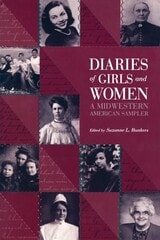
Diaries of Girls and Women
A Midwestern American SamplerSuzanne L. Bunkers
University of Wisconsin Press, 2001
Diaries of Girls and Women captures and preserves the diverse lives of forty-seven girls and women who lived in Minnesota, Iowa, and Wisconsin between 1837 and 1999—young schoolgirls, adolescents coming of age, newlywed wives, mothers grieving the loss of children, teachers, nurses, elderly women, Luxembourger immigrant nuns, and women traveling abroad. A compelling work of living history, it brings together both diaries from historical society archives and diaries still in possession of the diarists or their descendents.
Editor Suzanne L. Bunkers has selected these excerpts from more than 450 diaries she examined. Some diaries were kept only briefly, others through an entire lifetime; some diaries are the intensely private record of a life, others tell the story of an entire family and were meant to be saved and appreciated by future generations. By approaching diaries as historical documents, therapeutic tools, and a form of literature, Bunkers offers readers insight into the self-images of girls and women, the dynamics of families and communities, and the kinds of contributions that girls and women have made, past and present. As a representation of the girls and women of varied historical eras, locales, races, and economic circumstances who settled and populated the Midwest, Diaries of Girls and Women adds texture and pattern to the fabric of American history.
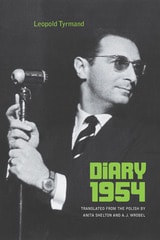
Diary 1954
Leopold Tyrmand
Northwestern University Press, 2014
Leopold Tyrmand, a Polish Jew who survived World War II by working in Germany under a false identity, would go on to live and write under Poland’s Communist regime for twenty years before emigrating to the West, where he continued to express his deeply felt anti-Communist views. Diary 1954—written after the independent weekly paper that employed him was closed for refusing to mourn Stalin’s death—is an account of daily life in Communist Poland. Like Czesław Miłosz, Václav Havel, and other dissidents who described the absurdities of Soviet-backed regimes, Tyrmand exposes the lies—big and small—that the regimes employed to stay in power. Witty and insightful, Tyrmand’s diary is the chronicle of a man who uses seemingly minor modes of resistance—as a provocative journalist, a Warsaw intellectual, the "spiritual father" of Polish hipsters, and a promoter of jazz in Poland—to maintain his freedom of thought.
Diary Volume 1
Witold Gombrowicz
Northwestern University Press, 1988
Diary Volume 2
Witold Gombrowicz
Northwestern University Press, 1989

Diary Volume 3
Witold Gombrowicz
Northwestern University Press, 1993
Diary and Letters of Kaethe Kollwitz
Kaethe Kollwitz
Northwestern University Press, 1988
Diary of Caroline Seabury
Caroline Seabury
University of Wisconsin Press, 1991
In 1854 Caroline Seabury of Brooklyn, New York, set out for Columbus, Mississippi, to teach French at its Institute for Young Ladies. She lived in Columbus until 1863, through the years of mounting sectional bitterness that preceded the Civil War and through the turmoil and hardships of the war itself. During that time, her most intimate confidant was her diary. Discovered in the archives of the Minnesota State Historical Society, it is published here for the first time.
The diary is an illuminating account of southern plantation society and the “peculiar institution” of slavery on the eve of its destruction. Seabury also records her uneasy attempts to come to terms with her position as an unmarried, white, Northern woman whose job was to educate wealthy, white, Southern girls in a setting seemingly oblivious to the horrors of slavery. The diary is not simply a chronicle of daily happenings; Seabury concentrates on remarkable events and the memorable feelings and ideas they generate, shaping them into entries that reveal her as an accomplished writer. She frames her narrative with her journey south in 1854 and the hazardous and exhausting return north through battle lines in 1863.
Disapproving of slavery, yet deeply attached to friends and her life in Columbus and also painfully conscious of the fragility of her own economic and social position, Seabury condemned privately in her diary the evils that she endured silently in public. There are striking scenes of plantation life that depict the brutalities of slavery and benumbed responses to them. Seabury also successfully captures the mood of Mississippi as it changed from a fire-eating appetite to fight the Yankees to a grim apprehension of inexorable defeat. Most impressive of all is Seabury’s poignantly honest presentation of herself, caught in the middle.
Diary of General Patrick Gordon of Auchleuchries 1635-1699
Volume 1: 1635-1659Dmitry Fedosov and Patrick Gordon
Aberdeen University Press, 2009
Diary of General Patrick Gordon of Auchleuchries 1635-1699
Volume 2: 1659-1667Dmitry Fedosov and Patrick Gordon
Aberdeen University Press, 2009
Diary of General Patrick Gordon of Auchleuchries 1635-1699
Volume 3: 1677-1678Dmitry Fedosov and Patrick Gordon
Aberdeen University Press, 2012
Diary of General Patrick Gordon of Auchleuchries 1635-1699
Volume 4: 1684-1689Dmitry Fedosov and Patrick Gordon
Aberdeen University Press, 2013
Diary of General Patrick Gordon of Auchleuchries 1635-1699
Volume 5: 1690-1695Dmitry Fedosov and Patrick Gordon
Aberdeen University Press, 2014
Diary of General Patrick Gordon of Auchleuchries 1635-1699
Volume 6: 1696-1699Dmitry Fedosov and Patrick Gordon
Aberdeen University Press, 2016
Diary of a Detour
Lesley Stern
Duke University Press, 2020
Diary of a Philosophy Student
Volume 1, 1926-27Simone de Beauvoir; Translation by Barbara Klaw; Edited by Barbara Klaw, Sylvie Le Bon de Beauvoir, and Margaret Simons, with the assistance of Marybeth Timmerman
University of Illinois Press, 2021
Presented for the first time in translation, this fully annotated first volume of the Diary includes essays from Barbara Klaw and Margaret A. Simons that address its philosophical, historical, and literary significance. It remains an invaluable resource for tracing the development of Beauvoir’s independent thinking and her influence on philosophy, feminism, and the world.
Diary of a Philosophy Student
Volume 2, 1928-29Simone de Beauvoir; Translation by Barbara Klaw; Edited by Barbara Klaw, Sylvie Le Bon de Beauvoir, Margaret A. Simons, and Marybeth Timmermann
University of Illinois Press, 2021
Presented for the first time in translation, this fully annotated first volume of the Diary includes essays from Barbara Klaw and Margaret A. Simons that address its philosophical, historical, and literary significance. It remains an invaluable resource for tracing the development of Beauvoir’s independent thinking and her influence on philosophy, feminism, and the world.
Diary of a Philosophy Student
Volume 3, 1926-30Simone de Beauvoir. Translation by Barbara Klaw. Edited by Barbara Klaw, Sylvie Le Bon de Beauvoir, and Margaret A. Simons with Marybeth Timmermann. Foreword by Sylvie Le Bon de Beauvoir
University of Illinois Press, 2024
In addition, the editors include a wealth of important supplementary material. Barbara Klaw provides a detailed consideration of the Diary’s role in the development of Beauvoir’s writing style by exploring her use of metanarrative and other literary techniques, part of a process of literary creation that saw Beauvoir use the notebooks to cultivate her talent. Margaret A. Simons’s essay places the assault by Sartre within an appraisal of Beauvoir’s complicated legacy for #MeToo while suggesting readers engage with the diary through the lens of trauma.
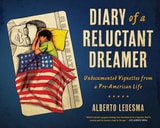
Diary of a Reluctant Dreamer
Undocumented Vignettes from a Pre-American LifeAlberto Ledesma
The Ohio State University Press, 2017
Exploring Ledesma’s experiences from immigrant to student to academic, Diary of a Reluctant Dreamer presents a humorous, gritty, and multilayered portrait of undocumented immigrant life in urban America. Ledesma’s vignettes about life in the midst of ongoing social trauma give voice to a generation that has long been silent about its struggles. Delving into the key moments of cultural transition throughout his childhood and adulthood—police at the back door waiting to deport his family, the ex-girlfriend who threatens to call INS and report him, and the interactions with law enforcement even after he is no longer undocumented—Ledesma, through his art and his words, provides a glimpse into the psychological and philosophical concerns of undocumented immigrant youth who struggle to pinpoint their identity and community.
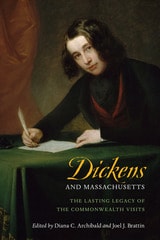
Dickens and Massachusetts
The Lasting Legacy of the Commonwealth VisitsDiana C. Archibald
University of Massachusetts Press, 2015
Charles Dickens traveled to North America twice, in 1842 and twenty-five years later in 1867–68, and on both trips Massachusetts was part of his itinerary. Although many aspects of his U.S. travels disappointed him, Massachusetts was the one state that met and even exceeded Dickens's expectations for “the republic of [his] imagination.” From the mills of Lowell to the Perkins School for the Blind, it offered an alternate vision of America that influenced his future writings, while the deep and lasting friendships he formed with Bostonians gave him enduring ties to the commonwealth.
This volume provides insight from leading scholars who have begun to reassess the significance of Massachusetts in the author's life and work. The collection begins with a broad biographical and historical overview taken from the full-length narrative of the award-winning exhibition Dickens and Massachusetts: A Tale of Power and Transformation, which attracted thousands of visitors while on display in Lowell. Abundant images from the exhibition, many of them difficult to find elsewhere, enhance the story of Dickens's relationship with the vibrant cultural and intellectual life of Massachusetts. The second section includes essays that consider the importance of Dickens's many connections to the commonwealth.
In addition to the volume editors, contributors include Chelsea Bray, Iain Crawford, Andre DeCuir, Natalie McKnight, Lillian Nayder, and Kit Polga.
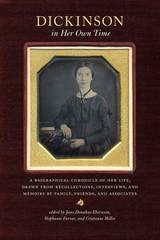
Dickinson in Her Own Time
A Biographical Chronicle of Her Life, Drawn from Recollections, Interviews, and Memoirs by Family, Friends, and AssociatesJane Donahue Eberwein, Stephanie Farrar, and Cristanne Miller
University of Iowa Press, 2015
In addition, promotional items, reviews, and correspondence relating to early publications are included, as well as some later documents that reveal the changing assessments of Dickinson’s poetry in response to evolving critical standards. These documents provide evidence that counters many popular conceptions of her life and reception, such as the belief that the writer best known for poems focused on loss, death, and immortality was herself a morose soul. In fact, those who knew her found her humorous, playful, and interested in other people.
Dickinson maintained literary and personal correspondence with major representatives of the national literary scene, developing a reputation as a remarkable writer even as she maintained extreme levels of privacy. Evidence compiled here also demonstrates that she herself made considerable provision for the survival of her poems and laid the groundwork for their eventual publication. Dickinson in Her Own Time reveals the poet as her contemporaries knew her, before her legend took hold.
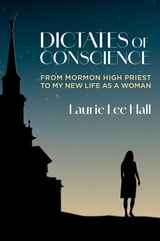
Dictates of Conscience
From Mormon High Priest to My New Life as a WomanLaurie Lee Hall
Signature Books, 2024
Laurie Lee Hall’s growing-up years were defined by the conflict between her physical condition as a boy and her inherent identity as a girl. Unable to explain or resolve her gender dysphoria, she committed to living her adult life as a male. She joined the Church of Jesus Christ of Latter-day Saints, eventually becoming chief architect of its temples and an ecclesiastical leader. In her church and community, rigid adherence to gender roles is not only the norm, but the defining issue of a faith that doctrinally declares one’s gender as an “eternal identity.” Against this traditional backdrop, Hall finally received spiritual confirmation and personally accepted that she was transgender and always had been. In this remarkable memoir, Laurie Lee details how she risked everything to live true to her long-suppressed gender identity.
Through the power of lived experience, Laurie Lee’s story affirms the reality of gender identity and the strength and joy of self-acceptance.
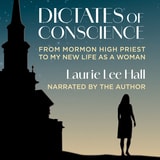
Dictates of Conscience
From Mormon High Priest to My New Life as a WomanLaurie Lee Hall
Signature Books, 2026
Laurie Lee Hall’s growing-up years were defined by the conflict between her physical condition as a boy and her inherent identity as a girl. Unable to explain or resolve her gender dysphoria, she committed to living her adult life as a male. She joined the Church of Jesus Christ of Latter-day Saints, eventually becoming chief architect of its temples and an ecclesiastical leader. In her church and community, rigid adherence to gender roles is not only the norm, but the defining issue of a faith that doctrinally declares one’s gender as an “eternal identity.” Against this traditional backdrop, Hall finally received spiritual confirmation and personally accepted that she was transgender and always had been. In this remarkable memoir, Laurie Lee details how she risked everything to live true to her long-suppressed gender identity.
Through the power of lived experience, Laurie Lee’s story affirms the reality of gender identity and the strength and joy of self-acceptance.
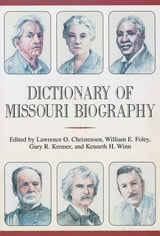
Dictionary of Missouri Biography
Edited by Lawrence O. Christensen, William E. Foley, Gary R. Kremer & Kenneth H.Winn
University of Missouri Press, 1999
In the making for almost a decade, the Dictionary of Missouri Biography is the most important reference work on Missouri biography to be published in the last half century. Written by nearly three hundred talented authors from around the country and edited by four of the leading authorities on Missouri history, this monumental work contains biographies of more than seven hundred individuals who have in some way made a contribution to the course of state and national history.
Covering all periods as well as all regions of the state, this remarkable volume illustrates the state's cultural, racial, and ethnic diversity. Although the men and women chosen for inclusion in this book came from many walks of life, all of them were either born in Missouri or through their lives touched the state in a significant way. Many of the people will be instantly recognizable, but others will be less well known. Each of them, however, achieved notoriety in some area of activity—politics, business, agriculture, the arts, entertainment, sports, education, military service, diplomacy, social reform, civic improvements, science, or religion.
Providing information on and insight into the lives, careers, personalities, and eras of all of the subjects, the book clearly presents the achievements of the featured individuals, as well as the richness of the state's heritage. Brief bibliographies after each entry direct the reader toward further research on a given subject.
Written in an easy-to-read and accessible style, the Dictionary of Missouri Biography will be an indispensable reference. Scholars, researchers, and the general reader will turn to this guide repeatedly to discover useful and reliable information about noteworthy Missourians. Every library, every school, every historian, and every Missouri family will want this important new work.
Dictionary of Modern Consternation
Brook McClurg
University of Alaska Press, 2024
A Dictionary of Modern Consternation is a genre-bending nonfiction lyric following one family through the years from the financial crisis to the COVID-19 pandemic. In this cheeky dictionary-shaped exploration of how language can often alienate and dehumanize, weakening feelings of community with societal trends that subsume individual lives, Brook McClurg offers a footnote narrative of an international life pursuing the business of words.
What starts as a lighthearted academic exploration becomes real when the pandemic hits—at the letter P—and the ability to treat each other humanely suddenly has grave consequences. Questioning the ways specialized jargon in language—often corporate, legal, and militaristic in nature—encroaches on our feelings of community and responsibility to one another, McClurg employs an abecedarian format, concealing his meaningful and sensitive explorations of personal strife inside a more formal facade. A Dictionary of Modern Consternation reveals its subjective viewpoint and ironic tone over the course of the text, confronting themes of loneliness and isolation, global strife and endless war, and intimacy, love, and family.
With approximately 500 satirical dictionary entries and 143 flash essays as footnotes, this experimental memoir is filled with satirical definitions, pseudo-aphorisms, and inquisitions into words or phrases. A Dictionary of Modern Consternation is for general readers, collectors, book-as-art lovers, and anyone interested in the political economy of language, as well as graduate classes exploring experimental forms.

Diesel
Technology And Society In Industrial GermanyDonald E. Thomas Jr.
University of Alabama Press, 1987
The life of Rudolf Diesel, a man who achieved a power plant with the potential for revolutionizing industry and transportation. Diesel demonstrated that he possessed both the scientific insight and technical skill needed to create the diesel engine.
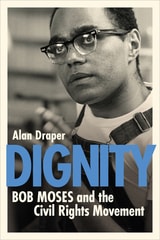
Dignity
Bob Moses and the Civil Rights MovementAlan Draper
University of Illinois Press, 2027
Challenging entrenched accounts, Alan Draper reveals that Moses could pursue either “Freedom Now” or develop local leaders, but not both. Rich with new details, Dignity follows Bob Moses from his early years through his death in 2021, presenting a clear-eyed view of his personality and achievements. Draper describes how Moses pursued Black voter registration in Mississippi and then in a second career devoted himself to math education. Just as dignity for Blacks in the twentieth century required voting rights, so did Moses believe that dignity for Blacks in the next century required math skills.
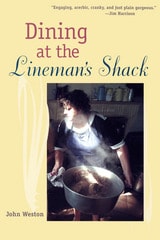
Dining at the Lineman's Shack
John Weston
University of Arizona Press, 2003
The place is Skull Valley in central Arizona, the time the 1930s. Taking food as his theme, Weston paints an instructive and often hilarious portrait of growing up, of rural family life under difficult circumstances, and of a remote Arizona community trying to hold body and soul together during tough times. His book recalls life in a lineman's shack, interlaced with "disquisitions on swamp life, rotting water, and the complex experience of finding enough to eat during the Great Depression."
Central to Weston's account is his mother Eloine, a valiant woman rearing a large brood in poverty with little help from her husband. Eloine cooks remarkably well—master of a small repertory from which she coaxes ideas surprising even to herself—and feeds her family on next to nothing. She is a woman whose first instinct is to cry out "Lord, what am I going to feed them" whenever visitors show up close to mealtime. Recalls Weston, "Her strength lay in a practical- and poverty-born sense that there must be more edible food in the world than most people realized," and he swears that six out of seven meals were from parts of four or five previous meals coming round again, like the buckets on a Ferris wheel.
Although Weston evokes a fond remembrance of a bygone era that moves from Depression-era Skull Valley to wartime Prescott, rest assured: food—its acquisition, its preparation, its wholehearted enjoyment—is the foundation of this book. "I did not have a deprived childhood, despite its slim pickings," writes Weston. "If I recall a boiling pig's head now and then, it is not to be read as some Jungian blip from Lord of the Flies but simply a recurring flicker of food-memory." Whether remembering his father's occasional deer poaching or his community's annual Goat Picnic, Weston laces his stories with actual recipes—even augmenting his instructions for roasted wild venison with tips for preparing jerky.
Dining at the Lineman's Shack teems with sparkling allusions, both literary and culinary, informed by Weston's lifetime of travels. Even his nagging memory of desperate boyhood efforts to trade his daily peanut-butter sandwich for bacon-and-egg, baloney, jelly, or most anything else is tempered by his acquaintance with "the insidious sa-teh sauce in Keo Sananikone's hole-in-the-wall restaurant on Kapahulu Street"—a peanut-butter-based delicacy for which he obligingly provides the ingredients (and which he promises will keep, refrigerated in a jar, for several weeks before baroque things begin to grow on it).
Through this tantalizing smorgasbord of memories, stories, and recipes, John Weston has fashioned a wholly captivating commentary on American culture, both in an earlier time and in our own. Dining at the Lineman's Shack is a book that will satisfy any reader's hunger for the unusual—and a book to savor, in every sense of the word.
Directing
Virginia Wright Wexman
Rutgers University Press, 2017
The latest volume in the Behind the Silver Screen series, this collection provides the first comprehensive overview of how directing, as both an art and profession, has evolved in tandem with changing film industry practices. Each chapter is written by an expert on a different period of Hollywood, from the silent film era to today’s digital filmmaking, providing in-depth examinations of key trends like the emergence of independent production after World War II and the rise of auteurism in the 1970s. Challenging the myth of the lone director, these studies demonstrate how directors work with a multitude of other talented creative professionals, including actors, writers, producers, editors, and cinematographers.
Directing examines a diverse range of classic and contemporary directors, including Orson Welles, Tim Burton, Cecil B. DeMille, Steven Soderbergh, Spike Lee, and Ida Lupino, offering a rich composite picture of how they have negotiated industry constraints, utilized new technologies, and harnessed the creative contributions of their many collaborators throughout a century of Hollywood filmmaking.
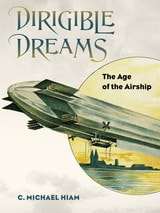
Dirigible Dreams
The Age of the AirshipC. Michael Hiam
University Press of New England, 2014
Dirty Jokes and Bawdy Songs
The Uncensored Life of Gershon LegmanSusan G. Davis
University of Illinois Press, 2019
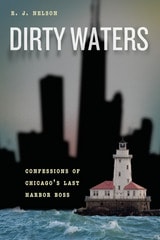
Dirty Waters
Confessions of Chicago's Last Harbor BossR. J. Nelson
University of Chicago Press, 2016
In 1987, the city of Chicago hired a former radical college chaplain to clean up rampant corruption on the waterfront. R. J. Nelson thought he was used to the darker side of the law—he had been followed by federal agents and wiretapped due to his antiwar stances in the sixties—but nothing could prepare him for the wretched bog that constituted the world of a Harbor Boss. Dirty Waters is the wry, no-holds-barred memoir of Nelson’s time controlling some of the city’s most beautiful spots while facing some of its ugliest traditions. Nelson takes us through Chicago's beloved “blue spaces” and deep into the city’s political morass, revealing the different moralities underlining three mayoral administrations and navigating the gritty mechanisms of the city’s political machine. Ultimately, Dirty Waters is a tale of morality, of what it takes to be a force for good in the world and what struggles come from trying to stay ethically afloat in a sea of corruption.
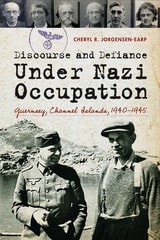
Discourse and Defiance under Nazi Occupation
Guernsey, Channel Islands, 1940–1945Cheryl R. Jorgensen-Earp
Michigan State University Press, 2013
Captured by German forces shortly after Dunkirk, and not relinquished until May of 1945, nearly a year after the Normandy invasion, the British Channel Islands (Guernsey, Jersey, Alderney, Sark, and Herm) were characterized during their occupation by severe deprivation and powerlessness. The Islanders, with few resources to stage an armed resistance, constructed a rhetorical resistance based upon the manipulation of discourse, construction of new symbols, and defiance of German restrictions on information. Though much of modern history has focused on the possibility that Islanders may have collaborated with the Germans, this eye-opening history turns to secret war diaries kept in Guernsey. A close reading of these private accounts, written at great risk to the diarists, allows those who actually experienced the Occupation to reclaim their voice and reveals new understandings of Island resistance. What emerges is a stirring account of the unquenchable spirit and deft improvisation of otherwise ordinary people in extraordinary circumstances. Under the most dangerous of conditions, Guernsey civilians used imaginative methods in reacting to their position as a subjugated population, devising a covert resistance of nuance and sustainability. Violence, this book and the people of Guernsey demonstrate, is not at all the only means with which to confront evil.
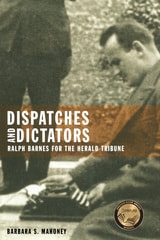
Dispatches and Dictators
Ralph Barnes for the Herald TribuneBarbara S. Mahoney
Oregon State University Press, 2002
Dispatches and Dictators uncovers the fascinating story of Oregon native Ralph Barnes, the New York Herald Tribune’s European correspondent, who served in Paris, Rome, Moscow, Berlin, and London in the years between the two world wars. Barnes has been praised by colleagues and competitors alike as one of the best reporters of that pivotal era. But since his death in the 1940 crash of a British bomber in Yugoslavia, he has been largely forgotten.
With persistence and unusually keen insight, Ralph Barnes reported on Fascism, Communism, Nazism, and the events leading to World War II. Stalin confined Barnes to Moscow for disclosing that millions were dying during the Soviet collectivization of agriculture, and Hitler expelled Barnes from Germany for predicting the Nazi attack on the Soviet Union.
In Dispatches and Dictators, historian Barbara Mahoney chronicles the short life and brilliant career of Ralph Barnes. Her biography of this extraordinary reporter provides new insights into the tumultuous decade leading up to World War II.
Dissing Elizabeth
Negative Representations of GlorianaJulia M. Walker, ed.
Duke University Press, 1998
As editor Julia M. Walker suggests, the breadth of dissent considered in this collection points to a dark side of the Cult of Elizabeth. Reevaluating neglected texts that had not previously been perceived as critical of the queen or worthy of critical appraisal, contributors consider dissent in a variety of forms, including artwork representing (and mocking) the queen, erotic and pornographic metaphors for Elizabeth in the popular press, sermons subtly critiquing her actions, and even the hostility encoded in her epitaph and in the placement of her tomb. Other chapters discuss gossip about Elizabeth, effigies of the queen, polemics against her marriage to the Duke of Alençon, common verbal slander, violence against emblems of her authority, and the criticism embedded in the riddles, satires, and literature of the period.
Distaff Diplomacy
The Empress Eugénie and the Foreign Policy of the Second EmpireBy Nancy Nichols Barker
University of Texas Press, 1967
The Empress Eugénie, wife of Napoleon III and one of the most beautiful women ever to grace a throne, was the victim of her own inconstant mind. A daughter of an aristocratic Spanish family, she had a natural reverence for legitimate monarchy; yet her high-spirited temperament and chivalric outlook made her admire instinctively the boldness and aura of glory that she associated with the Napoleonic empire. The incongruous principles of Legitimism and Bonapartism battling within the Empress produced in her a double-mindedness that had tragic consequences.
The Empress has always been a controversial figure. Her enemies have blamed her the fall of the Second Empire and the defeat of France; her admirers have disclaimed for her any part in the mistakes that led to the disastrous Franco-Prussian War of 1870. To determine the actual role that Eugénie played, Barker, using material from public and private European archives and a wide range of published works, examines in Distaff Diplomacy the development of the Empress' views on foreign affairs and ascertains their effect on the formation of the policies of the Second Empire.
Eugénie's influence fluctuated widely over the years. As a bride she was neither interested in nor knowledgable about foreign matters; as a middle-aged woman, in the late years of the Empire, she was discredited by her past errors, but she continued to pull strings outside of normal diplomatic channels. Her most sustained and effective work, from 1861 to 1863, was largely the inspiration for a grand design to remake the map to assure French hegemony in Europe and to establish an empire in Mexico. The success of this design rested on an Austro-French alliance; but the design itself, reflecting the Empress' incoherent thinking, contained the fatal inconsistencies that made Austrian rejection of it inevitable. Since the Mexican expedition and the diplomatic muddle of 1863 were the watershed from which the subsequent troubles of the Empire flowed, the Empress must be held responsible for seriously undermining the foreign policy of the Empire. Despite Eugénie's many fine qualities—her generosity of spirit, her splendid courage, and her moral integrity—her diplomatic efforts, affected as they were by her background, temperament, state of health, and changing moods, did not amount to statesmanship. This first systematic examination of the Empress' influence on foreign policy delves deeply and carefully into the subject.
Distant Fires
Duluth to Hudson BayScott Anderson
University of Minnesota Press, 2008
"Distant Fires, a true-life adventure, describes a 1,700-mile canoe trip from Duluth to York Factory on Hudson Bay. Anderson and a companion retraced the paddles taken by Eric Sevareid and a companion almost sixty years earlier. Their trials and tribulations, plus Anderson’s sense of humor, make the trip fun in book form. Pen-and-ink illustrations are by noted Minnesota wildlife artist Les Kouba." —Minneapolis Star Tribune
"Distant Fires is a voyage of discovery. Scott Anderson is an inquisitive traveler, and when he sees something that piques his interest, he stops for a chat. He also has a marvelous eye for the natural world that surrounds him in his summerlong journey. He is a natural-born writer." —Duluth News Tribune
"Some of [Anderson’s] phrasing is very happy indeed: ‘the resting place of the rivers.’ I wish I had written that." —Eric Sevareid
Distant Melodies
Music in Search of HomeEdward Dusinberre
University of Chicago Press, 2022
How does music played and heard over many years inform one’s sense of home? Writing during the COVID-19 pandemic, when travel is forbidden and distance felt anew, Edward Dusinberre, first violinist of the world-renowned Takács Quartet, searches for answers in the music of composers whose relationships to home shaped the pursuit of their craft—Antonín Dvořák, Edward Elgar, Béla Bartók, and Benjamin Britten.
Dusinberre has lived abroad for three decades. At the age of 21, he left his native England to pursue music studies at the Juilliard School in New York. Three years later he moved to Boulder, Colorado. Drawn to the stories of Dvořák’s, Bartók’s, and Britten’s American sojourns as they tried to reconcile their new surroundings with nostalgia for their homelands, Dusinberre reflects on his own evolving relationship to England and the idea of home. As he visits and imagines some of the places crucial to these composers’ creative inspiration, Dusinberre also reflects on Elgar’s unusual Piano Quintet and the landscapes that inspired it.
Combining travel writing with revealing insights into the working lives of string quartet musicians, Distant Melodies is a moving and humorous meditation on the relationship between music and home.
Distracted by Alabama
Tangled Threads of Natural History, Local History, and FolkloreJames Seay Brown Jr.
University of Alabama Press, 2022
Where rivers, railroads, and redhorse fish tell the story of Alabama’s soul.
A gateway to Alabama for the omnivorous mind, Distracted by Alabama is a collection of twelve captivating essays about Alabama and the South by Samford University writer and scholar Jim Brown, a former president of the Alabama Folklife Association.
During his decades living and teaching in Alabama, Brown followed his curiosity down myriad pathways about Alabama and the region, including the state’s majestic landscape, plants and animals found nowhere else, history, and rich folkways. In the tapestry of Alabama culture, Brown traces the threads of Native American, African slave, and European settler influences, woven over the centuries into novel patterns that surprise and fascinate.
Writing in the voice of a learned companion, Brown reveals insights and stories about unforgettable facets of Alabama culture, such as Sacred Harp singers and African American railroad callers, the use of handmade snares and stationary fishtraps to catch river redhorse and freshwater drum, white oak basketmaking and herbal medicine traditions, the evolution of the single-pen log cabin into the impressive two-story I-house, and a wealth of other engrossing stories.
An instant classic, Distracted by Alabama is a keepsake that readers who love, visit, or are curious about Alabama and Southern culture will return to again and again.
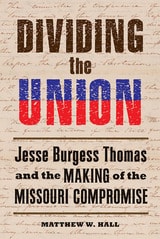
Dividing the Union
Jesse Burgess Thomas and the Making of the Missouri CompromiseMatthew W. Hall
Southern Illinois University Press, 2015
In 1820 the Missouri controversy erupted over the issue of slavery in the newly acquired lands of the Louisiana Purchase. It fell to Jesse Burgess Thomas (1777–1853), a junior U.S. senator from the new state of Illinois, to handle the delicate negotiations that led to the Missouri Compromise. Thomas’s maturity, good judgment, and restraint helped pull the country back from the brink of disunion and created a compromise that held for thirty-four years. In Dividing the Union, Matthew W. Hall examines the legal issues underlying the controversy and the legislative history of the Missouri Compromise while focusing on the aspects of Thomas’s life and character that gave him such influence. The first in-depth biography of Thomas, Hall’s work demonstrates how the legislative battle over the Compromise reflected the underlying nuances of the larger struggle over slavery.
The text of the Missouri Compromise originated from the Northwest Ordinance. Article VI of the Ordinance purported to prohibit slavery in the Northwest Territory, but paradoxically, a provision that assured property rights in another article was used to protect slavery. People in some parts of the Northwest sought to circumvent Article VI by formulating indenture laws and various state constitutional provisions addressing slavery. Pro- and antislavery activists eventually developed quite different interpretations of the relevant language in these documents, making negotiations over slavery in the new territory extremely complicated.
As Hall demonstrates, Thomas was perfectly situated geographically, politically, and ideologically to navigate the Missouri controversy. He was the first speaker of the Indiana Territorial General Assembly, one of the first territorial judges in the Illinois Territory, and the president of the Illinois State Constitutional Convention in 1818. Because the drive for statehood in Illinois was strong, the convention managed to skirt the divisive issue of slavery, due in large part to Thomas’s efforts. That he was never required to clearly articulate his own views on slavery allowed Thomas to maintain a degree of neutrality, and his varied political career gave him the experience necessary to craft a compromise.
Thomas’s final version of the Compromise included shrewdly worded ambiguities that supported opposing interests in the matter of slavery. These ambiguities secured the passage of the Compromise and its endurance until the Kansas-Nebraska Act of 1854. By weaving Thomas’s life story into the history of the Missouri Compromise, Hall offers new insight into both a pivotal piece of legislation and an important, previously overlooked figure in nineteenth-century American politics.
Divine Expectations
An American Woman In Nineteenth-Century PalestineBarbara Kreiger
Ohio University Press, 1999
Barbara Kreiger’s intriguing narrative presents the account of Clorinda Minor, a charismatic American Christian woman whose belief in the Second Coming prompted her to leave a comfortable life in Philadelphia in 1851 and take up agriculture in Palestine.
After her disappointment in a failed prophecy that the End of Days would take place in October 1844, Mrs. Minor determined that the Holy Land was not yet adequately prepared for such an event and decided that it would be her mission to teach the poverty-stricken Jews of Palestine to work the soil. In this very American story, Mrs. Minor, like so many other pioneers of her day, looked to the land as her future.
Even as her mission was distinctly religious, her daily efforts were in the social realm. And although her work brought Jews and Arabs together, and her small farm was a unique settlement where Christians, Muslims, and Jews labored alongside one another, the events detailed in Divine Expectations had dramatic and tragic diplomatic and international repercussions.
With the deft touch of a novelist, Barbara Kreiger weaves the little-known story of Clorinda Minor into the larger context of the region and its history, presenting it in its charming eccentricity and its gripping reality.

Dixie Dewdrop
The Uncle Dave Macon StoryMichael D. Doubler
University of Illinois Press, 2018
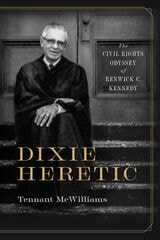
Dixie Heretic
The Civil Rights Odyssey of Renwick C. KennedyTennant McWilliams
University of Alabama Press, 2023
A life-and-times biography of the minister and social reformer Renwick C. Kennedy
Drawn from some 5,000 letters, six decades of daily-diary writings, and extensive interviews, Dixie Heretic: The Civil Rights Odyssey of Renwick C. Kennedy offers a life-and-times biography of the Alabama Black Belt minister, Renwick C. Kennedy (1900–1985). Here, Tennant McWilliams gives an unvarnished account of Kennedy’s tortuous efforts to make his congregants and other southern whites “better Christians.”
Kennedy came from “upcountry” South Carolina, a place rife with Scotch-Irish Associate Reformed Presbyterians—people of biblical infallibility and individual piety and salvation. In 1927, after a life-changing theology education at Princeton, he moved to Camden, Alabama, county seat of Wilcox County. There, he came to believe that God had a mandate for him: to change the “Half Christian” conservative, and the often violent, racial behaviors around him. As a neo-orthodox Protestant, Kennedy never rejected literal approaches to the Bible. Still, out of the “Full Christian” Social Gospel, he urged changed racial behavior. Ultimately this led him to publish confrontational short stories and essays in Christian Century and New Republic—most set in fictitious “Yaupon County.”
In World War II, Kennedy served as a chaplain with the famed 102nd Evacuation Hospital. He came home hoping the Allied victory would spur Americans to fight racial segregation just as they had fought racial fascism in Europe. The 1948 Dixiecrat movement dashed these hopes, turning much of his neo-orthodox optimism to cynicism. His hope found fleeting resurgence in the civil rights movement, and saw Kennedy quietly leading desegregation of Troy University, where he was an administrator. But the era’s assassinations, combined with George Wallace and the rise of southern white Republicans, regularly returned him to the frustrated hopes of 1948 and fostered a pessimism about truly changed hearts that he took to his grave in 1985.
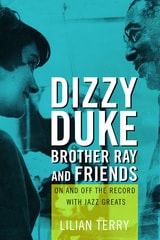
Dizzy, Duke, Brother Ray, and Friends
On and Off the Record with Jazz GreatsLillian Terry
University of Illinois Press, 2017
Drawing on Terry’s long friendships and professional associations, Dizzy, Duke, Brother Ray, and Friends offers readers a rare opportunity to hear intimate conversations with some of the world’s greatest musical figures. Dizzy Gillespie offers his thoughts on playing with “sanctified” rhythm and the all-important personal touch in performance. Duke Ellington discourses on jazz history and concludes an interview to sing a self-written ditty in Italian. Ray Charles gives candid thoughts on race and politics while taking charge of Terry’s tape recorder. Abbey Lincoln, Max Roach, Horace Silver, Bill Evans—all provide Terry and her readers with unforgettable encounters. The result is a collection of profiles, some stretching over a decade or more, that reveal these performers in ways that illuminate their humanity and expand our appreciation of their art.

Dizzy
A MemoirRachel Weaver
West Virginia University Press, 2026
Gold Medal Winner, Living Now Book Awards, Inspirational Memoir (Female)
“An arresting new memoir….”
– Maureen Corrigan, NPR’s Fresh Air
Beverly Donofrio, author of Riding in Cars with Boys, says “Dizzy is a testament to the power of hope. Weaver’s courage and strength are so inspiring they encourage the same in the reader. If all of that isn’t enough, the beauty and agility of the prose may make you regret reaching the last page.”
In her early thirties, Rachel Weaver woke up dizzy and unable to function. She spent the next ten years seeing more than thirty medical practitioners before receiving a diagnosis, and then another eight years before finding relief from her condition. Dizzy is amedical mystery and a cautionary tale about our broken healthcare system. It is a story about learning to live with life's uncertainty, persevering in the pursuit of answers, and striving to find joy in an imperfect yet beautiful world.
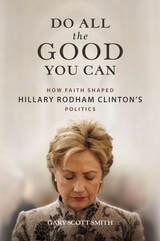
Do All the Good You Can
How Faith Shaped Hillary Rodham Clinton’s PoliticsGary Scott Smith
University of Illinois Press, 2023
Methodism in the public and private lives of the politician
After more than forty contentious years in the public eye, Hillary Rodham Clinton is one of the best-known political figures in the nation. Yet the strong religious faith at the heart of her politics and personal life often remains confounding, if not mysterious, to longtime observers. Even many of her admirers would be surprised to hear Clinton state that her Methodist outlook has “been a huge part of who I am and how I have seen the world, and what I believe in, and what I have tried to do in my life.”
Gary Scott Smith’s biography of Clinton’s journey in faith begins with her Methodist upbringing in Park Ridge, Illinois, where she faithfully attended worship services, Sunday school, and youth group meetings. Like many mainline Protestants, Clinton’s spiritual commitment developed gradually throughout childhood, while her combination of missionary zeal and impressive personal talents has informed her career from the time of her pro bono work at Yale on behalf of children to the present.
Her Methodist faith has been very important to many of Clinton’s high-profile endeavors and in helping her cope with the prominent travails brought on by two presidential campaigns, never-ending conservative rancor, and her husband’s infidelity. Smith’s account examines Clinton’s faith in the context of work ranging from her 1990s pursuit of healthcare reform to a “Hillary doctrine” of foreign policy focused on her longtime goal of providing basic human rights for children and women--a project she saw as essential to United States security. The result is an enlightening reconsideration of an extraordinary political figure who has defied private doubts and public controversy to live by John Wesley’s dictum: “Do all the good you can, by all the means you can, in all the ways you can, in all the places you can, at all the times you can, to all the people you can, as long as ever you can.”

Do My Heart Good
My Odyssey Through Country Music, Medicine, and HistoryCleve Francis
University of Illinois Press, 2026
Francis’s account follows his “multidimensional life” through two milieus that rarely welcome Black men: country music and medicine. Merging rich storytelling with thoughtful insights, Francis shares the obstacles and triumphs he experienced through his lifelong love of performing music and writing songs, his abiding interest in science and medicine, and his determination to overcome racial barriers. He also offers an insider’s view of the 1990s country music world—the discipline of finding songs and recording in Nashville, the fight to get his music on the radio, and a whirlwind of shows and encounters with country music legends.
Engaging and inspiring, Do My Heart Good is the story of how resolve, hard work, and joy composed a uniquely American success story.

Doc
The Story of a Birmingham Jazz ManFrank "Doc" Adams and Burgin Mathews
University of Alabama Press, 2012
Autobiography of jazz elder statesman Frank “Doc” Adams, highlighting his role in Birmingham, Alabama’s, historic jazz scene and tracing his personal adventure that parallels, in many ways, the story and spirit of jazz itself.
Doc tells the story of an accomplished jazz master, from his musical apprenticeship under John T. “Fess” Whatley and his time touring with Sun Ra and Duke Ellington to his own inspiring work as an educator and bandleader.
Central to this narrative is the often-overlooked story of Birmingham’s unique jazz tradition and community. From the very beginnings of jazz, Birmingham was home to an active network of jazz practitioners and a remarkable system of jazz apprenticeship rooted in the city’s segregated schools. Birmingham musicians spread across the country to populate the sidelines of the nation’s bestknown bands. Local musicians, like Erskine Hawkins and members of his celebrated orchestra, returned home heroes. Frank “Doc” Adams explores, through first-hand experience, the history of this community, introducing readers to a large and colorful cast of characters—including “Fess” Whatley, the legendary “maker of musicians” who trained legions of Birmingham players and made a significant mark on the larger history of jazz. Adams’s interactions with the young Sun Ra, meanwhile, reveal life-changing lessons from one of American music’s most innovative personalities.
Along the way, Adams reflects on his notable family, including his father, Oscar, editor of the Birmingham Reporter and an outspoken civic leader in the African American community, and Adams’s brother, Oscar Jr., who would become Alabama’s first black supreme court justice. Adams’s story offers a valuable window into the world of Birmingham’s black middle class in the days before the civil rights movement and integration. Throughout, Adams demonstrates the ways in which jazz professionalism became a source of pride within this community, and he offers his thoughts on the continued relevance of jazz education in the twenty-first century.
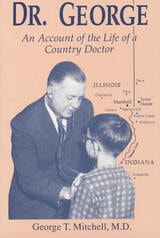
Doctor George
An Account of the Life of a Country DoctorGeorge T. Mitchell, M.D. Foreword by Glen W. Davidson
Southern Illinois University Press, 1993
Dr. George T. Mitchell of Marshall, Illinois, shares with humor and compassion stories and reflections about his medical practice of fifty years.
Having grown up in Marshall, Dr. Mitchell writes of his early experiences in midwestern America: basketball rivalries, school-boy pranks, and the traditions passed down through a family of doctors. Dr. Mitchell tells of his brief detour to obtain a degree in mechanical engineering, his decision to pursue a career in medicine, and his medical school experiences at the George Washington School of Medicine before the days of antibiotics and sophisticated medical technology. He vividly describes his subsequent service in World War II as a young surgeon at a military hospital helping injured soldiers resume normal lives while enduring the frustrations and occasional horrors of military life.
After the war, Dr. Mitchell joined his father’s practice in Marshall, where, he observes, he was among sixteen physicians in a rural county with a population of less than twenty thousand people. Within twenty-five years, the number of doctors had dropped to only four. In this memoir Dr. Mitchell conveys his unwillingness to just sit by and watch the health needs of his community increase while medical and other services decline. He, instead, became a community activist, representing rural concerns to the state medical society, organizing the first emergency medical technician teams in the county, masterminding the planning of a regional medical center, campaigning successfully for improved highway safety, and spurring the extension of reliable telephone service throughout his area.
As Dr. Mitchell recounts the house calls, farm accidents, emergency surgeries, and family counseling that comprised the life of this country doctor, he offers the keen insights of a clinician trained to look beyond what others only see.

Doctor Jim
A Community, a Commune, and a Clinic in the Oregon WoodsJim Shames
Oregon State University Press, 2027
In 1973 Jim Shames, a young doctor questioning life in a country divided by the Vietnam War, learned of a counterculture community in Southern Oregon interested in establishing its own medical clinic. A recent graduate from medical school, with limited hands-on experience as a doctor, Jim found the promise and opportunity of a community in the woods, far from the turmoil of the times, appealing. In a leap of faith, he joined the back-to-the-earth movement and became a country doctor.
In the impoverished Illinois River Valley of Southern Oregon, Shames moved to Takilma and the Mystic Mountain commune. There Shames found a home, family, and fulfilling work at the Takilma People’s Clinic. It was a different world, offering an alternative journey and self-reflection. Surrounded by uninhibited friendliness, joy, and music, Doctor Jim cared for the patients of the community. Collectively the clinic treated rattlesnake bites, gunshot wounds, obstetrical complications, meningitis, cancer, and more for the residents of Southern Oregon.
Doctor Jim offers a window into communal life and the challenges of healthcare in rural Oregon. Shames highlights the struggles and rewards to be found in simple daily activities with like-minded souls sharing emotional and physical work. In reflecting on his unique medical career, Shames teaches that healing is about the intimate interaction between the patient and the doctor rather than medications or procedures. What started as an experiment evolved into a medical practice caring for a broader community beyond its counterculture brethren.