Results by title
8812 books match the query 'Political Science' and 352 start with d
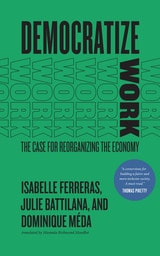
Democratize Work
The Case for Reorganizing the EconomyIsabelle Ferreras, Julie Battilana, and Dominique Méda
University of Chicago Press, 2022
What happens to a society—and a planet—when capitalism outgrows democracy? The tensions between democracy and capitalism are longstanding, and they have been laid bare by the social effects of COVID-19. The narrative of “essential workers” has provided thin cover for the fact that society’s lowest paid and least empowered continue to work risky jobs that keep our capitalism humming. Democracy has been subjugated by the demands of capitalism. For many, work has become unfair.
In Democratize Work, essays from a dozen social scientists—all women—articulate the perils and frustrations of our collective moment, while also framing the current crisis as an opportunity for renewal and transformation. Amid mounting inequalities tied to race, gender, and class—and with huge implications for the ecological fate of the planet—the authors detail how adjustments in how we organize work can lead to sweeping reconciliation. By treating workers as citizens, treating work as something other than an asset, and treating the planet as something to be cared for, a better way is attainable. Building on cross-disciplinary research, Democratize Work is both a rallying cry and an architecture for a sustainable economy that fits the democratic project of our societies.
Contributors include Alyssa Battistoni (Barnard College of Columbia University), Adelle Blackett (McGill University), Julia Cagé (Sciences Po), Neera Chandhoke (University of Delhi), Lisa Herzog (University of Groningen), Imge Kaya Sabanci (IE Business School), Sara Lafuente (European Trade Union Institute), Hélène Landemore (Yale University), Flávia Máximo (Universidade Federal de Ouro Preto, Brazil), and Pavlina R. Tcherneva (Levy Economics Institute of Bard College).

Democratizing Communist Militaries
The Cases of the Czech and Russian Armed ForcesMarybeth Peterson Ulrich
University of Michigan Press, 2000
In a groundbreaking study, Marybeth Peterson Ulrich explores the attitudes of the leaders of the armed forces in Russia and the Czech Republic toward the new democratic governments and suggests ways in which we might encourage the development of politically neutral militaries in these states. Building on the work of Samuel Huntington and others on the relationship between the military and the state, the author suggests that norms of military professionalism must change if the armies in countries making a transition from communist rule are to become strong supporters of the democratic state. The Czech Republic and Russia are interesting cases, because they have had very different experiences in the transition; they have different geopolitical goals; and they experienced different military-civilian relationships during the Soviet period. The author also explores American and NATO programs to promote democratization in these militaries and suggests changes in the programs.
Marybeth Peterson Ulrich is Associate Professor of Government, U.S. Army War College.

Democratizing Texas Politics
Race, Identity, and Mexican American Empowerment, 1945-2002By Benjamin Márquez
University of Texas Press, 2014
Winner, Outstanding Book Award, NACCS Tejas Foco Award for Non-Fiction, National Association for Chicana and Chicano Studies Tejas, 2015
By the beginning of the twenty-first century, Texas led the nation in the number of Latino officeholders, despite the state’s violent history of racial conflict. Exploring this and other seemingly contradictory realities of Texas’s political landscape since World War II, Democratizing Texas Politics captures powerful, interrelated forces that drive intriguing legislative dynamics. These factors include the long history of Mexican American activism; population growth among Mexican American citizens of voting age; increased participation among women and minorities at state and national levels in the Democratic Party, beginning in the 1960s; the emergence of the Republican Party as a viable alternative for Southern conservatives; civil rights legislation; and the transition to a more representative two-party system thanks to liberal coalitions.
Culling extensive archival research, including party records and those of both Latino activists and Anglo elected officials, as well as numerous interviews with leading figures and collected letters of some of Texas’s most prominent voices, Benjamin Márquez traces the slow and difficult departure from a racially uniform political class to a diverse one. As Texas transitioned to a more representative two-party system, the threat of racial tension and political exclusion spurred Mexican Americans to launch remarkably successful movements to ensure their incorporation. The resulting success and dilemmas of racially based electoral mobilization, embodied in pivotal leaders such as Henry B. Gonzalez and Tony Sanchez, is vividly explored in Democratizing Texas Politics.
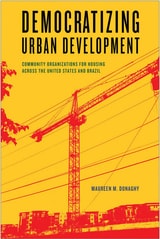
Democratizing Urban Development
Community Organizations for Housing across the United States and BrazilMaureen M. Donaghy
Temple University Press, 2018
Rising housing costs put secure and decent housing in central urban neighborhoods in peril. How do civil society organizations (CSOs) effectively demand accountability from the state to address the needs of low-income residents? In her groundbreaking book, Democratizing Urban Development, Maureen Donaghy charts the constraints and potential opportunities facing these community organizations. She assesses the various strategies CSOs engage to influence officials and ensure access to affordable housing through policies, programs, and institutions.
Democratizing Urban Development presents efforts by CSOs in four cities across the hemispheric divide: Rio de Janeiro, São Paulo, Washington, DC, and Atlanta. Donaghy studies the impact and outcomes that ensue from these efforts, noting that CSOs must sometimes shift their own ideology or adapt to the political environment in which they operate to ensure access to housing and support the goals of an inclusive city.

Demos Assembled
Democracy and the International Origins of the Modern State, 1840–1880Stephen W. Sawyer
University of Chicago Press, 2018
Previous studies have covered in great detail how the modern state slowly emerged from the early Renaissance through the seventeenth century, but we know relatively little about the next great act: the birth and transformation of the modern democratic state. And in an era where our democratic institutions are rife with conflict, it’s more important now than ever to understand how our institutions came into being.
Stephen W. Sawyer’s Demos Assembled provides us with a fresh, transatlantic understanding of that political order’s genesis. While the French influence on American political development is well understood, Sawyer sheds new light on the subsequent reciprocal influence that American thinkers and politicians had on the establishment of post-revolutionary regimes in France. He argues that the emergence of the stable Third Republic (1870–1940), which is typically said to have been driven by idiosyncratic internal factors, was in fact a deeply transnational, dynamic phenomenon. Sawyer’s findings reach beyond their historical moment, speaking broadly to conceptions of state formation: how contingent claims to authority, whether grounded in violence or appeals to reason and common cause, take form as stateness.
Demos Rising
Democracy and the Popular Construction of Public Power in France, 1800–1850Stephen W. Sawyer
University of Chicago Press, 2025
In his previous book, Demos Assembled, historian Stephen W. Sawyer offered a transatlantic account of the birth and transformation of the modern democratic state. In Demos Rising, he presents readers of political history with a prequel whose ambitious claim is that a genuine demos became possible in France only with the development of government regulation and administration. Focusing on democracy as a form of administration rather than as a form of sovereignty allows Sawyer to explore urban planning, work and private enterprise, health administration, and much more as cornerstones of a self-governing society of equals.
Examining the period between 1800 and 1850, Sawyer studies a set of thinkers who debated at length over the material problems of everyday life, sparking calls for political action and social reform in the face of conflict wreaked by deforestation, urbanization, health crises, labor relations, industrial capitalism, religious tensions, and imperial expansion. The solutions to these problems, Sawyer argues, were sought—and sometimes found—not through elections, as one might assume, but rather through the “care for all” promised by modern administrative power, regulatory intervention, and social welfare programs. By studying this profound transformation in governance, the book wagers, we can better understand the origin and meaning of democracy—even when events in our own time have thrown the concept into doubt.

Departing from Deviance
A History of Homosexual Rights and Emancipatory Science in AmericaHenry L. Minton
University of Chicago Press, 2001

Derelict Paradise
Homelessness and Urban Development in Cleveland, OhioDaniel R. Kerr
University of Massachusetts Press, 2011
Seeking answers to the question, “Who benefits from homelessness?” this book takes the reader on a sweeping tour of Cleveland's history from the late nineteenth-century through the early twenty-first. Daniel Kerr shows that homelessness has deep roots in the shifting ground of urban labor markets, social policy, downtown development, the criminal justice system, and corporate power. Rather than being attributable to the illnesses and inadequacies of the unhoused themselves, it is a product of both structural and political dynamics shaping the city. Kerr locates the origins of today's shelter system in the era that followed the massive railroad rebellions of 1877. From that period through the Great Depression, business and political leaders sought to transform downtown Cleveland to their own advantage. As they focused on bringing business travelers and tourists to the city and beckoned upper-income residents to return to its center, they demolished two downtown working-class neighborhoods and institutionalized a shelter system to contain and control the unhoused and unemployed. The precedents from this period informed the strategies of the post–World War II urban renewal era as the "new urbanism" of the late twentieth century. The efforts of the city's elites have not gone uncontested. Kerr documents a rich history of opposition by people at the margins of whose organized resistance and everyday survival strategies have undermined the grand plans crafted by the powerful and transformed the institutions designed to constrain the lives of the homeless.

Derrida and the Time of the Political
Pheng Cheah and Suzanne Guerlac, eds.
Duke University Press, 2009
The volume opens with a substantial introduction in which Pheng Cheah and Suzanne Guerlac survey Derrida’s entire corpus and position his later work in relation to it. The remaining essays address the concerns that arise out of Derrida’s analysis of politics and the conditions of the political, such as the meaning and scope of democracy, the limits of sovereignty, the relationship between the ethical and the political, the nature of responsibility, the possibility for committed political action, the implications of deconstructive thought for non-Western politics, and the future of nationalism in an era of globalization and declining state sovereignty. The collection is framed by original contributions from Hélène Cixous and Judith Butler.
Contributors. Étienne Balibar, Geoffrey Bennington, Wendy Brown, Judith Butler, Pheng Cheah, Hélène Cixous, Rodolphe Gasché, Suzanne Guerlac, Marcel Hénaff, Martin Jay, Anne Norton, Jacques Rancière, Soraya Tlatli, Satoshi Ukai
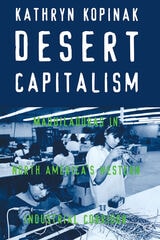
Desert Capitalism
Maquiladoras in North America's Western Industrial CorridorKathryn Kopinak
University of Arizona Press, 1996

Desert Water
The Future of Utah's Water ResourcesHal Crimmel
University of Utah Press, 2014

Deserving Americans
Partisanship and the New Politics of Social PolicyChris Faricy and Christopher Ellis
University of Chicago Press, 0
A new framework for showing why deservingness politics, more than ideology, has become the central battleground for social policy in a polarized age.
Why do Americans support some government programs but not others? In Deserving Americans, Chris Faricy and Christopher Ellis argue that the answer lies in identity, not ideology. Specifically, support for particular social policies depends on perceptions of whether beneficiaries of government assistance actually deserve the aid that they receive. As partisanship and social identity have converged, partisans increasingly view government aid as a vehicle for rewarding ingroups and punishing outgroups, creating a politics polarized on identity and who government should serve.
Faricy and Ellis show how these dynamics play out across a wide range of policy domains, from antipoverty to health care to family policy and more. Their findings help to clarify many of our current predicaments, yielding insights that explain trends in public opinion and partisan debates over public policy. Deserving Americans offers a powerful new framework for understanding how Americans view social policy—and each other.

Design for Democracy
Ballot and Election DesignMarcia Lausen
University of Chicago Press, 2007
Handsomely designed itself, this volume showcases adaptable design models that can improve almost every part of the election process by maximizing the clarity and usability of ballots, registration forms, posters and signs, informational brochures and guides, and even administrative materials for poll workers. Design for Democracy also lays out specific guidelines—covering issues of color palette, typography, and image use—that anchor the comprehensive election design system devised by the group of design specialists from whose name the book takes its title. Part of a major AIGA strategic program, this group's prototypes and recommendations have already been used successfully in major Illinois and Oregon elections and, collected here, are likely to spread across the country as more people become aware of the myriad benefits and broad applicability of improved election design.
An essential tool for designers and election officials, lawmakers and citizens, Design for Democracy harnesses the power of design to increase voter confidence, promote government transparency, and, perhaps most important, create an informed electorate.
Designing Democratic Government
Making Institutions WorkMargaret Levi
Russell Sage Foundation, 2008
Designing Judicial Review
Interest Groups, Congress, and Communications PolicyCharles R. Shipan
University of Michigan Press, 2000

Desire and Imitation in International Politics
Jodok Troy
Michigan State University Press, 2021

Desired States
Sex, Gender, and Political Culture in ChileLessie Jo Frazier
Rutgers University Press, 2020
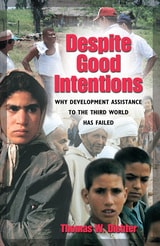
Despite Good Intentions
Why Development Assistance to the Third World Has FailedThomas W. Dichter
University of Massachusetts Press, 2003
For more than thirty-five years, Thomas W. Dichter has worked in the field of international development, managing and evaluating projects for nongovernmental organizations, directing a Peace Corps country program, and serving as a consultant for such agencies as USAID, UNDP, and the World Bank. On the basis of this extensive and varied experience, he has become an outspoken critic of what he terms the “international poverty alleviation industry.” He believes that efforts to reduce world poverty have been well-intentioned but largely ineffective. On the whole, the development industry has failed to serve the needs of the people it has sought to help.
To make his case, Dichter reviews the major trends in development assistance from the 1960s through the 1990s, illustrating his analysis with eighteen short stories based on his own experiences in the field. The analytic chapters are thus grounded in the daily life of development workers as described in the stories.
Dichter shows how development organizations have often become caught up in their own self-perpetuation and in public relations efforts designed to create an illusion of effectiveness. Tracing the evolution of the role of money (as opposed to ideas) in development assistance, he suggests how financial imperatives have reinforced the tendency to sponsor time-bound projects, creating a dependency among aid recipients. He also examines the rise of careerism and increased bureaucratization in the industry, arguing that assistance efforts have become disconnected from important lessons learned on the ground, and often lessons of world history.
In the end, Dichter calls for a more light-handed and artful approach to development assistance, with fewer agencies and experts involved. His stance is pragmatic, rather than ideological or political. What matters, he says, is what works, and the current practices of the development industry are simply not effective.

Destinies of the Disadvantaged
The Politics of Teen ChildbearingFrank F. Furstenberg
Russell Sage Foundation, 2007

Destroy Them Gradually
Displacement as AtrocityAndrew R. Basso
Rutgers University Press, 2024

Detente in Europe
The Soviet Union & The West Since 1953John Van Oudenaren
Duke University Press, 1991
In redefining détente as a process, rather than a code of conduct, Van Oudenaren looks to its origins in Soviet policy earlier than previously identified and analyzes both its history and character. His study explores the restoration of four-power negotiations in Germany and Austria in the mid-1950s, their subsequent breakdown in the Berlin crisis, their unexpected revival in 1990 in the form of “two plus four” talks on German unity, and the future of the Soviet Union as a European power.
Among the key elements of détente discussed are diplomacy, particularly the role of summit conferences; cooperation among parliaments, political parties, and trade unions; arms control; economic relations; and links among cultural institutions, churches, and peace movements.

Dethroning the Deceitful Pork Chop
Rethinking African American Foodways from Slavery to ObamaJennifer Jensen Wallach
University of Arkansas Press, 2015
2017 Association for the Study of Food and Society Award, best edited collection.
The fifteen essays collected in Dethroning the Deceitful Pork Chop utilize a wide variety of methodological perspectives to explore African American food expressions from slavery up through the present. The volume offers fresh insights into a growing field beginning to reach maturity. The contributors demonstrate that throughout time black people have used food practices as a means of overtly resisting white oppression—through techniques like poison, theft, deception, and magic—or more subtly as a way of asserting humanity and ingenuity, revealing both cultural continuity and improvisational finesse. Collectively, the authors complicate generalizations that conflate African American food culture with southern-derived soul food and challenge the tenacious hold that stereotypical black cooks like Aunt Jemima and the depersonalized Mammy have on the American imagination. They survey the abundant but still understudied archives of black food history and establish an ongoing research agenda that should animate American food culture scholarship for years to come.

Detours
Travel and the Ethics of Research in the Global SouthEdited by M. Bianet Castellanos
University of Arizona Press, 2019
Influenced by the works of anthropologists Ruth Behar and Renato Rosaldo, the scholars and journalists in this volume consider how first encounters—those initial, awkward attempts to learn about a culture and a people—evolved into enduring and critical engagements. Contemplating the ethics and racial politics of traveling and doing research abroad, they call attention to the power and privilege that permit researchers to enter people’s lives, ask intimate questions, and publish those disclosures. Focusing on Latin America and the Caribbean, they ask, Why this place? What keeps us coming back? And what role do we play in producing narratives of inequality, uneven development, and global spectacle?
The book examines the “politics of return”—the experiences made possible by revisiting a field site over extended periods of time—of scholars and journalists who have spent decades working in and writing about Latin America and the Caribbean. Contributors aren’t telling a story of enlightenment and goodwill; they focus instead on the slippages and conundrums that marked them and raised questions of their own intentions and intellectual commitments.
Speaking from the intersection of race, class, and gender, the contributors explore the hubris and nostalgia that motivate returning again and again to a particular place. Through personal stories, they examine their changing ideas of Latin America and the Caribbean and how those places have shaped the people they’ve become, as writers, as teachers, and as activists.

Detroit's Cold War
The Origins of Postwar ConservatismColleen Doody
University of Illinois Press, 2017
Developing Partnerships
Gender, Sexuality, and the Reformed World BankKate Bedford
University of Minnesota Press, 2009
A nuanced critique of how the World Bank encourages gender norms through its policies, Developing Partnerships argues that financial institutions are key players in the global enforcement of gender and family expectations.
By combining analysis of documents produced and sponsored by the World Bank with interviews of World Bank staffers and case studies, Kate Bedford presents a detailed examination of gender and sexuality in the policies of the world's largest and most influential development institution. Looking concurrently at economic and gender policy, Bedford connects reform of markets to reform of masculinities, loan agreements for export promotion to pamphlets for indigenous adolescents advising daily genital bathing, and attempts to strengthen institutions after the Washington Consensus to efforts to promote loving couplehood in response to economic crisis. In doing so, she reveals the shifting relationships between development and sexuality and the ways in which gender policy impacts debates about the future of neoliberalism.
Providing a multilayered account of how gender-aware policies are conceived and implemented by the World Bank, Developing Partnerships demonstrates as well how institutional practices shape development.
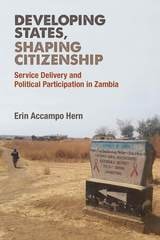
Developing States, Shaping Citizenship
Service Delivery and Political Participation in ZambiaErin Accampo Hern
University of Michigan Press, 2019
Erin Accampo Hern draws on original data from an original large-N survey, interviews, Afrobarometer data, and archival materials collected over 12 months in Zambia. The theory underlying this book’s framework is that of policy feedback, which argues that policies, once in place, influence the subsequent political participation of the affected population. This theory has predominantly been applied to advanced industrial democracies, and this book is the first explicit effort to adapt the theory to the developing country context.

Developing the City
Community Development, Power, and Urban Democracy in U.S. CitiesEdited by Ashley E. Nickels and Zachary D. Wood
Temple University Press, 2027
Developing the City investigates the forms, levels, and spaces of power (visible, hidden, and invisible) involved in community development ecosystems. The editors and contributors, a mix of embedded activists, academics, and community leaders, provide a series of diverse case studies that evaluate the local dynamics that shape urban policy.
Chapters address racialized power dynamics in Cleveland, OH, community development funding in Memphis, TN, economic growth and inclusion in Newark, NJ, housing policies in Denver and Colorado Springs, CO, and participatory governance in Reno, NV among other topics. They reflect the unique manifestations of power within each local context, shaped by distinctive histories and sociopolitical dynamics.
In addition to exploring how various dimensions of power influence decision-making, resource allocation, democratic engagement, and civic participation, Developing the City provides a systematic framework for understanding and questioning these power dynamics, and advocates for a power-conscious approach to foster more equitable and democratic urban futures with respect to economic, racial, social, and environmental justice.
Contributors: Nakeefa Cilicia Bernard, Prentiss A. Dantzler, Caraline Feairheller, Austin Harrison, Brad A. M. Johnson, Katherine Lambert-Pennington, Eric Stokan, Robert Stoker, Jill Yordy, and the editors

Developing to Scale
Technology and the Making of Global HealthHeidi Morefield
University of Chicago Press, 2023
In 1973, economist E. F. Schumacher published Small Is Beautiful, which introduced a mainstream audience to his theory of “appropriate technology”: the belief that international development projects in the Global South were most sustainable when they were small-scale, decentralized, and balanced between the traditional and the modern. His theory gained widespread appeal, as cuts to the foreign aid budget, the national interests of nations seeking greater independence, postcolonial activism, and the rise of the United States’ tech sector drove stakeholders across public and private institutions toward cheaper tools. In the ensuing decades, US foreign assistance shifted away from massive modernization projects, such as water treatment facilities, toward point-of-use technologies like village water pumps and oral rehydration salts. This transition toward the small scale had massive implications for the practice of global health.
Developing to Scale tells the history of appropriate technology in international health and development, relating the people, organizations, and events that shaped this consequential idea. Heidi Morefield examines how certain technologies have been defined as more or less “appropriate” for the Global South based on assumptions about gender, race, culture, and environment. Her study shows appropriate technology to be malleable, as different constituencies interpreted its ideas according to their own needs. She reveals how policymakers wielded this tool to both constrain aid to a scale that did not threaten Western interests and to scale the practice of global health through the development and distribution of technical interventions.
Developing to Scale
Technology and the Making of Global HealthHeidi Morefield
University of Chicago Press, 2023
The first critical book on “appropriate technology,” Developing to Scale shows how global health came to be understood as a problem to be solved with the right technical interventions.
In 1973, economist E. F. Schumacher published Small Is Beautiful, which introduced a mainstream audience to his theory of “appropriate technology”: the belief that international development projects in the Global South were most sustainable when they were small-scale, decentralized, and balanced between the traditional and the modern. His theory gained widespread appeal, as cuts to the foreign aid budget, the national interests of nations seeking greater independence, postcolonial activism, and the rise of the United States’ tech sector drove stakeholders across public and private institutions toward cheaper tools. In the ensuing decades, US foreign assistance shifted away from massive modernization projects, such as water treatment facilities, toward point-of-use technologies like village water pumps and oral rehydration salts. This transition toward the small scale had massive implications for the practice of global health.
Developing to Scale tells the history of appropriate technology in international health and development, relating the people, organizations, and events that shaped this consequential idea. Heidi Morefield examines how certain technologies have been defined as more or less “appropriate” for the Global South based on assumptions about gender, race, culture, and environment. Her study shows appropriate technology to be malleable, as different constituencies interpreted its ideas according to their own needs. She reveals how policymakers wielded this tool to both constrain aid to a scale that did not threaten Western interests and to scale the practice of global health through the development and distribution of technical interventions.
Development Theory and the Economics of Growth
Jaime Ros
University of Michigan Press, 2000
Development and Crisis of the Welfare State
Parties and Policies in Global MarketsEvelyne Huber and John D. Stephens
University of Chicago Press, 2001
Building on their previous research, Huber and Stephens show how high wages and generous welfare states are still possible in an age of globalization and trade competition.

Development as Communication
A Perspective on IndiaUma Narula
Southern Illinois University Press, 1986
This book applies a systematic communication theory to the 30-plus years of development experience in India.
Never before has development been treated from a communication perspective. This perspective demonstrates that the role of communication in development is not limited to the technology of satellites or to the economics of mass media; it is a way of thinking about the interaction among all agents involved.
The empirical data describe patterns of social realities, actions, and communication networks among planners, contact agents, and the masses in two Indian communities. The result is an analytical review of development theories and practice in India.
This study is practical as well as theoretical. The authors show how the theory of the “coordinated management of meaning” applies to large-scale social interactions. They also offer specific recommendations for Indian development planners.
Development in Multiple Dimensions
Social Power and Regional Policy in IndiaAlexander Lee
University of Michigan Press, 2019
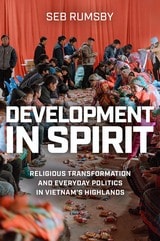
Development in Spirit
Religious Transformation and Everyday Politics in Vietnam’s HighlandsSeb Rumsby
University of Wisconsin Press, 2023
Following state-led market reforms in the 1980s, Vietnam experienced stunning economic transformation. But for the Hmong communities of the country’s north and central highlands, the benefits proved elusive. Instead, the Hmong people have pursued their own alternative paths to development. Rumsby shows how mass conversion to Christianity led to a case of “unplanned development” that put the Hmong on a trajectory of simultaneous integration into the market economy and resistance to state authority.
Many of the strategies community members employ are tied to the Christianization of everyday life. Religious actors play complex and often contradictory roles in facilitating networks of exchange, challenging or enforcing gender norms, promoting communalism and enforcing discipline, and shaping local ideas about progress. They are influenced by national and transnational religious networks, especially US-produced radio broadcasts by Hmong American Christians and local converts.
This compelling account provides fresh theoretical and empirical insights into the interplay of religion, neoliberal development, and marketization across the world.

Developments in Central and East European Politics 5
Stephen White, Paul G. Lewis, and Judy Batt, eds.
Duke University Press, 0
Central and East Europe is a large, extremely diverse region, encompassing full-fledged EU members—the Czech Republic, Hungary, Poland, Estonia, Latvia, Lithuania, Slovenia, and Slovakia, followed later by Bulgaria and Romania—as well as nations of the Western Balkans that are progressing at various speeds along the EU path—Croatia, about to join; Macedonia, Montenegro and Serbia, with EU candidate status; and Albania, Bosnia and Herzegovina, and Kosovo, struggling to keep up. The region also includes the East European states of Ukraine, Belarus, and Moldova. In this collection, leading authorities examine how these heterogeneous nations have fared since the collapse of communism. The contributors look at executive leadership, elections and voter behavior, parliamentary systems, political parties, citizen engagement in civil society, the effects of neoliberalism, and the quality of life in postcommunist democracies. Most of the essays are new to this edition; the rest have been thoroughly updated.
Contributors. Judy Batt, Sarah Birch, Nathaniel Copsey, Terry Cox, Rick Fawn, Tim Haughton, Krzysztof Jasiewicz, Paul G. Lewis, Frances Millard, David M. Olson, Mitchell A. Orenstein, Andrew Roberts, Ray Taras, Stephen White, Andrew Wilson

Developments in Central and East European Politics 5
Stephen White, Paul G. Lewis, and Judy Batt, eds.
Duke University Press, 0
Central and East Europe is a large, extremely diverse region, encompassing full-fledged EU members—the Czech Republic, Hungary, Poland, Estonia, Latvia, Lithuania, Slovenia, and Slovakia, followed later by Bulgaria and Romania—as well as nations of the Western Balkans that are progressing at various speeds along the EU path—Croatia, about to join; Macedonia, Montenegro and Serbia, with EU candidate status; and Albania, Bosnia and Herzegovina, and Kosovo, struggling to keep up. The region also includes the East European states of Ukraine, Belarus, and Moldova. In this collection, leading authorities examine how these heterogeneous nations have fared since the collapse of communism. The contributors look at executive leadership, elections and voter behavior, parliamentary systems, political parties, citizen engagement in civil society, the effects of neoliberalism, and the quality of life in postcommunist democracies. Most of the essays are new to this edition; the rest have been thoroughly updated.
Contributors. Judy Batt, Sarah Birch, Nathaniel Copsey, Terry Cox, Rick Fawn, Tim Haughton, Krzysztof Jasiewicz, Paul G. Lewis, Frances Millard, David M. Olson, Mitchell A. Orenstein, Andrew Roberts, Ray Taras, Stephen White, Andrew Wilson

Developments in German Politics 3
Stephen Padgett, William E. Paterson, and Gordon Smith, eds.
Duke University Press, 0
Contributors. David P. Conradt, Russell J. Dalton, Kenneth Dyson, Klaus H. Goetz, Simon Green, Adrian Hyde-Price, Charlie Jeffery, Stephen Padgett, William E. Paterson, Wolfgang Rüdig, Martin Seeleib-Kaiser, Gordon Smith, Roland Sturm
Developments in Russian Politics 10
Henry E. Hale, Juliet Johnson, and Tomila V. Lankina, editors
Duke University Press, 0
Developments in Russian Politics 6
Stephen White, Zvi Gitelman, and Richard Sakwa, eds.
Duke University Press, 0
Contributors. Alfred B. Evans, Zvi Gitelman, Gordon Hahn, Margot Light, Michael McFaul, Sarah Oates, Thomas F. Remington, Peter Rutland, Richard Sakwa, Robert Sharlet, Darrell Slider, Judy Twigg, Stephen White, John P. Willerton
Developments in Russian Politics 7
Stephen White, Richard Sakwa, and Henry E. Hale, eds.
Duke University Press, 0
Contributors. Alfred B. Evans, Henry E. Hale, P. Hanson, Margot Light, N. Manning, J. Mathers, Michael McFaul, Sarah Oates, Thomas F. Remington, C. Ross, Richard Sakwa, Darrell Slider, G. Smith, Stephen White, John P. Willerton

Developments in Russian Politics 7
Stephen White, Richard Sakwa, and Henry E. Hale, eds.
Duke University Press, 0
Contributors. Alfred B. Evans, Henry E. Hale, P. Hanson, Margot Light, N. Manning, J. Mathers, Michael McFaul, Sarah Oates, Thomas F. Remington, C. Ross, Richard Sakwa, Darrell Slider, G. Smith, Stephen White, John P. Willerton

Developments in Russian Politics 8
Stephen White, Richard Sakwa and Henry E. Hale, eds.
Duke University Press, 0
Contributors. Vladimir Gel'man, Henry E. Hale, Philip Hanson, Kathryn Hendley, Margot Light, Jennifer Mathers, Ian McAllister, Sarah Oates, Thomas F. Remington, Graeme Robertson, Richard Sakwa, Darrell Slider, Svetlana Stephenson, Stephen White, John P. Willerton

Developments in Russian Politics 9
Richard Sakwa, Henry E. Hale, and Stephen White, editors
Duke University Press, 2019
Contributors. Samuel Charap, Valentina Feklyunina, Henry E. Hale, Philip Hanson, Kathryn Hendley, Marlene Laruelle, Ellen Mickiewicz, Ben Noble, Thomas F. Remington, Bettina Renz, Ora John Reuter, Graeme Robertson, Richard Sakwa, Darrell Slider, Stephen White, John P. Willerton

Devils Hole Pupfish
The Unexpected Survival of an Endangered Species in the Modern American WestKevin C. Brown
University of Nevada Press, 2021

Devouring Cultures
Perspectives on Food, Power, and Identity from the Zombie Apocalypse to Downton AbbeyCammie M. Sublette
University of Arkansas Press, 2016
Devouring Cultures brings together contributors from a wide range of disciplines including media studies, rhetoric, gender studies, philosophy, anthropology, literary criticism, film criticism, race theory, history, and linguistics to examine the ways food signifies both culture and identity.
These scholars look for answers to intriguing questions: What does our choice of dining house say about our social class? Can restaurants teach us about a culture? How does food operate in Downton Abbey? How does food consumption in zombie apocalypse films and apocalyptic literature relate to contemporary food-chain crises and food nostalgia? What aspects of racial conflict, assimilation, and empowerment may be represented in restaurant culture and food choice?
Restaurants, from their historical development to their modern role as surrogate kitchen, are studied as markers of gender, race, and social class, and also as forums for the exhibition of tensions or spaces where culture is learned through the language of food. Food, as it is portrayed in literature, movies, and television, is illuminated as a platform for cultural assimilation, a way for the oppressed to find agency, or even a marker for the end of a civilization.
The essays in Devouring Cultures show how our choices about what we eat, where we eat, and with whom we eat are linked to identity and meaning and how the seemingly simple act of consumption has implications that extend far beyond sustenance.

Diamond and Juba
The Raucous World of 19th-Century Challenge DancingApril F. Masten
University of Illinois Press, 2025

Diamonds in the Rough
Corporate Paternalism and African Professionalism on the Mines of Colonial Angola, 1917–1975Todd Cleveland
Ohio University Press, 2015
Diamonds in the Rough explores the lives of African laborers on Angola’s diamond mines from the commencement of operations in 1917 to the colony’s independence from Portugal in 1975. The mines were owned and operated by the Diamond Company of Angola, or Diamang, which enjoyed exclusive mining and labor concessions granted by the colonial government. Through these monopolies, the company became the most profitable enterprise in Portugal’s African empire. After a tumultuous initial period, the company’s mines and mining encampments experienced a remarkable degree of stability, in striking contrast to the labor unrest and ethnic conflicts that flared in other regions. Even during the Angolan war for independence (1961–75), Diamang’s zone of influence remained comparatively untroubled.
Todd Cleveland explains that this unparalleled level of quietude was a product of three factors: African workers’ high levels of social and occupational commitment, or “professionalism”; the extreme isolation of the mining installations; and efforts by Diamang to attract and retain scarce laborers through a calculated paternalism. The company’s offer of decent accommodations and recreational activities, as well as the presence of women and children, induced reciprocal behavior on the part of the miners, a professionalism that pervaded both the social and the workplace environments. This disparity between the harshness of the colonial labor regime elsewhere and the relatively agreeable conditions and attendant professionalism of employees at Diamang opens up new ways of thinking about how Africans in colonial contexts engaged with forced labor, mining capital, and ultimately, each other.

Diaspora Identities
Exile, Nationalism and Cosmopolitanism in Past and PresentEdited by Susanne Lachenicht and Kirsten Heinsohn
Campus Verlag, 2009
Historical work on the late nineteenth and early twentieth centuries suggests that as nation-states were solidifying throughout Western Europe, exiled groups tended to develop rival national identities—an occurrence that had been fairly uncommon in the two preceding centuries. Diaspora Identities draws on eight case studies, ranging from the early modern period through the twentieth century, to explore the interconnectedness of exile, nationalism, and cosmopolitanism as concepts, ideals, attitudes, and strategies among diasporic groups.