Results by title
28164 books match the query 'History' and 908 start with d

Death to Fascism
Louis Adamic's Fight for DemocracyJohn P. Enyeart
University of Illinois Press, 2019

Death's Door
True Tales of Tragedy, Mystery, and Bravery from the Great Lakes' Most Dangerous WatersBarbara Joosse
Wisconsin Historical Society Press, 2023
This beautifully illustrated book for children ages 8–11 relates dramatic moments from Great Lakes maritime history in a graphic-novel style. The book’s five true stories span four centuries but take place in one location: a dangerous stretch of water near Lake Michigan’s western shore that is known as “Death’s Door.”
Young readers will devour these tales of tragic accidents, mysterious disappearances, and heroic moments. The stories feature a 17th-century fur trading crew, an 18th-century Potawatomi trading party, a mail carrier and a shipbuilding family from the 19th century, and an early 20th-century basketball team. The narrator is Death’s Door itself, who wonders why people insist on crossing its treacherous waters, concluding it is “because they are human. Ambitious and restless…but loving too.”
An informative afterword provides insight into the author’s sources and features archival images and additional historical details about each of the stories.
Silver winner of the 2023 Midwest Book Award for Graphic Novels

Death's Futurity
The Visual Life of Black PowerSampada Aranke
Duke University Press, 2023
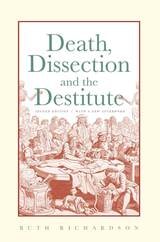
Death, Dissection and the Destitute
Ruth Richardson
University of Chicago Press, 2001

Debate of the Romance of the Rose
Christine de Pizan
University of Chicago Press, 2010
In 1401, Christine de Pizan (1365–1430?), one of the most renowned and prolific woman writers of the Middle Ages, wrote a letter to the provost of Lille criticizing the highly popular and widely read Romance of the Rose for its blatant and unwarranted misogynistic depictions of women. The debate that ensued, over not only the merits of the treatise but also of the place of women in society, started Europe on the long path to gender parity. Pizan’s criticism sparked a continent-wide discussion of issues that is still alive today in disputes about art and morality, especially the civic responsibility of a writer or artist for the works he or she produces.
In Debate of the “Romance of the Rose,” David Hult collects, along with the debate documents themselves, letters, sermons, and excerpts from other works of Pizan, including one from City of Ladies—her major defense of women and their rights—that give context to this debate. Here, Pizan’s supporters and detractors are heard alongside her own formidable, protofeminist voice. The resulting volume affords a rare look at the way people read and thought about literature in the period immediately preceding the era of print.
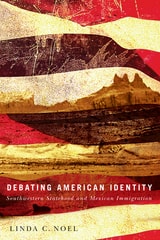
Debating American Identity
Southwestern Statehood and Mexican ImmigrationLinda C. Noel
University of Arizona Press, 2014
In Debating American Identity, Linda C. Noel examines several nation-defining events—the proposed statehood of Arizona and New Mexico, the creation of a temporary worker program during the First World War, immigration restriction in the 1920s, and the repatriation of immigrants in the early 1930s. Noel uncovers the differing ways in which Americans argued about how newcomers could fit within the nation-state, in terms of assimilation, pluralism, or marginalization, and the significance of class status, race, and culture in determining American identity.
Noel shows not only how the definition of American was contested, but also how the economic and political power of people of Mexican descent, their desire to incorporate as Americans or not, and the demand for their territory or labor by other Americans played an important part in shaping decisions about statehood and national immigration policies. Debating American Identity skillfully shows how early twentieth century debates over statehood influenced later ones concerning immigration; in doing so, it resonates with current discussions, resulting in a well-timed look at twentieth century citizenship.

Debating Darwin
Robert J. Richards and Michael Ruse
University of Chicago Press, 2016
Examining key disagreements about Darwin that continue to confound even committed Darwinists, Richards and Ruse offer divergent views on the origins and nature of Darwin and his ideas. Ruse argues that Darwin was quintessentially British and that the roots of his thought can be traced back to the eighteenth century, particularly to the Industrial Revolution and thinkers such as Adam Smith and Thomas Robert Malthus. Ruse argues that when these influences are appreciated, we can see how Darwin’s work in biology is an extension of their theories. In contrast, Richards presents Darwin as a more cosmopolitan, self-educated man, influenced as much by French and particularly German thinkers. Above all, argues Richards, it was Alexander von Humboldt who both inspired Darwin and gave him the conceptual tools that he needed to find and formulate his evolutionary hypotheses. Together, the authors show how the reverberations of the contrasting views on Darwin’s influences can be felt in theories about the nature of natural selection, the role of metaphor in science, and the place of God in Darwin’s thought.
Revealing how much there still is to investigate and interrogate about Darwin’s ideas, Debating Darwin contributes to our understanding of evolution itself. The book concludes with a jointly authored chapter that brings this debate into the present, focusing on human evolution, consciousness, religion, and morality. This will be powerful, essential reading for anyone seeking a comprehensive understanding of modern-day evolutionary science and philosophy.

Debating Muslims
Cultural Dialogues in Postmodernity and TraditionMichael M. J. Fischer and Mehdi Abedi
University of Wisconsin Press, 1990
In a world of multinational commerce, satellite broadcasting, migration, terrorism, and global arms dealing, what is said and how it is said in one society can no longer be isolated from what is said and how it is said in another. Debating Muslims focuses on Iranian culture, Shi’ite Islam, and Iranians in the United States, offering an experiment in postmodern ethnography and an invitation to think in a multifaceted way about Islam in the contemporary world.
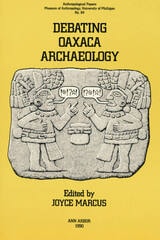
Debating Oaxaca Archaeology
Edited by Joyce Marcus
University of Michigan Press, 1990

Debating Women's Equality
Toward a Feminist Theory of Law from a European PerspectiveGerhard, Ute
Rutgers University Press, 2001
Ute Gerhard places women's rights at the center of legal philosophy and sees the struggle for equality as a driving force in the history of law. Focusing on Europe and taking the course of German feminism and law as primary examples, she incorporates the various social contexts in which questions of equality and gender difference have been raised into an analysis that challenges misconceptions about the principle of equality itself.
Gerhard reviews the history of women's movements in the nineteenth and twentieth centuries and traces the historical development of claims to gender equality as well as obstacles to these claims. Critically exploring the influence of philosophers such as Rousseau, Fichte, and Kant, Gerhard concludes that women need to be recognized as both equal and different-that claims to equality do not simply eliminate difference, but also articulate it. Mindful of the social and political contexts surrounding equality arguments, Gerhard probes three legal issues: women's rights in the public sphere, especially the right to vote; women's legal capacities in private law, or the legal doctrine of so-called gender tutelage; and women's human rights, a prominent concern in the current international women's movement.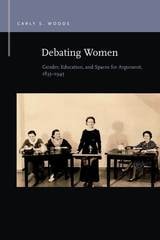
Debating Women
Gender, Education, and Spaces for Argument, 1835-1945Carly S. Woods
Michigan State University Press, 2018

Debating the American Dream
How Explanations for Inequality Polarize PoliticsElizabeth Suhay
Russell Sage Foundation, 2025
Drawing on public opinion surveys spanning more than four decades, Suhay finds that Americans’ belief in the American Dream is strongly related to their political party affiliation. Democratic Party leaders have increasingly questioned the fairness of the American economy, and, in effect, have called into question whether the American Dream is “real.” Republican Party leaders, by contrast, have consistently defended the fairness of the economy and the American Dream. While it is true that Americans have become more skeptical of the American Dream overall, Suhay finds this skepticism is concentrated among Democratic members of the public. Despite the increasingly working-class make-up of the Republican coalition, most Republican members of the public continue to believe the American Dream is reality.
Suhay finds that both Democrats and Republicans tend to adhere to their party’s economic narratives when identifying the causes of inequality between rich and poor, White and Black and Latino Americans, and men and women. Democrats and liberals often attribute inequality between these groups to societal causes, such as lack of access to education and jobs or discrimination. Republicans and conservatives, on the other hand, are more likely to blame individuals and lower income groups for their difficulties. However, Americans’ beliefs are less polarized when they consider socioeconomic inequalities rarely debated by politicians. For example, when asking Republicans and Democrats about the roots of rural-urban and White-Asian inequality, there is no clear unequal opportunity-individual responsibility partisan divide. Suhay argues that the availability of partisan “scripts” helps to explain differences in the public’s views on inequality between groups that have been politicized. These beliefs appear to bolster support for the two parties’ policy agendas among party supporters, driving a wedge between Democrats and Republicans in support for redistributive economic policy as well as the political candidates who support or oppose redistribution.
Debating the American Dream provides fascinating insights into politics’ role in Americans’ beliefs and attitudes concerning inequality.
Debating the End of History
The Marketplace, Utopia, and the Fragmentation of Intellectual LifeDavid W. Noble
University of Minnesota Press, 2012
Why do modern people assume that there will be perpetual economic growth? Because, David W. Noble tells us in this provocative study of cultural criticism, such a utopian conviction is the necessary foundation for bourgeois culture. One can imagine the existence of modern middle classes only as long as the capitalist marketplace is expanding. For Noble, the related—and relevant—question is, how can the middle classes believe that a finite earth is an environment in which infinite growth is possible? The answer, which Noble so painstakingly charts, is nothing less than a genealogy of the uses and abuses of knowledge that lie at the heart of so many of our political problems today.
As far back as Plato and as recently as Alan Greenspan, Noble finds proponents of the idea of a world of independent, rational individuals living in timeless simplicity, escaping from an old world of interdependence and generations. Such notions, although in sync with Newtonian science, have come up against the subsequent conclusions of geology, biology, and the physics of Einstein. In a survey of the responses to this quandary of historians, economists, literary critics, and ecologists, Noble reveals how this confrontation, and its implications for a single global marketplace, has forced certain academic disciplines into unnatural—and untenable—positions.
David Noble’s work exposes the cost—not academic at all—of the segregation of the physical sciences from the humanities and social sciences, even as it demonstrates the required movement of the humanities toward the ecological vision of a single, interconnected world.

Debating the Past
Modern Bulgarian Historiography—From Stambolov to ZhivkovRoumen Daskalov
Central European University Press, 2011

Deberlinization
Refabulating the World, a Theory of PraxisEdited by Bonaventure Soh Bejeng Ndikung, Ibou Coulibaly Diop, and Franck Hermann Ekra
Diaphanes, 2025
In 1884, the Chancellor of the German Empire, Otto von Bismarck, convened a conference in Berlin to organize the division of the African continent among the industrial and military powers of the time. The result was a profound dismemberment of Africa’s original political structures, which, driven by nationalism and a barbaric ethos of rule, had a lasting impact on the continent’s political, socioeconomic, cultural, and spiritual development. One hundred and forty years after the Berlin Conference, it seems more than urgent to disentangle this complex of colonial appropriation, identify its after-effects, and question its epistemological legacy—all the more so as Europe searches for a new positioning in the changing geopolitical balance of power.
This multidisciplinary anthology takes up the idea of a transnational performative utopia to explore the possibilities of refabulating the world order and its future. Between creative action and resistance, memory and foresight, Deberlinization opens up perspectives on trans-African cohesion and outlines a new poetics of sovereignty.

Debt and Dispossession
Farm Loss in America's HeartlandKathryn Marie Dudley
University of Chicago Press, 2000
The farm crisis of the 1980s was the worst economic disaster to strike rural America since the Depression—thousands of farmers lost their land and homes, irrevocably altering their communities and, as Kathryn Marie Dudley shows, giving rise to devastating social trauma that continues to affect farmers today. Through interviews with residents of an agricultural county in western Minnesota, Dudley provides an incisive account of the moral dynamics of loss, dislocation, capitalism, and solidarity in farming communities.
Debt, Investment, Slaves
Credit Relations in East Feliciana Parish, Louisiana, 1825-1885Richard Holcombe Kilbourne
University of Alabama Press, 2013
For his landmark Debt, Investment, Slaves, Louisiana attorney Richard Holcombe Kilbourne Jr. performed a thorough survey of parish mortgage records and other manuscripts to create a rich map of antebellum credit relationships in the region. He demonstrates that most credit relationships, collateralized and uncollateralized, were grounded in slave property and not, as a contemporary reader would assume, land or other forms of wealth. Antebellum slavery was thus not only an arrangement of labor, but also an arrangement of finance and economics that shaped all of Southern life and politics. For this reason, defeat in the Civil War and emancipation not only freed enslaved people to work and earn wages, it occasioned a monumental credit implosion from which the Southern economy did not recover for the remainder of the nineteenth century.
To understand the antebellum South, it is necessary to set aside assumptions shared by modern Americans about the nature of borrowing, lending, banking, and investing. Kilbourne's seminal work reminds readers of the absence of banks outside of major cities like Charleston, New Orleans, and Mobile. He explains the defined and ad hoc roles that regional banks, intermediary lenders, and flexible agents ("factors") played in the absence of a robust banking system. He persuasively shows that this network of borrowers and lenders was based to an extent not well understood today on bondage. He then demonstrates how this fragile and improvised financial system had no ability to respond to the shocks and disruptions of war.
Setting out to write a book of local history, Kilbourne achieved an enduring work that illuminated aspects of Southern life that are indispensable to understanding American history.

Debunking Creation Myths about America's Public Lands
John D. Leshy
University of Utah Press, 2018
This lecture was presented on March 14, 2018, at the 23rd annual symposium of the Wallace Stegner Center for Land, Resources and the Environment at the S.J. Quinney College of Law, University of Utah

Decade of Disaster
Ann Larabee
University of Illinois Press, 2000
Decade of Disaster gives voice to a diverse cast of disaster participants, including Bhopal widows, people with AIDS, Chernobyl tourists, NASA administrators, international nuclear power authorities, and corporate spokespeople. Integrating sources ranging from official reports and scientific studies to news stories, movies, and science fiction novels, Larabee explores the fierce debates that followed these disasters, as government agencies, corporations, public interest groups, academics, and local communities fought to control their meaning. An incisive commentary at the intersection of cultural history and cultural studies, Decade of Disaster peels away layers and screens of rhetoric to expose the underlying process of cultural negotiation.
Decay and Afterlife
Form, Time, and the Textuality of Ruins, 1100 to 1900Aleksandra Prica
University of Chicago Press, 2022
Western ruins have long been understood as objects riddled with temporal contradictions, whether they appear in baroque poetry and drama, Romanticism’s nostalgic view of history, eighteenth-century paintings of classical subjects, or even recent photographic histories of the ruins of postindustrial Detroit. Decay and Afterlife pivots away from our immediate, visual fascination with ruins, focusing instead on the textuality of ruins in works about disintegration and survival. Combining an impressive array of literary, philosophical, and historiographical works both canonical and neglected, and encompassing Latin, Italian, French, German, and English sources, Aleksandra Prica addresses ruins as textual forms, examining them in their extraordinary geographical and temporal breadth, highlighting their variability and reflexivity, and uncovering new lines of aesthetic and intellectual affinity. Through close readings, she traverses eight hundred years of intellectual and literary history, from Seneca and Petrarch to Hegel, Goethe, and Georg Simmel. She tracks European discourses on ruins as they metamorphose over time, identifying surprising resemblances and resonances, ignored contrasts and tensions, as well as the shared apprehensions and ideas that come to light in the excavation of these discourses.

Decentering the Regime
Ethnicity, Radicalism, and Democracy in Juchitán, MexicoJeffrey W. Rubin
Duke University Press, 1997
Employing an interdisciplinary approach, Rubin shows that the Juchitecos’ ability to organize and sustain a radical political movement grew out of a century-long history of negotiation of political rule. He argues that factors outside the realm of formal politics—such as ethnicity, language, gender, and religion—play an important part in the dynamics of regional political struggles and relationships of power. While offering a detailed view of the Zapotec community and its interactions, Rubin reconceptualizes democracy by considering the question of how meaningful autonomy, self-government, cultural expression, and material well-being can be forged out of violence and repression.
Decentralization and Popular Democracy
Governance from Below in BoliviaJean-Paul Faguet
University of Michigan Press, 2013
Bolivia decentralized in an effort to deepen democracy, improve public services, and make government more accountable. Unlike many countries, Bolivia succeeded. Over the past generation, public investment shifted dramatically toward primary services and resource distribution became far more equitable, partly due to the creation of new local governments. Many municipalities responded to decentralization with transparent, accountable government, yet others suffered ineptitude, corruption, or both. Why? Jean-Paul Faguet combines broad econometric data with deep qualitative evidence to investigate the social underpinnings of governance. He shows how the interaction of civic groups and business interests determines the quality of local decision making.
In order to understand decentralization, Faguet argues, we must understand governance from the ground up. Drawing on his findings, he offers an evaluation of the potential benefits of decentralization and recommendations for structuring successful reform.

Deception in High Places
A History of Bribery in Britain's Arms TradeNicholas Gilby
Pluto Press, 2014
Based on painstaking research in government archives, collections of private and court papers and documents won by the author in a landmark Freedom of Information Tribunal against the Foreign and Commonwealth Office, the book illuminates a shadow world of bribery and elite enrichment.
Deception in High Places charts British government involvement in arms trade corruption and presents the fullest history yet of bribery in Britain’s arms deals with Saudi Arabia. It includes the backstory of the controversial termination of a Serious Fraud Office corruption investigation following pressure by the Saudi Royal Family and the British establishment.

Decision at Brandywine
The Battle on Birmingham HillRobert Dunkerly
Westholme Publishing, 2025
The Battle of Brandywine, fought on September 11, 1777, along its namesake creek in the bucolic Pennsylvania countryside, was one of the largest engagements of the Revolutionary War. To those who participated in this massive battle, spread out over ten square miles and lasting from late afternoon until dark, it was unforgettable. Soon after the action, Major Joseph Bloomfield of the 3rd New Jersey recorded that it was “the grandest scene I ever saw, a sight beyond description.” Brandywine was the first major battle for the recently reorganized Continental Army. Units had fought in small engagements, but not until Brandywine did the army fight as a whole against the British. As the two armies clashed, a ferocious and desperate action developed on a hill at the heart of the battlefield, and it was here where the battle’s outcome was determined.
Despite its size and significance—Brandywine was the third bloodiest engagement of the war, with 1,300 American and 581 British casualties—the battle has been the subject of very few studies. In Decision at Brandywine: The Battle on Birmingham Hill, historian Robert M. Dunkerly analyzes the fighting near the Birmingham Meeting House where the battle turned. By dissecting the struggle on Birmingham Hill in detail, he offers a case study in weapons, tactics, and terrain analysis critical to a holistic understanding of the entire battle and what it would mean for the future of the Continental Army. In the process he not only explains how the Continental Army’s lack of uniformed training and inexperience in large open-field battles played a major role in their defeat, but also provides important information about Revolutionary War combat in general.
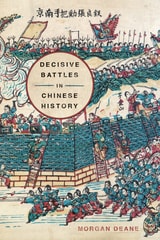
Decisive Battles in Chinese History
Morgan Deane
Westholme Publishing, 2024
“If you know the enemy and know yourself, you need not fear the result of a hundred battles. If you know yourself but not the enemy, for every victory gained you will also suffer a defeat. If you know neither the enemy nor yourself, you will succumb in every battle.”― Sun Tzu, The Art of War
The study of Chinese battles faces many hurdles that include different spelling systems, a haze of seemingly impenetrable names, places, and ideas, and different approaches to recording history. Early indigenous Chinese histories were written by Confucians with an antimilitary bias, and used rather laconic phrases to describe battles. These accounts were then transmitted to Jesuit missionaries who shared the Confucian disdain for martial matters. The modern discipline of history developed in the West during a time of particular Chinese weakness and political division, resulting in the lack of parallel material. Decisive Battles in Chinese History by Morgan Deane overcomes these obstacles to present the vast span of recorded Chinese history through key battles, from Maling, fought in 342 BC during the Warring States period, to Hengyang in 1944, which marked the end of major Japanese operations in China. Each of the twelve chapters highlights a significant conflict that selectively focuses on unique Chinese characteristics of the time, including belief systems, ruling ideology, the connection between technology and warfare, military theory, political events and rulers, and foreign policy, including China’s eventual interaction with the West. The book pushes back on a variety of ideas and stereotypes, ranging from the Chinese use of gunpowder, their supposedly weak reaction to the West, the viability of the Dynastic Cycle in studying history, the context of Chinese military theory, the exclusivity of martial and cultural spheres, and the uniqueness of Western imperialism. It also offers a groundbreaking reassessment of Mao Zedong’s leadership and his impact on the development of guerilla warfare. In a world filled with disturbing reports of conflict and potential warfare, Decisive Battles in Chinese History offers a unique addition to students, historians, and general readers wishing to better understand Chinese history.

Deckhand
Life on Freighters of the Great LakesNelson "Mickey" Haydamacker with Alan D. Millar
University of Michigan Press, 2009
Long before popular television shows such as Dirty Jobs and The Deadliest Catch, everyday men and women---the unsung heroes of the job world---toiled in important but mostly anonymous jobs. One of those jobs was deckhand on the ore boats.
With numerous photographs and engaging stories, Deckhand offers an insider's view of both the mundane and the intriguing duties performed by deckhands on these gritty cargo vessels. Boisterous port saloons, monster ice jams, near drownings, and the daily drudgery of soogeying---cleaning dirt and grime off the ships---are just a few of the experiences Mickey Haydamacker had as a young deckhand working on freighters of the Great Lakes in the early 1960s. Haydamacker sailed five Interlake Steamship Company boats, from the modern Elton Hoyt 2nd to the ancient coal-powered Colonel James Pickands with its backbreaking tarp-covered hatches.
Deckhand will appeal to shipping buffs and to anyone interested in Great Lakes shipping and maritime history as it chronicles the adventures of living on the lakes from the seldom-seen view of a deckhand.
Declaration House
Edited by Anna Arabindan-Kesson, Paul M. Farber, and Yolanda Wisher
Temple University Press, 2026
During the drafting of the Declaration of Independence in 1776, Thomas Jefferson and enslaved valet Robert Hemmings spent several months at 700 Market Street in Philadelphia. The editors and contributors to Declaration House reflect on the history of this site and illuminate the entangled legacy of freedom and enslavement at the core of our nation’s founding. They expand our history by revisiting and mapping this historic place in the city and nation, past and present, as a way to tend to our democracy today.
At the center of the book is artist Sonya Clark’s revelatory public artwork “The Descendants of Monticello,” a multichannel video installation created in collaboration with Hemmings’ collateral descendants and others who are related to the hundreds of people enslaved at Monticello. Interviews and essays about the project and the site consider history, memory, and the founding of our country. Like Clark’s project, Declaration House asks the timely question, "What does the Declaration of Independence mean to us today?"
Contributors: Niya Bates, Kerry Bickford, Paul Buchanan, Sonya Clark, Andrew M. Davenport, Kai Davis, Husnaa Haajarah Hashim, J. Calvin Jefferson Sr., Jabari Jefferson, Jane Kamensky, Matthew Kenyatta, Salamishah Tillet, Gayle Jessup White, Auriana Woods, and the editors
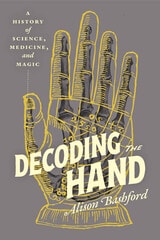
Decoding the Hand
A History of Science, Medicine, and MagicAlison Bashford
University of Chicago Press, 2025
“Delightful.”—Times Literary Supplement • “Intriguing.”—The Sydney Morning Herald • “Fascinating, well-illustrated.”—Nature • “Altogether surprising and hard to categorise.”—London Review of Books • “There are many stories to be told here, and Bashford tells them well.”—Literary Review
The astonishing history of palmistry and biometrics—from occult physicians to the very foundations of modern science and medicine.
Why did Isaac Newton read books on chiromancy, the occult science of hand reading that revealed the secrets of the soul? Why did Charles Darwin claim that the hand gave humans dominion over all other species? Why did psychoanalyst Charlotte Wolff climb into the primate cages of the London Zoo, taking hundreds of delicate palm prints? Why did Francis Galton, the father of fingerprinting, take palm prints too? And why did world-leading geneticists study the geometry of palm lines in their search for the secrets of chromosomal syndromes?
Decoding the Hand is an astounding history of magic, medicine, and science, of an enduring search for how our bodily surfaces might reveal an inner self—a soul, a character, an identity. From sixteenth-century occult physicians influenced by the Kabbalah to twentieth-century geneticists, and from criminologists to eugenicists, award-winning historian Alison Bashford takes us on a remarkable journey into the strange world of hand readers, revealing how signs on the hand—its shape, lines, marks, and patterns—have been elaborately decoded over the centuries. Sometimes learned, sometimes outrageously deceptive, sometimes earnest, and, more often than we ever expected, medically and scientifically trained, these palm readers of the past prove to be essential links in the human quest to peer into bodies, souls, minds, and selves. Not only for fortune-telling palmists were the future and the past, health, and character laid bare in the hand, but for other experts in bodies and minds as well: anatomists, psychiatrists, embryologists, primatologists, evolutionary biologists, geneticists, and more.
Drawing telling parallels between the divination promised by palmistry and the appeal to self-knowledge offered by modern genetic testing, Decoding the Hand also makes clear that palm-reading is far from a relic or simple charlatanism. Bashford’s sagacious history of human hands touching and connecting opens wide the essential human pursuit of what lies within and beyond.

Decolonial Care
Reimagining Caregiving in the French CaribbeanJennifer Boum Make
Rutgers University Press, 2025

Decolonial Topophilia
Nature, Place, and History in Puerto Rican PoetryVíctor Figueroa
Bucknell University Press, 2026
Decolonial Topophilia: Nature, Place, and History in Puerto Rican Poetry examines how four major poets—Luis Lloréns Torres, Luis Palés Matos, Juan Antonio Corretjer, and Julia de Burgos—address the ecological and human consequences of colonial domination in early twentieth-century Puerto Rico. Their poetry raises questions about the capitalist transformation of land through monocultures like sugarcane, the reduction of nature to exploitable resources, and the ties between attachment to place and nationalism. In tracing these connections, this pathbreaking book reveals how poetic visions of place can challenge colonial histories and imagine more reciprocal ways of inhabiting the world.
Published by Bucknell University Press. Distributed worldwide by Rutgers University Press.
Decolonisation and Criticism
The Construction of Irish LiteratureGerry Smyth
Pluto Press, 1998
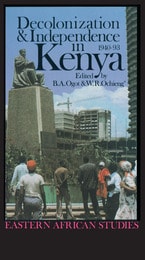
Decolonization and Independence in Kenya, 1940–1993
B. A. Ogot
Ohio University Press, 1995
This is a sharply observed assessment of the history of the last half century by a distinguished group of historians of Kenya. At the same time the book is a courageous reflection in the dilemmas of African nationhood.
Professor B. A. Ogot says:
“The main purpose of the book is to show that decolonization does not only mean the transfer of alien power to sovereign nationhood; it must also entail the liberation of the worlds of spirit and culture, as well as economics and politics.
“The book also raises a more fundamental question, that is: How much independence is available to any state, national economy or culture in today’s world? It asks how far are Africa’s miseries linked to the colonial past and to the process of decolonization?
“In particular the book raises the basic question of how far Kenya is avoidably neo-colonial? And what does neo-colonial dependence mean? The book answers these questions by discussing the dynamic between the politics of decolonization, the social history of class formation and the economics of dependence. The book ends with a provocative epilogue discussing the transformation of the post-colonial state from a single-party to a multi-party system.”
Decolonizing Afghanistan
Countering Imperial Knowledge and PowerWazhmah Osman and Robert D. Crews, editors
Duke University Press, 2025
Contributors. Matthieu Aikins, Dawood Azami, Purnima Bose, Paula Chakravartty, Robert D. Crews, Marya Hannun, Ali Karimi, Nivi Manchanda, Sabauon Nasseri, Tausif Noor, Wazhmah Osman, Hosai Qasmi, Zohra Saed, Gazelle Samizay, Morwari Zafar, Helena Zeweri

Decolonizing Extinction
The Work of Care in Orangutan RehabilitationJuno Salazar Parreñas
Duke University Press, 2018
Decolonizing German and European History at the Museum
Katrin Sieg
University of Michigan Press, 2021
Decolonizing German and European History at the Museum examines efforts by European museums to investigate colonialism as part of an unprocessed past, confront its presence, and urge repair. A flurry of exhibitions and the overhaul of numerous large museums in the last decade signal that an emergent colonial memory culture is now reaching broader publics. Exhibitions pose the question of what Europeans owe to those they colonized.
Decolonizing German and European History at the Museum shows how museums can help visitors mourn historic violence and identify the contemporary agents, beneficiaries, victims, survivors, and resisters of colonial presence. At the same time, the book treats the museum as part of the racialized power relations that activists, academics, and artists have long protested against. This book asks whether museums have made the dream of activists, academics, and artists to build equitable futures more acceptable and more durable—or whether in packaging that dream for general audiences they curtail it. Confronting colonial violence, this book argues, pushes Europeans to face the histories of racism and urges them to envision antiracism at the global scale.

Decolonizing Independence
Statecraft in Nigeria’s First Republic and Israeli InterventionsLynn Schler
Michigan State University Press, 2022
Decolonizing Israel, Liberating Palestine
Zionism, Settler Colonialism, and the Case for One Democratic StateJeff Halper
Pluto Press, 2021
For decades we have spoken of the 'Israel-Palestine conflict', but what if our understanding of the issue has been wrong all along? This book explores how the concept of settler colonialism provides a clearer understanding of the Zionist movement's project to establish a Jewish state in Palestine, displacing the Palestinian Arab population and marginalizing its cultural presence.
Jeff Halper argues that the only way out of a colonial situation is decolonization: the dismantling of Zionist structures of domination and control and their replacement by a single democratic state, in which Palestinians and Israeli Jews forge a new civil society and a shared political community.
To show how this can be done, Halper uses the 10-point program of the One Democratic State Campaign as a guide for thinking through the process of decolonization to its post-colonial conclusion. Halper's unflinching reframing will empower activists fighting for the rights of the Palestinians and democracy for all.
Decolonizing Native Histories
Collaboration, Knowledge, and Language in the AmericasFlorencia E. Mallon, ed.
Duke University Press, 2012
These wide-ranging case studies consider how language, the law, and the archive have historically served as instruments of colonialism and how they can be creatively transformed in constructing autonomy. The collection highlights points of commonality and solidarity across geographical, cultural, and linguistic boundaries and also reflects deep distinctions between North and South. Decolonizing Native Histories looks at Native histories and narratives in an internationally comparative context, with the hope that international collaboration and understanding of local histories will foster new possibilities for indigenous mobilization and an increasingly decolonized future.
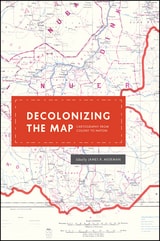
Decolonizing the Map
Cartography from Colony to NationEdited by James R. Akerman
University of Chicago Press, 2017
These essays, originally delivered as the 2010 Kenneth Nebenzahl, Jr., Lectures in the History of Cartography at the Newberry Library, encompass more than two centuries and three continents—Latin America, Africa, and Asia. Ranging from the late eighteenth century through the mid-twentieth, contributors study topics from mapping and national identity in late colonial Mexico to the enduring complications created by the partition of British India and the racialized organization of space in apartheid and post-apartheid South Africa. A vital contribution to studies of both colonization and cartography, Decolonizing the Map is the first book to systematically and comprehensively examine the engagement of mapping in the long—and clearly unfinished—parallel processes of decolonization and nation building in the modern world.
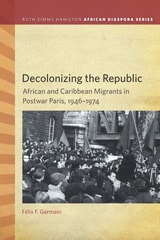
Decolonizing the Republic
African and Caribbean Migrants in Postwar Paris, 1946–1974Félix F. Germain
Michigan State University Press, 2016
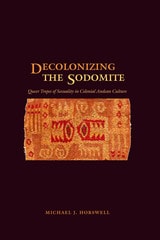
Decolonizing the Sodomite
Queer Tropes of Sexuality in Colonial Andean CultureBy Michael J. Horswell
University of Texas Press, 2006
Early Andean historiography reveals a subaltern history of indigenous gender and sexuality that saw masculinity and femininity not as essential absolutes. Third-gender ritualists, Ipas, mediated between the masculine and feminine spheres of culture in important ceremonies and were recorded in fragments of myths and transcribed oral accounts. Ritual performance by cross-dressed men symbolically created a third space of mediation that invoked the mythic androgyne of the pre-Hispanic Andes. The missionaries and civil authorities colonizing the Andes deemed these performances transgressive and sodomitical.
In this book, Michael J. Horswell examines alternative gender and sexuality in the colonial Andean world, and uses the concept of the third gender to reconsider some fundamental paradigms of Andean culture. By deconstructing what literary tropes of sexuality reveal about Andean pre-Hispanic and colonial indigenous culture, he provides an alternative history and interpretation of the much-maligned aboriginal subjects the Spanish often referred to as "sodomites." Horswell traces the origin of the dominant tropes of masculinist sexuality from canonical medieval texts to early modern Spanish secular and moralist literature produced in the context of material persecution of effeminates and sodomites in Spain. These values traveled to the Andes and were used as powerful rhetorical weapons in the struggle to justify the conquest of the Incas.
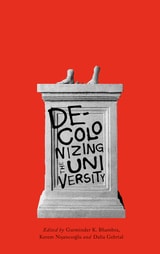
Decolonizing the University
Edited by Gurminder K. Bhambra, Kerem Nisancioglu and Dalia Gebrial
Pluto Press, 2018
In 2015, students at the University of Cape Town demanded the removal of a statue of Cecil Rhodes, the imperialist, racist business magnate, from their campus. Their battle cry, #RhodesMustFall, sparked an international movement calling for the decolonization of universities all over the world.
Today, as the movement develops beyond the picket line, how might it go on to radically transform the terms upon which universities exist? In this book, students, activists, and scholars discuss the possibilities and the pitfalls of doing decolonial work in the heart of the establishment. Subverting curricula, demanding diversity, and destroying old boundaries, this is a radical call for a new era of education. Chapters include:
*Rhodes Must Fall: Oxford and Movements for Change (Dalia Febrial)
*Race and the Neoliberal University ((John Holmwood)
*Black/Academia (Robbie Shilliam)
*The Challenge for Black Studies in the Neoliberal University (Kehinde Andrews)
*Open Initiatives for Decolonising the Curriculum (Pat Lockley)
*Decolonising Education: A Pedagogic Intervention (Carol Azumah Dennis)
*Understanding Eurocentrism as a Structural Problem of Undone Science (William Jamal Richardson)
As the book’s insightful Introduction states, "Taking colonialism as a global project as a starting point, it becomes difficult to turn away from the Western university as a key site through which colonialism—and colonial knowledge in particular—is produced, consecrated, institutionalized and naturalized." Offering resources for students and academics to challenge and resist colonialism inside and outside the classroom, Decolonizing the University provides the tools for radical change in educational disciplines, pedagogies, and institutions.

Deconstructing the American Mosque
Space, Gender, and AestheticsBy Akel Ismail Kahera
University of Texas Press, 2002
From the avant-garde design of the Islamic Cultural Center in New York City to the simplicity of the Dar al-Islam Mosque in Abiquiu, New Mexico, the American mosque takes many forms of visual and architectural expression. The absence of a single, authoritative model and the plurality of design nuances reflect the heterogeneity of the American Muslim community itself, which embodies a whole spectrum of ethnic origins, traditions, and religious practices.
In this book, Akel Ismail Kahera explores the history and theory of Muslim religious aesthetics in the United States since 1950. Using a notion of deconstruction based on the concepts of "jamal" (beauty), "subject," and "object" found in the writings of Ibn Arabi (d. 1240), he interprets the forms and meanings of several American mosques from across the country. His analysis contributes to three debates within the formulation of a Muslim aesthetics in North America—first, over the meaning, purpose, and function of visual religious expression; second, over the spatial and visual affinities between American and non-American mosques, including the Prophet's mosque at Madinah, Arabia; and third, over the relevance of culture, place, and identity to the making of contemporary religious expression in North America.
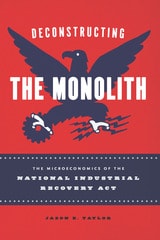
Deconstructing the Monolith
The Microeconomics of the National Industrial Recovery ActJason E. Taylor
University of Chicago Press, 2019
The NIRA is generally viewed as a monolithic program, its dramatic and sweeping effects best measurable through a macroeconomic lens. In this pioneering book, however, Jason E. Taylor examines the act instead using microeconomic tools, probing the uneven implementation of the act’s codes and the radical heterogeneity of its impact across industries and time. Deconstructing the Monolith employs a mixture of archival and empirical research to enrich our understanding of how the program affected the behavior and well-being of workers and firms during the two years NIRA existed as well as in the period immediately following its demise.

Deconstruction
An American InstitutionGregory Jones-Katz
University of Chicago Press, 2021
Deconstruction begins well before Jacques Derrida’s initial American presentation of his deconstructive work in a famed lecture at Johns Hopkins University in 1966 and continues through several decades of theoretic growth and tumult. While much of the subsequent story remains focused, inevitably, on Yale University and the personalities and curriculum that came to be lumped under the “Yale school” umbrella, Deconstruction makes clear how crucial feminism, queer theory, and gender studies also were to the lifeblood of this mode of thought. Ultimately, Jones-Katz shows that deconstruction in the United States—so often caricatured as a French infection—was truly an American phenomenon, rooted in our preexisting political and intellectual tensions, that eventually came to influence unexpected corners of scholarship, politics, and culture.

Decorative Games
Ornament, Rhetoric, and Noble Culture in the Work of Gilles-Marie Oppenord (1672-1742)Jean-François Bédard
University of Delaware Press, 2011
This book features an extraordinary album of ornament designs by the French architect Gilles-Marie Oppenord (1672-1742). In charge of the buildings and grounds of Philippe, duke of Orléans, regent of France during the minority of Louis XV, Oppenord was at the center of the architectural practice of his time. As made evident by this album, his consummate draftsmanship, praised by his contemporaries and coveted by collectors, exceeded by far the practical demands usually required of architects.
On a copy of the first French edition of Cesare Ripa’s Iconologia, published by Jean Baudoin in 1636 with engravings by Jacques de Bié, Oppenord drew vignettes, head and tail pieces, borders and other ornamental motifs. For the first time, this publication reproduces Oppenord’s album in its initial state. Today’s reassembled and rebound album of sixty sheets bears little resemblance to Oppenord’s original copy. A bibliographic analysis of the Ripa-Baudoin book, based on a copy kept at the Bibliothèque nationale de France, and confirmed by a previously unnoticed numbering by Oppenord, guided this first reconstitution. In lieu of a haphazard succession of sketches, it reveals Oppenord’s fascinating interplay between text, engraved and drawn images.
Published by University of Delaware Press. Distributed worldwide by Rutgers University Press.
Dedan Kimathi on Trial
Colonial Justice and Popular Memory in Kenya’s Mau Mau RebellionJulie MacArthur
Ohio University Press, 2017
The transcript from this historic trial, long thought destroyed or hidden, unearths a piece of the British colonial archive at a critical point in the Mau Mau Rebellion. Its discovery and landmark publication unsettles an already contentious Kenyan history and its reverberations in the postcolonial present.
Perhaps no figure embodied the ambiguities, colonial fears, and collective imaginations of Kenya’s decolonization era more than Dedan Kimathi, the self-proclaimed field marshal of the rebel forces that took to the forests to fight colonial rule in the 1950s. Kimathi personified many of the contradictions that the Mau Mau Rebellion represented: rebel statesman, literate peasant, modern traditionalist. His capture and trial in 1956, and subsequent execution, for many marked the end of the rebellion and turned Kimathi into a patriotic martyr.
Here, the entire trial transcript is available for the first time. This critical edition also includes provocative contributions from leading Mau Mau scholars reflecting on the meaning of the rich documents offered here and the figure of Kimathi in a much wider field of historical and contemporary concerns. These include the nature of colonial justice; the moral arguments over rebellion, nationalism, and the end of empire; and the complexities of memory and memorialization in contemporary Kenya.
Contributors: David Anderson, Simon Gikandi, Nicholas Githuku, Lotte Hughes, and John Lonsdale. Introductory note by Willy Mutunga.

Dedicated to the People of Darfur
Writings on Fear, Risk, and HopeEdited and with an Introduction by Luke Reynolds and Jennifer Reynolds
Rutgers University Press, 2009
Nobel and Pulitzer Prize winners, a gallery of O.Henry award recipients, and many best-selling authors come together to share personal and compelling challenges and experiences. From contemplations on past drug use to reflections on gun control, social justice, passion and its sacrifices, and adventures such as skydiving, mountain climbing, and golfing, the topics vary greatly. This kaleidoscopic anthology is a commentary on the lives of prominent literary artists and ordinary citizens who have made simple, yet powerful choices that provoked change in one's self and for humanityùmuch the same way that Luke and Jennifer Reynolds do by building this invaluable collection for readers and the world of human rights.
Not too long ago, as struggling graduate students, Luke and Jennifer Reynolds conceived this uniquely themed volume as a way to raise funds to support ending the genocide in Darfur. Some people carry signs, others make speeches, many take action. What is most special about this book is that it extends beyond words and ideas, into a tangible effort to effect change. To this end, all royalties from the sales of Dedicated to the People of Darfur:Writings on Fear, Risk, and Hope will benefit The Save Darfur Coalition, an organization that seeks to end the genocide in Darfur, Sudan.
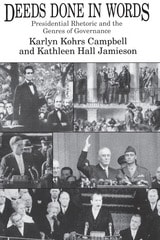
Deeds Done in Words
Presidential Rhetoric and the Genres of GovernanceKarlyn Kohrs Campbell and Kathleen Hall Jamieson
University of Chicago Press, 1990
"Deeds Done in Words is a thoughtful survey of how a democracy uses language to transact its business. Based on an enlivened understanding of genre theory and on numerous pieces of original criticism, Campbell and Jamieson vividly show how central public discourse has become the lifeblood of the American polity."—Roderick Hart, author of The Sound of Leadership
"The rhetoric that issues from the White House is becoming an ever more salient part of what the presidency means and does. This acute inquiry provides a great many insights into the forms, meanings, and functions of presidential discourse. It is an enlightening contribution to our understanding of American politics."—Murray Edelman, author of Constructing the Political Spectacle
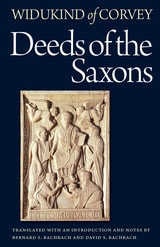
Deeds of the Saxons
Catholic University of America Press, 2014