Results by title
8113 books match the query 'Literary Criticism' and 287 start with d
Double-Consciousness/Double Bind
Theoretical Issues in Twentieth-Century Black LiteratureSandra Adell
University of Illinois Press, 1994
Double-Take
A Revisionist Harlem Renaissance AnthologyPatton, Venetria K
Rutgers University Press, 2001
The editors have included works from a wide variety of genres-poetry, short stories, drama, and essays-allowing readers to understand the true interdisciplinary quality of this cultural movement. Biographical sketches of the authors are provided and most of the pieces are included in their entirety. Double-Take also includes artwork and illustrations, many of which are from original journals and have never before been reprinted. Significantly, Double-Take is the first Harlem Renaissance title to include song lyrics to illustrate the interrelation of various art forms.
Down By The Lemonade Springs
Essays On Wallace StegnerJackson J. Benson
University of Nevada Press, 2001
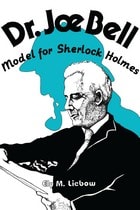
Dr. Joe Bell
Model for Sherlock HolmesEly M. Liebow
University of Wisconsin Press, 1982
A distinguished physician and professor of medicine at Edinburgh University, and a forensic expert for the British Crown, Joseph Bell was well known for his remarkable powers of observation and deduction. In what would become true Sherlockian fashion, he had the ability to deduce facts about his patients from otherwise unremarkable details. In one instance recounted by Arthur Conan Doyle himself—and similar to Sherlock Holmes's own observations in "The Greek Interpreter"—Bell took little time to determine that one of his patients had recently served in the army, a non-commissioned officer discharged from his Highland regiment stationed in Barbados:
“The man was a respectful man, but did not remove his hat. They do not in the army, but he would have learned civilian ways had he been long discharged. He has an air of authority and he is obviously Scottish. As to Barbados, his complaint is elephantitis, which is West Indian and not British.”
Based on extensive research into the life of Bell and including tantalizing accounts of the connections between Bell and Conan Doyle, this biography is required reading for anyone interested in Victorian medicine, in the history of detective fiction, and in Sherlock Holmes and Dr. Watson.

Dracula's Crypt
Bram Stoker, Irishness, and the Question of BloodJoseph Valente
University of Illinois Press, 2001
An ingenious reappraisal of a classic text, Dracula's Crypt presents Stoker's novel as a subtly ironic commentary on England's preoccupation with racial purity. Probing psychobiographical, political, and cultural elements of Stoker's background and milieu, Joseph Valente distinguishes Stoker's viewpoint from that of his virulently racist, hypermasculine vampire hunters, showing how the author's dual Anglo-Celtic heritage and uncertain status as an Irish parvenu among London's theatrical elite led him to espouse a progressive racial ideology at odds with the dominant Anglo-Saxon supremacism. In the light of Stoker's experience, the shabby-genteel Count Dracula can be seen as a doppelgänger, an ambiguous figure who is at once the blood-conscious landed aristocrat and the bloodthirsty foreign invader.
Stoker also confronts gender ideals and their implications, exposing the "inner vampire" in men like Jonathan Harker who dominate and absorb the women who become their wives. Ultimately, Valente argues, the novel celebrates a feminine heroism, personified by Mina Harker, that upholds an ethos of social connectivity against the prevailing obsession with blood as a vehicle of identity.
Revealing a profound and heretofore unrecognized ethical and political message, Dracula's Crypt maintains that the real threat delineated in Dracula is not racial degeneration but the destructive force of racialized anxiety itself. Stoker's novel emerges as a powerful critique of the very anxieties it has previously been taken to express: anxieties concerning the decline of the British empire, the deterioration of Anglo-Saxon culture, and the contamination of the Anglo-Saxon race.
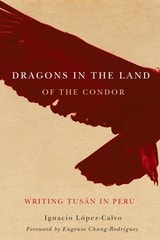
Dragons in the Land of the Condor
Writing Tusán in PeruIgnacio López-Calvo, Foreword by Eugenio Chang-Rodríguez
University of Arizona Press, 2014
While authors like Siu Kam Wen and Julia Wong often rely on their Chinese cultural heritage for inspiration, many others, like Pedro Zulen, Mario Wong, and Julio Villanueva Chang, choose other sources of inspiration and identification. López-Calvo studies the different strategies used by these writers to claim either their belonging in the Peruvian national project or their difference as a minority ethnic group within Peru. Whether defending the rights of indigenous Peruvians, revealing the intricacies of a life of self-exploitation among Chinese shopkeepers, exploring their identitarian dilemmas, or re-creating—beyond racial memory—life under the political violence in Lima of the 1980s, these authors provide their community with a voice and a collective agency, while concomitantly repositioning contemporary Peruvian culture as transnational.
López-Calvo bridges from his earlier study of Peruvian Nikkei’s testimonials and literature and raises this question: why are Chinese Peruvian authors seemingly more disconnected from their Asian heritage than Japanese Peruvian authors from theirs? The author argues that the Chinese arrival in Peru half a century earlier influenced a stronger identification with the criollo world. Yet he argues that this situation may soon be changing as the new geopolitical and economic influence of the People’s Republic of China in the world, particularly in Latin America and the Caribbean, affects the way Chinese and Sino–Latin American communities and their cultures are produced and perceived.
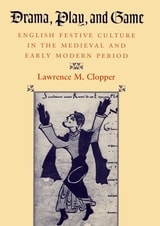
Drama, Play, and Game
English Festive Culture in the Medieval and Early Modern PeriodLawrence M. Clopper
University of Chicago Press, 2001
Drama, Play, and Game demonstrates that the theatrum repudiated by medieval clerics was not "theater" as we understand the term today. Clopper contends that critics have misrepresented Western stage history because they have assumed that theatrum designates a place where drama is performed. While theatrum was thought of as a site of spectacle during the Middle Ages, the term was more closely connected with immodest behavior and lurid forms of festive culture. Clerics were not opposed to liturgical representations in churches, but they strove ardently to suppress May games, ludi, festivals, and liturgical parodies. Medieval drama, then, stemmed from a more vernacular tradition than previously acknowledged-one developed by England's laity outside the boundaries of clerical rule.
Dramatic Extracts in Seventeenth-Century English Manuscripts
Watching, Reading, Changing PlaysLaura Estill
University of Delaware Press, 2015
Throughout the seventeenth century, early modern play readers and playgoers copied dramatic extracts (selections from plays and masques) into their commonplace books, verse miscellanies, diaries, and songbooks. Dramatic Extracts in Seventeenth-Century English Manuscripts: Watching, Reading, Changing Plays is the first to examine these often overlooked texts, which reveal what early modern audiences and readers took, literally and figuratively, from plays. As this under-examined archival evidence shows, play readers and playgoers viewed plays as malleable and modular texts to be altered, appropriated, and, most importantly, used. These records provide information that is not available in other forms about the popularity and importance of early modern plays, the reasons plays appealed to their audiences, and the ideas in plays that most interested audiences.
Tracing the course of dramatic extracting from the earliest stages in the 1590s, through the prolific manuscript circulation at the universities, to the closure and reopening of the theatres, Estill gathers these microhistories to create a comprehensive overview of seventeenth-century dramatic extracts and the culture of extracting from plays. Dramatic Extracts in Seventeenth-Century English Manuscripts: Watching, Reading, Changing Plays explores new archival evidence (from John Milton’s signature to unpublished university plays) while also analyzing the popularity of perennial favorites such as Shakespeare’s The Tempest. The study of dramatic extracts is the study of particulars: particular readers, particular manuscripts, particular plays or masques, particular historic moments. As D. F. McKenzie puts it, “different readers [bring] the text to life in different ways.” By providing careful analyses of these rich source texts, this book shows how active play-viewing and play-reading (that is, extracting) ultimately led to changing the plays themselves, both through selecting and manipulating the extracts and positioning the plays in new contexts.
Published by University of Delaware Press. Distributed worldwide by Rutgers University Press.
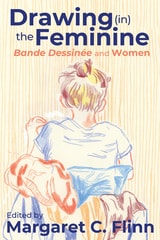
Drawing (in) the Feminine
Bande Dessinée and WomenEdited by Margaret C. Flinn
The Ohio State University Press, 2024
Winner, Eisner Award for Best Academic/Scholarly Work 2025
Finalist, Comics Studies Society Edited Book Prize 2025
Drawing (in) the Feminine celebrates and examines the richness of contemporary women's production in French and Francophone comics art and considers the history of representations made by both dominant and marginalized creators. Bridging historical and contemporary comics output, these essays illuminate the interfaces among genre, gender, and cultural history. Contributors from both sides of the Atlantic, and across a variety of methodologies and disciplinary orientations, challenge prevailing claims about the absence of women creators, characters, and readers in bande dessinée, arguing that women have always been part of its history. While still far from achieving parity with their male counterparts, female creators are occupying an increasingly significant portion of the French-language comics publishing industry, and creators of all genders are putting forth stories that reflect on the diversity and richness of women's and gender-nonconforming people's experiences. In the essays collected here, contributors push back against the ways in which the marginalization of women within bande dessinée history has overshadowed their significant contributions, extending avenues for further exploring the true diversity of a flourishing contemporary production.
Contributors:
Armelle Blin-Rolland, Véronique Bragard, Michelle Bumatay, Benoît Crucifix, Isabelle Delorme, Jacques Dürrenmatt, Margaret C. Flinn, Alexandra Gueydan-Turek, Jennifer Howell, Jessica Kohn, Sylvain Lesage, Catriona MacLeod, Mark McKinney
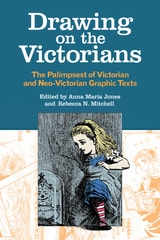
Drawing on the Victorians
The Palimpsest of Victorian and Neo-Victorian Graphic TextsAnna Maria Jones
Ohio University Press, 2017
Late nineteenth-century Britain experienced an unprecedented explosion of visual print culture and a simultaneous rise in literacy across social classes. New printing technologies facilitated quick and cheap dissemination of images—illustrated books, periodicals, cartoons, comics, and ephemera—to a mass readership. This Victorian visual turn prefigured the present-day impact of the Internet on how images are produced and shared, both driving and reflecting the visual culture of its time.
From this starting point, Drawing on the Victorians sets out to explore the relationship between Victorian graphic texts and today’s steampunk, manga, and other neo-Victorian genres that emulate and reinterpret their predecessors. Neo-Victorianism is a flourishing worldwide phenomenon, but one whose relationship with the texts from which it takes its inspiration remains underexplored.
In this collection, scholars from literary studies, cultural studies, and art history consider contemporary works—Alan Moore’s League of Extraordinary Gentlemen, Moto Naoko’s Lady Victorian, and Edward Gorey’s Gashlycrumb Tinies, among others—alongside their antecedents, from Punch’s 1897 Jubilee issue to Alice in Wonderland and more. They build on previous work on neo-Victorianism to affirm that the past not only influences but converses with the present.
Contributors: Christine Ferguson, Kate Flint, Anna Maria Jones, Linda K. Hughes, Heidi Kaufman, Brian Maidment, Rebecca N. Mitchell, Jennifer Phegley, Monika Pietrzak-Franger, Peter W. Sinnema, Jessica Straley
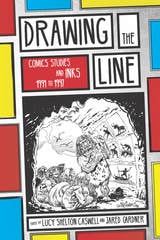
Drawing the Line
Comics Studies and INKS, 1994–1997Lucy Shelton Caswell and Jared Gardner
The Ohio State University Press, 2017
Included in the volume are essays by pioneering comics scholars on newspaper comic strips, Japanese manga, Chinese lianhuanhua, comic books, graphic novels, and editorial cartoons, alongside writings and artwork by celebrated cartoonists such as Will Eisner, Oliver Harrington, Charles Schulz, and Frank Stack. This volume serves as an invaluable resource for anyone interested in the history and study of the comics form, visual culture, or the history of journalism.

Dread Poetry and Freedom
Linton Kwesi Johnson and the Unfinished RevolutionDavid Austin
Pluto Press, 2018
Standing at the forefront of political poetry since the 1970s, Linton Kwesi Johnson has been fighting neo-fascism, police violence and promoting socialism while putting pen to paper to refute W.H. Auden's claim that 'poetry makes nothing happen'. For Johnson, only the second living poet to have been published in the Penguin Modern Classics series, writing has always been 'a political act' and poetry 'a cultural weapon'.
In Dread Poetry and Freedom - the first book dedicated to the work of this 'political poet par excellence' - David Austin explores the themes of poetry, political consciousness and social transformation through the prism of Johnson's work. Drawing from the Bible, reggae and Rastafari, and surrealism, socialism and feminism, and in dialogue with Aime Cesaire and Frantz Fanon, C.L.R. James and Walter Rodney, and W.E.B. Du Bois and the poetry of d'bi young anitafrika, Johnson's work becomes a crucial point of reflection on the meaning of freedom in this masterful and rich study.
In the process, Austin demonstrates why art, and particularly poetry, is a vital part of our efforts to achieve genuine social change in times of dread.
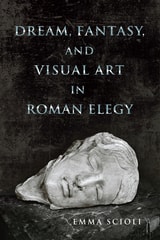
Dream, Fantasy, and Visual Art in Roman Elegy
Emma Scioli
University of Wisconsin Press, 2015
By treating dreams as a mode for viewing, an analogy suggested by diverse ancient authors, Emma Scioli extracts new information from the poetry of Propertius, Tibullus, and Ovid about the Roman concept of “seeing” dreams. Through comparison with other visual modes of description, such as ekphrasis and simile, as well as with related types of visual experience, such as fantasy and voyeurism, Scioli demonstrates similarities between artist, dreamer, and poet as creators, identifying the dreamer as a particular type of both viewer and narrator.

Dreamer of the Ghetto
The Life and Works of Israel ZangwillJoseph H. Udelson
University of Alabama Press, 1990
"An impressive achievement. . . . Udelson provides a trenchant analysis of Zangwill's works set within a historical context, i.e., Jewish emancipation and the dilemma of how one might remain fully Jewish while becoming fully modern, that helps to illuminate Zangwill's life as well as his writings."
—Jewish Book News
"By carefully following the threads of Zangwill's own divided self through the labyrinths of his life and writings, Udelson convinces us not only of the author's startling political prescience, but that he embodies attitudes now shared by almost all secular Jews as a result of events Zangwill did not witness—Nazism and the founding of Israel."
—Shofar
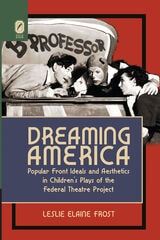
Dreaming America
Popular Front Ideals and Aesthetics in Children's Plays of the Federal Theatre ProjectLeslie Elaine Frost
The Ohio State University Press, 2013
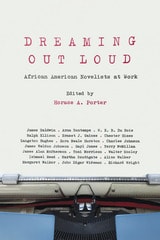
Dreaming Out Loud
African American Novelists at WorkHorace Porter
University of Iowa Press, 2015
Some essays explore the challenges of being an African American writer in the United States, broadly addressing aesthetic and racial prejudice in American publishing and literature and its changing face over the decades. Others are more specific and personal, recounting how the authors came to be a reader and writer in a culture that did not always encourage them to do so. Some are more general and focus on practice and craft, while still other essays offer detailed behind-the-scenes accounts of how famous novels, such as Native Son, Invisible Man, The Autobiography of Miss Jane Pittman, and The Color Purple, came to life. Ranging from the Harlem Renaissance, through the Civil Rights movement, and into the twenty-first century, this anthology explores what it has meant to be an African American novelist over the past hundred years.
Found within are essays by twenty-one African American novelists, including Nobel Prize-winner Toni Morrison, National Book Award-winners Ralph Ellison and Charles Johnson, Pulitzer Prize-winners Alice Walker and James Alan McPherson, and well-known canonical writers such as W. E. B. Du Bois, James Weldon Johnson, Langston Hughes, Richard Wright, Zora Neale Hurston, and Margaret Walker. Dreaming Out Loud seeks to inspire writers and readers alike, while offering a fascinating and important portrait of novelists at work in their own words.
CONTRIBUTORS
James Baldwin, Arna Bontemps, W. E. B. Du Bois, Ralph Ellison, Ernest Gaines, Chester Himes, Langston Hughes, Zora Neale Hurston, Charles Johnson, James Weldon Johnson, Gayl Jones, Terry McMillan, James Alan McPherson, Toni Morrison, Walter Mosley, Ishmael Reed, Martha Southgate, Alice Walker, Margaret Walker, John Edgar Wideman, Richard Wright

Dreaming Revolution
Transgression in the Development of American RomanceScott Bradfield
University of Iowa Press, 1993
Dreaming Revolution usefully employs current critical theory to address how the European novel of class revolt was transformed into the American novel of imperial expansion. Bradfield shows that early American romantic fiction—including works by William Godwin, Charles Brockden Brown, James Fenimore Cooper, and Edgar Allan Poe—can and should be considered as part of a genre too often limited to the nineteenth-century European novel. In a spirited discussion of the works from these four authors, Bradfield argues that Americans take the class dynamics of the European psychological novel and apply them to the American landscape, reimagining psychological spaces as geographical ones.

Dreaming in Books
The Making of the Bibliographic Imagination in the Romantic AgeAndrew Piper
University of Chicago Press, 2009
At the turn of the nineteenth century, publishing houses in London, New York, Paris, Stuttgart, and Berlin produced books in ever greater numbers. But it was not just the advent of mass printing that created the era’s “bookish” culture. According to Andrew Piper, romantic writing and romantic writers played a crucial role in adjusting readers to this increasingly international and overflowing literary environment. Learning how to use and to want books occurred through more than the technological, commercial, or legal conditions that made the growing proliferation of books possible; the making of such bibliographic fantasies was importantly a product of the symbolic operations contained within books as well.
Examining novels, critical editions, gift books, translations, and illustrated books, as well as the communities who made them, Dreaming in Books tells a wide-ranging story of the book’s identity at the turn of the nineteenth century. In so doing, it shows how many of the most pressing modern communicative concerns are not unique to the digital age but emerged with a particular sense of urgency during the bookish upheavals of the romantic era. In revisiting the book’s rise through the prism of romantic literature, Piper aims to revise our assumptions about romanticism, the medium of the printed book, and, ultimately, the future of the book in our so-called digital age.
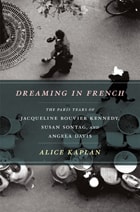
Dreaming in French
The Paris Years of Jacqueline Bouvier Kennedy, Susan Sontag, and Angela DavisAlice Kaplan
University of Chicago Press, 2012
All three women would go on to become icons, key figures in American cultural, intellectual, and political life, but when they embarked for France, they were young, little-known, uncertain about their future, and drawn to the culture, sophistication, and drama that only Paris could offer. Yet their backgrounds and their dreams couldn’t have been more different. Jacqueline Bouvier was a twenty-year-old debutante, a Catholic girl from a wealthy East Coast family. Susan Sontag was twenty-four, a precocious Jewish intellectual from a North Hollywood family of modest means, and Paris was a refuge from motherhood, a failing marriage, and graduate work in philosophy at Oxford. Angela Davis, a French major at Brandeis from a prominent African American family in Birmingham, Alabama, found herself the only black student in her year abroad program—in a summer when all the news from Birmingham was of unprecedented racial violence.
Kaplan takes readers into the lives, hopes, and ambitions of these young women, tracing their paths to Paris and tracking the discoveries, intellectual adventures, friendships, and loves that they found there. For all three women, France was far from a passing fancy; rather, Kaplan shows, the year abroad continued to influence them, a significant part of their intellectual and cultural makeup, for the rest of their lives. Jackie Kennedy carried her love of France to the White House and to her later career as a book editor, bringing her cultural and linguistic fluency to everything from art and diplomacy to fashion and historic restoration—to the extent that many, including Jackie herself, worried that she might seem “too French.” Sontag found in France a model for the life of the mind that she was determined to lead; the intellectual world she observed from afar during that first year in Paris inspired her most important work and remained a key influence—to be grappled with, explored, and transcended—the rest of her life. Davis, meanwhile, found that her Parisian vantage strengthened her sense of political exile from racism at home and brought a sense of solidarity with Algerian independence. For her, Paris was a city of political commitment, activism, and militancy, qualities that would deeply inform her own revolutionary agenda and soon make her a hero to the French writers she had once studied.
Kaplan, whose own junior year abroad played a prominent role in her classic memoir, French Lessons, spins these three quite different stories into one evocative biography, brimming with the ferment and yearnings of youth and shot through with the knowledge of how a single year—and a magical city—can change a whole life. No one who has ever dreamed of Paris should miss it.
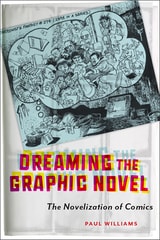
Dreaming the Graphic Novel
The Novelization of ComicsPaul Williams
Rutgers University Press, 2020
Honorable Mention, 2019-2020 Research Society for American Periodicals Book Prize
The term “graphic novel” was first coined in 1964, but it wouldn’t be broadly used until the 1980s, when graphic novels such as Watchmen and Maus achieved commercial success and critical acclaim. What happened in the intervening years, after the graphic novel was conceptualized yet before it was widely recognized?
Dreaming the Graphic Novel examines how notions of the graphic novel began to coalesce in the 1970s, a time of great change for American comics, with declining sales of mainstream periodicals, the arrival of specialty comics stores, and (at least initially) a thriving underground comix scene. Surveying the eclectic array of long comics narratives that emerged from this fertile period, Paul Williams investigates many texts that have fallen out of graphic novel history. As he demonstrates, the question of what makes a text a ‘graphic novel’ was the subject of fierce debate among fans, creators, and publishers, inspiring arguments about the literariness of comics that are still taking place among scholars today.
Unearthing a treasure trove of fanzines, adverts, and unpublished letters, Dreaming the Graphic Novel gives readers an exciting inside look at a pivotal moment in the art form’s development.
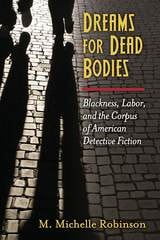
Dreams for Dead Bodies
Blackness, Labor, and the Corpus of American Detective FictionM. Michelle Robinson
University of Michigan Press, 2016
The author constructs an interracial genealogy of detective fiction to create a nuanced picture of the ways that black and white authors appropriated and cultivated literary conventions that coalesced in a recognizable genre at the turn of the twentieth century. These authors tinkered with detective fiction’s puzzle-elements to address a variety of historical contexts, including the exigencies of chattel slavery, the erosion of working-class solidarities by racial and ethnic competition, and accelerated mass production. Dreams for Dead Bodies demonstrates that nineteenth- and early twentieth-century American literature was broadly engaged with detective fiction, and that authors rehearsed and refined its formal elements in literary works typically relegated to the margins of the genre. By looking at these margins, the book argues, we can better understand the origins and cultural functions of American detective fiction.
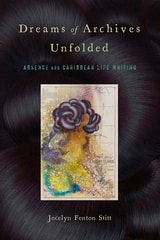
Dreams of Archives Unfolded
Absence and Caribbean Life WritingJocelyn Fenton Stitt
Rutgers University Press, 2021
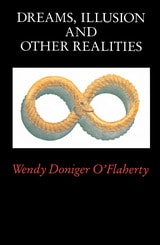
Dreams, Illusion, and Other Realities
Wendy Doniger O'Flaherty
University of Chicago Press, 1984
"Dazzling analysis. . . . The book is firm and convincing once you appreciate its central point, which is that in traditional Hindu thought the dream isn't an accident or byway of experience, but rather the locus of epistemology. In its willful confusion of categories, its teasing readiness to blur the line between the imagined and the real, the dream actually embodies the whole problem of knowledge. . . . [O'Flaherty] wants to make your mental flesh creep, and she succeeds."—Mark Caldwell, Village Voice
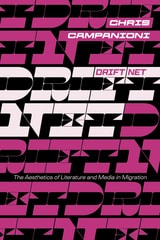
Drift Net
The Aesthetics of Literature and Media in MigrationChris Campanioni
Lever Press, 2025
Through a model Campanioni calls a “migratory text,” Drift Net advances a theory of literature and art born in translation that calls into question established theories of world literature, national literatures, literary periodization, and translation itself. Through an analysis of works born in translation and produced in passage, detention, and exile, Campanioni utilizes this model to read creatively across a wide range of social and political formations, from the experience of his parents' exiles to alternative housing initiatives and asylum reform efforts throughout Europe, including the largest LGBT+ refugee center in the world. Drawing on a mixed methodology of qualitative interviews with asylum applicants and shelter directors, textual analysis, and autoethnographic narrative, Drift Net traces literary developments alongside contemporary social and political interventions. This approach proposes interventions on the organizational levels of asylum, integration, public housing, and membership. It also marks the ways migrant creators have reformulated subjectivity through the same genres and modes that have contributed to their devaluation as minoritized subjects.
Drift Net both deepens and broadens our conceptualization of migrant literature, and recovers an understanding and application of transmedia that predates digital cultures. Campanioni offers a wide-ranging study of texts including Edward Said and Jean Mohr’s After the Last Sky: Palestinian Lives, Edgar Garcia’s Skins of Columbus, Anna Seghers’s Transit, Francis Ponge’s Soap, Walid Raad’s The Atlas Group, Klára Hosnedlová’s embroidered paintings, Reem Karssli and Caroline Williams’s Now is the Time To Say Nothing, Cornelia Schleime’s paper prints, and more. Drift Net formulates the “migratory” as a site of artistic production, resistance, and possibility, where theory is not an end but the beginning of tools and practices that might help researchers, instructors, and organizers to develop their strategies.
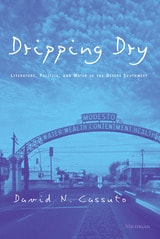
Dripping Dry
Literature, Politics and Water in the Desert SouthwestDavid N. Cassuto
University of Michigan Press, 2001
The four works selected (Animal Dreams, The Monkey Wrench Gang, The Grapes of Wrath, and The Ford) present a composite portrait of reclamation, which the author argues is one of the most important cultural and ecological phenomena in the nation's history. The tensions and contradictions presented by the novels underscore the compelling need for an ecocritique of the relationship between literature and politics. David N. Cassuto deciphers the myths of reclamation and restoration and presents a third alternative--sustainability--in their stead. The challenge is a large one, because of the size and complexity of the region and because nature continues to evolve and create itself, a process involving language, ideology, and the land.
The book is designed to be an interdisciplinary contribution both to the emerging field of literature and the environment, as well as to environmental studies. It will be welcomed by scholars as well as general readers interested in new approaches to literature and environmental issues, and by those interested in the geography and literature of the western United States.
David N. Cassuto, formerly of the English Department of the University of Missouri-Rolla, is a practicing attorney in San Francisco, specializing in environmental issues.
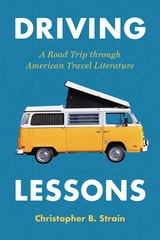
Driving Lessons
A Road Trip through American Travel LiteratureChristopher B. Strain
University of Alabama Press, 2025
Weaves the author’s own four-month cross-country sojourn in a VW van with thoughts on travel narratives across the history of American literature
In Driving Lessons, Christopher B. Strain sets out on a quintessential American road trip, exploring not just the roads and byways of the country but the road trip’s place in American culture. Strain dives into the well of American travel writing, illuminating fascinating aspects of the road trip, such as how race, class, and gender shape the experiences of road trippers.
In the summer of 1998, amid a professional crisis of confidence, Strain settled on a plan to reconnect with both himself and the country he studies. He purchased a 1972 Volkswagen Westfalia van and set off on his own cross-country odyssey. In the weeks that followed, he ruminated on his own ongoing journey alongside great journeys from the past and how they reveal the heart of the traveler as well as the landscape of the nation.
Visiting archives and landmarks across the United States, Strain's journey became a parallel to the stories he studied—an opportunity to see and experience the cities, national parks, and monuments that define US history. Driving Lessons is a compelling blend of literary analysis and memoir, offering readers an insightful and heartfelt reflection on the enduring power of the American road trip.
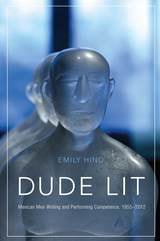
Dude Lit
Mexican Men Writing and Performing Competence, 1955–2012Emily Hind
University of Arizona Press, 2019
The makings of the “best” writers have to do with superficial aspects, like conformist wardrobes and unsmiling expressions, and more complex techniques, such as friendship networks, prizewinners who become judges, dropouts who become teachers, and the key tactic of being allowed to shift roles from rule maker (the civilizado) to rule breaker (the bárbaro). Certain writing habits also predict success, with the “high and hard” category reserved for men’s writing and even film directing. In both film and literature, critically respected artwork by men tends to rely on obscenity interpreted as originality, negative topics viewed as serious, and coolly inarticulate narratives about bullying understood as maximum literary achievement.
To build the case regarding “rebellion as conformity,” Dude Lit contemplates a wide set of examples while always returning to three figures, each born some two decades apart from the immediate predecessor: Juan Rulfo (with Pedro Páramo), José Emilio Pacheco (with Las batallas en el desierto), and Guillermo Fadanelli (with Mis mujeres muertas, as well as the range of his publications). Why do we believe Mexican men are competent performers of the role of intellectual? Dude Lit answers this question through a creative intersection of sources. Drawing on interviews, archival materials, and critical readings, this provocative book changes the conversation on literature and gendered performance.
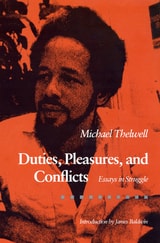
Duties, Pleasures, and Conflicts
Essays in StruggleMichael M. Thelwell
University of Massachusetts Press, 1987
This powerful collection of essays and short stories provides a unique perspective on the black civil rights movement over the past twenty-five years. A long-time activist, Michael Thelwell was a member of the Student Non-Violent Coordinating Committee (SNCC) and the Mississippi Freedom Democratic Party in the early 1960s, a founder of the W.E.B. Du Bois Department of Afro-American Studies at the University of Massachusetts in 1970, author of the widely praised novel The Harder They Come published in 1980, and an organizer for Jesse Jackson's presidential campaign in 1984. Thelwell is a writer of rare grace, integrity, and strong political convictions.
The collection begins with three stories. Set in the Mississippi Delta in the 1960s, the stories explore how individuals manage to preserve their dignity in a world of racism and violence. The next six essays, also written in the 1960s, are historical and journalistic. They discuss the March on Washington for Jobs and Freedom, the situation in the South as seen by SNCC workers, the political challenges in Mississippi, the articulation of the Black Power movement, the causes of the black student revolt at Cornell, and the need for Black Studies as the intellectual offensive in the struggle for black liberation.
The section that follows is composed of literary pieces: two appreciative essays on James Baldwin, two critical reviews of William Styron and his treatment of Nat Turner, an excoriating assessment of V. S. Naipaul, a profile of Amos Tutuola, and a thoughtful analysis of the social responsibility of the black writer.
The final essay examines the history of Jesse Jackson's presidential campaign and comments on the political climate of the 1980s.
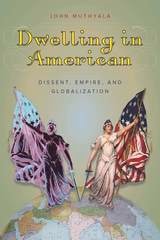
Dwelling in American
Dissent, Empire, and GlobalizationJohn Muthyala
Dartmouth College Press, 2012
Dwelling in Fiction
Poetics of Place and the Experimental Novel in Latin AmericaAshley R. Brock
Northwestern University Press, 2023
The radical formal experiments undertaken by writers across Latin America in the mid-twentieth century introduced friction, opacity, and self-reflexivity to the very act of reading. Dwelling in Fiction: Poetics of Place and the Experimental Novel in Latin America explores the limitations and the possibilities of literature for conveying place-specific forms of life. Focusing on authors such as José María Arguedas, João Guimarães Rosa, and Juan José Saer, who are often celebrated for universalizing regional themes, Ashley R. Brock brings a new critical lens to Latin American writers who were ambivalent toward their era’s “boom.”
Beyond mere resistance to or critique of the commodification and political instrumentalization of rural topics and types, this countertrend of critical regionalism positions readers themselves as outsiders, pushing them to engage their senses, to train their attention, and to learn to dwell in unknown textual landscapes. Dwelling in Fiction draws on a transnational community of thinkers and writers to show how their midcentury aesthetic practices of sensorial pedagogy anticipate contemporary turns toward affect, embodiment, decoloniality, and ecological thought.
Dying Modern
A Meditation on ElegyDiana Fuss
Duke University Press, 2013
Focusing primarily on American and British poetry written during the past two centuries, Fuss maintains that poetry can still offer genuine ethical compensation, even for the deep wounds and shocking banalities of modern death. As dying, loss, and grief become ever more thoroughly obscured from public view, the dead start chattering away in verse. Through bold, original interpretations of little-known works, as well as canonical poems by writers such as Emily Dickinson, Randall Jarrell, Elizabeth Bishop, Richard Wright, and Sylvia Plath, Fuss explores modern poetry's fascination with pre- and postmortem speech, pondering the literary desire to make death speak in the face of its cultural silencing.
Dying Planet
Mars in Science and the ImaginationRobert Markley
Duke University Press, 2005
Markley interweaves chapters on science and science fiction, enabling him to illuminate each arena and to explore the ways their concerns overlap and influence one another. He tracks all the major scientific developments, from observations through primitive telescopes in the seventeenth century to data returned by the rovers that landed on Mars in 2004. Markley describes how major science fiction writers—H. G. Wells, Kim Stanley Robinson, Philip K. Dick, Edgar Rice Burroughs, Ray Bradbury, Robert Heinlein, and Judith Merril—responded to new theories and new controversies. He also considers representations of Mars in film, on the radio, and in the popular press. In its comprehensive study of both science and science fiction, Dying Planet reveals how changing conceptions of Mars have had crucial consequences for understanding ecology on Earth.
Dying in Character
Memoirs on the End of LifeJeffrey Berman
University of Massachusetts Press, 2012
Examining the works cited above, as well as memoirs by Mitch Albom, Roland Barthes, Jean-Dominique Bauby, Art Buchwald, Randy Pausch, David Rieff, Philip Roth, and Morrie Schwartz, Jeffrey Berman's analysis of this growing genre yields some surprising insights. While the authors have much to say about the loneliness and pain of dying, many also convey joy, fulfillment, and gratitude. Harold Brodkey is willing to die as long as his writings survive. Art Buchwald and Randy Pausch both use the word fun to describe their dying experiences. Dying was not fun for Morrie Schwartz and Tony Judt, but they reveal courage, satisfaction, and fearlessness during the final stage of their lives, when they are nearly paralyzed by their illnesses.
It is hard to imagine that these writers could feel so upbeat in their situations, but their memoirs are authentically affirmative. They see death coming, yet they remain stalwart and focused on their writing. Berman concludes that the contemporary end-of-life memoir can thus be understood as a new form of death ritual, "a secular example of the long tradition of ars moriendi, the art of dying."
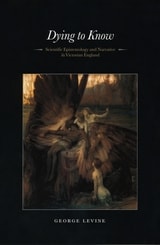
Dying to Know
Scientific Epistemology and Narrative in Victorian EnglandGeorge Levine
University of Chicago Press, 2002
In Dying to Know, eminent critic George Levine makes a landmark contribution to the history and theory of scientific knowledge. This long-awaited book explores the paradoxes of our modern ideal of objectivity, in particular its emphasis on the impersonality and disinterestedness of truth. How, asks Levine, did this idea of selfless knowledge come to be established and moralized in the nineteenth century?
Levine shows that for nineteenth-century scientists, novelists, poets, and philosophers, access to the truth depended on conditions of such profound self-abnegation that pursuit of it might be taken as tantamount to the pursuit of death. The Victorians, he argues, were dying to know in the sense that they could imagine achieving pure knowledge only in a condition where the body ceases to make its claims: to achieve enlightenment, virtue, and salvation, one must die.
Dying to Know is ultimately a study of this moral ideal of epistemology. But it is also something much more: a spirited defense of the difficult pursuit of objectivity, the ethical significance of sacrifice, and the importance of finding a shareable form of knowledge.
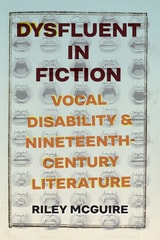
Dysfluent in Fiction
Vocal Disability and Nineteenth-Century LiteratureRiley McGuire
The Ohio State University Press, 2025
Honorable Mention, 2025 Victorian Popular Fiction Association First Book Prize
In Dysfluent in Fiction, Riley McGuire unspools a literary history of vocal disability in the nineteenth century, arguing that this underexamined literary trope helps us to understand vocal hierarchies that still structure our present. Adopting the term “dysfluency” to show departure from normative expectations of pace, pitch, and fluency, McGuire reveals how dysfluent speech populates an enormous number of nineteenth-century texts and played a formative role in the lives of some of the period’s most influential writers.
Dysfluent in Fiction examines anglophone literature during the long nineteenth century in both England and America by authors such as William Makepeace Thackeray, Charlotte Brontë, Lewis Carroll, Mary Elizabeth Braddon, and Frederick Douglass. Examples of dysfluencies across genres include lisping lovers, a baby-talking fairy, a mute detective, various disabilities in narratives of enslavement, and more. These representations show how disabled speech was both stigmatized and celebrated in ways that clarify our contemporary response to the spectrum of human articulation and that are a vocal corollary to current notions of neurodiversity. Dysfluency’s power, McGuire contends, lies in its denial that a single mode of articulation is possible, let alone desirable.
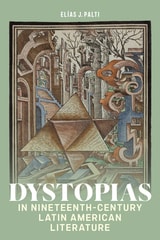
Dystopias in Nineteenth-Century Latin American Literature
Elías J. Palti
Bucknell University Press, 2027
How did nineteenth-century Latin American novelists respond to moments when history itself seemed to come undone? Rather than treating dystopia as a futuristic genre, Palti traces its emergence from concrete political crises in Mexico, Argentina, and Brazil, as writers confronted national defeat, dictatorship, and revolutionary uncertainty. Reading Mexican fiction written after the U.S. occupation; Argentine texts produced under Juan Manuel de Rosas, including works by Esteban Echeverría, Domingo F. Sarmiento, and José Mármol; and Brazilian novels from the transition from Empire to Republic, with particular attention to Machado de Assis, the book shows how narrative form begins to falter. Plots stall, identities fragment, and stories resist closure. These breakdowns constitute early dystopian modes—atopia-atropia, heterotopia, and transtopia—through which literature registers the collapse of historical intelligibility. By locating dystopia in narrative form rather than theme, Palti offers a rich new account of literature under political catastrophe.
Published by Bucknell University Press. Distributed worldwide by Rutgers University Press.
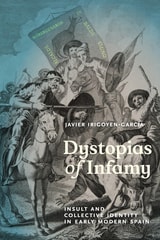
Dystopias of Infamy
Insult and Collective Identity in Early Modern SpainJavier Irigoyen-García
Bucknell University Press, 2022