Results by title
28164 books match the query 'History' and 908 start with d
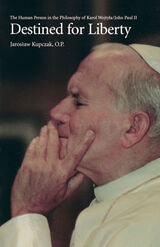
Destined for Liberty
The Human Person in the Philosophy of Karol Wojtyla/John Paul IIJaroslaw Kupczak, O.P.
Catholic University of America Press, 2000
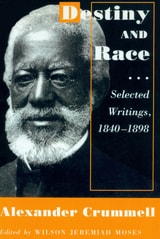
Destiny and Race
Selected Writings, 1840-1898Alexander Crummell
University of Massachusetts Press, 1992
A major reformer and intellectual, Alexander Crummell (1819–1898) was the first black American to graduate from Cambridge University. From 1858 to 1872, he lived in Liberia, where he worked as a farmer, educator, and Episcopal missionary. Returning to America, he established St. Luke’s Episcopal Church in Washington D.C., serving as its pastor until 1894. In 1897 he founded the American Negro Academy, which he intended as a challenge to the accommodationist philosophy of Booker T. Washington.
A prolific writer, Crummell produced pioneering works on black nationalism, black self-determination, and Pan Africanism that influenced W.E.B. Du Bois and other African-American leaders of the time. His surviving papers include over four hundred sermons and political essays and a voluminous correspondence.
Yet despite his importance to American and African-American history, Crummell is little known today, and there have been virtually no modern printings of his writing. This volume is intended to restore Crummell’s voice and to prompt a reevaluation of his work.

Destroyer HMCS Haida
Rindert van Zinderen-Bakker
Amsterdam University Press, 2023
Nowadays she is the only surviving Tribal-class destroyer out of 27 units that were constructed between 1937-1945 for the Royal Navy, Royal Australian Navy, and the Royal Canadian Navy.

Destroyer HNLMS Kortenaer
Rindert van Zinderen-Bakker
Amsterdam University Press, 2023
Destruction and Sorrow beneath the Heavens
ReportageLászló Krasznahorkai
Seagull Books, 2016
Known for his brilliantly dark fictional visions, László Krasznahorkai is one of the most respected European writers of his generation and the winner of the 2015 Man Booker International Prize. Here, he brings us on a journey through China at the dawn of the new millennium. On the precipice of its emergence as a global power, China is experiencing cataclysms of modernity as its harsh Maoist strictures meet the chaotic flux of globalism. What remains of the Middle Kingdom’s ancient cultural riches? And can a Westerner truly understand China’s past and present—or the murky waters where the two meet?
Destruction and Sorrow beneath the Heavens is both a travel memoir and the chronicle of a distinct intellectual shift as one of the most captivating contemporary writers and thinkers begins to engage with the cultures of Asia and the legacies of its interactions with Europe in a newly globalized society. Rendered in English by award-winning translator Ottilie Mulzet, Destruction and Sorrow beneath the Heavens is an important work, marking the emergence of Krasznahorkai as a truly global novelist.
Praise for Krasznahorkai
“The contemporary Hungarian master of the apocalypse.”—Susan Sontag
“Krasznahorkai delights in unorthodox description; no object is too insignificant for his worrying gaze. . . . He offers us stories that are relentlessly generative and defiantly irresolvable. They are haunting, pleasantly weird, and ultimately, bigger than the worlds they inhabit.”—New York Times
“Krasznahorkai is an expert with the complexity of human obsessions. Each of his books feel like an event, a revelation.”—Daily Beast
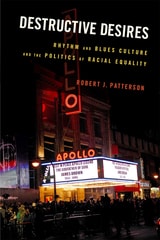
Destructive Desires
Rhythm and Blues Culture and the Politics of Racial EqualityRobert J. Patterson
Rutgers University Press, 2019

Destructive Sublime
World War II in American Film and MediaAllison, Tanine
Rutgers University Press, 2018
Destructive Sublime traces a new aesthetic history of the World War II combat genre by looking back at it through the lens of contemporary video games like Call of Duty. Allison locates some of video games’ glorification of violence, disruptive audiovisual style, and bodily sensation in even the most canonical and seemingly conservative films of the genre. In a series of case studies spanning more than seventy years—from wartime documentaries like The Battle of San Pietro to fictional reenactments like The Longest Day and Saving Private Ryan to combat video games like Medal of Honor—this book reveals how the genre’s aesthetic forms reflect (and influence) how American culture conceives of war, nation, and representation itself.

Detection and Its Designs
Narrative and Power in Nineteenth-Century Detective FictionPeter Thoms
Ohio University Press, 1998
In readings of Godwin's Caleb Williams, Poe's Dupin stories, Dickens's Bleak House, Collins's The Moonstone, and Doyle's The Hound of the Baskervilles, Thoms argues that the detective's figurative writing emerges out of a desire to exert control over others and sometimes over himself.
Detection and Its Designs demonstrates that, far from being a naïve form, early detective fiction grapples with the medium of storytelling itself. To pursue these inward-turning fictions is to uncover the detective's motives of controlling the representation of both himself and others, a discovery that in turn significantly undermines the authority of his solutions.

Detente in Europe
The Soviet Union & The West Since 1953John Van Oudenaren
Duke University Press, 1991
In redefining détente as a process, rather than a code of conduct, Van Oudenaren looks to its origins in Soviet policy earlier than previously identified and analyzes both its history and character. His study explores the restoration of four-power negotiations in Germany and Austria in the mid-1950s, their subsequent breakdown in the Berlin crisis, their unexpected revival in 1990 in the form of “two plus four” talks on German unity, and the future of the Soviet Union as a European power.
Among the key elements of détente discussed are diplomacy, particularly the role of summit conferences; cooperation among parliaments, political parties, and trade unions; arms control; economic relations; and links among cultural institutions, churches, and peace movements.

Dethroning historical reputations
universities, museums and the commemoration of benefactorsEdited by Jill Pellew and Lawrence Goldman
University of London Press, 2018
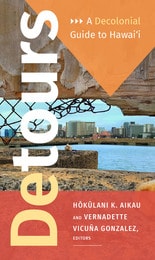
Detours
A Decolonial Guide to Hawai'iHokulani K. Aikau and Vernadetta Vicuña Gonzalez, editors
Duke University Press, 2019
Contributors. Hōkūlani K. Aikau, Malia Akutagawa, Adele Balderston, Kamanamaikalani Beamer, Ellen-Rae Cachola, Emily Cadiz, Iokepa Casumbal-Salazar, David A. Chang, Lianne Marie Leda Charlie, Greg Chun, Joy Lehuanani Enomoto, S. Joe Estores, Nicholas Kawelakai Farrant, Jessica Ka‘ui Fu, Candace Fujikane, Linda H. L. Furuto, Sonny Ganaden, Cheryl Geslani, Vernadette Vicuña Gonzalez, Noelani Goodyear-Ka‘ōpua, Tina Grandinetti, Craig Howes, Aurora Kagawa-Viviani, Noelle M. K. Y. Kahanu, Haley Kailiehu, Kyle Kajihiro, Halena Kapuni-Reynolds, Terrilee N. Kekoolani-Raymond, Kekuewa Kikiloi, William Kinney, Francesca Koethe, Karen K. Kosasa, N. Trisha Lagaso Goldberg, Kapulani Landgraf, Laura E. Lyons, David Uahikeaikalei‘ohu Maile, Brandy Nālani McDougall, Davianna Pōmaika‘i McGregor, Laurel Mei-Singh, P. Kalawai‘a Moore, Summer Kaimalia Mullins-Ibrahim, Jordan Muratsuchi, Hanohano Naehu, Malia Nobrega-Olivera, Katrina-Ann R. Kapā‘anaokalāokeola Nākoa Oliveira, Jamaica Heolimelekalani Osorio, No‘eau Peralto, No‘u Revilla, Kalaniua Ritte, Maya L. Kawailanaokeawaiki Saffery, Dean Itsuji Saranillio, Noenoe K. Silva, Ty P. Kāwika Tengan, Stephanie Nohelani Teves, Stan Tomita, Mehana Blaich Vaughan, Wendy Mapuana Waipā, Julie Warech

Detroit Country Music
Mountaineers, Cowboys, and RockabilliesCraig Maki with Keith Cady
University of Michigan Press, 2013
The richness of Detroit’s music history has by now been well established. We know all about Motown, the MC5, and Iggy and the Stooges. We also know about the important part the Motor City has played in the history of jazz. But there are stories about the music of Detroit that remain untold. One of the lesser known but nonetheless fascinating histories is contained within Detroit’s country music roots. At last, Craig Maki and Keith Cady bring to light Detroit’s most important country and western and bluegrass stars, such as Chief Redbird, the York Brothers, and Roy Hall. Beyond the individuals, Maki and Cady also map out the labels, radio programs, and performance venues that sustained Detroit’s vibrant country and bluegrass music scene. In the process, Detroit Country Music examines how and why the city’s growth in the early twentieth century, particularly the southern migration tied to the auto industry, led to this vibrant roots music scene.
This is the first book—the first resource of any kind—to tell the story of Detroit’s contributions to country music. Craig Maki and Keith Cady have spent two decades collecting music and images, and visiting veteran musicians to amass more than seventy interviews about country music in Detroit. Just as astounding as the book’s revelations are the photographs, most of which have never been published before. Detroit Country Musicwill be essential reading for music historians, record collectors, roots music fans, and Detroit music aficionados.
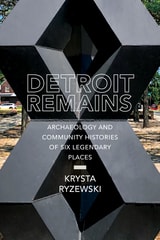
Detroit Remains
Archaeology and Community Histories of Six Legendary PlacesKrysta Ryzewski
University of Alabama Press, 2021
WINNER OF THE UNIVERSITY OF MARY WASHINGTON CENTER FOR HISTORIC PRESERVATION BOOK PRIZE, THE JAMES DEETZ BOOK AWARD, AND THE JOAN GERO BOOK AWARD
An interdisciplinary study of urban archaeology, community heritage, and social justice in modern Detroit.
The city of Detroit has endured periods of unprecedented industrial growth, decline, and revitalization between the late nineteenth century and the present. In Detroit Remains: Archaeology and Community Histories of Six Legendary Places, Krysta Ryzewski presents six archaeological case studies of legendary Detroit institutions—Little Harry speakeasy, the Ransom Gillis house, the Blue Bird Inn, Gordon Park, the Grande Ballroom, and the Halleck Street log cabin—that trace the contours of the city’s underrepresented communities and their relationship to local currents of capitalism and social justice. Through a combination of rigorous historical archaeological research and narrative storytelling, Ryzewski deftly contextualizes the cases within the city’s current struggles, including recovery from bankruptcy, and future-oriented recovery efforts.
This is the first historical archaeology book focused on Detroit and one of the few to foreground the archaeology of the Great Migration era (ca. 1915–1970). The archaeological scholarship is rooted in collaborative, community-involved, and public-facing initiatives. The case studies examine how power is and has been exercised in Detroit’s communities over the past century: how it was stripped from the city’s twentieth- and twenty-first-century residents, but also how they acquired alternative sources of agency by establishing creative and illicit economies, most of which still operated within the city’s capitalist framework.
Throughout this book, connections run deep between archaeology, heritage, politics, historic preservation, and storytelling. Detroit Remains demonstrates how the city’s past, present, and future lie not in ruins but in the tangible archaeological traces of the everyday lives of Detroiters and their legacies.
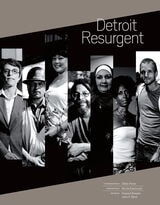
Detroit Resurgent
Howard Bossen
Michigan State University Press, 2014

Detroit's Cold War
The Origins of Postwar ConservatismColleen Doody
University of Illinois Press, 2017
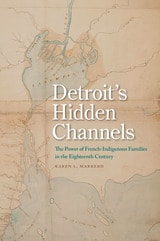
Detroit's Hidden Channels
The Power of French-Indigenous Families in the Eighteenth CenturyKaren L. Marrero
Michigan State University Press, 2020

Detroit
Race Riots, Racial Conflicts, and Efforts to Bridge the Racial DivideJoe T. Darden and Richard Thomas
Michigan State University Press, 2013

Deus
The Fall of Pompeii and the Rise of ChristianityGabriel Zuchtriegel
University of Chicago Press, 2027
Amid the city’s ruins, the director of the Pompeii Archaeological Park seeks signs of profound religious and cultural transformation to come.
Recent excavations in Pompeii have unearthed stunning discoveries and a new understanding of how people really lived, revealing a city simmering with tension in an age of great upheaval. From the author of The Buried City comes a riveting account of religious and ritual engagement in and around Pompeii at the time of its destruction in 79 CE, a moment when Christianity was just beginning to gain footing in the Roman world.
Drawing on ancient artifacts and the latest findings from Pompeii, Gabriel Zuchtriegel, director of the Pompeii Archaeological Park, considers how such a momentous transformation might have come to pass. Each chapter takes a different deity as its starting point, exploring the place of the ancient gods in the life of the city and its people. Inviting readers behind the scenes to experience discoveries through the eyes of the excavation team, Zuchtriegel shares insights about Pompeii’s red-light district, where archaeologists have found graffiti that may refer to Christians; excavations in several of the city’s sanctuaries and in nearby Longola, a Bronze and Early Iron Age precursor of Pompeii; a top-secret dig in the House of the Thiasus that has yielded wall paintings as provocative as those of the famous Villa of the Mysteries; and much more. With intimate detail, this book brings to life a raw and often brutal society, capturing beauty and humanity in places both expected and surprising.

Developing Animals
Wildlife and Early American PhotographyMatthew Brower
University of Minnesota Press, 2010
Developing Animals compellingly investigates the way photography changed our perception of animals. Brower analyzes how photographers created new ideas about animals as they moved from taking pictures of taxidermic specimens in so-called natural settings to the emergence of practices such as camera hunting, which made it possible to capture images of creatures in the wild.
By combining approaches in visual cultural studies and the history of photography, Developing Animals goes further to argue that photography has been essential not only to the understanding of wildlife but also to the conceptual separation of humans and animals.
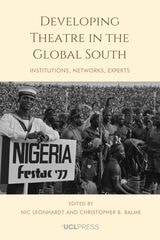
Developing Theatre in the Global South
Institutions, Networks, ExpertsEdited by Nic Leonhardt and Christopher B. Balme
University College London, 2024
This collection presents innovative institutional approaches to the theatre historiography of the Global South, proposing a fundamental reexamination of the historiography of theater in emerging countries since 1945. Covering perspectives from Africa, Asia, the Middle East, Latin America, and Eastern Europe, the chapters explore how US philanthropy, international organizations, and pan-African festivals all contributed to the globalization and institutionalization of the performing arts in the Global South.
During the Cultural Cold War, the Global North intervened in and promoted forms of cultural infrastructure that were deemed adaptable to any environment. This form of politics impacted the construction of national theaters, the introduction of new pedagogical tools, and the invention of the workshop as a format. The networks of experts responsible for this foreground seminal figures, both celebrated (Augusto Boal, Efua Sutherland) but also lesser-known (Albert Botbol, Severino Montano, Metin And), who contributed to the worldwide theatrical epistemic community of the postwar years.
Developing Theatre in the Global South investigates the institutional factors that led to the emergence of professional theatre in the postwar period throughout the decolonizing world. The book’s institutional and transnational approach enables theatre studies to overcome its commonly strong national and local focus on plays and productions and to connect it to current discourses in transnational and global history.
Developing Uganda
Hölger Bernt Hansen
Ohio University Press, 1998
Essays by the top scholars in the Weld span the breadth of the issue, from Uganda's growth out of poverty to development at the grass roots level. Developing Uganda replaces the myth and misinformation the last decade has witnessed with a realistic scrutiny by those who have studied it with care and caution.
Developing to Scale
Technology and the Making of Global HealthHeidi Morefield
University of Chicago Press, 2023
In 1973, economist E. F. Schumacher published Small Is Beautiful, which introduced a mainstream audience to his theory of “appropriate technology”: the belief that international development projects in the Global South were most sustainable when they were small-scale, decentralized, and balanced between the traditional and the modern. His theory gained widespread appeal, as cuts to the foreign aid budget, the national interests of nations seeking greater independence, postcolonial activism, and the rise of the United States’ tech sector drove stakeholders across public and private institutions toward cheaper tools. In the ensuing decades, US foreign assistance shifted away from massive modernization projects, such as water treatment facilities, toward point-of-use technologies like village water pumps and oral rehydration salts. This transition toward the small scale had massive implications for the practice of global health.
Developing to Scale tells the history of appropriate technology in international health and development, relating the people, organizations, and events that shaped this consequential idea. Heidi Morefield examines how certain technologies have been defined as more or less “appropriate” for the Global South based on assumptions about gender, race, culture, and environment. Her study shows appropriate technology to be malleable, as different constituencies interpreted its ideas according to their own needs. She reveals how policymakers wielded this tool to both constrain aid to a scale that did not threaten Western interests and to scale the practice of global health through the development and distribution of technical interventions.
Developing to Scale
Technology and the Making of Global HealthHeidi Morefield
University of Chicago Press, 2023
The first critical book on “appropriate technology,” Developing to Scale shows how global health came to be understood as a problem to be solved with the right technical interventions.
In 1973, economist E. F. Schumacher published Small Is Beautiful, which introduced a mainstream audience to his theory of “appropriate technology”: the belief that international development projects in the Global South were most sustainable when they were small-scale, decentralized, and balanced between the traditional and the modern. His theory gained widespread appeal, as cuts to the foreign aid budget, the national interests of nations seeking greater independence, postcolonial activism, and the rise of the United States’ tech sector drove stakeholders across public and private institutions toward cheaper tools. In the ensuing decades, US foreign assistance shifted away from massive modernization projects, such as water treatment facilities, toward point-of-use technologies like village water pumps and oral rehydration salts. This transition toward the small scale had massive implications for the practice of global health.
Developing to Scale tells the history of appropriate technology in international health and development, relating the people, organizations, and events that shaped this consequential idea. Heidi Morefield examines how certain technologies have been defined as more or less “appropriate” for the Global South based on assumptions about gender, race, culture, and environment. Her study shows appropriate technology to be malleable, as different constituencies interpreted its ideas according to their own needs. She reveals how policymakers wielded this tool to both constrain aid to a scale that did not threaten Western interests and to scale the practice of global health through the development and distribution of technical interventions.
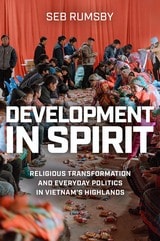
Development in Spirit
Religious Transformation and Everyday Politics in Vietnam’s HighlandsSeb Rumsby
University of Wisconsin Press, 2023
Following state-led market reforms in the 1980s, Vietnam experienced stunning economic transformation. But for the Hmong communities of the country’s north and central highlands, the benefits proved elusive. Instead, the Hmong people have pursued their own alternative paths to development. Rumsby shows how mass conversion to Christianity led to a case of “unplanned development” that put the Hmong on a trajectory of simultaneous integration into the market economy and resistance to state authority.
Many of the strategies community members employ are tied to the Christianization of everyday life. Religious actors play complex and often contradictory roles in facilitating networks of exchange, challenging or enforcing gender norms, promoting communalism and enforcing discipline, and shaping local ideas about progress. They are influenced by national and transnational religious networks, especially US-produced radio broadcasts by Hmong American Christians and local converts.
This compelling account provides fresh theoretical and empirical insights into the interplay of religion, neoliberal development, and marketization across the world.
Development of Southern French and Catalan Society, 718-1050
By Archibald R. Lewis
University of Texas Press, 1965
Early in the eighth century, the current of the Muslim movement that inundated northern Spain crept over the Pyrenees to spread across a portion of the French Midi. From the north the tide of Carolingian conquest forced the Muslims back and took in these same southern French and northern Spanish provinces. During the same era the Vikings raided intermittently and with varying degrees of intensity along the seacoasts and up the inland waterways, sometimes controlling considerable areas for extended periods.
These raids and conquests inevitably affected the way of life of the people of southern France and Catalonia. Contemporary travelers and later scholars have noted that the feudal traditions and obligations that were so strong in the north seemed very weak or nonexistent in the south. They found that the land seemed to be held largely as allods, not as feudal fiefs; they saw that women held positions of surprising power, that throughout the area there was great emphasis on money, and that the traditions of Roman and Visigothic law still survived.
Although scholars have noted these differences, no one has made a comprehensive study of southern French and Catalan society as a whole. It is to fill this void that Archibald Lewis provides this volume. In a detailed and scholarly study, based largely upon original records and chronicles, he examines the familial, social, economic, governmental, military, and religious life of the area from 718 to 1050 A.D.
Lewis gives as comprehensive a picture as the records will permit of the society that existed in the early eighth century, describes and discusses the major changes which took place during the next three centuries, and analyzes their causes and effects. This study, which includes careful and detailed notes and an extensive bibliography, provides a reliable and long-needed reference tool.

Developments in German Politics 3
Stephen Padgett, William E. Paterson, and Gordon Smith, eds.
Duke University Press, 0
Contributors. David P. Conradt, Russell J. Dalton, Kenneth Dyson, Klaus H. Goetz, Simon Green, Adrian Hyde-Price, Charlie Jeffery, Stephen Padgett, William E. Paterson, Wolfgang Rüdig, Martin Seeleib-Kaiser, Gordon Smith, Roland Sturm
Developments in Russian Politics 10
Henry E. Hale, Juliet Johnson, and Tomila V. Lankina, editors
Duke University Press, 0
Developments in Russian Politics 7
Stephen White, Richard Sakwa, and Henry E. Hale, eds.
Duke University Press, 0
Contributors. Alfred B. Evans, Henry E. Hale, P. Hanson, Margot Light, N. Manning, J. Mathers, Michael McFaul, Sarah Oates, Thomas F. Remington, C. Ross, Richard Sakwa, Darrell Slider, G. Smith, Stephen White, John P. Willerton

Developments in Russian Politics 7
Stephen White, Richard Sakwa, and Henry E. Hale, eds.
Duke University Press, 0
Contributors. Alfred B. Evans, Henry E. Hale, P. Hanson, Margot Light, N. Manning, J. Mathers, Michael McFaul, Sarah Oates, Thomas F. Remington, C. Ross, Richard Sakwa, Darrell Slider, G. Smith, Stephen White, John P. Willerton
Deviant Art Histories
From Radical Psychiatry to Cultural CitizenshipKaira M. Cabañas
University of Chicago Press, 2027
A groundbreaking examination of the entanglement between psychiatry, art, and art history.
Looking beyond the white walls of art galleries and museums, Kaira M. Cabañas explores art history through the psychiatric wards of the twentieth century, offering a reevaluation of the relationship between madness, making, and the art world and considering the deeply intertwined fields of psychiatry and art.
Putting aside romanticized myths about “outsider art,” Cabañas argues for a radical revisioning that centers artists in psychiatric settings not as deviants and curiosities but rather as skilled, sophisticated innovators and active participants in shared culture. Beginning with the story of legendary art historian Aby Warburg, whose own psychiatric internment and subsequent recovery serve as a point of departure, the narrative then covers the globe, following visionary reformers such as Nise da Silveira in Brazil and Franco and Franca Basaglia in Italy. The book tracks how psychiatrists collaborated with professional artists and patients to turn clinical spaces into laboratories of liberation. By documenting how patient-artists moved from being subjects of clinical study to recognized cultural producers, Deviant Art Histories demonstrates how art was a primary vehicle for reclaiming their agency. Featuring a diverse cast of figures—including Lygia Clark, Ornette Coleman, and Antonin Artaud—the book offers a powerful testament to art’s ability to break the clinical frame and transform the definition of what it means to be a creative citizen in the modern world.

Deviant and Useful Citizens
The Cultural Production of the Female Body in Eighteenth-Century PeruMariselle Melendez
Vanderbilt University Press, 2011
The book focuses on the different ways male authorities, as well as female subjects, conceived the female body as deeply connected to notions of what constituted a useful or deviant citizen within the Viceroyalty. Using eighteenth-century legal documents, illustrated chronicles, religious texts, and newspapers, Meléndez explores in depth the representation of the female body in periods of political, economic, and religious transformation to determine how it was conceived within certain contexts.
Deviant and Useful Citizens presents a highly complex society that relied on representations of utility and productivity to understand the female body, as it reveals the surprisingly large stake that colonial authorities had in defining the status of women during a crucial time in South American history.
Devil's Game
The Civil War Intrigues of Charles A. DunhamCarman Cumming
University of Illinois Press, 2003
The first book-length study of one of the Civil War's most outlandish and mysterious characters
Devil's Game traces the amazing career of Charles A. Dunham, Civil War spy, forger, journalist, and master of dirty tricks. Writing for a variety of New York papers under alternate names, Dunham routinely faked stories, created new identities, and later boldly cast himself to play those roles. He achieved his greatest infamy when he was called to testify in Washington concerning Abraham Lincoln's assassination. Many parts of Dunham's career remain shadowy, but Cumming offers the first detailed tour of Dunham's convoluted, high-stakes, international deceits, including his effort to sell Lincoln on plans for a raid to capture Jefferson Davis.
Exhaustively researched and unprecedented in depth, this carefully crafted assessment of Dunham's motives, personality, and the complex effects of his schemes changes assumptions about covert operations during the Civil War.
Devils Hole Pupfish
The Unexpected Survival of an Endangered Species in the Modern American WestKevin C. Brown
University of Nevada Press, 2021
Devils Will Reign
How Nevada BeganSally Zanjani
University of Nevada Press, 2007
Devils and Rebels
The Making of Hawthorne's Damned PoliticsLarry J. Reynolds
University of Michigan Press, 2010
"An outstanding combination of literary interpretation and cultural and historical context that will be an important addition to the critical literature on Hawthorne."
---Nina Baym, University of Illinois
"It is difficult to imagine a more timely book than Devils and Rebels. Examining the role of the public intellectual and writer during a time of political conflict and war, Reynolds takes up his charges with great precision and historical finesse. What particularly distinguishes this book is its attention to the ways in which one of this country's most important authors struggled to resist the waves of political extremism and patriotic hysteria that swept around him."
---Jeffrey Steele, University of Wisconsin—Madison
Widely condemned even in his own time, Nathaniel Hawthorne's views on abolitionism and slavery are today frequently characterized by scholars as morally reprehensible. Devils and Rebels explores the historical and biographical record to reveal striking evidence of the author's true political values---values grounded in pacifism and resistant to the kind of binary thinking that could lead to violence and war.
The book offers fresh readings of not only Hawthorne's four major romances but also some of his less familiar works like "Legends of the Province House," The Whole History of Grandfather's Chair, Journal of an African Cruiser, The Life of Franklin Pierce, and "Septimius Felton." Reynolds argues that Hawthorne---whether in his politics or his art---drew upon racialized imagery from America's past revolution and war on witchcraft to create a politics of quiet imagination, alert to the ways in which New England righteousness could become totalitarian by imposing its narrow view of the world on others.
Meticulously researched and cogently argued, this groundbreaking work demonstrates the need to examine perspectives and values from beyond the New England region when studying the literary history of the American Renaissance and illuminates the difficulties faced by public intellectuals during times of political strife---an issue as relevant today as it was some one hundred and fifty years ago.
Larry J. Reynolds is Thomas Franklin Mayo Professor of Liberal Arts and Professor of English at Texas A&M University. His previous books include A Historical Guide to Nathaniel Hawthorne, National Imaginaries, American Identities: The Cultural Work of American Iconography, and European Revolutions and the American Literary Renaissance as well as an edition of the European writings of Margaret Fuller.
Devotion in Motion
Pilgrimage in Modern MexicoEdward Wright-Ríos
University of Chicago Press, 2025
For many, pilgrimage conjures ideas about ancient traditions and somber journeys of self-discovery—an escape from modern life. In Devotion in Motion, Edward Wright-Ríos argues that we misunderstand pilgrimage (past and present) if we ignore its dynamic relationship with the rhythms of daily life and community.
Through the story of a centuries-old, ever-changing Catholic shrine to Our Lady of Juquila in Oaxaca, Mexico, Wright-Ríos reveals how tradition, innovation, marketing, and devotion coexist and interact in pilgrimage. Devotees, he shows, are not dissuaded by the embeddedness of the sacred site in the complexities, hierarchies, or conflicts of their lives. In fact, the truckers, accountants, and health-care workers we meet in this book actively seek new resources (including social media) to aid and share their devotion. Part microhistory, part ethnography, Devotion in Motion is a celebration of pilgrimage as a living experience in every generation.
Devotion of These Women
Rhode Island in the Antislavery NetworkDeborah B. Van Broekhoven
University of Massachusetts Press, 2009
Despite the efforts of these groups, by 1842 the antislavery movement in Rhode Island was nearly moribund, the unified hopes of earlier years having fallen victim to political wrangling. A year later the largest auxiliary in the state, the Providence Antislavery Society, turned its funds over to Amarancy Paine, who in concert with other women not only revived the abolitionist movement in the state but kept it running for another ten years.
This detailed study explores how and why women like Paine emerged from the background to resuscitate and lead the antislavery cause in Rhode Island. It suggests that women more than men were accustomed to working behind the scenes, informally and without much public recognition.
The crumbling of the male-centered organization revealed a previously invisible female-based structure of personal ties on which leaders were able to build the Rhode Island State Anti-Slavery Society. Because these informal ties crossed traditional racial, geographic, and gender-role boundaries, they were often tenuous and fragile. Nevertheless, by developing this network among themselves and then extending it to national leaders, a few dedicated women managed to continue a program of antislavery petitioning, meetings, and literature circulation.

Devotion to the Adopted Country
U.S. Immigrant Volunteers in the Mexican WarTyler V. Johnson
University of Missouri Press, 2012

Dewey's Empirical Theory of Knowledge and Reality
John R. Shook
Vanderbilt University Press, 2000
that Dewey's metaphysical empiricism remained more indebted to Kant and Hegel than is commonly supposed;
that Dewey owed more to the influence of Wundt than is commonly believed;
that the influence of Peirce and James was not as significant for the development of Dewey's theories of mind and truth as has been argued in the past;
and that Dewey's pragmatic theory of knowledge never really abandoned idealism.
Shook's exposition of the unity of Dewey's thought challenges a large scholarly industry devoted to suppressing or explaining away the consistency between Dewey's early thought and his later work. In every respect, Dewey's Empirical Theory of Knowledge and Reality is a provocative and engaging study that will occupy a unique niche in this field. It is certain to stimulate discussion and controversy, forcing Dewey traditionalists out of habitual modes of thought and transforming our conventional understanding of the development of classical American philosophy.

Dewey, Russell, Whitehead
Philosophers as EducatorsBrian Patrick Hendley
Southern Illinois University Press, 1986
In Philosophers as Educators Brian Patrick Hendley argues that philosophers of education should reject their preoccupation with defining terms and analyzing concepts and embrace the philosophical task of constructing general theories of education. Hendley discusses in detail the educational philosophies of John Dewey, Bertrand Russell, and Alfred North Whitehead. He sees in these men excellent role models that contemporary philosophers might well follow. Hendley believes that, like these mentors, philosophers should take a more active, practical role in education. Dewey and Russell ran their own schools, and Whitehead served as a university administrator and as a member of many committees created to study education.

Dharma Lion
A Biography of Allen GinsbergMichael Schumacher
University of Minnesota Press, 2016
With the sweep of an epic novel, Michael Schumacher tells the story of Allen Ginsberg and his times, with fascinating portraits of Jack Kerouac, Neal Cassady, and William Burroughs, among others, along with many rarely seen photographs.
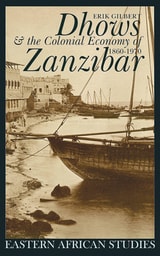
Dhows and the Colonial Economy of Zanzibar, 1860-1970
1860-1970Erik Gilbert
Ohio University Press, 2004
Conventional history assumes that the rise of the steamship trade killed off the Indian Ocean dhow trade in the twentieth century. Erik Gilbert argues that the dhow economy played a major role in shaping the economic and social life of colonial Zanzibar. Dhows, and the regional trade they fostered, allowed a class of indigenous entrepreneurs to thrive in Zanzibar. These entrepreneurs, whose economic interests stretched across continents and colonial boundaries, were able to thwart or shape many of the colonial state’s pet projects. Not only did steamships fail to drive out indigenous sailing craft, but in some cases dhows were able to drive the steamer out of specific market niches. In highlighting the role of East Africa’s commercial connections to the Middle East and India during the colonial period, Dhows and the Colonial Economy of Zanzibar, 1860-1970 makes a major contribution to African history as part of world history.

Diagnoses in Assyrian and Babylonian Medicine
Ancient Sources, Translations, and Modern Medical AnalysesTranslated and with Commentary by JoAnn Scurlock and Burton R. Andersen
University of Illinois Press, 2005
The collaboration of medical expert Burton R. Andersen and cuneiformist JoAnn Scurlock makes it finally possible to survey this collected corpus and discern magic from experimental medicine in Ashur, Babylon, and Nineveh. Diagnoses in Assyrian and Babylonian Medicine is the first systematic study of all the available texts, which together reveal a level of medical knowledge not matched again until the nineteenth century A.D. Over the course of a millennium, these nations were able to develop tests, prepare drugs, and encourage public sanitation. Their careful observation and recording of data resulted in a description of symptoms so precise as to enable modern identification of numerous diseases and afflictions.

Diagnosis, Therapy, and Evidence
Conundrums in Modern American MedicineGrob, Gerald N
Rutgers University Press, 2010
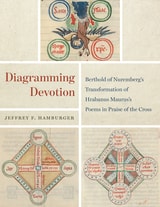
Diagramming Devotion
Berthold of Nuremberg’s Transformation of Hrabanus Maurus’s Poems in Praise of the CrossJeffrey F. Hamburger
University of Chicago Press, 2020
Dialectic and Dialogue
Plato's Practice of Philosophical InquiryFrancisco J. Gonzalez
Northwestern University Press, 1998
Dialectical Imaginaries
Materialist Approaches to U.S. Latino/a Literature in the Age of NeoliberalismMarcial González and Carlos Gallego, editors
University of Michigan Press, 2018
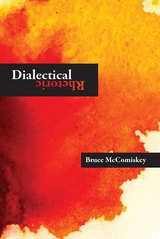
Dialectical Rhetoric
Bruce Mccomiskey
Utah State University Press, 2015
In Dialectical Rhetoric, Bruce McComiskey argues that the historical conflict between rhetoric and dialectic can be overcome in ways useful to both composition theory and the composition classroom.
Historically, dialectic has taken two forms in relation to rhetoric. First, it has been the logical development of linear propositions leading to necessary conclusions, a one-dimensional form that was the counterpart of rhetorics in which philosophical, metaphysical, and scientific truths were conveyed with as little cognitive interference from language as possible. Second, dialectic has been the topical development of opposed arguments on controversial issues and the judgment of their relative strengths and weaknesses, usually in political and legal contexts, a two-dimensional form that was the counterpart of rhetorics in which verbal battles over competing probabilities in public institutions revealed distinct winners and losers.
The discipline of writing studies is on the brink of developing a new relationship between dialectic and rhetoric, one in which dialectics and rhetorics mediate and negotiate different arguments and orientations that are engaged in any rhetorical situation. This new relationship consists of a three-dimensional hybrid art called “dialectical rhetoric,” whose method is based on five topoi: deconstruction, dialogue, identification, critique, and juxtaposition. Three-dimensional dialectical rhetorics function effectively in a wide variety of discursive contexts, including digital environments, since they can invoke contrasts in stagnant contexts and promote associations in chaotic contexts. Dialectical Rhetoric focuses more attention on three-dimensional rhetorics from the rhetoric and composition community.
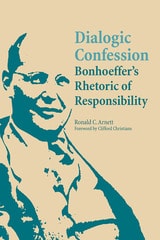
Dialogic Confession
Bonhoeffer's Rhetoric of ResponsibilityRonald C. Arnett. Foreword by Clifford Christians
Southern Illinois University Press, 2005
In this landmark volume of contemporary communication theory, Ronald C. Arnett applies the metaphor of dialogic confession—which enables historical moments to be addressed from a confessed standpoint and through a communicative lens—to the works of German theologian Dietrich Bonhoeffer, who pointed to an era of postmodern difference with his notion of "a world come of age." Arnett’s interpretations of Bonhoeffer’s life and scholarship in contention with Nazi dominance offer implications for a dialogic confession that engages the complexity of postmodern narrative contention.
Rooted in classical theory, the field of communication ethics is abstract and arguably outmoded. In Dialogic Confession: Bonhoeffer’s Rhetoric of Responsibility, Arnett locates cross-cultural and comparative anchors that not only bring legitimacy and relevance to the field but also develop a conceptual framework that will advance and inspire future scholarship.