Results by title
18284 books match the query 'United States' and 684 start with d
Disability in Twentieth-Century German Culture
Carol Poore
University of Michigan Press, 2010
"Comprehensively researched, abundantly illustrated and written in accessible and engaging prose . . . With great skill, Poore weaves diverse types of evidence, including historical sources, art, literature, journalism, film, philosophy, and personal narratives into a tapestry which illuminates the cultural, political, and economic processes responsible for the marginalization, stigmatization, even elimination, of disabled people---as well as their recent emancipation."
---Disability Studies Quarterly
"A major, long-awaited book. The chapter on Nazi images is brilliant---certainly the best that has been written in this arena by any scholar."
---Sander L. Gilman, Emory University
"An important and pathbreaking book . . . immensely interesting, it will appeal not only to students of twentieth-century Germany but to all those interested in the growing field of disability studies."
---Robert C. Holub, University of Tennessee
Disability in Twentieth-Century German Culture covers the entire scope of Germany's most tragic and tumultuous century---from the Weimar Republic to the current administration---revealing how central the notion of disability is to modern German cultural history. By examining a wide range of literary and visual depictions of disability, Carol Poore explores the contradictions of a nation renowned for its social services programs yet notorious for its history of compulsory sterilization and eugenic dogma. This comprehensive volume focuses particular attention on the horrors of the Nazi era, when those with disabilities were considered "unworthy of life," but also investigates other previously overlooked topics including the exile community's response to disability, socialism and disability in East Germany, current bioethical debates, and the rise and gains of Germany's disability rights movement.
Richly illustrated, wide-ranging, and accessible, Disability in Twentieth-Century German Culture gives all those interested in disability studies, German studies, visual culture, Nazi history, and bioethics the opportunity to explore controversial questions of individuality, normalcy, citizenship, and morality. The book concludes with a memoir of the author's experiences in Germany as a person with a disability.
Carol Poore is Professor of German Studies at Brown University.
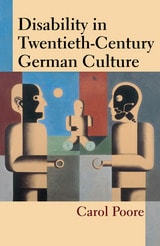
Illustration: "Monument to the Unknown Prostheses" by Heinrich Hoerle © 2007 Artists Rights Society (ARS), New York / VG Bild-Kunst, Bonn
A volume in the series Corporealities: Discourses of Disability
"Insightful and meticulously researched . . . Using disability as a concept, symbol, and lived experience, the author offers valuable new insights into Germany's political, economic, social, and cultural character . . . Demonstrating the significant ‘cultural phenomena' of disability prior to and long after Hitler's reign achieves several important theoretical and practical aims . . . Highly recommended."
---Choice
Disability, Civil Rights, and Public Policy
The Politics of ImplementationStephen L. Percy
University of Alabama Press, 1989
Following on the heels of other Civil Rights movements, disability rights laws emerged in the late 1960s and early 1970s. Often these laws were more symbolic than precise in terms of objectives and strategies to guide the implementation of antidiscrimination policies. Policy refinement, the process of translating legislative mandates into strategies and procedures to govern administrative action, is both dynamic and controversial.
The premise of Disability, Civil Rights, and Public Policy is that implementation policies in these areas evolved through protracted political struggles among a variety of persons and groups affected by disability rights laws. Efforts to influence policies extended far beyond the process of legislative enactment and resulted in struggles that were played out in the courts and in the executive branch. Included within this examination of federal disability rights laws are the role of symbolic politics, the strengths and weaknesses of contemporary models used for the study of policy implementation, and the politics of administrative policymaking.
Disabled Upon Arrival
Eugenics, Immigration, and the Construction of Race and DisabilityJay Timothy Dolmage
The Ohio State University Press, 2018
Through careful archival research and consideration of the larger ideologies of racialization and xenophobia, Disabled Upon Arrival links anti-immigration rhetoric to eugenics—the flawed “science” of controlling human population based on racist and ableist ideas about bodily values. Dolmage casts an enlightening perspective on immigration restriction, showing how eugenic ideas about the value of bodies have never really gone away and revealing how such ideas and attitudes continue to cast groups and individuals as disabled upon arrival.
Disaffected
The Cultural Politics of Unfeeling in Nineteenth-Century AmericaXine Yao
Duke University Press, 2021
Duke University Press Scholars of Color First Book Award recipient
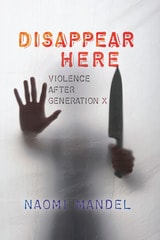
Disappear Here
Violence after Generation XNaomi Mandel
The Ohio State University Press, 2015
Examining developments in media, philosophy, literature, and politics in the years Xers were coming of age, Mandel demonstrates that Generation X’s unique attitude toward violence was formed by developments in home media, personal computing, and reality TV. This attitude, Mandel contends, is key to understanding our current world of media ubiquity, online activism, simulated sensation, and jihad. With chapters addressing both fictional and filmic representations of violence, Mandel studies the work of Bret Easton Ellis, Chuck Palahniuk, Claire Messud, Jess Walter, and Jonathan Safran Foer. A critical and conceptual tour de force, Disappear Here sets forth a new, and necessary, approach to violence, the real, and real violence for the twenty-first century.
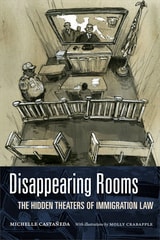
Disappearing Rooms
The Hidden Theaters of Immigration LawMichelle Castañeda
Duke University Press, 2023
Duke University of Press Scholars of Color First Book Award Recipient

Disarming the Nation
Women's Writing and the American Civil WarElizabeth Young
University of Chicago Press, 1999
Combining literary analysis, cultural history, and feminist theory, Disarming the Nation argues that the Civil War functioned in women's writings to connect female bodies with the body politic. Women writers used the idea of "civil war" as a metaphor to represent struggles between and within women—including struggles against the cultural prescriptions of "civility." At the same time, these writers also reimagined the nation itself, foregrounding women in their visions of America at war and in peace. In a substantial afterword, Young shows how contemporary black and white women—including those who crossdress in Civil War reenactments—continue to reshape the meanings of the war in ways startlingly similar to their nineteenth-century counterparts.
Learned, witty, and accessible, Disarming the Nation provides fresh and compelling perspectives on the Civil War, women's writing, and the many unresolved "civil wars" within American culture today.
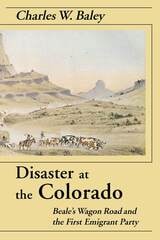
Disaster At The Colorado
Charles W. Baley
Utah State University Press, 2002
Across north-central New Mexico and Arizona, along the line of Route 66, now Interstate 40, there first ran a little-known wagon trail called Beale's Wagon Road, after Edward F. Beale, who surveyed it for the War Department in 1857. This survey became famous for employing camels. Not so well known is the fate of the first emigrants who the next year attempted to follow its tracks. The government considered the 1857 exploration a success and the road it opened a promising alternative route to California but expected such things as military posts and developed water supplies to be needed before it was ready for regular travel. Army representatives in New Mexico were more enthusiastic.
In 1858 there was a need for an alternative. Emigrants avoided the main California Trail because of a U.S. Army expedition to subdue Mormons in Utah. The Southern Route ran through Apache territory, was difficult for the army to guard, and was long. When a party of Missouri and Iowa emigrants known as the Rose-Baley wagon train arrived in Albuquerque, they were encouraged to be the first to try the new Beale road. Their journey became a rolling disaster. Beale's trail was more difficult to follow than expected; water sources and feed for livestock harder to find. Indians along the way had been described as peaceful, but the Hualapais persistently harassed the emigrants and shot their stock, and when the wagon train finally reached the Colorado River, a large party of Mojaves attacked them. Several of the emigrants were killed, and the remainder began a difficult retreat to Albuquerque. Their flight, with wounded companions and reduced supplies, became ever more arduous. Along the way they met other emigrant parties and convinced them to join the increasingly disorderly and distressed return journey.
Charles Baley tells this dramatic story and discusses its aftermath, for the emigrants, for Beale's Wagon Road, and for the Mojaves, against whom some of the emigrants pressed legal claims with the federal government.
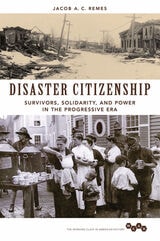
Disaster Citizenship
Survivors, Solidarity, and Power in the Progressive EraJacob Remes
University of Illinois Press, 2015
In Disaster Citizenship, Jacob A. C. Remes draws on histories of the Salem and Halifax events to explore the institutions--both formal and informal--that ordinary people relied upon in times of crisis. He explores patterns and traditions of self-help, informal order, and solidarity and details how people adapted these traditions when necessary. Yet, as he shows, these methods--though often quick and effective--remained illegible to reformers. Indeed, soldiers, social workers, and reformers wielding extraordinary emergency powers challenged these grassroots practices to impose progressive "solutions" on what they wrongly imagined to be a fractured social landscape.
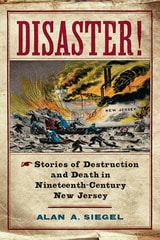
Disaster!
Stories of Destruction and Death in Nineteenth-Century New JerseySiegel, Alan A
Rutgers University Press, 2014
By every measure, Hurricane Sandy was a disaster of epic proportions. The deadliest storm to strike the East Coast since Hurricane Diane in 1955, Sandy killed thirty-seven people and caused more than $30 billion in damages in 2012 to New Jersey alone. But earlier centuries experienced their own catastrophes.
In Disaster!, Alan A. Siegel brings readers face-to-face with twenty-eight of the deadliest natural and human-caused calamities to strike New Jersey between 1821 and 1906, ranging from horrific transportation accidents to uncontrolled fires of a kind rarely seen today. As Siegel writes in his introduction, “None of the stories end well—there are dead and injured by the thousands as well as millions in property lost.” Accounts of these fires, steamboat explosions, shipwrecks, train wrecks, and storms are told in the words of the people who experienced the events firsthand, lending a sense of immediacy to each story.
Disasters bring out the worst as well as the best in people. Siegel focuses on the bravest individuals, including harbor pilot Thomas Freeborn who drowned while attempting to save fifty passengers and crew of a ship foundering on the Jersey Shore, and Warwicke Greene, a fourteen-year-old schoolboy who rescued the injured “like the hero of an epic poem” after a train wreck in the Hackensack Meadows. These and many other stories of forgotten acts of courage in the face of danger will make Disaster! an unforgettable read.
Discerning Experts
The Practices of Scientific Assessment for Environmental PolicyMichael Oppenheimer, Naomi Oreskes, Dale Jamieson, Keynyn Brysse, Jessica O’Reilly, Matthew Shindell, and Milena Wazeck
University of Chicago Press, 2019
Discerning Experts uncovers factors that can generate systematic bias and error, and recommends how the process can be improved. As the first study of the internal workings of large environmental assessments, this book reveals their strengths and weaknesses, and explains what assessments can—and cannot—be expected to contribute to public policy and the common good.
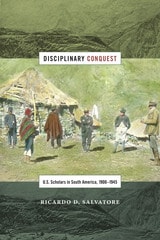
Disciplinary Conquest
U.S. Scholars in South America, 1900–1945Ricardo D. Salvatore
Duke University Press, 2016

Discipline and History
Political Science in the United StatesJames Farr and Raymond Seidelman, Editors
University of Michigan Press, 1993
James Farr and Raymond Seidelman bring new historical reflection to the "state of the discipline" debate in political science. This anthology offers a panorama of views about the state of the discipline that have been sketched by leading political scientists and disciplinary historians from the late nineteenth century to the past.
The essays in this volume explore four distinct periods in the development of the discipline, with special emphasis on the subfields of American politics and political theory, revealing that the identity of the discipline is constituted not so much by agreements over fundamental principles as by the history of debates about the meaning of politics, the methods of science, the theories of behavioralism and the state, and the responsibilities of public professionals and civic educators.
Contributors are Terence Ball, Charles A. Beard, John W. Burgess, Robert A. Dahl, David Easton, John G. Gunnell, Norman Jacobson, Harold D. Lasswell, Francis Lieber, Charles E. Merriam, David M. Ricci, William H. Riker, Dorothy Ross, Helene Silverberg, Leonard D. White, Woodrow Wilson, and W.W. Willoughby.
Its unprecedented treatment of the history of political science makes Discipline and History essential reading for political scientists and their students. Historians of the social sciences will also find much to consider.
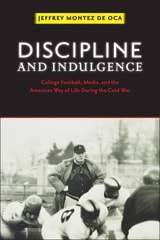
Discipline and Indulgence
College Football, Media, and the American Way of Life during the Cold WarMontez de Oca, Jeffrey
Rutgers University Press, 2013
The early Cold War (1947–1964) was a time of optimism in America. Flushed with confidence by the Second World War, many heralded the American Century and saw postwar affluence as proof that capitalism would solve want and poverty. Yet this period also filled people with anxiety. Beyond the specter of nuclear annihilation, the consumerism and affluence of capitalism’s success were seen as turning the sons of pioneers into couch potatoes.
In Discipline and Indulgence, Jeffrey Montez de Oca demonstrates how popular culture, especially college football, addressed capitalism’s contradictions by integrating men into the economy of the Cold War as workers, warriors, and consumers. In the dawning television age, college football provided a ritual and spectacle of the American way of life that anyone could participate in from the comfort of his own home. College football formed an ethical space of patriotic pageantry where men could produce themselves as citizens of the Cold War state. Based on a theoretically sophisticated analysis of Cold War media, Discipline and Indulgence assesses the period’s institutional linkage of sport, higher education, media, and militarism and finds the connections of contemporary sport media to today’s War on Terror.
Disciplining Feminism
From Social Activism to Academic DiscourseEllen Messer-Davidow
Duke University Press, 2002
Working within a firm theoretical framework and drawing on years of both personal involvement and fieldwork in and outside of academe, Messer-Davidow traces the metamorphosis of a once insurgent project in three steps. After illustrating how early feminists meshed their activism with institutional processes to gain footholds on campuses and in disciplinary associations, she turns to the relay between institutionalization and intellectualization, examining the way feminist studies coalesced into an academic field beginning in the mid-1970s. Without denying the successes of this feminist passage into the established system of higher learning, Messer-Davidow nonetheless insists that the process of institutionalization itself necessarily alters all new entrants—no matter how radical. Her final chapters look to the future of feminism in an increasingly conservative environment and to the possibilities for social change in general.
Disciplining Feminism’s interdisciplinary scope and cross-sector analysis will attract a broad range of readers interested in women’s studies, American higher education, and the dynamics of social transformation.
Disciplining the Poor
Neoliberal Paternalism and the Persistent Power of RaceJoe Soss, Richard C. Fording, and Sanford F. Schram
University of Chicago Press, 2011
Disciplining the Poor explains the transformation of poverty governance over the past forty years—why it happened, how it works today, and how it affects people. In the process, it clarifies the central role of race in this transformation and develops a more precise account of how race shapes poverty governance in the post–civil rights era. Connecting welfare reform to other policy developments, the authors analyze diverse forms of data to explicate the racialized origins, operations, and consequences of a new mode of poverty governance that is simultaneously neoliberal—grounded in market principles—and paternalist—focused on telling the poor what is best for them. The study traces the process of rolling out the new regime from the federal level, to the state and county level, down to the differences in ways frontline case workers take disciplinary actions in individual cases. The result is a compelling account of how a neoliberal paternalist regime of poverty governance is disciplining the poor today.
Discourse and the Other
The Production of the Afro-American TextW. Lawrence Hogue
Duke University Press, 1986
Hogue presents an illuminating discussion of the publication and review history of "major" and neglected texts. He illustrates the acceptance of texts as exotica, as sociological documents, or as carriers of sufficient literary conventions to receive approbation. Although the sixties movement allowed the text to move to the periphery of the dominant ideology, providing some new myths about the Afro-American historical past, this marginal position was subsequently sabotaged, co-opted, or appropriated (Afros became a fad; presidents gave the soul handshake; the hip-talking black was dressing one style and talking another.)
This study includes extended discussion of four works; Ernest J. Gaines's The Autobiography of Miss Jane Pittman, Alice Walker's The Third Life of Grange Copeland, Albert Murray's Train Whistle Guitar, and Toni Morrison's Sula. Hogue assesses the informing worldviews of each and the extent and nature of their acceptance by the dominant American cultural apparatus.

Discover Colorado, Second Edition
Matthey Downey
University Press of Colorado, 2015

Discover the Hidden New Jersey
Roberts, Russell
Rutgers University Press, 1995
Did you know—
—that a New Jerseyan was the first president of the United States?
—that New Jersey was the site of the first organized college football game?
—that New Jersey was the location of one of the most devastating espionage attacks of World War I?
—that the heroics of a New Jersey woman saved thousands of people from dying of yellow fever?
These and other fascinating stores can be found in Discover the Hidden New Jersey, a treasury of New Jersey stories that celebrate the unique heritage and importance of the Garden State. Russell Roberts has scoured New Jersey, from High Point to Cape May, to bring readers a delightful potpourri of facts, essays, lists, photos, stories, and legends about New Jersey. Readers will learn how New Jersey used to be the center of the motion picture universe, the origin of the Jersey Devil and other popular tall tales, where Norman Mailer and Abbot & Costello were born, where Aaron Burr and Leo, the M-G-M lion, lie buried, and much more. Learn about the geology of New Jersey, find out about the state’s ever-changing weather, and hear about some of the best places to go for the day. All this and more is in Discover the Hidden New Jersey, the ultimate New Jersey book.
Discovering North American Rock Art
Edited by Lawrence L. Loendorf, Christopher Chippindale, and David S. Whitley
University of Arizona Press, 2005
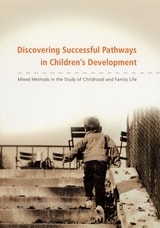
Discovering Successful Pathways in Children's Development
Mixed Methods in the Study of Childhood and Family LifeEdited by Thomas S. Weisner
University of Chicago Press, 2005
This volume includes new studies of minority and immigrant families, school achievement, culture, race and gender, poverty, identity, and experiments and interventions meant to improve family and child contexts. Discovering Successful Pathways in Children's Development will be of enormous value to everyone interested in the issues of human development, education, and social welfare, and among professionals charged with the task of improving the lives of children in our communities.
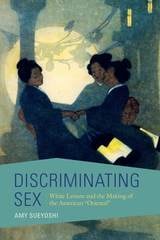
Discriminating Sex
White Leisure and the Making of the American "Oriental"Amy Sueyoshi
University of Illinois Press, 2018
Amy Sueyoshi draws on everything from newspapers to felony case files to oral histories in order to examine how whites' pursuit of gender and sexual fulfillment gave rise to racial caricatures. As she reveals, white reporters, writers, artists, and others conflated Chinese and Japanese, previously seen as two races, into one. There emerged the Oriental—a single pan-Asian American stereotype weighted with sexual and gender meaning. Sueyoshi bridges feminist, queer, and ethnic studies to show how the white quest to forge new frontiers in gender and sexual freedom reinforced—and spawned—racial inequality through the ever evolving Oriental.
Informed and fascinating, Discriminating Sex reconsiders the origins and expression of racial stereotyping in an American city.
Discriminating Taste
How Class Anxiety Created the American Food RevolutionFinn, S. Margot
Rutgers University Press, 2017
For the past four decades, increasing numbers of Americans have started paying greater attention to the food they eat, buying organic vegetables, drinking fine wines, and seeking out exotic cuisines. Yet they are often equally passionate about the items they refuse to eat: processed foods, generic brands, high-carb meals. While they may care deeply about issues like nutrition and sustainable agriculture, these discriminating diners also seek to differentiate themselves from the unrefined eater, the common person who lives on junk food.
Discriminating Taste argues that the rise of gourmet, ethnic, diet, and organic foods must be understood in tandem with the ever-widening income inequality gap. Offering an illuminating historical perspective on our current food trends, S. Margot Finn draws numerous parallels with the Gilded Age of the late nineteenth century, an era infamous for its class divisions, when gourmet dinners, international cuisines, slimming diets, and pure foods first became fads.
Examining a diverse set of cultural touchstones ranging from Ratatouille to The Biggest Loser, Finn identifies the key ways that “good food” has become conflated with high status. She also considers how these taste hierarchies serve as a distraction, leading middle-class professionals to focus on small acts of glamorous and virtuous consumption while ignoring their class’s larger economic stagnation. A provocative look at the ideology of contemporary food culture, Discriminating Taste teaches us to question the maxim that you are what you eat.
Discrimination by Design
A Feminist Critique of the Man-Made EnvironmentLeslie Kanes Weisman
University of Illinois Press, 1992
-- Women's Review of Books
"A readable account of the force of male dominance in the built environment. . . . Those looking to this book for a clearer vision of the changes that need to be made in the organization and design of housing, work, and public space to foster gender equality will not be disappointed."
-- Journal of Planning Education and Research
"A pioneering work that will pave new territory not only for feminists but all those who are prepared to rethink environmental and societal issues."
-- Choice
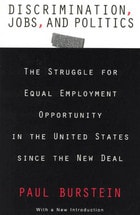
Discrimination, Jobs, and Politics
The Struggle for Equal Employment Opportunity in the United States since the New DealPaul Burstein
University of Chicago Press, 1985
"This is an important, well-researched book. . . . Burstein has had the courage to break through narrow specializations within sociology . . . and even to address the types of acceptable questions usually associated with three different disciplines (political science, sociology, and economics). . . . This book should be read by all professionals interested in political sociology and social movements."—Donald Tomaskovic-Devey, Social Forces
"Discrimination, Jobs and Politics [is] satisfying because it tells a more complete story . . . than does most sociological research. . . . I find myself returning to it when I'm studying the U.S. women's movement and recommending it to students struggling to do coherent research."—Rachel Rosenfeld, Contemporary Sociology
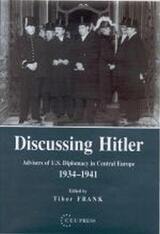
Discussing Hitler
Advisers of U.S. Diplomacy in Central Europe, 1934-41Tibor Frank
Central European University Press, 2003

Disease And Medical Care In The Mountain West
Essays On Region, History, And PracticeMartha L. Hildreth
University of Nevada Press, 1998
This collection of eight essays examines the health, disease, and medical care of the American West—an area flanked by the Rocky Mountains, Sierra Nevada, and Cascade Mountains. Topics include Mormons and the Thomsonian Movement in the nineteenth century, the silicosis epidemic in hardrock mining, Native American health, frontier nursing, and Chinese medicine.

Disease and Class
Tuberculosis and the Shaping of Modern North American SocietyGeorgina D. Feldberg
Rutgers University Press, 1995
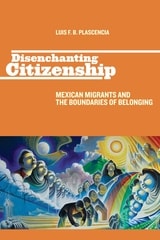
Disenchanting Citizenship
Mexican Migrants and the Boundaries of BelongingLuis F. B. Plascencia
Rutgers University Press, 2012
The book explores the meaning of U.S. citizenship through the experience of a unique group of Mexican migrants who were granted Temporary Status under the “legalization” provisions of the 1986 IRCA, attained Lawful Permanent Residency, and later became U.S. citizens. Plascencia integrates an extensive and multifaceted collection of interviews, ethnographic fieldwork, ethno-historical research, and public policy analysis in examining efforts that promote the acquisition of citizenship, the teaching of citizenship classes, and naturalization ceremonies. Ultimately, he unearths citizenship’s root as a Janus-faced construct that encompasses a simultaneous process of inclusion and exclusion. This notion of citizenship is mapped on to the migrant experience, arguing that the acquisition of citizenship can lead to disenchantment with the very status desired. In the end, Plascencia expands our understanding of the dynamics of U.S. citizenship as a form of membership and belonging.
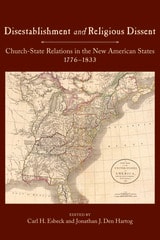
Disestablishment and Religious Dissent
Church-State Relations in the New American States, 1776-1833Edited by Carl H. Esbeck and Jonathan J. Den Hartog
University of Missouri Press, 2026
traditions of church-state relations rooted in the colony’s peoples, their country of origin, and religion.
This definitive volume, comprising twenty-one original essays by eminent historians and political scientists, is a comprehensive state-by-state account of disestablishment in the original thirteen states, as well as a look at similar events in the soon-to-be-admitted states of Vermont, Tennessee, and Kentucky. Also considered are disestablishment in Ohio (the first state admitted from the Northwest Territory), Louisiana and Missouri (the first states admitted from the Louisiana Purchase), and Florida (wrestled from Spain under U.S. pressure). The volume makes a unique scholarly contribution by recounting in detail the process of disestablishment in each of the colonies, as well as religion’s constitutional and legal place in the new states of the federal republic.
Disforming The American Canon
African-Arabic Slave Narratives and the VernacularRonald A.T. Judy
University of Minnesota Press, 1993
Dishing It Out
Waitresses and Their Unions in the Twentieth CenturyDorothy Sue Cobble
University of Illinois Press, 1991
Back when SOS or Adam and Eve on a raft were things to order if you were hungry but a little short on time and money, nearly one-fourth of all waitresses belonged to unions. By the time their movement peaked in the 1940s and 1950s, the women had developed a distinctive form of working-class feminism, simultaneously pushing for equal rights and pay and affirming their need for special protections.
Dorothy Sue Cobble shows how sexual and racial segregation persisted in wait work, but she rejects the idea that this was caused by employers' actions or the exclusionary policies of male trade unionists. Dishing It Out contends that the success of waitress unionism was due to several factors: waitresses, for the most part, had nontraditional family backgrounds, and most were primary wage-earners. Their close-knit occupational community and sex-separate union encouraged female assertiveness and a decidedly unromantic view of men and marriage. Cobble skillfully combines oral interviews and extensive archival records to show how waitresses adopted the basic tenets of male-dominated craft unions but rejected other aspects of male union culture. The result is a book that will expand our understanding of feminism and unionism by including the gender conscious perspectives of working women.
Disintegrating the Musical
Black Performance and American Musical FilmArthur Knight
Duke University Press, 2002
Arthur Knight focuses on American film’s classic sound era, when Hollywood studios made eight all-black-cast musicals—a focus on Afro-America unparalleled in any other genre. It was during this same period that the first black film stars—Paul Robeson, Louis Armstrong, Lena Horne, Harry Belafonte, Dorothy Dandridge—emerged, not coincidentally, from the ranks of musical performers. That these films made so much of the connection between African Americans and musicality was somewhat ironic, Knight points out, because they did so in a form (song) and a genre (the musical) celebrating American social integration, community, and the marriage of opposites—even as the films themselves were segregated and played before even more strictly segregated audiences.
Disintegrating the Musical covers territory both familiar—Show Boat, Stormy Weather, Porgy and Bess—and obscure—musical films by pioneer black director Oscar Micheaux, Lena Horne’s first film The Duke Is Tops, specialty numbers tucked into better-known features, and lost classics like the short Jammin’ the Blues. It considers the social and cultural contexts from which these films arose and how African American critics and audiences responded to them. Finally, Disintegrating the Musical shows how this history connects with the present practices of contemporary musical films like O Brother, Where Art Thou? and Bamboozled.
Disney's Most Notorious Film
Race, Convergence, and the Hidden Histories of Song of the SouthBy Jason Sperb
University of Texas Press, 2012
The Walt Disney Company offers a vast universe of movies, television shows, theme parks, and merchandise, all carefully crafted to present an image of wholesome family entertainment. Yet Disney also produced one of the most infamous Hollywood films, Song of the South. Using cartoon characters and live actors to retell the stories of Joel Chandler Harris, SotS portrays a kindly black Uncle Remus who tells tales of Brer Rabbit, Brer Fox, and the “Tar Baby” to adoring white children. Audiences and critics alike found its depiction of African Americans condescending and outdated when the film opened in 1946, but it grew in popularity—and controversy—with subsequent releases. Although Disney has withheld the film from American audiences since the late 1980s, SotS has an enthusiastic fan following, and pieces of the film—such as the Oscar-winning “Zip-a-Dee-Doo-Dah”—remain throughout Disney’s media universe.
Disney’s Most Notorious Film examines the racial and convergence histories of Song of the South to offer new insights into how audiences and Disney have negotiated the film’s controversies over the last seven decades. Jason Sperb skillfully traces the film’s reception history, showing how audience perceptions of SotS have reflected debates over race in the larger society. He also explores why and how Disney, while embargoing the film as a whole, has repurposed and repackaged elements of SotS so extensively that they linger throughout American culture, serving as everything from cultural metaphors to consumer products.
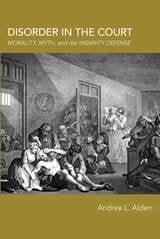
Disorder in the Court
Morality, Myth, and the Insanity DefenseAndrea L. Alden
University of Alabama Press, 2018
The first book-length rhetorical history and analysis of the legal and moral questions behind the insanity defense.
The insanity defense is considered one of the most controversial, most misunderstood, and least straightforward subjects in the American legal system. Disorder in the Court: Morality, Myth, and the Insanity Defense traces the US legal standards for the insanity defense as they have evolved from 1843, when they were first codified in England, to 1984, when the US government attempted to revise them through the Insanity Defense Reform Act. Throughout this period “insanity” existed primarily as a legal term rather than a medical one; yet the testimony of psychiatric experts is required in cases in which an insanity defense is raised.
The adjudication of such cases by courtroom practice is caught between two different but overlapping discourses, the legal and the medical, both of which have historically sought to assert and maintain firm disciplinary boundaries. Both expert and lay audiences have struggled to understand and apply commonplace definitions of sanity, and the portrayal of the insanity defense in popular culture has only served to further frustrate such understandings.
Andrea L. Alden argues that the problems with understanding the insanity defense are, at their foundation, rhetorical. The legal concept of what constitutes insanity and, therefore, an abdication of responsibility for one’s actions does not map neatly onto the mental health professions’ understandings of mental illness and how that affects an individual’s ability to understand or control his or her actions. Additionally, there are multiple layers of persuasion involved in any effort to convince a judge, jury—or a public, for that matter—that a defendant is or is not responsible for his or her actions at a particular moment in time.
Alden examines landmark court cases such as the trial of Daniel McNaughtan, Durham v. United States, and the trial of John Hinckley Jr. that signal the major shifts in the legal definitions of the insanity defense. Combining archival, textual, and rhetorical analysis, Alden offers a close reading of texts including trial transcripts, appellate court opinions, and relevant medical literature from the time period. She contextualizes these analyses through popular texts—for example, newspaper articles and editorials—showing that while all societies have maintained some version of mental illness as a mitigating factor in their penal systems, the insanity defense has always been fraught with controversy.

Disorders Of Desire
Janice Irvine
Temple University Press, 1991
This revised and expanded edition features new chapters addressing:
- The diagnosis of "sex addiction"in the 1970s and its social and political implications.
- New developments within the field of sexology, including the "Viagra Revolution" that began in the 1990s.
- The pharmaceutical industry's role in the development of sexual enhancements and the search for the female equivalent of Viagra.
Disorders Of Desire Rev
Sexuality And Gender In Modern American SexologyJanice Irvine
Temple University Press, 2005
This revised and expanded edition features new chapters addressing:
•The diagnosis of "sex addiction"in the 1970s and its social and political implications.
•New developments within the field of sexology, including the "Viagra Revolution" that began in the 1990s.
•The pharmaceutical industry's role in the development of sexual enhancements and the search for the female equivalent of Viagra.

Disorienting Politics
Chimerican Media and Transpacific EntanglementsFan Yang
University of Michigan Press, 2024
Examining how Chimerican media are shaped by and perpetuate uneven power relations, Disorienting Politics argues that the pervasive tendency among wide-ranging cultural producers to depict the Chinese state as a racialized Other in American media life diminishes the possibility of engaging transpacific entanglements as a basis for envisioning new political horizons. Such othering of China not only results in overt racism against people of Asian descent, Yang argues, but also impacts the wellbeing of people of color more generally. This interdisciplinary book demonstrates the ways in which race is embedded in geopolitics even when the subject of discussion is not the people, but the (Chinese) state. Bridging media and cultural studies, Asian and Asian American studies, geography, and globalization studies, Disorienting Politics calls for a relational politics that acknowledges the multifarious interconnectivity between people, places, media, and environment.
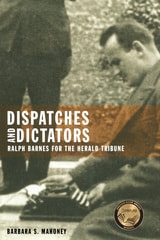
Dispatches and Dictators
Ralph Barnes for the Herald TribuneBarbara S. Mahoney
Oregon State University Press, 2002
Dispatches and Dictators uncovers the fascinating story of Oregon native Ralph Barnes, the New York Herald Tribune’s European correspondent, who served in Paris, Rome, Moscow, Berlin, and London in the years between the two world wars. Barnes has been praised by colleagues and competitors alike as one of the best reporters of that pivotal era. But since his death in the 1940 crash of a British bomber in Yugoslavia, he has been largely forgotten.
With persistence and unusually keen insight, Ralph Barnes reported on Fascism, Communism, Nazism, and the events leading to World War II. Stalin confined Barnes to Moscow for disclosing that millions were dying during the Soviet collectivization of agriculture, and Hitler expelled Barnes from Germany for predicting the Nazi attack on the Soviet Union.
In Dispatches and Dictators, historian Barbara Mahoney chronicles the short life and brilliant career of Ralph Barnes. Her biography of this extraordinary reporter provides new insights into the tumultuous decade leading up to World War II.
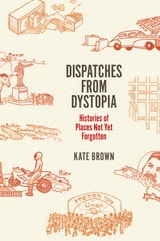
Dispatches from Dystopia
Histories of Places Not Yet ForgottenKate Brown
University of Chicago Press, 2015
In Dispatches from Dystopia, Brown wanders the Chernobyl Zone of Alienation, first on the Internet and then in person, to figure out which version—the real or the virtual—is the actual forgery. She also takes us to the basement of a hotel in Seattle to examine the personal possessions left in storage by Japanese-Americans on their way to internment camps in 1942. In Uman, Ukraine, we hide with Brown in a tree in order to witness the annual male-only Rosh Hashanah celebration of Hasidic Jews. In the Russian southern Urals, she speaks with the citizens of the small city of Kyshtym, where invisible radioactive pollutants have mysteriously blighted lives. Finally, Brown returns home to Elgin, Illinois, in the midwestern industrial rust belt to investigate the rise of “rustalgia” and the ways her formative experiences have inspired her obsession with modernist wastelands.
Dispatches from Dystopia powerfully and movingly narrates the histories of locales that have been silenced, broken, or contaminated. In telling these previously unknown stories, Brown examines the making and unmaking of place, and the lives of the people who remain in the fragile landscapes that are left behind.
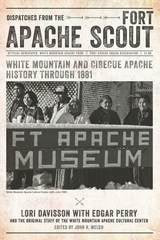
Dispatches from the Fort Apache Scout
White Mountain and Cibecue Apache History Through 1881Lori Davisson with Edgar Perry and the Original Staff of the White Mountain Apache Cultural Center; Edited by John R. Welch
University of Arizona Press, 2016
The book showcases and annotates dispatches published between June 1973 and October 1977, in the tribe’s Fort Apache Scout newspaper. This twenty-eight-part series of articles shared Western Apache culture and history through 1881 and the Battle of Cibecue, emphasizing early encounters with Spanish, Mexican, and American outsiders. Along the way, rich descriptions of Ndee ties to the land, subsistance, leadership, and values emerge. The articles were the result of the dogged work of journalist, librarian, and historian Lori Davisson along with Edgar Perry, a charismatic leader of White Mountain Apache culture and history programs, and his staff who prepared these summaries of historical information for the local readership of the Scout.
Davisson helped to pioneer a mutually beneficial partnership with the White Mountain Apache Tribe. Pursuing the same goal, Welch’s edited book of the dispatches stakes out common ground for understanding the earliest relations between the groups contesting Southwest lands, powerfully illustrating how, as elder Cline Griggs, Sr., writes in the prologue, “the past is present.”
Dispatches from the Fort Apache Scout is both a tribute to and continuation of Davisson’s and her colleagues’ work to share the broad outlines and unique details of the early history of Ndee and Ndee lands.
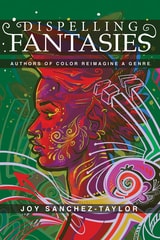
Dispelling Fantasies
Authors of Color Reimagine a GenreJoy Sanchez-Taylor
The Ohio State University Press, 2025
In Dispelling Fantasies, Joy Sanchez-Taylor examines how authors of color, such as R. F. Kuang, N. K. Jemisin, Nnedi Okorafor, Tomi Adeyemi, Tasha Suri, Aiden Thomas, Nghi Vo, and Marlon James, among others, offer critical counterpoints to the history of white-dominated, Eurocentric fantasy. The traditional fantasy that these authors are writing against reinforces Christian virtues and colonial, white supremacist structures; Sanchez-Taylor argues that its racial tropes are tied to a history of colonization and Christian missionary practices, with popular fantasy narratives often depicting Indigenous groups as primitive, deviant peoples in need of salvation. Such representations are based on a Western binary of rational versus magical and are influenced by tenets of Christianity, ultimately contributing to depictions of “the dark fantastic” or fantasy worlds where dark and othered characters are implicitly portrayed as evil and irredeemable. Organized around four Christian ideals that appear frequently in Western fantasy texts—virtue, envy, patriarchy, and salvation—Dispelling Fantasies demonstrates how non-Eurocentric fantasy worlds offer alternative versions of morality, race, gender, and sexuality and make space for authors to move away from hierarchical, binary systems of good and evil.
Displaced
Life in the Katrina DiasporaEdited by Lynn Weber and Lori Peek
University of Texas Press, 2012
Hurricane Katrina forced the largest and most abrupt displacement in U.S. history. About 1.5 million people evacuated from the Gulf Coast preceding Katrina’s landfall. New Orleans, a city of 500,000, was nearly emptied of life after the hurricane and flooding. Katrina survivors eventually scattered across all fifty states, and tens of thousands still remain displaced. Some are desperate to return to the Gulf Coast but cannot find the means. Others have chosen to make their homes elsewhere. Still others found a way to return home but were unable to stay due to the limited availability of social services, educational opportunities, health care options, and affordable housing.
The contributors to Displaced have been following the lives of Katrina evacuees since 2005. In this illuminating book, they offer the first comprehensive analysis of the experiences of the displaced. Drawing on research in thirteen communities in seven states across the country, the contributors describe the struggles that evacuees have faced in securing life-sustaining resources and rebuilding their lives. They also recount the impact that the displaced have had on communities that initially welcomed them and then later experienced “Katrina fatigue” as the ongoing needs of evacuees strained local resources. Displaced reveals that Katrina took a particularly heavy toll on households headed by low-income African American women who lost the support provided by local networks of family and friends. It also shows the resilience and resourcefulness of Katrina evacuees who have built new networks and partnered with community organizations and religious institutions to create new lives in the diaspora.
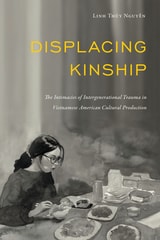
Displacing Kinship
The Intimacies of Intergenerational Trauma in Vietnamese American Cultural ProductionLinh Thuy Nguyen
Temple University Press, 2024
Second-generation texts illustrate how the children of refugees from Vietnam are haunted by trauma and a violent, ever-present, but mostly unarticulated past. Linh Thủy Nguyễn's analysis reveals that present experiences of economic insecurity and racism also shape these narratives of familial loss.
Developing a theory of intergenerational trauma, Nguyễn rethinks how U.S. imperialism, the discourse of communism, and assimilation impacted families across generations. Through ethnic studies and feminist and queer-of-color critique, Displacing Kinship offers a critical approach for reading family tensions and interpersonal conflict as affective investments informed by the material, structural conditions of white supremacy and racial capitalism.
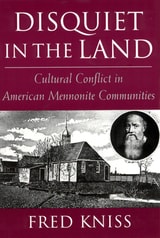
Disquiet in the Land
Cultural Conflict in American Mennonite CommunitiesKniss, Fred
Rutgers University Press, 1997
Mennonites have long referred to themselves as "The Quiet in the Land," but their actual historical experience has been marked by internal disquiet and contention over religious values and cultural practice. As Fred Kniss argues in his impressive study of Mennonite history, the story of this sectarian pacifist group is a story of conflict. How can we understand the ironic phenomenon of Mennonite conflict? How do ideas and symbols-both those of the American mainstream and those that are specifically Mennonite-influence the emergence and course of this conflict? What is the relationship betweenintra-Mennonite conflict and the changing historical context in which Mennonites are situated?
Through a rigorous analysis of a century of disputes over dress codes, congregational authority, and religious practice, Kniss offers the tools both to understand conflict within a specific religious group and to answer larger questions about culture, ideology, and social and historical change.
Disrupted Childhoods
Children of Women in PrisonSiegel, Jane A
Rutgers University Press, 2011
Millions of children in the United States have a parent who is incarcerated and a growing number of these nurturers are mothers. Disrupted Childhoods explores the issues that arise from a mother's confinement and provides first-person accounts of the experiences of children with moms behind bars. Jane A. Siegel offers a perspective that recognizes differences over the long course of a family's interaction with the criminal justice system.
Presenting an unparalleled view into the children's lives both before and after their mothers are imprisoned, this book reveals the many challenges they face from the moment such a critical caregiver is arrested to the time she returns home from prison. Based on interviews with nearly seventy youngsters and their mothers conducted at different points of their parent's involvement in the process, the rich qualitative data of Disrupted Childhoods vividly reveals the lived experiences of prisoners' children, telling their stories in their own words. Siegel places the mother's incarceration in context with other aspects of the youths' experiences, including their family life and social worlds, and provides a unique opportunity to hear the voices of a group that has been largely silent until now.
Disrupting Kinship
Transnational Politics of Korean Adoption in the United StatesKimberly D. McKee
University of Illinois Press, 2019
Kimberly D. McKee examines the growth of the neocolonial, multi-million-dollar global industry that shaped these families—a system she identifies as the transnational adoption industrial complex. As she shows, an alliance of the South Korean welfare state, orphanages, adoption agencies, and American immigration laws powered transnational adoption between the two countries. Adoption became a tool to supplement an inadequate social safety net for South Korea's unwed mothers and low-income families. At the same time, it commodified children, building a market that allowed Americans to create families at the expense of loving, biological ties between Koreans. McKee also looks at how Christian Americanism, South Korean welfare policy, and other facets of adoption interact with and disrupt American perceptions of nation, citizenship, belonging, family, and ethnic identity.
Disrupting the School-to-Prison Pipeline
An Action Guide for LibrariesCarrie Scott Banks and Jill Anderson
American Library Association, 2026
The school-to-prison pipeline impacts communities across the country; often, this system and families impacted by it remain invisible. But librarians, educators, and others who work with youth know first-hand that libraries and reading can be life-altering for youth impacted by incarceration. Written by public librarians who have supported youth before, during, and after incarceration, this book draws from their own experiences while showcasing insights from other library workers, researchers, educators, people who work in the juvenile justice fields, and mental health professionals. Designed to empower libraries and their staff to provide children and teens with information, visibility, knowledge and skills, recreation, and role models, it shares practical strategies for helping youth avoid the school-to-prison pipeline or contend with it. Readers will discover
- a concise explanation of the school-to-prison pipeline, including statistics on how and why it disproportionately impacts LGBTQ+, BIPOC, and disabled youth;
- concrete, proven strategies for disrupting youth incarceration pathways by giving young people the tools and support they need to avoid incarceration;
- steps for bolstering youth engagement during out of school time;
- guidance on how to align disciplinary approaches with trauma-informed practices when dealing with rowdy youth and other disruptive behavior;
- an overview of what libraries are doing to provide programs and services inside a youth facility, including literacy support, high school equivalency/GED programs, and televisiting;
- strategies for combatting the isolation of children of incarcerated parents by creating inclusive and welcoming library environments;
- information about the complex and difficult process of reentry for incarcerated youth, with adaptable ideas and lessons from the work being done in libraries for reentering adults; and
- an inspiring vision, extrapolating from work in adjacent fields, of what libraries can do to overcome barriers to bringing more youth into the library.
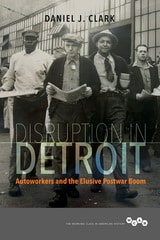
Disruption in Detroit
Autoworkers and the Elusive Postwar BoomDaniel J. Clark
University of Illinois Press, 2018

Dissecting Stephen King
From the Gothic to Literary NaturalismHeidi Strengell
University of Wisconsin Press, 2005
Ultimately, Strengell shows how King shatters our illusions of safety and control: "King places his decent and basically good characters at the mercy of indifferent forces, survival depending on their moral strength and the responsibility they may take for their fellow men."