Results by title
1218 books match the query 'African Americans' and 20 start with e
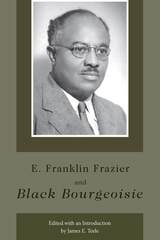
E. Franklin Frazier and Black Bourgeoisie
E. Franklin Frazier
University of Missouri Press, 2002
When E. Franklin Frazier was elected the first black president of the American Sociological Association in 1948, he was established as the leading American scholar on the black family and was also recognized as a leading theorist on the dynamics of social change and race relations. By 1948 his lengthy list of publications included over fifty articles and four major books, including the acclaimed Negro Family in the United States. Frazier was known for his thorough scholarship and his mastery of skills in both history and sociology.
With the publication of Bourgeoisie Noire in 1955 (translated in 1957 as Black Bourgeoisie), Frazier apparently set out on a different track, one in which he employed his skills in a critical analysis of the black middle class. The book met with mixed reviews and harsh criticism from the black middle and professional class. Yet Frazier stood solidly by his argument that the black middle class was marked by conspicuous consumption, wish fulfillment, and a world of make-believe. While Frazier published four additional books after 1948, Black Bourgeoisie remained by far his most controversial.
Given his status in American sociology, there has been surprisingly little study of Frazier's work. In E. Franklin Frazier and Black Bourgeoisie, a group of distinguished scholars remedies that lack, focusing on his often-scorned Black Bourgeoisie.
This in-depth look at Frazier's controversial publication is relevant to the growing concerns about racism, problems in our cities, the limitations of affirmative action, and the promise of self-help.
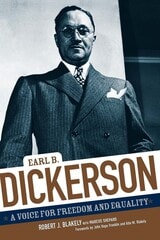
Earl B. Dickerson
A Voice for Freedom and EqualityRobert J. Blakely
Northwestern University Press, 2006
At fifteen, Earl Burrus Dickerson stowed away on a train in Canton, Mississippi, fleeing the racial oppression of his native South. But Chicago, the boy's destination, was no haven of racial fairness and equality. His flight north was in fact the beginning of a journey that would last a lifetime--and would forever pit Dickerson against the forces of racial injustice. Earl B. Dickerson's story, told here for the first time, is one of courage and character, of remarkable accomplishment in the face of terrible odds; it is also emblematic of the twentieth-century struggle for civil rights--a crucial chapter of African American history as it was lived by one uncompromising individual.
In this book, Robert J. Blakely tells how Dickerson (1891-1986) worked his way through preparatory schools and college, a segregated officer's training school, and law school at the University of Chicago. The story follows Dickerson's career as general counsel to the first insurance company owned and operated by African Americans; the first African American Democratic alderman elected to the Chicago City Council; a member of FDR's first Fair Employment Practices Committee; leader of the movement that broke the color barrier to membership in the Illinois Bar Association; and, perhaps most famously, the power behind Hansberry v. Lee, the U.S. Supreme Court case that marked the beginning of the end of restrictive real estate covenants--one of the most pernicious legal tools of segregation in the North. Blakely gives us a sense of the man behind the achievements, the life that defied conventions and statistics, and the world in which "the dean of Chicago's black lawyers" became a pioneering architect for equal opportunity in American life.
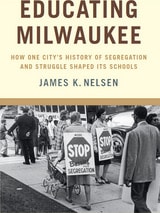
Educating Milwaukee
How One City’s History of Segregation and Struggle Shaped Its SchoolsJames K. Nelsen
Wisconsin Historical Society Press, 2015
"Milwaukee's story is unique in that its struggle for integration and quality education has been so closely tied to [school] choice." --from the Introduction
"Educating Milwaukee: How One City's History of Segregation and Struggle Shaped Its Schools" traces the origins of the modern school choice movement, which is growing in strength throughout the United States. Author James K. Nelsen follows Milwaukee's tumultuous education history through three eras--"no choice," "forced choice," and "school choice." Nelsen details the whole story of Milwaukee's choice movement through to modern times when Milwaukee families have more schooling options than ever--charter schools, open enrollment, state-funded vouchers, neighborhood schools--and yet Milwaukee's impoverished African American students still struggle to succeed and stay in school. "Educating Milwaukee" chronicles how competing visions of equity and excellence have played out in one city's schools in the modern era, offering both a cautionary tale and a "choice" example.
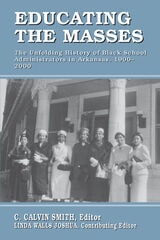
Educating the Masses
The Unfolding History of Black School Administrators in Arkansas, 1900-2000C. Calvin Smith
University of Arkansas Press, 2003
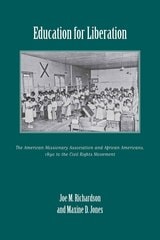
Education for Liberation
The American Missionary Association and African Americans, 1890 to the Civil Rights MovementJoe M. Richardson
University of Alabama Press, 2009
Even after the optimism of Reconstruction was shattered by violence, fraud, and intimidation and the white South relegated African Americans to segregated and disfranchised second-class citizenship, the AMA never abandoned its claim that blacks were equal in God’s sight, that any “backwardness” was the result of circumstance rather than inherent inferiority, and that blacks could and should become equal citizens with other Americans. The organization went farther in recognition of black ability, humanity, and aspirations than much of 19th and 20th century white America by publicly and consistently opposing lynching, segregation, disfranchisement, and discrimination.
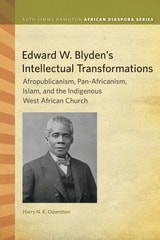
Edward W. Blyden's Intellectual Transformations
Afropublicanism, Pan-Africanism, Islam, and the Indigenous West African ChurchHarry N. K. Odamtten
Michigan State University Press, 2019
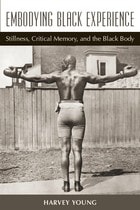
Embodying Black Experience
Stillness, Critical Memory, and the Black BodyHarvey Young
University of Michigan Press, 2010
"Young's linkage between critical race theory, historical inquiry, and performance studies is a necessary intersection. Innovative, creative, and provocative."
---Davarian Baldwin, Paul E. Raether Distinguished Professor of American Studies, Trinity College
In 1901, George Ward, a lynching victim, was attacked, murdered, and dismembered by a mob of white men, women, and children. As his lifeless body burned in a fire, enterprising white youth cut off his toes and, later, his fingers and sold them as souvenirs. In Embodying Black Experience, Harvey Young masterfully blends biography, archival history, performance theory, and phenomenology to relay the experiences of black men and women who, like Ward, were profoundly affected by the spectacular intrusion of racial violence within their lives. Looking back over the past two hundred years---from the exhibition of boxer Tom Molineaux and Saartjie Baartman (the "Hottentot Venus") in 1810 to twenty-first century experiences of racial profiling and incarceration---Young chronicles a set of black experiences, or what he calls, "phenomenal blackness," that developed not only from the experience of abuse but also from a variety of performances of resistance that were devised to respond to the highly predictable and anticipated arrival of racial violence within a person's lifetime.
Embodying Black Experience pinpoints selected artistic and athletic performances---photography, boxing, theater/performance art, and museum display---as portals through which to gain access to the lived experiences of a variety of individuals. The photographs of Joseph Zealy, Richard Roberts, and Walker Evans; the boxing performances of Jack Johnson, Joe Louis, and Muhammad Ali; the plays of Suzan-Lori Parks, Robbie McCauley, and Dael Orlandersmith; and the tragic performances of Bootjack McDaniels and James Cameron offer insight into the lives of black folk across two centuries and the ways that black artists, performers, and athletes challenged the racist (and racializing) assumptions of the societies in which they lived.
Blending humanistic and social science perspectives, Embodying Black Experience explains the ways in which societal ideas of "the black body," an imagined myth of blackness, get projected across the bodies of actual black folk and, in turn, render them targets of abuse. However, the emphasis on the performances of select artists and athletes also spotlights moments of resistance and, indeed, strength within these most harrowing settings.
Harvey Young is Associate Professor of Theatre, Performance Studies, and Radio/Television/Film at Northwestern University.
A volume in the series Theater: Theory/Text/Performance
Empowerment and Black Deaf Persons
Lindsay Moeletsi Dunn
Gallaudet University Press, 2024
This is the inaugural volume in the Early Papers in Deaf Studies series, which will consist of reissued works originally published by the Gallaudet University College for Continuing Education but long out of print. The aim of this series is to restore these foundational papers to the scholarly community. Empowerment and Black Deaf Persons is available in both print and open digital formats, ensuring broad access to this important contribution to the literature.
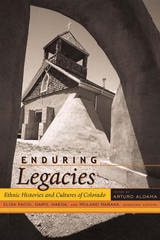
Enduring Legacies
Ethnic Histories and Cultures of ColoradoArturo J. Aldama
University Press of Colorado, 2011
Addressing the dearth of scholarship on the varied communities within Colorado-a zone in which collisions structured by forces of race, nation, class, gender, and sexuality inevitably lead to the transformation of cultures and the emergence of new identities-this volume is the first to bring together comparative scholarship on historical and contemporary issues that span groups from Chicanas and Chicanos to African Americans to Asian Americans.
This book will be relevant to students, academics, and general readers interested in Colorado history and ethnic studies.
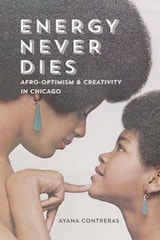
Energy Never Dies
Afro-Optimism and Creativity in ChicagoAyana Contreras
University of Illinois Press, 2021
Passionate and enlightening, Energy Never Dies uses the power of storytelling to show how optimism and courage fuel the dreams of Black Chicago.
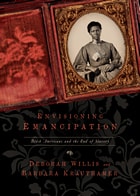
Envisioning Emancipation
Black Americans and the End of SlaveryDeborah Willis
Temple University Press, 2017
The Emancipation Proclamation is one of the most important documents in American history. As we commemorate its 150th anniversary, what do we really know about those who experienced slavery?
In their pioneering book, Envisioning Emancipation, renowned photographic historian Deborah Willis and historian of slavery Barbara Krauthamer have amassed 150 photographs—some never before published—from the antebellum days of the 1850s through the New Deal era of the 1930s. The authors vividly display the seismic impact of emancipation on African Americans born before and after the Proclamation, providing a perspective on freedom and slavery and a way to understand the photos as documents of engagement, action, struggle, and aspiration.
Envisioning Emancipation illustrates what freedom looked like for black Americans in the Civil War era. From photos of the enslaved on plantations and African American soldiers and camp workers in the Union Army to Juneteenth celebrations, slave reunions, and portraits of black families and workers in the American South, the images in this book challenge perceptions of slavery. They show not only what the subjects emphasized about themselves but also the ways Americans of all colors and genders opposed slavery and marked its end.
Filled with powerful images of lives too often ignored or erased from historical records, Envisioning Emancipation provides a new perspective on American culture.
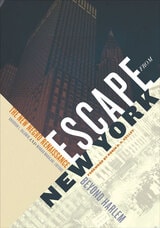
Escape from New York
The New Negro Renaissance beyond HarlemDavarian L. Baldwin
University of Minnesota Press, 2013
In the midst of vast cultural and political shifts in the early twentieth century, politicians and cultural observers variously hailed and decried the rise of the “New Negro.” This phenomenon was most clearly manifest in the United States through the outpouring of Black arts and letters and social commentary known as the Harlem Renaissance. What is less known is how far afield of Harlem that renaissance flourished—how much the New Negro movement was actually just one part of a collective explosion of political protest, cultural expression, and intellectual debate all over the world.
In this volume, the Harlem Renaissance “escapes from New York” into its proper global context. These essays recover the broader New Negro experience as social movements, popular cultures, and public behavior spanned the globe from New York to New Orleans, from Paris to the Philippines and beyond. Escape from New York does not so much map the many sites of this early twentieth-century Black internationalism as it draws attention to how New Negroes and their global allies already lived. Resituating the Harlem Renaissance, the book stresses the need for scholarship to catch up with the historical reality of the New Negro experience. This more comprehensive vision serves as a lens through which to better understand capitalist developments, imperial expansions, and the formation of brave new worlds in the early twentieth century.
Contributors: Anastasia Curwood, Vanderbilt U; Frank A. Guridy, U of Texas at Austin; Claudrena Harold, U of Virginia; Jeannette Eileen Jones, U of Nebraska–Lincoln; Andrew W. Kahrl, Marquette U; Shannon King, College of Wooster; Charlie Lester; Thabiti Lewis, Washington State U, Vancouver; Treva Lindsey, U of Missouri–Columbia; David Luis-Brown, Claremont Graduate U; Emily Lutenski, Saint Louis U; Mark Anthony Neal, Duke U; Yuichiro Onishi, U of Minnesota, Twin Cities; Theresa Runstedtler, U at Buffalo (SUNY); T. Denean Sharpley-Whiting, Vanderbilt U; Michelle Stephens, Rutgers U, New Brunswick; Jennifer M. Wilks, U of Texas at Austin; Chad Williams, Brandeis U.
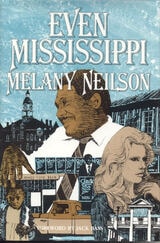
Even Mississippi
Melany Neilson
University of Alabama Press, 1989
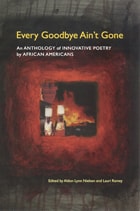
Every Goodbye Ain't Gone
An Anthology of Innovative Poetry by African AmericansEdited by Aldon Lynn Nielsen and Lauri Ramey
University of Alabama Press, 2006
Every Goodbye Ain’t Gone presents the groundbreaking work of many of these poets who carried on the innovative legacies of Melvin Tolson, Gwendolyn Brooks, and Robert Hayden. Whereas poetry by such key figures such as Amiri Baraka, Tolson, Jayne Cortez, Clarence Major, and June Jordan is represented, this anthology also elevates into view the work of less studied poets such as Russell Atkins, Jodi Braxton, David Henderson, Bob Kaufman, Stephen Jonas, and Elouise Loftin. Many of the poems collected in the volume are currently unavailable and some will appear in print here for the first time.
Coeditors Aldon Lynn Nielsen and Lauri Ramey provide a critical introduction that situates the poems historically and highlights the ways such poetry has been obscured from view by recent critical and academic practices. The result is a record of experimentation, instigation, and innovation that links contemporary African American poetry to its black modernist roots and extends the terms of modern poetics into the future.
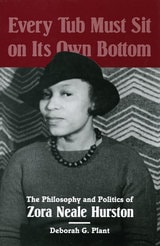
Every Tub Must Sit on Its Own Bottom
The Philosophy and Politics of Zora Neale HurstonDeborah G. Plant
University of Illinois Press, 1995
needed at this point in the evolving critical assessment of Hurston. It
is a paradigm for the study of individual African American women writers."
-- Alice Deck, University of Illinois at Urbana-Champaign
In a ground-breaking study
of Zora Neale Hurston, Deborah Plant takes issue with current notions
of Hurston as a feminist and earlier impressions of her as an intellectual
lightweight who disregarded serious issues of race in American culture.
Instead, Plant calls Hurston a "writer of resistance" who challenged
the politics of domination both in her life and in her work. One of the
great geniuses of the Harlem Renaissance, Hurston stands out as a strong
voice for African-American women. Her anthropological inquiries as well
as her evocative prose provide today's readers with a rich history of
African American folk culture, a folk culture through which Hurston expressed
her personal and political strategy of resistance and self-empowerment.
Through readings of Hurston's
fiction and autobiographical writings, Plant offers one of the first book-length
discussions of Hurston's personal philosophy of individualism and self-preservation.
From a discussion of Hurston's preacher father and influential mother,
whose guiding philosophy is reflected in the title of this book, to the
influence of Spinoza and Nietzsche, Plant puts into perspective the driving
forces behind Hurston's powerful prose.
This fresh look at one of
the most important writers of the twentieth century is sure to shape future
study of Hurston and her work.
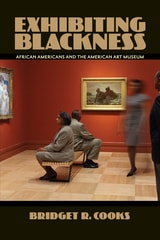
Exhibiting Blackness
African Americans and the American Art MuseumBridget R. Cooks
University of Massachusetts Press, 2011
In Exhibiting Blackness, art historian Bridget R. Cooks analyzes the curatorial strategies, challenges, and critical receptions of the most significant museum exhibitions of African American art. Tracing two dominant methodologies used to exhibit art by African Americans—an ethnographic approach that focuses more on artists than their art, and a recovery narrative aimed at correcting past omissions—Cooks exposes the issues involved in exhibiting cultural difference that continue to challenge art history, historiography, and American museum exhibition practices. By further examining the unequal and often contested relationship between African American artists, curators, and visitors, she provides insight into the complex role of art museums and their accountability to the cultures they represent.
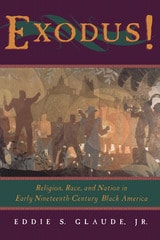
Exodus!
Religion, Race, and Nation in Early Nineteenth-Century Black AmericaEddie S. Glaude Jr.
University of Chicago Press, 2000
Exodus! shows how this biblical story inspired a pragmatic tradition of racial advocacy among African Americans in the early nineteenth century—a tradition based not on race but on a moral politics of respectability. Eddie S. Glaude, Jr., begins by comparing the historical uses of Exodus by black and white Americans and the concepts of "nation" it generated. He then traces the roles that Exodus played in the National Negro Convention movement, from its first meeting in 1830 to 1843, when the convention decided—by one vote—against supporting Henry Highland Garnet's call for slave insurrection.
Exodus! reveals the deep historical roots of debates over African-American national identity that continue to rage today. It will engage anyone interested in the story of black nationalism and the promise of African-American religious culture.
Extraordinary Measures
Afrocentric Modernism and 20th-Century American PoetryLorenzo Thomas
University of Alabama Press, 2000
From early 20th-century writings to present-day poetry slams, African American poetry exhibits an impressive range of style and substance. Lorenzo Thomas has written an important new history of the genre that offers a critical reassessment of its development in the 20th century within the contexts of modernism and the troubled racial history of the United States.
Basing his study on literary history, cultural criticism, and close readings, Thomas revives and appraises the writings of a number of this century's most important African American poets, including Margaret Walker, Amiri Baraka, Askia M. Toure, Harryette Mullen, and Kalamu ya Salaam. Thomas analyzes the work of Fenton Johnson within the context of emerging race consciousness in Chicago, contributes to critical appraisals of William Stanley Braithwaite and Melvin B. Tolson, and examines the Black Arts Movement of the 1960s and 1970s. Throughout the book, Thomas demonstrates the continuity within the Afrocentric tradition while acknowledging the wide range of stylistic approaches and ideological stances that the tradition embraces.
By reassessing the African American poetry tradition, Thomas effectively reassesses the history of all 20th-century American literature by exploring avenues of debate that have not yet received sufficient attention. Written with intelligence and humor, his book is itself an extraordinary measure that reflects years of scholarship and opens up African American poetry to a wider audience.
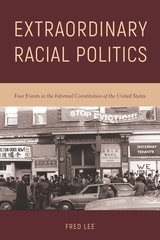
Extraordinary Racial Politics
Four Events in the Informal Constitution of the United StatesFred Lee
Temple University Press, 2018
Extraordinary racial politics rupture out of and reset everyday racial politics. In his cogent book, Fred Lee examines four unusual, episodic, and transformative moments in U.S. history: the 1830s–1840s southeastern Indian removals, the Japanese internment during World War II, the post-war civil rights movement, and the 1960s–1970s racial empowerment movements. Lee helps us connect these extraordinary events to both prior and subsequent everyday conflicts.
Extraordinary Racial Politics brings about an intellectual exchange between ethnic studies, which focuses on quotidian experiences and negotiations, and political theory, which emphasizes historical crises and breaks. In ethnic studies, Lee draws out the extraordinary moments in Michael Omi and Howard Winant’s as well as Charles Mills’s accounts of racial formation. In political theory, Lee considers the strengths and weaknesses of using Carl Schmitt’s and Hannah Arendt’s accounts of public constitution to study racial power.
Lee concludes that extraordinary racial politics represent both the promises of social emancipation and the perils of state power. This promise and peril characterizes our contentious racial present.
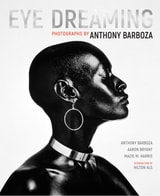
Eye Dreaming
Photographs by Anthony BarbozaAnthony Barboza
J. Paul Getty Trust, The, 2022
Anthony Barboza (b. 1944) is a celebrated artist and writer who has made thousands of photographs in the studio and on the street since 1963. A member of the Kamoinge collective of photographers in New York, Barboza is largely self-taught and has an inimitable, highly intuitive vision that he refers to as “eye dreaming,” or “a state of mind that’s almost like meditation.” Throughout the years he has made countless commercial images, including celebrity portraits, advertisements, and album covers. His personal photographic projects illuminate his deep investment in the art and concerns of Black communities, not only in the United States but also around the globe.
This lavishly illustrated volume follows Barboza’s prolific career from his youth in New Bedford, Massachusetts, to his formative years in New York in the 1960s, to the present day. An introduction by renowned author and critic Hilton Als underscores Barboza’s importance and impact. An essay by curator Aaron Bryant contextualizes Barboza’s life and career as they map against major civil rights events in the United States. In an intimate interview between the artist and curator Mazie M. Harris, Barboza offers astute, humorous, and intimate musings on his long career, foundational influences, and artistic legacy. This monograph, the first on the artist, will appeal to aficionados of photography and Black art and culture.