Results by title
50 books match the query 'Case' and 3 start with e
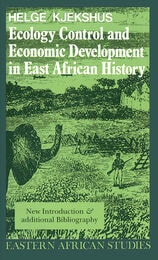
Ecology Control and Economic Development in East African History
The Case of Tanganyika, 1850–1950Helge Kjekshus
Ohio University Press, 1995
This pioneering book was one of the first to place the history of East Africa within the context of the environment. It has been used continuously for student teaching. It is now reissued with an introduction placing it within the debate that has developed on the subject; there is also an updated bibliography.
The book puts people at the centre of events. It thus serves as a modification to nationalist history with its emphasis on leaders. It presents environmental factors that had been underestimated; for instance, it points to the critical importance of the rinderpest outbreak.
Helge Kjekshus provides evidence to suggest that the nineteenth century was a period of relative prosperity with well-developed trade. He questions the view that warfare was pervasive and that the slave trade led to depopulation. He points to a balance between man and the environment.
This book is reissued at the same time as the first publication of Custodians of the Land: Ecology and Culture in the History of Tanzania edited by Gregory Maddox, James I. Giblin and Isaria N. Kimambo. The footnotes in that book point to the importance of the work of Helge Kjekshus.
[more]
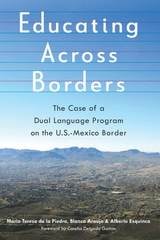
Educating Across Borders
The Case of a Dual Language Program on the U.S.-Mexico BorderMaría Teresa de la Piedra, Blanca Araujo, and Alberto Esquinca; Foreword by Concha Delgado Gaitan
University of Arizona Press, 2018
Educating Across Borders is an ethnography of the learning experiences of transfronterizxs, border-crossing students who live on the U.S.-Mexico border, their lives spanning two countries and two languages. Authors María Teresa de la Piedra, Blanca Araujo, and Alberto Esquinca examine language practices and funds of knowledge these students use as learning resources to navigate through their binational, dual language school experiences.
The authors, who themselves live and work on the border, question artificially created cultural and linguistic borders. To explore this issue, they employed participant-observation, focus groups, and individual interviews with teachers, administrators, and staff members to construct rich understandings of the experiences of transfronterizx students. These ethnographic accounts of their daily lives counter entrenched deficit perspectives about transnational learners.
Drawing on border theory, immigration and border studies, funds of knowledge, and multimodal literacies, Educating Across Borders is a critical contribution toward the formation of a theory of physical and metaphorical border crossings that ethnic minoritized students in U.S. schools must make as they traverse the educational system.
[more]
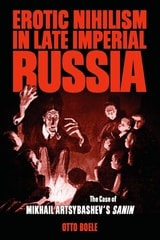
Erotic Nihilism in Late Imperial Russia
The Case of Mikhail Artsybashev's SaninOtto Boele
University of Wisconsin Press, 2009
Banned shortly after its publication in 1907, the Russian novel Sanin scandalized readers with the sexual exploits of its eponymous hero. Wreaking havoc on the fictional town he visits in Mikhail Artsybashev’s story, the character Sanin left an even deeper imprint on the psyche of the real-life Russian public. Soon “Saninism” became the buzzword for the perceived faults of the nation. Seen as promoting a wave of hedonistic, decadent behavior, the novel was suppressed for decades, leaving behind only the rumor of its supposedly epidemic effect on a vulnerable generation of youth.
Who were the Saninists, and what was their “teaching” all about? Delving into police reports, newspaper clippings, and amateur plays, Otto Boele finds that Russian youth were not at all swept away by the self-indulgent lifestyle of the novel’s hero. In fact, Saninism was more smoke than fire—a figment of the public imagination triggered by anxieties about the revolution of 1905 and the twilight of the Russian empire. The reception of the novel, Boele shows, reflected much deeper worries caused by economic reforms, an increase in social mobility, and changing attitudes toward sexuality.
Showing how literary criticism interacts with the age-old medium of rumor, Erotic Nihilism in Late Imperial Russia offers a meticulous analysis of the scandal’s coverage in the provincial press and the reactions of young people who appealed to their peers to resist the novel’s nihilistic message. By examining the complex dialogue between readers and writers, children and parents, this study provides fascinating insights into Russian culture on the eve of World War I.
[more]