Results by title
975 books match the query 'Case studies' and 44 start with e
Economic Policy Reform
The Second StageEdited by Anne O. Krueger
University of Chicago Press, 2000
Economic Policy Reform: The Second Stage provides an incisive overview of the context of these crucial second-stage reforms with a thorough examination of the issues confronting the policymakers involved. Edited by Anne O. Krueger, it features studies from distinguished experts in various fields of economics. Each chapter of this book addresses a key issue in economic policy, examines the progress of reforms in the markets considered, and then explores what research might further aid leaders as they embark on fundamental changes.
Both a handbook for economists and practitioners and a theoretical exploration of the most significant challenges currently facing the economic world, this new book will be indispensable to anyone involved in the global economic scene.
Contributors:
Vittorio Corbo
Cimon Cowan
Sebastian Edwards
Stephan Haggard
Michael Kremer
Steven Matusz
Frederic S. Mishkin
Jonathan Morduch
Roger G. Noll
Miguel A. Savastano
T. Paul Shultz
Mary M. Shirley
T.N. Srinivasan
Joseph E. Stiglitz
Vito Tanzi
David Tarr
Aaron Tornell
Economic Shocks and Authoritarian Stability
Duration, Financial Control, and InstitutionsVictor C. Shih, Editor
University of Michigan Press, 2020
Over two billion people still live under authoritarian rule. Moreover, authoritarian regimes around the world command enormous financial and economic resources, rivaling those controlled by advanced democracies. Yet authoritarian regimes as a whole are facing their greatest challenges in the recent two decades due to rebellions and economic stress. Extended periods of hardship have the potential of introducing instability to regimes because members of the existing ruling coalition suffer welfare losses that force them to consider alternatives, while previously quiescent masses may consider collective uprisings a worthwhile gamble in the face of declining standards of living.
Economic Shocks and Authoritarian Stability homes in on the economic challenges facing authoritarian regimes through a set of comparative case studies that include Iran, Iraq under Saddam Hussein, Malaysia, Indonesia, Jordan, Russia, the Eastern bloc countries, China, and Taiwan—authored by the top experts in these countries. Through these comparative case studies, this volume provides readers with the analytical tools for assessing whether the current round of economic shocks will lead to political instability or even regime change among the world’s autocracies. This volume identifies the duration of economic shocks, the regime’s control over the financial system, and the strength of the ruling party as key variables to explain whether authoritarian regimes would maintain the status quo, adjust their support coalitions, or fall from power after economic shocks.

Educated in Romance
Women, Achievement, and College CultureDorothy C. Holland and Margaret A. Eisenhart
University of Chicago Press, 1990
Education Behind the Wall
Why and How We Teach College in PrisonEdited by Mneesha Gellman
Brandeis University Press, 2022
An edited volume reflecting on different aspects of teaching in prison and different points of view.
This book seeks to address some of the major issues faced by faculty who are teaching college classes for incarcerated students. Composed of a series of case studies meant to showcase the strengths and challenges of teaching a range of different disciplines in prison, this volume brings together scholars who articulate some of the best practices for teaching their expertise inside alongside honest reflections on the reality of educational implementation in a constrained environment. The book not only provides essential guidance for faculty interested in developing their own courses to teach in prisons, but also places the work of higher education in prisons in philosophical context with regards to racial, economic, social, and gender-based issues. Rather than solely a how-to handbook, this volume also helps readers think through the trade-offs that happen when teaching inside, and about how to ensure the full integrity of college access for incarcerated students.
Elections in Australia, Ireland, and Malta under the Single Transferable Vote
Reflections on an Embedded InstitutionShaun Bowler and Bernard Grofman, Editors
University of Michigan Press, 2000
Electoral Reform and the Fate of New Democracies
Lessons from the Indonesian CaseSarah Shair-Rosenfield
University of Michigan Press, 2019
When and why do democratic political actors change the electoral rules, particularly regarding who is included in a country’s political representation? The incidences of these major electoral reforms have been on the rise since 1980.
Electoral Reform and the Fate of New Democracies argues that elite inexperience may constrain self-interest and lead elites to undertake incremental approaches to reform, aiding the process of democratic consolidation. Using a multimethods approach, the book examines three consecutive periods of reform in Indonesia, the world’s largest Muslim majority country and third largest democracy, between 1999 and 2014. Each case study provides an in-depth process tracing of the negotiations leading to new reforms, including key actors in the legislature, domestic civil society, international experts, and government bureaucrats. A series of counterfactual analyses assess the impact the reforms had on actual election outcomes, versus the possible alternative outcomes of different reform options discussed during negotiations. With a comparative analysis of nine cases of iterated reform processes in other new democracies, the book confirms the lessons from the Indonesian case and highlights key lessons for scholars and electoral engineers.
Elites and Economic Development
Comparative Studies on the Political Economy of Latin American CitiesBy John Walton
University of Texas Press, 1977
This book is a detailed comparative analysis of development politics in four urban regions of Latin America, two in Mexico and two in Colombia. John Walton has based his studies on the assumption that the problems of economic growth are essentially political, that is, are problems of choice, decision-making, and the exercise of power. His fundamental purpose has been to discover how elites of different kinds are more and less successful in the promotion of economic development, which he defines as a process in the organization of a society leading not only to higher levels of efficient output but also to a more equitable distribution of benefits.
At the time, the four cities compared were the second- and third-largest metropolitan areas in each country, Guadalajara and Monterrey in Mexico, Medellín and Cali in Colombia. This selection allows the author to pair, across countries, cases of early and large-scale industrialization (Monterrey and Medellín) with cases of more recent industrial growth in agricultural-commercial centers (Guadalajara and Cali). Walton presents historical introductions to each of the regions and integrates these with original fieldwork and interviews with more than three hundred members of the political and economic elites.
The findings are extensive, but in general they demonstrate that where political and economic power is more broadly distributed, where elites are more open and accessible, and where organizational life is more active and coordinated, regions tend to develop qualitatively as well as quantitatively, showing increases both in productivity and in such benefits as public services, housing, education, and a more balanced distribution of income. If these characteristics are absent, regions may be industrialized but do not provide a broad sharing of the benefits. Walton places a good deal of emphasis on the role of foreign investments, demonstrating that the more penetrated regions are also the less developed.
Finally, the results of these studies are used to evaluate and advance theories of underdevelopment and particularly of economic dependency.

Elizabeth Packard
A Noble FightLinda V. Carlisle
University of Illinois Press, 2010

Embedded Librarians
Moving Beyond One-Shot InstructionCassandra Kvenild
Assoc of College & Research Libraries, 2011

Embedding Librarianship In Learning Management Systems
Beth E. Tumbleson
American Library Association, 2013
Empirical Studies of Strategic Trade Policy
Edited by Paul Krugman and Alasdair Smith
University of Chicago Press, 1994
The nine papers cover the U.S. and European auto industries, the U.S. steel industry, the commercial aircraft industry, airline deregulation in Scandinavia, and labor and industrial policy in Korea and Taiwan. The authors refine the basic techniques for measuring policy effectiveness, extend them to encompass industry dynamics, and test the implications of new trade models.
International economists and trade experts in government and business will find important new insights into the role of strategic trade policy in international competitiveness.
Engaging Cultural Differences
The Multicultural Challenge in Liberal DemocraciesRichard A., Shweder
Russell Sage Foundation, 2002
Engineering Culture
Control and Commitment in a High-Tech CorporationGideon Kunda
Temple University Press, 2006
Engineering Mountain Landscapes
An Anthropology of Social InvestmentLaura L. Scheiber and María N. Zedeño
University of Utah Press, 2015
England's Great Transformation
Law, Labor, and the Industrial RevolutionMarc W. Steinberg
University of Chicago Press, 2016
Building his argument on three case studies—the Hanley pottery industry, Hull fisheries, and Redditch needlemakers—Steinberg employs both local and national analyses to emphasize the ways in which these master-servant laws allowed employers to use the criminal prosecutions of workers to maintain control of their labor force. Steinberg provides a fresh perspective on the dynamics of labor control and class power, integrating the complex pathways of Marxism, historical institutionalism, and feminism, and giving readers a subtle yet revelatory new understanding of workplace control and power during England’s Industrial Revolution.

Enhancing Diversity
Educators with DisabilitiesRonald J. Anderson
Gallaudet University Press, 1998
Environmental Activism and the Urban Crisis
Baltimore, St. Louis, ChicagoRobert Gioielli
Temple University Press, 2015
Environmental Activism and the Urban Crisis focuses on the wave of environmental activism and grassroots movements that swept through America's older, industrial cities during the late 1960s and early 1970s. Robert Gioielli offers incisive case studies of Baltimore, St. Louis, and Chicago to show how urban activism developed as an impassioned response to a host of racial, social, and political conflicts. As deindustrialization, urban renewal, and suburbanization caused the decline of the urban environment, residents--primarily African Americans and working-class whites--organized to protect their families and communities from health threats and environmental destruction.
Gioielli examines various groups' activism in response to specific environmental problems caused by the urban crisis in each city. In doing so, he forms concrete connections between environmentalism, the African American freedom struggle, and various urban social movements such as highway protests in Baltimore and air pollution activism in Chicago. Eventually, the efforts of these activists paved the way for the emergence of a new movement-environmental justice.
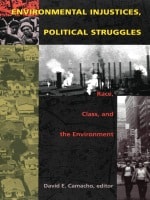
Environmental Injustices, Political Struggles
Race, Class and the EnvironmentDavid E. Camacho, ed.
Duke University Press, 1998
David E. Camacho’s collection of essays examines the value-laden choices behind the public policy that determines placement of commercial environmental hazards, points to the underrepresentation of people of color in the policymaking process, and discusses the lack of public advocates representing low-income neighborhoods and communities. This book combines empirical evidence and case studies—from the failure to provide basic services to the “colonias” in El Paso County, Texas, to the race for water in Nevada—and covers in great detail the environmental dangers posed to minority communities, including the largely unexamined communities of Native Americans. The contributors call for cooperation between national environmental interest groups and local grassroots activism, more effective incentives and disincentives for polluters, and the adoption by policymakers of an alternative, rather than privileged, perspective that is more sensitive to the causes and consequences of environmental inequities.
Environmental Injustices, Political Struggles is a unique collection for those interested in the environment, public policy, and civil rights as well as for students and scholars of political science, race and ethnicity, and urban and regional planning.
Contributors. C. Richard Bath, Kate A. Berry, John G. Bretting, David E. Camacho, Jeanne Nienaber Clarke, Andrea K. Gerlak, Peter I. Longo, Diane-Michele Prindeville, Linda Robyn, Stephen Sandweiss, Janet M. Tanski, Mary M. Timney, Roberto E. Villarreal, Harvey L. White

Environmental Preservation and the Grey Cliffs Conflict
Negotiating Common Narratives, Values, and EthosKristin D. Pickering
Utah State University Press, 2024
Though environmental degradation and unauthorized use threatened the Grey Cliffs recreational lake area to the point that the Corps considered closure, community members valued it highly and wanted to keep it open. The community near this damaged and crime-ridden area needed help rejuvenating its landscape and image, but the Corps and community were sharply divided on how to maintain this beloved geographic space because of the stakeholders’ different cultural backgrounds and values, as well as the narratives used to discuss them. By co-constructing and aligning narratives, values, and ethos over time—a difficult and lengthy process—the Corps and community succeeded, and Grey Cliffs remains open to all. Focusing on field notes, participant interviews, and analysis of various texts created throughout the conflict, Pickering applies rhetorical analysis and a grounded theory approach to regulation, identity, sustainability, and community values to analyze this communication process.
Illustrating the positive change that can occur when governmental organizations and rural communities work together to construct shared values and engage in a rhetoric of relationship that preserves the environment, Environmental Preservation and the Grey Cliffs Conflict provides key recommendations for resolving environmental conflicts within local communities, especially for those working in technical and professional communication, organizational communication, environmental science, and public policy.
Environmental Security
Concepts, Challenges, and Case StudiesEdited by John M. Lanicci, Elisabeth Hope Murray, and James D. Ramsay
American Meteorological Society, 2019
The purpose of text is to better address the many aspects of environmental security and to represent this major area of academic research in an introductory text format that can be used in the rapidly growing number of homeland security studies programs as well as related degree programs. The concepts, challenges, and case studies in this text vitally extended such curricula, giving students a deeper appreciation for the critical role environmental security plays in overall state security, as well as for our nation, our way of life, and indeed for the human race at large.
Environmentalism and Economic Justice
Two Chicano Struggles in the SouthwestLaura Pulido
University of Arizona Press, 1996
Environments For Student Growth And Development
LibraryLisa Hinchliffe
Assoc of College & Research Libraries, 2012

Eradicating Extreme Poverty
Democracy, Globalisation and Human RightsEdited by Xavier Godinot
Pluto Press, 2012
The failure of attempts to tackle global poverty have bred cynicism and 'compassion fatigue'. Eradicating Extreme Poverty provides an urgently needed fresh approach which will re-energise action on this issue.
Rejecting traditional 'top-down' approaches, Xavier Godinot and his colleagues start from the experiences, capabilities and strategies of the poor themselves. They argue that the first step is a close connection with poor communities followed by a commitment to take action alongside them. Life-stories from Burkina Faso, France, Peru and the Philippines are used to show that the poor must be involved in their own liberation.
After decades of failed development policies, this book outlines a radical new approach which will enliven debate amongst policy-makers, researchers, students and academics.
Essays on Genocide and Humanitarian Intervention
Guenter Lewy
University of Utah Press, 2012
The essays in this book, written over a span of some twenty years but updated for this publication, discuss episodes of mass murder that are often considered instances of genocide: the large-scale killing of Armenians in Ottoman Turkey during World War I, the near-extinction of North America’s Indian population, the vicious persecution of the “Roma” or Gypsies under the Nazi regime. But in line with Article II of the Genocide Convention of 1948, Lewy stresses the crucial importance of looking closely at the intent of the perpetrators. In contrast to the Holocaust, the killers in the atrocities mentioned above did not seek to destroy an entire people, and so, these three large-scale killings do not deserve the label of genocide.
Lewy argues that affirming the distinctiveness of the Holocaust does not deny, downgrade, or trivialize the suffering of other people. The crimes against the Ottoman Armenians, the American Indians, and the Gypsies—even if they did not reach the threshold of genocide—involved horrendous suffering and a massive loss of life. The genocides of Cambodia and Rwanda that took place in the second half of the twentieth century remind us that man’s inhumanity to man can take many forms and is not the special prerogative of any particular group. The last essay of the collection deals with the complications of humanitarian intervention to prevent genocide. As the recent support of the Libyan rebels by NATO demonstrates, the issues raised here remain topical and controversial.
Ethics in Action
Case Studies in Archaeological DilemmasChip Colwell-Chanthaphonh
University Press of Colorado, 2008
Ethnic Origins
The Adaptation of Cambodian and Hmong Refugees in Four American CitiesJeremy Hein
Russell Sage Foundation, 2006
Ethnography in Unstable Places
Everyday Lives in Contexts of Dramatic Political ChangeCarol J. Greenhouse, Elizabeth Mertz, and Kay B. Warren, eds.
Duke University Press, 2002
Using grounded ethnographic detail to explore the challenges to the anthropological imagination that are posed by modern uncertainties, the contributors confront the ambiguities and paradoxes that exist across the spectrum of human cultures and geographies. The collection is framed by introductory and concluding chapters that highlight different dimensions of the book’s interrelated themes—agency and ethnographic reflexivity, identity and ethics, and the inseparability of political economy and interpretivism.
Ethnography in Unstable Places will interest students and specialists in social anthropology, sociology, political science, international relations, and cultural studies.
Contributors. Eve Darian-Smith, Howard J. De Nike, Elizabeth Faier, James M. Freeman, Robert T. Gordon, Carol J. Greenhouse, Nguyen Dinh Huu, Carroll McC. Lewin, Elizabeth Mertz, Philip C. Parnell, Nancy Ries, Judy Rosenthal, Kay B. Warren, Stacia E. Zabusky
Even More Great Ideas for Libraries and Friends
Sally Gardner Reed
American Library Association, 2008
Every Child Ready for School
Helping Adults Inspire Young Children to LearnDorothy Stoltz
American Library Association, 2013
Everyday Dirty Work
Invisibility, Communication, and Immigrant LaborWilfredo Alvarez
The Ohio State University Press, 2022
Winner, 2023 NCA Ethnography Division Best Book Award
Wilfredo Alvarez’s Everyday Dirty Work: Invisibility, Communication, and Immigrant Labor is an exploration into co-cultural communication practices within the workplace. Specifically, Alvarez investigates how Latin American immigrant janitors communicate from their marginalized standpoints in a predominantly White academic organization. He examines how custodial workers perceive, interpret, and thematize routine messages regarding race, ethnicity, social class, immigrant status, and occupation, and how those messages and overall communicative experiences affect both their work and personal lives.
A Latin American immigrant himself, Alvarez relates his own experiences to those of the research participants. His positionality informs and enhances his research as he demonstrates how everyday interpersonal encounters create discursive spaces that welcome or disqualify people based on symbolic and social capital. Alvarez offers valuable insights into the lived experiences of critical––but often undervalued and invisible––organizational members. Through theoretical insights and research data, he provides practical recommendations for organizational leaders to improve how they can relate to and support all stakeholders.
Everyday Equalities
Making Multicultures in Settler Colonial CitiesRuth Fincher
University of Minnesota Press, 2019
A timely new look at coexisting without assimilating in multicultural cities
If city life is a “being together of strangers,” what forms of being together should we strive for in cities with ethnic and racial diversity? Everyday Equalities seeks evidence of progressive political alternatives to racialized inequality that are emerging from everyday encounters in Los Angeles, Melbourne, Sydney, and Toronto—settler colonial cities that, established through efforts to dispossess and eliminate indigenous societies, have been destinations for waves of immigrants from across the globe ever since.
Everyday Equalities finds such alternatives being developed as people encounter one another in the process of making a home, earning a living, moving around the city, and forming collective actions or communities. Here four leading scholars in critical urban geography come together to deliver a powerful and cohesive message about the meaning of equality in contemporary cities. Drawing on both theoretical reflection and urban ethnographic research, they offer the formulation “being together in difference as equals” as a normative frame to reimagine the meaning and pursuit of equality in today’s urban multicultures.
As the examples in Everyday Equalities indicate, much emotional labor, combined with a willingness to learn from each other, negotiate across differences, and agitate for change goes into constructing environments that foster being together in difference as equals. Importantly, the authors argue, a commitment to equality is not only a hope for a future city but also a way of being together in the present.

Everyday Evidence-Based Practice in Academic Libraries
Case Studies and ReflectionsClare Walker Wiley
Assoc of College & Research Libraries, 2023
Everyday Evidence-Based Practice in Academic Libraries: Case Studies and Reflections collects excellent, thorough examples of EBP across functional areas of academic libraries and includes many evidence types in a variety of contexts. Five sections explore:
- Understanding Users
- Leadership and Management
- Instruction and Outreach
- Collections
- Open Initiatives
Everyday Evidence-Based Practice in Academic Libraries offers high-quality evidence from a variety of perspectives and inspires a commitment to evidence-based practice in your day-to-day work and library culture.
Everyday Revolutionaries
Gender, Violence, and Disillusionment in Postwar El SalvadorIrina Carlota Silber
Rutgers University Press, 2011
Winner of the 2013 International Latino Book Awards in the Best First Book, Nonfiction category
Everyday Revolutionaries provides a longitudinal and rigorous analysis of the legacies of war in a community racked by political violence. By exploring political processes in one of El Salvador's former war zones-a region known for its peasant revolutionary participation-Irina Carlota Silber offers a searing portrait of the entangled aftermaths of confrontation and displacement, aftermaths that have produced continued deception and marginalization.
Silber provides one of the first rubrics for understanding and contextualizing postwar disillusionment, drawing on her ethnographic fieldwork and research on immigration to the United States by former insurgents. With an eye for gendered experiences, she unmasks how community members are asked, contradictorily and in different contexts, to relinquish their identities as "revolutionaries" and to develop a new sense of themselves as productive yet marginal postwar citizens via the same "participation" that fueled their revolutionary action. Beautifully written and offering rich stories of hope and despair, Everyday Revolutionaries contributes to important debates in public anthropology and the ethics of engaged research practices.

Evil Summer
Babe Leopold, Dickie Loeb, and the Kidnap-Murder of Bobby FranksJohn Theodore
Southern Illinois University Press, 2007
In 1924, fourteen-year-old Bobby Franks was abducted while walking home from school, killed by a chisel blow to his head, and later found stuffed in a culvert in a marshy wasteland at the Illinois-Indiana state line. Acid had been poured over his naked body. Evil Summer examines the shocking kidnapping and murder of Franks by two University of Chicago students, Nathan “Babe” Leopold and Richard “Dickie” Loeb, both from families of privilege.
In this new examination of the crime, author John Theodore takes readers into the minds of the two criminals as he focuses on three months in 1924. Theodore covers the killing, the confessions, the defense, and the sentencing surrounding the horrific murder, placing the killers’ actions and Clarence Darrow’s historic defense into the context of 1920s Chicago.
Theodore deftly investigates the psychological dimensions of the crime, revealing the murderers’ fantasies, relationships, sexuality, and motives. The author examines the killers’ past, outlining Loeb’s obsession with detective fiction and crime and his editorial on random killing—written at age nine—and Leopold’s nightly master-slave fantasies and fascination with Nietzsche.
Evil Summer, which includes twenty-three illustrations, meticulously traces the murder from inception to confession, including such details as the special-delivery ransom letter sent to Jacob Franks and the discovery of Leopold’s horn-rimmed eyeglasses lying on a railroad embankment near Bobby’s dead body. Theodore re-creates such scenes as the convergence of hundreds of people in front of the Franks home, Bobby’s body lying in a small white casket in the library, and Loeb being voyeuristically drawn to the home while Bobby’s classmates carry the casket to the hearse.
Worldwide press coverage reflected the public fascination with the case in what was then called “the trial of the century.” The story became a media circus: Chicago’s six daily newspapers battled vigorously for readers, two Daily News cub reporters became part of the story, and the Chicago Tribune carried a voting ballot asking readers whether radio station WGN should broadcast the courtroom spectacle. The changing drama was delivered to Chicagoans every morning and evening, and the public feasted on every press run.
More than a crime story, Evil Summer illuminates the dark side of American life in the 1920s, including the excesses of privileged youth, the troubled childhoods, the random victimization, the anti-Semitism, and the sexuality.
Exchanging the Past
A Rainforest World of Before and AfterBruce M. Knauft
University of Chicago Press, 2002
In this book, Knauft explores the Gebusi's encounter with modern institutions and highlights what their experience tells us more generally about the interaction between local peoples and global forces. As desire for material goods grew among Gebusi, Knauft shows that they became more accepting of and subordinated by Christian churches, community schools,and government officials in their attempt to benefit from them—a process Knauft terms "recessive agency." But the Gebusi also respond actively to modernity, creating new forms of feasting, performance, and music that meld traditional practices with Western ones, all of which Knauft documents in this fascinating study.

Exhibiting Scotland
Objects, Identity, and the National MuseumAlima Bucciantini
University of Massachusetts Press, 2018
In Exhibiting Scotland, Alima Bucciantini traces how these collections have helped tell the changing stories of this country for centuries and how the museum reflects the Scots' continuing negotiation of their place within modern Britain.

Exhibits in Archives and Special Collections Libraries
Jessica Lacher-Feldman
Society of American Archivists, 2013
Exiting the Fragility Trap
Rethinking Our Approach to the World’s Most Fragile StatesDavid Carment
Ohio University Press, 2019
State fragility is a much-debated yet underinvestigated concept in the development and international security worlds. Based on years of research as part of the Country Indicators for Foreign Policy project at Carleton University, Exiting the Fragility Trap marks a major step toward remedying the lack of research into the so-called fragility trap. In examining the nature and dynamics of state transitions in fragile contexts, with a special emphasis on states that are trapped in fragility, David Carment and Yiagadeesen Samy ask three questions: Why do some states remain stuck in a fragility trap? What lessons can we learn from those states that have successfully transitioned from fragility to stability and resilience? And how can third-party interventions support fragile state transitions toward resilience?
Carment and Samy consider fragility’s evolution in three state types: countries that are trapped, countries that move in and out of fragility, and countries that have exited fragility. Large-sample empirical analysis and six comparative case studies—Pakistan and Yemen (trapped countries), Mali and Laos (in-and-out countries), and Bangladesh and Mozambique (exited countries)—drive their investigation, which breaks ground toward a new understanding of why some countries fail to see sustained progress over time.

Expanding the Record
Case Studies in Reparative DescriptionKatherine M. Wisser
Society of American Archivists, 2026

Expelled to a Friendlier Place
A Study of Effective Alternative SchoolsMartin Gold and David W. Mann
University of Michigan Press, 1984
Expelling Public Schools
How Antiracist Politics Enable School Privatization in NewarkJohn Arena
University of Minnesota Press, 2023
Exploring the role of identitarian politics in the privatization of Newark’s public school system
In Expelling Public Schools, John Arena explores the more than two-decade struggle to privatize public schools in Newark, New Jersey—a conflict that is raging in cities across the country—from the vantage point of elites advancing the pro-privatization agenda and their grassroots challengers.
Analyzing the unsuccessful effort of Cory Booker—Newark’s leading pro-privatization activist and mayor—to generate popular support for the agenda, and Booker’s rival and ultimate successor Ras Baraka’s eventual galvanization of the charter movement, Arena argues that Baraka’s black radical politics cloaked a revanchist agenda of privatization.
Expelling Public Schools reveals the political rise of Booker and Baraka, their one-time rivalry and subsequent alliance, and what this particular case study illuminates about contemporary post–civil rights Black politics. Ultimately, Expelling Public Schools is a critique of Black urban regime politics and the way in which antiracist messaging obscures real class divisions, interests, and ideological diversity.
Extensible Processing for Archives and Special Collections
Reducing Processing BacklogsDaniel A. Santamaria
American Library Association, 2015
Extraordinary Racial Politics
Four Events in the Informal Constitution of the United StatesFred Lee
Temple University Press, 2018
Extraordinary racial politics rupture out of and reset everyday racial politics. In his cogent book, Fred Lee examines four unusual, episodic, and transformative moments in U.S. history: the 1830s–1840s southeastern Indian removals, the Japanese internment during World War II, the post-war civil rights movement, and the 1960s–1970s racial empowerment movements. Lee helps us connect these extraordinary events to both prior and subsequent everyday conflicts.
Extraordinary Racial Politics brings about an intellectual exchange between ethnic studies, which focuses on quotidian experiences and negotiations, and political theory, which emphasizes historical crises and breaks. In ethnic studies, Lee draws out the extraordinary moments in Michael Omi and Howard Winant’s as well as Charles Mills’s accounts of racial formation. In political theory, Lee considers the strengths and weaknesses of using Carl Schmitt’s and Hannah Arendt’s accounts of public constitution to study racial power.
Lee concludes that extraordinary racial politics represent both the promises of social emancipation and the perils of state power. This promise and peril characterizes our contentious racial present.

e-mail trouble
love and addiction @ the matrixBy S. Paige Baty
University of Texas Press, 1999
"This is about a society of isolates who all communicate with one another from terminal sites. This is about being disembodied, distanced, distinct, and that sort of boundary-thing. It is not about being present. It is not about being there. It is not about a shared history, or a shared meal, or a shared story, or any kind of mutuality. It is about contact between virtual strangers. . . . It happens when you feel that you are so alone that you need anybody to talk to—anybody at all—because you believe that your connections have failed you. This kind of connection leaves you cold and dead inside, because it lacks history and a language of belonging."
In this daring, postmodern autobiography, S. Paige Baty recounts her search for love and community on the Internet. Taking Jack Kerouac's On the Road as a point of departure, Baty describes both an actual road trip to meet the object of an e-mail romance and the cyber-search for connection that draws so many people into the matrix of the Internet. Writing in a bold, experimental style that freely mixes e-mails, poems, fragments of quotations, and puns into expository text, she convincingly links e-mail trouble with "female trouble" in the displacement of embodied love and accountable human relationships to opaque screens and alienated identities. Her book stands as a vivid feminist critique of our culture's love affair with technology and its dehumanizing effect on personal relationships.