Results by title
1882 books match the query 'Criticism and interpretation' and 67 start with e

E.B. White
The Emergence of an EssayistRobert L., Jr. Root
University of Iowa Press, 1999

Early Stevens
The Nietzschean IntertextB. J. Leggett
Duke University Press, 1992
Concentrating on poems published between 1915 and 1935—but moving occasionally into later poems, as well as letters and essays—B. J. Leggett draws together texts of Stevens and Nietzsche to produce new and surprising readings of the poet's early work. This intertextual critique reveals previously undisclosed ideologies operating at the margins of Stevens's work, enabling Leggett to read aspects of the poetry that have until now been unreadable. Leggett's analysis demonstrates that the Nietzschean presence in Stevens brings with it certain assumptions that need to be made explicit if the form of the poetry is to be understood.
Though many critics have discussed the concept of intertextuality, few have attempted a truly intertextual reading of a particular poet. Early Stevens not only develops an exemplary model of such a reading; it also provides crucial insights into Stevens's notions of femininity, virility, and poetry and elucidates the notions of art, untruth, fiction, and interpretation in both Stevens and Nietzsche.
Ecological Poetics; or, Wallace Stevens’s Birds
Cary Wolfe
University of Chicago Press, 2020
Stevens, Wolfe argues, is an ecological poet in the sense that his places, worlds, and environments are co-created by the life forms that inhabit them. Wolfe argues for a “nonrepresentational” conception of ecopoetics, showing how Stevens’s poems reward study alongside theories of system, environment, and observation derived from a multitude of sources, from Ralph Waldo Emerson and Niklas Luhmann to Jacques Derrida and Stuart Kauffman. Ecological Poetics is an ambitious interdisciplinary undertaking involving literary criticism, contemporary philosophy, and theoretical biology.
Economies of Feeling
Russian Literature under Nicholas IJillian Porter
Northwestern University Press, 2017
Porter shows how, for Pushkin, Gogol, Dostoevsky, and Faddei Bulgarin, ambition became a staging ground for experiments with transnational literary exchange. In its encounters with the celebrated Russian cultural value of hospitality and the age-old vice of miserliness, ambition appears both timely and anachronistic, suspiciously foreign and disturbingly Russian—it challenges readers to question the equivalence of local and imported words, feelings, and forms.
Economies of Feeling examines founding texts of nineteenth-century Russian prose alongside nonliterary materials from which they drew energy—from French clinical diagnoses of “ambitious monomania” to the various types of currency that proliferated under Nicholas I. It thus contributes fresh and fascinating insights into Russian characters’ impulses to attain rank and to squander, counterfeit, and hoard. Porter’s interdisciplinary approach will appeal to scholars of comparative as well as Russian literature.
Ed Ruscha's Streets of Los Angeles
Artist, Image, Archive, CityAndrew Perchuk
J. Paul Getty Trust, The, 2025
In 1966, Ed Ruscha drove a car rigged with a motorized camera to capture Los Angeles’ most iconic street: Sunset Boulevard. He created a time capsule of its famed facades, beginning a sixty-year-long commitment to documenting the changing urban landscape of postwar Los Angeles. The Streets of Los Angeles project that comprises these photographs is likely the most comprehensive artistic record of any city, with over 900,000 images of major thoroughfares. Ruscha’s photographs constitute an unparalleled visual chronicle of both iconic and everyday sites in L.A., including popular music venues, neighborhood restaurants, and billboards promoting Hollywood’s latest blockbusters.
In this volume, scholars from disciplines such as urban planning, cultural geography, architecture, art history, and musicology explore the Streets of Los Angeles Archive as a rich repository for analyzing Ruscha’s practice and the city’s visual culture. Using his photographs and new data visualizations, the authors consider what it means to interpret an archive mostly accessible through digital technologies, and they demonstrate how histories of art have been indelibly reshaped since the advent of the information age in the 1960s.
This publication was created using Quire™, a multiformat publishing tool from Getty. The free online edition of this open-access publication is available at www.getty.edu/publications/ruscha/ and includes video, data visualizations, and zoomable illustrations. Free PDF and EPUB downloads of the book are also available.
Edge of Irony
Modernism in the Shadow of the Habsburg EmpireMarjorie Perloff
University of Chicago Press, 2016
Perloff explores works ranging from Karl Kraus’s drama The Last Days of Mankind and Elias Canetti’s memoir The Tongue Set Free to Ludwig Wittgenstein’s notebooks and Paul Celan’s lyric poetry. Throughout, she shows that Austro-Modernist literature is characterized less by the formal and technical inventions of a modernism familiar to us in the work of Joyce and Pound, Dada and Futurism, than by a radical irony beneath a seemingly conventional surface, an acute sense of exile, and a sensibility more erotic and quixotic than that of its German contemporaries. Skeptical and disillusioned, Austro-Modernism prefers to ask questions rather than formulate answers.
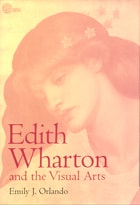
Edith Wharton and the Visual Arts
Emily J. Orlando
University of Alabama Press, 2008
An insightful look at representations of women’s bodies and female authority.
This work explores Edith Wharton's career-long concern with a 19th-century visual culture that limited female artistic agency and expression. Wharton repeatedly invoked the visual arts--especially painting—as a medium for revealing the ways that women's bodies have been represented (as passive, sexualized, infantalized, sickly, dead). Well-versed in the Italian masters, Wharton made special use of the art of the Pre-Raphaelite Brotherhood, particularly its penchant for producing not portraits of individual women but instead icons onto whose bodies male desire is superimposed.
Emily Orlando contends that while Wharton's early work presents women enshrined by men through art, the middle and later fiction shifts the seat of power to women. From Lily Bart in The House of Mirth to Undine Spragg in The Custom of the Country and Ellen Olenska in The Age of Innocence, women evolve from victims to vital agents, securing for themselves a more empowering and satisfying relationship to art and to their own identities.
Orlando also studies the lesser-known short stories and novels, revealing Wharton’s re-workings of texts by Browning, Poe, Balzac, George Eliot, Sir Joshua Reynolds, and, most significantly, Dante Gabriel Rossetti. Edith Wharton and the Visual Arts is the first extended study to examine the presence in Wharton's fiction of the Pre-Raphaelite poetry and painting of Rossetti and his muses, notably Elizabeth Siddall and Jane Morris. Wharton emerges as one of American literature's most gifted inter-textual realists, providing a vivid lens through which to view issues of power, resistance, and social change as they surface in American literature and culture.
Edith Wharton in Context
Essays on IntertextualityAdeline R. Tintner
University of Alabama Press, 1999
Tintner provides a detailed analysis of the complex interplay between Wharton and James—how they influenced each other and how some of their writings operate as homages or personal jokes. So deeply was James in Wharton’s confidence, Tintner argues, that he provided her with source models for a number of her characters. In addition, Wharton found in his fiction structures for her own, especially for The Age of Innocence.
Tintner also brings her considerable knowledge of art history to bear in her study of art allusions in Wharton’s work. Wharton’s response both to the Italian painters active before Raphael and to the English Pre-Raphaelites of a generation before her own is analyzed here in three essays. These pieces demonstrate Wharton’s sensibility to changes in art tastes and collecting, the inheritance of Rossetti’s revolutionary paintings in the unfinished novel, The Buccaneers, and the importance of home in The Glimpses of the Moon, as demonstrated by Wharton’s use of Tiepolo’s fresco in the church of Scalzi.
Tintner concludes by considering Wharton’s literary legacy and who Wharton has figured in the imaginations of recent writers, including Richard Howard, Louis Auchincloss, and Cathleen Schine. Tintner finds some part of Wharton’s personality or work evoked in a number of contemporary works and argues that this presence signals the beginning of an increasing influence.
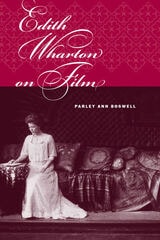
Edith Wharton on Film
Parley Ann Boswell
Southern Illinois University Press, 2007
Edith Wharton (1862–1937), who lived nearly half of her life during the cinema age when she published many of her well-known works, acknowledged that she disliked the movies, characterizing them as an enemy of the imagination. Yet her fiction often referenced film and popular Hollywood culture, and she even sold the rights to several of her novels to Hollywood studios.
Edith Wharton on Film explores these seeming contradictions and examines the relationships among Wharton’s writings, the popular culture in which she published them, and the subsequent film adaptations of her work (three from the 1930s and four from the 1990s). Author Parley Ann Boswell examines the texts in which Wharton referenced film and Hollywood culture and evaluates the extant films adapted from Wharton’s fiction.
The volume introduces Wharton’s use of cinema culture in her fiction through the 1917 novella Summer, written during the nation’s first wave of feminism, in which the heroine Charity Royall is moviegoer and new American woman, consumer and consumable. Boswell considers the source of this conformity and entrapment, especially for women. She discloses how Wharton struggled to write popular stories and then how she revealed her antipathy toward popular movie culture in two late novels.
Boswell describes Wharton’s financial dependence on the American movie industry, which fueled her antagonism toward Hollywood culture, her well-documented disdain for popular culture, and her struggles to publish in women’s magazines.
This first full-length study that examines the film adaptations of Wharton’s fiction covers seven films adapted from Wharton’s works between 1930 and 2000 and the fifty-year gap in Wharton film adaptations. The study also analyzes Sophy Viner in The Reef as pre-Hollywood ingénue, characters in Twilight Sleep and The Children and the real Hollywood figures who might have inspired them, and The Sheik and racial stereotypes.
Boswell traces the complicated relationship of fiction and narrative film, the adaptations and cinematic metaphors of Wharton’s work in the 1990s, and Wharton’s persona as an outsider. Wharton’s fiction on film corresponds in striking ways to American noir cinema, says Boswell, because contemporary filmmakers recognize and celebrate the subversive qualities of Wharton’s work.
Edith Wharton on Film, which includes eleven illustrations, enhances Wharton’s stature as a major American author and provides persuasive evidence that her fiction should be read as American noir literature.
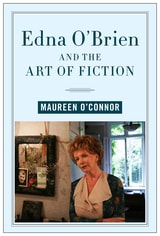
Edna O'Brien and the Art of Fiction
Maureen O'Connor
Bucknell University Press, 2022
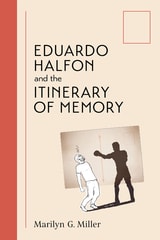
Eduardo Halfon and the Itinerary of Memory
Marilyn G. Miller
Vanderbilt University Press, 2024
Marilyn G. Miller has written the first study to focus exclusively on this important voice in Jewish–Latin American letters. Only after returning to Guatemala and regaining his command of Spanish through reading literature did Halfon begin to build his life as a writer and translator. Nonetheless, the author admits that “one thing is stubbornly true, and it’s this: every sentence that I write, every verb or adjective that I painstakingly insert or remove, every literary thought that I have while writing, always . . . begins and ends in English.” Halfon’s translated works are never parallel texts, however. Thus, translation and its side effects (foreign words, linguistic lacunae, multilingual modes of perception) offer us crucial keys to understanding the author’s fictional world as a vehicle for retelling and surviving Jewish trauma and finding his own particular plurilingual voice.
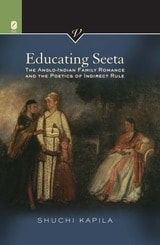
Educating Seeta
The Anglo-Indian Family Romance and the Poetics of Indirect RuleShuchi Kapila
The Ohio State University Press, 2010
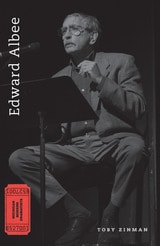
Edward Albee
Toby Zinman
University of Michigan Press, 2008
Edward Albee was a giant in American theater, in the same pantheon with Arthur Miller, Eugene O’Neill, and Tennessee Williams. His prolific career included three Pulitzer Prizes and the 2005 Lifetime Achievement Tony Award.
Albee continued producing major works for the theater into his eighties, including a prequel to The Zoo Story, which shocked the country when it first appeared in 1958—and his plays have seen major revivals on and off Broadway in recent years. Yet even with this resurgence of popularity, no up-to-date treatment of his plays is currently in print.
With engaging discussions of his most famous plays, such as Who’s Afraid of Virginia Woolf and Three Tall Women, as well as his lesser known works, this essential guide reveals the heart of Albee’s drama, highlighting the themes of sex, death, loneliness, and time that have occupied the playwright during his more than fifty years in the theater.
Toby Zinman is the theater critic for the Philadelphia Inquirer. She has written for numerous publications, including Variety,American Theater, and Theatre Journal. She is Professor of English at the University of the Arts, Philadelphia.
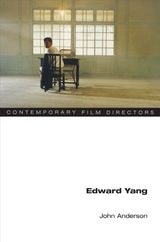
Edward Yang
John Anderson
University of Illinois Press, 2005
Having largely given up on a career in film, Edward Yang had been working as a computer engineer for several years when he saw Herzog's Aguirre, Wrath of God. Inspired to return to film, Yang, along with a handful of other filmmakers, including the great Hou Hsiao-hsien, went on to found the Taiwanese New Wave of the early 1980s.
Film critic John Anderson's Edward Yang offers a comprehensive overview of the work of the writer-director—already considered one of the most important filmmakers of the past twenty years—from his breakthrough feature That Day, on the Beach to the epic Yi-Yi. Rooted in questions about what it means to be Taiwanese, Yang's films reveal the complexity of life within the island's patchwork culture. Anderson identifies the key narrative strategies, formal devices, moral vision, and sociopolitical concerns shot through Yang's films. He explains what makes these films so distinctive by pinpointing the specific qualities of Yang's style and outlook.
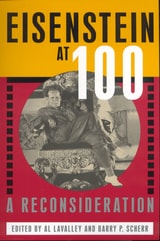
Eisenstein at 100
Edited by Al LaValley and P. Scherr
Rutgers University Press, 2001
Like many other figures once closely associated with the Soviet state, the great Russian filmmaker Sergei Eisenstein has become the subject of renewed interest. A decade after the fall of the Soviet Union, and with fresh material on his life and art now available, a more complex picture of Eisenstein is emerging. This collection-featuring the work of major film theorists and Russian scholars-offers the first post-Soviet reconsideration of Eisenstein's contribution to world cinema.
The contributors address themes previously avoided by Soviet critics, such as sexuality, religion, gender, and politics, in The Battleship Potemkin, October, Alexander Nevsky, and Ivan the Terrible. These films and others are also reassessed in light of a more thorough knowledge of Eisenstein’s life and of the complicated historical, cultural, and political contexts in which he worked. Of particular concern here is Eisenstein’s struggle with Soviet censorship, which resulted in a tenuous balance between the pressures of the state and his goals as an artist. Essays explore the manner in which Eisenstein’s later theoretical writings reveal continuity with the more well known earlier work, issues of historical revisionism, and the relationship between autobiography and the films. Eisenstein’s undeniable influence on his contemporaries and subsequent generations, as well as his reception by the film community and the public, are illuminated.
Rather than fostering the popular image of Eisenstein as the “inventor” of film montage, the director of Potemkin, and the enthusiastic early supporter of the Bolsheviks, Eisenstein at 100 presents a much richer and more profound picture of Eisenstein the man, the director, and the film theorist.
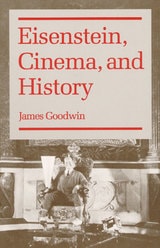
Eisenstein, Cinema, and History
James Goodwin
University of Illinois Press, 1993
stands alone as the maker of a fully historical cinema. James Goodwin treats
issues of revolutionary history and historical representation as central to
an understanding of Eisentein's work, which explores two movements within Soviet
history and consciousness: the Bolshevik Revolution and the Stalinist state.
Goodwin articulates intersections
between Eisentein's ideas and aspects of the thought of Walter Benjamin, Georg
Lukács, Ernst Bloch, and Bertolt Brecht. He also shows how the formal
properties and filmic techniques of each work reveal perspectives on history
. Individual chapters focus on Strike, Battleship Potemkin, October, Old
and New, projects of the 1930s, Alexander Nevsky, and Ivan the
Terrible.
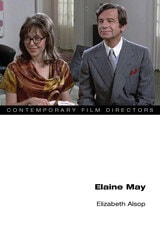
Elaine May
Elizabeth Alsop
University of Illinois Press, 2025
A compelling reconsideration of an iconoclast and original, Elaine May reveals how a surprisingly radical auteur created her trademark cinema of discomfort.
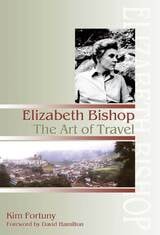
Elizabeth Bishop
Kim Fortuny
University Press of Colorado, 2003
Elizabeth Bishop and the Literary Archive
Bethany Hicok
Lever Press, 2020
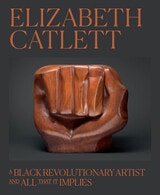
Elizabeth Catlett
A Black Revolutionary Artist and All That It ImpliesEdited by Dalila Scruggs
University of Chicago Press, 2024
Accomplished printmaker and sculptor, avowed feminist, and lifelong activist Elizabeth Catlett (1915–2012) built a remarkable career around intersecting passions for formal rigor and social justice. This book, accompanying a major traveling retrospective, offers a revelatory look at the artist and her nearly century-long life, highlighting overlooked works alongside iconic masterpieces.
Catlett’s activism and artistic expression were deeply connected, and she protested the injustices of her time throughout her life. Her work in printmaking and sculpture draws on organic abstraction, the modernism of the United States and Mexico, and African art to center the experiences of Black and Mexican women. Catlett attended Howard University, studied with the painter Grant Wood, joined the Harlem artistic community, and worked with a leftist graphics workshop in Mexico, where she lived in exile after the US accused her of communism and barred her re-entry into her home country.
The book’s essays address a range of topics, including Catlett’s early development as an artist-activist, the impact of political exile on her work, her pedagogical legacy, her achievement as a social realist printmaker, her work with the arts community of Chicago’s South Side, and the diverse influences that shaped her practice.
Ellen Glasgow
Beyond ConventionBy Linda W. Wagner
University of Texas Press, 1982
For many years Pulitzer Prize winner Ellen Glasgow has been regarded as a classic American regional novelist. But Glasgow is far more than a Southern writer, as Linda Wagner demonstrates in this fascinating reassessment of her work.
A Virginia lady, Glasgow began to write at a time when the highest praise for a literary woman was to be mistaken for a male writer. In her early fiction, published at the turn of the century, all attention is focused on male protagonists; the strong female characters who do appear early in these novels gradually fade into the background.
But Ellen Glasgow grew to become a woman who, born to be protected from the very life she wanted to chronicle, moved “beyond convention” to live her life on her own terms. And as her own self-image changed, the perspective of her novels became more feminine, the female characters moved to center stage, and their philosophies became central to her themes. Glasgow’s best novels, then—Barren Ground, Vein of Iron, and the romantic trilogy that includes The Sheltered Life—came late in her life, when she was no longer content to imitate fashionable male novelists.
Glasgow’s increased self-assurance as writer and woman led to a far greater awareness of craft. Her style became more highly imaged, more suggestive, as though she wished to widen the range of resources available to move her readers. She became a writer both popular and respected. Her novels appeared as selections of the Literary Guild and the Book-of-the-Month Club, and one became a best seller. At the same time she was chosen as one of the few female members of the Academy of Arts and Letters, and in 1942 she was awarded the Pulitzer Prize for her novel In This Our Life.
Ellington Uptown
Duke Ellington, James P. Johnson, and the Birth of Concert JazzJohn Howland
University of Michigan Press, 2009
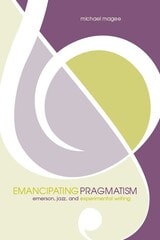
Emancipating Pragmatism
Emerson, Jazz, and Experimental WritingMichael Magee
University of Alabama Press, 2004
A radical rereading of Emerson that posits African- American culture, literature, and jazz as the very continuation and embodiment of pragmatic thought and democratic tradition
Emancipating Pragmatism is a radical rereading of Emerson that posits African- American culture, literature, and jazz as the embodiment of pragmatic thought and democratic tradition. It traces Emerson's philosophical legacy through the 19th and 20th centuries to discover how Emersonian thought continues to inform issues of race, aesthetics, and poetic discourse.
Emerson’s pragmatism derives from his abolitionism, Michael Magee argues, and any pragmatic thought that aspires toward democracy cannot ignore and must reckon with its racial roots. Magee looks at the ties between pragmatism and African-American culture as they manifest themselves in key texts and movements, such as William Carlos Williams’s poetry; Ralph Ellison’s discourse in Invisible Man and Juneteenth and his essays on jazz; the poetic works of Robert Creeley, Amiri Baraka, and Frank O'Hara; as well as the “new jazz” being forged at clubs like The Five Spot in New York.
Ultimately, Magee calls into question traditional maps of pragmatist lineage and ties pragmatism to the avant-garde American tradition.
Emerson and the Defense of Equality
Greg Garvey
University of Massachusetts Press, 2025
Arguing for equality as the necessary foundation of liberty
During Ralph Waldo Emerson’s lifetime, the idea of universal human equality was under intensive assault. Repeatedly—in contexts ranging from slavery, to marriage, to politics and workers’ rights—Americans of the time were being told that equality was an obsolete ideal and that the future would belong to those who accepted the hard truth that liberty lies not in egalitarian values but in hierarchies of domination and submission. Greg Garvey’s Emerson and the Defense of Equality focuses on Emerson as a real-time defender of equality during the antebellum culture wars.
In contrast to studies that treat individual liberty as Emerson’s primary concern, Garvey argues that Emerson’s works define a broad and sustained defense of equality as the necessary foundation of liberty. When read as part of a debate about equality, Emerson’s Nature is a treatise on individuality and the common weal; his anti-slavery speeches and English Traits advance evolutionary theories to rebut polygenesist arguments for white supremacy; the essays “Love” and “Domestic Life” challenge gender spheres and explore equality in marriage, friendship, and citizenship. As Emerson speculates on the future, “Politics” and “The Young American” anticipate a “beneficent socialism” in which human rights will always have priority over property rights. In his career-long effort to defend a threatened ideal, Emerson develops an aspirational vision of society that understands equality to be a fundamental aspect of liberty.
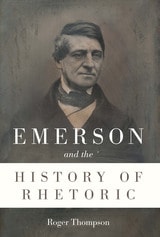
Emerson and the History of Rhetoric
Roger Thompson
Southern Illinois University Press, 2017
Moving beyond dominant literary critical thinking, Thompson argues that for Emerson, rhetoric was both imaginative and nonsystematic. This book covers the influences of rhetoricians from a range of periods on Emerson’s model of rhetoric. Drawing on Emerson’s manuscript notes, journal entries, and some of his rarely discussed essays and lectures as well as his more famous works, the author bridges the divide between literary and rhetorical studies, expanding our understanding of this iconic nineteenth-century man of letters.
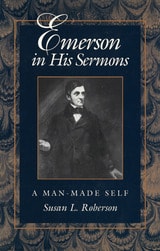
Emerson in His Sermons
A Man-Made SelfSusan L. Roberson
University of Missouri Press, 1994
Ralph Waldo Emerson is universally recognized as one of America's most influential authors and thinkers. Before achieving eminence as lecturer, essayist, and poet, though, he was a Unitaarian preacher. Emerson in His Sermons is the first major study of the sermons since the publication of The Complete Sermons of Ralph Waldo Emerson. Susan Roberson examines Emerson's ministerial career from 1826 to 1832, shedding new light on those early, crucial years in Emerson's personal and intellectual development.
Treating the sermons extensively as an autobiographical text, Roberson establishes that Emerson's years in the pulpit were pivotal and that his sermons are key texts in revealing the essential development of his thought. Central to Roberson's explication of the sermons is Emerson's conception of self-reliance, his invention of a new hero for a new age, and his merging of his own identity with that heroic idea.
Roberson focuses on Emerson's reaction to what was perhaps the most signifcant event in his personal life: the death of his young wife, Ellen, of tuberculosis in 1831, after only sixteen months of marriage. Roberson's correlation of the sermons written during that time with the complexity of Emerson's emotional and intellectual response to the tragedy of Ellen's illness and death is the most detailed and sophisticated treatment of that material to date.
Roberson understands Emerson's emergence from the ministry as his rejection of ready-made institutions and sytems of thought. Through her careful readings of the sermons, Roberson finds that Emerson's objective was less the translation of his life into writing than the translation of his life through writing. By considering the sermons in this way, Roberson is able to enrich our understanding of the private and passionte impulses of this seminal thinker.
Emerson in His Sermons offers the first real look at how the sermons fit into Emerson's own development and will have a far-reaching impact on Emerson scholarship. Anyone concerned with the cultural and religious history of America will find this book invaluable.
Emerson, Romanticism, and Intuitive Reason
The Transatlantic "Light of All Our Day"Patrick J. Keane
University of Missouri Press, 2005
Emerson’s Liberalism
Neal Dolan
University of Wisconsin Press, 2009
Neal Dolan offers the first comprehensive and historically informed exposition of all of Ralph Waldo Emerson’s writings as a contribution to the theory and practice of liberal culture. Rather than projecting twentieth-century viewpoints onto the past, he restores Emerson’s great body of work to the classical liberal contexts that most decisively shaped its general political-cultural outlook—the libertarian-liberalism of John Locke, the Scottish Enlightenment, the American founders, and the American Whigs.
In addition to in-depth consideration of Emerson’s journals and lectures, Dolan provides original commentary on many of Emerson’s most celebrated published works, including Nature, the “Divinity School Address,” “History,” “Compensation,” “Experience,” the political addresses of the early 1840s, “An Address . . . on . . . The Emancipation of the Negroes in the British West Indies,” Representative Men, English Traits, and The Conduct of Life. He considers Emerson’s distinctive elaborations of foundational liberal values—progress, reason, work, property, limited government, rights, civil society, liberty, commerce, and empiricism. And he argues that Emerson’s ideas are a morally bracing and spiritually inspiring resource for the ongoing sustenance of American culture and civilization, reminding us of the depth, breadth, and strength of our common liberal inheritance.

Emily Dickinson and the Labor of Clothing
Daneen Wardrop
University of New Hampshire Press, 2009
Emily Dickinson'S Gothic
Goblin With A GaugeDaneen Wardrop
University of Iowa Press, 1996
Emily Dickinson should stand as a major gothic author among her nineteenth-century American contemporaries, but two factors have previously prevented her inclusion in such company. Perhaps the most obvious is the problem of the genre: Dickinson writes gothic poetry, whereas gothic fiction defines the genre. In addition, her poetic personae have served over the decades to prompt critics to “protect” her; traditional critics concentrated on the sweet, romantic elements of her oeuvre. More recent readers, notably Sandra Gilbert and Susan Gubar, Jane Egerwein, and Cynthia Griffin Wolff, have begun studying Dickinson's gothic traits; Emily Dickinson's Gothic explores Dickinsonian gothicism with the systematic rigor it demands and deserves.
Emily Dickinson's Gothic also addresses sociohistorical concerns, from hallowed gothic conventions dating from Horace Walpole's eighteenth century to such modernist neogothic topics as rape, the void, and disjunctive language that appear in the latter nineteenth and early twentieth centuries. Wardrop recognizes the full extent to which the gothic pervades Dickinson's canon and the means by which the gothic determines her aesthetic. Such full consideration of women's gothicism allows the placement of Dickinson within a literary context, both in terms of American writers and in terms of women writers.
Emily Dickinson's Approving God
Divine Design and the Problem of SufferingPatrick J. Keane
University of Missouri Press, 2008
Emily Dickinson's Music Book and the Musical Life of an American Poet
George Boziwick
University of Massachusetts Press, 2022
After years of studying piano as a young woman in her family home in Amherst, Massachusetts, Emily Dickinson curated her music book, a common practice at the time. Now part of the Dickinson Collection in the Houghton Library of Harvard University, this bound volume of 107 pieces of published sheet music includes the poet’s favorite instrumental piano music and vocal music, ranging from theme and variation sets to vernacular music, which was also enjoyed by the family’s servants.
Offering a fresh historical perspective on a poetic voice that has become canonical in American literature, this original study brings this artifact to life, documenting Dickinson’s early years of musical study through the time her music was bound in the early 1850s, which tellingly coincided with the writing of her first poems. Using Dickinson’s letters and poems alongside newspapers and other archival sources, George Boziwick explores the various composers, music sellers, and publishers behind this music and Dickinson’s attendance at performances, presenting new insights into the multiple layers of meaning that music held for her.
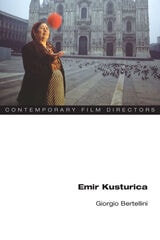
Emir Kusturica
Emir Kusturica
University of Illinois Press, 2015
Leading scholar-critic Giorgio Bertellini divides Kusturica's career into three stages--dissention, disconnection, and dissonance--to reflect both the historic and cultural changes going on around him and the changes his cinema has undergone. He uses Kusturica's Palme d'Or winning Underground (1995)--the famously inflammatory take on Yugoslav history after World War II--as the pivot between the tone of romantic, yet pungent critique of the director's early works and later journeys into Balkanist farce marked by slapstick and a self-conscious primitivism.
Eschewing the one-sided polemics Kusturica's work often provokes, Bertellini employs balanced discussion and critical analysis to offer a fascinating and up-to-date consideration of a major figure in world cinema.
Emo
How Fans Defined a SubcultureJudith May Fathallah
University of Iowa Press, 2020
For many, the word “emo” calls to mind angsty teenagers, shaggy black haircuts, and skinny jeans. A popular music phenomenon in the early 2000s, emo is short for “emotional hardcore,” and refers to both a music genre and a youth scene notable for its androgynous style. Judith May Fathallah pushes beyond the stereotypes and social stigma to explore how online fandom has shaped the definition of emo, with significant implications both for millennial constructs of gender and for contemporary fan studies.
First laying out the debate over what emo is, Fathallah walks superfans and newcomers through the culture surrounding thegenre’s major bands, including the emo holy trinity: My Chemical Romance, Fall Out Boy, and Panic! At the Disco. Next she examines fans’ main mode of participation in the emo subculture—online communities such as LiveJournal, Tumblr, MySpace, and band websites. Taking a hard look at the gender politics that dominated those spaces, she unearths a subculture that simultaneously defines itself by its sensitivity and resistance to traditional forms of masculinity, yet ruthlessly enforces homophobic and sexist standards. Fathallah demonstrates fandom’s key role in defining emo as a concept and genre after 2001, with probing insight into its implications for gender constructions through popular music.
Empire of Objects
Iurii Trifonov and the Material World of Soviet CultureBenjamin M. Sutcliffe
University of Wisconsin Press, 2023
Scholars have both neglected Trifonov in recent years and focused their limited attention on the author’s most famous works, produced in the 1960s through 1980s. Yet almost half of his output was written before then. In Empire of Objects, Benjamin Sutcliffe takes care to consider the author’s entire oeuvre. Trifonov’s work reflects the paradoxes of a culture that could neither honestly confront the past nor create a viable future, one that alternated between trying to address and attempting to obscure the trauma of Stalinism. He became increasingly incensed by what he perceived as the erosion of sincerity in public and private life, by the impact of technology, and by the state’s tacit support of greed and materialism. Trifonov’s work, though fictional, offers a compelling window into Soviet culture.

Encounters with Kenneth Burke
William H. Rueckert
University of Illinois Press, 1994
1963 study, Kenneth Burke and the Drama of Human Relations, is often
credited with bringing the field of Burke studies into existence. Here, Rueckert
has gathered his "encounters" with Burke over the past thirty years--brieft
talks, position papers, rethinking and reformation of earlier ideas, and detailed
analyses of individual texts--into one volume that offers readers the best of
Burkean criticism.

Encounters with Rauschenberg
(A Lavishly Illustrated Lecture)Leo Steinberg
University of Chicago Press, 2000
With the sharpness and confidence that can only come from a critic who has long been involved with Rauschenberg's work, Steinberg offers an in-depth discussion of such major pieces as the Erased DeKooning Drawing, Bed, and Monogram. He explains the subtle differences between his interpretations and those of other critics, such as Clement Greenberg and Hilton Kramer. He candidly reflects on how he has changed his mind over the years, and defends his new ideas about Rauschenberg's work with precise, fresh arguments. He critically evaluates Rauschenberg's more recent work and addresses how it falls short from the artist's earlier work.
From Rauschenberg's silk-screen prints of the 1960s to the vegetable dye transfer prints of the 1990s, Steinberg warns against the dangers of overinterpretation and iconographic enthusiasm. He argues that the unifying strand through this great artist's work is his drive to appropriate, to take objects and images from the world and make them his own by making them become a part of his art.
Provocative, intelligent, and beautifully articulated, Steinberg's words shed light on one remarkable artist and on the post-war New York art scene, on Steinberg's particular appreciation of Rauschenberg and on his life's work as an art critic.
Enduring Postwar
Yasuoka Shotaro and Literary Memory in JapanKendall Heitzman
Vanderbilt University Press, 2019
For a long period, Yasuoka was at the center of the Japanese literary establishment, serving on prize committees and winning the major literary prizes of the era: the Akutagawa, the Noma, the Yomiuri, and the Kawabata. But what makes Yasuoka fascinating as a writer is the way that he consciously, deliberately resisted accepted narratives of modern Japanese history through his approach to personal and collective memory.
In Enduring Postwar, the first literary and biographical study of Yasuoka in English, Kendall Heitzman explores the element of memory in Yasuoka's work in the context of his life and evolving understanding of postwar Japan.
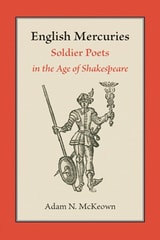
English Mercuries
Soldier Poets in the Age of ShakespeareAdam N. McKeown
Vanderbilt University Press, 2009
These misgivings are a powerful undercurrent in much of the literature of the period, even the most ostensibly patriotic works, but it is in the writings on war by soldier poets where they are most clearly pronounced. Fashioning themselves as servants of both Mars and Mercury (the god of war and the god of writing), Elizabethan soldier poets focused their war stories on the gritty realities of military campaigning, the price individuals paid for serving the state, and the difficulties of returning to civilian life. The book reconsiders some familiar writers like John Donne and Ben Jonson in the context of their military experiences and provides comprehensive studies of some important but underappreciated soldier poets like Thomas Churchyard, George Gascoigne, and John Harington.
Enraptured Space
Gender, Class, and Ecology in the Work of Paula MeehanKathryn J. Kirkpatrick
West Virginia University Press, 2025
In Paula Meehan, Kirkpatrick has found a powerful poet to both study and love, and her reading of Meehan’s poetry and prose through the lenses of gender studies, the environmental humanities, and social class offers a passionate endorsement of Meehan’s radical interventions in the canon of Irish poetry. This work explores eight volumes of Meehan’s poetry, including Dharmakaya, Painting Rain, and Geomantic.
Enter Rabelais, Laughing
Barbara C. Bowen
Vanderbilt University Press, 1998
While most books about Rabelais have relatively little to say about his comedic genius, Enter Rabelais, Laughing analyzes the many sides of Rabelais's humor, focusing on why his writing was so hilariously funny to sixteenth-century readers. The author begins by discussing how the Renaissance defined laughter and situates Rabelais in a long tradition of literary laughter. Subsequent chapters examine specific contexts relevant to Gargantua and Pantagruel, beginning with the comic aspects of epic, chronicle, mock-epic, and farce, and proceeding to Renaissance and Reformation humanist satire, rhetoric, medicine, and law. All of these chapters combine information, much of it new, on the humanist message Rabelais wanted to convey to his readers, with an analysis of how he used his wit to reinforce his message.
Rarely is a writer's work treated in such illuminating detail. On a broad level, Enter Rabelais, Laughing serves as an excellent introduction to French Renaissance literature and exhibits a remarkably charming and lucid writing style, free of jargon. To Rabelais scholars in particular it offers a thorough and innovative analysis that corrects misconceptions and questions commonly held views.
Envisioning Taiwan
Fiction, Cinema, and the Nation in the Cultural ImaginaryJune Yip
Duke University Press, 2004
Yip traces a distinctly Taiwanese sense of self vis-à-vis China, Japan, and the West through two of the island’s most important cultural movements: the hsiang-t’u (or “nativist”) literature of the 1960s and 1970s, and the Taiwanese New Cinema of the 1980s and 1990s. At the heart of the book are close readings of the work of the hsiang-t’u writer Hwang Chun-ming and the New Cinema filmmaker Hou Hsiao-hsien. Key figures in Taiwan’s assertion of a national identity separate and distinct from China, both artists portray in vibrant detail daily life on the island. Through Hwang’s and Hou’s work and their respective artistic movements, Yip explores “the imagining of a nation” on the local, national, and global levels. In the process, she exposes a perceptible shift away from traditional models of cultural authenticity toward a more fluid, postmodern hybridity—an evolution that reflects both Taiwan’s peculiar multicultural reality and broader trends in global culture.
Epic Ambition
Hercules and the Politics of Emulation in Valerius Flaccus' ArgonauticaJessica Blum-Sorensen
University of Wisconsin Press, 2023
Focusing especially on Hercules, Blum-Sorensen explores how Valerius’ characters—and, by extension, their Roman audience—misinterpret exemplars of past achievement, or apply them to sad effect in changed circumstances. By reading such models as normative guides to epic triumph, Valerius’ Argonauts find themselves enacting tragic outcomes: effectively, the characters impose their nostalgic longing for epic triumph on the events before them, even as Valerius and his audience anticipate the tragedy awaiting his heroes. Valerius thus questions Rome’s reliance on the past as a guide to the present, allowing for doubt about the empire’s success under the new Flavian regime. It is the literary tradition’s exchange between triumphant epic and tragedy that makes the Argo’s voyage a perfect vehicle for Valerius’ exploration: the tensions between genres both raise and prohibit resolution of anxieties about how the new age—mythological or real—will turn out.
Epic and Exile
Novels of the German Popular Front, 1933-1945Hunter Bivens
Northwestern University Press, 2015
Equivocal Beings
Politics, Gender, and Sentimentality in the 1790s--Wollstonecraft, Radcliffe, Burney, AustenClaudia L. Johnson
University of Chicago Press, 1995
Demonstrating the interrelationships among politics, gender, and feeling in the fiction of this period, Johnson provides detailed readings of Wollstonecraft, Radcliffe, and Burney, and treats the qualities that were once thought to mar their work—grotesqueness, strain, and excess—as indices of ideological conflict and as strategies of representation during a period of profound political conflict. She maintains that the reactionary reassertion of male sentimentality as a political duty displaced customary gender roles, rendering women, in Wollstonecraft's words, "equivocal beings."
Ernest Hemingway
The Oak Park LegacyJames Nagel
University of Alabama Press, 1996
Ernest Hemingway: The Oak Park Legacy is the first extensive examination of the relationship of Hemingway to his hometown, Oak Park, Illinois, and the influence its people, places, and underlying values had on his early work. In this volume, 11 leading Hemingway scholars explore various aspects of these issues, from the migration of the Hemingway family from Connecticut to Illinois in the 1850s, to Hemingway's high-school stories and the dramatic breakthrough of In Our Time and The Sun Also Rises. With these books, Hemingway suddenly became one of the most influential writers of the 20th century. The essays in this collection explore the social and family background that provided the material and sensibility for these literary masterpieces.
In these essays, James Nagel provides the first account ever published of the move of the Hemingway family from Connecticut to Illinois. Writing his account after the discovery of a lost diary by one of Hemingway's ancestors, Nagel explores dates and places, the motivation for the move to the Midwest, and the tragedies that awaited the family there, including the death of two young men in the Civil War. Michael Reynolds, the premiere biographer of Ernest Hemingway, describes the culture of the village of Oak Park at the turn of the century, and Larry E. Grimes presents an important new assessment of the religious training the Hemingway children received. David Marut discusses the short stories Hemingway published while still a highschool student, and Carlos Azevedo, Mary Anne O'Neal, Abby H. P. Werlock, and George Monteiro examine the early stories about Nick Adams. In an insightful afterword, Morris Buske, the Historian of the Ernest Hemingway Foundation of Oak Park, reflects on the differing values of Ernest Hemingway's parents, the artistic, cultured Hall family as opposed to the scientific, more practical Hemingways, charting the influence the two traditions had on the young Ernest.
Ernest Hemingway
Thought in ActionMark Cirino
University of Wisconsin Press, 2012
In Cirino’s analysis of Hemingway’s work through this lens—including such celebrated classics as A Farewell to Arms, The Old Man and the Sea, and “Big Two-Hearted River” and less-appreciated works including Islands in the Stream and “Because I Think Deeper”—an entirely different Hemingway hero emerges: intelligent, introspective, and ruminative.
Eschatological Subjects
Divine and Literary Judgment in Fourteenth-Century French PoetryJ. M. Moreau
The Ohio State University Press, 2014
But Eschatological Subjects goes even further to demonstrate the largely unrecognized duality of this judge figure: not just God, the judge is also the imperious and imperfect human reader. The simultaneous divine and human judgments in (and of) French poetry reveal much about the ethical stakes of writing vernacular poetry in the later Middle Ages and, most importantly, about the relationships between authors and audiences.
Focusing on Guillaume de Deguileville, Guillaume de Machaut, and Jean Froissart (each of whom composed scenes in which they appear on trial before God), Moreau contributes important new insights on the complex “trial process” of later medieval literature, in which poetic authority and fame depended on the poet’s ability to defend himself before a fearful court of reader opinion.

Essaying Shakespeare
Karen Newman
University of Minnesota Press, 2009
A pioneering scholar of Shakespeare and early modern letters provides an overview of work in the field
For more than twenty-five years, Karen Newman has brought her critical acumen to bear on early modern studies. In this collection of her essays on Shakespeare—some acknowledged classics and others never before published—Newman shows how changing theoretical trends have shaped Shakespeare studies, from new historicism and gender studies to critical race studies and globalization.
Central to Newman’s work is social exchange, or the circulation of people and objects. At least two of these essays have had a powerful and lasting impact on Shakespeare studies: “Renaissance Family Politics and Shakespeare’s The Taming of the Shrew” and “‘And wash the Ethiop White’: Femininity and the Monstrous in Othello.” Three essays appear in print for the first time: an examination of clothing of the poor and the portrayal of the king as a beggar in Richard II; a stinging review of Harold Bloom’s book Shakespeare: The Invention of the Human; and a rethinking of claims about the globalization of culture and cultural translation.Essaying Shakespeare chronicles Newman’s own critical development to provide a significant map of critical work on Shakespeare.
Essays on Gogol
Logos and the Russian WordSusanne Fusso and Priscilla Meyer
Northwestern University Press, 1994