Results by title
917 books match the query 'Economics' and 74 start with e

Economic Analysis of the Digital Economy
Edited by Avi Goldfarb, Shane M. Greenstein, and Catherine E. Tucker
University of Chicago Press, 2015
Economic Analysis of the Digital Economy explores the economic impact of digitization, with each chapter identifying a promising new area of research. The Internet is one of the key drivers of growth in digital communication, and the first set of chapters discusses basic supply-and-demand factors related to access. Later chapters discuss new opportunities and challenges created by digital technology and describe some of the most pressing policy issues. As digital technologies continue to gain in momentum and importance, it has become clear that digitization has features that do not fit well into traditional economic models. This suggests a need for a better understanding of the impact of digital technology on economic activity, and Economic Analysis of the Digital Economy brings together leading scholars to explore this emerging area of research.

Economic Aspects of Obesity
Edited by Michael Grossman and Naci Mocan
University of Chicago Press, 2011
In the past three decades, the number of obese adults in the United States has doubled and the number of obese children almost tripled, which may lead to increased medical expenditures, productivity loss, and stress on the health care system. Economic analysis now shows that weight gain is the result of individual choices in response to economic environments and demonstrates that incentives can influence individual behaviors affecting weight. Determinants are varied and include year- and area-specific food prices, availability of food outlets and recreational facilities, health insurance, and minimum wage levels. Timely and important, Economic Aspects of Obesity provides a strong foundation for evaluating the costs and benefits of various proposals designed to control obesity rates.

Economic Dimensions of Personalized and Precision Medicine
Edited by Ernst R. Berndt, Dana P. Goldman, and John Rowe
University of Chicago Press, 2019
This volume explores the intersection of the scientific, clinical, and economic factors affecting the development of PPM, including its effects on the drug pipeline, on reimbursement of PPM diagnostics and treatments, and on funding of the requisite underlying research; and it examines recent empirical applications of PPM.

Economic Engagements with Art, Volume 31
Craufurd D. W. Goodwin and Neil de Marchi, eds.
Duke University Press, 0
This volume, which deals mostly with painting, is divided into three sections that consider the interplay between art and economics from different perspectives. In the first section, Art and Economic Theory, economists clarify the need to construct a framework for understanding the roles of taste and fashion in art valuation. A historical view is considered in a piece about the teacher of Velasquez and artistic adviser to the Inquisition in Seville, who took into account not only market factors, like demand, but also the "truth" and the nobility of the artist’s profession and of the painting itself. Also in this section is an essay on Rousseau’s perspective on the worth of a painting based on its envy value in social circles; other contributions focus on William Stanley Jevons, a nineteenth century British political economist, whose problems with art stemmed from the uniqueness of each work, rendering definitive market and economic terms irrelevant. The second section of the book, Art and Economic Policy, looks at broader policy issues with regard to the historical role of art. Essays consider policy with respect to art exports and imports and federal patronage of the arts during theDepression; Lionel Robbins and the political economy of art; and the interplay among economy, architecture, and politics as shown in certain postwar Hilton hotels. In the final section, The Business of Art, a variety of perspectives are considered: the economics of art in early modern times, discussed in the context of both humanist and scholastic approaches; the pricing of pictures based on a study of the Smith-Reynolds connection; and the relationships between Otto Nuerath, graphic art, and the social order.
The first collaborative and historical treatment of the connection between art and economics, Economic Engagements with Art will appeal to people across, from history and economics to art history.
Contributors. Márcia Balisciano, William J. Barber, Neil de Marchi, Bertil Fridén, Crauford D. Goodwin, Guido Guerzoni, Robert J. Leonard, Harro Maas, Ernest Mathijs, Steven G. Medema, Bert Mosselmans, Zarinés Negrón, Marcia Pointon, Helen Rees, Toon van Houdt, Annabel Wharton, Sara Zablotney
Economic Engagements with Art, Volume 31
Craufurd D. W. Goodwin and Neil de Marchi, eds.
Duke University Press, 0
This volume, which deals mostly with painting, is divided into three sections that consider the interplay between art and economics from different perspectives. In the first section, Art and Economic Theory, economists clarify the need to construct a framework for understanding the roles of taste and fashion in art valuation. A historical view is considered in a piece about the teacher of Velasquez and artistic adviser to the Inquisition in Seville, who took into account not only market factors, like demand, but also the "truth" and the nobility of the artist’s profession and of the painting itself. Also in this section is an essay on Rousseau’s perspective on the worth of a painting based on its envy value in social circles; other contributions focus on William Stanley Jevons, a nineteenth century British political economist, whose problems with art stemmed from the uniqueness of each work, rendering definitive market and economic terms irrelevant. The second section of the book, Art and Economic Policy, looks at broader policy issues with regard to the historical role of art. Essays consider policy with respect to art exports and imports and federal patronage of the arts during theDepression; Lionel Robbins and the political economy of art; and the interplay among economy, architecture, and politics as shown in certain postwar Hilton hotels. In the final section, The Business of Art, a variety of perspectives are considered: the economics of art in early modern times, discussed in the context of both humanist and scholastic approaches; the pricing of pictures based on a study of the Smith-Reynolds connection; and the relationships between Otto Nuerath, graphic art, and the social order.
The first collaborative and historical treatment of the connection between art and economics, Economic Engagements with Art will appeal to people across, from history and economics to art history.
Contributors. Márcia Balisciano, William J. Barber, Neil de Marchi, Bertil Fridén, Crauford D. Goodwin, Guido Guerzoni, Robert J. Leonard, Harro Maas, Ernest Mathijs, Steven G. Medema, Bert Mosselmans, Zarinés Negrón, Marcia Pointon, Helen Rees, Toon van Houdt, Annabel Wharton, Sara Zablotney
Economic Exchange and Social Interaction in Southeast Asia
Perspectives from Prehistory, History, and EthnographyKarl L. Hutterer, Editor
University of Michigan Press, 1978
Yet in social science research in Southeast Asia, the area of economic studies has lagged behind, despite the great study potential represented by the tremendous diversity of its physical and human environment. Economic Exchange and Social Interaction in Southeast Asia attempts to take advantage of that opportunity. As a number of the contributions to this volume show, many if not most of the systems organized on very different levels of integration interact with each other. Taken as a whole, they provide evidence of the incredible diversity of economic and social systems that may be investigated in Southeast Asia.
Economic Knowledge in Socialism, 1945–1989
Till Düppe and Ivan Boldyrev, issue editors
Duke University Press, 0
Contributors. Oleg Ananyin, Johanna Bockman, Ivan Boldyrev, Till Düppe, Richard Ericson, Yakov Feygin, Olessia Kirtchik, Martha Lampland, Adam Leeds, Denis Melnik, Chris Miller, György Peteri, Eglė Rindzevičiūtė, Vítězslav Sommer, Joachim Zweynert
Economic Performance in the Nordic World
Torben M. Andersen
University of Wisconsin Press, 2021
Economist Torben M. Andersen shows how the Nordic model rests on two pillars: the social safety net, which offers income compensation to the majority of those unable to support themselves, and the provision of services like education, childcare, and healthcare to all. The Nordic model can be characterized as one of employment, since its financial viability rests on a high labor participation rate with few working poor.
Andersen lays out the structure of the model and highlights factors important for understanding its economic performance. He then looks into specific policy areas based on Denmark's experiences regarding labor market policies (flexicurity), pension systems, and preparation for an aging population; and addresses the challenges arising from new technologies and globalization.
Economic Policy Reform
The Second StageEdited by Anne O. Krueger
University of Chicago Press, 2000
Economic Policy Reform: The Second Stage provides an incisive overview of the context of these crucial second-stage reforms with a thorough examination of the issues confronting the policymakers involved. Edited by Anne O. Krueger, it features studies from distinguished experts in various fields of economics. Each chapter of this book addresses a key issue in economic policy, examines the progress of reforms in the markets considered, and then explores what research might further aid leaders as they embark on fundamental changes.
Both a handbook for economists and practitioners and a theoretical exploration of the most significant challenges currently facing the economic world, this new book will be indispensable to anyone involved in the global economic scene.
Contributors:
Vittorio Corbo
Cimon Cowan
Sebastian Edwards
Stephan Haggard
Michael Kremer
Steven Matusz
Frederic S. Mishkin
Jonathan Morduch
Roger G. Noll
Miguel A. Savastano
T. Paul Shultz
Mary M. Shirley
T.N. Srinivasan
Joseph E. Stiglitz
Vito Tanzi
David Tarr
Aaron Tornell
Economic Regulation and Its Reform
What Have We Learned?Edited by Nancy L. Rose
University of Chicago Press, 2014
Economic Regulation and Its Reform collects research by a group of distinguished scholars who explore these and other issues surrounding government economic intervention. Determining the consequences of such intervention requires a careful assessment of the costs and benefits of imperfect regulation. Moreover, government interventions may take a variety of forms, from relatively nonintrusive performance-based regulations to more aggressive antitrust and competition policies and barriers to entry. This volume introduces the key issues surrounding economic regulation, provides an assessment of the economic effects of regulatory reforms over the past three decades, and examines how these insights bear on some of today’s most significant concerns in regulatory policy.
Economic Transfers in the United States
Edited by Marilyn Moon
University of Chicago Press, 1984
Social security, private pension benefits, housing, and health care are traditional kinds of transfers. Accurate measurements of the degree and effect of these and of other, newly interpreted transfers are vital to economic policy making. Though this volume is not directly concerned with policy-making issues, it does impinge on many areas of current public concern; methods of transfer valuation, for example, may affect how we view the status of the aged.
Researchers, policy analysts, and those who compile statistics on which social programs are based on will value the diverse approaches of these ten papers and their accompanying comments. Taken together the essays give great insight into the complexities of defining transfers and provide a wealth of new analytic methods. They were developed from material presented at the Income and Wealth Conference on Social Accounting for Transfers held at Madison, Wisconsin, in 1982.
Economic Turbulence
Is a Volatile Economy Good for America?Clair Brown, John Haltiwanger, and Julia Lane
University of Chicago Press, 2006
Every day, in every sector of our economy, a business shuts down while another starts up, jobs are created while others are cut, and workers are hired while others are laid off. This constant flux, or turbulence, is a defining characteristic of our free market system, yet it mostly inspires angst about unemployment, loss of earnings, and the overall competitiveness of corporations. But is this endless cycle of fluctuation really so bad for America? Might something positive be going on in the economy as a result of it?
In this penetrating work, three esteemed economists seek to answer these questions by exploring the real impact of volatility on American workers and businesses alike. According to the authors, while any number of events--shifts in consumer demand, changes in technology, mergers and acquisitions, or increased competition--can contribute to economic turbulence, our economy as a whole is, by and large, stronger for it, because these processes of creation and destruction make it more flexible and adaptable. The authors also acknowledge and document the adverse consequences of this turbulence on different groups of workers and firms and discuss the resulting policy challenges. Basing their argument on an up-close look into the dealings and practices of five key industries—financial services, retail food services, trucking, semiconductors, and software—the authors demonstrate the positive effects of turbulence on career paths, employee earnings, and firm performance.
The first substantial attempt to disentangle and make clear the complexities of this phenomenon in the United States, Economic Turbulence will be viewed as a major achievement and the centerpiece of any discussion on the subject for years to come.
Economic and Financial Crises in Emerging Market Economies
Edited by Martin Feldstein
University of Chicago Press, 2003
This book rises to that challenge, presenting accessible papers and commentaries on the topic not only from leading academic economists, but also from high-ranking government officials (in both industrial and developing nations), senior policymakers at international institutions, and major financial investors. Six non-technical papers, each written by a specialist in the topic, provide essential economic background, introducing sections on exchange rate regimes, financial policies, industrial country policies, IMF stabilization policies, IMF structural programs, and creditor relations. Next, personal statements from the major players give firsthand accounts of what really went on behind the scenes during the crises, giving us a rare glimpse into how international economic policy decisions are actually made. Finally, wide-ranging discussions and debates sparked by these papers and statements are summarized at the end of each section.
The result is an indispensable overview of the key issues at work in these crises, written by the people who move markets and reshape economies, and accessible to not just economists and policymakers, but also to educated general readers.
Contributors:
Montek S. Ahluwalia, Domingo F. Cavallo, William R. Cline, Andrew Crockett, Michael P. Dooley, Sebastian Edwards, Stanley Fischer, Arminio Fraga, Jeffrey Frankel, Jacob Frenkel, Timothy F. Geithner, Morris Goldstein, Paul Keating, Mervyn King, Anne O. Krueger, Roberto Mendoza, Frederic S. Mishkin, Guillermo Ortiz, Yung Chul Park, Nouriel Roubini, Robert Rubin, Jeffrey Sachs, Ammar Siamwalla, George Soros

Economic and Monetary Sovereignty in 21st Century Africa
Maha Ben Gadha
Pluto Press, 2021
Over forty years after the formal end of colonialism, suffocating ties to Western financial systems continue to prevent African countries from achieving any meaningful monetary sovereignty.
Economic and Monetary Sovereignty in 21st Century Africa traces the recent history of African monetary and financial dependencies, looking at the ways African nations are resisting colonial legacies. Using a comparative, multi-disciplinary approach, this book uncovers what went wrong after the Pan-African approaches that defined the early stages of independence, and how most African economies fell into the firm grip of the IMF, World Bank, and the EU’s strict neoliberal policies.
This collection is the first to offer a wide-ranging, comparative and historical look at how African societies have attempted to increase their policy influence and move beyond neoliberal orthodoxy and US-dollar dependency. Economic and Monetary Sovereignty in 21st Century Africa is essential reading for anyone interested in the African quest for self-determination in a turbulent world of recurring economic and financial crises.

Economic and Societal Impacts of Tornadoes
Kevin M. Simmons and Daniel Sutter
American Meteorological Society, 2011
For almost a decade, economists Kevin M. Simmons and Daniel Sutter have been studying the economic impacts and social consequences of the approximately 1,200 tornadoes that touch down across the United States annually. During this time, Simmons and Sutter have been compiling information from sources such as the National Oceanic and Atmospheric Administration and the U.S. Census in order to examine the casualties caused by tornadoes and to evaluate the National Weather Service’s efforts to reduce these casualties. In Economic and Societal Impacts of Tornadoes, Simmons and Sutter present their findings. This analysis will be extremely useful to anyone studying meteorology and imperative for anyone working in emergency disaster management.
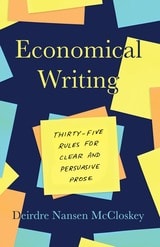
Economical Writing, Third Edition
Thirty-Five Rules for Clear and Persuasive ProseDeirdre Nansen McCloskey
University of Chicago Press, 2019
Economics is not a field that is known for good writing. Charts, yes. Sparkling prose, no.
Except, that is, when it comes to Deirdre Nansen McCloskey. Her conversational and witty yet always clear style is a hallmark of her classic works of economic history, enlivening the dismal science and engaging readers well beyond the discipline. And now she’s here to share the secrets of how it’s done.
Economical Writing is itself economical: a collection of thirty-five pithy rules for making your writing clear, concise, and effective. Proceeding from big-picture ideas to concrete strategies for improvement at the level of the paragraph, sentence, or word, McCloskey shows us that good writing, after all, is not just a matter of taste—it’s a product of adept intuition and a rigorous revision process. Debunking stale rules, warning us that “footnotes are nests for pedants,” and offering an arsenal of readily applicable tools and methods, she shows writers of all levels of experience how to rethink the way they approach their work, and gives them the knowledge to turn mediocre prose into magic.
At once efficient and digestible, hilarious and provocative, Economical Writing lives up to its promise. With McCloskey as our guide, it’s impossible not to see how any piece of writing—on economics or any other subject—can be a pleasure to read.
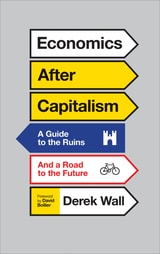
Economics After Capitalism
A Guide to the Ruins and a Road to the FutureDerek Wall
Pluto Press, 2015
Challenging the arguments for markets, mainstream economics and capitalism from Adam Smith onwards, Economics After Capitalism provides a step-by-step guide to various writers, movements and schools of thought, critical of neoliberal globalisation. These range from Keynesian-inspired reformists such as Geroge Soros and Joseph Stiglitz, critics of inequality like Thomas Piketty and Amaitya Sen, to more radical voices including Naomi Klein, Marxists such as David Harvey, anarchists, and autonomists including Toni Negri and Michael Hardt.
By providing a clear and accessible guide to the economics of anti-capitalism, Derek Wall successfully demonstrates that an open source eco-socialist alternative to rampant climate change, elite rule and financial chaos is not just necessary, but possible.

Economics Transformed
Discovering the Brilliance of MarxRobert Albritton
Pluto Press, 2007
Economics and Elections
The Major Western DemocraciesMichael S. Lewis-Beck
University of Michigan Press, 1990
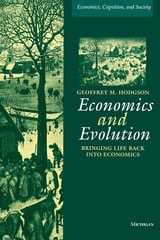
Economics and Evolution
Bringing Life Back into EconomicsGeoffrey M. Hodgson
University of Michigan Press, 1996
This book is about the application to economics of evolutionary ideas from biology. It is not about selfish genes or determination of our behavior by genetic code. The idea that evolution supports a laissez-faire policy is rebutted. The conception of evolution as progress toward greater perfection, along with the competitive individualism sometimes inferred from the notion of the "survival of the fittest," is found to be problematic. Hodgson explores the ambiguities inherent in biology and the problems involved in applying ideas of past economic thinkers--including Malthus, Smith, Marx, Marshall, Veblen, Schumpeter, and Hayek--and argues that the new evolutionary economics can learn much from the many differing conceptions of economic evolution.
"This is a work of enormous perceptivity and subtlety as well as judiciousness of interpretation and critique . . . [that] establish[es] Hodgson as the leading institutional theorist, and as one of the leading evolutionary theorists, of his generation." --Warren J. Samuels
"A daring and successful attempt to expunge the monopoly of reductionist and mechanistic thinking over evolutionary theory . . . a must for anyone who is interested not only in the foundations of economics, but also in the foundations of social theory." --Elias L. Khalil, Ohio State University
Geoffrey M. Hodgson is University Lecturer in Economics, Judge Institute for Management Studies, University of Cambridge.
Economics and National Security
A History of Their Interaction, Volume 23Craufurd D. W. Goodwin
Duke University Press, 1991
Economics and Politics of World Sugar Policies
Stephen V. Marks and Keith E. Maskus, Editors
University of Michigan Press, 1993
Economics and Politics
The Calculus of SupportHelmut Norpoth, Michael S. Lewis-Beck, and Jean-Dominique Lafay, Editors
University of Michigan Press, 1991
Economics and World History
Myths and ParadoxesPaul Bairoch
University of Chicago Press, 1993
In Economics and World History, Paul Bairoch clearly and succinctly debunks a number of commonly held beliefs about economic history and the causes and consequences of important events around the world. Taking on twenty commonly held misconceptions, including that free trade and population growth have historically led to periods of economic growth; that a move away from free trade caused the Great Depression; and that colonial powers in the nineteenth and early twentieth centuries became rich through the exploitation of the Third World, Bairoch shows in each case where the mistaken belief originated and why deeper knowledge of economics shows it to b wrong. The resulting book is a treasury for free thinkers, a book that will simultaneously clear up mistakes and help readers avoid making new ones.
Economics and the Antagonism of Time
Time, Uncertainty, and Choice in Economic TheoryDouglas Vickers
University of Michigan Press, 1994
Economics as a Social Science
An Approach to Nonautistic TheoryAndrew M. Kamarck
University of Michigan Press, 2002
Economics for Everyone, Second Edition
A Short Guide to the Economics of CapitalismJim Stanford
Pluto Press, 2015
Through clear bite-sized chapters interspersed with illuminating illustrations, this is an antidote to the abstract and ideological way that economics is normally taught and reported on in in media. Key concepts such as finance, competition and wages are explored, and their importance to everyday life is revealed. It answers questions such as 'Do workers need capitalists?', 'Why does capitalism harm the environment?', and 'What really happens on the stock market?'.
The book is supported with a comprehensive set of web-based course materials including videos for popular economics courses.
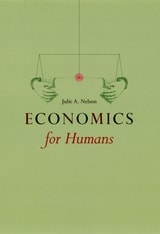
Economics for Humans
Julie A. Nelson
University of Chicago Press, 2006
At its core, an economy is about providing goods and services for human well-being. But many economists and critics preach that an economy is something far different: a cold and heartless system that operates outside of human control. In this impassioned and perceptive work, Julie A. Nelson asks a compelling question: If our economic world is something that we as humans create, aren’t ethics and human relationships—dimensions of a full and rich life—intrinsically part of the picture? Is it possible to take this thing we call economics and give it a body and a soul?
Economics for Humans argues against the well-ingrained notion that economics is immune to moral values and distant from human relationships. Here, Nelson locates the impediment to envisioning a more considerate economic world in an assumption that is shared by both neoliberals and the political left. Despite their seemingly insurmountable differences, Nelson notes that they both make use of the metaphor, first proposed by Adam Smith, that the economy is a machine. This pervasive idea, Nelson argues, has blinded us to the qualities that make us work and care for one another—qualities that also make businesses thrive and markets grow. We can wed our interest in money with our justifiable concerns about ethics and social well-being. And we can do so if we recognize that an economy is not a machine, but a living, beating heart that circulates blood to all parts of the body while also serving as an emblem of compassion and care.
Nothing less than a manifesto, Economics for Humans will both invigorate and inspire readers to reshape the way they view the economy, its possibilities, and their place within it.
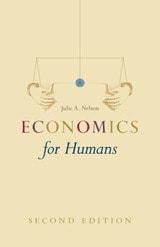
Economics for Humans, Second Edition
Julie A. Nelson
University of Chicago Press, 2018
Economics for Humans argues against the well-ingrained notion that economics is immune to moral values and distant from human relationships. Here, Nelson locates the impediment to a more considerate economic world in an assumption that is shared by both neoliberals and the political left. Despite their seemingly insurmountable differences, both make use of the metaphor, first proposed by Adam Smith, that the economy is a machine. This pervasive idea, Nelson argues, has blinded us to the qualities that make us work and care for one another—qualities that also make businesses thrive and markets grow. We can wed our interest in money with our justifiable concerns about ethics and social well-being. And we can do so if we recognize that an economy is not a machine, but a living thing in need of attention and careful tending.
This second edition has been updated and refined throughout, with expanded discussions of many topics and a new chapter that investigates the apparent conflict between economic well-being and ecological sustainability. Further developing the main points of the first edition, Economics for Humans will continue to both invigorate and inspire readers to reshape the way they view the economy, its possibilities, and their place within it.
Economics for Humans, Second Edition
Julie A. Nelson
University of Chicago Press, 2018
At its core, an economy is about providing goods and services for human well-being. But many economists and critics preach that an economy is something far different: a cold and heartless system that operates outside of human control. In this impassioned and perceptive work, Julie A. Nelson asks a compelling question: given that our economic world is something that we as humans create, aren’t ethics and human relationships—dimensions of a full and rich life—intrinsically part of the picture?
Economics for Humans argues against the well-ingrained notion that economics is immune to moral values and distant from human relationships. Here, Nelson locates the impediment to a more considerate economic world in an assumption that is shared by both neoliberals and the political left. Despite their seemingly insurmountable differences, both make use of the metaphor, first proposed by Adam Smith, that the economy is a machine. This pervasive idea, Nelson argues, has blinded us to the qualities that make us work and care for one another—qualities that also make businesses thrive and markets grow. We can wed our interest in money with our justifiable concerns about ethics and social well-being. And we can do so if we recognize that an economy is not a machine, but a living thing in need of attention and careful tending.
This second edition has been updated and refined throughout, with expanded discussions of many topics and a new chapter that investigates the apparent conflict between economic well-being and ecological sustainability. Further developing the main points of the first edition, Economics for Humans will continue to both invigorate and inspire readers to reshape the way they view the economy, its possibilities, and their place within it.

Economics of Child Care
David M. Blau
Russell Sage Foundation, 1991
Economics of Forestry and Rural Development
An Empirical Introduction from AsiaWilliam F. Hyde and Gregory S. Amacher, and Colleagues
University of Michigan Press, 2000
Economics of Means-Tested Transfer Programs in the United States, Volume I
Edited by Robert A. Moffitt
University of Chicago Press, 2016
These two volumes update the earlier Means-Tested Transfer Programs in the United States with a discussion of the many changes in means-tested government programs and the results of new research over the past decade. While some programs that experienced falling outlays in the years prior to the previous volume have remained at low levels of expenditure, many others have grown, including Medicaid, the Earned Income Tax Credit, the Supplemental Nutrition Assistance Program, and subsidized housing programs. For each program, the contributors describe its origins and goals, summarize its history and current rules, and discuss recipients’ characteristics and the types of benefits they receive.
This is an invaluable reference for researchers and policy makers that features detailed analyses of many of the most important transfer programs in the United States.
Economics of Means-Tested Transfer Programs in the United States, Volume II
Edited by Robert A. Moffitt
University of Chicago Press, 2016
These two volumes update the earlier Means-Tested Transfer Programs in the United States with a discussion of the many changes in means-tested government programs and the results of new research over the past decade. While some programs that experienced falling outlays in the years prior to the previous volume have remained at low levels of expenditure, many others have grown, including Medicaid, the Earned Income Tax Credit, the Supplemental Nutrition Assistance Program, and subsidized housing programs. For each program, the contributors describe its origins and goals, summarize its history and current rules, and discuss recipients’ characteristics and the types of benefits they receive.
This is an invaluable reference for researchers and policy makers that features detailed analyses of many of the most important transfer programs in the United States.

Economics of Research and Innovation in Agriculture
Edited by Petra Moser
University of Chicago Press, 2021

Economics of the Family
Marriage, Children, and Human CapitalEdited by Theodore W. Schultz
University of Chicago Press, 1975
Economics--Mathematical Politics or Science of Diminishing Returns?
Alexander Rosenberg
University of Chicago Press, 1992
Economics
The Culture of a Controversial ScienceMelvin W. Reder
University of Chicago Press, 1998
Since the 1930s economists have increasingly emphasized the scientific, quantitative side of their field, which has directed research to topics that can be elaborated through mathematical models. Economist Melvin Reder argues that this ongoing historical shift has been the result of pressure from two directions: from society's demand that expert advice be based on "scientific findings," and from economists themselves, who have wanted to view their own profession as a science. This book describes the profession of economics as it has developed in response to these challenges.
The diversity of the responses points to persistent internal disagreements within the economics community about its proper scope and methods. These disagreements, in turn, have led to incompatible proposals for the direction of research and divergent recommendations for public policy. Although Reder does not pretend to resolve these difficulties, he appraises different arguments and demonstrates how they have influenced both economists' behavior and public esteem for the profession. While recognizing that serious questions remain about economics's scientific status and practical utility, this book shows where economics has obtained practically usable results and where its fruits have been limited to elaboration of analytical constructions of uncertain applicability.
"[A] fascinating account of the sociology and philosophy of a profession. . . . This is an important book about an important field."—John L. Casti, New Scientist
Economists Lives
Biography and Autobiography in the History of Economics, Volume 39E. Roy Weintraub and Evelyn L. Forget, eds.
Duke University Press, 0
Contributors to this collection question whether biography is essential to understanding the history of economic ideas and consider how autobiographical materials should be read and interpreted by historians. Articles consider the treatment of autobiographical materials such as conversations and testimonies, the construction of heroes and villains, the relationship between scientific biography and literary biography, and concerns related to living subjects. Several essays address the role of biography and autobiography in the study of economists such as F. A. Hayek, Harry Johnson, Alfred Marshall, John Maynard Keynes, Oskar Morgenstern, and François Quesnay, concluding with several accounts of the interconnection of the historians’ projects with their own autobiographies.
All 2007 subscribers to History of Political Economy will receive a copy of “Economists’ Lives: Biography and Autobiography in the History of Economics” as part of their subscription.
Contributors
Roger E. Backhouse
Bruce Caldwell
Loïc Charles
William Coleman
Robert W. Dimand
Paul John Eakin
Ross B. Emmett
Evelyn L. Forget
Craufurd D. Goodwin
Peter Groenewegen
Malachi Haim Hacohen
Jan-Otmar Hesse
Patricia Laurence
Frederic S. Lee
Robert Leonard
Tiago Mata
D. E. Moggridge
Jeremy D. Popkin
Mike Reay
Christine Théré
E. Roy Weintraub
Economists Papers, 1750-1950
A Guide to Archive and other Manuscript Sources for the History of British and Irish Economic ThoughtR. P. Sturges
Duke University Press, 1975
Economizing Mind, 1870–2015
When Economics and Psychology Met . . . or Didn’tMarina Bianchi and Neil De Marchi, special issue editors
Duke University Press, 2016
Economists and psychologists share an interest in explaining how people make the choices that they do. However, economists have tended to stress individual rationality, shaped by economic motives and expressed in formal logical or mathematical models, while psychologists have preferred to identify influences through experimentation. In recent decades, behavioral economics has bridged the two fields and challenged the traditional economic assumption that individuals choose rationally. The essays collected here provide a longer view and reflect on episodic contact between psychology and economics beginning in the late nineteenth century. They help explain why meaningful, sustained joint inquiry eluded both disciplines for so long and usefully complement the recent inclination of researchers in each field to find inadequacy in the other.
Contributors: Marina Bianchi, Simon J. Cook, Neil De Marchi, José Edwards, Tiziana Foresti, Craufurd D. Goodwin, Judy L. Klein, Harro Maas, Ivan Moscati, John Staddon, Andrej Svorenčík
Economy and Interest
A New Presentation of the Fundamental Problems Related to the Economic Role of the Rate of Interest and Their SolutionsMaurice Allais
University of Chicago Press, 2024
The essential work from the Nobel Prize-winning virtuoso of twentieth-century economics, translated to English for the first time.
Few scholars advanced the frontier of economic modeling more than French economist Maurice Allais. Allais’s contributions—beyond his famous Allais’s Paradox—earned him the Nobel Prize and drew comparisons to the works of Paul Samuelson and even some modern mathematical behavioral economists.
Allais’s accomplishments, however, went largely unread by non-Francophone readers due to the challenge of their translation for publishers. The effects of this gap are immeasurable. As Paul Samuelson wrote, “Had Allais's earliest writings been in English, a whole generation of economic theory would have taken a different course.”
Economy and Interest is the milestone translation of Allais's most influential work, one whose staggering findings predate their accepted formulations by other famed economists decades later. In its sweep and technical virtuosity, Economy and Interest is certain to delight and challenge new generations of English-language readers.
Economy and the Future
A Crisis of FaithJean-Pierre Dupuy
Michigan State University Press, 2014
Economy of Words
Communicative Imperatives in Central BanksDouglas R. Holmes
University of Chicago Press, 2013
Holmes examines the New York District Branch of the Federal Reserve, the European Central Bank, Deutsche Bundesbank, and the Bank of England, among others, and shows how officials there have created a new monetary regime that relies on collaboration with the public to achieve the ends of monetary policy. Central bankers, Holmes argues, have shifted the conceptual anchor of monetary affairs away from standards such as gold or fixed exchange rates and toward an evolving relationship with the public, one rooted in sentiments and expectations. Going behind closed doors to reveal the intellectual world of central banks,Economy of Words offers provocative new insights into the way our economic circumstances are conceptualized and ultimately managed.
Educating Economists
David Colander and Reuven Brenner, Editors
University of Michigan Press, 1992
Education, Skills, and Technical Change
Implications for Future US GDP GrowthEdited by Charles R. Hulten and Valerie A. Ramey
University of Chicago Press, 2018
Education, Skills, and Technical Change explores various facets of these questions and provides an overview of educational attainment in the United States and the channels through which labor force skills and education affect GDP growth. Contributors to this volume focus on a range of educational and training institutions and bring new data to bear on how we understand the role of college and vocational education and the size and nature of the skills gap. This work links a range of research areas—such as growth accounting, skill development, higher education, and immigration—and also examines how well students are being prepared for the current and future world of work.
Effective Social Science
Eight Cases in Economics, Political Science, and SociologyBernard Barber
Russell Sage Foundation, 1987
Egalitarian Capitalism
Jobs, Incomes, and Growth in Affluent CountriesLane Kenworthy
Russell Sage Foundation, 2004
Elements of Econometrics
Second EditionJan Kmenta
University of Michigan Press, 1997
Throughout the book the emphasis is on simplification whenever possible, assuming the readers know college algebra and basic calculus. Jan Kmenta explains all methods within the simplest framework, and generalizations are presented as logical extensions of simple cases. And while a relatively high degree of rigor is preserved, every conflict between rigor and clarity is resolved in favor of the latter. Apart from its clear exposition, the book's strength lies in emphasizing the basic ideas rather than just presenting formulas to learn and rules to apply.
The book consists of two parts, which could be considered jointly or separately. Part one covers the basic elements of the theory of statistics and provides readers with a good understanding of the process of scientific generalization from incomplete information. Part two contains a thorough exposition of all basic econometric methods and includes some of the more recent developments in several areas.
As a textbook, Elements of Econometrics is intended for upper-level undergraduate and master's degree courses and may usefully serve as a supplement for traditional Ph.D. courses in econometrics. Researchers in the social sciences will find it an invaluable reference tool.
A solutions manual is also available for teachers who adopt the text for coursework.
Jan Kmenta is Professor Emeritus of Economics and Statistics, University of Michigan.

Elements of Time Series Econometrics
An Applied Approach - Third EditionEvzen Kocenda and Alexandr Cerný
Karolinum Press, 2017