Results by title
153 books match the query 'Egypt' and 8 start with e
East-West Divan
In Memory of Werner Mark LinzEdited by Aran Byrne
Gingko, 2014
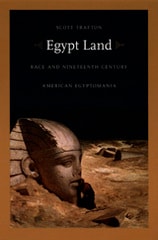
Egypt Land
Race and Nineteenth-Century American EgyptomaniaScott Trafton
Duke University Press, 2004
Drawing on literary and cultural studies, art and architectural history, political history, religious history, and the histories of archaeology and ethnology, Trafton illuminates anxieties related to race in different manifestations of nineteenth-century American Egyptomania, including the development of American Egyptology, the rise of racialized science, the narrative and literary tradition of the imperialist adventure tale, the cultural politics of the architectural Egyptian Revival, and the dynamics of African American Ethiopianism. He demonstrates how debates over what the United States was and what it could become returned again and again to ancient Egypt. From visions of Cleopatra to the tales of Edgar Allan Poe, from the works of Pauline Hopkins to the construction of the Washington Monument, from the measuring of slaves’ skulls to the singing of slave spirituals—claims about and representations of ancient Egypt served as linchpins for discussions about nineteenth-century American racial and national identity.
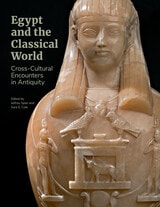
Egypt and the Classical World
Cross-Cultural Encounters in AntiquityJeffrey Spier
J. Paul Getty Trust, The, 2022
From Mycenaean weaponry found among the cargo of a Bronze Age shipwreck off the Turkish coast to the Egyptian-inspired domestic interiors of a luxury villa built in Greece during the Roman Empire, Egypt and the Classical World documents two millennia of cultural and artistic interconnectedness in the ancient Mediterranean. This volume gathers pioneering research from the Getty scholars' symposium that helped shape the major international loan exhibition Beyond the Nile: Egypt and the Classical World (J. Paul Getty Museum, 2018).
Generously illustrated essays consider a range of artistic and other material evidence, including archaeological finds, artworks, papyri, and inscriptions, to shed light on cultural interactions between Egypt, Greece, and Rome from the Bronze Age to the Late Period and Ptolemaic dynasty to the Roman Empire. The military's role as a conduit of knowledge and ideas in the Bronze Age Aegean, and an in-depth study of hieroglyphic Egyptian inscriptions found on Roman obelisks offer but two examples of scholarly lacunae addressed by this publication. Specialists across the fields of art history, archaeology, Classics, Egyptology, and philology will benefit from the volume's investigations into syncretic processes that enlivened and informed nearly twenty-five hundred years of dynamic cultural exchange.
The free online edition of this open-access publication is available at www.getty.edu/publications/egypt-classical-world/ and includes zoomable, high-resolution photography. Also available are free PDF, EPUB, and Kindle/MOBI downloads of the book.
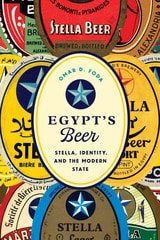
Egypt's Beer
Stella, Identity, and the Modern StateBy Omar D. Foda
University of Texas Press, 2019
Although alcohol is generally forbidden in Muslim countries, beer has been an important part of Egyptian identity for much of the last century. Egypt’s Stella beer (which only coincidentally shares a name with the Belgian beer Stella Artois) became a particularly meaningful symbol of the changes that occurred in Egypt after British Occupation.
Weaving cultural studies with business history, Egypt’s Beer traces Egyptian history from 1880 to 2003 through the study of social, economic, and technological changes that surrounded the production and consumption of Stella beer in Egypt, providing an unparalleled case study of economic success during an era of seismic transformation. Delving into archival troves—including the papers of his grandfather, who for twenty years was CEO of the company that produced Stella—Omar D. Foda explains how Stella Beer achieved a powerful presence in all popular forms of art and media, including Arabic novels, songs, films, and journalism. As the company’s success was built on a mix of innovation, efficient use of local resources, executive excellence, and shifting cultural dynamics, this is the story of the rise of a distinctly Egyptian “modernity” seen through the lens of a distinctly Egyptian brand.
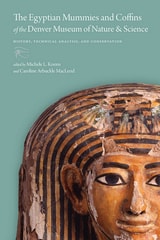
Egyptian Mummies and Coffins of the Denver Museum of Nature & Science
History, Technical Analysis, and ConservationMichele L. Koons
University Press of Colorado, 2020
This interdisciplinary volume provides a history of the mummies’ discovery and relocation to Colorado. It guides the reader through various analytical techniques, detailing past research and introducing new data and best practices for future conservation efforts. The new analysis includes more accurate radiocarbon dating, fully comprehensive data from updated CT scans, examples of Egyptian blue and yellow pigments on the coffins uncovered by non-invasive x-ray fluorescence, unprecedented analysis of the coffin wood, updated translations and stylistic analysis of the text and imagery on the coffins, gas chromatography of the paints and resins, linen analysis, and much more.
The Egyptian Mummies and Coffins of the Denver Museum of Nature & Science provides replicable findings and consistent terminology for institutions performing holistic studies on extant museum collections of a range of material types. It will add substantially to what we know about the effective conservation of Egyptian mummies and coffins.
Contributors: Christopher H. Baisan, Hans Barnard, Bonnie Clark, Pearce Paul Creasman, Farrah Cundiff, Jessica M. Fletcher, Kari L. Hayes, Kathryn Howley, Stephen Humphries, Keith Miller, Vanessa Muros, Robyn Price, David Rubinstein, Judith Southward, Jason Weinman
Egypt’s Football Revolution
Emotion, Masculinity, and Uneasy PoliticsBy Carl Rommel
University of Texas Press, 2021
Both a symbol of the Mubarak government’s power and a component in its construction of national identity, football served as fertile ground for Egyptians to confront the regime’s overthrow during the 2011 revolution. With the help of the state, appreciation for football in Egypt peaked in the late 2000s. Yet after Mubarak fell, fans questioned their previous support, calling for a reformed football for a new, postrevolutionary nation.
In Egypt’s Football Revolution, Carl Rommel examines the politics of football as a space for ordinary Egyptians and state forces to negotiate a masculine Egyptian chauvinism. Basing his discussion on several years of fieldwork with fans, players, journalists, and coaches, he investigates the increasing attention paid to football during the Mubarak era; its demise with the 2011 uprisings and 2012 Port Said massacre, which left seventy-two fans dead; and its recent rehabilitation. Cairo’s highly organized and dedicated Ultras fans became a key revolutionary force through their antiregime activism, challenging earlier styles of fandom and making visible entrenched ties between sport and politics. As the appeal of football burst, alternative conceptions of masculinity, emotion, and politics came to the fore to demand or prevent revolution and reform.
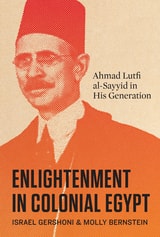
Enlightenment in Colonial Egypt
Ahmad Lutfi al-Sayyid in His GenerationIsrael Gershoni and Molly Bernstein
University of Texas Press, 2026
A study of Ahmad Lutfi al-Sayyid, widely recognized as the creator of Egyptian nationalism, and his impact on Egyptian culture and history.
Ahmad Lutfi al-Sayyid (1872–1963) stands among the most creative, impactful intellectuals of modern Egypt and the Middle East. While best known as the architect of Egyptian nationalism, his nationalist endeavor was in fact part of his broader project to bring enlightenment to Egypt under the yoke of British colonialism. Through his articles, editorials, and mentoring, his newspaper al-Jarida became a key forum for the lively debates of the time, ranging from the role of Islam in society to women's inclusion, all toward shaping a unique colonial modernity for his country.
The most comprehensive study of Lutfi, his writing, and his impact, Enlightenment in Colonial Egypt deconstructs the view that he was a covert apologist for empire out of admiration for the liberal aspects of European enlightenment. Lutfi faced this duality head on: He believed it essential to embrace parts of the West’s enlightenment values and to decolonize and Egyptianize them in order to establish an authentic, indigenous, Egyptian civilization, appropriate for modernity. Israel Gershoni and Molly Bernstein argue that Lutfi successfully engaged with these most difficult challenges, shaping a detailed plan to implement enlightenment in the Egyptian national context.
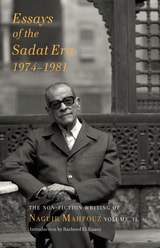
Essays of the Sadat Era
The Non-Fiction of Naguib Mahfouz: Volume IINaguib Mahfouz
Gingko, 2025
In these essays of the Sadat era, published in the state-owned Al-Ahram newspaper, Mahfouz seems an unreliable narrator. The tension between an author who rails against censorship, yet is bound within its confines, runs through this fascinating body of nonfiction writing. Nonetheless, Mahfouz’s own thoughts are unmistakably present. We gain his insight into diverse political topics, such as socioeconomic class, democracy and dictatorship, and Islam and extremism, topics which still seem highly pertinent to the situation in Egypt today.
A vital accompaniment to his literature, this collected work is contemporaneous with Mahfouz’s fictional works such as Karnak Café, The Harafish, and Arabian Nights and Days. Essays of the Sadat Era is the second of four volumes in which Mahfouz’s nonfiction work is translated into English for the first time.