Results by title
76 books match the query 'Elite (Social sciences)' and 10 start with e
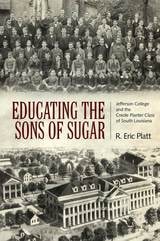
Educating the Sons of Sugar
Jefferson College and the Creole Planter Class of South LouisianaR. Eric Platt
University of Alabama Press, 2017
The education of individual planter classes—cotton, tobacco, sugar—is rarely treated in works of southern history. Of the existing literature, higher education is typically relegated to a footnote, providing only brief glimpses into a complex instructional regime responsive to wealthy planters. R. Eric Platt’s Educating the Sons of Sugar allows for a greater focus on the mindset of French Creole sugar planters and provides a comprehensive record and analysis of a private college supported by planter wealth.
Jefferson College was founded in St. James Parish in 1831, surrounded by slave-holding plantations and their cash crop, sugar cane. Creole planters (regionally known as the “ancienne population”) designed the college to impart a “genteel” liberal arts education through instruction, architecture, and geographic location. Jefferson College played host to social class rivalries (Creole, Anglo-American, and French immigrant), mirrored the revival of Catholicism in a region typified by secular mores, was subject to the “Americanization” of south Louisiana higher education, and reflected the ancienne population’s decline as Louisiana’s ruling population.
Resulting from loss of funds, the college closed in 1848. It opened and closed three more times under varying administrations (French immigrant, private sugar planter, and Catholic/Marist) before its final closure in 1927 due to educational competition, curricular intransigence, and the 1927 Mississippi River flood. In 1931, the campus was purchased by the Society of Jesus (Jesuits) and reopened as a silent religious retreat. It continues to function to this day as the Manresa House of Retreats. While in existence, Jefferson College was a social thermometer for the white French Creole sugar planter ethos that instilled the “sons of sugar” with a cultural heritage resonant of a region typified by the management of plantations, slavery, and the production of sugar.
Electoral Reform and the Fate of New Democracies
Lessons from the Indonesian CaseSarah Shair-Rosenfield
University of Michigan Press, 2019
When and why do democratic political actors change the electoral rules, particularly regarding who is included in a country’s political representation? The incidences of these major electoral reforms have been on the rise since 1980.
Electoral Reform and the Fate of New Democracies argues that elite inexperience may constrain self-interest and lead elites to undertake incremental approaches to reform, aiding the process of democratic consolidation. Using a multimethods approach, the book examines three consecutive periods of reform in Indonesia, the world’s largest Muslim majority country and third largest democracy, between 1999 and 2014. Each case study provides an in-depth process tracing of the negotiations leading to new reforms, including key actors in the legislature, domestic civil society, international experts, and government bureaucrats. A series of counterfactual analyses assess the impact the reforms had on actual election outcomes, versus the possible alternative outcomes of different reform options discussed during negotiations. With a comparative analysis of nine cases of iterated reform processes in other new democracies, the book confirms the lessons from the Indonesian case and highlights key lessons for scholars and electoral engineers.
Elite-Led Mobilization and Gay Rights
Dispelling the Myth of Mass Opinion BacklashBenjamin George Bishin, Thomas J. Hayes, Matthew B. Incantalupo, and Charles Anthony Smith
University of Michigan Press, 2021
Media and scholastic accounts describe a strong public opinion backlash—a sharply negative and enduring opinion change—against attempts to advance gay rights. Academic research, however, increasingly questions backlash as an explanation for opposition to LGBT rights. Elite-Led Mobilization and Gay Rights argues that what appears to be public opinion backlash against gay rights is more consistent with elite-led mobilization—a strategy used by anti-gay elites, primarily white evangelicals, seeking to prevent the full incorporation of LGBT Americans in the polity in order to achieve political objectives and increase political power. This book defines and tests the theory of Mass Opinion Backlash and develops and tests the theory of Elite-Led Mobilization by employing a series of online and natural experiments, surrounding the U.S. Supreme Court rulings in Obergefell v. Hodges and United States v. Windsor, and President Obama’s position change on gay marriage. To evaluate these theories, the authors employ extensive survey, voting behavior, and campaign finance data, and examine the history of the LGBT movement and its opposition by religious conservatives, from the Lavender Scare to the campaign against Trans Rights in the defeat of Houston’s 2015 HERO ordinance. Their evidence shows that opposition to LGBT rights is a top-down process incited by anti-gay elites rather than a bottom-up reaction described by public opinion backlash.
Elites and Economic Development
Comparative Studies on the Political Economy of Latin American CitiesBy John Walton
University of Texas Press, 1977
This book is a detailed comparative analysis of development politics in four urban regions of Latin America, two in Mexico and two in Colombia. John Walton has based his studies on the assumption that the problems of economic growth are essentially political, that is, are problems of choice, decision-making, and the exercise of power. His fundamental purpose has been to discover how elites of different kinds are more and less successful in the promotion of economic development, which he defines as a process in the organization of a society leading not only to higher levels of efficient output but also to a more equitable distribution of benefits.
At the time, the four cities compared were the second- and third-largest metropolitan areas in each country, Guadalajara and Monterrey in Mexico, Medellín and Cali in Colombia. This selection allows the author to pair, across countries, cases of early and large-scale industrialization (Monterrey and Medellín) with cases of more recent industrial growth in agricultural-commercial centers (Guadalajara and Cali). Walton presents historical introductions to each of the regions and integrates these with original fieldwork and interviews with more than three hundred members of the political and economic elites.
The findings are extensive, but in general they demonstrate that where political and economic power is more broadly distributed, where elites are more open and accessible, and where organizational life is more active and coordinated, regions tend to develop qualitatively as well as quantitatively, showing increases both in productivity and in such benefits as public services, housing, education, and a more balanced distribution of income. If these characteristics are absent, regions may be industrialized but do not provide a broad sharing of the benefits. Walton places a good deal of emphasis on the role of foreign investments, demonstrating that the more penetrated regions are also the less developed.
Finally, the results of these studies are used to evaluate and advance theories of underdevelopment and particularly of economic dependency.
Elites and the Politics of Accountability in Africa
Wale Adebanwi and Rogers Orock, Editors
University of Michigan Press, 2021
Elites and the Politics of Accountability in Africa examines the ways that accountability offers an effective interpretive lens to the social, cultural, and institutional struggles of both the elites and ordinary citizens in Africa. Each chapter investigates questions of power, its public deliberation, and its negotiation in Africa by studying elites through the framework of accountability. The book enters conversations about political subjectivity and agency, especially from ongoing struggles around identities and belonging, as well as representation and legitimacy. Who speaks to whom? And on whose behalf do they speak? The contributors to this volume offer careful analyses of how such concerns are embedded in wider forms of cultural, social, and institutional discussions about transparency, collective responsibility, community, and public decision-making processes. These concerns affect prospects for democratic oversight, as well as questions of alienation, exclusivity, privilege and democratic deficit. The book situates our understanding of the emergence, meaning, and conceptual relevance of elite accountability, to study political practices in Africa. It then juxtaposes this contextualization of accountability in relation to the practices of African elites. Elites and the Politics of Accountability in Africa offers fresh, dynamic, and multifarious accounts of elites and their practices of accountability and locally plausible self-legitimation, as well as illuminating accounts of contemporary African elites in relation to their socially and historicallysituated outcomes of contingency, composition, negotiation, and compromise.

Elites, Masses, and Modernization in Latin America, 1850–1930
By E. Bradford Burns and Thomas E. Skidmore
University of Texas Press, 1979
The interactions between the elites and the lower classes of Latin America are explored from the divergent perspectives of three eminent historians in this volume. The result is a counterbalance of viewpoints on the urban and the rural, the rich and the poor, and the Europeanized and the traditional of Latin America during the late nineteenth and early twentieth centuries.
E. Bradford Burns advances the view that two cultures were in conflict in nineteenth-century Latin America: that of the modernizing, European-oriented elite, and that of the “common folk” of mixed racial background who lived close to the earth. Thomas E. Skidmore discusses the emerging field of labor history in twentieth-century Latin America, suggesting that the historical roots of today’s exacerbated tensions lie in the secular struggle of army against workers that he describes. In the introduction, Richard Graham takes issue with both authors on certain basic premises and points out implications of their essays for the understanding of North American as well as Latin American history.

Ethnic Elites
Japanese, Ukrainians, and Scots, 1919-1971Aya Fujiwara
University of Manitoba Press, 2012
Evading the Patronage Trap
Interest Representation in MexicoBrian Palmer-Rubin
University of Michigan Press, 2022
Why have Latin American democracies proven unable to confront the structural inequalities that cripple their economies and stymie social mobility? Brian Palmer-Rubin contends that we may lay the blame on these countries’ systems of interest representation, which exhibit “biased pluralism,” a system in which the demands of organizations representing economic elites—especially large corporations—predominate. A more inclusive model of representation would not only require a more encompassing and empowered set of institutions to represent workers, but would also feature spaces for non-eliteproducers—such as farmers and small-business owners to have a say in sectoral economic policies.
With analysis drawing on over 100 interviews, an original survey, and official government data, this book focuses on such organizations and develops an account of biased pluralism in developing countries typified by the centrality of patronage—discretionarily allocated state benefits. Rather than serving as conduits for demand-making about development models, political parties and interest organizations often broker state subsidies or social programs, augmenting the short-term income of beneficiaries, but doing little to improve their long-term economic prospects. When organizations become diverted into patronage politics, the economic demands of the masses go unheard in the policies that most affect their lives, and along the way, their economic interests go unrepresented.
Excavations at Cerro Tilcajete
A Monte Albán II Administrative Center in the Valley of OaxacaChristina Elson
University of Michigan Press, 2007
Exemplary Violence
Rewriting History in Colonial ColombiaAlberto Villate-Isaza
Bucknell University Press, 2021