Results by title
681 books match the query 'English language' and 31 start with e
Eating Is an English Word
Annemarie Mol
Duke University Press, 2024
Ecology and the Environment
A Look at Ecosystems of the WorldAmy L. Tickle
University of Michigan Press, 1996
Economical Writing, Third Edition
Thirty-Five Rules for Clear and Persuasive ProseDeirdre Nansen McCloskey
University of Chicago Press, 2019
Economics is not a field that is known for good writing. Charts, yes. Sparkling prose, no.
Except, that is, when it comes to Deirdre Nansen McCloskey. Her conversational and witty yet always clear style is a hallmark of her classic works of economic history, enlivening the dismal science and engaging readers well beyond the discipline. And now she’s here to share the secrets of how it’s done.
Economical Writing is itself economical: a collection of thirty-five pithy rules for making your writing clear, concise, and effective. Proceeding from big-picture ideas to concrete strategies for improvement at the level of the paragraph, sentence, or word, McCloskey shows us that good writing, after all, is not just a matter of taste—it’s a product of adept intuition and a rigorous revision process. Debunking stale rules, warning us that “footnotes are nests for pedants,” and offering an arsenal of readily applicable tools and methods, she shows writers of all levels of experience how to rethink the way they approach their work, and gives them the knowledge to turn mediocre prose into magic.
At once efficient and digestible, hilarious and provocative, Economical Writing lives up to its promise. With McCloskey as our guide, it’s impossible not to see how any piece of writing—on economics or any other subject—can be a pleasure to read.
Economies of Writing
Revaluations in Rhetoric and CompositionBruce Horner
Utah State University Press, 2016
Economies of Writing advances scholarship on political economies of writing and writing instruction, considering them in terms of course subject, pedagogy, technology, and social practice. Taking the "economic" as a necessary point of departure and contention for the field, the collection insists that writing concerns are inevitably participants in political markets in their consideration of forms of valuation, production, and circulation of knowledge with labor and with capital.
Approaching the economic as plural, contingent, and political, chapters explore complex forces shaping the production and valuation of literacies, languages, identities, and institutions and consider their implications for composition scholarship, teaching, administration, and public rhetorics. Chapters engage a range of issues, including knowledge transfer, cyberpublics, graduate writing courses, and internationalized web domains.
Economies of Writing challenges dominant ideologies of writing, writing skills, writing assessment, language, writing technology, and public rhetoric by revealing the complex and shifting valuations of writing practices as they circulate within and across different economies. The volume is a significant contribution to rhetoric and composition’s understanding of and ways to address its seemingly perennial unease about its own work.
Contributors: Anis Bawarshi, Deborah Brandt, Jenn Fishman, T. R. Johnson, Jay Jordan, Kacie Kiser, Steve Lamos, Donna LeCourt, Rebecca Lorimer Leonard, Samantha Looker, Katie Malcolm, Paul Kei Matsuda, Joan Mullin, Jason Peters, Christian J. Pulver, Kelly Ritter, Phyllis Mentzell Ryder, Tony Scott, Scott Wible, Yuching Jill Yang, James T. Zebroski
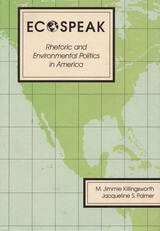
Ecospeak
Rhetoric and Environmental Politics in AmericaM. Jimmie Killingsworth and Jacqueline S. Palmer
Southern Illinois University Press, 1992
In this book, M. Jimmie Killingsworth and Jacqueline S. Palmer have a twofold purpose: to analyze the patterns of rhetoric used in written discourse about environmental politics and to make a practical contribution to the art of rhetorical criticism through the study of rhetoric in use.
The language, professional objectivity, and research programs of scientists insulate these best-informed citizens in enclaves of specialization, limiting access to crucial information and hindering effective reformative action. Science, the authors stress, is not merely a database to rely upon but a view of the world that must be broadened in order to affect social morality. Science-based activism must arise to ensure the care and future of the environment.
Killingsworth and Palmer argue that for grassroots activism to be tied to this globally conscious philosophy, a rhetoric of sustainability must be cultivated.
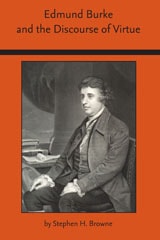
Edmund Burke and the Discourse of Virtue
Stephen Howard Browne
University of Alabama Press, 2007
"A major accomplishment in the study of Burke." —Choice
More than 200 years after his death, Edmund Burke remains among the most influential conservative writers in the Anglophone world. Burke’s relevance has only grown as the nature of what it means to be a conservative has become hotly contested.
And yet Burke is often discussed more than he is read. Worse, his rhetoric is often pressed into the service of other ideologies. In Edmund Burke and the Discourse of Virtue, Stephen Browne of Pennsylvania State University subjects Burke’s work to the close textual analysis it has never received.
The result of Browne's study is to present Burke and his work in a light that was clearly essential to Burke himself, one that illuminates the link between rhetoric and action that is key to understanding Burke, his career, his work, and his influence on contemporary conservatism.
Readers interested in the development of conversative philosophy, politics, and writing from its earliest roots will value this rare and illuminating work.
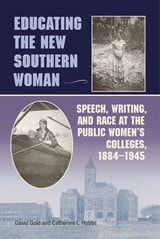
Educating the New Southern Woman
Speech, Writing, and Race at the Public Women's Colleges, 1884-1945David Gold and Catherine L. Hobbs
Southern Illinois University Press, 2014
From the end of Reconstruction through World War II, a network of public colleges for white women flourished throughout the South. Founded primarily as vocational colleges to educate women of modest economic means for life in the emerging “new” South, these schools soon transformed themselves into comprehensive liberal arts–industrial institutions, proving so popular that they became among the largest women’s colleges in the nation. In this illuminating volume, David Gold and Catherine L. Hobbs examine rhetorical education at all eight of these colleges, providing a better understanding of not only how women learned to read, write, and speak in American colleges but also how they used their education in their lives beyond college.
With a collective enrollment and impact rivaling that of the Seven Sisters, the schools examined in this study—Mississippi State College for Women (1884), Georgia State College for Women (1889), North Carolina College for Women (1891), Winthrop College in South Carolina (1891), Alabama College for Women (1896), Texas State College for Women (1901), Florida State College for Women (1905), and Oklahoma College for Women (1908)—served as important centers of women’s education in their states, together educating over a hundred thousand students before World War II and contributing to an emerging professional class of women in the South. After tracing the establishment and evolution of these institutions, Gold and Hobbs explore education in speech arts and public speaking at the colleges and discuss writing instruction, setting faculty and departmental goals and methods against larger institutional, professional, and cultural contexts. In addition to covering the various ways the public women’s colleges prepared women to succeed in available occupations, the authors also consider how women’s education in rhetoric and writing affected their career choices, the role of race at these schools, and the legacy of public women’s colleges in relation to the history of women’s education and contemporary challenges in the teaching of rhetoric and writing.
The experiences of students and educators at these institutions speak to important conversations among scholars in rhetoric, education, women’s studies, and history. By examining these previously unexplored but important institutional sites, Educating the New Southern Woman provides a richer and more complex history of women’s rhetorical education and experiences.
Embodied Literacies
Imageword and a Poetics of TeachingKristie S. Fleckenstein
Southern Illinois University Press, 2003
Embodied Literacies: Imageword and a Poetics of Teaching is a response to calls to enlarge the purview of literacy to include imagery in its many modalities and various facets. Kristie S. Fleckenstein asserts that all meaning, linguistic or otherwise, is a result of the transaction between image and word. She implements the concept of imageword—a mutually constitutive fusion of image and word—to reassess language arts education and promote a double vision of reading and writing. Utilizing an accessible fourfold structure, she then applies the concept to the classroom, reconfiguring what teachers do when they teach, how they teach, what they teach with, and how they teach ethically.
Fleckenstein does not discount the importance of text in the quest for literacy. Instead, she places the language arts classroom and teacher at the juncture of image and word to examine the ways imagery enables and disables the teaching of and the act of reading and writing. Learning results from the double play of language and image, she argues. Helping teachers and students dissolve the boundaries between text and image, the volume outlines how to see reading and writing as something more than words and language and to disestablish our definitions of literacy as wholly linguistic.
Embodied Literacies: Imageword and a Poetics of Teaching comes at a critical time in our cultural history. Echoing the opinion that postmodernity is a product of imagery rather than textuality, Fleckenstein argues that we must evolve new literacies when we live in a culture saturated by images on computer screens, televisions, even billboards. Decisively and clearly, she demonstrates the importance of incorporating imagery—which is inextricably linked to our psychological, social, and textual lives—into our epistemologies and literacy teaching.
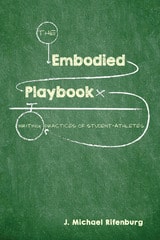
Embodied Playbook
Writing Practices of Student-AthletesJ. Michael Rifenburg
Utah State University Press, 2018
The Embodied Playbook discovers a new approach to understanding student literacy in a surprising place: the university athletics department. Through analysis of a yearlong case study of the men’s basketball team at the University of North Georgia, J. Michael Rifenburg shows that a deeper and more refined understanding of how humans learn through physical action can help writing instructors reach a greater range of students.
Drawing from research on embodiment theory, the nature and function of background knowledge, jazz improvisation, and other unexpected domains, The Embodied Playbook examines a valuable but unexplored form of literacy: the form used by student-athletes when learning and using scripted plays. All students’ extracurricular prior knowledge is vital for the work they undertake in the classroom, and student-athletes understand the strengths and constraints of written text much as they understand the text of game plays: through embodying text and performing it in a competitive space. The book focuses on three questions: What are plays and what do they do? How do student-athletes learn plays? How can teachers of composition and rhetoric better connect with student-athletes?
The Embodied Playbook reveals the literacy of the body as a rich and untapped resource for writing instruction. Given the numbers of students who are involved in athletics, whether intramural, community-related, or extracurricular, Rifenburg’s conclusions hold important implications not only for how we define literacy but also for how writing programs can serve all of their students most effectively.
Emerging Writing Research from the Middle East-North Africa Region
Lisa Arnold
University Press of Colorado, 2017
While events in the Middle East-North Africa region dominate world news, it is an area little understood by the rest of the world—not only historically, politically, and culturally but also within the discipline of Rhetoric and Composition and Second Language Writing. The editors and contributors to this collection share scholarship that addresses how writing programs and writing-across-the-curriculum initiatives—in the region and outside of it—are responding to the increasing globalization of higher education and contributing to international discussions about World Englishes and other language varieties as well as translingual approaches to writing and writing pedagogy.
Contributors: Samer Annous, James P. Austin, William DeGenaro, Rula Diab, Michele Eodice, Juheina Fakhreddine, Aneta Hayes, Tom Highley, Amy Hodges, Rima Iskandarani, Najla Jarkas, Holly Johnson, Brenda Kent, Malakeh Raif Khoury-Khayat, Nasser Mansour, Ryan T. Miller, Maureen O’Day Nicolas, Saman Hussein Omar, Silvia Pessoa, Mysti Rudd, Zane Siraj Sinno, Michael Telafici, Connie Kendall Theado, Martha Townsend, Hacer Hande Uysal, Margaret Willard-Traub
Empathy and the Other
Difference, Connection, and the Teaching of WritingLisa Blankenship
Utah State University Press, 2026
Empathy and the Other: Difference, Connection, and the Teaching of Writing focuses on the theoretical basis for empathy as a pedagogical concern, adding to important conversations happening in writing studies about how to foster empathetic understanding and practices for teachers and students. It offers ways for higher education classrooms to become sites for the cultivation of a critical form of empathy that can help address the most important challenges of our time.
Drawing on the study of empathy in rhetorical theory and related fields, teacher-scholars from a variety of institutions and backgrounds offer pedagogical rationales and approaches for fostering empathetic, inclusive, and antiracist pedagogies centered around five key themes related to empathetic teaching: difference, citizenship, storytelling, assessment, and process. A reflective and critical approach to empathetic teaching—as presented by the authors in this collection—can begin to address forces of social division, particularly in the ways we read and write about others. Teaching grounded in empathetic principles can offer students ways of relating to one another across cultural, religious, class, ethnic, political, and ideological differences.
Empathy and the Other is a companion volume to Enacting Empathy: Stories and Strategies from the Writing Classroom, which features vignettes and praxis pieces focused on classroom experiences and reflections on teaching empathy. The two collections may stand alone or be read together and are of great interest to writing teachers and graduate students invested in social justice in the classroom.
Empowering Young Writers
The "Writers Matter" ApproachDeborah S Yost
Temple University Press, 2014
Launched in middle schools in the fall of 2005, the "Writers Matter" approach was designed to discover ways to improve the fit between actual English curricula, district/state standards and, more recently, the Common Core Curriculum Standards for writing instruction. Adapted from Erin Gruwell's successful Freedom Writers Program, "Writers Matter" develops students' skills in the context of personal growth, understanding others, and making broader connections to the world.
Empowering Young Writers explains and expands on the practical aspects of the "Writers Matter" approach, emphasizing a focus on free expression and establishing connections between the curriculum and students' personal lives. Program creator Robert Vogel, and his co-authors offer proven ways to motivate adolescents to write, work diligently to improve their writing skills, and think more critically about the world.
This comprehensive book will help teachers, administrators, and education students apply and reproduce the "Writers Matter" approach more broadly, which can have a profound impact on their students' lives and social development.
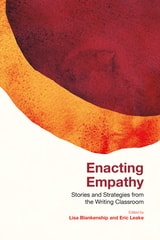
Enacting Empathy
Stories and Strategies from the Writing ClassroomLisa Blankenship
Utah State University Press, 2026
Featuring vignettes and praxis pieces focused on classroom experiences and reflections on teaching empathy, Enacting Empathy: Stories and Strategies from the Composition Classroom provides inspiration and consideration of how and why teachers might adopt an emphasis on empathy. Contributors locate empathy in the particulars of writing assignments, classroom discussions, responses to students, interpretations of texts, and connections with communities.
The challenges and means of understanding one another—as we encounter one another in words, images, and texts—are a central focus of the writing classroom. Teaching for and about empathy has become only more important as we have experienced increased social division, greater recognition and attention to identity, and an emphasis on attending to personal experiences and stories as part of larger efforts to support social justice. With its possibilities for critical reflection and revision, writing is a key tool for developing empathy. Empathy likewise can make us more present, accountable, and socially engaged in our writing. This collection explores how empathy might best be put into practice in the composition classroom, featuring teaching resources, assignment designs, and reflections on empathy and teaching writing for diverse institutional contexts.
The first edited collection in at least thirty years to present strategies for teaching empathy in composition classrooms, Enacting Empathy is a companion volume to Empathy and the Other: Difference, Connection, and the Teaching of Writing, which focuses on the theoretical basis for empathy as a pedagogical concern. The two volumes may stand alone or be read together and are of great interest to writing teachers and graduate students invested in social justice in the classroom.
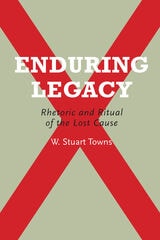
Enduring Legacy
Rhetoric and Ritual of the Lost CauseW. Stuart. Towns
University of Alabama Press, 2013
Explores the crucial role of rhetoric and oratory in creating and propagating a “Lost Cause” public memory of the American South
Enduring Legacy explores the vital place of ceremonial oratory in the oral tradition in the South and analyses how rituals such as Confederate Memorial Day, Confederate veteran reunions, and dedication of Confederate monuments have contributed to creating and sustaining a Lost Cause paradigm for Southern identity. Towns studies in detail secessionist and Civil War speeches and how they laid the groundwork for future generations, including Southern responses to the civil rights movement, and beyond.
The Lost Cause orators that came after the Civil War, Towns argues, helped to shape a lasting mythology of the brave Confederate martyr, and the Southern positions for why the Confederacy lost and who was to blame. Innumerable words were spent—in commemorative speeches, newspaper editorials, and statehouse oratory—condemning the evils of Reconstruction, redemption, reconciliation, and the new and future South. Towns concludes with an analysis of how Lost Cause myths still influence Southern and national perceptions of the region today, as evidenced in debates over the continued deployment of the Confederate flag and the popularity of Civil War reenactments.
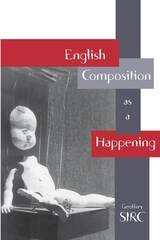
English Composition As A Happening
Geoffrey Sirc
Utah State University Press, 2002
"Contemporary Composition is still inflected by the epistemic turn taken in the 1980s, convincing me that we need to remember what we've forgotten—namely, how impassioned resolves and thrilling discoveries were abandoned and why. I'd like to retrace the road not taken in Composition Studies, to salvage what can still be recovered... I want to inspect the wreckage, in order to show what was the promise of the Happenings for Composition, as well as the huge gray longueur of its pale replacement, Eighties Composition. In so doing, I hope to begin a reconfiguration of our field's pre- and after history."
What happened to the bold, kicky promise of writing instruction in the 1960s? The current conservative trend in composition is analyzed allegorically by Geoffrey Sirc in this book-length homage to Charles Deemer's 1967 article, in which the theories and practices of Happenings artists (multi-disciplinary performance pioneers) were used to invigorate college writing. Sirc takes up Deemer's inquiry, moving through the material and theoretical concerns of such pre- and post-Happenings influences as Duchamp and Pollock, situationists and punks, as well as many of the Happenings artists proper.
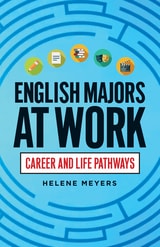
English Majors at Work
Career and Life PathwaysHelene Meyers
Rutgers University Press, 2027
English Majors at Work: Career and Life Pathways details the professional superpowers—the many marketable skills—gained from studying literature, creative writing, film, and popular culture. It prepares English majors to know themselves and their worth so that they can feed their bodies and souls in rapidly changing 21st century economies. Written for prospective and current English majors as well as recent grads, the book shows that skills associated with the major--innovative thinking, excellent written communication, and the ability to read people, rooms, and data---can sustain lifelong successful careers. It also provides real talk about internships, networking, and graduate school. In keeping with a major that focuses on storytelling and analysis, each chapter concludes with a lively discussion of a relevant literary or media text. English Majors at Work is an essential guide for literature students as well as the professors, career services professionals, and parents who advise them.
English Syntax
An IntroductionJon-Bok Kim and Peter Sells
CSLI, 2008
English Verb Classes and Alternations
A Preliminary InvestigationBeth Levin
University of Chicago Press, 1993
The first part of the book sets out alternate ways in which verbs can express their arguments. The second presents classes of verbs that share a kernel of meaning and explores in detail the behavior of each class, drawing on the alternations in the first part. Levin's discussion of each class and alternation includes lists of relevant verbs, illustrative examples, comments on noteworthy properties, and bibliographic references. The result is an original, systematic picture of the organization of the verb inventory.
Easy to use, English Verb Classes and Alternations sets the stage for further explorations of the interface between lexical semantics and syntax. It will prove indispensable for theoretical and computational linguists, psycholinguists, cognitive scientists, lexicographers, and teachers of English as a second language.
English Words from Latin and Greek Elements
Donald M. Ayers; Revised by Thomas D. Worthen
University of Arizona Press, 1986
Since its first publication in 1965, English Words from Latin and Greek Elements by Donald M. Ayers has empowered thousands of students to expand their vocabulary by uncovering the classical roots embedded in modern English. Now in its enduring second edition, this trusted resource proves that vocabulary is most effectively learned through understanding—not memorization.
Why dedicate an entire book to this approach? Because Ayers goes beyond the basics. Students are introduced to a broad spectrum of Latin and Greek roots, encounter new vocabulary in meaningful context, and reinforce their learning through targeted exercises. This method equips learners with lifelong tools to decode unfamiliar words and deepen their command of English.
Written for English learners—not classical language scholars—this book requires no prior knowledge of Latin or Greek. It’s proven effective across high school and college classrooms, and adaptable for both remedial and accelerated programs.
English across the Curriculum
Voices from around the WorldBruce Morrison
University Press of Colorado, 2021
English for Specific Purposes in Theory and Practice
Diane Belcher, Editor
University of Michigan Press, 2009
The field of English for Specific Purposes (ESP) is among the richest areas of second language research and practice because increasing globalization and changing technologies spawn new modes of intercultural connection and new occasions for second language use. English for Specific Purposes in Theory and Practice compasses this burgeoning field by presenting new research and commentary from some of the field’s leading scholars.
This volume explores ESP from academic (secondary and tertiary), occupational (business, medical, and legal), and socio-cultural perspectives. Recurring motifs throughout the volume are the effects of globalization, English as a lingua franca, and the impact of migrant populations. One of the major questions this volume seeks to answer is, How can ESP instructors meet their own teacher knowledge needs? Also considered is, How have ESP practitioners succeeded in gaining control of the knowledge they need to address their students’ needs?
English in Today's Research World
A Writing GuideJohn M. Swales and Christine B. Feak
University of Michigan Press, 2000
In addition to instruction on writing for publication, English in Today's Research World provides needed advice on applications, recommendations, and requests--types of communications that are particularly vulnerable to influences from national cultural expectations and conventions and that, therefore, place the NNS writer at increased disadvantage.
The text is both a reference manual and a course book, so that researchers can continue to use the book after they have completed their formal education. New ESL/EFL teachers can use English in Today's Research World as a reference book for themselves or as a teaching aid in the classroom.
English-Basque Dictionary
Gorka Aulestia
University of Nevada Press, 1990
Essays in Linguistics
Dialectology, Grammar, and Lexicography in Honor of James B. McmillanJames C. Raymond
University of Alabama Press, 2004
"Raymond and Russell have fashioned a lively, useful volume. . . . The ability and integrity of the contributors make much of the difference, but the editors have given the book direction by soliciting state of the art essays in three fields . . . dialectology (the articles represent area linguistics at its best), grammar and usage (Algeo on usage shibboleths is particularly fine), and lexicography (a delight)."
—Choice
"These essays are quietly unassuming in tone but highly useful."
—Language in Society
Essays on Classical Rhetoric and Modern Discourse
Edited by Robert J. Connors, Lisa S. Ede, and Andrea A. Lunsford
Southern Illinois University Press, 1984
Eighteen essays by leading scholars in English, speech communication, education, and philosophy explore the vitality of the classical rhetorical tradition and its influence on both contemporary discourse studies and the teaching of writing.
Some of the essays investigate theoretical and historical issues. Others show the bearing of classical rhetoric on contemporary problems in composition, thus blending theory and practice. Common to the varied approaches and viewpoints expressed in this volume is one central theme: the 20th-century revival of rhetoric entails a recovery of the classical tradition, with its marriage of a rich and fully articulated theory with an equally efficacious practice. A preface demonstrates the contribution of Edward P. J.Corbett to the 20th-century revival, and a last chapter includes a bibliography of his works.
Every Day I Write the Book
Notes on StyleAmitava Kumar
Duke University Press, 2020
Everyday English 1500-1700
A ReaderBridget Cusack, Editor
University of Michigan Press, 1998
This unique source book of essential documents designed for courses on Early Modern English is designed as a teaching text with full guidance to each text, including glossary, explanatory and background notes, and suggested topics for linguistic evaluation. Everyday English takes an up-to-the-minute approach by focusing on language as it was used and spoken at the time.
This wide-ranging collection for the first time makes available to students a corpus of examples of the ordinary, nonstandard language of the man and woman in the street, coming from areas as diverse as England, Scotland, and America. The emphasis throughout is on providing as much assistance as possible to the reader to aid understanding and appreciation of both the linguistic features and the everyday lifestyles of the time.
"The only book a really conscientious teacher of the history and structure of Early Modern English would use for source texts." --Roger Lass, University of Cape Town
Bridget Cusack was lecturer in English Language, University of Edinburgh.
Everyday Genres
Writing Assignments across the DisciplinesMary Soliday
Southern Illinois University Press, 2011
Soliday provides an overview of the contemporary theory and research in Writing across the Curriculum programs, focusing specifically on the implementation of the Writing Fellows Program at the City College of New York. Drawing on her direct observations of colleagues and students at the school, she addresses the everyday challenges that novice writers face, such as developing an appropriate "stance" in one's writing, and the intricacies of choosing and developing content.
The volume then goes on to address some of the most pressing questions being asked by teachers of composition: To what extent can writing be separated from its situation? How can rhetorical expertise be shared across fields? And to what degree is writing ability local rather than general? Soliday argues that, while writing is closely connected to situation, general rhetorical principles can still be capably applied if those situations are known. The key to improving writing instruction, she maintains, is to construct contexts that expose writers to the social actions that genres perform for readers.
Supplementing the author's case study are six appendixes, complete with concrete examples and helpful teaching tools to establish effective classroom practices and exercises in Writing across the Curriculum programs. Packed with useful information and insight, Everyday Genres is an essential volume for both students and teachers seeking to expand their understanding of the nature of writing.
Everyday Writing Center
A Community of PracticeAnne E. Geller, Michele Eodice, Frankie Condon, Meg Carroll, Elizabeth H. Boquet
Utah State University Press, 2007
The Everyday Writing Center challenges some of the most comfortable traditions in its field, and it does so with a commitment and persuasiveness that one seldom sees in scholarly discussion. The book, at its core, is an argument for a new writing center consciousness--one that makes the most of the writing center's unique, and uniquely fluid, identity.
Writing center specialists live with a liminality that has been acknowledged but not fully explored in the literature. Their disciplinary identity is with the English department, but their mission is cross-disciplinary; their research is pedagogical, but they often report to central administration. Their education is in humanities, but their administrative role demands constant number-crunching. This fluid identity explains why Trickster--an icon of spontaneity, shape-shifting, and the creative potential of chaos--has come to be a favorite cultural figure for the authors of this book.
Adapting Lewis Hyde and others, these authors use Trickster to develop a theme of ordinary disruptions ("the everyday") as a source of provocative learning moments that can liberate both student writers and writing center staff. At the same time, the authors parlay Etienne Wenger's concept of "community of practice" into an ethos for a dynamic, learner-centered pedagogy that is especially well-suited to the peculiar teaching situation of the writing center.
Through Trickster, they question not only accepted approaches to writing center pedagogy, but conventional approaches to race, time, leadership, and collaboration as well. They encourage their field to exploit the creative potential in ordinary events that are normally seen as disruptive or defeating, and they challenge traditions in the field that tend to isolate a writing center director from the department and campus.
Yet all is not random, for the authors anchor this high-risk/high-yield approach in their commitment to a version of Wenger's community of practice. Conceiving of themselves, their colleagues, student writers, and student tutors as co-learners engaged together in a dynamic life of learning, the authors find a way to ground the excess and randomness of the everyday, while advancing an ethic of mutual respect and self-challenge.
Committed to testing a region beyond the edge of convention, the authors of The Everyday Writing Center constantly push themselves and their field toward deeper, more significant research, and more reflective, dynamic teaching.
Exploring Composition Studies
Sites, Issues, PerspectivesKelly Ritter and Paul Matsuda
Utah State University Press, 2012
Kelly Ritter and Paul Kei Matsuda have created an essential introduction to the field of composition studies for graduate students and instructors new to the study of writing. The book offers a careful exploration of this diverse field, focusing specifically on scholarship of writing and composing. Within this territory, the authors draw the boundaries broadly, to include allied sites of research such as professional and technical writing, writing across the curriculum programs, writing centers, and writing program administration.
Importantly, they represent composition as a dynamic, eclectic field, influenced by factors both within the academy and without. The editors and their sixteen seasoned contributors have created a comprehensive and thoughtful exploration of composition studies as it stands in the early twenty-first century. Given the rapid growth of this field and the evolution of it research and pedagogical agendas over even the last ten years, this multi-vocal introduction is long overdue.
Exploring Options in Academic Writing
Effective Vocabulary and Grammar UseJan Frodesen and Margi Wald
University of Michigan Press, 2016
Following a unit on using resources for vocabulary development, the contents are divided into three parts: Showing Relationships within Sentences, Connecting and Focusing across Sentences, and Qualifying Statements and Reporting Research. Part 1 focuses on verbs and modifiers that express increases and decreases, verbs and abstract nouns that describe change, connectors and verbs describing causal relationships, and parallel structures. Part 2 explores the words that help connect ideas and add cohesion. Part 3 discusses how to express degrees of certainty and accuracy and the use of reporting verbs.