Results by title
377 books match the query 'French' and 11 start with e
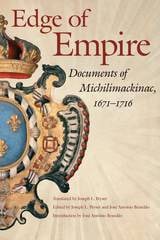
Edge of Empire
Documents of Michilimackinac, 1671-1716Joseph L. Peyser
Michigan State University Press, 2008
Few places were as important in the seventeenth-century European colonial New World as the pays d’en haut. This term means "upper country" and refers to the western Great Lakes (Huron, Michigan, and Superior) and the areas immediately north, south, and west of them. The region was significant because of its large Native American population, because it had an extensive riverine system needed for beaver populations—essential to the fur trade—and because it held the transportation key to westward expansion.
It was vital to the French, who controlled the region, to be on good terms with its peoples. To maintain good relations through trade and diplomacy with the nations in the pays d’en haut, the French built a number of posts, including one at Michilimackinac and one on the St. Joseph River (near Niles, Michigan). These posts were garrisoned by French troops and run by French commanders who contracted with merchants to manage business matters.
Edge of Empire provides both an overview and an intensely detailed look at Michilimackinac at a very specific period of history. While the introduction offers an overview of the French fur trade, of the place of Michilimackinac in that network, and of what Michilimackinac was like in the years up to 1716, the body of the book is comprised of over sixty French-language documents, now translated into English. Collected from archives in France, Canada, and the United States, the documents identify many of the people involved in the trade and reveal a great deal about the personal and professional relations among people who traded. They also reveal clearly the process by which trade was carried out, including the roles of both Native Americans and women. At the same time, the documents open a window into French colonial society in New France.
Enemy Within
Culture Wars and Political Identity in Novels of the French Third RepublicGilbert D. Chaitin
The Ohio State University Press, 2008

Engraven Desire
Eros, Image, and Text in the French Eighteenth CenturyPhilip Stewart
Duke University Press, 1992
Focusing on the objectification of women by the “male gaze,” Stewart analyzes the varous ways in which this masculine power is simultaneously represented and veiled: the fascination with women playing “male” roles, such as soldiers; the preponderance of voyeuristic images of the naked female body; the transformation of male power into hostile forces of nature that render women helpless. Further, Stewart shows how “indecent” engravings that purported to test the limits of eighteenth-century morality often merely reinforced prevailing images of women.
Addressing critical concerns about the societal enforcement of gender roles in literature along with essential questions about the function of illustration, Engraven Desire provides surprising insight into the culturally conditioned act of reading. Stewart’s work, itself richly illustrated with hundreds of arresting reproductions, makes a significant contribution to our understanding of the interplay of art, literature, and society.

Enter Rabelais, Laughing
Barbara C. Bowen
Vanderbilt University Press, 1998
While most books about Rabelais have relatively little to say about his comedic genius, Enter Rabelais, Laughing analyzes the many sides of Rabelais's humor, focusing on why his writing was so hilariously funny to sixteenth-century readers. The author begins by discussing how the Renaissance defined laughter and situates Rabelais in a long tradition of literary laughter. Subsequent chapters examine specific contexts relevant to Gargantua and Pantagruel, beginning with the comic aspects of epic, chronicle, mock-epic, and farce, and proceeding to Renaissance and Reformation humanist satire, rhetoric, medicine, and law. All of these chapters combine information, much of it new, on the humanist message Rabelais wanted to convey to his readers, with an analysis of how he used his wit to reinforce his message.
Rarely is a writer's work treated in such illuminating detail. On a broad level, Enter Rabelais, Laughing serves as an excellent introduction to French Renaissance literature and exhibits a remarkably charming and lucid writing style, free of jargon. To Rabelais scholars in particular it offers a thorough and innovative analysis that corrects misconceptions and questions commonly held views.
Eschatological Subjects
Divine and Literary Judgment in Fourteenth-Century French PoetryJ. M. Moreau
The Ohio State University Press, 2014
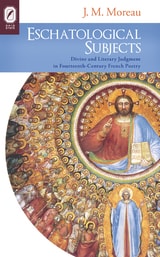
But Eschatological Subjects goes even further to demonstrate the largely unrecognized duality of this judge figure: not just God, the judge is also the imperious and imperfect human reader. The simultaneous divine and human judgments in (and of) French poetry reveal much about the ethical stakes of writing vernacular poetry in the later Middle Ages and, most importantly, about the relationships between authors and audiences.
Focusing on Guillaume de Deguileville, Guillaume de Machaut, and Jean Froissart (each of whom composed scenes in which they appear on trial before God), Moreau contributes important new insights on the complex “trial process” of later medieval literature, in which poetic authority and fame depended on the poet’s ability to defend himself before a fearful court of reader opinion.

Essay on the Origin of Languages and Writings Related to Music
Jean Jacques Rousseau
Dartmouth College Press, 2009
Essays in French Colonial History
Proceedings of the 21st Annual Meeting of the French Colonial Historical SocietyA.J.B. Johnston
Michigan State University Press, 1997
On 31 May - 3 June 1995, more than 200 participants gathered in Sydney and at Fortress Louisbourg, Nova Scotia, for the 21st annual conference of the French Colonial Historical Society. Essays in French Colonial History contains seventeen of the best articles presented at this meeting. It is a wide-ranging collection that explores many new and innovative facets of the French experience outre mer. The contributors, a mix of established experts and younger scholars, examine French activity in North America, the West Indies, Africa, and South America and focus on issues military, social, cultural, native, and political history.
Among the subject areas explored are: the 16th century French colonies in Brazil and Florida; Victor Hugues and the Reign of Terror on Guadeloupe; commerce and the distinctiveness of Louisbourg; the importance of letter-writing and compagnonnage; unresolved territory of the Creek Nation; case studies in the area of transition patrimonial; French colonial interests and policies in Atlantic Canada, Africa, and South America; attitudes among African Americans in post-French St. Louis; and a research report on the Historical Atlas of Quebec.
Ethnic Entrepreneurs, Crony Capitalism, and the Making of the Franco-Mexican Elite
José Galindo
University of Alabama Press, 2021
A groundbreaking historical narrative of corruption and economic success in Mexico.
Ethnic Entrepreneurs, Crony Capitalism, and the Making of the Franco-Mexican Elite provides a new way to understand the scope and impact of crony capitalism on institutional development in Mexico. Beginning with the Porfiriato, the period between 1876 and 1911 named for the rule of President Porfirio Díaz, José Galindo identifies how certain behavioral patterns of the Mexican political and economic elite have repeated over the years, and analyzes aspects of the political economy that have persisted, shaping and at times curtailing Mexico’s economic development.
Strong links between entrepreneurs and politicians have allowed elite businessmen to receive privileged support, such as cheap credit, tax breaks, and tariff protection, from different governments and to run their companies as monopolies. In turn, successive governments have obtained support from businesses to implement public policies, and, on occasion, public officials have received monetary restitution. Galindo notes that Mexico’s early twentieth-century institutional framework was weak and unequal to the task of reining in these systematic abuses. The cost to society was high and resulted in a lack of fair market competition, unequal income distribution, and stunted social mobility.
The most important investors in the banking, commerce, and manufacturing sectors at the beginning of the twentieth century in Mexico were of French origin, and Galindo explains the formation of the Franco-Mexican elite. This Franco-Mexican narrative unfolds largely through the story of one of the richest families in Mexico, the Jeans, and their cotton textile empire. This family has maintained power and wealth through the current day as Emilio Azcárraga Jean, a great-grandson of one of the members of the first generation of the Jean family to arrive in Mexico, owns Televisa, a major mass media company with one of the largest audiences for Spanish-language content in the world.
Etymologies and Genealogies
A Literary Anthropology of the French Middle AgesR. Howard Bloch
University of Chicago Press, 1983
"Bloch's Study is a genuinely interdisciplinary one, bringing together elements of history, ethnology, philology, philosophy, economics and literature, with the undoubted ambition of generating a new synthesis which will enable us to read the Middle Ages in a different light.
Stated simply, and in terms which do justice neither to the density nor the subtlety of his argument, Bloch's thesis is this: that medieval society perceived itself in terms of a vertical mode of descent from origins. This model is articulated etymologically in medieval theories of grammar and language, and is consequently reflected in historical and theological writings; it is also latent in the genealogical structure of the aristocratic family as it began to be organized in France in the twelfth century, and is made manifest in such systems of signs as heraldry and the adoption of patronymns. . . .
It is an ingenious and compelling synthesis which no medievalist, even on this side of the Atlantic, can afford to ignore." –Nicholas Mann, Times Literary Supplement
Exile, Non-Belonging and Statelessness in Grangaud, Jabès, Lubin and Luca
No Man's LanguageGreg Kerr
University College London, 2021
Poetry has often been understood as a powerful vector of collective belonging. The idea that certain poets are emblematic of a national culture is one of the chief means by which literature historicizes itself, inscribes itself in a shared cultural past, and supplies modes of belonging to those who consume it. But, how does the exiled, migrant, or translingual poet complicate this narrative? For Armen Lubin, Ghérasim Luca, Edmond Jabès, and Michelle Grangaud, the practice of poetry is inseparable from a sense of restlessness or unease. Ranging across borders within and beyond the Francosphere—from Algeria, Armenia, Egypt, and Romania—this book shows how a poetic practice inflected by exile, statelessness, or non-belonging has the potential to disrupt long-held assumptions about the relation between subjects, the language they use, and the place from which they speak.
Extreme-Occident
French Intellectuals and AmericaJean-Philippe Mathy
University of Chicago Press, 1993
Western site that gives historical reality to the utopias of the Renaissance and the Enlightenment?
Jean-Philippe Mathy offers the first systematic examination of French texts that address the question of America. He shows how prominent French intellectuals have represented America as myth and metaphor, covering the entire ideological spectrum from Maurras to Duhamel, and from Sartre to Aron. The texts themselves range from novels and poems to travel narratives and philosophical essays by Claudel, Sartre, de Beauvoir, Lyotard, Baudrillard, Kristeva, and many others.
Mathy deftly situates these discourses on America against the background of French intellectual and political history since 1789. The judgments on American culture that originate in France, he contends, are also statements about France itself. Widespread condemnation of American
materialism and pragmatism cuts across deep ideological and political divides in France, primarily because French intellectuals still operate within a framework of critical and aesthetic models born in the late Middle Ages and the Renaissance and elaborated in the age of French classicism.
Mathy engages issues central to interpreting the American experience, such as the current controversies over multiculturalism and Eurocentrism. Although Mathy deals mainly with French authors, he does not limit himself to them. Rather, he uses a comparative, cross-cultural approach that also takes in accounts of America by Nietzsche, Heidegger, Junger, Gramsci, and other Europeans, as well as American self-interpretations from Emerson and Dewey to Cornel West and Christopher Lasch.
Because debates on American modernity have played a crucial intellectual role in France, Extrême-Occident is a major contribution to modern French cultural
history. It will be essential reading for anyone wishing to understand the main currents of twentieth-century French thought.