Results by title
5448 books match the query 'History and criticism' and 158 start with e
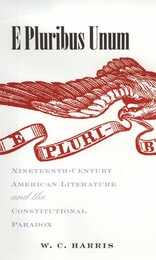
E Pluribus Unum
Nineteenth-Century American Literature and the Constitutional ParadoxHarris, W. C.
University of Iowa Press, 2005
The project of E Pluribus Unum is twofold. Its first and underlying concern is the general philosophic problem of the one and the many as it came to be understood at the time. W. C. Harris supplies a detailed account of the genealogy of the concept, exploring both its applications and its paradoxes as a basis for state and identity formation.
Harris then considers the perilous integration of the one and the many as a motive in the major literary accomplishments of 19th-century U.S. writers. Drawing upon critical as well as historical resources and upon contexts as diverse as cosmology, epistemology, poetics, politics, and Bible translation, he discusses attempts by Poe, Whitman, Melville, and William James to resolve the problems of social construction caused by the paradox of e pluribus unum by writing literary and philosophical texts that supplement the nation’s political founding documents.
Poe (Eureka), Whitman (Leaves of Grass), Melville (Billy Budd), and William James (The Varieties of Religious Experience) provide their own distinct, sometimes contradictory resolutions to the conflicting demands of diversity and unity, equality and hierarchy. Each of these texts understands literary and philosophical writing as having the potential to transform-conceptually or actually-the construction of social order.
This work will be of great interest to literary and constitutional scholars.

E.B. White
The Emergence of an EssayistRobert L., Jr. Root
University of Iowa Press, 1999
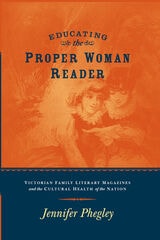
EDUCATING THE PROPER WOMAN READER
VICTORIAN FAMILY LITERARY MAGAZINES & CULTURAL HEALTH OF THE NATIONJennifer Phegley
The Ohio State University Press, 2004
Jennifer Phegley presents an examination of four mid-Victorian magazines that middle-class women read widely. Educating the Proper Woman Reader reevaluates prevailing assumptions about the vexed relationship between nineteenth-century women readers and literary critics.
While many scholars have explored the ways nineteenth-century critics expressed their anxiety about the dangers of women’s unregulated and implicitly uncritical reading practices, which were believed to threaten the sanctity of the home and the cultural status of the nation, Phegley argues that family literary magazines revolutionized the position of women as consumers of print by characterizing them as educated readers and able critics. Her analysis of images of influential women readers (in Harper’s), intellectual women readers (in The Cornhill), independent women readers (in Belgravia), and proto-feminist women readers/critics (in Victoria) indicates that women played a significant role in determining the boundaries of literary culture within these magazines. She argues that these publications supported women’s reading choices, inviting them to define literary culture rather than to consume it passively.
Not only does this book revise our understanding of nineteenth-century attitudes toward women readers, but it also takes a fresh look at the transatlantic context of literary production. Further, Phegley demonstrates the role these publications played in improving cultural literacy among women of the middle classes as well as the interplay between fiction and essays of the time by writers such as Mary Braddon, Charles Dickens, George Eliot, Elizabeth Gaskell, G. H. Lewes, Harriet Martineau, Margaret Oliphant, George Sala, William Thackeray, and Anthony Trollope.
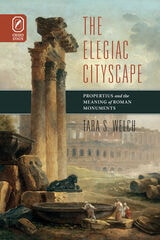
ELEGIAC CITYSCAPE
Propertius and the Meaning of Roman MonumentsTara S. Welch
The Ohio State University Press, 2005
The Elegiac Cityscape explores Propertius’ Rome and the various ways his poetry about the city illuminates the dynamic relationship between one individual and his environment. Combining the approaches of archaeology and literary criticism, Tara S. Welch examines how Propertius’ poems on Roman places scrutinize the monumentalization of various ideological positions in Rome, as they poke and prod Rome’s monuments to see what further meanings they might admit. The result is a poetic book rife with different perspectives on the eternal city, perspectives that often call into question any sleepy or complacent adherence to Rome’s traditional values.
ELUSIVE CHILDHOOD
IMPOSSIBLE REPRESENTATIONS IN MODERN FICTIONSusan Honeyman
The Ohio State University Press, 2005
Each Hour Redeem
Time and Justice in African American LiteratureDaylanne K. English
University of Minnesota Press, 2013
Each Hour Redeem advances a major reinterpretation of African American literature from the late eighteenth century to the present by demonstrating how its authors are centrally concerned with racially different experiences of time. Daylanne K. English argues that, from Phillis Wheatley to Suzan-Lori Parks, African American writers have depicted distinctive forms of temporality to challenge racial injustices supported by dominant ideas of time. The first book to explore the representation of time throughout the African American literary canon, Each Hour Redeem illuminates how the pervasive and potent tropes of timekeeping provide the basis for an overarching new understanding of the tradition.
Combing literary, historical, legal, and philosophical approaches, Each Hour Redeem examines a wide range of genres, including poetry, fiction, drama, slave narratives, and other forms of nonfiction. English shows that much of African American literature is characterized by “strategic anachronism,” the use of prior literary forms to investigate contemporary political realities, as seen in Walter Mosley’s recent turn to hard-boiled detective fiction. By contrast, “strategic presentism” is exemplified in the Black Arts Movement and the Harlem Renaissance and their investment in contemporary political potentialities, for example, in Langston Hughes and Amiri Baraka’s adaptation of the jazz of their eras for poetic form and content. Overall, the book effectively demonstrates how African American writers have employed multiple and complex conceptions of time not only to trace racial injustice but also to help construct a powerful literary tradition across the centuries.
Eardrums
Literary Modernism as Sonic WarfareTyler Whitney
Northwestern University Press, 2019
Eardrums is the first book-length study to explore the relationship between acoustical modernity and German modernism, charting a literary and cultural history written in and around the eardrum. The result is not only a new way of understanding the sonic impulses behind key literary texts from the period. It also outlines an entirely new approach to the study of literature as as the interaction of text and sonic practice, voice and noise, which will be of interest to scholars across literary studies, media theory, sound studies, and the history of science.
Early Blues
The First Stars of Blues GuitarJas Obrecht
University of Minnesota Press, 2015
Winner of the 2016 Living Blues Award for Blues Book of the Year
The complete history of early blues guitar, with portraits of its first stars—now in paperback
Since the early 1900s, blues and the guitar have traveled side by side. This book tells the story of their pairing from the first reported sightings of blues musicians, to the rise of nationally known stars, to the onset of the Great Depression, when blues recording virtually came to a halt.
Like the best music documentaries, Early Blues: The First Stars of Blues Guitar interweaves musical history, quotes from celebrated musicians (B.B. King, John Lee Hooker, Ry Cooder, and Johnny Winter, to name a few), and a spellbinding array of life stories to illustrate the early days of blues guitar in rich and resounding detail. In these chapters, you’ll meet Sylvester Weaver, who recorded the world’s first guitar solos, and Paramount Records artists Papa Charlie Jackson, Blind Lemon Jefferson, and Blind Blake, the “King of Ragtime Blues Guitar.” Blind Willie McTell, the Southeast’s superlative twelve-string guitar player, and Blind Willie Johnson, street-corner evangelist of sublime gospel blues, also get their due, as do Lonnie Johnson, the era’s most influential blues guitarist; Mississippi John Hurt, with his gentle, guileless voice and syncopated fingerpicking style; and slide guitarist Tampa Red, “the Guitar Wizard.”
Drawing on a deep archive of documents, photographs, record company ads, complete discographies, and up-to-date findings of leading researchers, this is the most comprehensive and complete account ever written of the early stars of blues guitar—an essential chapter in the history of American music.
Early Spanish American Narrative
By Naomi Lindstrom
University of Texas Press, 2004
The world discovered Latin American literature in the twentieth century, but the roots of this rich literary tradition reach back beyond Columbus's discovery of the New World. The great pre-Hispanic civilizations composed narrative accounts of the acts of gods and kings. Conquistadors and friars, as well as their Amerindian subjects, recorded the clash of cultures that followed the Spanish conquest. Three hundred years of colonization and the struggle for independence gave rise to a diverse body of literature—including the novel, which flourished in the second half of the nineteenth century.
To give everyone interested in contemporary Spanish American fiction a broad understanding of its literary antecedents, this book offers an authoritative survey of four centuries of Spanish American narrative. Naomi Lindstrom begins with Amerindian narratives and moves forward chronologically through the conquest and colonial eras, the wars for independence, and the nineteenth century. She focuses on the trends and movements that characterized the development of prose narrative in Spanish America, with incisive discussions of representative works from each era. Her inclusion of women and Amerindian authors who have been downplayed in other survey works, as well as her overview of recent critical assessments of early Spanish American narratives, makes this book especially useful for college students and professors.
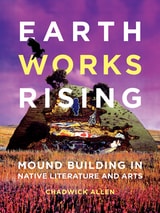
Earthworks Rising
Mound Building in Native Literature and ArtsChadwick Allen
University of Minnesota Press, 2022
A necessary reexamination of Indigenous mounds, demonstrating their sustained vitality and vibrant futurity by centering Native voices
Typically represented as unsolved mysteries or ruins of a tragic past, Indigenous mounds have long been marginalized and misunderstood. In Earthworks Rising, Chadwick Allen issues a compelling corrective, revealing a countertradition based in Indigenous worldviews. Alongside twentieth- and twenty-first-century Native writers, artists, and intellectuals, Allen rebuts colonial discourses and examines the multiple ways these remarkable structures continue to hold ancient knowledge and make new meaning—in the present and for the future.
Earthworks Rising is organized to align with key functional categories for mounds (effigies, platforms, and burials) and with key concepts within mound-building cultures. From the Great Serpent Mound in Ohio to the mound metropolis Cahokia in Illinois to the generative Mother Mound in Mississippi, Allen takes readers deep into some of the most renowned earthworks. He draws on the insights of poets Allison Hedge Coke and Margaret Noodin, novelists LeAnne Howe and Phillip Carroll Morgan, and artists Monique Mojica and Alyssa Hinton, weaving in a personal history of earthwork encounters and productive conversation with fellow researchers.
Spanning literature, art, performance, and built environments, Earthworks Rising engages Indigenous mounds as forms of “land-writing” and as conduits for connections across worlds and generations. Clear and compelling, it provokes greater understanding of the remarkable accomplishments of North America’s diverse mound-building cultures over thousands of years and brings attention to new earthworks rising in the twenty-first century.
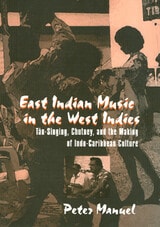
East Indian Music
Peter Manuel
Temple University Press, 2000
In recent decades, however, tan-singing has been declining, regarded as quaint and crude by younger generations raised on MTV, Hindi film music, and disco. At the same time, Indo-Caribbeans have been participating in their countries' economic, political, and cultural lives to a far greater extent than previously. Accompanying this participation has been a lively cultural revival, encompassing both an enhanced assertion of Indianness and a spirit of innovative syncretism. One of the most well-known products of this process is chutney, a dynamic music and dance phenomenon that is simultaneously a folk revival and a pop hybrid. In Trinidad, it has also been the vehicle for a controversial form of female empowerment and an agent of a new, more inclusive, conception of national identity.
Thus, East Indian Music in the West Indies is a portrait of a diaspora community in motion. It documents the social and cultural development of a people "without history," a people who have sometimes been dismissed as foreigners who merely perpetuate the culture of the homeland rather than becoming "truly" Caribbean. Professor Manuel shows how inaccurate this characterization is. On the one hand, in the form of tan-singing, it examines the distinctiveness of traditional Indo-Caribbean musical culture. On the other, in the form of chutney, it examines the new assertiveness and syncretism of Indo-Caribbean popular music.
Students of Indo-Caribbean music and curious world-music fans alike will be fascinated by Professor Manuel's guided tour through the complex and exciting world of Indo-Caribbean musical culture.
East-West Literary Imagination
Cultural Exchanges from Yeats to MorrisonYoshinobu Hakutani
University of Missouri Press, 2017
This study traces the shaping presence of cultural interactions, arguing that American literature has become a hybridization of Eastern and Western literary traditions. Cultural exchanges between the East and West began in the early decades of the nineteenth century as American transcendentalists explored Eastern philosophies and arts. Hakutani examines this influence through the works of Emerson, Thoreau, and Whitman. He further demonstrates the East-West exchange through discussions of the interactions by modernists such as Yone Noguchi, Yeats, Pound, Camus, and Kerouac.
Finally, he argues that African American literature, represented by Richard Wright, Ralph Ellison, Alice Walker, Toni Morrison, and James Emanuel, is postmodern. Their works exhibit their concerted efforts to abolish marginality and extend referentiality, exemplifying the postmodern East-West crossroads of cultures. A fuller understanding of their work is gained by situating them within this cultural conversation. The writings of Wright, for example, take on their full significance only when they are read, not as part of a national literature, but as an index to an evolving literature of cultural exchanges.
Eastern Figures
Orient and Empire in British WritingDouglas Kerr
Hong Kong University Press, 2008
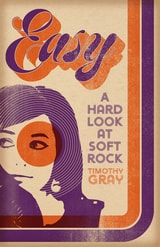
Easy
A Hard Look at Soft RockTimothy Gray
University of Iowa Press, 2026
Echo Chambers
Figuring Voice In NarrativePatrick O'Donnell
University of Iowa Press, 1992
Echo Chambers provides an illuminating discussion of the representation of “voice” in novels by Dickens, Joyce, Faulkner, Lowry, and Gaddis. Focusing on the paradoxes of “voice” as an indication of how different authors understand the contradictions of “identity,” O'Donnell charts the recent history of subjectivity as reflected in the development of modern fiction. With strong theoretical underpinning—O'Donnell skillfully utilizes the theories formulated by Bakhtin, Derrida, Bersani, De Man, Deleuze, and Guattari, among others, and the semiotics of voice put forth by Julia Kristeva—Echo Chambers shows how identity is inherently contradictory, conflicted, and multiple.
This insightful volume compellingly demonstrates that “voice” is a revealing (because contradictory and heterogeneous) site where language, the body, culture, and subjectivity meet. Echo Chambers makes an important contribution to the study of modern literature, the semiotics of identity, and cultural poetics as they are informed by the projections of voice in modern narrativ
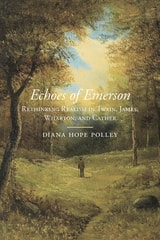
Echoes of Emerson
Rethinking Realism in Twain, James, Wharton, and CatherDiana Hope Polley
University of Alabama Press, 2017
Probes the ways in which two major periods in nineteenth-century American literature—Romanticism and Realism—have come to be understood and defined.
Echoes of Emerson: Rethinking Realism in Twain, James, Wharton, and Cather traces the complex and unexplored relationship between American realism and the philosophy of Ralph Waldo Emerson. Critics often read American realism as a clear disavowal of earlier American romantic philosophy and as a commitment to recognizing the stark realities of a new postbellum order. Diana Hope Polley’s study complicates these traditional assumptions by reading American realism as an ongoing dialogue with the ideas—often idealisms—of America’s greatest romantic philosopher, Ralph Waldo Emerson.
In this illuminating work, Polley offers detailed readings of Mark Twain’s Adventures of Huckleberry Finn, Henry James’s The Portrait of a Lady, Edith Wharton’s The House of Mirth, and Willa Cather’s My Ántonia—all through the lens of Emersonian philosophy and discourse. This unique contribution to nineteenth- and early twentieth-century literary studies shows how these texts revisit Emerson’s antebellum “republic of the spirit” philosophy, specifically the trope of the Emersonian hero/heroine navigating the harsh contingencies of the modern world.
Romanticism and realism are often seen as opposing binaries, with romanticism celebrating the individual, self-reliance, and nature and realism emphasizing the weight of socio-historical forces. Realism is often characterized as rejecting the transcendent principles of Emersonian thought. Rather than accept those distinct boundaries between romance and realism, Polley argues that American realists struggled between celebrating Emerson’s core philosophies of individual possibility and acknowledging the stark “realities” of American social and historical life. In short, this study recognizes within realism a divided loyalty between two historical trends and explores how these seemingly contradictory notions—Emerson’s romantic philosophy and later nineteenth-century visions of historical reality—exist, simultaneously, within the literature of the period.
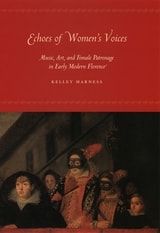
Echoes of Women's Voices
Music, Art, and Female Patronage in Early Modern FlorenceKelley Harness
University of Chicago Press, 2006
Through commissions, patrons sought to promote a vision of the world and their place in it. The unique social norms, laws, educational backgrounds, and life experiences of female patrons meant the expression of a worldview that differed significantly from that of their male counterparts. Joining exceptional archival research with telling analysis of significant examples of music, art, and drama, Kelley Harness challenges the prevailing view that Florence saw a political and artistic decline during this period. She argues convincingly that the female domination of these years brought forth artistic patronage that was both continuous and well-conceived.
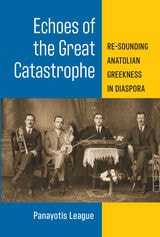
Echoes of the Great Catastrophe
Re-Sounding Anatolian Greekness in DiasporaPanayotis League
University of Michigan Press, 2021
Echoes of the Great Catastrophe: Re-sounding Anatolian Greekness in Diaspora explores the legacy of the Great Catastrophe—the death and expulsion from Turkey of 1.5 million Greek Christians following the Greco-Turkish War of 1919–1922—through the music and dance practices of Greek refugees and their descendants over the last one hundred years. The book draws extensively on original ethnographic research conducted in Greece (on the island of Lesvos in particular) and in the Greater Boston area, as well as on the author’s lifetime immersion in the North American Greek diaspora. Through analysis of handwritten music manuscripts, homemade audio recordings, and contemporary live performances, the book traces the routes of repertoire and style over generations and back and forth across the Atlantic Ocean, investigating the ways that the particular musical traditions of the Anatolian Greek community have contributed to their understanding of their place in the global Greek diaspora and the wider post-Ottoman world. Alternating between fine-grained musicological analysis and engaging narrative prose, it fills a lacuna in scholarship on the transnational Greek experience.
Echoing Hylas
A Study in Hellenistic and Roman MetapoeticsMark Heerink
University of Wisconsin Press, 2015
In Echoing Hylas, Mark Heerink argues that the story of Hylas—a famous episode of the Argonauts' voyage—was used by poets throughout classical antiquity to reflect symbolically on the position of their poetry in the literary tradition. Certain elements of the story, including the characters of Hylas and Hercules themselves, functioned as metaphors of the art of poetry. In the Hellenistic age, for example, the poet Theocritus employed Hylas as an emblem of his innovative
bucolic verse, contrasting the boy with Hercules, who symbolized an older, heroic-epic tradition. The Roman poet Propertius further developed and transformed Theocritus's metapoetical allegory by turning Heracles into an elegiac lover in pursuit of an unattainable object of affection. In this way, the myth of Hylas became the subject of a dialogue among poets across time, from the Hellenistic age to the Flavian era. Each poet, Heerink demonstrates, used elements of the myth to claim his own place in a developing literary tradition.
With this innovative diachronic approach, Heerink opens a new dimension of ancient metapoetics and offers many insights into the works of Apollonius of Rhodes, Theocritus, Virgil, Ovid, Valerius Flaccus, and Statius.
Eclipse of Action
Tragedy and Political EconomyRichard Halpern
University of Chicago Press, 2017
Since Aristotle, tragedy has been seen as uniquely exhibiting the importance of action for human happiness. Beginning with Adam Smith, however, political economy has claimed that the source of happiness is primarily production. Eclipse of Action examines the tense relations between action and production, doing and making, in playwrights from Aeschylus, Marlowe, Shakespeare, and Milton to Beckett, Arthur Miller, and Sarah Kane. Richard Halpern places these figures in conversation with works by Aristotle, Smith, Hegel, Marx, Hannah Arendt, Georges Bataille, and others in order to trace the long history of the ways in which economic thought and tragic drama interact.
Eclipse of Empires
World History in Nineteenth-Century U.S. Literature and CulturePatricia Jane Roylance
University of Alabama Press, 2013
Patricia Jane Roylance’s central claim in Eclipse of Empires is that historical episodes of imperial eclipse, for example Incan Peru yielding to Spain or the Ojibway to the French, heightened the concerns of many American writers about specific intranational social problems plaguing the nation at the time—race, class, gender, religion, economics. Given the eventual dissolution of great civilizations previously plagued by these very same problems, many writers, unlike those who confidently emphasized U.S. exceptionalism, exhibited both an anxiety about the stability of American society and a consistent practice of self-scrutiny in identifying the national defects that they felt could precipitate America’s decline.
Roylance studies, among other texts, James Fenimore Cooper’s The Water-Witch (1830) and The Bravo (1831), which address the eclipse of Venice by New York City as a maritime power in the eighteenth century; William Hickling Prescott’s Conquest of Peru (1847), which responds to widespread anxiety about communist and abolitionist threats to the U.S. system of personal property by depicting Incan culture as a protocommunist society doomed to failure; and Henry Wadsworth Longfellow’s The Song of Hiawatha (1855), which resists the total eclipse of Ojibwa culture by incorporating Ojibway terms and stories into his poem and by depicting the land as permanently marked by their occupation.
Ecoambiguity
Environmental Crises and East Asian LiteraturesKaren Laura Thornber
University of Michigan Press, 2012
Ecoambiguity is the first book in any language to analyze Chinese, Japanese, Korean, and Taiwanese literary treatments of damaged ecosystems. Thornber closely examines East Asian creative portrayals of inconsistent human attitudes, behaviors, and information concerning the environment and takes up texts by East Asians who have been translated and celebrated around the world, including Gao Xingjian, Ishimure Michiko, Jiang Rong, and Ko Un, as well as fiction and poetry by authors little known even in their homelands. Ecoambiguity addresses such environmental crises as deforesting, damming, pollution, overpopulation, species eradication, climate change, and nuclear apocalypse. This book opens new portals of inquiry in both East Asian literatures and ecocriticism (literature and environment studies), as well as in comparative and world literature.

Ecofeminist Literary Criticism
Theory, Interpretation, PedagogyEdited by Greta Gaard and Patrick D. Murphy
University of Illinois Press, 1998
Ecofeminism is a practical movement for social change that discerns interconnections among all forms of oppression: the exploitation of nature, the oppression of women, class exploitation, racism, colonialism. Against binary divisions such as self/other, culture/nature, man/woman, humans/animals, and white/non-white, ecofeminist theory asserts that human identity is shaped by more fluid relationships and by an acknowledgment of both connection and difference.
Once considered the province of philosophy and women's studies, ecofeminism in recent years has been incorporated into a broader spectrum of academic discourse. Ecofeminist Literary Criticism assembles some of the most insightful advocates of this perspective to illuminate ecofeminism as a valuable component of literary criticism.

Ecomusicology
Rock, Folk, and the EnvironmentMark Pedelty
Temple University Press, 2012
Can musicians really make the world more sustainable? Anthropologist Mark Pedelty, joined an eco-oriented band, the Hypoxic Punks, to find out. In his timely and exciting book, Ecomusicology, Pedelty explores the political ecology of rock, from local bands to global superstars. He examines the climate change controversies of U2's 360 Degrees stadium tour—deemed excessive by some—and the struggles of local folk singers who perform songs about the environment. In the process, he raises serious questions about the environmental effects and meanings on music.
Ecomusicology examines the global, national, regional, and historical contexts in which environmental pop is performed. Pedelty reveals the ecological potentials and pitfalls of contemporary popular music, in part through ethnographic fieldwork among performers, audiences, and activists. Ultimately, he explains how popular music dramatically reflects both the contradictions and dreams of communities searching for sustainability.
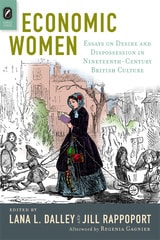
Economic Women
Essays on Desire and Dispossession in Nineteenth-Century British CultureEdited by Lana L. Dalley and Jill Rappoport
The Ohio State University Press, 2013
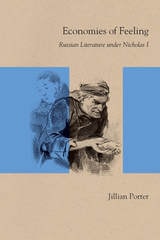
Economies of Feeling
Russian Literature under Nicholas IJillian Porter
Northwestern University Press, 2017
Porter shows how, for Pushkin, Gogol, Dostoevsky, and Faddei Bulgarin, ambition became a staging ground for experiments with transnational literary exchange. In its encounters with the celebrated Russian cultural value of hospitality and the age-old vice of miserliness, ambition appears both timely and anachronistic, suspiciously foreign and disturbingly Russian—it challenges readers to question the equivalence of local and imported words, feelings, and forms.
Economies of Feeling examines founding texts of nineteenth-century Russian prose alongside nonliterary materials from which they drew energy—from French clinical diagnoses of “ambitious monomania” to the various types of currency that proliferated under Nicholas I. It thus contributes fresh and fascinating insights into Russian characters’ impulses to attain rank and to squander, counterfeit, and hoard. Porter’s interdisciplinary approach will appeal to scholars of comparative as well as Russian literature.
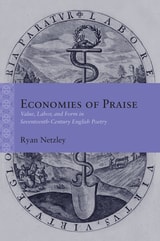
Economies of Praise
Value, Labor, and Form in Seventeenth-Century English PoetryRyan Netzley
Northwestern University Press, 2024
Reevaluates early modern poems of praise as, paradoxically, challenging an artistic economy that values exchange and productivity
Early modern poems of praise typically insist that they do not have a purpose or enact real labor beyond their effortless listing of laudable qualities. And yet the poets discussed in this study, including Ben Jonson, Andrew Marvell, Anne Bradstreet, Lucy Hutchinson, and John Milton, hint at an alternative aesthetic economy at work in their verse. Poetic praise, it turns out, might show us a social world outside the organizing principle of exchange.
In Economies of Praise: Value, Labor, and Form in Seventeenth‑Century English Poetry, Ryan Netzley explores how poems of praise imagine alternatives to market and gift economies and point instead to a self-contained aesthetic economy that works against a more expansive and productivist understanding of literary art. By depicting exchange as inconsequential, unproductive, and redundant rather than a necessary constituent of social order, these poems model for modern readers a world without the imperative to create, appraise, and repeatedly demonstrate one’s own value.
Ecopoetics
Essays in the FieldAngela Hume and Gillian Osborne
University of Iowa Press, 2018
Ecopoetics: Essays in the Field makes a formidable intervention into the emerging field of ecopoetics. The volume’s essays model new and provocative methods for reading twentieth and twenty-first century ecological poetry and poetics, drawing on the insights of ecocriticism, contemporary philosophy, gender and sexuality studies, black studies, Native studies, critical race theory, and disability studies, among others.
Contributors offer readings of a diverse range of poets, few of whom have previously been read as nature writers—from midcentury Beat poet Michael McClure, Objectivist poet George Oppen, and African American poets Melvin Tolson and Robert Hayden; to contemporary writers such as Diné poet Sherwin Bitsui, hybrid/ collage poets Claudia Rankine and Evelyn Reilly, emerging QPOC poet Xandria Phillips, and members of the Olimpias disability culture artists’ collective. While addressing preconceptions about the categories of nature writing and ecopoetics, contributors explore, challenge, and reimagine concepts that have been central to environmental discourse, from apocalypse and embodiment to toxicity and sustainability.
This collection of essays makes the compelling argument that ecopoetics should be read as “coextensive with post-1945 poetry and poetics,” rather than as a subgenre or movement within it. It is essential reading for any student or scholar working on contemporary literature or in the environmental humanities today.
Contributors: Joshua Bennett, Rob Halpern, Matt Hooley, Angela Hume, Lynn Keller, Petra Kuppers, Michelle Niemann, Gillian Osborne, Samia Rahimtoola, Joan Retallack, Joshua Schuster, Jonathan Skinner.
Ecopoetics
The Language of Nature, the Nature of LanguageScott Knickerbocker
University of Massachusetts Press, 2012
Ecopoetics probes the complex relationship between artifice and the natural world in the work of modern American poets—in particular Wallace Stevens, Elizabeth Bishop, Richard Wilbur, and Sylvia Plath. These poets relate to nature as a deep wellspring of meaning, although they all avoid using language the way most nature writers do, merely to reflect or refer directly to the world. Each of these poets, in his or her own distinct way, employs instead what Knickerbocker terms sensuous poesis, the process of rematerializing language through sound effects and other formal devices as a sophisticated response to nonhuman nature.
Rather than attempt to erase the artifice of their own poems, to make them seem more natural and thus supposedly closer to nature, the poets in this book unapologetically embrace artifice—not for its own sake but in order to perform and enact the natural world. Indeed, for them, artifice is natural. In examining their work, Knickerbocker charts a new direction for ecocriticism.
Ecopoetry
Critical IntroductionScott Bryson
University of Utah Press, 2002
The burgeoning field of ecocriticism is beginning to address the work of such ecopoets as Gary Snyder, Mary Oliver, W. S. Merwin, and Wendell Berry, among others, whose poems increasingly deal with ecological and environmental issues. Ecopoetry: A Critical Introduction assembles previously unpublished contributions from many of the most important scholars in the field as they discuss the historical and crosscultural roots of ecopoetry, while expanding the boundaries to include such themes as genocide and extinction, the lesbian body, and post colonialism. This volume gathers these necessary voices in the emerging conversation regarding poetry’s place in the environmental debate.
Ecospatiality
A Place-Based Approach to American LiteratureLowell Wyse
University of Iowa Press, 2021
Ecospatiality explores modern and contemporary American prose literature through the lens of place, showing how authors like William Least Heat-Moon, Willa Cather, Richard Wright, and Leslie Marmon Silko represent and reimagine real places in the world and the human-environment relationships therein. Building on the work of scholars in geography, sociology, ecocriticism, and geocriticism, this book articulates the theory of ecospatiality: an understanding of place as simultaneously spatial, ecological, and historical.
In our current historical moment, which is characterized by ongoing ecological collapse and a not-unrelated increase in social disorder, few issues are more urgent than the human relationship with our environments. Whether we characterize this new epoch as the climate change era or the Anthropocene, we can no longer ignore the fact that the places we live are rapidly changing in response to economic and environmental pressures. Rather than thinking of place as a neutral site for social interaction, we should recognize how it underpins and intertwines with human experience.
Fortunately, literature can help us think through how place operates. Lowell Wyse shows that texts can be understood as works of literary cartography. Focusing on works of nonfiction and fiction whose primary settings are on the North American continent, Ecospatiality demonstrates how these narratives rely on realistic literary geography to invoke, and sometimes retell, important aspects of environmental history within particular communities and bioregions.
Ecosublime
Environmental Awe and Terror from New World to OddworldLee Rozelle
University of Alabama Press, 2006
Explores 19th-century, modern, postmodern, and millennial texts as they portray the changing ecological face of America
Lee Rozelle probes the metaphor of environmental catastrophe in American literature of the last 150 years. In each instance, Rozelle finds evidence that the ecosublime--nature experienced as an instance of wonder and fear--profoundly reflects spiritual and political responses to the natural world, America’s increasingly anti-ecological trajectory, and the ascendance of a post-natural landscape.
In the 19th century, Rozelle argues, Isabella Bird and Edgar Allan Poe represented the western wilderness as culturally constructed and idealized landscapes. Gardens, forests, and frontiers are conceptual frameworks that either misrepresent or uphold ecological space. Modernists like Nathanael West and William Carlos Williams, on the other hand, portray urban space as either wastelands or mythical urban gardens. A chapter on Charles W. Chesnutt and Rebecca Harding Davis analyzes a new breed of literary eco-advocate, educating and shocking mainstream readers through depictions of ecological disaster. A later chapter probes the writings of Edward Abbey and the Unabomber Manifesto to delve into the sublime dimensions of environmental activism, monkey-wrenching, and eco-terrorism.
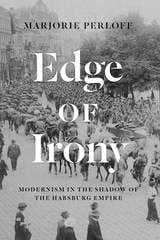
Edge of Irony
Modernism in the Shadow of the Habsburg EmpireMarjorie Perloff
University of Chicago Press, 2016
Perloff explores works ranging from Karl Kraus’s drama The Last Days of Mankind and Elias Canetti’s memoir The Tongue Set Free to Ludwig Wittgenstein’s notebooks and Paul Celan’s lyric poetry. Throughout, she shows that Austro-Modernist literature is characterized less by the formal and technical inventions of a modernism familiar to us in the work of Joyce and Pound, Dada and Futurism, than by a radical irony beneath a seemingly conventional surface, an acute sense of exile, and a sensibility more erotic and quixotic than that of its German contemporaries. Skeptical and disillusioned, Austro-Modernism prefers to ask questions rather than formulate answers.
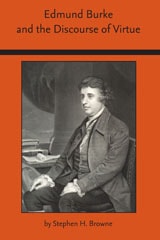
Edmund Burke and the Discourse of Virtue
Stephen Howard Browne
University of Alabama Press, 2007
"A major accomplishment in the study of Burke." —Choice
More than 200 years after his death, Edmund Burke remains among the most influential conservative writers in the Anglophone world. Burke’s relevance has only grown as the nature of what it means to be a conservative has become hotly contested.
And yet Burke is often discussed more than he is read. Worse, his rhetoric is often pressed into the service of other ideologies. In Edmund Burke and the Discourse of Virtue, Stephen Browne of Pennsylvania State University subjects Burke’s work to the close textual analysis it has never received.
The result of Browne's study is to present Burke and his work in a light that was clearly essential to Burke himself, one that illuminates the link between rhetoric and action that is key to understanding Burke, his career, his work, and his influence on contemporary conservatism.
Readers interested in the development of conversative philosophy, politics, and writing from its earliest roots will value this rare and illuminating work.
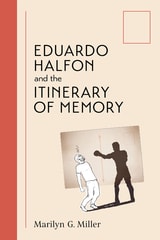
Eduardo Halfon and the Itinerary of Memory
Marilyn G. Miller
Vanderbilt University Press, 2024
Marilyn G. Miller has written the first study to focus exclusively on this important voice in Jewish–Latin American letters. Only after returning to Guatemala and regaining his command of Spanish through reading literature did Halfon begin to build his life as a writer and translator. Nonetheless, the author admits that “one thing is stubbornly true, and it’s this: every sentence that I write, every verb or adjective that I painstakingly insert or remove, every literary thought that I have while writing, always . . . begins and ends in English.” Halfon’s translated works are never parallel texts, however. Thus, translation and its side effects (foreign words, linguistic lacunae, multilingual modes of perception) offer us crucial keys to understanding the author’s fictional world as a vehicle for retelling and surviving Jewish trauma and finding his own particular plurilingual voice.
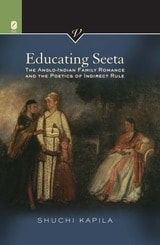
Educating Seeta
The Anglo-Indian Family Romance and the Poetics of Indirect RuleShuchi Kapila
The Ohio State University Press, 2010
Educating Women
Cultural Conflict and Victorian LiteratureLaura Morgan Green
Ohio University Press, 2001
In 1837, when Queen Victoria came to the throne, no institution of higher education in Britain was open to women. By the end of the century, a quiet revolution had occurred: women had penetrated even the venerable walls of Oxford and Cambridge and could earn degrees at the many new universities founded during Victoria's reign. During the same period, novelists increasingly put intellectually ambitious heroines students, teachers, and frustrated scholars—at the center of their books. Educating Women analyzes the conflict between the higher education movement's emphasis on intellectual and professional achievement and the Victorian novel's continuing dedication to a narrative in which women's success is measured by the achievement of emotional rather than intellectual goals and by the forging of social rather than institutional ties.
Focusing on works by Charlotte Brontë, George Eliot, Anna Leonowens, and Thomas Hardy, Laura Morgan Green demonstrates that those texts are shaped by the need to mediate the conflict between the professionalism and publicity increasingly associated with education, on the one hand, and the Victorian celebration of women as emblems of domesticity, on the other. Educating Women shows that the nineteenth-century “heroines” of both history and fiction were in fact as indebted to domestic ideology as they were eager to transform it.
Education in the School of Dreams
Travelogues and Early Nonfiction FilmJennifer Lynn Peterson
Duke University Press, 2013
Peterson describes the travelogue's characteristic form and style and demonstrates how imperialist ideologies were realized and reshaped through the moving image. She argues that although educational films were intended to legitimate filmgoing for middle-class audiences, travelogues were not simply vehicles for elite ideology. As a form of instructive entertainment, these technological moving landscapes were both formulaic and also wondrous and dreamlike. Considering issues of spectatorship and affect, Peterson argues that scenics produced and disrupted viewers' complacency about their own place in the world.
Edward Said and the Work of the Critic
Speaking Truth to PowerPaul A. Bové, ed.
Duke University Press, 2000
In two separate interviews, Said himself comments on a variety of topics, among them the response of the American Jewish community to his political efforts in the Middle East. Yet even as the Palestinian struggle finds a central place in his work, it is essential—as the contributors demonstrate—to see that this struggle rests on and gives power to his general "critique of colonizers" and is not simply the outgrowth of a local nationalism. Perhaps more than any other person in the United States, Said has changed how the U.S. media and American intellectuals must think about and represent Palestinians, Islam, and the Middle East. Most importantly, this change arises not as a result of political action but out of a potent humanism—a breadth of knowledge and insight that has nourished many fields of inquiry. Originally a special issue of boundary 2, the book includes new articles on minority culture and on orientalism in music, as well as an interview with Said by Jacqueline Rose.
Supporting the claim that the last third of the twentieth century can be called the "Age of Said," this collection will enlighten and engage students in virtually any field of humanistic study.
Contributors. Jonathan Arac, Paul A. Bové, Terry Cochran, Barbara Harlow, Kojin Karatani, Rashid I. Khalidi, Sabu Kohsu, Ralph Locke, Mustapha Marrouchi, Jim Merod, W. J. T. Mitchell, Aamir R. Mufti, Jacqueline Rose, Edward W. Said, Gayatri Chakravorty Spivak, Lindsay Waters

Edwardian Stories of Divorce
Janice Hubbard Harris
Rutgers University Press, 1996
Much as abortion in the United States today is a contentious issue used for scripting women's roles and potential into the national agenda, divorce was an issue dividing England in the Edwardian era. According to Janice Harris, anything and everything, from illicit sex and family values to the Garden of Eden, wrath of children, poverty of women, nature of cruelty, scandal of America, threat of Germany, and future of England were part of the debate over divorce. Living under marriage laws far more restrictive than those of their Protestant neighbors, Edwardian women and men campaigned for reform with a barrage of compelling stories. Organizing her analysis around three major sources of narrative on divorce––the Sunday papers, the Report of the Royal Commission on Divorce and Matrimonial causes, and the novel––Harris uncovers a war of words and a competition of tales. In raising questions about the winners, losers, and spoils, Harris expands our understanding of the history of divorce, the wars between the sexes, and the political import of those wars.
In the end, she presents a complex and lively story herself, one that illuminates battles over marriage and divorce taking place in our own era as well. This humane book on a long-neglected subject marks an important contribution to narrative studies and Edwardian history.
Effeminism
The Economy of Colonial DesireRevathi Krishnaswamy
University of Michigan Press, 2011
Eighteenth-Century Contexts
Historical Inquiries in Honor of Philip HarthHoward D. Weinbrot
University of Wisconsin Press, 2001
Eighteenth-Century Contexts offers a lively array of essays that consider literary, intellectual, political, theological, and cultural aspects of the years 1650–1800, in the British Isles and Europe. At the center of the book is Jonathan Swift; several essays delve into his poetry, his similarities to Bernard Mandeville, his response to Anthony Collins’s Discourse of Free-Thinking, and the relationship between his Gulliver’s Travels and Thomas More’s Utopia. Other essays discuss Alexander Pope, eighteenth-century music and poetry, William Congreve, James Boswell, Samuel Richardson, and women’s novels of the eighteenth century.

Eighteenth-Century Literary History
An MLQ ReaderMarshall Brown, ed.
Duke University Press, 1999
While examining different parts of the century, as well as different aspects and countries, contributors explore the intersection of literary studies with history, philosophy, psychology, and the visual arts. They discuss a creative range of topics, including feminism, nationalism, domestic ideology, the classical novel–drama–lyric poetry triad, and both aesthetic and philosophical writings. This span of subjects and approaches extends the focus of Eighteenth-Century Literary History beyond its period to project a spirit of inquiry onto literary history in general.
Contributors. Nancy Armstrong, Marshall Brown, Sanford Budick, Catherine Gallagher, Thomas M. Kavanagh, Jon Klancher, Jill Kowalik, Jonathan Brody Kramnick, Christie McDonald, Jerome McGann, Ruth Perry, Michael B. Prince, Leonard Tennenhouse
Eisenstein, Cinema, and History
James Goodwin
University of Illinois Press, 1993
stands alone as the maker of a fully historical cinema. James Goodwin treats
issues of revolutionary history and historical representation as central to
an understanding of Eisentein's work, which explores two movements within Soviet
history and consciousness: the Bolshevik Revolution and the Stalinist state.
Goodwin articulates intersections
between Eisentein's ideas and aspects of the thought of Walter Benjamin, Georg
Lukács, Ernst Bloch, and Bertolt Brecht. He also shows how the formal
properties and filmic techniques of each work reveal perspectives on history
. Individual chapters focus on Strike, Battleship Potemkin, October, Old
and New, projects of the 1930s, Alexander Nevsky, and Ivan the
Terrible.
El Eternauta, Daytripper, and Beyond
Graphic Narrative in Argentina and BrazilBy David William Foster
University of Texas Press, 2016
El Eternauta, Daytripper, and Beyond examines the graphic narrative tradition in the two South American countries that have produced the medium’s most significant and copious output. Argentine graphic narrative emerged in the 1980s, awakened by Héctor Oesterheld’s groundbreaking 1950s serial El Eternauta. After Oesterheld was “disappeared” under the military dictatorship, El Eternauta became one of the most important cultural texts of turbulent mid-twentieth-century Argentina. Today its story, set in motion by an extraterrestrial invasion of Buenos Aires, is read as a parable foretelling the “invasion” of Argentine society by a murderous tyranny. Because of El Eternauta, graphic narrative became a major platform for the country’s cultural redemocratization. In contrast, Brazil, which returned to democracy in 1985 after decades of dictatorship, produced considerably less analysis of the period of repression in its graphic narratives. In Brazil, serious graphic narratives such as Fábio Moon and Gabriel Bá’s Daytripper, which explores issues of modernity, globalization, and cross-cultural identity, developed only in recent decades, reflecting Brazilian society’s current and ongoing challenges.
Besides discussing El Eternauta and Daytripper, David William Foster utilizes case studies of influential works—such as Alberto Breccia and Juan Sasturain’s Perramus series, Angélica Freitas and Odyr Bernardi’s Guadalupe, and others—to compare the role of graphic narratives in the cultures of both countries, highlighting the importance of Argentina and Brazil as anchors of the production of world-class graphic narrative.
Electric Meters
Victorian Physiological PoeticsJason Rudy
Ohio University Press, 2009
Combining formal poetic analysis with cultural history, Rudy traces the development of Victorian physiological poetics from the Romantic poetess tradition through to the works of Alfred Tennyson, the “Spasmodic” poets, Elizabeth Barrett Browning, Gerard Manley Hopkins, and Algernon Swinburne, among others. He demonstrates how poetic rhythm came increasingly to be understood throughout the nineteenth century as a physiological mechanism, as poets across class, sex, and national boundaries engaged intensely and in a variety of ways with the human body’s subtle response to rhythmic patterns. Whether that opportunity for transcendence was interpersonal or spiritual in nature, nineteenth–century poets looked to electricity as a model for overcoming boundaries, for communicating across the gaps between sound and sense, between emotion and thought, and—perhaps—between individuals in the modern world.
Electric Meters will appeal to those interested in poetry of any period and particularly those interested in nineteenth–century culture and history.
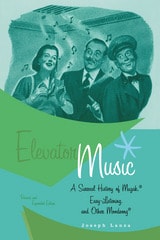
Elevator Music
A Surreal History of Muzak, Easy-Listening, and Other Moodsong; Revised and Expanded EditionJoseph Lanza
University of Michigan Press, 2004
Musical cognoscenti decry its insipid content; regular folk -- if they notice -- bemoan its pervasiveness; while hipsters and campsters celebrate its retro chic. Mindful of the many voices, Joseph Lanza's Elevator Music sings seriously, with tongue in cheek, the praises of this venerable American institution.
Lanza addresses the criticisms of elites who say that Muzak and its ilk are dehumanized, vapid, or cheesy. These reactions, he argues, are based more on cultural prejudices than honest musical appraisal.
Says Lanza, today's so-called mood music is the inheritor of a long tradition of mood-altering music stretching back to the ancients; Nero's fiddle and the sirens of Odysseus being two famous examples. Contemporary atmospheric music, Lanza argues, not only serves the same purpose, it is also the inevitable background for our media-dominated age.
One of Lanza's premises, to quote Mark Twain, is that this music is "better than it sounds." "This book will have succeeded in its purpose," he writes, "if I can help efface...the distinction between one person's elevator music and another's prized recording."
Joseph Lanza is an author, producer, and music historian. His most recent book is Russ Columbo and the Crooner Mystique.
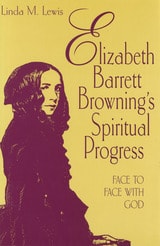
Elizabeth Barrett Browning's Spiritual Progress
Face to Face With GodLinda M. Lewis
University of Missouri Press, 1997
Elizabeth Barrett Browning believed that "Christ's religion is essentially poetry—poetry glorified." In Elizabeth Barrett Browning's Spiritual Progress, Linda M. Lewis studies Browning's religion as poetry, her poetry as religion. The book interprets Browning's literary life as an arduous spiritual quest—the successive stages being a rejection of Promethean pride for Christ-like humility, affirmation of the gospels of suffering and of work, internalization of the doctrine of Apocalypse, and ascent to divine love and truth.
Lewis follows this religious crusade from the poet's childhood to her posthumous Last Poems--including such topics as her Bible reading, her introduction to the Greek church fathers and the English Protestant reformers, the theological debates in which she participated, her quarrel with the theology of Paradise Lost, and her scandalous involvement in mesmerism and Swedenborgianism. Using insights from contemporary feminist thought, Lewis argues that Browning's religious assumptions and insights range from the conventional to the iconoclastic and that women's spirituality is, for Browning as well as for other Victorian women writers, separate from orthodox patriarchy. Lewis demonstrates that Browning's political and social ideology--often labeled inconsistent and illogical—really makes sense in light of this spiritual quest, which leads her to confront her God "face to face."
Elizabeth Barrett Browning's Spiritual Progress examines not only Browning's most admired works, such as Sonnets from the Portuguese and Aurora Leigh, but also her large body of political works and her important early poems—The Seraphim and A Drama of Exile. This intertextual book compares Browning's ideology to that of feminists such as Margaret Fuller, Harriet Martineau, and Florence Nightingale; influential conservatives such as Thomas Carlyle; and those most esteemed of Victorian poets, Alfred Lord Tennyson and Robert Browning.
Concluding with an examination of religion as a central focus of Victorian women poets, Lewis clarifies the ways in which Browning differs from Christina Rossetti, Felicia Hemans, Dora Greenwell, Jean Ingelow, and Mary Howitt. Elizabeth Barrett Browning's Spiritual Progress maintains that Browning's peculiar face-to-face struggle with the patristic and poetic tradition—as well as with God—sets her work apart.
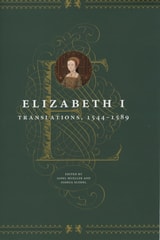
Elizabeth I
Translations, 1544-1589Elizabeth I
University of Chicago Press, 2008
Presenting original and modernized spellings in a facing-page format, these two volumes will answer the call to make all of Elizabeth’s writings available. They include her renderings of epistles of Cicero and Seneca, religious writings of John Calvin and Marguerite de Navarre, and Horace’s Ars poetica, as well as Elizabeth’s Latin Sententiae drawn from diverse sources, on the responsibilities of sovereign rule and her own perspectives on the monarchy. Editors Janel Mueller and Joshua Scodel offer introduction to each of the translated selections, describing the source text, its cultural significance, and the historical context in which Elizabeth translated it. Their annotations identify obscure meanings, biblical and classical references, and Elizabeth’s actual or apparent deviations from her sources.
The translations collected here trace Elizabeth’s steady progression from youthful evangelical piety to more mature reflections on morality, royal responsibility, public and private forms of grief, and the right way to rule. Elizabeth I: Translations is the queen’s personal legacy, an example of the very best that a humanist education can bring to the conduct of sovereign rule.
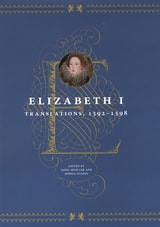
Elizabeth I
Translations, 1592-1598Elizabeth I
University of Chicago Press, 2009
Presenting original and modernized spellings in a facing-page format, these two volumes will answer the call to make all of Elizabeth’s writings available. They include her renderings of epistles of Cicero and Seneca, religious writings of John Calvin and Marguerite de Navarre, and Horace’s Ars poetica, as well as Elizabeth’s Latin Sententiae drawn from diverse sources, on the responsibilities of sovereign rule and her own perspectives on the monarchy. Editors Janel Mueller and Joshua Scodel offer introduction to each of the translated selections, describing the source text, its cultural significance, and the historical context in which Elizabeth translated it. Their annotations identify obscure meanings, biblical and classical references, and Elizabeth’s actual or apparent deviations from her sources.
The translations collected here trace Elizabeth’s steady progression from youthful evangelical piety to more mature reflections on morality, royal responsibility, public and private forms of grief, and the right way to rule. Elizabeth I: Translations is the queen’s personal legacy, an example of the very best that a humanist education can bring to the conduct of sovereign rule.