Results by title
59 books match the query 'Indians, Treatment of' and 2 start with e
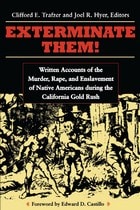
Exterminate Them
Written Accounts of the Murder, Rape, and Enslavement of Native Americans during the California Gold RushClifford E. Trafzer
Michigan State University Press, 1999
Popular media depict miners as a rough-and-tumble lot who diligently worked the placers along scenic rushing rivers while living in roaring mining camps in the foothills of the Sierra Nevada Mountains. Trafzer and Hyer destroy this mythic image by offering a collection of original newspaper articles that describe in detail the murder, rape, and enslavement perpetrated by those who participated in the infamous gold rush. "It is a mercy to the Red Devils," wrote an editor of the Chico Courier, "to exterminate them." Newspaper accounts of the era depict both the barbarity and the nobility in human nature, but while some protested the inhumane treatment of Native Americans, they were not able to end the violence. Native Americans fought back, resisting the invasion, but they could not stop the tide of white miners and settlers. They became "strangers in a stolen land."
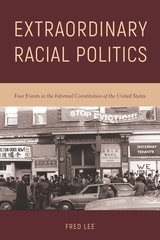
Extraordinary Racial Politics
Four Events in the Informal Constitution of the United StatesFred Lee
Temple University Press, 2018
Extraordinary racial politics rupture out of and reset everyday racial politics. In his cogent book, Fred Lee examines four unusual, episodic, and transformative moments in U.S. history: the 1830s–1840s southeastern Indian removals, the Japanese internment during World War II, the post-war civil rights movement, and the 1960s–1970s racial empowerment movements. Lee helps us connect these extraordinary events to both prior and subsequent everyday conflicts.
Extraordinary Racial Politics brings about an intellectual exchange between ethnic studies, which focuses on quotidian experiences and negotiations, and political theory, which emphasizes historical crises and breaks. In ethnic studies, Lee draws out the extraordinary moments in Michael Omi and Howard Winant’s as well as Charles Mills’s accounts of racial formation. In political theory, Lee considers the strengths and weaknesses of using Carl Schmitt’s and Hannah Arendt’s accounts of public constitution to study racial power.
Lee concludes that extraordinary racial politics represent both the promises of social emancipation and the perils of state power. This promise and peril characterizes our contentious racial present.