Results by title
1917 books match the query 'Law' and 51 start with e
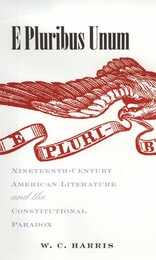
E Pluribus Unum
Nineteenth-Century American Literature and the Constitutional ParadoxHarris, W. C.
University of Iowa Press, 2005
The project of E Pluribus Unum is twofold. Its first and underlying concern is the general philosophic problem of the one and the many as it came to be understood at the time. W. C. Harris supplies a detailed account of the genealogy of the concept, exploring both its applications and its paradoxes as a basis for state and identity formation.
Harris then considers the perilous integration of the one and the many as a motive in the major literary accomplishments of 19th-century U.S. writers. Drawing upon critical as well as historical resources and upon contexts as diverse as cosmology, epistemology, poetics, politics, and Bible translation, he discusses attempts by Poe, Whitman, Melville, and William James to resolve the problems of social construction caused by the paradox of e pluribus unum by writing literary and philosophical texts that supplement the nation’s political founding documents.
Poe (Eureka), Whitman (Leaves of Grass), Melville (Billy Budd), and William James (The Varieties of Religious Experience) provide their own distinct, sometimes contradictory resolutions to the conflicting demands of diversity and unity, equality and hierarchy. Each of these texts understands literary and philosophical writing as having the potential to transform-conceptually or actually-the construction of social order.
This work will be of great interest to literary and constitutional scholars.
ENACTing Change
A Handbook for Teaching Advocacy and Civic EngagementKathleen Cole, Robert W. Glover, Richard J. Meagher, and Katharine A. Owens
Brandeis University Press, 2025
ENACT: The Educational Network for Active Civic Transformation aims to teach college students about democracy through engagement with the state legislative process. Built on the values of knowledge, cooperation, justice, and integrity, ENACT is a national, intercollegiate nonpartisan network. The program empowers students to be active participants in democratic processes by connecting with policymakers and community organizations, conducting research and analysis, and informing public policy with evidence and expertise.
ENACTing Change introduces teachers to the philosophy and practice of the ENACT model—which includes workshops, courses, an online network, as well as pilot projects and other initiatives—while providing detailed guidance on how to incorporate the model into their courses, regardless of discipline or educational settings. The book offers instructors recommendations for developing and teaching courses that engage in state-level policy advocacy with a focus on learning outcomes. ENACTing Change takes instructors through each step of the course design process, from how to build the relationships needed to teach the class to the next steps for students to work in the community after ENACT.
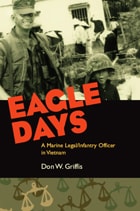
Eagle Days
A Marine Legal/Infantry Officer in VietnamDonald W. Griffis
University of Alabama Press, 2007
A rare Vietnam memoir from the crossroads of combat and military justice.
Much has been written about America’s war in Vietnam, and an enduring and troubling subtext is the composition of the body of soldiers that made up the U.S. troop deployment: from the initially well-trained and disciplined group of largely elite units that served in the mid-sixties to what has been termed an “armed mob” by the end of that decade and into the early 1970s. Drug use, insubordination, racial antagonism that often became violent, theft and black market dealing, and even “fragging” (murder of officers and senior noncoms by disgruntled troops) marred the record of the U.S. military presence. Don Griffis served in the twin roles of legal officer charged at various times with the task of both defending and prosecuting servicemen, while at the same time leading combat patrols in “search and destroy” missions against the Viet Cong and North Vietnamese enemy. Eagle Days is a remarkable account of Griffis’ personal record of experiencing what the military should do best—meet, engage, and defeat the enemy—and what it becomes when esprit de corps, discipline, and a sense of purpose decay.
Eat What You Kill
The Fall of a Wall Street LawyerMilton C. Regan, Jr.
University of Michigan Press, 2005
-Nancy Rapoport, University of Houston Law Center
"Eat What You Kill is gripping and well written. . . . It weaves in academic commentary and understanding of professional ethics issues in a way that makes it accessible to everyone."
-Frank Partnoy, University of San Diego Law School
He had it all, and then he lost it. But why did he do it, risking everything-wealth, success, livelihood, freedom, and the security of family?
Eat What You Kill is the story of John Gellene, a rising star and bankruptcy partner at one of Wall Street's most venerable law firms. But when Gellene became entangled in a web of conflicting corporate and legal interests involving one of his clients, he was eventually charged with making false statements, indicted, found guilty of a federal crime, and sentenced to prison.
Milton C. Regan Jr. uses Gellene's case to prove that such conflicting interests are now disturbingly commonplace in the world of American corporate finance. Combining a journalist's eye with sharp psychological insight, Regan spins Gellene's story into a gripping drama of fundamental tensions in modern-day corporate practice and describes in perfect miniature the inexorable confluence of the interests of American corporations and their legal counselors.
This confluence may seem natural enough, but because these law firms serve many masters-corporations, venture capitalists, shareholder groups-it has paradoxically led to deep, pervasive conflicts of interest. Eat What You Kill gives us the story of a man trapped in this labyrinth, and reveals the individual and systemic factors that contributed to Gellene's demise.
Eco-pragmatism
Making Sensible Environmental Decisions in an Uncertain WorldDaniel A. Farber
University of Chicago Press, 1999
"A comprehensive well-argued effort to address many of the most difficult issues facing legislators concerned with environmental issues."—Stephen P. Adamian, Boston Book Review
"A timely and well-argued contribution."—Calestous Juma, Nature
Editing and Advocacy
Patrick Barry
Michigan Publishing Services, 2022
This book— which is based on a popular course taught at the University of Chicago Law School, the University of Michigan Law School, and the UCLA School of Law— is designed to help you become one of those editors. You’ll learn how to edit with empathy. You’ll learn how to edit with statistics. You’ll learn, in short, a wide range of compositional skills you can use to elevate your advocacy and better champion the causes you care about the most.
Educated by Initiative
The Effects of Direct Democracy on Citizens and Political Organizations in the American StatesDaniel A. Smith and Caroline J. Tolbert
University of Michigan Press, 2004
--Kristina Wilfore, Executive Director, Ballot Initiative Strategy Center and Foundation
Educated by Initiative moves beyond previous evaluations of public policy to emphasize the educational importance of the initiative process itself. Since a majority of ballots ultimately fail or get overturned by the courts, Smith and Tolbert suggest that the educational consequences of initiative voting may be more important than the outcomes of the ballots themselves. The result is a fascinating and thoroughly-researched book about how direct democracy teaches citizens about politics, voting, civic engagement and the influence of special interests and political parties. Designed to be accessible to anyone interested in the future of American democracy, the book includes boxes (titled "What Matters") that succinctly summarize the authors' data into easily readable analyses.
Daniel A. Smith is Associate Professor of Political Science at the University of Florida.
Caroline J. Tolbert is Associate Professor of Political Science at Kent State University.
Ekklesia
Three Inquiries in Church and StatePaul Christopher Johnson, Pamela E. Klassen, and Winnifred Fallers Sullivan
University of Chicago Press, 2018
The first of a closely linked trio of essays is by Paul Johnson, and offers a new interpretation of the Brazilian community gathered at Canudos and its massacre in 1896–97, carried out as a joint churchstate mission and spectacle. In the second essay, Pamela Klassen argues that the colonial churchstate relationship of Canada came into being through local and national practices that emerged as Indigenous nations responded to and resisted becoming “possessions” of colonial British America. Finally, Winnifred Sullivan’s essay begins with reflection on the increased effort within the United States to ban Bibles and scriptural references from death penalty courtrooms and jury rooms; she follows with a consideration of the political theological pressure thereby placed on the jury that decides between life and death. Through these three inquiries, Ekklesia takes up the familiar topos of “church and state” in order to render it strange.
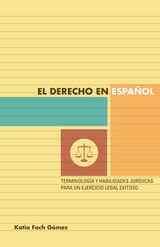
El derecho en español
terminología y habilidades jurídicas para un ejercicio legal exitosoBy Katia Fach Gómez
University of Texas Press, 2014
El español es el segundo idioma más hablado en el mundo. Un número creciente de personas en los Estados Unidos y en otros países son conocedores de este idioma y además lo utilizan profesionalmente en el ámbito jurídico. No obstante, a muchos de ellos les gustaría mejorar su comprensión idiomática y jurídica del mismo. En la actualidad existen pocos recursos didácticos y profesionales a los que recurrir. El derecho en español: Terminología y habilidades jurídicas para un ejercicio legal exitoso es el único libro actualmente en el mercado que ofrece al mismo tiempo instrucción avanzada en español jurídico e información selecta sobre los marcos legales contemporáneos en los que este idioma se utiliza.
Este libro monolingüe en español puede ser utilizado en el aula y también como herramienta de auto-aprendizaje por parte de universitarios y profesionales que posean un nivel intermedio de conocimiento del idioma. El libro contiene diez lecciones, cada una de ellas dedicada a un área clave del derecho: constitucional, contratos, actividades bancarias, penal, familia, inmigración, derechos humanos, litigios internacionales y arbitraje. Todas estas lecciones presentan un vocabulario escogido sobre el tema jurídico abordado en ellas, y después ofrecen una serie de ejercicios basados en documentos jurídicos reales procedentes de diversos países de habla hispana. El último capítulo es una guía para facilitar la comprensión de varias películas que contienen interesantes cuestiones legales y que pueden ser utilizadas para el análisis contextual de los temas abordados en las lecciones precedentes. A través de todos estos materiales de capacitación, los lectores aprenderán a utilizar el vocabulario español jurídico en su contexto operativo adecuado, y podrán entender las diferencias lingüísticas y conceptuales entre los distintos países de América Latina y España. Al mismo tiempo se familiarizarán con las disposiciones y los documentos más utilizados en la práctica jurídica en español. Finalmente, también podrán mejorar sus habilidades de escucha y de redacción jurídica.
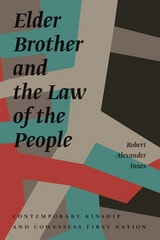
Elder Brother and the Law of the People
Contemporary Kinship and Cowessess First NationRobert Alexander Innes
University of Manitoba Press, 2013

Electronic Evidence
Edited by Stephen Mason and Daniel Seng
University of London Press, 2017
Electronic Evidence
Edited by Stephen Mason and Daniel Seng
University of London Press, 2017
In this updated edition of the well-established practitioner text, Stephen Mason and Daniel Seng have brought together a team of experts in the field to provide an exhaustive treatment of electronic evidence. This fourth edition continues to follow the tradition in English evidence text books by basing the text on the law of England and Wales, with appropriate citations of relevant case law and legislation from other jurisdictions. Stephen Mason (of the Middle Temple, Barrister) is a leading authority on electronic evidence and electronic signatures, having advised global corporations and governments on these topics. He is also the author of Electronic Signatures in Law and editor of International Electronic Evidence, founding the innovative international open access journal Digital Evidence and Electronic Signatures Law Review in 2004. Stephen is an IALS Associate Research Fellow and Visiting Lecturer at the School of Law, University of Tartu, Estonia. Daniel Seng (Associate Professor, National University of Singapore) teaches and researches on information technology law, infocommunications law, evidence and procedure, artificial intelligence, machine learning and legal reasoning. His research interests also include empirical legal studies and quantitative research and data analytics on big data sets. Between 2001 and 2003, he was concurrently the Director of Research, Technology Law Development Group at the Singapore Academy of Law. Daniel is also a special consultant to the World Intellectual Property Organization, where he has researched, delivered papers and published monographs on copyright exceptions for academic institutions, music copyright in the Asia Pacific and the liability of Internet intermediaries. He is also a non-residential fellow with the Centre for Legal Informatics (CodeX), Stanford University. This book is also available online at http://ials.sas.ac.uk/digital/humanities-digital-library/observing-law-ials-open-book-service-law.
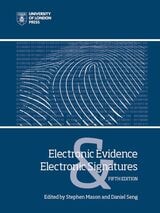
Electronic Evidence and Electronic Signatures
Stephen Mason and Daniel Seng
University of London Press, 2021
In this updated edition of a well-established practitioner text, Stephen Mason and Daniel Seng have brought together a team of experts in the field to provide an exhaustive treatment of electronic evidence and electronic signatures. This fifth edition continues to follow the tradition in English evidence textbooks by basing the text on the law of England and Wales, with appropriate citations of relevant case law and legislation from other jurisdictions.
Electronic Signatures in Law
Stephen Mason
University of London Press, 2016
This fourth edition of the well-established practitioner text sets out what constitutes an electronic signature, the form an electronic signature can take, and discusses the issues relating to evidence – illustrated by analysis of relevant case law and legislation from a wide range of common law and civil law jurisdictions. Stephen Mason is a leading authority on electronic signatures and electronic evidence, having advised global corporations and governments on these topics. He is also the editor of Electronic Evidence and International Electronic Evidence, and he founded the international open-source journal Digital Evidence and Electronic Signature Law Review in 2004. This book is also available online at http://ials.sas.ac.uk/digital/humanities-digital-library/observing-law-ials-open-book-service-law.
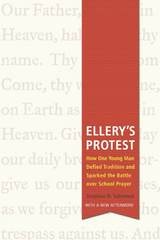
Ellery's Protest
How One Young Man Defied Tradition and Sparked the Battle over School PrayerStephen D. Solomon
University of Michigan Press, 2010
“Solomon’s fascinating and sweeping history of the legal fight over mandatory school prayers is compelling, judicious, and elegantly written. Fabulous!”
—David Rudenstine, Dean, Benjamin N. Cardozo School of Law, Yeshiva University
“Stephen Solomon’s Ellery’s Protest provides a brilliant analysis of a major Supreme Court decision that redefined the relationship between church and state almost a half century ago. This study goes well beyond simply offering a gripping account of the course of litigation that brought before the Justices the contentious issue of prayer and Bible reading in public schools, though the thoroughness of that account would merit careful reading by itself. Especially impressive is the author’s deep probing of hitherto neglected sources, and invaluable primary material including extensive direct contact with the plaintiff, the ‘Ellery’ of the book’s title. Finally, and perhaps most impressive, is Solomon’s careful placement of the issue and the case in a far broader context that is as critical to national life and policy today as it was four and a half decades ago when the high Court first tackled these questions.”
—Robert O’Neil, Professor of Law, University of Virginia
Great legal decisions often result from the heroic actions of average citizens. Ellery’s Protest is the story of how one student’s objection to mandatory school prayer and Bible reading led to one of the most controversial court cases of the twentieth century—and a decision that still reverberates in the battle over the role of religion in public life.
Abington School District v. Schempp began its journey through the nation’s courts in 1956, when sixteen-year-old Ellery Schempp protested his public school’s compulsory prayer and Bible-reading period by reading silently from the Koran. Ejected from class for his actions, Schempp sued the school district. The Supreme Court’s decision in his favor was one of the most important rulings on religious freedom in our nation’s history. It prompted a conservative backlash that continues to this day, in the skirmishes over school prayer, the teaching of creationism and intelligent design, and the recitation of the Pledge of Allegiance with the phrase “under God.”
Author Stephen D. Solomon tells the fascinating personal and legal drama of the Schempp case: the family’s struggle against the ugly reactions of neighbors, and the impassioned courtroom clashes as brilliant lawyers on both sides argued about the meaning of religious freedom. But Schempp was not the only case challenging religious exercises in the schools at the time, and Ellery’s Protest describes the race to the Supreme Court among the attorneys for four such cases, including one involving the colorful atheist Madalyn Murray.
Solomon also explores the political, cultural, and religious roots of the controversy. Contrary to popular belief, liberal justices did not kick God out of the public schools. Bitter conflict over school Bible reading had long divided Protestants and Catholics in the United States. Eventually, it was the American people themselves who removed most religious exercises from public education as a more religiously diverse nation chose tolerance over sectarianism. Ellery’s Protest offers a vivid account of the case that embodied this change, and a reminder that conservative justices of the 1950s and 60s not only signed on to the Schempp decision, but strongly endorsed the separation of church and state.
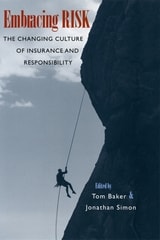
Embracing Risk
The Changing Culture of Insurance and ResponsibilityEdited by Tom Baker and Jonathan Simon
University of Chicago Press, 2001
Embracing Risk explores this new approach from a variety of perspectives. The first part of the book focuses on the interplay between risk and insurance in various historical and social contexts. The second part examines how risk is used to govern fields outside the realm of insurance, from extreme sports to policing, mental health institutions, and international law. Offering an original approach to risk, insurance, and responsibility, the provocative and wide-ranging essays in Embracing Risk demonstrate that risk has moved well beyond its origins in the insurance trade to become a central organizing principle of social and cultural life.
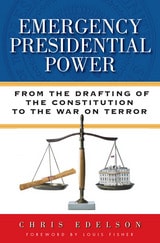
Emergency Presidential Power
From the Drafting of the Constitution to the War on TerrorChris Edelson; Foreword by Louis Fisher
University of Wisconsin Press, 2013
Winner, Crader Family Book Prize in American Values, Department of History and Crader Family Endowment for American Values, Southeast Missouri State University
Employment, Disability, and the Americans with Disabilities Act
Issues in Law, Public Policy, and ResearchPeter David Blanck
Northwestern University Press, 2000
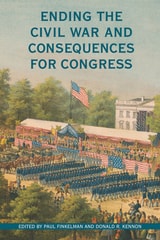
Ending the Civil War and Consequences for Congress
Paul Finkelman
Ohio University Press, 2019
The social changes and human and economic costs of the Civil War led to profound legal and constitutional developments after it ended, not least of which were the Fourteenth and Fifteenth Amendments and the many laws devised to protect the civil rights of newly freed African Americans. These amendments and laws worked for a while, but they were ineffective or ineffectively enforced for more than a century.
In Ending the Civil War and the Consequences for Congress, contributors explore how the end of the war both continued the trauma of the conflict and enhanced the potential for the new birth of freedom that Lincoln promised in the Gettysburg Address. Collectively, they bring their multidisciplinary expertise to bear on the legal, economic, social, and political aspects of the aftermath of the war and Reconstruction era. The book concludes with the reminder of how the meaning of the war has changed over time. The Civil War is no longer the “felt” history it once was, Clay Risen reminds us, and despite the work of many fine scholars it remains contested.
Contributors: Jenny Bourne, Carole Emberton, Paul Finkelman, Lorien Foote, William E. Nelson, Clay Risen, Anne Sarah Rubin, and Peter Wallenstein
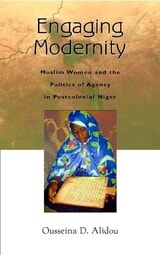
Engaging Modernity
Muslim Women and the Politics of Agency in Postcolonial NigerOusseina Alidou
University of Wisconsin Press, 2005
Engaging Modernity is Ousseina Alidou’s rich and compelling portrait of Muslim women in Niger as they confront the challenges and opportunities of the twentieth century. Contrary to Western stereotypes of passive subordination, these women are taking control of their own lives and resisting domination from indigenous traditions, westernization, and Islam alike.
Based on thorough scholarly research and extensive fieldwork—including a wealth of interviews—Alidou’s work offers insights into the meaning of modernity for Muslim women in Niger. Mixing biography with sociological data, social theory and linguistic analysis, this is a multilayered vision of political Islam, education, popular culture, and war and its aftermath. A gripping look at one of the Muslim world’s most powerful untold stories.
Runner-up for the Aidoo-Snyder Book Prize, Women’s Caucus of the African Studies Association
Engines of Anxiety
Academic Rankings, Reputation, and Accountabilityespeland
Russell Sage Foundation, 2016
Students and the public routinely consult various published college rankings to assess the quality of colleges and universities and easily compare different schools. However, many institutions have responded to the rankings in ways that benefit neither the schools nor their students. In Engines of Anxiety, sociologists Wendy Espeland and Michael Sauder delve deep into the mechanisms of law school rankings, which have become a top priority within legal education. Based on a wealth of observational data and over 200 in-depth interviews with law students, university deans, and other administrators, they show how the scramble for high rankings has affected the missions and practices of many law schools.
Engines of Anxiety tracks how rankings, such as those published annually by the U.S. News & World Report, permeate every aspect of legal education, beginning with the admissions process. The authors find that prospective law students not only rely heavily on such rankings to evaluate school quality, but also internalize rankings as expressions of their own abilities and flaws. For example, they often view rejections from “first-tier” schools as a sign of personal failure. The rankings also affect the decisions of admissions officers, who try to balance admitting diverse classes with preserving the school’s ranking, which is dependent on factors such as the median LSAT score of the entering class. Espeland and Sauder find that law schools face pressure to admit applicants with high test scores over lower-scoring candidates who possess other favorable credentials.
Engines of Anxiety also reveals how rankings have influenced law schools’ career service departments. Because graduates’ job placements play a major role in the rankings, many institutions have shifted their career-services resources toward tracking placements, and away from counseling and network-building. In turn, law firms regularly use school rankings to recruit and screen job candidates, perpetuating a cycle in which highly ranked schools enjoy increasing prestige. As a result, the rankings create and reinforce a rigid hierarchy that penalizes lower-tier schools that do not conform to the restrictive standards used in the rankings. The authors show that as law schools compete to improve their rankings, their programs become more homogenized and less accessible to non-traditional students.
The ranking system is considered a valuable resource for learning about more than 200 law schools. Yet, Engines of Anxiety shows that the drive to increase a school’s rankings has negative consequences for students, educators, and administrators and has implications for all educational programs that are quantified in similar ways.
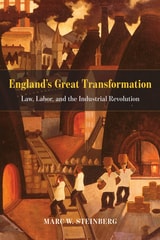
England's Great Transformation
Law, Labor, and the Industrial RevolutionMarc W. Steinberg
University of Chicago Press, 2016
Building his argument on three case studies—the Hanley pottery industry, Hull fisheries, and Redditch needlemakers—Steinberg employs both local and national analyses to emphasize the ways in which these master-servant laws allowed employers to use the criminal prosecutions of workers to maintain control of their labor force. Steinberg provides a fresh perspective on the dynamics of labor control and class power, integrating the complex pathways of Marxism, historical institutionalism, and feminism, and giving readers a subtle yet revelatory new understanding of workplace control and power during England’s Industrial Revolution.
Ensuring Corporate Misconduct
How Liability Insurance Undermines Shareholder LitigationTom Baker and Sean J. Griffith
University of Chicago Press, 2010
Shareholder litigation and class action suits play a key role in protecting investors and regulating big businesses. But Directors and Officers liability insurance shields corporations and their managers from the financial consequences of many illegal acts, as evidenced by the recent Enron scandal and many of last year’s corporate financial meltdowns. Ensuring Corporate Misconduct demonstrates for the first time how corporations use insurance to avoid responsibility for corporate misconduct, dangerously undermining the impact of securities laws.
As Tom Baker and Sean J. Griffith demonstrate, this need not be the case. Opening up the formerly closed world of corporate insurance, the authors interviewed people from every part of the industry in order to show the different instances where insurance companies could step in and play a constructive role in strengthening corporate governance—yet currently do not. Ensuring Corporate Misconduct concludes with a set of readily implementable reforms that could significantly rehabilitate the system.
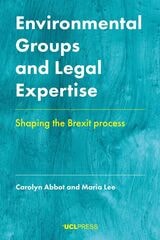
Environmental Groups and Legal Expertise
Shaping the Brexit processCarolyn Abbot and Maria Lee
University College London, 2021
This book explores the use and understanding of law and legal expertise by environmental groups. Rather than focusing on the courtroom, however, this volume scrutinizes environmental NGO advocacy during the extraordinarily dramatic Brexit process, from the referendum on leaving the EU in 2016 to the debate around the new Environment Bill in 2020. In an effort to show how legal expertise is more than a campaign tool or the threat of litigation, this book describes the ways in which law can provide distinctive ways of both seeing and changing the world. Legal resources in the environmental sector are not just a practical limit on what can be done, but an opportunity to investigate the very understanding of what should be done. Legal expertise was heavily and often effectively used in the anomalously law-heavy Brexit-environment debate. This book will clarify this moment and the NGO collaboration that made it possible for environmental advocates to call upon legal expertise in a moment of crisis.
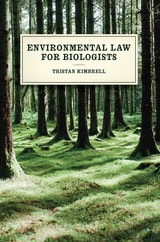
Environmental Law for Biologists
Tristan Kimbrell
University of Chicago Press, 2016
With Environmental Law for Biologists, ecologist and lawyer Tristan Kimbrell bridges this gap in legal knowledge. Complete with a concise introduction to environmental law and an appendix describing the most important federal and international statutes and treaties discussed, the book is divided into four broad parts: laws that focus on individual species, like invasive species policies, the Endangered Species Act, and international treaties such as CITES; laws that focus on land, from federal public lands to agricultural regulations and urban planning; laws that focus on water, such as the Clean Water Act; and laws that focus on air, such as the Clean Air Act and international measures meant to mitigate global climate change. Written for working biologists and students alike, this book will be a catalyst for both more effective policy and enhanced research, offering hope for the manifold frictions between science and the law.
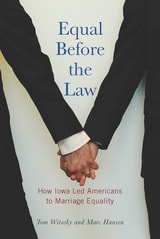
Equal Before the Law
How Iowa Led Americans to Marriage EqualityTom Witosky, Marc Hansen
University of Iowa Press, 2015
The court’s decision in Varnum v. Brien made Iowa only the third state in the nation to permit same-sex couples to wed—moderate, midwestern Iowa, years before such left-leaning coastal states as California and New York. And unlike the earlier decisions in Massachusetts and Connecticut, Varnum v. Brien was unanimous and unequivocal. It catalyzed the unprecedented and rapid shift in law and public opinion that continues today.
Equal Before the Law tells the stories behind this critical battle in the fight for marriage equality and traces the decision’s impact. The struggle began in 1998 with the easy passage of Iowa’s Defense of Marriage Act and took a turn, surprising to many, in 2005, when six ordinary Iowa couples signed on to Lambda Legal’s suit against the law. Their triumph in 2009 sparked a conservative backlash against the supreme court justices, three of whom faced tough retention elections that fall.
Longtime, award-winning reporters Tom Witosky and Marc Hansen talked with and researched dozens of key figures, including opponent Bob Vander Plaats, proponents Janelle Rettig and Sharon Malheiro, attorneys Roger Kuhle, Dennis Johnson, and Camilla Taylor, and politicians Matt McCoy, Mary Lundby, and Tom Vilsack, who had to weigh their careers against their convictions. Justice Mark Cady, who wrote the decision, explains why the court had to rule in favor of the plaintiffs. At the center of the story are the six couples who sacrificed their privacy to demand public respect for their families.
Through these voices, Witosky and Hansen show that no one should have been surprised by the 2009 decision. Iowans have a long history of leadership on civil rights. Just a year after Iowa became a state, its citizens adopted as their motto the phrase, “Our liberties we prize and our rights we will maintain.” And they still do today.
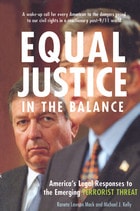
Equal Justice in the Balance
America's Legal Responses to the Emerging Terrorist ThreatRaneta Lawson Mack and Michael J. Kelly
University of Michigan Press, 2004
-Michael Ratner, President, Center for Constitutional Rights, from the foreword
"A compelling and sophisticated critique of the U.S. government's post-9/11 actions. Mack and Kelly set the stage with the historical perspective on America's response to terrorism and the assessment of terrorist threats, before launching into a comprehensive analysis of the USA Patriot Act. Their hard-hitting approach and easy-to-read style makes for a fascinating treatment of the government's legislative and executive response to the attacks."
-Michael P. Scharf, Case Western Reserve University School of Law
With its sweeping critique of the USA Patriot Act and the Bush administration's maneuvers in pursuit of terrorists, Equal Justice in the Balance is a sobering and exacting look at American legal responses to terrorism, both before and after 9/11.
The authors detail wide-ranging and persuasive evidence that American antiterrorism legislation has led to serious infringements of our civil rights. They show us how deviations from our fundamental principles of fairness and justice in times of heightened national anxiety-whether the Red Scare, World War II, or the War on Terrorism-have resulted in overreaction and excess, later requiring apologies and reparations to those victimized by a paranoia-driven justice system.
While terrorist attacks-especially on a large scale and on American soil-damage our national pride and sense of security, the authors offer powerful arguments for why we must allow our judicial infrastructure, imperfect as it is, to respond without undue interference from the politics of anger and vengeance.
Equality for Same-Sex Couples
The Legal Recognition of Gay Partnerships in Europe and the United StatesYuval Merin
University of Chicago Press, 2002
Merin begins by providing a historical overview of the transformation of marriage from antiquity to the present. He then identifies and critically compares four principal models for the legal regulation and recognition of same-sex partnerships: civil marriage, registered partnership, domestic partnership, and cohabitation. Merin concludes that all of the models except civil marriage discriminate against gays and lesbians just as the "separate but equal" doctrine discriminated against African Americans; thus, so-called alternatives to marriage, even if they provide the same rights and benefits as marriage, are inherently unequal and therefore unconstitutional.
Equity and the Constitution
The Supreme Court, Equitable Relief, and Public PolicyGary L. McDowell
University of Chicago Press, 1982
In this volume, Gary McDowell considers the equity power created by Article III of the Constitution, on which the most controversial decisions of the Supreme Court have rested. He points out the equity was originally understood as an extraordinary means of offering relief to individuals in cases of fraud, accident, mistake, or trust and as a means of "confining the operation of unjust and partial laws." It has now been stretched to offer relief to broadly defined social classes. This "sociological" understanding, in McDowell's view, has undermined equity as a substantive body of law. He urges a return to the former definition as a means of restraining the reach of federal jurisdiction.
Errors, Lies, and Libel
Peter E. Kane. Foreword by Elmer Gertz
Southern Illinois University Press, 1992
Peter E. Kane takes a critical look at the development of the present law through a discussion of seventeen landmark libel cases.
One of the many points Kane clarifies is the important distinction between an error and a lie when judging whether someone is guilty of libel. For example, in the series of events that led to Goldwater vs. Ginzburg, Ralph Ginzburg, publisher of fact magazine, compiled and printed in fact a montage of quotes he had collected from psychiatrists about Barry Goldwater. It took five years of legal sparring for the courts to conclude that Ginzburg had deliberately published a malicious and irresponsible document and to rule in favor of Goldwater. Kane closes with a discussion of current thinking on possible libel reform.
Espana Pontifica
Papal Letters to Spain 1198-1303Peter Linehan
Catholic University of America Press, 2022
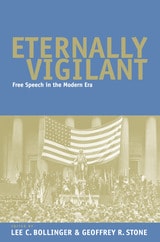
Eternally Vigilant
Free Speech in the Modern EraEdited by Lee C. Bollinger and Geoffrey R. Stone
University of Chicago Press, 2001
"With group efforts, such as this collection of essays, it is almost inevitable that there will be a couple—and often several—duds among the bunch, or at least a dismaying repetition of ideas. Such is not the case here. . . . Whether one agrees with a given author or not (and it is possible to do both with any of the essays), each has something to add. Overall, Eternally Vigilant is a thoughtful and thought-provoking book, consistently intelligent and, at times, brilliant."—Richard J. Mollot, New York Law Journal
Contributors:
Lillian R. BeVier
Vincent Blasi
Lee C. Bollinger
Stanley Fish
Owen M. Fiss
R. Kent Greenawalt
Richard A. Posner
Robert C. Post
Frederick Schauer
Geoffrey R. Stone
David A. Strauss
Cass R. Sunstein
Ethics and Law for Neurosciences Clinicians
Foundations and Evolving ChallengesJames E. Szalados
Rutgers University Press, 2019
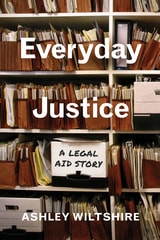
Everyday Justice
A Legal Aid StoryAshley Wiltshire
Vanderbilt University Press, 2022
Those surviving on low incomes often see the legal system as an oppressive force stacked against them. Everyday Justice is about lawyers trying to make the law work for these people. This book traces the development and evolution of legal aid in Middle Tennessee from the late 1960s to the turn of the millennium, as told by Ashley Wiltshire, who worked for the Legal Aid Society of Middle Tennessee and the Cumberlands in all its incarnations for four decades, beginning a year after its inception.
Set in the context of the legal aid movement in the United States—beginning as a part of the social awakening in the post–Civil War era, continuing with volunteer efforts in the first part of the twentieth century, and coming to fruition beginning with the OEO Office of Legal Services grants of the 1960s as part of the War on Poverty—Everyday Justice is a story of Nashville, which levied an extended period of opposition because of prevailing cultural and religious views on race and poverty.
Everyday Justice
A Legal Aid StoryAshley Wiltshire
Vanderbilt University Press, 2022
Those surviving on low incomes often see the legal system as an oppressive force stacked against them. Everyday Justice is about lawyers trying to make the law work for these people. This book traces the development and evolution of legal aid in Middle Tennessee from the late 1960s to the turn of the millennium, as told by Ashley Wiltshire, who worked for the Legal Aid Society of Middle Tennessee and the Cumberlands in all its incarnations for four decades, beginning a year after its inception.
Set in the context of the legal aid movement in the United States—beginning as a part of the social awakening in the post–Civil War era, continuing with volunteer efforts in the first part of the twentieth century, and coming to fruition beginning with the OEO Office of Legal Services grants of the 1960s as part of the War on Poverty—Everyday Justice is a story of Nashville, which levied an extended period of opposition because of prevailing cultural and religious views on race and poverty.
Everyday Law on the Street
City Governance in an Age of DiversityMariana Valverde
University of Chicago Press, 2012
Everyman's Constitution
Historical Essays on the Fourteenth Amendment, the "Conspiracy Theory," and American ConstitutionalismHoward Jay Graham
Wisconsin Historical Society Press, 1968
Everyone against Us
Public Defenders and the Making of American JusticeAllen Goodman
University of Chicago Press, 2023
As a public defender, Allen Goodman faced cross-examination from family and friends every day: How could he work to help criminals? How could he live with himself? Presumed guilty by association, Goodman quickly learned that people didn’t really want an answer; they wanted a justification, perhaps even an apology. Ever the idealist, Goodman answered anyway: Everyone deserves justice.
Everyone against Us is Goodman’s testimony of his life as a public defender. In it, he documents his efforts to defend clients, both guilty and innocent, against routine police abuse, prosecutorial misconduct, and unjust sentencing. To work in criminal justice, Goodman shows, is to confront and combat vivid human suffering, of both victims and perpetrators. From sex trafficking, murder, and abuse to false conviction, torture, and systemic racism, Goodman describes the daily experiences that both rattled his worldview and motivated him to work ever harder. Part memoir, part exposé, Everyone against Us is the moving story of an embattled civil servant who staves off the worst abuses of the criminal justice system, at great personal cost.
Evidence and Inference in History and Law
Interdisciplinary DialoguesWilliam Twining and Ian Hampsher-Monk
Northwestern University Press, 2003
Coedited by Twining, one of the world's outstanding evidence scholars, and Iain Hampsher-Monk, a leading political theorist, the volume considers intriguing questions from Assyriology, theater iconography, musicology, criminology, the history of ideas, and colonial history as it reveals how particular concepts, lines of questioning, and techniques of reasoning and analysis developed in one context can be fruitfully applied in others. Did cuneiform languages really die out in the second or third century B.C.? Was Schubert responsible for any of the guitar arrangements for some of his lieder? In these cases and others, the authors' work demonstrates that, regardless of the field or the problem, all such projects involve drawing inferences from evidence, and that the logic of this kind of inquiry is always governed by the same principles.
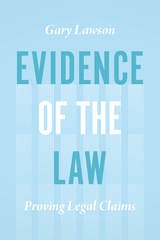
Evidence of the Law
Proving Legal ClaimsGary Lawson
University of Chicago Press, 2017
As Gary Lawson shows, legal claims are inherently objects of proof, and whether or not the law acknowledges the point openly, proof of legal claims is just a special case of the more general norms governing proof of any claim. As a result, similar principles of evidentiary admissibility, standards of proof, and burdens of proof operate, and must operate, in the background of claims about the law. This book brings these evidentiary principles for proving law out of the shadows so that they can be analyzed, clarified, and discussed. Viewing legal problems through this lens of proof illuminates debates about everything from constitutional interpretation to the role of stipulations in litigation. Rather than prescribe resolutions to any of those debates, Evidence of the Law instead provides a set of tools that can be used to make those debates more fruitful, whatever one’s substantive views may be. As lawyers, judges, and legal subjects confront uncertainty about what the law is, they can, should, and must, Lawson argues, be guided by the same kinds of abstract considerations, structures, and doctrines long used to make determinations about questions of fact.

Evidence
Its Meanings in Health Care and in Law, Volume 26Mark Peterson, ed.
Duke University Press, 0
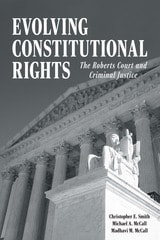
Evolving Constitutional Rights
The Roberts Court and Criminal JusticeChristopher E. Smith, Michael A. McCall, and Madhavi M. McCall
Southern Illinois University Press, 2025
Illuminating continuity and change in Supreme Court decisions
Evolving Constitutional Rights: The Roberts Court and Criminal Justice offers a compelling and in-depth analysis of how the U.S. Supreme Court has reshaped constitutional protections under Chief Justice John Roberts. Authors Christopher E. Smith, Michael A. McCall, and Madhavi M. McCall examine the Court’s significant decisions from 2005 to Justice Breyer’s retirement in 2022, revealing a complex judicial landscape where traditional doctrines are revised and fundamental rights are redefined.
The Roberts Court played a decisive role in some of the most contentious issues in American law. Due to several justices’ application of originalist interpretations, its rulings have reconfigured key constitutional protections—often in ways that expand the authority of law enforcement while constraining legislative power over criminal statutes. The trajectory of the Court’s conservative supermajority raises pressing questions about the future of constitutional rights.
Taking a rigorous yet accessible approach, Evolving Constitutional Rights breaks down the Court’s influence across the full spectrum of criminal justice issues, from sentencing and trial rights to search-and-seizure protections, Miranda warnings, and corrections policies. Using both legal and empirical analysis, the authors track patterns in judicial ideology, uncovering how the Roberts Court has not only reinforced conservative principles but also unexpectedly broadened rights in areas such as digital privacy and defense counsel obligations.
This timely and insightful book goes beyond historical rulings to offer a forward-looking perspective on the Supreme Court’s role in shaping public safety, legal precedent, and the balance of power in American government. Essential reading for legal scholars, policymakers, and anyone concerned with the future of constitutional rights, this new volume provides a clear and authoritative examination of the Roberts Court’s lasting impact on American law.
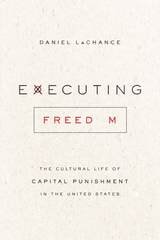
Executing Freedom
The Cultural Life of Capital Punishment in the United StatesDaniel LaChance
University of Chicago Press, 2016
That question is at the heart of Executing Freedom, a powerful, wide-ranging examination of the place of the death penalty in American culture and how it has changed over the years. Drawing on an array of sources, including congressional hearings and campaign speeches, true crime classics like In Cold Blood, and films like Dead Man Walking, Daniel LaChance shows how attitudes toward the death penalty have reflected broader shifts in Americans’ thinking about the relationship between the individual and the state. Emerging from the height of 1970s disillusion, the simplicity and moral power of the death penalty became a potent symbol for many Americans of what government could do—and LaChance argues, fascinatingly, that it’s the very failure of capital punishment to live up to that mythology that could prove its eventual undoing in the United States.
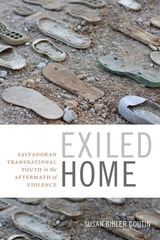
Exiled Home
Salvadoran Transnational Youth in the Aftermath of ViolenceSusan Bibler Coutin
Duke University Press, 2016

Expanding Intellectual Property
Copyrights and Patents in 20th Century Europe and beyondAugusta Dimou
Central European University Press, 2017
Experiencing Other Minds in the Courtroom
Neal Feigenson
University of Chicago Press, 2016
In Experiencing Other Minds in the Courtroom, Neal Feigenson turns the courtroom into a forum for exploring the profound philosophical, psychological, and legal ramifications of our efforts to know what other people’s conscious experiences are truly like. Drawing on disciplines ranging from cognitive psychology to psychophysics to media studies, Feigenson harnesses real examples of digitally simulated subjective perceptions to explain how the epistemological value of this evidence is affected by who creates it, how it is made, and how it is presented. Through his close scrutiny of the different kinds of simulations and the different knowledge claims they make, Feigenson is able to suggest best practices for how we might responsibly incorporate such evidence into the courtroom.
Expert Legal Writing
By Teresa Ross LeClercq
University of Texas Press, 1995
For many years, Terri LeClercq's "Legal Writing" column in the Texas Bar Journal helped polish the prose of lawyers and law students, judges and clerks, paralegals, writing instructors, and legal secretaries. This book collects all the advice she has given in her columns into one authoritative guide for expert legal writing. LeClercq covers everything a legal writer needs to know, from the mechanics of grammar and punctuation to the finer points of style, organization, and clarity of meaning. With her practical, readable, and often humorous advice, those who prepare legal documents can rid their prose of mind-numbing "legalese" and write with the clarity and precision that characterize the very best legal writing.

Exploiting the Wilderness
An Analysis of Wildlife CrimeGreg L. Warchol
Temple University Press, 2017
Illegally harvested ivory and endangered plants, mammals, reptiles, birds, and even insects are easily found for sale throughout East and Southern Africa. And this is just one part of the multi-billion-dollar illegal global trade in wildlife.
Wildlife is an important and even vital asset for both intrinsic and economic reasons. Yet it is illegally exploited on a massive scale to the point where some species now risk extinction. Exploiting the Wilderness provides a concise overview of this shameful business, describing some of the main species being exploited and examining select wildlife whose survival is imperiled due to heavy pressure from poachers to meet consumer demand.
Greg Warchol draws on his firsthand experience and research in Africa to examine the structure and operation of the illegal trade in wildlife. He identifies the participants as well as their motivations and operations, and explains the behavior of poachers, traffickers, and consumers of illegally obtained goods. He concludes with a description of legislative and law enforcement efforts to control and prevent wildlife exploitation along with a number of contemporary conservation initiatives designed to improve the ability of rangers to protect wildlife.
Exploring the Nature of Law
Thomistic Juridical Realism and the Elements of Law's OntologyPetar Popovic
Catholic University of America Press, 2025