Results by title
262 books match the query 'Love' and 13 start with e
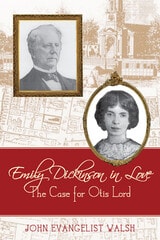
Emily Dickinson in Love
The Case for Otis LordWalsh, John Evangelist
Rutgers University Press, 2012
From the award-winning author of Poe the Detective: The Curious Circumstances Behind "The Mystery of Marie Roget" comes a compelling argument for the identity of Emily Dickinson’s true love
Proud of my broken heart
Since thou didst break it,
Proud of the pain I
Did not feel till thee . . .
Those words were written by Emily Dickinson to a married man. Who was he?
For a century or more the identity of Emily Dickinson’s mysterious “Master” has been eagerly sought, especially since three letters from her to him were found and published in 1955. In Emily Dickinson in Love, John Evangelist Walsh provides the first book-length treatment of this fascinating subject, offering a solution based wholly on documented facts and the poet’s own writings.
Crafting the affair as a love story of rare appeal, and writing with exquisite attention to detail, in Part I Walsh reveals and meticulously proves the Master to be Otis Lord, a friend of the poet’s father and a man of some reputation in law and politics. Part II portrays the full dimensions of their thirty-year romance, most of it clandestine, including a series of secret meetings in Boston.
After uncovering and confirming the Master’s identity, Walsh fits that information into known events of Emily’s life to make sense of facts long known but little understood—Emily’s decision to dress always in white, for instance, or her extreme withdrawal from a normal existence when she had previously been an active, outgoing friend to many men and women.
In a lengthy section of Notes and Sources, Walsh presents his proofs in abundant detail, demonstrating that the evidence favors one man so irresistibly that there is left no room for doubt. Each reader will decide if he has truly succeeded in making the case for Otis Lord.
Emotional Landscapes
Love, Gender, and MigrationEdited by Marcelo J. Borges, Sonia Cancian, and Linda Reeder
University of Illinois Press, 2020
Affecting and perceptive, Emotional Landscapes moves from war and transnational families to gender and citizenship to explore the crossroads of migration and the history of emotion.
Contributors: María Bjerg, Marcelo J. Borges, Sonia Cancian, Tyler Carrington, Margarita Dounia, Alexander Freund, Donna R. Gabaccia, A. James Hammerton, Mirjam Milharčič Hladnik, Emily Pope-Obeda, Linda Reeder, Roberta Ricucci, Suzanne M. Sinke, and Elizabeth Zanoni
Enthusiasm And Divine Madness
Josef Pieper
St. Augustine's Press, 1999
Pieper gives interpretation of the dialogue. Leaving the more recondite scholarly preoccupations aside, he concentrates on the content, bringing the actual situation in the dialogue – Athens and its intellectuals engaged in spirited debate – alive. Equally alive is the discussion of ideas, which are brought to bear on contemporary experience and made to prove the perennial validity of Socratic wisdom, and its power to excite the mind. The main thesis – that in poetry and in love man is "beside himself," that is, divinely inspired - is discussed with reference to modern poets, novelists, and modern psychology.
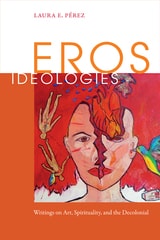
Eros Ideologies
Writings on Art, Spirituality, and the DecolonialLaura E. Pérez
Duke University Press, 2018
Eros, Wisdom, and Silence
Plato's Erotic DialoguesJames M. Rhodes
University of Missouri Press, 2003
Erotic Faith
Being in Love from Jane Austen to D. H. LawrenceRobert M. Polhemus
University of Chicago Press, 1990
Drawing on a wide range of disciplines, Polhemus shows the reciprocity of love as subject, the novel as form, and faith as motive in important works by Jane Austen, Walter Scott, the Brontës, Dickens, George Eliot, Trollope, Thomas Hardy, Joyce, D. H. Lawrence, Virginia Woolf, and Samuel Beckett. Throughout, Polhemus relates the novelists' representation of love to that of such artists as Botticelli, Vermeer, Claude Lorrain, Redon, and Klimt. Juxtaposing their paintings with nineteenth- and twentieth-century texts both reveals the ways in which novels develop and individualize common erotic and religious themes and illustrates how the novel has influenced our perception of all art.
Erotikon
Essays on Eros, Ancient and ModernEdited by Shadi Bartsch and Thomas Bartscherer
University of Chicago Press, 2005
An idea charged with paradox, eros has always defied categorization, and yet it cannot—it will not—be ignored. Erotikon aims to raise the difficult question of what, if anything, unifies the erotic manifold. How is eros in a sculpture like eros in a poem? Does the ancient story of Cupid and Psyche still speak meaningfully to modern readers, and if so, why? Is Plato's eros the same as Freud's? Or Proust's? And what is the erotic dimension in Nietzsche's thought? While each essay takes on a specific issue, together they constitute a wide-ranging conversation in which these broader questions are at play. A compilation of the latest, best efforts to reckon with eros, Erotikon will appeal not just to scholars and educators, but also to artists and critics, to the curious and the disillusioned, to the prurient and the prudent.

Europe and Love in Cinema
Edited by Luisa Passerini, Jo Labanyi, and Karen Diehl
Intellect Books, 2012
Europe and Love in Cinema explores the relationship between love and Europeanness in a wide range of films from the 1920s to the present. A critical look at the manner in which love—in its broadest sense—is portrayed in cinema from across Europe and the United States, this volume exposes constructed notions of "Europeanness" that both set Europe apart and define some parts of it as more "European" than others. Through the international distribution process, these films in turn engage with ideas of Europe from both outside and within, while some, treated extensively in this volume, even offer alternative models of love. A bracing collection of essays from top film scholars, Europe and Love in Cinema demonstrates the centrality of desire to film narrative and explores multiple models of love within Europe's frontiers.
Everyone I Love, Alive
Jason Bayani
Omnidawn, 2025
With this collection of poems, Jason Bayani leans into traditions of lyric, song, and prayer to cultivate life while existing within a time of empire and societal collapse. Everyone I Love, Alive wrestles with form to summon both the living and the dead. Bayani’s rich language calls us to experience a connection to cultural heritage and, even during times of oppression, to find the compassion and awareness needed to drive change. These poems show how not only our love and desires—but also our rage and resistance—can be the very things that keep us alive.
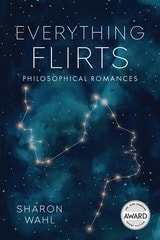
Everything Flirts
Philosophical RomancesSharon Wahl
University of Iowa Press, 2024
At the heart of the stories in Everything Flirts are some of life’s trickiest questions: Why is it so hard to make the first move on a date? How do we find the person we will love? If you finally find a person to love, how do you convince them to love you back?
With a mixture of humor and reverence, Sharon Wahl hijacks classic works of philosophy and turns their focus to love. The philosopher Wittgenstein helps us consider the limits of language: Does there exist an argument, a logical deduction, that will cause another person to love us? The philosopher Zeno’s laws of motion stipulate that we can only ever cross half of any distance. This principle is applied to a first date, where making a first move becomes more and more impossible because the movie this couple goes to see is a depressing mood-killer. A woman afraid of love applies Bentham’s utilitarian principles to find her perfect match, testing every man she meets until she finds one who aces every one of her tests. Nonetheless, she wonders: Is he right for her? Is she ready to fall in love forever? The sublime and the ridiculous come together to playfully examine why love just might be a topic too hard for philosophers to explain.
Exemplary Tales of Love and Tales of Disillusion
María de Zayas y Sotomayor
University of Chicago Press, 2009

Ezra Pound and the Mysteries of Love
A Plan for the CantosAkiko Miyake
Duke University Press, 1991
Drawing upon this key five-volume work, as well as comprehensive research in both primary and secondary sources, Miyake brings the partial perceptions of other critics and commentators into an illuminating whole. Disclosing the deliberateness of The Cantos, Miyake provides new insight into Pound’s sense of culture and into the nature of his Confucianism. She sheds light on the disastrous path Pound followed into Fascism and anti-Semitism, and, in contrast to the image of a “pagan” Pound that has emerged in recent years, reveals a poet writing as a Christian from within the Christian mythical tradition.
e-mail trouble
love and addiction @ the matrixBy S. Paige Baty
University of Texas Press, 1999
"This is about a society of isolates who all communicate with one another from terminal sites. This is about being disembodied, distanced, distinct, and that sort of boundary-thing. It is not about being present. It is not about being there. It is not about a shared history, or a shared meal, or a shared story, or any kind of mutuality. It is about contact between virtual strangers. . . . It happens when you feel that you are so alone that you need anybody to talk to—anybody at all—because you believe that your connections have failed you. This kind of connection leaves you cold and dead inside, because it lacks history and a language of belonging."
In this daring, postmodern autobiography, S. Paige Baty recounts her search for love and community on the Internet. Taking Jack Kerouac's On the Road as a point of departure, Baty describes both an actual road trip to meet the object of an e-mail romance and the cyber-search for connection that draws so many people into the matrix of the Internet. Writing in a bold, experimental style that freely mixes e-mails, poems, fragments of quotations, and puns into expository text, she convincingly links e-mail trouble with "female trouble" in the displacement of embodied love and accountable human relationships to opaque screens and alienated identities. Her book stands as a vivid feminist critique of our culture's love affair with technology and its dehumanizing effect on personal relationships.