Results by title
534 books match the query 'Making' and 20 start with e
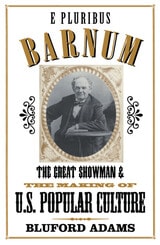
E Pluribus Barnum
The Great Showman and the Making of U.S. Popular CultureBluford Adams
University of Minnesota Press, 1997
The first book to consider the career of P. T. Barnum from a cultural studies perspective.
Phineas Taylor Barnum lived from 1810 until 1891, and in the eighty-one years of his life he created show business as we know it. In E Pluribus Barnum, Bluford Adams investigates the influence Barnum had on American popular culture of the nineteenth century, and expands our understanding of the ways he continues to influence us today.
Beginning with a discussion of Barnum’s early shows, Adams demonstrates the dynamic interplay between Barnum’s increasingly “respectable” aspirations for his entertainments and his active cultivation of middle-class sensibilities in his audiences. In his discussion of the 1850-51 concert tour of the “Swedish Nightingale” Jenny Lind, Adams explores the role played by women’s rights and class issues in Barnum’s management of these concerts. Barnum’s American Museum and the “moral dramas” presented in its theater (which included a play of Uncle Tom’s Cabin) are examined in the context of debates about slavery and temperance. The later circuses are discussed in terms of their international pageants and their staging of orientalism through racial exhibitions. Adams relates the rise of Barnum to the emergence of a new U.S. society, one riven by conflicts over slavery, feminism, immigration, and capitalism. He documents Barnum’s efforts to negotiate those conflicts by steadily remaking his amusements and his public image. E Pluribus Barnum examines Barnum’s shifting political allegiances for what they tell us about American culture at the time, examines the audiences he created, and considers his career as a crucial moment in the ongoing struggle over the politics of U.S. commercial entertainments.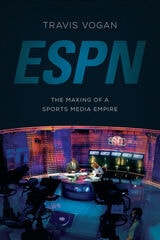
ESPN
The Making of a Sports Media EmpireTravis Vogan
University of Illinois Press, 2015
Travis Vogan teams archival research and interviews with an all-star cast to pen the definitive account of how ESPN turned X's and O's into billions of $$$. Vogan's institutional and cultural history focuses on the network since 1998, the year it launched a high-motor effort to craft its brand and grow audiences across media platforms. As he shows, innovative properties like SportsCentury, ESPN The Magazine, and 30 for 30 built the network's cultural caché. This credibility, in turn, propelled ESPN's transformation into an entity that lapped its run-of-the-mill competitors and helped fulfill its self-proclaimed status as the "Worldwide Leader in Sports."
Ambitious and long overdue, ESPN: The Making of a Sports Media Empire offers an inside look at how the network changed an industry and reshaped the very way we live as sports fans.
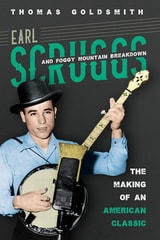
Earl Scruggs and Foggy Mountain Breakdown
The Making of an American ClassicThomas Goldsmith
University of Illinois Press, 2019
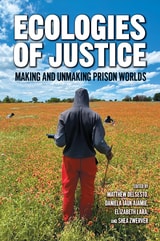
Ecologies of Justice
Making and Unmaking Prison WorldsMatthew DelSesto
Rutgers University Press, 2027
What is the role of multi-species ecologies in creating spaces that counteract the violence in carceral systems and environmental destruction? This book brings together, for the first time, contributions on issues related to prison, jail, and reentry programs, community-based interventions, environmental justice, and sustainability. Through rigorous analysis, detailed case studies, poetry, and personal reflections, the book offers ways of thinking and acting at the intersection of environmental issues and the carceral system. It gathers hard-earned wisdom and insight of researchers, activists, practitioners, and community leaders from within and beyond prison walls who have taken up their projects despite profound institutional constraints.
Approaches in the book range from reform to abolition, as authors detail both practical interventions and imaginative courses of action. More than a contribution to academic knowledge, the book also uniquely highlights voices of those who are incarcerated, survivors of crime, and institutional stakeholders. In addition to writing about the carceral system based on research and personal experience, authors describe practices that are creating transformative spaces of environmental education, building effective pipelines for green workforce development, and sustaining reciprocal relationships for eco-social healing.
Visit for more information: ecologiesofjustice.net
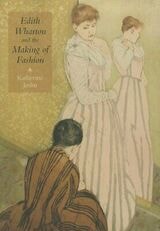
Edith Wharton and the Making of Fashion
Katherine Joslin
University of New Hampshire Press, 2011
Edith Wharton and the Making of Fashion places the iconic New York figure and her writing in the context of fashion history and shows how dress lies at the very center of her thinking about art and culture. The study traces American patronage of the Paris couture houses from Worth and Doucet through Poiret and Chanel and places Wharton's characters in these establishments and garments to offer fresh readings of her well-known novels. Less known are Wharton's knowledge of and involvement in the craft of garment making in her tales of seamstresses, milliners, and textile workers, as well as in her creation of workshops in Paris during the First World War to employ Belgian and French seamstresses and promote the value of handmade garments in a world given to machine-driven uniformity of design and labor. Pointing the way toward further research and inquiry, Katherine Joslin has produced a truly interdisciplinary work that combines the best of literary criticism with an infectious love and appreciation of material culture.
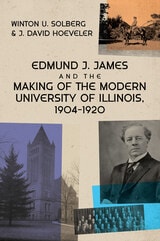
Edmund J. James and the Making of the Modern University of Illinois, 1904-1920
Winton U. Solberg and J. David Hoeveler
University of Illinois Press, 2024
In 1904, Edmund J. James inherited the leadership of an educational institution in search of an identity. His sixteen-year tenure transformed the University of Illinois from an industrial college to a major state university that fulfilled his vision of a center for scientific investigation.
Winton U. Solberg and J. David Hoeveler provide an account of a pivotal time in the university’s evolution. A gifted intellectual and dedicated academic reformer, James began his tenure facing budget battles and antagonists on the Board of Trustees. But as time passed, he successfully campaigned to address the problems faced by women students, expand graduate programs, solidify finances, create a university press, reshape the library and faculty, and unify the colleges of liberal arts and sciences. Combining narrative force with exhaustive research, the authors illuminate the political milieu and personalities around James to draw a vivid portrait of his life and times.
The authoritative conclusion to a four-part history, Edmund J. James and the Making of the Modern University of Illinois, 1904–1920 tells the story of one man’s mission to create a university worthy of the state of Illinois.

Empire City
The Making And Meaning OfDavid Scobey
Temple University Press, 2003
Author David Scobey paints a remarkable panorama of New York's uneven development, a city-building process careening between obsessive calculation and speculative excess. Envisioning a new kind of national civilization, "bourgeois urbanists" attempted to make New York the nation's preeminent city. Ultimately, they created a mosaic of grand improvements, dynamic change, and environmental disorder. Empire City sets the stories of the city's most celebrated landmarks -- Central Park, the Brooklyn Bridge, the downtown commercial center -- within the context of this new ideal of landscape design and a politics of planned city building. Perhaps such an ambitious project for guiding growth, overcoming spatial problems, and uplifting public was bound to fail; still, it grips the imagination.
Empire of the Superheroes
America’s Comic Book Creators and the Making of a Billion-Dollar IndustryBy Mark Cotta Vaz
University of Texas Press, 2021
Superman may be faster than a speeding bullet, but even he can't outrun copyright law. Since the dawn of the pulp hero in the 1930s, publishers and authors have fought over the privilege of making money off of comics, and the authors and artists usually have lost. Jerry Siegel and Joe Shuster, the creators of Superman, got all of $130 for the rights to the hero.
In Empire of the Superheroes, Mark Cotta Vaz argues that licensing and litigation do as much as any ink-stained creator to shape the mythology of comic characters. Vaz reveals just how precarious life was for the legends of the industry. Siegel and Shuster—and their heirs—spent seventy years battling lawyers to regain rights to Superman. Jack Kirby and Joe Simon were cheated out of their interest in Captain America, and Kirby's children brought a case against Marvel to the doorstep of the Supreme Court. To make matters worse, the infant comics medium was nearly strangled in its crib by censorship and moral condemnation. For the writers and illustrators now celebrated as visionaries, the "golden age" of comics felt more like hard times.
The fantastical characters that now earn Hollywood billions have all-too-human roots. Empire of the Superheroes digs them up, detailing the creative martyrdom at the heart of a pop-culture powerhouse.
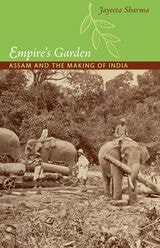
Empire's Garden
Assam and the Making of IndiaJayeeta Sharma
Duke University Press, 2011
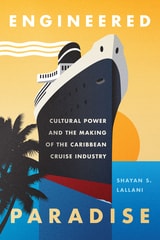
Engineered Paradise
Cultural Power and the Making of the Caribbean Cruise IndustryShayan S. Lallani
University of Illinois Press, 2027
We celebrate cruise ships as gateways to new cultures. However, over the past half a century, the mass-market cruise industry has increasingly relied on global supply chains, exploited maritime labor, and corporate control over the consumer experience to turn cultural contact into profit.
Shayan S. Lallani uncovers the historical scaffolding behind the cruise industry’s strategic co-opting of global cultures. Tracing the evolution of the modern mega-ship from its roots in postwar ocean liners to the floating cities of the twenty-first century, Lallani demonstrates how cruise lines paired commodified cultural referents with immersive spatial design and international labor to maximize guest spending. This corporate grip extended to Caribbean destinations, where companies steadily gained control of port enclaves and vetted shore excursions to manage contact with local communities while retaining the profits.
A sobering look at a vacation mainstay, <i>Engineered Paradise</i> explores where leisure becomes entangled with culture, capitalism, and power.
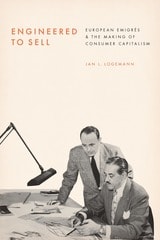
Engineered to Sell
European Émigrés and the Making of Consumer CapitalismJan L. Logemann
University of Chicago Press, 2019
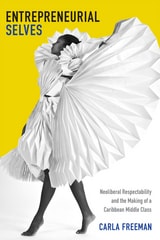
Entrepreneurial Selves
Neoliberal Respectability and the Making of a Caribbean Middle ClassCarla Freeman
Duke University Press, 2014

Escaping into Nature
The Making of a Sportsman-Conservationist and Environmental HistorianJohn F. Reiger
Oregon State University Press, 2013
In Escaping into Nature, prominent wildlife conservationist and environmental historian John Reiger shares his story of an angler and hunter who found a cause and a calling and combined them for his life’s work.
John Reiger’s outdoor adventures as a young man primed him for the teachings of the great sportsmen-conservationists of the past, particularly George Bird Grinnell, Theodore Roosevelt, and Aldo Leopold. Inspired by these conservation giants, Reiger left the security of a tenured professorship to serve as executive director of the Connecticut Audubon Society where he, sometimes controversially, put his ideals into practice. Later, he resumed his academic career to illuminate the lives of early wildlife conservationists, visionaries who continue to inspire us to care deeply about the future of the natural world.
Abused psychologically within his family in his early years, Reiger found solace in nature. Though he first entered the outdoors as an escape from his unpleasant circumstances, he soon found the study and pursuit of insects, fishes, and birds to be exciting ends in themselves. He came to believe that it was only by participating in the life and death of other creatures that one could learn to truly value the natural world, be a part of it, and be inspired to work for its conservation.
John Reiger’s autobiography is also the story of his own developing fascination with America’s past, especially as it relates to human interaction with the natural world; his desire to share that passion with others; and his experiences on the road to becoming a nationally recognized scholar. The twists and turns of that journey, and his accounts of the people—and of the wild creatures—who helped him along the way, will appeal to history enthusiasts and nature lovers alike.
Ethnic Entrepreneurs, Crony Capitalism, and the Making of the Franco-Mexican Elite
José Galindo
University of Alabama Press, 2021
A groundbreaking historical narrative of corruption and economic success in Mexico.
Ethnic Entrepreneurs, Crony Capitalism, and the Making of the Franco-Mexican Elite provides a new way to understand the scope and impact of crony capitalism on institutional development in Mexico. Beginning with the Porfiriato, the period between 1876 and 1911 named for the rule of President Porfirio Díaz, José Galindo identifies how certain behavioral patterns of the Mexican political and economic elite have repeated over the years, and analyzes aspects of the political economy that have persisted, shaping and at times curtailing Mexico’s economic development.
Strong links between entrepreneurs and politicians have allowed elite businessmen to receive privileged support, such as cheap credit, tax breaks, and tariff protection, from different governments and to run their companies as monopolies. In turn, successive governments have obtained support from businesses to implement public policies, and, on occasion, public officials have received monetary restitution. Galindo notes that Mexico’s early twentieth-century institutional framework was weak and unequal to the task of reining in these systematic abuses. The cost to society was high and resulted in a lack of fair market competition, unequal income distribution, and stunted social mobility.
The most important investors in the banking, commerce, and manufacturing sectors at the beginning of the twentieth century in Mexico were of French origin, and Galindo explains the formation of the Franco-Mexican elite. This Franco-Mexican narrative unfolds largely through the story of one of the richest families in Mexico, the Jeans, and their cotton textile empire. This family has maintained power and wealth through the current day as Emilio Azcárraga Jean, a great-grandson of one of the members of the first generation of the Jean family to arrive in Mexico, owns Televisa, a major mass media company with one of the largest audiences for Spanish-language content in the world.
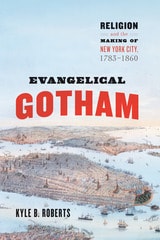
Evangelical Gotham
Religion and the Making of New York City, 1783–1860Kyle B. Roberts
University of Chicago Press, 2016
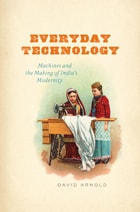
Everyday Technology
Machines and the Making of India's ModernityDavid Arnold
University of Chicago Press, 2013
Everyone against Us
Public Defenders and the Making of American JusticeAllen Goodman
University of Chicago Press, 2023
As a public defender, Allen Goodman faced cross-examination from family and friends every day: How could he work to help criminals? How could he live with himself? Presumed guilty by association, Goodman quickly learned that people didn’t really want an answer; they wanted a justification, perhaps even an apology. Ever the idealist, Goodman answered anyway: Everyone deserves justice.
Everyone against Us is Goodman’s testimony of his life as a public defender. In it, he documents his efforts to defend clients, both guilty and innocent, against routine police abuse, prosecutorial misconduct, and unjust sentencing. To work in criminal justice, Goodman shows, is to confront and combat vivid human suffering, of both victims and perpetrators. From sex trafficking, murder, and abuse to false conviction, torture, and systemic racism, Goodman describes the daily experiences that both rattled his worldview and motivated him to work ever harder. Part memoir, part exposé, Everyone against Us is the moving story of an embattled civil servant who staves off the worst abuses of the criminal justice system, at great personal cost.
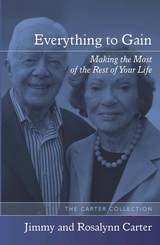
Everything to Gain
Making the Most of the Rest of Your LifeJimmy Carter
University of Arkansas Press, 1995
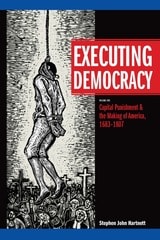
Executing Democracy
Volume One: Capital Punishment & the Making of America, 1683-1807Stephen J. Hartnett
Michigan State University Press, 2010
Executing Democracy: Capital Punishment & the Making of America, 1683-1807 is the first volume of a rhetorical history of public debates about crime, violence, and capital punishment in America. This examination begins in 1683, when William Penn first struggled to govern the rowdy indentured servants of Philadelphia, and continues up until 1807, when the Federalists sought to impose law-and-order upon the New Republic.
This volume offers a lively historical overview of how crime, violence, and capital punishment influenced the settling of the New World, the American Revolution, and the frantic post-war political scrambling to establish norms that would govern the new republic.
By presenting a macro-historical overview, and by filling the arguments with voices from different political camps and communicative genres, Hartnett provides readers with fresh perspectives for understanding the centrality of public debates about capital punishment to the history of American democracy.
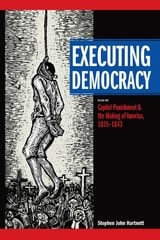
Executing Democracy
Volume Two: Capital Punishment and the Making of America, 1835-1843Stephen Hartnett
Michigan State University Press, 2024
This eye-opening and well-researched companion to the first volume of Executing Democracy enters the death-penalty discussion during the debates of 1835 and 1843, when pro-death penalty Calvinist minister George Barrell Cheever faced off against abolitionist magazine editor John O’Sullivan. In contrast to the macro-historical overview presented in volume 1, volume 2 provides micro-historical case studies, using these debates as springboards into the discussion of the death penalty in America at large. Incorporating a wide range of sources, including political poems, newspaper editorials, and warring manifestos, this second volume highlights a variety of perspectives, thus demonstrating the centrality of public debates about crime, violence, and punishment to the history of American democracy. Hartnett’s insightful assessment bears witness to a complex national discussion about the political, metaphysical, and cultural significance of the death penalty.