Results by title
337 books match the query 'North America' and 15 start with e
Ecology and Management of North American Savannas
Guy R. McPherson
University of Arizona Press, 1997
Ecology and Management of the North American Moose, Second Edition
Charles C. Schwartz
University Press of Colorado, 2007
Contributors include Warren B. Ballard, Arnold H. Boer, Anthony B. Bubenik, M. E. Buss, Kenneth N. Child, Vincent F.J. Crichton, Albert W. Franzmann, Kris J. Hundertmark, Patrick D. Karns, Murray W. Lankester, Richard E. McCabe, James M. Peek, Henry M. Reeves, Wayne L. Regelin, Lyle A. Renecker, William M. Samuel, Charles C. Schwartz, Robert W. Stewart, Ian D. Thompson, H. R. Timmermann, and Victor Van Ballenberghe. A Wildlife Management Institute book
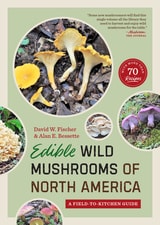
Edible Wild Mushrooms of North America
A Field-to-kitchen GuideBy David W. Fischer and Alan E. Bessette
University of Texas Press, 1992
Unusual shapes and colors make many mushrooms alluring to the eye, while the exotic flavors and textures of edible mushrooms are a gourmet delicacy for the palate. Yet many people never venture beyond the supermarket offerings, fearing that all other mushrooms are poisonous.
With amateur mushroom hunters especially in mind, David Fischer and Alan Bessette have prepared Edible Wild Mushrooms of North America. This field guide presents more than 100 species of the most delicious mushrooms, along with detailed information on how to find, gather, store, and prepare them for the table. More than 70 savory recipes, ranging from soups and salads to casseroles, canapes, quiches, and even a dessert, are included.
Throughout, the authors constantly emphasize the need for correct identification of species for safe eating. Each species is described in detailed, nontechnical language, accompanied by a list of key identifying characteristics that reliably rule out all but the target species. Superb color photographs also aid in identification. Poisonous "lookalikes" are described and illustrated, and the authors also assess the risks of allergic or idiosyncratic reactions to edible species and the possibilities of chemical or bacterial contamination.
Edith and Winnifred Eaton
Chinatown Missions and Japanese RomancesDominika Ferens
University of Illinois Press, 2002
Arguing that Edith as much as Winnifred constructed her persona along with her pen name, Ferens considers the fiction of both Eaton sisters as ethnography. Edith and Winnifred Eaton suggests that both authors wrote through the filter of contemporary ethnographic discourse on the Far East and also wrote for readers hungry for "authentic" insight into the morals, manners, and mentality of an exotic other.
Ferens traces two distinct discursive traditions–-missionary and travel writing–-that shaped the meanings of "China" and "Japan" in the nineteenth century. She shows how these traditions intersected with the unconventional literary careers of the Eaton sisters, informing the sober, moralistic tone of Edith's stories as well as Winnifred's exotic narrative style, plots, settings, and characterizations.
Bringing to the Eatons' writings a contemporary understanding of the racial and textual politics of ethnographic writing, this important account shows how these two very different writers claimed ethnographic authority, how they used that authority to explore ideas of difference, race, class and gender, and how their depictions of nonwhites worked to disrupt the process of whites' self-definition.
Enduring Seeds
Native American Agriculture and Wild Plant ConservationGary Paul Nabhan; Forewords by Wendell Berry and Miguel Altieri
University of Arizona Press, 2002
Gary Paul Nabhan here reveals the rich diversity of plants found in tropical forests and their contribution to modern crops, then tells how this diversity is being lost to agriculture and lumbering. He then relates "local parables" of Native American agriculture—from wild rice in the Great Lakes region to wild gourds in Florida—that convey the urgency of this situation and demonstrate the need for saving the seeds of endangered plants. Nabhan stresses the need for maintaining a wide gene pool, not only for the survival of these species but also for the preservation of genetic strains that can help scientists breed more resilient varieties of other plants.
Enduring Seeds is a book that no one concerned with our environment can afford to ignore. It clearly shows us that, as agribusiness increasingly limits the food on our table, a richer harvest can be had by preserving ancient ways.
This edition features a new foreword by Miguel Altieri, one of today's leading spokesmen for sustainable agriculture and the preservation of indigenous farming methods.
Energy Impacts
A Multidisciplinary Exploration of North American Energy DevelopmentJeffrey B. Jacquet
University Press of Colorado, 2020
Twelve chapters from respected scholars in a variety of disciplines present new ways to consider and analyze energy impact research. Focused on varied energy topics, geographies, and disciplines, each chapter includes a policy brief that summarizes the work and provides “key takeaways” to apply the findings to policy and public discourse.
Meaningful public engagement is critical in limiting the negative implications of energy development, and understanding the social influences on and of energy systems is a cornerstone of addressing the climate crisis. As such, Energy Impacts is a significant work for students, scholars, and professionals working in sociology, education, geography, environmental studies, and public health.
This material is based upon work supported by the National Science Foundation under Grant No. 1528422. Publication is also supported, in part, by Montana State University.
Contributors:
Ali Adil, Lisa Bailey-Davis, Nancy Bowen-Elizey, Morey Burnham, Weston Eaton, Heather Feldhaus, Felix Fernando, Emily Grubert, C. Clare Hinrichs, John Hintz, Richard Hirsh, Season Hoard, Tamara Laninga, Eric Larson, Achla Marathe, Natalie Martinkus, Seven Mattes, Ronald Meyers, Patrick Miller, Ethan Minier, Myra Moss, Jacob Mowery, Thomas Murphy, Sevda Ozturk Sari, John Parkins, Christopher Podeschi, Nathan Ratledge, Sanne Rijkhoff, Kelli Roemer, Todd Schenk, Anju Seth, Kate Sherren, Jisoo Sim, Marc Stern, Jessica Ulrich-Schad, Cameron Whitley, Laura Zachary
Engaged Anthropology
Research Essays on North American Archaeology, Ethnobotany, and MuseologyEdited by Michelle Hegmon and B. Sunday Eiselt
University of Michigan Press, 2005

Engendering Song
Singing and Subjectivity at Prespa Albanian WeddingsJane C. Sugarman
University of Chicago Press, 1997
Combining photographs, song texts, and vibrant recordings of the music with her own evocative descriptions, ethnomusicologist Jane C. Sugarman focuses her account of Prespa weddings on notions of gendered identity, demonstrating the capacity of singing to generate and transform relations of power within Prespa society. Engendering Song is an innovative theoretical work, with a scholarly importance extending far beyond southeast European studies. It offers unique and timely contributions to the analysis of music and gender, music in diaspora cultures, and the social constitution of self and subjectivity.
Entering America
Northeast Asia and Beringia Before the Last Glacial MaximumDavid B. Madsen
University of Utah Press, 2004
Where did the first Americans come from and when did they get here? That basic question of American archaeology, long thought to have been solved, is re-emerging as a critical issue as the number of well-excavated sites dating to pre-Clovis times increases. It now seems possible that small populations of human foragers entered the Americas prior to the creation of the continental glacial barrier. While the archaeological and paleoecological aspects of a post-glacial entry have been well studied, there is little work available on the possibility of a pre-glacial entry.
Entering America seeks to fill that void by providing the most up-to-date information on the nature of environmental and cultural conditions in northeast Asia and Beringia (the Bering land bridge) immediately prior to the Last Glacial Maximum. Because the peopling of the New World is a question of international archaeological interest, this volume will be important to specialists and nonspecialists alike.
Equals in Learning and Piety
Muslim Women Scholars in Nigeria and North AmericaBeverly Mack
University of Wisconsin Press, 2023
Mack shows how women scholars instructed rural Hausa and Fulani women in Muslim ethics, doctrine, traditions, and behavior that followed and replaced the traumatic experience of warfare unleashed by the Jihad. She shows that these unique social engagements shaped people’s agency in the dynamic process of social change throughout the nineteenth century. Women imaginatively reconciled Muslim reformist doctrines and traditional practices in Nigeria, and these doctrines have continued to be influential in the diaspora, especially among Black American Muslims in the United States in the twenty-first century. With this major investigation of a little-studied phenomenon, Mack demonstrates the importance of women to the religious, political, and social transformation of Nigerian Muslim society.
Essays in French Colonial History
Proceedings of the 21st Annual Meeting of the French Colonial Historical SocietyA.J.B. Johnston
Michigan State University Press, 1997
On 31 May - 3 June 1995, more than 200 participants gathered in Sydney and at Fortress Louisbourg, Nova Scotia, for the 21st annual conference of the French Colonial Historical Society. Essays in French Colonial History contains seventeen of the best articles presented at this meeting. It is a wide-ranging collection that explores many new and innovative facets of the French experience outre mer. The contributors, a mix of established experts and younger scholars, examine French activity in North America, the West Indies, Africa, and South America and focus on issues military, social, cultural, native, and political history.
Among the subject areas explored are: the 16th century French colonies in Brazil and Florida; Victor Hugues and the Reign of Terror on Guadeloupe; commerce and the distinctiveness of Louisbourg; the importance of letter-writing and compagnonnage; unresolved territory of the Creek Nation; case studies in the area of transition patrimonial; French colonial interests and policies in Atlantic Canada, Africa, and South America; attitudes among African Americans in post-French St. Louis; and a research report on the Historical Atlas of Quebec.
Eternal Sovereigns
Indigenous Artists, Activists, and Travelers Reframing RomeGloria Jane Bell
Duke University Press, 2024
Evolution of Fossil Ecosystems
Paul A. Selden and John R. Nudds
University of Chicago Press, 2005
Beginning with a general introduction to fossil Lagerstätten, Evolution of Fossil Ecosystems goes on, chapter by chapter, to consider each fossil site, detailing its evolutionary position and significance; a brief history of the locality; its background sedimentology, stratigraphy, and paleoenvironment; its biota and paleoecology; and its commonalities with similar Lagerstätten. Considering deposits both marine and terrestrial, the book covers one fossil site from the Precambrian era, five sites from the Paleozoic era, five sites from the Mesozoic era, and three sites from the Cenozoic era.
Illustrated with hundreds of color photographs and drawings, Evolution of Fossil Ecosystems is a sophisticated yet accessible guide to these critical sites. Containing useful appendixes listing important museums, instructions on how to visit the fossil sites, and additional suggested reading, this book will attract students, academics, and professionals in paleontology, evolution, and the earth and life sciences, as well as dedicated amateurs interested in fossils and geology.
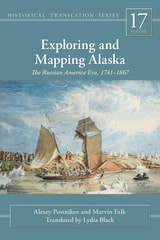
Exploring and Mapping Alaska
The Russian America Era, 1741-1867Alexey Postnikov and Marvin Falk
University of Alaska Press, 2015
Exploring and Mapping Alaska focuses on this foundational period in Arctic cartography. Russia spurred a golden era of cartographic exploration, while shrouding their efforts in a veil of secrecy. They drew both on old systems developed by early fur traders and new methodologies created in Europe. With Great Britain, France, and Spain following close behind, their expeditions led to an astounding increase in the world’s knowledge of North America.
Through engrossing descriptions of the explorations and expert navigators, aided by informative illustrations, readers can clearly trace the evolution of the maps of the era, watching as a once-mysterious region came into sharper focus. The result of years of cross-continental research, Exploring and Mapping Alaska is a fascinating study of the trials and triumphs of one of the last great eras of historic mapmaking.
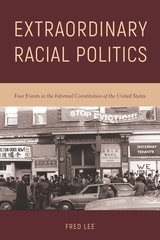
Extraordinary Racial Politics
Four Events in the Informal Constitution of the United StatesFred Lee
Temple University Press, 2018
Extraordinary racial politics rupture out of and reset everyday racial politics. In his cogent book, Fred Lee examines four unusual, episodic, and transformative moments in U.S. history: the 1830s–1840s southeastern Indian removals, the Japanese internment during World War II, the post-war civil rights movement, and the 1960s–1970s racial empowerment movements. Lee helps us connect these extraordinary events to both prior and subsequent everyday conflicts.
Extraordinary Racial Politics brings about an intellectual exchange between ethnic studies, which focuses on quotidian experiences and negotiations, and political theory, which emphasizes historical crises and breaks. In ethnic studies, Lee draws out the extraordinary moments in Michael Omi and Howard Winant’s as well as Charles Mills’s accounts of racial formation. In political theory, Lee considers the strengths and weaknesses of using Carl Schmitt’s and Hannah Arendt’s accounts of public constitution to study racial power.
Lee concludes that extraordinary racial politics represent both the promises of social emancipation and the perils of state power. This promise and peril characterizes our contentious racial present.