Results by title
3785 books match the query 'Poetry' and 103 start with e
Each and Her
Valerie Martínez
University of Arizona Press, 2010
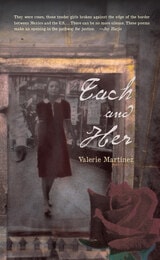
Martínez departs from traditional narrative to reveal the hidden effects and outcomes of the horrific and heart-wrenching cases of femicide. These poems—lyric fragments and prose passages that form a collage—have an intricate relation to one another, creating a complex literary quilt that feels like it can be read from the beginning, the end, or anywhere in between. Martínez is personally invested in the topic, evoking the loss of her sister, and Each and Her emerges as a biography of sorts and a compelling homage to all those who have suffered. Other authors may elaborate on or investigate this topic, but Martínez humanizes it by including names, quotations, realistic details, and stark imagery.
The women of Juárez, like other women around the world, are ravaged by inequality, discontinuity, politics, and economic plagues that contribute to gender violence. Martínez offers us a poignant and alarming glance into another world with these never-before-told stories. Her refreshing and explosive voice will keep readers transfixed and intrigued about these events and emotions—removed from us and yet so close to the heart.
Each in a Place Apart
James McMichael
University of Chicago Press, 1994
Early American Poetry
Selections from Bradstreet, Taylor, Dwight, Freneau, and BryantEdited by Jane Donahue Eberwein
University of Wisconsin Press, 1978
Here is the first major-figure anthology of American poetry of the colonial and early national periods, an indispensable volume for both students and scholars of American literature and civilization.
Five major literary figures are spotlighted: Anne Bradstreet (1612-1672), Edward Taylor (1642?"-1729), Timothy Dwight (1752-1817), Philip Freneau (1752-1832), and William Cullen Bryant (1794-1878). An introduction to each chapter summarizes the life of the poet, reviews his or her literary career, describes and evaluates artistic achievement, and places the poet in an intellectual context. The writer's relationship to changing religious, philosophical, political, and cultural patters is established. The contemporary perspective is augmented by the inclusion of an appendix which presents three important poems by other writers: Micheal Wigglesworth's "God's Controversy with New England," Ebenezer Cook's The Sot-Weed Factor, and Joel Barlow's "Hasty Pudding."
Eberwein goes beyond the most popular and familiar works to include those of unrecognized literary merit, presenting a thoroughly unique approach which illuminates the full range of the writers' themes, forms and poetic voices.
Early Greek Lyric Poetry
Translated with an Introduction and Commentary by David Mulroy
University of Michigan Press, 1999
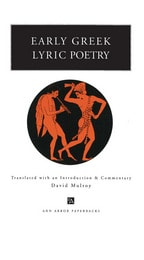
In Early Greek Lyric Poetry David Mulroy offers an accurate and lively translation of all the important lyric fragments and new papyri, as well as selections from the more fully preserved works of Theognis, Bacchylides, and Pindar. Unlike any other version of these poems, Early Greek Lyric Poetry also provides a translation of the literary context in which each poem survives. This format enables readers to see for themselves why particular lines or phrases happen to be preserved, and it also provides information on how earlier writers understood the poems.
The poems and fragments are accompanied by a comprehensive introduction to the genre and to the individual poets, explanatory notes, and a useful bibliography. Early Greek Lyric Poetry is indispensable for courses on Greek culture and literature in translation or on literary "great books."
David Mulroy is Associate Professor of Classics, University of Wisconsin at Milwaukee. He is also the author of Horace's Odes and Epodes: Translated with an Introduction and Commentary.

Early Poetry of Jaroslav Seifert
Jaroslav Seifert
Northwestern University Press, 1997

Early Stevens
The Nietzschean IntertextB. J. Leggett
Duke University Press, 1992
Concentrating on poems published between 1915 and 1935—but moving occasionally into later poems, as well as letters and essays—B. J. Leggett draws together texts of Stevens and Nietzsche to produce new and surprising readings of the poet's early work. This intertextual critique reveals previously undisclosed ideologies operating at the margins of Stevens's work, enabling Leggett to read aspects of the poetry that have until now been unreadable. Leggett's analysis demonstrates that the Nietzschean presence in Stevens brings with it certain assumptions that need to be made explicit if the form of the poetry is to be understood.
Though many critics have discussed the concept of intertextuality, few have attempted a truly intertextual reading of a particular poet. Early Stevens not only develops an exemplary model of such a reading; it also provides crucial insights into Stevens's notions of femininity, virility, and poetry and elucidates the notions of art, untruth, fiction, and interpretation in both Stevens and Nietzsche.

Earth on Earth
Bin Ramke
Omnidawn, 2021
A kind of translation of the thousand-year-old poem “Earth Took of Earth,” this book is an attempt to restate in personal, emotional terms a sense of both the danger of and the consolation given by earth itself. Many of these poems arose during a collaboration with the ecologist-ceramicist Mia Mulvey: her work with earth, clay often extruded through digitally guided machinery, echoes Ramke’s attempts to understand damages done to and celebrate the facts of earth—for instance, that geosmin, the scent of wet soil, is so powerfully recognizable even in trace amounts. The title of this book is also a play on the phrase “heaven on earth,” turning this idea around and encouraging us to instead turn our hopes toward earth on earth.
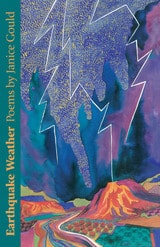
Earthquake Weather
PoemsJanice Gould
University of Arizona Press, 1996
Showing a steady courage in the midst of this alienation, her words are also stark testimony to the struggle of an individual caught in social and emotional contexts defined by others. In Earthquake Weather, as in an evolving friendship, Gould opens herself to the reader in stages. "I did not know how lonely I was / till we began to talk," she writes in an opening section, setting the introspective tone of what’s to come. She begins with a focus on those universal truths that both bind us and isolate us from each other: the pain of loss, the finality of death, our longing to see beneath the surface of things. Next, the poet turns to her growing-up years during the Vietnam War and the civil rights movement. She describes a family in turmoil and an Indian heritage that, oddly, was one of the factors that made her feel most disconnected from other people. And she writes poignantly about her increasing alienation from prescribed sexual roles. "What’s wrong with me? / Where do I belong? Why / am I here? Why can’t I / hold on?" Finally, as in a trusting friendship, Gould offers the reader vivid word portraits of relationships in her life—women she has loved and who have loved her.
Erotic and deeply personal, these poems serve as both a reconciliation and affirmation of her individuality. "Yet would you deny / that between women desire exists / that in our friendship a delicate / and erotic strand of fire unites us?" The poems in this book, says critic Toby Langen, are most powerful for their "courageous drawing on experience and feelings." They will speak to many general readers as well as anyone interested in questions of gender and identity, including students of literature, lesbian/women’s studies, social/cultural studies, or American Indian studies.
Echo of Ice Letting Go
Julie LeMay
University of Alaska Press, 2017

Echoes of the Sunbird
An Anthology of Contemporary African PoetryDon Burness
Ohio University Press, 1993
Echoes
Poems Left BehindJohn Ciardi
University of Arkansas Press, 1989
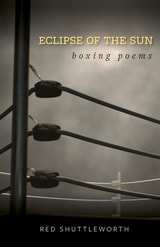
Eclipse of the Sun
Boxing PoemsRed Shuttleworth
University of Nevada Press, 2023
In this striking poetry collection, Red Shuttleworth, who holds the record as the oldest active boxer (professional or amateur), offers evocative imagery that unapologetically reveals the life of a boxer. From the inspiring hopes of an early career to agonizing defeats, the poems in Eclipse of the Sun take readers on a journey from moderate successes to the realization that a dream of a promising future has become the reality of the long haul of a journeyman. Along the way, Shuttleworth rubs elbows with greats like Muhammad Ali, Chickie Ferrara, and Ron Lyle, exposing the resolute path and difficult end of a hard-lived life.
This collection is an homage to boxing at its grittiest levels, and to fighters who persevere—with hope, blood, and bone—against sense and loss. Few professional boxers earn a living in the ring, and even fewer arrive in their forties with any money left from their sport. In this collection, boxers attain poverty rather than riches, end up in post-career menial jobs, and have no pension plan to fall back on. Shuttleworth’s poetry is a visceral inside look at the brutality and humanity at the heart of boxing.
Eclogues and Georgics
Vergil, Translated by James Bradley Wells
University of Wisconsin Press, 2022
The accompanying introductory essays situate Vergil’s poems in a rich literary tradition. Wells provides historical context and literary analysis of these two works, eschewing facile interpretations of these oft examined texts and ensconcing them in the society and culture from which they originated. These annotated essays, a pronunciation guide, and a glossary, alongside Wells’s bold vision for what translation choices can reveal, guide readers as they explore this ancient and famously difficult poetry.
Ecological Poetics; or, Wallace Stevens’s Birds
Cary Wolfe
University of Chicago Press, 2020
Stevens, Wolfe argues, is an ecological poet in the sense that his places, worlds, and environments are co-created by the life forms that inhabit them. Wolfe argues for a “nonrepresentational” conception of ecopoetics, showing how Stevens’s poems reward study alongside theories of system, environment, and observation derived from a multitude of sources, from Ralph Waldo Emerson and Niklas Luhmann to Jacques Derrida and Stuart Kauffman. Ecological Poetics is an ambitious interdisciplinary undertaking involving literary criticism, contemporary philosophy, and theoretical biology.
Economies of Praise
Value, Labor, and Form in Seventeenth-Century English PoetryRyan Netzley
Northwestern University Press, 2024
Reevaluates early modern poems of praise as, paradoxically, challenging an artistic economy that values exchange and productivity
Early modern poems of praise typically insist that they do not have a purpose or enact real labor beyond their effortless listing of laudable qualities. And yet the poets discussed in this study, including Ben Jonson, Andrew Marvell, Anne Bradstreet, Lucy Hutchinson, and John Milton, hint at an alternative aesthetic economy at work in their verse. Poetic praise, it turns out, might show us a social world outside the organizing principle of exchange.
In Economies of Praise: Value, Labor, and Form in Seventeenth‑Century English Poetry, Ryan Netzley explores how poems of praise imagine alternatives to market and gift economies and point instead to a self-contained aesthetic economy that works against a more expansive and productivist understanding of literary art. By depicting exchange as inconsequential, unproductive, and redundant rather than a necessary constituent of social order, these poems model for modern readers a world without the imperative to create, appraise, and repeatedly demonstrate one’s own value.
Ecopoetics
Essays in the FieldAngela Hume and Gillian Osborne
University of Iowa Press, 2018
Ecopoetics: Essays in the Field makes a formidable intervention into the emerging field of ecopoetics. The volume’s essays model new and provocative methods for reading twentieth and twenty-first century ecological poetry and poetics, drawing on the insights of ecocriticism, contemporary philosophy, gender and sexuality studies, black studies, Native studies, critical race theory, and disability studies, among others.
Contributors offer readings of a diverse range of poets, few of whom have previously been read as nature writers—from midcentury Beat poet Michael McClure, Objectivist poet George Oppen, and African American poets Melvin Tolson and Robert Hayden; to contemporary writers such as Diné poet Sherwin Bitsui, hybrid/ collage poets Claudia Rankine and Evelyn Reilly, emerging QPOC poet Xandria Phillips, and members of the Olimpias disability culture artists’ collective. While addressing preconceptions about the categories of nature writing and ecopoetics, contributors explore, challenge, and reimagine concepts that have been central to environmental discourse, from apocalypse and embodiment to toxicity and sustainability.
This collection of essays makes the compelling argument that ecopoetics should be read as “coextensive with post-1945 poetry and poetics,” rather than as a subgenre or movement within it. It is essential reading for any student or scholar working on contemporary literature or in the environmental humanities today.
Contributors: Joshua Bennett, Rob Halpern, Matt Hooley, Angela Hume, Lynn Keller, Petra Kuppers, Michelle Niemann, Gillian Osborne, Samia Rahimtoola, Joan Retallack, Joshua Schuster, Jonathan Skinner.
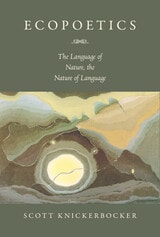
Ecopoetics
The Language of Nature, the Nature of LanguageScott Knickerbocker
University of Massachusetts Press, 2012
Ecopoetics probes the complex relationship between artifice and the natural world in the work of modern American poets—in particular Wallace Stevens, Elizabeth Bishop, Richard Wilbur, and Sylvia Plath. These poets relate to nature as a deep wellspring of meaning, although they all avoid using language the way most nature writers do, merely to reflect or refer directly to the world. Each of these poets, in his or her own distinct way, employs instead what Knickerbocker terms sensuous poesis, the process of rematerializing language through sound effects and other formal devices as a sophisticated response to nonhuman nature.
Rather than attempt to erase the artifice of their own poems, to make them seem more natural and thus supposedly closer to nature, the poets in this book unapologetically embrace artifice—not for its own sake but in order to perform and enact the natural world. Indeed, for them, artifice is natural. In examining their work, Knickerbocker charts a new direction for ecocriticism.
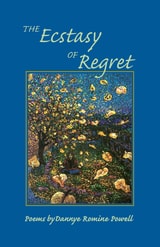
Ecstasy of Regret
PoemsDannye Powell
University of Arkansas Press, 2002
Ecstatic Émigré
An Ethics of PracticeClaudia Keelan
University of Michigan Press, 2018
Ecstatic Émigré pays homage to poets from Thoreau and Whitman to Alice Notley, all of whom share a commitment to living and writing in the moment. Keelan asks the same questions about the growth of flowers or the meaning of bioluminescence as she does about the poetics of John Cage or George Oppen. Her originality is grounded by the ways in which she connects poetic principles with the spiritual concepts of via negativa demonstrated both in St. John of the Cross and Mahayana Buddhism. In addition, her essays demonstrate an activist spirit and share a commitment to the passive resistance demonstrated in Martin Luther King, Jr.’s concept of the “beloved community” and philosopher Simone Weil’s dedication to “exile.”
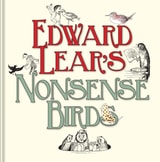
Edward Lear's Nonsense Birds
Edward Lear
Bodleian Library Publishing, 2013
Edward Lear’s Nonsense Birds collects more than sixty of Lear’s bird illustrations from across his entire body of work. Often, the birds have hilariously human characteristics. There is, for instance, a Good-Natured Grey Gull, a Hasty Hen, and a Querulous Quail. The Judicious Jay is chiefly concerned with good grooming. The Vicious Vulture, meanwhile, turns out to be a wordsmith whose verses on vellum celebrate veal. Each bird is endowed with a unique personality, while collectively they form a wonderfully amusing flock. Also included are a series of twenty-four hand-colored illustrations.
Bright and beautifully illustrated, this book will make a perfect gift for children of all ages and will also be welcomed by all who love Lear’s work or are interested in learning more about his fascination with birds.
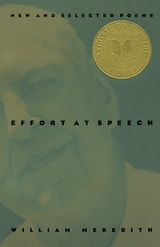
Effort at Speech
New and Selected PoemsWilliam Meredith
Northwestern University Press, 1997
A contemporary of Berryman, Bishop, and Lowell, William Meredith shared neither the bohemian excesses of the Beats nor the exhibitionist excesses of the "confessional" poets. Rather, he was known as a poet whose unadorned, formal verse marked him as a singular voice. Effort at Speech, the definitive collection of Meredith's life work, contains poems chosen by the author from throughout his career, as well as several new works and an essay by Michael Collier placing Meredith in his times.
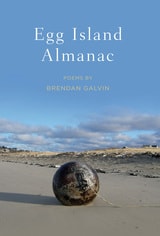
Egg Island Almanac
Brendan Galvin
Southern Illinois University Press, 2017
The poems chronicle the waxing and waning of the seasons from one winter to the next in the area around Egg Island, the dunes near a small seacoast town on the outermost reaches of Cape Cod, Massachusetts. Galvin’s training as a naturalist and environmental writer is evident as his practiced eye roves the waves, marshes, and forests, finding meaning and beauty in the smallest detail— bird-watching, rebuilding a woodpile, or the flight of bobwhite quail. Other poems recall the poet’s affectionate memories of his deceased wife and the life they shared together, acknowledging grief without veering into the maudlin. Always present beneath the surface is the question of where humans fit into this wild, ever-changing landscape.
In meditations that recall the poetry and prose of Mary Oliver or W. S. Merwin, Galvin sets off on a vivid journey sure to increase readers’ appreciation for the natural world. Perhaps his most compelling message is that readers need not jet off to Everest or Kilimanjaro to experience mystery and beauty on Earth—there’s wonder aplenty in our own backyards.
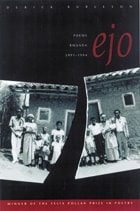
Ejo
Poems, Rwanda, 1991–1994Derick Burleson
University of Wisconsin Press, 2000
In 1994 the worst episode of genocide since the Holocaust of the Second World War ravaged the Central African country of Rwanda. Derick Burleson lived there and taught at the National University during the two years leading up to the genocide. The poems in this collection explore the cataclysm in a variety of forms and voices through the culture, myths, and customs he absorbed during this time. Ejo, meaning "yesterday and tomorrow" in Kinyarwandan, celebrates in language both lyrical and austere the lives of the friends Burleson made in Rwanda, those who survived to tell their own stories, and those whose voices were silenced.
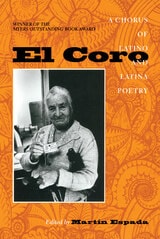
El Coro
A Chorus of Latino and Latina PoetryMartin Espada
University of Massachusetts Press, 1997
Here we find the open expression of anger and grief, self-mocking humor, the music of protest, the quiet assertion of dignity, and the raucous celebration of survival. There are poems about stoop labor and welfare offices and housing projects, but also poems about the Four Horsemen of the Apocalypse and the Minotaur.
Among the poets are former farm workers and gang members, a practicing physician, an ex-tenant lawyer, two professional chefs, and a Vietnam veteran. One poet was a political prisoner for six years; another staged a famous hunger strike; still another was indicted for her work with Central American refugees. In many ways this collection of poets comprises a chorus. Their song humanizes in the face of dehumanization.
El Dorado
Peter Campion
University of Chicago Press, 2013
Electric Meters
Victorian Physiological PoeticsJason Rudy
Ohio University Press, 2009
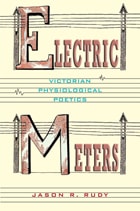
Combining formal poetic analysis with cultural history, Rudy traces the development of Victorian physiological poetics from the Romantic poetess tradition through to the works of Alfred Tennyson, the “Spasmodic” poets, Elizabeth Barrett Browning, Gerard Manley Hopkins, and Algernon Swinburne, among others. He demonstrates how poetic rhythm came increasingly to be understood throughout the nineteenth century as a physiological mechanism, as poets across class, sex, and national boundaries engaged intensely and in a variety of ways with the human body’s subtle response to rhythmic patterns. Whether that opportunity for transcendence was interpersonal or spiritual in nature, nineteenth–century poets looked to electricity as a model for overcoming boundaries, for communicating across the gaps between sound and sense, between emotion and thought, and—perhaps—between individuals in the modern world.
Electric Meters will appeal to those interested in poetry of any period and particularly those interested in nineteenth–century culture and history.
Elegy for Desire
Luis Omar Salinas
University of Arizona Press, 2005
Are those of love and those of death.
I’m half in love and half dead.
It stands to reason that I’ve come upon a difficult task.
Despite his disclaimer, it seems no difficult task at all. One of the pioneers of Chicano poetry and a highly esteemed artist in the Mexican American community, Luis Omar Salinas is a poet with Tex-Mex bordertown roots whose work is studied at the Sorbonne. Beginning with his legendary first book, Crazy Gypsy, he has been a major figure not only in Chicano literature but in all of American poetry—both a poet of the people and a voice for other poets.
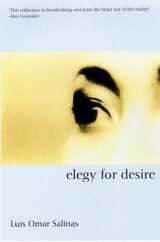
In Elegy for Desire, Salinas has crafted visionary poems about growing older and looking back on a rich life of poetry. In this quiet yet hallucinatory volume, Salinas offers us a prismatic collection of odes, elegies, and cantos of desire—complex poems about our place in the world. Poems to be savored in solitude, or better still with an intimate companion. Few poets, Latino or otherwise, are as daring with love poetry that is so honestly fierce. Salinas gives us a meditation on gently aging while continuing to celebrate personal experience that draws upon the world. One need only sample these rich, elegant stanzas to recognize the wealth of wisdom found in their words.
Elegy for Desire is a testament to a singular talent that has survived for decades . . . and will continue to inspire long beyond his lifetime.
The dead can’t complain, and lovers always do.
Well, I’m here, and that is important.
And if life can be as exciting as this,
I must be doing something right.
Elephant
Soren Stockman
Four Way Books, 2022
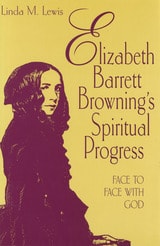
Elizabeth Barrett Browning's Spiritual Progress
Face to Face With GodLinda M. Lewis
University of Missouri Press, 1997
Elizabeth Barrett Browning believed that "Christ's religion is essentially poetry—poetry glorified." In Elizabeth Barrett Browning's Spiritual Progress, Linda M. Lewis studies Browning's religion as poetry, her poetry as religion. The book interprets Browning's literary life as an arduous spiritual quest—the successive stages being a rejection of Promethean pride for Christ-like humility, affirmation of the gospels of suffering and of work, internalization of the doctrine of Apocalypse, and ascent to divine love and truth.
Lewis follows this religious crusade from the poet's childhood to her posthumous Last Poems--including such topics as her Bible reading, her introduction to the Greek church fathers and the English Protestant reformers, the theological debates in which she participated, her quarrel with the theology of Paradise Lost, and her scandalous involvement in mesmerism and Swedenborgianism. Using insights from contemporary feminist thought, Lewis argues that Browning's religious assumptions and insights range from the conventional to the iconoclastic and that women's spirituality is, for Browning as well as for other Victorian women writers, separate from orthodox patriarchy. Lewis demonstrates that Browning's political and social ideology--often labeled inconsistent and illogical—really makes sense in light of this spiritual quest, which leads her to confront her God "face to face."
Elizabeth Barrett Browning's Spiritual Progress examines not only Browning's most admired works, such as Sonnets from the Portuguese and Aurora Leigh, but also her large body of political works and her important early poems—The Seraphim and A Drama of Exile. This intertextual book compares Browning's ideology to that of feminists such as Margaret Fuller, Harriet Martineau, and Florence Nightingale; influential conservatives such as Thomas Carlyle; and those most esteemed of Victorian poets, Alfred Lord Tennyson and Robert Browning.
Concluding with an examination of religion as a central focus of Victorian women poets, Lewis clarifies the ways in which Browning differs from Christina Rossetti, Felicia Hemans, Dora Greenwell, Jean Ingelow, and Mary Howitt. Elizabeth Barrett Browning's Spiritual Progress maintains that Browning's peculiar face-to-face struggle with the patristic and poetic tradition—as well as with God—sets her work apart.
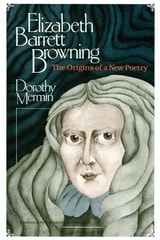
Elizabeth Barrett Browning
The Origins of a New PoetryDorothy Mermin
University of Chicago Press, 1989
Barrett Browning's place at the wellhead of a new female tradition remains the single most important fact about her in terms of literary history, and it was central to her self-consciousness as a poet. Mermin's study shows that Barrett Browning's anomalous situation was constantly present to her imagination and that questions of gender shaped almost everything she wrote. Mermin argues that Barrett Browning's poetry covertly inspects and dismantles the barriers set in her path by gender and that in her major works—Sonnets from the Portuguese, Aurora Leigh, her best political poems, "A Musical Instrument"—difficulty is turned into triumph, incorporating the author's femininity, her situation as a woman poet, and her increasingly substantial fame.
Mermin skillfully interweaves biography and close readings of the poems to show precisely how Barrett Browning's life as a woman writer is a part of the essential meaning of her art. Both her personal and her literary achievements are exceptionally well documented, especially for her formative years. Mermin makes extensive use of the poet's early essays, a diary covering most of her twenty-sixth year, and the enormous number of letters that have survived. Ranging from her earliest ambitions through her long periods of discouragement and illness to her happy married life with Robert Browning, this comprehensive study of Elizabeth Barrett Browning is essential reading for students of the Victorian period, English literature, and women's studies.

Elizabeth Bishop
Kim Fortuny
University Press of Colorado, 2003

Elizabeth Bishop and Her Art
Lloyd Schwartz and Sybil P. Estess, Editors
University of Michigan Press, 1983

Elizabeth Bishop and the Literary Archive
Bethany Hicok
Lever Press, 2020
Elizabethan Poetry in Manuscript
An Edition of British Library Harley MS 7392(2)Edited by Jessica Edmondes
Iter Press, 2022
This edition preserves the appearance, spelling, and punctuation of the original manuscript while expanding antiquated contractions to provide an easily readable text. Textual notes appear on the page, and in-depth contextual notes and word glosses are provided in the commentary section. The analyses add to our knowledge of early modern manuscript culture and literary manuscript transmission, and a substantial introduction provides context for the compilation of the anthology.

Elk in Winter
Robert Pack
University of Chicago Press, 2004
Eloquence and Mere Life
Essays on the Art of PoetryAlan Williamson
University of Michigan Press, 1994
Emily Dickinson's Music Book and the Musical Life of an American Poet
George Boziwick
University of Massachusetts Press, 2022
After years of studying piano as a young woman in her family home in Amherst, Massachusetts, Emily Dickinson curated her music book, a common practice at the time. Now part of the Dickinson Collection in the Houghton Library of Harvard University, this bound volume of 107 pieces of published sheet music includes the poet’s favorite instrumental piano music and vocal music, ranging from theme and variation sets to vernacular music, which was also enjoyed by the family’s servants.
Offering a fresh historical perspective on a poetic voice that has become canonical in American literature, this original study brings this artifact to life, documenting Dickinson’s early years of musical study through the time her music was bound in the early 1850s, which tellingly coincided with the writing of her first poems. Using Dickinson’s letters and poems alongside newspapers and other archival sources, George Boziwick explores the various composers, music sellers, and publishers behind this music and Dickinson’s attendance at performances, presenting new insights into the multiple layers of meaning that music held for her.
Emily Dickinson's Open Folios
Scenes of Reading, Surfaces of WritingMarta L. Werner
University of Michigan Press, 1996
Emily Dickinson's Shakespeare
Paraic Finnerty
University of Massachusetts Press, 2006
Páraic Finnerty clarifies the essential role that Shakespeare had in Dickinson's life by locating her allusions to his writings within a nineteenth-century American context and by treating reading as a practice that is shaped, to a large extent, by culture. In the process, he throws new light on Shakespeare's multifaceted presence in Dickinson's world: in education, theater, newspapers, public lectures, reading clubs, and literary periodicals.
Through analysis of letters, journals, diaries, records, periodicals, newspapers, and marginalia, Finnerty juxtaposes Dickinson's engagement with Shakespeare with the responses of her contemporaries. Her Shakespeare emerges as an immoral dramatist and highly moral poet; a highbrow symbol of class and cultivation and a lowbrow popular entertainer; an impetus behind the emerging American theater criticism and an English author threatening American creativity; a writer culturally approved for women and yet one whose authority women often appropriated to critique their culture. Such a context allows the explication of Dickinson's specific references to Shakespeare and further conjecture about how she most likely read him.
Finnerty also examines those of Dickinson's responses to Shakespeare that deviated from what might have been expected and approved of by her culture. Imaginatively departing from the commonplace, Dickinson chose to admire three of Shakespeare's most powerful and transgressive female characters—Cleopatra, Queen Margaret, and Lady Macbeth—instead of his more worthy and virtuous heroines. More startling, although the poet found resonance for her own life in Hamlet, Romeo and Juliet, and Macbeth, she chose, in the racially charged atmosphere of nineteenth-century America, to identify with Shakespeare's most controversial character, Othello, thereby defying expectations once again.
Emily Dickinson
Monarch of PerceptionDomhnall Mitchell
University of Massachusetts Press, 2000
Emily Dickinson has often been pictured as a sensitive but isolated poet—someone who published very little in her lifetime and limited herself to lyrics, considered to be the kind of poems most removed from social and political life. In recent years, scholars have challenged that view, and this book extends the discussion in valuable new directions.
Domhnall Mitchell begins by focusing on three historical phenomena—the railroad, the Dickinson homestead, and horticulture—and argues that poems about trains, home, and flowers engage with their meanings in ways that extend beyond the confines of the aesthetic. He shows how Dickinson's poems and letters reveal the full complexity of her position as a woman situated within a larger social and economic class.
In the second half of the book, Mitchell considers the ideological, textual, and editorial implications of Dickinson's strategic privatization of her art. He relates the particular forms of her manuscripts' appearance, distribution, and collation to aspects of her social as well as her literary consciousness. In a chapter that is certain to provoke debate, he explores what it means to read individual poems and letters in manuscript versions rather than in printed editions. By paying close attention to textual evidence, he makes the case that various features of the manuscripts are actually matters of accident or immediate convenience rather than the visual markers of a new aesthetic principle.
Mitchell closes by using the theories of Mikhail Bakhtin to explore the contradictions of a “private” poetry that engages verbally in multiple areas of nineteenth-century life and discourse. By attending to the contemporaneous particularities of recurrent words and images, he demonstrates that Dickinson could stay at home and still be at home in history, too.
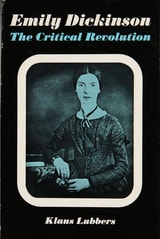
Emily Dickinson
The Critical RevolutionKlaus Lubbers
University of Michigan Press, 2025
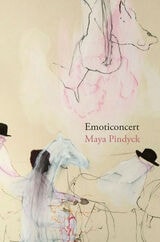
Emoticoncert
Maya Pindyck
Four Way Books, 2016
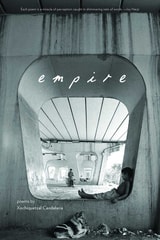
Empire
Xochiquetzal Candelaria
University of Arizona Press, 2011
This distinctive collection ranges from the frighteningly whimsical image of Cortés dancing gleefully around a cannon to the haunting and poignant discovery of a dead refugee boy seemingly buried within the poet herself. The blending of styles works to blur the lines between subjects, creating a textured narrative full of both imagination and nuance.
Ultimately, Empire situates individual experience in the wider social context, highlighting the power of poetry as song, performance, testimony, and witness. Addressing themes such as war, family, poverty, gender, race, and migration, Candelaria gives us a dialogue between historical and personal narratives, as well as discreet “conversations” between content and form.
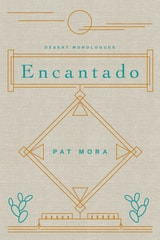
Encantado
Desert MonologuesPat Mora
University of Arizona Press, 2018
Each poem forms a story that reveals the complex and emotional journeys we take through life. Mora meanders through the thoughts of Encantado’s residents—the mothers and sisters, brothers and fathers in whom we see slivers of ourselves and our loved ones—and paints a portrait of a community through its inhabitants’ own diverse voices. Even the river has a voice we understand.
Inspired by both the real and imagined stories around her, Mora transports us to the heart of what it means to join in a chorus of voices. A community. A town. Encantado.
Encounter with Zen
writings on poetry and ZenLucien. Stryk
Ohio University Press, 1981
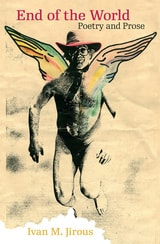
End of the World
Poetry and ProseIvan M. Jirous
Karolinum Press, 2020
End of the World is the first major collection in English of the works of this legendary Czech “madman.” Although nicknamed for his aggressive and rebellious behavior, Jirous’s writing reveal a refined, sophisticated, and even tender sensibility. Translated in part by Paul Wilson, an original member of the Plastic People, the book gathers his poems and letters from prison, as well as his book-length prose work, The True Story of the Plastic People, alongside critical essays on Jirous’s life and work. End of the World is an ideal introduction to the raucous writer who playwright Tom Stoppard referred to as one of the most interesting personalities in modern Czech history.

Ends of the Earth
PoemsKate Partridge
University of Alaska Press, 2017
While the poems turn an inquisitive, contemporary lens to the subject of Alaska, elements throughout the book are influenced by twentieth-century writers like Elizabeth Bishop and Marianne Moore. The manuscript also combines personal experience with collaged material from the Epic of Gilgamesh, Walt Whitman's notebooks, and other classic sources, to investigate the ideas of love, isolation, and location. Through humor and observation, Partridge takes a new look at what it means to live in urban Alaska and the world at large.
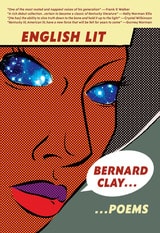
English Lit
PoemsBernard Clay
Ohio University Press, 2021
Autobiographical poetry from one of Kentucky’s rising Affrilachian literary stars.
Bernard Clay’s autobiographical poetry debut, English Lit, juxtaposes the roots of Black male identity against an urban and rural Kentucky landscape. Hailed as one of the most authentic voices of his generation, Clay artfully renders coming-of-age in the predominately Black West End of Louisville, Kentucky. Balancing the spirited grit of a farmer and the careful lyricism of a poet, English Lit is a triumph of new Affrilachian—African American and Appalachian—literature.

Engraved
Anna Meek
Tupelo Press, 2013

Enraptured Space
Gender, Class, and Ecology in the Work of Paula MeehanKathryn J. Kirkpatrick
West Virginia University Press, 2025
In Paula Meehan, Kirkpatrick has found a powerful poet to both study and love, and her reading of Meehan’s poetry and prose through the lenses of gender studies, the environmental humanities, and social class offers a passionate endorsement of Meehan’s radical interventions in the canon of Irish poetry. This work explores eight volumes of Meehan’s poetry, including Dharmakaya, Painting Rain, and Geomantic.