Results by title
704 books match the query 'Political Process' and 24 start with e
ELECTORAL REFORM AND MINORITY REPRESENTATION
LOCAL EXPERIMENTS WITH ALTERNATIVE ELECTIONSSHAUN BOWLER
The Ohio State University Press, 2003
Questions of minority representation have long plagued the U.S. voting systems. The standard election often leaves political, racial, or ethnic minorities with little chance of being represented. Race-conscious districting remains the primary policy tool used for providing representation of racial and ethnic minorities in the United States—and it continues to generate tremendous conflict. Can alternatives to race-conscious, single-member districts offer benefits that extend beyond simply providing descriptive representations of minorities?
This study examines one such “semi-proportional” representation election system: Cumulative Voting (CV). For over a decade, scores of local U.S. governments have been elected by Cumulative Voting. This provides us with the ability to examine the effects of CV elections over time. Moreover, the use of CV in the United States allows us to compare politics in places that adopted CV to highly similar places that did not. Electoral Reform and Minority Representation shares evidence that CV elections can produce minority representation that matches levels generated with the drawing of race-conscious “majority-minority” districting. It also offers evidence that the quality of democratic processes in CV communities is in several ways higher that those under districts.
Given America’s growing racial and ethnic diversity, and given successful legal challenges that limit the use of race-conscious districting Electoral Reform and Minority Representation suggests that Cumulative Voting may be a better way to achieve minority representation in U.S. politics.
EXPRESSIVE POLITICS
ISSUE STRATEGIES OF CONGRESSIONAL CHALLENGERSROBERT G. BOATRIGHT
The Ohio State University Press, 2004
This research makes two types of contributions to existing political science literature. On a theoretical level, it argues for a reconceptualization of the motives of candidates and parties in rational choice analysis. On a practical level, it seeks to enrich our understanding of the role that challengers play in American elections and of the reason why different types of challengers emerge in different types of elections. Boatright argues that the role of challengers in the American electoral process can be understood only if we broaden our theories about rational candidate behavior.
Echo Chambers
How Partisan Communication Took Over CongressSoRelle W. Gaynor
University of Chicago Press, 2027
An incisive analysis of how congressional communication with constituents has changed and what this means for representation and polarization.
Members of Congress have a duty to talk to their constituents back home about what’s going on in Washington. But today, the average politician lacks the time, resources, and knowledge necessary to coherently explain the bills and legislative actions up for debate. Therefore, they turn to those who hold the keys to the chamber: party leaders.
Consequently, Congress is now more reliant than ever on its leaders’ partisan talking points, and constituents hear more about nationalized political battles rather than the local issues affecting their districts. Drawing on large-scale text analysis, campaign expenditures, and congressional district data, as well as in-depth interviews, Echo Chambers examines how partisan communication took over Congress, the key differences in that messaging across parties and chambers, and what these combined forces mean for US citizens today.
Educated by Initiative
The Effects of Direct Democracy on Citizens and Political Organizations in the American StatesDaniel A. Smith and Caroline J. Tolbert
University of Michigan Press, 2004
--Kristina Wilfore, Executive Director, Ballot Initiative Strategy Center and Foundation
Educated by Initiative moves beyond previous evaluations of public policy to emphasize the educational importance of the initiative process itself. Since a majority of ballots ultimately fail or get overturned by the courts, Smith and Tolbert suggest that the educational consequences of initiative voting may be more important than the outcomes of the ballots themselves. The result is a fascinating and thoroughly-researched book about how direct democracy teaches citizens about politics, voting, civic engagement and the influence of special interests and political parties. Designed to be accessible to anyone interested in the future of American democracy, the book includes boxes (titled "What Matters") that succinctly summarize the authors' data into easily readable analyses.
Daniel A. Smith is Associate Professor of Political Science at the University of Florida.
Caroline J. Tolbert is Associate Professor of Political Science at Kent State University.
Electing Judges
The Surprising Effects of Campaigning on Judicial LegitimacyJames L. Gibson
University of Chicago Press, 2012
Electing a President
The Markle Commission Research on Campaign '88By Bruce Buchanan, Lloyd N. Morrisett, and Robert M. O'Neil
University of Texas Press, 1991
The image of a prison with a revolving door helped George Bush win the presidency in 1988, but did negative advertising damage the electoral process itself? Why did campaign ’88 represent an all-time low in the minds of many voters? These are some of the questions that impel this thought-provoking analysis of the 1988 presidential election, sponsored by the John and Mary R. Markle Foundation.
Using extensive empirical studies of the candidates, the media, and the voters, Bruce Buchanan, executive director of the Markle Commission on the Media and the Electorate, traces the roots of popular dissatisfaction with the 1988 election. Buchanan argues that the campaign drifted too far from popular ideals of how democratic processes ought to work—that the substitution of negative advertising and quickie “sound bites” for reasoned debate on national problems and issues alienated much of the electorate, causing the lowest voter turnout in sixty-four years.
Negative campaigning, however, cannot bear the full blame for the 1988 election. While the Markle Commission offers specific recommendations for improvements in candidate and media performance, the great need, says Buchanan, is for voters to reclaim the electoral process, to insist that candidates and the media give enough information about positions and programs for voters to make informed choices. Voters need to be educated out of the idea that democratic elections and representative government can somehow occur without the participation of ordinary citizens.
At a time when the American democratic process is being used as a model by newly independent nations around the world, it is particularly appropriate to ask how well it works at home. Electing a President does just that.
Elections and Political Order in Russia
Peter Lentini
Central European University Press, 1995
Elections in Australia, Ireland, and Malta under the Single Transferable Vote
Reflections on an Embedded InstitutionShaun Bowler and Bernard Grofman, Editors
University of Michigan Press, 2000
Electoral Campaigns, Media, and the New World of Digital Politics
David Taras and Richard Davis, Editors
University of Michigan Press, 2022
Today, political leaders and candidates for office must campaign in a multimedia world through traditional forums—newspapers, radio, and television—as well as new digital media, particularly social media. Electoral Campaigns, Media, and the New World of Digital Politics chronicles how Twitter, Facebook, Reddit, email, and memes are used successfully and unsuccessfully to influence elections. Each of these platforms have different affordances and reach various audiences in different ways. Campaigns often have to wage different campaigns on each of these mediums. In some instances, they are crucial in altering coverage in the mainstream media. In others, digital media remains underutilized and undeveloped. As has always been the case in politics, outcomes that depend on economic and social conditions often dictate people’s readiness for certain messages. However, the method and content of those messages has changed with great consequences for the health and future of democracy.
This book answers several questions: How do candidates/parties reach audiences that are preoccupied, inattentive, amorphous, and bombarded with so many other messages? How do they cope with the speed of media reporting in a continuous news cycle that demands instantaneous responses? How has media fragmentation altered the campaign styles and content of campaign communication, and general campaign discourse? Finally and most critically, what does this mean for how democracies function?
Electoral Dynamics in Indonesia
Money Politics, Patronage and Clientelism at the GrassrootsEdited by Edward Aspinall and Mada Sukmajati
National University of Singapore Press, 2016
Electoral Reform and Democracy in Malaysia
Edited by Helen Ting M. H. and Donald L. Horowitz
National University of Singapore Press, 2023
Electoral Reform and the Fate of New Democracies
Lessons from the Indonesian CaseSarah Shair-Rosenfield
University of Michigan Press, 2019
When and why do democratic political actors change the electoral rules, particularly regarding who is included in a country’s political representation? The incidences of these major electoral reforms have been on the rise since 1980.
Electoral Reform and the Fate of New Democracies argues that elite inexperience may constrain self-interest and lead elites to undertake incremental approaches to reform, aiding the process of democratic consolidation. Using a multimethods approach, the book examines three consecutive periods of reform in Indonesia, the world’s largest Muslim majority country and third largest democracy, between 1999 and 2014. Each case study provides an in-depth process tracing of the negotiations leading to new reforms, including key actors in the legislature, domestic civil society, international experts, and government bureaucrats. A series of counterfactual analyses assess the impact the reforms had on actual election outcomes, versus the possible alternative outcomes of different reform options discussed during negotiations. With a comparative analysis of nine cases of iterated reform processes in other new democracies, the book confirms the lessons from the Indonesian case and highlights key lessons for scholars and electoral engineers.
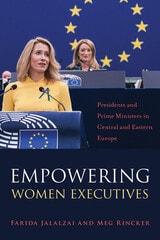
Empowering Women Executives
Presidents and Prime Ministers in Central and Eastern EuropeFarida Jalalzai and Meg Rincker
Temple University Press, 2027
What role does gender play as women pursue government positions, gain office, and govern countries in Central and Eastern Europe? In Empowering Women Executives, Farida Jalalzai and Meg Rincker examine women’s paths to and influence at the executive level, focusing specifically on Croatia, Poland, Slovakia, Estonia, and Romania.
The authors interview President Kersti Kaljulaid of Estonia, Prime Minister Jadranka Kosor of Croatia, Prime Minister Iveta Radičová of Slovakia, and Prime Minister Viorica Dăncilă of Romania as well as dozens of political experts and insiders to provide an in-depth look at female executives’ power in office. The authors also show the impact these leaders had in a region where traditional gender roles expanded only after the fall of Communism.
Each case study describes the historical context in which a woman emerges as a candidate, her ability to shape legislation, and how the media portrays her gender in analyzing her leadership. The authors also consider how gender influences a female executive’s leadership style or policy priorities—from appointing women to government positions and support for policies benefitting women to being a role model.
Empowering Women Executives illuminates women’s political inclusion in an area of the world where women have gained significant political agency.
Empowering the Public-Private Partnership
The Future of America’s Local GovernmentGeorge V. Voinovich
Ohio University Press, 2017
America’s cities are increasingly acknowledged as sites of renewal and economic opportunity—but how can city leaders facing physical and financial constraints harness this positive energy to create sustainable development? The story of Cleveland in the early 1980s provides the necessary roadmap. Mayor George V. Voinovich, by drawing on the combined strengths of the public and private sectors, took Cleveland from financial default to becoming “America’s Comeback City,” and he later used the best practices he developed there to tackle state-level challenges as governor of Ohio. The public-private partnership model that Voinovich pioneered has since become the gold standard for cities seeking to maximize resources.
Using lessons from Cleveland, Voinovich developed this handbook for governments and private entities seeking a mutually enriching partnership. It is his legacy to those who will guide America’s cities to new growth and vitality.
Encrypted Propaganda
The Democratic Promise and Despotic Peril of Chat AppsInga Kristina Trauthig and Samuel Woolley
University of Chicago Press, 0
Essential reading on a hard-to-study but dominant communication tool, encrypted messaging apps—WhatsApp, Signal, and their kin—showing their promise and dangers.
Pundits have long pointed to social media’s power to catalyze or end political movements—and to strengthen or weaken democracies. But this power is shifting from social media platforms (such as Facebook and YouTube) to lesser-studied encrypted messaging apps (such as WhatsApp and Signal). This urgent book explains how these technologies work and how they differ from their predecessors, outlining their strengths and vulnerabilities at a crucial stage in their evolution.
While many Facebook users have at least heard of propaganda and the algorithms used to filter and highlight content on that platform, they are more likely to trust messaging apps as sources of authentic and secure information. Paired with a growing distrust of traditional media, more people are joining large groups on these apps and using them as news sources, even when those groups include relative strangers. This makes these apps particularly vulnerable to political propaganda—and even government espionage.
Security studies scholar Inga Kristina Trauthig and propaganda scholar Samuel Woolley consider both the role of these apps in spreading disinformation and as tools for maintaining free speech and civic discourse in the face of censorship. The same closed nature that makes these apps seem trustworthy has made them particularly difficult to research. And so this qualitative study draws on some 180 interviews with propagandists, activists, influence campaigners, and other users in fourteen countries. The book’s findings and the authors’ recommendations are crucial for understanding the future of online communication and safeguarding democratic speech.
Engaging Young People in Civic Life
James Youniss
Vanderbilt University Press, 2009
The thirteen original essays are based on research in schools and in settings beyond the schoolyard where civic life is experienced. One focus is on programs for those schools in poor communities that tend to overlook civic education. Another chapter reports on how two city governments—Hampton, Virginia, and San Francisco—have invited youth to participate on boards and in agencies. A cluster of chapters focuses on the civic education programs in Canada and Western Europe, where, as in the United States, immigration and income inequality raise challenges to civic life.
Ethnic Cues
The Role of Shared Ethnicity in Latino Political ParticipationMatt A. Barreto
University of Michigan Press, 2010
Ethnic Federalism
The Ethiopian Experience in Comparative PerspectiveDavid Turton
Ohio University Press, 2006
Since 1991, Ethiopia has gone further than any other country in using ethnicity as the fundamental organizing principle of a federal system of government. And yet this pioneering experiment in “ethnic federalism” has been largely ignored in the growing literature on democratization and ethnicity in Africa and on the accommodation of ethnic diversity in democratic states. Ethnic Federalism brings a much-needed comparative dimension to the discussion of this experiment in Ethiopia.
Ethnic Federalism closely examines aspects of the Ethiopean case and asks why the use of territorial decentralism to accommodate ethnic differences has been generally unpopular in Africa, while it is growing in popularity in the West.
The book includes case studies of Nigerian and Indian federalism and suggests how Ethiopia might learn from both the failures and successes of these older federations. In the light of these broader issues and cases, it identifies the main challenges facing Ethiopia in the next few years, as it struggles to bring political practice into line with constitutional theory and thereby achieve a genuinely federal division of powers.

Europe's Alliance with Israel
Aiding the OccupationDavid Cronin
Pluto Press, 2010
In carefully crafted official statements, the European Union presents itself as an honest broker in the Middle East. In reality, however, the EU’s 27 governments have been engaged in a long process of accommodating Israel’s occupation of Palestinian territories.
Journalist David Cronin interrogates the relationship and its outcomes. A recent agreement for 'more intense, more fruitful, more influential co-operation' between the EU and Israel has meant that Israel has become a member state of the Union in all but name. Cronin shows that rather than using this relationship to encourage Israeli restraint, the EU has legitimised actions such as the ill-treatment of prisoners and the Gaza invasion.
Concluding his revealing and shocking account, Cronin calls for a continuation and deepening of international activism and protest to halt the EU's slide into complicity.

Evangelicals and Democracy in America
Religion and PoliticsSteven G. Brint
Russell Sage Foundation, 2009

Evangelicals and Democracy in America
Religion and SocietySteven G. Brint
Russell Sage Foundation, 2009
Everyday Democracy
Liberals, Conservatives, and Their Routine Political LivesJeffrey M. Berry, James M. Glaser and Deborah J. Schildkraut
University of Chicago Press, 2025
How the everyday habits and attitudes of ordinary liberals and conservatives shape the health of American democracy.
In Everyday Democracy, Jeffrey M. Berry, James M. Glaser, and Deborah J. Schildkraut study Americans’ views of several manifestations of “everyday democracy,” which they define as the attitudes, behaviors, and processes that people experience in daily life and their routine considerations of politics and community. Examples include engaging in dialogue with political opponents and giving politicians license to compromise. Ordinary political moments like these constitute much of politics, and they can lay the foundation that shapes if, when, and how crisis moments unfold.
Paying particular attention to the role of ideology in shaping how Americans emulate daily democratic ideals, this book considers such questions as: How do liberals and conservatives support different aspects of democratic practice, and are there ideological asymmetries between the two groups? If and when asymmetries emerge, what factors might explain them? The authors consider what their findings mean for the health of American democracy broadly.
Everyday Forms of State Formation
Revolution and the Negotiation of Rule in Modern MexicoGilbert M. Joseph and Daniel Nugent, eds.
Duke University Press, 1994
Structured in the form of a dialogue between a distinguished array of Mexicanists and comparative social theorists, this volume boldly reassesses past analyses of the Mexican revolution and suggests new directions for future study. Showcasing a wealth of original archival and ethnographic research, this collection provides a new and deeper understanding of Mexico’s revolutionary experience. It also speaks more broadly to a problem of extraordinary contemporary relevance: the manner in which local societies and self-proclaimed "revolutionary" states are articulated historically. The result is a unique collection bridging social history, anthropology, historical sociology, and cultural studies in its formulation of new approaches for rethinking the multifaceted relationship between power, culture, and resistance.
Contributors. Ana María Alonso, Armando Bartra, Marjorie Becker, Barry Carr, Philip Corrigan, Romana Falcón, Gilbert M. Joseph, Alan Knight, Florencia E. Mallon, Daniel Nugent, Elsie Rockwell, William Roseberry, Jan Rus, Derek Sayer, James C. Scott
Exploring the Public Effects of Religious Communication on Politics
Brian Calfano, Editor
University of Michigan Press, 2021
Though not all people are religious believers, religion has played important historic roles in developing political systems, parties, and policies—affecting believers and nonbelievers alike. This is particularly true in the United States, where scholars have devoted considerable attention to a variety of political phenomena at the intersection of religious belief and identity, including social movements, voting behavior, public opinion, and public policy. These outcomes are motivated by “identity boundary-making” among the religiously affiliated. The contributors to this volume examine two main factors that influence religious identity: the communication of religious ideas and the perceptions of people (including elites) in communicating said ideas.
Exploring the Public Effects of Religious Communication on Politics examines an array of religious communication phenomena. These include the media’s role in furthering religious narratives about minority groups, religious strategies that interest groups use to advance their appeal, the variable strength of Islamophobia in cross-national contexts, what qualifies as an “evangelical” identity, and clergy representation of religious and institutional teachings. The volume also provides ways for readers to think about developing new insights into the influence religious communication has on political outcomes.