Results by title
597 books match the query 'Psychological aspects' and 30 start with e

Each One Another
The Self in Contemporary ArtRachel Haidu
University of Chicago Press, 2023
With Each One Another, Rachel Haidu argues that contemporary art can teach us how to understand ourselves as selves—how we come to feel oneness, to sense our own interiority, and to shift between the roles that connect us to strangers, those close to us, and past and future generations. Haidu looks to intergenerational pairings of artists to consider how three aesthetic vehicles––shape in painting, characters in film and video, and roles in dance––allow us to grasp selfhood. Better understandings of our selves, she argues, complement our thinking about identity and subjecthood.
She shows how Philip Guston’s figurative works explore shapes’ descriptive capacities and their ability to investigate history, while Amy Sillman’s paintings allow us to rethink expressivity and oneness. Analyzing a 2004 video by James Coleman, Haidu explores how we enter characters through their interior monologues, and she also looks at how a 2011 film by Steve McQueen positions a protagonist’s refusal to speak as an argument for our right to silence. In addition, Haidu examines how Anne Teresa de Keersmaeker’s distribution of roles across dancers invites us to appreciate formal structures that separate us from one another while Yvonne Rainer’s choreography shows how such formal structures also bring us together. Through these examples, Each One Another reveals how artworks allow us to understand oneness, interiority, and how we become fluid agents in the world, and it invites us to examine—critically and forgivingly—our attachments to selfhood.
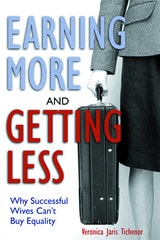
Earning More and Getting Less
Why Successful Wives Can't Buy EqualityVeronica Jaris Tichenor
Rutgers University Press, 2005
In Earning More and Getting Less, sociologist Veronica Jaris Tichenor shows how, historically, men have derived a great deal of power over financial and household decisions by bringing home all (or most) of the family's income. Yet, financial superiority has not been a similar source of power for women. Tichenor demonstrates how wives, instead of using their substantial incomes to negotiate more egalitarian relationships, enable their husbands to perpetuate male dominance within the family.
Weaving personal accounts, in-depth interviews, and compelling narrative, this important study reveals disturbing evidence that the conventional power relations defined by gender are powerful enough to undermine hierarchies defined by money. Earning More and Getting Less is essential reading in sociology, psychology, and family and gender studies.
Earworm and Event
Music, Daydreams, and Other Imaginary RefrainsEldritch Priest
Duke University Press, 2022
Eating in Theory
Annemarie Mol
Duke University Press, 2021
Ecological Feelings
A Rhetorical CompendiumJoshua Trey Barnett
Michigan State University Press, 2025
Edges of Loss
From Modern Drama to Postmodern TheoryMark Pizzato
University of Michigan Press, 1998
Egotopia
Narcissism and the New American LandscapeJohn Miller
University of Alabama Press, 1999
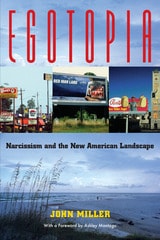
Egotopia explains why individual political and economic interests have eclipsed aesthetic considerations in the rampant billboards, malls, and urban sprawl of the New American Landscape
Egotopia begins where other critiques of the American landscape end: identifying the physical ugliness that defines and homogenizes America's cities, suburbs, and countryside. Believing that prevailing assessments of the American landscape are inadequate and injudicious, John Miller calls into question the conventional wisdom of environmentalists, urban planners,and architects alike. In this precedent-shattering examination of what he sees as the ugliness that is the American consumer society, Miller contends that our aesthetic condition can be fully understood only by explorers of the metaphoric environment.Metaphorically, the ugliness of America's great suburban sprawl is the physical manifestation of our increasing narcissism- our egotopia. The ubiquity of psychotherapy as a medium promoting self-indulgence has deified private man as it has demonized public man. The New American Landscape, Miller argues, is no longer the physical manifestation of public and communal values. Instead it has become a projection of private fantasies and narcissistic self-indulgence. Individual interests and private passions can no longer tolerate, nor even recognize, aesthetic concerns in such a landscape dedicated to uncompromising notions of utility.
Elevator Music
A Surreal History of Muzak, Easy-Listening, and Other Moodsong; Revised and Expanded EditionJoseph Lanza
University of Michigan Press, 2004
Musical cognoscenti decry its insipid content; regular folk -- if they notice -- bemoan its pervasiveness; while hipsters and campsters celebrate its retro chic. Mindful of the many voices, Joseph Lanza's Elevator Music sings seriously, with tongue in cheek, the praises of this venerable American institution.
Lanza addresses the criticisms of elites who say that Muzak and its ilk are dehumanized, vapid, or cheesy. These reactions, he argues, are based more on cultural prejudices than honest musical appraisal.
Says Lanza, today's so-called mood music is the inheritor of a long tradition of mood-altering music stretching back to the ancients; Nero's fiddle and the sirens of Odysseus being two famous examples. Contemporary atmospheric music, Lanza argues, not only serves the same purpose, it is also the inevitable background for our media-dominated age.
One of Lanza's premises, to quote Mark Twain, is that this music is "better than it sounds." "This book will have succeeded in its purpose," he writes, "if I can help efface...the distinction between one person's elevator music and another's prized recording."
Joseph Lanza is an author, producer, and music historian. His most recent book is Russ Columbo and the Crooner Mystique.
Embodying American Slavery in Contemporary Culture
Lisa Woolfork
University of Illinois Press, 2008
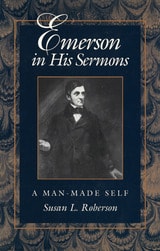
Emerson in His Sermons
A Man-Made SelfSusan L. Roberson
University of Missouri Press, 1994
Ralph Waldo Emerson is universally recognized as one of America's most influential authors and thinkers. Before achieving eminence as lecturer, essayist, and poet, though, he was a Unitaarian preacher. Emerson in His Sermons is the first major study of the sermons since the publication of The Complete Sermons of Ralph Waldo Emerson. Susan Roberson examines Emerson's ministerial career from 1826 to 1832, shedding new light on those early, crucial years in Emerson's personal and intellectual development.
Treating the sermons extensively as an autobiographical text, Roberson establishes that Emerson's years in the pulpit were pivotal and that his sermons are key texts in revealing the essential development of his thought. Central to Roberson's explication of the sermons is Emerson's conception of self-reliance, his invention of a new hero for a new age, and his merging of his own identity with that heroic idea.
Roberson focuses on Emerson's reaction to what was perhaps the most signifcant event in his personal life: the death of his young wife, Ellen, of tuberculosis in 1831, after only sixteen months of marriage. Roberson's correlation of the sermons written during that time with the complexity of Emerson's emotional and intellectual response to the tragedy of Ellen's illness and death is the most detailed and sophisticated treatment of that material to date.
Roberson understands Emerson's emergence from the ministry as his rejection of ready-made institutions and sytems of thought. Through her careful readings of the sermons, Roberson finds that Emerson's objective was less the translation of his life into writing than the translation of his life through writing. By considering the sermons in this way, Roberson is able to enrich our understanding of the private and passionte impulses of this seminal thinker.
Emerson in His Sermons offers the first real look at how the sermons fit into Emerson's own development and will have a far-reaching impact on Emerson scholarship. Anyone concerned with the cultural and religious history of America will find this book invaluable.
Emotion and Meaning in Music
Leonard B. Meyer
University of Chicago Press, 1961
"Altogether it is a book that should be required reading for any student of music, be he composer, performer, or theorist. It clears the air of many confused notions . . . and lays the groundwork for exhaustive study of the basic problem of music theory and aesthetics, the relationship between pattern and meaning."—David Kraehenbuehl, Journal of Music Theory
"This is the best study of its kind to have come to the attention of this reviewer."—Jules Wolffers, The Christian Science Monitor
"It is not too much to say that his approach provides a basis for the meaningful discussion of emotion and meaning in all art."—David P. McAllester, American Anthropologist
"A book which should be read by all who want deeper insights into music listening, performing, and composing."—Marcus G. Raskin, Chicago Review
Emotional Landscapes
Love, Gender, and MigrationEdited by Marcelo J. Borges, Sonia Cancian, and Linda Reeder
University of Illinois Press, 2020
Affecting and perceptive, Emotional Landscapes moves from war and transnational families to gender and citizenship to explore the crossroads of migration and the history of emotion.
Contributors: María Bjerg, Marcelo J. Borges, Sonia Cancian, Tyler Carrington, Margarita Dounia, Alexander Freund, Donna R. Gabaccia, A. James Hammerton, Mirjam Milharčič Hladnik, Emily Pope-Obeda, Linda Reeder, Roberta Ricucci, Suzanne M. Sinke, and Elizabeth Zanoni
Empathy and Performance
Enactments of Power in Latinx AmericaLaura V. Sández
Vanderbilt University Press, 2024
To survey different answers to these queries, Sández studies Indigurrito (Nao Bustamante); Dominicanish (Josefina Báez); ¡Bienvenidos Blancos! or Welcome White People! (Alex Torra); the apology delivered by the group Veterans Stand with Standing Rock during protests against the Dakota Access Pipeline; and Kukuli Velarde’s body of work, from We, the Colonized Ones to A Mi Vida. In these artistic enactments, which range from 1992 to 2021, the historical construct of boundaries and bodies becomes evident. Following recent work on empathy by Lanzoni, Maibom, Calloway-Thomas, Bloom, Hogan, and Matravers, among others, Sández examines in-group/out-group divisions, the establishment of identity categories through performance, and the exploration of subaltern identities.
Ending Ageism, or How Not to Shoot Old People
Gullette, Margaret Morganroth
Rutgers University Press, 2017
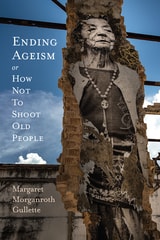
When the term “ageism” was coined in 1969, many problems of exclusion seemed resolved by government programs like Social Security and Medicare. As people live longer lives, today’s great demotions of older people cut deeper into their self-worth and human relations, beyond the reach of law or public policy. In Ending Ageism, or How Not to Shoot Old People, award-winning writer and cultural critic Margaret Morganroth Gullette confronts the offenders: the ways people aging past midlife are portrayed in the media, by adult offspring; the esthetics and politics of representation in photography, film, and theater; and the incitement to commit suicide for those with early signs of “dementia.”
In this original and important book, Gullette presents evidence of pervasive age-related assaults in contemporary societies and their chronic affects. The sudden onset of age-related shaming can occur anywhere—the shove in the street, the cold shoulder at the party, the deaf ear at the meeting, the shut-out by the personnel office or the obtuseness of a government. Turning intimate suffering into public grievances, Ending Ageism, Or How Not to Shoot Old People effectively and beautifully argues that overcoming ageism is the next imperative social movement of our time.
About the cover image:
This elegant, dignified figure--Leda Machado, a Cuban old enough to have seen the Revolution--once the center of a vast photo mural, is now a fragment on a ruined wall. Ageism tears down the structures that all humans need to age well; to end it, a symbol of resilience offers us all brisk blue-sky energy.
“Leda Antonia Machado” from “Wrinkles of the City, 2012.”
Piotr Trybalski / Trybalski.com. Courtesy of the artist.
A Declaration of Grievances
"A Declaration of Grievances" was written by Margaret Morganroth Gullette and is excerpted from her book Ending Ageism, or How Not to Shoot Old People (2017, Rutgers University Press). The poster was designed by Carolyn Kerchof.
- A Declaration of Grievances (in English): https://d3tto5i5w9ogdd.cloudfront.net/wp-content/uploads/2023/01/15175130/A-Declaration-of-Grievances_Eng.pdf
- A Declaration of Grievances (in Spanish): https://d3tto5i5w9ogdd.cloudfront.net/wp-content/uploads/2023/01/15175131/A-Declaration-of-Grievances_Spanish.pdf
- A Declaration of Grievances (in French): https://d3tto5i5w9ogdd.cloudfront.net/wp-content/uploads/2023/01/15175130/A-Declaration-of-Grievances_French.pdf
- A Declaration of Grievances (in German): https://d3tto5i5w9ogdd.cloudfront.net/wp-content/uploads/2023/01/15175131/A-Declaration-of-Grievances_German.pdf
Print the PDF (make sure to click "fit to page") and hang the Declaration up in your home or place of work. Please share this link with other people you know who care about the rights of older persons. Share on social media with the hashtags #ADeclarationOfGrievances and #EndingAgeismGullette.
For more information, an excerpt, links to reviews, and special offers on this book, go to: https://www.rutgersuniversitypress.org/ending-ageism
Related website: (https://www.brandeis.edu/wsrc/scholars/profiles/gullette.html)
Endless Intervals
Cinema, Psychology, and Semiotechnics around 1900Jeffrey West Kirkwood
University of Minnesota Press, 2022
Revealing cinema’s place in the coevolution of media technology and the human
Cinema did not die with the digital, it gave rise to it. According to Jeffrey West Kirkwood, the notion that digital technologies replaced analog obscures how the earliest cinema laid the technological and philosophical groundwork for the digital world. In Endless Intervals, he introduces a theory of semiotechnics that explains how discrete intervals of machines came to represent something like a mind—and why they were feared for their challenge to the uniqueness of human intelligence.
Examining histories of early cinematic machines, Kirkwood locates the foundations for a scientific vision of the psyche as well as the information age. He theorizes an epochal shift in the understanding of mechanical stops, breaks, and pauses that demonstrates how cinema engineered an entirely new model of the psyche—a model that was at once mechanical and semiotic, discrete and continuous, physiological and psychological, analog and digital.
Recovering largely forgotten and untranslated texts, Endless Intervals makes the case that cinema, rather than being a technology assaulting the psyche, is in fact the technology that produced the modern psyche. Kirkwood considers the ways machines can create meaning, offering a fascinating theory of how the discontinuous intervals of soulless mechanisms ultimately produced a rich continuous experience of inner life.
Enduring Cancer
Life, Death, and Diagnosis in DelhiDwaipayan Banerjee
Duke University Press, 2020
English Composition As A Happening
Geoffrey Sirc
Utah State University Press, 2002
"Contemporary Composition is still inflected by the epistemic turn taken in the 1980s, convincing me that we need to remember what we've forgotten—namely, how impassioned resolves and thrilling discoveries were abandoned and why. I'd like to retrace the road not taken in Composition Studies, to salvage what can still be recovered... I want to inspect the wreckage, in order to show what was the promise of the Happenings for Composition, as well as the huge gray longueur of its pale replacement, Eighties Composition. In so doing, I hope to begin a reconfiguration of our field's pre- and after history."
What happened to the bold, kicky promise of writing instruction in the 1960s? The current conservative trend in composition is analyzed allegorically by Geoffrey Sirc in this book-length homage to Charles Deemer's 1967 article, in which the theories and practices of Happenings artists (multi-disciplinary performance pioneers) were used to invigorate college writing. Sirc takes up Deemer's inquiry, moving through the material and theoretical concerns of such pre- and post-Happenings influences as Duchamp and Pollock, situationists and punks, as well as many of the Happenings artists proper.

Epidemic of Rumors
How Stories Shape Our Perception of DiseaseJon D. Lee
Utah State University Press, 2014
Folklore studies brings important and useful perspectives to understanding cultural responses to the outbreak of disease. Through this etiological study Lee shows the similarities between the narratives of the SARS outbreak and the narratives of other contemporary disease outbreaks like AIDS and the H1N1 virus. His analysis suggests that these disease narratives do not spring up with new outbreaks or diseases but are in continuous circulation and are recycled opportunistically. Lee also explores whether this predictability of vernacular disease narratives presents the opportunity to create counter-narratives released systematically from the government or medical science to stymie the negative effects of the fearful rumors that so often inflame humanity.
With potential for practical application to public health and health policy, An Epidemic of Rumors will be of interest to students and scholars of health, medicine, and folklore.
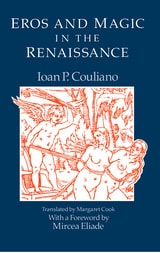
Eros and Magic in the Renaissance
Ioan P. Couliano
University of Chicago Press, 1987
Renaissance magic, according to Ioan Couliano, was a scientifically plausible attempt to manipulate individuals and groups based on a knowledge of motivations, particularly erotic motivations. Its key principle was that everyone (and in a sense everything) could be influenced by appeal to sexual desire. In addition, the magician relied on a profound knowledge of the art of memory to manipulate the imaginations of his subjects. In these respects, Couliano suggests, magic is the precursor of the modern psychological and sociological sciences, and the magician is the distant ancestor of the psychoanalyst and the advertising and publicity agent.
In the course of his study, Couliano examines in detail the ideas of such writers as Giordano Bruno, Marsilio Ficino, and Pico della Mirandola and illuminates many aspects of Renaissance culture, including heresy, medicine, astrology, alchemy, courtly love, the influence of classical mythology, and even the role of fashion in clothing.
Just as science gives the present age its ruling myth, so magic gave a ruling myth to the Renaissance. Because magic relied upon the use of images, and images were repressed and banned in the Reformation and subsequent history, magic was replaced by exact science and modern technology and eventually forgotten. Couliano's remarkable scholarship helps us to recover much of its original significance and will interest a wide audience in the humanities and social sciences.
Ethnographers In The Field
The Psychology of ResearchJohn L. Wengle
University of Alabama Press, 1988
A study of how doing field research submerged in a different culture impacts one's sense of identity.

Europe
or Up and Down with Schreiber and BaggishRichard Stern
Northwestern University Press, 2007
Originally published in 1961, this shrewd, smartly written novel follows two American men traveling in Europe. Though both have struck out for the same continent, each man’s methods of and motives for travel lead him to have a very different experience than the other. Underlying it all is the premise that Europe--the contrast, the otherness of it--can be a refiner’s fire, deeply affecting a person’s character. Europe represents a crucial step in Stern’s development as a writer and stands as a witty, sharp point of entry into his writings and the writings of novelists who rose to prominence in the 1960s.

Every Home a Fortress
Cold War Fatherhood and the Family Fallout ShelterThomas Bishop
University of Massachusetts Press, 2020
Every Last Breath
A Memoir of Two IllnessesJoanne Jacobson
University of Utah Press, 2020
Everything Flirts
Philosophical RomancesSharon Wahl
University of Iowa Press, 2024
At the heart of the stories in Everything Flirts are some of life’s trickiest questions: Why is it so hard to make the first move on a date? How do we find the person we will love? If you finally find a person to love, how do you convince them to love you back?
With a mixture of humor and reverence, Sharon Wahl hijacks classic works of philosophy and turns their focus to love. The philosopher Wittgenstein helps us consider the limits of language: Does there exist an argument, a logical deduction, that will cause another person to love us? The philosopher Zeno’s laws of motion stipulate that we can only ever cross half of any distance. This principle is applied to a first date, where making a first move becomes more and more impossible because the movie this couple goes to see is a depressing mood-killer. A woman afraid of love applies Bentham’s utilitarian principles to find her perfect match, testing every man she meets until she finds one who aces every one of her tests. Nonetheless, she wonders: Is he right for her? Is she ready to fall in love forever? The sublime and the ridiculous come together to playfully examine why love just might be a topic too hard for philosophers to explain.

Excavation
A MemoirWendy C. Ortiz
Northwestern University Press, 2025
A darkly vibrant and daring memoir, Wendy C. Ortiz’s Excavation challenged the standard telling of abuse narratives when first published in 2014; over a decade later, it remains deeply prescient. Set in Los Angeles’s San Fernando Valley in the late 1980s, the narrative follows the spiraling entanglement between Wendy and her eighth-grade English teacher as she becomes both victim to and participant in a simultaneously predatorial and impassioned relationship. Baited by initial praise and a false sense of control, Wendy tumbles into a dangerous dynamic that spans the duration of her teens. Artfully constructed from her own journals and decades of personal excavation, the story of this secret relationship has imprinted on Wendy and readers alike. A stunningly honest look at memory, agency, and power, Excavation will claim your whole heart.
Excommunication
Three Inquiries in Media and MediationAlexander R. Galloway, Eugene Thacker, and McKenzie Wark
University of Chicago Press, 2013
Experiencing Other Minds in the Courtroom
Neal Feigenson
University of Chicago Press, 2016
In Experiencing Other Minds in the Courtroom, Neal Feigenson turns the courtroom into a forum for exploring the profound philosophical, psychological, and legal ramifications of our efforts to know what other people’s conscious experiences are truly like. Drawing on disciplines ranging from cognitive psychology to psychophysics to media studies, Feigenson harnesses real examples of digitally simulated subjective perceptions to explain how the epistemological value of this evidence is affected by who creates it, how it is made, and how it is presented. Through his close scrutiny of the different kinds of simulations and the different knowledge claims they make, Feigenson is able to suggest best practices for how we might responsibly incorporate such evidence into the courtroom.

Experiencing War Memorials
Environment, Affect, and Public MemoryEdited by Jennifer K. Ladino
University of Alabama Press, 2026
Examines the emotional, formal, and environmental dimensions of war commemoration
Experiencing War Memorials is a compelling edited collection of essays that examines how war is commemorated through public memorials and the powerful emotions and ideologies these sites generate. Drawing on fields such as war studies, affect studies, public memory studies, and the environmental humanities, the volume demonstrates that commemoration is not only an intellectual act but an embodied, affective experience.
Through diverse case studies, contributors analyze how memorials shape public feelings about fast and slow violence, including battles, massacres, and incarceration. The essays reveal how materials, landscapes, narrative conventions, and innovative memorial forms guide emotional responses such as grief, pride, ambivalence, and outrage while making injustice perceptible. Against the backdrop of ongoing debates over heritage and violence, the collection insists on the importance of attending to the messy and disordered emotional dimensions of public memory. Some essays explore varied human and animal experiences, including military working dogs; scrutinize unsettling sites such as Confederate monuments and overlooked Holocaust locations; and consider digital, ecological, and pandemic-era memorials that expand the boundaries of commemoration.
Edited by Jennifer K. Ladino, Experiencing War Memorials offers nuanced insights into how memorial practices shape national identities, ethical understanding, and the possibilities for social change, illuminating the profound ways public remembrance influences how societies feel, remember, and reckon with violence in all its forms. This volume will appeal to scholars and students of memory studies, war and cultural studies, environmental humanities, and American studies, as well as museum professionals, artists, and readers interested in the politics and emotions of public commemoration.
Experimental Ethnography
The Work of Film in the Age of VideoCatherine Russell
Duke University Press, 1999
Russell provides detailed analyses of more than thirty-five films and videos from the 1890s to the 1990s and discusses a wide range of film and videomakers, including Georges Méliès, Maya Deren, Peter Kubelka, Ray Birdwhistell, Jean Rouch, Su Friedrich, Bill Viola, Kidlat Tahimik, Margaret Mead, Tracey Moffatt, and Chantal Akerman. Arguing that video enables us to see film differently—not as a vanishing culture but as bodies inscripted in technology, Russell maps the slow fade from modernism to postmodern practices. Combining cultural critique with aesthetic analysis, she explores the dynamics of historical interruption, recovery, and reevaluation. As disciplinary boundaries dissolve, Russell contends, ethnography is a means of renewing the avant-gardism of “experimental” film, of mobilizing its play with language and form for historical ends. “Ethnography” likewise becomes an expansive term in which culture is represented from many different and fragmented perspectives.
Original in both its choice of subject and its theoretical and methodological
approaches, Experimental Ethnography will appeal to visual anthropologists, as well as film scholars interested in experimental and documentary practices.

e-mail trouble
love and addiction @ the matrixBy S. Paige Baty
University of Texas Press, 1999
"This is about a society of isolates who all communicate with one another from terminal sites. This is about being disembodied, distanced, distinct, and that sort of boundary-thing. It is not about being present. It is not about being there. It is not about a shared history, or a shared meal, or a shared story, or any kind of mutuality. It is about contact between virtual strangers. . . . It happens when you feel that you are so alone that you need anybody to talk to—anybody at all—because you believe that your connections have failed you. This kind of connection leaves you cold and dead inside, because it lacks history and a language of belonging."
In this daring, postmodern autobiography, S. Paige Baty recounts her search for love and community on the Internet. Taking Jack Kerouac's On the Road as a point of departure, Baty describes both an actual road trip to meet the object of an e-mail romance and the cyber-search for connection that draws so many people into the matrix of the Internet. Writing in a bold, experimental style that freely mixes e-mails, poems, fragments of quotations, and puns into expository text, she convincingly links e-mail trouble with "female trouble" in the displacement of embodied love and accountable human relationships to opaque screens and alienated identities. Her book stands as a vivid feminist critique of our culture's love affair with technology and its dehumanizing effect on personal relationships.