436 books match the query 'Renaissance' and 41 start with e
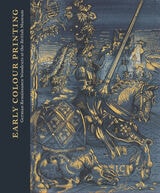
cover of Early Colour Printing: German Renaissance Woodcuts at the British Museum

Early Colour Printing

German Renaissance Woodcuts at the British Museum

Elizabeth Savage

Paul Holberton Publishing, 2020

This illustrated volume reproduces and describes effectively every early modern German color print held at the British Museum, one of the world’s most significant collections of these rare milestones of cultural heritage and technology. New photography reveals 150 impressions in jaw-dropping detail, some of which have never been seen in public or reproduced. 

From artworks to missals and icons to wallpapers, this book breaks new ground by revealing the fascinating underlying technologies that enabled the production of these color-printed objects. Further, the volume offers significant new scholarship, pinpointing attributions to printers—not just to artists or designers. In doing so, it lays the groundwork for a new understanding of the history of print, one that encompasses all forms of printed material. Thoroughly researched and engagingly written, this collection guide will be a standard reference on German graphic art, early modern visual culture, and the history of printing itself.
[more]
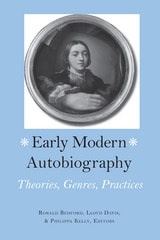
cover of Early Modern Autobiography: Theories, Genres, Practices

Early Modern Autobiography

Theories, Genres, Practices

Ronald Bedford, Lloyd Davis and Philippa Kelly, Editors

University of Michigan Press, 2006

Why, and in what ways, did late medieval and early modern English people write about themselves, and what was their understanding of how "selves" were made and discussed? This collection goes to the heart of current debate about literature and autobiography, addressing the contentious issues of what is meant by early modern autobiographical writing, how it was done, and what was understood by self-representation in a society whose groupings were both elaborate and highly regulated. Early Modern Autobiography considers the many ways in which autobiographical selves emerged from the late medieval period through the seventeenth century, with the aim of understanding the interaction between those individuals’ lives and their worlds, the ways in which they could be recorded, and the contexts in which they are read. In addressing this historical arc, the volume develops new readings of significant autobiographical works, while also suggesting the importance of texts and contexts that have rarely been analyzed in detail, enabling the contributors to reflect on, and challenge, some prevailing ideas about what it means to write autobiographically and about the development of notions of self-representation.

“The idea of the self, as seen from diverse and fascinating perspectives on sixteenth- and seventeenth-century life: this is what readers can expect from Early Modern Autobiography. A beautifully edited collection, genuinely far-reaching and insightful, Early Modern Autobiography makes known to us a great deal about how people saw themselves four hundred years ago."
—Derek Cohen, Professor of English, McLaughlin College, York University

"Acutely addressing a range of central issues from subjectivity to theatricality to religion, these essays will be of great interest to specialists in early modern studies and students of autobiographical writings from all eras."
—Heather Dubrow, Tighe-Evans Professor and John Bascom Professor, Department of English, University of Wisconsin

"The essays in this volume show where archival discoveries—memoirs, letters, account books, wills, and marginalia—can take us in understanding early modern mentalities. They document the interdependence of the abstract and the everyday, the social constructedness of self-awareness, local contexts for self-recordation, and impulses that range from legal purpose to imaginative escape. The sixteen chapters open many fascinating new perspectives on identity and personhood in Renaissance England."—Lena Cowen Orlin, Executive Director, The Shakespeare Association of America and Professor of English, University of Maryland Baltimore County
Ronald Bedford is Reader in the School of English, Communication and Theatre at the Unversity of New England in Armidale, New South Wales, and author of The Defence of Truth: Herbert of Cherbury and the Seventeenth Century and Dialogues with Convention: Readings in Renaissance Poetry. The late Lloyd Davis was Reader in the School of English at the University of Queensland, and author of Guise and Disguise: Rhetoric and Characterization in the English Renaissance (1993) and editor of Sexuality and Gender in the English Renaissance (1998) and Shakespeare Matters: History, Teaching, Performance (2003). Philippa Kelly is a Senior Research Fellow at the University of New South Wales, and has published widely in the areas of Shakespeare studies, cultural studies, feminism, and postcolonial studies.
[more]
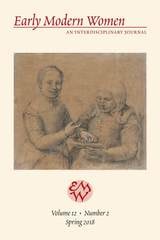
cover of Early Modern Women Journal Volume 12.2

Early Modern Women Journal Volume 12.2

Edited by Mihoko Suzuki

Arizona Center for Medieval and Renaissance Studies, 2018
Early Modern Women: An Interdisciplinary Journal (EMWJ) is the only journal devoted solely to the interdisciplinary and global study of women and gender spanning the late medieval through early modern periods. Each volume gathers essays on early modern women from every country and region by scholars from a wide range of academic disciplines including art history, cultural studies, music, history, languages and literatures, political science, religion, theatre, history of science, and history of philosophy.
[more]
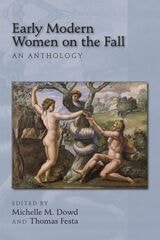
cover of Early Modern Women on the Fall: An Anthology

Early Modern Women on the Fall

An Anthology

Michelle M. Dowd

Arizona Center for Medieval and Renaissance Studies, 2012
[more]
cover of Early Modern Women: An Interdisciplinary Journal, volume 16 number 1 (Fall 2021)

Early Modern Women

An Interdisciplinary Journal, volume 16 number 1 (Fall 2021)

The University of Chicago Press

University of Chicago Press Journals, 2021
This is volume 16 issue 1 of Early Modern Women: An Interdisciplinary Journal. Early Modern Women: An Interdisciplinary Journal (EMW) is the only journal devoted solely to the interdisciplinary and global study of women and gender spanning the late medieval through early modern periods. Each volume gathers essays on early modern women from every country and region by scholars from a wide range of academic disciplines including art history, cultural studies, music, history, languages and literatures, political science, religion, theatre, history of science, and history of philosophy.
[more]
cover of Early Modern Women: An Interdisciplinary Journal, volume 16 number 2 (Spring 2022)

Early Modern Women

An Interdisciplinary Journal, volume 16 number 2 (Spring 2022)

The University of Chicago Press

University of Chicago Press Journals, 2022
This is volume 16 issue 2 of Early Modern Women: An Interdisciplinary Journal. Early Modern Women: An Interdisciplinary Journal (EMW) is the only journal devoted solely to the interdisciplinary and global study of women and gender spanning the late medieval through early modern periods. Each volume gathers essays on early modern women from every country and region by scholars from a wide range of academic disciplines including art history, cultural studies, music, history, languages and literatures, political science, religion, theatre, history of science, and history of philosophy.
[more]
cover of Early Modern Women: An Interdisciplinary Journal, volume 17 number 1 (Fall 2022)

Early Modern Women

An Interdisciplinary Journal, volume 17 number 1 (Fall 2022)

The University of Chicago Press

University of Chicago Press Journals, 2022
This is volume 17 issue 1 of Early Modern Women: An Interdisciplinary Journal. Early Modern Women: An Interdisciplinary Journal (EMW) is the only journal devoted solely to the interdisciplinary and global study of women and gender spanning the late medieval through early modern periods. Each volume gathers essays on early modern women from every country and region by scholars from a wide range of academic disciplines including art history, cultural studies, music, history, languages and literatures, political science, religion, theatre, history of science, and history of philosophy.
[more]
cover of Early Modern Women: An Interdisciplinary Journal, volume 17 number 2 (Spring 2023)

Early Modern Women

An Interdisciplinary Journal, volume 17 number 2 (Spring 2023)

The University of Chicago Press

University of Chicago Press Journals, 2023
This is volume 17 issue 2 of Early Modern Women: An Interdisciplinary Journal. Early Modern Women: An Interdisciplinary Journal (EMW) is the only journal devoted solely to the interdisciplinary and global study of women and gender spanning the late medieval through early modern periods. Each volume gathers essays on early modern women from every country and region by scholars from a wide range of academic disciplines including art history, cultural studies, music, history, languages and literatures, political science, religion, theatre, history of science, and history of philosophy.
[more]
cover of Early Modern Women: An Interdisciplinary Journal, volume 18 number 1 (Fall 2023)

Early Modern Women

An Interdisciplinary Journal, volume 18 number 1 (Fall 2023)

The University of Chicago Press

University of Chicago Press Journals, 2023
This is volume 18 issue 1 of Early Modern Women: An Interdisciplinary Journal. Early Modern Women: An Interdisciplinary Journal (EMW) is the only journal devoted solely to the interdisciplinary and global study of women and gender spanning the late medieval through early modern periods. Each volume gathers essays on early modern women from every country and region by scholars from a wide range of academic disciplines including art history, cultural studies, music, history, languages and literatures, political science, religion, theatre, history of science, and history of philosophy.
[more]
cover of Early Modern Women: An Interdisciplinary Journal, volume 18 number 2 (Spring 2024)

Early Modern Women

An Interdisciplinary Journal, volume 18 number 2 (Spring 2024)

The University of Chicago Press

University of Chicago Press Journals, 2024
This is volume 18 issue 2 of Early Modern Women: An Interdisciplinary Journal. Early Modern Women: An Interdisciplinary Journal (EMW) is the only journal devoted solely to the interdisciplinary and global study of women and gender spanning the late medieval through early modern periods. Each volume gathers essays on early modern women from every country and region by scholars from a wide range of academic disciplines including art history, cultural studies, music, history, languages and literatures, political science, religion, theatre, history of science, and history of philosophy.
[more]
cover of Early Modern Women: An Interdisciplinary Journal, volume 19 number 1 (Fall 2024)

Early Modern Women

An Interdisciplinary Journal, volume 19 number 1 (Fall 2024)

The University of Chicago Press

University of Chicago Press Journals, 2024
This is volume 19 issue 1 of Early Modern Women: An Interdisciplinary Journal. Early Modern Women: An Interdisciplinary Journal (EMW) is the only journal devoted solely to the interdisciplinary and global study of women and gender spanning the late medieval through early modern periods. Each volume gathers essays on early modern women from every country and region by scholars from a wide range of academic disciplines including art history, cultural studies, music, history, languages and literatures, political science, religion, theatre, history of science, and history of philosophy.
[more]
cover of Early Modern Women: An Interdisciplinary Journal, volume 19 number 2 (Spring 2025)

Early Modern Women

An Interdisciplinary Journal, volume 19 number 2 (Spring 2025)

The University of Chicago Press

University of Chicago Press Journals, 2025
This is volume 19 issue 2 of Early Modern Women: An Interdisciplinary Journal. Early Modern Women: An Interdisciplinary Journal (EMW) is the only journal devoted solely to the interdisciplinary and global study of women and gender spanning the late medieval through early modern periods. Each volume gathers essays on early modern women from every country and region by scholars from a wide range of academic disciplines including art history, cultural studies, music, history, languages and literatures, political science, religion, theatre, history of science, and history of philosophy.
[more]
cover of Early Modern Women: An Interdisciplinary Journal, volume 20 number 1 (Fall 2025)

Early Modern Women

An Interdisciplinary Journal, volume 20 number 1 (Fall 2025)

The University of Chicago Press

University of Chicago Press Journals, 2025
This is volume 20 issue 1 of Early Modern Women: An Interdisciplinary Journal. Early Modern Women: An Interdisciplinary Journal (EMW) is the only journal devoted solely to the interdisciplinary and global study of women and gender spanning the late medieval through early modern periods. Each volume gathers essays on early modern women from every country and region by scholars from a wide range of academic disciplines including art history, cultural studies, music, history, languages and literatures, political science, religion, theatre, history of science, and history of philosophy.
[more]
cover of Early Modern Women: An Interdisciplinary Journal, volume 20 number 2 (Spring 2026)

Early Modern Women

An Interdisciplinary Journal, volume 20 number 2 (Spring 2026)

The University of Chicago Press

University of Chicago Press Journals, 2026
This is volume 20 issue 2 of Early Modern Women: An Interdisciplinary Journal. Early Modern Women: An Interdisciplinary Journal (EMW) is the only journal devoted solely to the interdisciplinary and global study of women and gender spanning the late medieval through early modern periods. Each volume gathers essays on early modern women from every country and region by scholars from a wide range of academic disciplines including art history, cultural studies, music, history, languages and literatures, political science, religion, theatre, history of science, and history of philosophy.
[more]
cover of Early Modern Women: An Interdisciplinary Journal, volume 21 number 1 (Fall 2026)

Early Modern Women

An Interdisciplinary Journal, volume 21 number 1 (Fall 2026)

The University of Chicago Press

University of Chicago Press Journals, 2026
This is volume 21 issue 1 of Early Modern Women: An Interdisciplinary Journal. Early Modern Women: An Interdisciplinary Journal (EMW) is the only journal devoted solely to the interdisciplinary and global study of women and gender spanning the late medieval through early modern periods. Each volume gathers essays on early modern women from every country and region by scholars from a wide range of academic disciplines including art history, cultural studies, music, history, languages and literatures, political science, religion, theatre, history of science, and history of philosophy.
[more]
cover of Egyptian Oedipus: Athanasius Kircher and the Secrets of Antiquity

Egyptian Oedipus

Athanasius Kircher and the Secrets of Antiquity

Daniel Stolzenberg

University of Chicago Press, 2013
A contemporary of Descartes and Newton, Athanasius Kircher, S. J. (1601/2–80), was one of Europe’s most inventive and versatile scholars in the baroque era. He published more than thirty works in fields as diverse as astronomy, magnetism, cryptology, numerology, geology, and music. But Kircher is most famous—or infamous—for his quixotic attempt to decipher the Egyptian hieroglyphs and reconstruct the ancient traditions they encoded. In 1655, after more than two decades of toil, Kircher published his solution to the hieroglyphs, Oedipus Aegyptiacus, a work that has been called “one of the most learned monstrosities of all times.” Here Daniel Stolzenberg presents a new interpretation of Kircher’s hieroglyphic studies, placing them in the context of seventeenth-century scholarship on paganism and Oriental languages.
           
Situating Kircher in the social world of baroque Rome, with its scholars, artists, patrons, and censors, Stolzenberg shows how Kircher’s study of ancient paganism depended on the circulation of texts, artifacts, and people between Christian and Islamic civilizations. Along with other participants in the rise of Oriental studies, Kircher aimed to revolutionize the study of the past by mastering Near Eastern languages and recovering ancient manuscripts hidden away in the legendary libraries of Cairo and Damascus. The spectacular flaws of his scholarship have fostered an image of Kircher as an eccentric anachronism, a throwback to the Renaissance hermetic tradition. Stolzenberg argues against this view, showing how Kircher embodied essential tensions of a pivotal phase in European intellectual history, when pre-Enlightenment scholars pioneered modern empirical methods of studying the past while still working within traditional frameworks, such as biblical history and beliefs about magic and esoteric wisdom.
[more]
cover of Elizabethan Poetry in Manuscript: An Edition of British Library Harley MS 7392(2)

Elizabethan Poetry in Manuscript

An Edition of British Library Harley MS 7392(2)

Edited by Jessica Edmondes

Iter Press, 2022

This volume presents the first printed edition of a late sixteenth-century poetic miscellany and provides invaluable insight into understanding the literature of the period. Its owner and principal scribe, Humfrey Coningsby, drew on texts circulating in manuscript , predominantly by contemporary writers of the time—including Philip Sidney, Edward Dyer, Arthur Gorges, Walter Ralegh, Elizabeth I, the Earl of Oxford, Nicholas Breton, George Peele, and Thomas Watson. Coningsby also added at least two of his own compositions, along with anonymous poems not found in any other manuscripts or printed books.

This edition preserves the appearance, spelling, and punctuation of the original manuscript while expanding antiquated contractions to provide an easily readable text. Textual notes appear on the page, and in-depth contextual notes and word glosses are provided in the commentary section. The analyses add to our knowledge of early modern manuscript culture and literary manuscript transmission, and a substantial introduction provides context for the compilation of the anthology.

[more]
cover of Encore!: The Renaissance of Wisconsin Opera Houses

Encore!

The Renaissance of Wisconsin Opera Houses

Brian Leahy Doyle

Wisconsin Historical Society Press, 2009

A remarkable number of Wisconsin towns and cities were home to an opera house in the late 1800s and early 1900s. Some were freestanding structures built by local benefactors, industrialists, and capitalists. Others were located within a city hall building and financed by local tax dollars with the support of government officials who believed in the value of the arts for their community

In Encore! The Renaissance of Wisconsin Opera Houses, Brian Leahy Doyle chronicles the histories of ten Wisconsin opera houses and theaters, from their construction to their heydays as live performance spaces and through the periods when many of these stages went dark. But what makes these stories so compelling is that all but one of the featured theaters has been restored to its original splendor. Just as the beginnings of these theaters were often the result of the efforts of local citizens, Doyle discovers that their restoration is due to the commitment of dedicated and passionate people. More than one of these revived theaters has spurred the revitalization of its surrounding downtown business district as well.

Encore! is the second book in the Places along the Way series. Richly illustrated with historic and contemporary photos, the Places along the Way series links Wisconsin's past with its present, exploring the state's history through its architecture.
 

[more]
cover of Engineering the Eternal City: Infrastructure, Topography, and the Culture of Knowledge in Late Sixteenth-Century Rome

Engineering the Eternal City

Infrastructure, Topography, and the Culture of Knowledge in Late Sixteenth-Century Rome

Pamela O. Long

University of Chicago Press, 2018

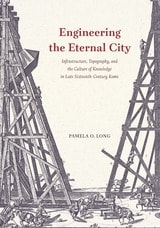
Between the catastrophic flood of the Tiber River in 1557 and the death of the “engineering pope” Sixtus V in 1590, the city of Rome was transformed by intense activity involving building construction and engineering projects of all kinds. Using hundreds of archival documents and primary sources, Engineering the Eternal City explores the processes and people involved in these infrastructure projects—sewers, bridge repair, flood prevention, aqueduct construction, the building of new, straight streets, and even the relocation of immensely heavy ancient Egyptian obelisks that Roman emperors had carried to the city centuries before.
 
This portrait of an early modern Rome examines the many conflicts, failures, and successes that shaped the city, as decision-makers tried to control not only Rome’s structures and infrastructures but also the people who lived there. Taking up visual images of the city created during the same period—most importantly in maps and urban representations, this book shows how in a time before the development of modern professionalism and modern bureaucracies, there was far more wide-ranging conversation among people of various backgrounds on issues of engineering and infrastructure than there is in our own times. Physicians, civic leaders, jurists, cardinals, popes, and clerics engaged with painters, sculptors, architects, printers, and other practitioners as they discussed, argued, and completed the projects that remade Rome.
[more]
cover of English Literary Renaissance, volume 52 number 1 (Winter 2022)

English Literary Renaissance, volume 52 number 1 (Winter 2022)

The University of Chicago Press

University of Chicago Press Journals, 2022
This is volume 52 issue 1 of English Literary Renaissance. English Literary Renaissance (ELR) is a leading journal for new research in Tudor and Stuart literature, including the Sidneys, Spenser, Shakespeare, Jonson, Donne, Milton, and their many contemporaries. In addition to critical work, ELR also publishes review essays and occasional editions of short significant manuscripts, such as letters, legal documents with literary relevance, and poetry.
[more]
cover of English Literary Renaissance, volume 52 number 2 (Spring 2022)

English Literary Renaissance, volume 52 number 2 (Spring 2022)

The University of Chicago Press

University of Chicago Press Journals, 2022
This is volume 52 issue 2 of English Literary Renaissance. English Literary Renaissance (ELR) is a leading journal for new research in Tudor and Stuart literature, including the Sidneys, Spenser, Shakespeare, Jonson, Donne, Milton, and their many contemporaries. In addition to critical work, ELR also publishes review essays and occasional editions of short significant manuscripts, such as letters, legal documents with literary relevance, and poetry.
[more]
cover of English Literary Renaissance, volume 52 number 3 (Autumn 2022)

English Literary Renaissance, volume 52 number 3 (Autumn 2022)

The University of Chicago Press

University of Chicago Press Journals, 2022
This is volume 52 issue 3 of English Literary Renaissance. English Literary Renaissance (ELR) is a leading journal for new research in Tudor and Stuart literature, including the Sidneys, Spenser, Shakespeare, Jonson, Donne, Milton, and their many contemporaries. In addition to critical work, ELR also publishes review essays and occasional editions of short significant manuscripts, such as letters, legal documents with literary relevance, and poetry.
[more]
cover of English Literary Renaissance, volume 53 number 1 (Winter 2023)

English Literary Renaissance, volume 53 number 1 (Winter 2023)

The University of Chicago Press

University of Chicago Press Journals, 2023
This is volume 53 issue 1 of English Literary Renaissance. English Literary Renaissance (ELR) is a leading journal for new research in Tudor and Stuart literature, including the Sidneys, Spenser, Shakespeare, Jonson, Donne, Milton, and their many contemporaries. In addition to critical work, ELR also publishes review essays and occasional editions of short significant manuscripts, such as letters, legal documents with literary relevance, and poetry.
[more]
cover of English Literary Renaissance, volume 53 number 2 (Spring 2023)

English Literary Renaissance, volume 53 number 2 (Spring 2023)

The University of Chicago Press

University of Chicago Press Journals, 2023
This is volume 53 issue 2 of English Literary Renaissance. English Literary Renaissance (ELR) is a leading journal for new research in Tudor and Stuart literature, including the Sidneys, Spenser, Shakespeare, Jonson, Donne, Milton, and their many contemporaries. In addition to critical work, ELR also publishes review essays and occasional editions of short significant manuscripts, such as letters, legal documents with literary relevance, and poetry.
[more]
cover of English Literary Renaissance, volume 53 number 3 (Autumn 2023)

English Literary Renaissance, volume 53 number 3 (Autumn 2023)

The University of Chicago Press

University of Chicago Press Journals, 2023
This is volume 53 issue 3 of English Literary Renaissance. English Literary Renaissance (ELR) is a leading journal for new research in Tudor and Stuart literature, including the Sidneys, Spenser, Shakespeare, Jonson, Donne, Milton, and their many contemporaries. In addition to critical work, ELR also publishes review essays and occasional editions of short significant manuscripts, such as letters, legal documents with literary relevance, and poetry.
[more]
cover of English Literary Renaissance, volume 54 number 1 (Winter 2024)

English Literary Renaissance, volume 54 number 1 (Winter 2024)

The University of Chicago Press

University of Chicago Press Journals, 2024
This is volume 54 issue 1 of English Literary Renaissance. English Literary Renaissance (ELR) is a leading journal for new research in Tudor and Stuart literature, including the Sidneys, Spenser, Shakespeare, Jonson, Donne, Milton, and their many contemporaries. In addition to critical work, ELR also publishes review essays and occasional editions of short significant manuscripts, such as letters, legal documents with literary relevance, and poetry.
[more]
cover of English Literary Renaissance, volume 54 number 2 (Spring 2024)

English Literary Renaissance, volume 54 number 2 (Spring 2024)

The University of Chicago Press

University of Chicago Press Journals, 2024
This is volume 54 issue 2 of English Literary Renaissance. English Literary Renaissance (ELR) is a leading journal for new research in Tudor and Stuart literature, including the Sidneys, Spenser, Shakespeare, Jonson, Donne, Milton, and their many contemporaries. In addition to critical work, ELR also publishes review essays and occasional editions of short significant manuscripts, such as letters, legal documents with literary relevance, and poetry.
[more]
cover of English Literary Renaissance, volume 54 number 3 (Autumn 2024)

English Literary Renaissance, volume 54 number 3 (Autumn 2024)

The University of Chicago Press

University of Chicago Press Journals, 2024
This is volume 54 issue 3 of English Literary Renaissance. English Literary Renaissance (ELR) is a leading journal for new research in Tudor and Stuart literature, including the Sidneys, Spenser, Shakespeare, Jonson, Donne, Milton, and their many contemporaries. In addition to critical work, ELR also publishes review essays and occasional editions of short significant manuscripts, such as letters, legal documents with literary relevance, and poetry.
[more]
cover of English Literary Renaissance, volume 55 number 1 (Winter 2025)

English Literary Renaissance, volume 55 number 1 (Winter 2025)

The University of Chicago Press

University of Chicago Press Journals, 2025
This is volume 55 issue 1 of English Literary Renaissance. English Literary Renaissance (ELR) is a leading journal for new research in Tudor and Stuart literature, including the Sidneys, Spenser, Shakespeare, Jonson, Donne, Milton, and their many contemporaries. In addition to critical work, ELR also publishes review essays and occasional editions of short significant manuscripts, such as letters, legal documents with literary relevance, and poetry.
[more]
cover of English Literary Renaissance, volume 55 number 2 (Spring 2025)

English Literary Renaissance, volume 55 number 2 (Spring 2025)

The University of Chicago Press

University of Chicago Press Journals, 2025
This is volume 55 issue 2 of English Literary Renaissance. English Literary Renaissance (ELR) is a leading journal for new research in Tudor and Stuart literature, including the Sidneys, Spenser, Shakespeare, Jonson, Donne, Milton, and their many contemporaries. In addition to critical work, ELR also publishes review essays and occasional editions of short significant manuscripts, such as letters, legal documents with literary relevance, and poetry.
[more]
cover of English Literary Renaissance, volume 55 number 3 (Autumn 2025)

English Literary Renaissance, volume 55 number 3 (Autumn 2025)

The University of Chicago Press

University of Chicago Press Journals, 2025
This is volume 55 issue 3 of English Literary Renaissance. English Literary Renaissance (ELR) is a leading journal for new research in Tudor and Stuart literature, including the Sidneys, Spenser, Shakespeare, Jonson, Donne, Milton, and their many contemporaries. In addition to critical work, ELR also publishes review essays and occasional editions of short significant manuscripts, such as letters, legal documents with literary relevance, and poetry.
[more]
cover of English Literary Renaissance, volume 56 number 1 (Winter 2026)

English Literary Renaissance, volume 56 number 1 (Winter 2026)

The University of Chicago Press

University of Chicago Press Journals, 2026
This is volume 56 issue 1 of English Literary Renaissance. English Literary Renaissance (ELR) is a leading journal for new research in Tudor and Stuart literature, including the Sidneys, Spenser, Shakespeare, Jonson, Donne, Milton, and their many contemporaries. In addition to critical work, ELR also publishes review essays and occasional editions of short significant manuscripts, such as letters, legal documents with literary relevance, and poetry.
[more]
cover of English Literary Renaissance, volume 56 number 2 (Spring 2026)

English Literary Renaissance, volume 56 number 2 (Spring 2026)

The University of Chicago Press

University of Chicago Press Journals, 2026
This is volume 56 issue 2 of English Literary Renaissance. English Literary Renaissance (ELR) is a leading journal for new research in Tudor and Stuart literature, including the Sidneys, Spenser, Shakespeare, Jonson, Donne, Milton, and their many contemporaries. In addition to critical work, ELR also publishes review essays and occasional editions of short significant manuscripts, such as letters, legal documents with literary relevance, and poetry.
[more]
cover of English Literary Renaissance, volume 56 number 3 (Autumn 2026)

English Literary Renaissance, volume 56 number 3 (Autumn 2026)

The University of Chicago Press

University of Chicago Press Journals, 2026
This is volume 56 issue 3 of English Literary Renaissance. English Literary Renaissance (ELR) is a leading journal for new research in Tudor and Stuart literature, including the Sidneys, Spenser, Shakespeare, Jonson, Donne, Milton, and their many contemporaries. In addition to critical work, ELR also publishes review essays and occasional editions of short significant manuscripts, such as letters, legal documents with literary relevance, and poetry.
[more]
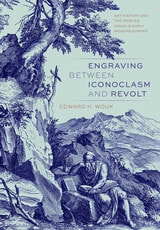
cover of Engraving Between Iconoclasm and Revolt: Art History and the Printed Image in Early Modern Europe

Engraving Between Iconoclasm and Revolt

Art History and the Printed Image in Early Modern Europe

Edward H. Wouk

University of Chicago Press, 0

An alternative history of Renaissance art from a Netherlandish perspective and focusing on printed images.

Through his treatises, letters, and support of printmaking projects, Bruges-born humanist Dominicus Lampsonius (1532–1599) tested the limits of what it meant to be an artist in the early modern period. This book—the first monographic study of Lampsonius to appear in the English language—investigates the convergence of art history, aesthetics, cultural politics, and theology in Lampsonius’s writings, with a particular focus on his novel theory of the printed image as a work of art.

In Lampsonius’s art history, painting recedes and engraving comes to the fore. This inversion of traditional hierarchies entailed a remaking of the Renaissance image as a graphic and replicable phenomenon. Here was a new way of looking at the image: not as a painted likeness of the sacred or the world, but rather as a graphic representation formed from the attenuated patterns of the engraved surface. In both meaning and making, printed images deflected the threats of iconoclasm precisely because, as manufactured objects, they could never be confused for what they represented—the sacred “prototype” they explicitly did not resemble. Tracing Lampsonius’s evolving views against the religious, political, and cultural upheaval of the Dutch Revolt, Edward H. Wouk considers the lasting implications of his efforts to change the course of art history.
[more]
cover of Enrico; or, Byzantium Conquered: A Heroic Poem

Enrico; or, Byzantium Conquered

A Heroic Poem

Lucrezia Marinella

University of Chicago Press, 2009

Lucrezia Marinella (1571–1653) is, by all accounts, a phenomenon in early modernity: a woman who wrote and published in many genres, whose fame shone brightly within and outside her native Venice, and whose voice is simultaneously original and reflective of her time and culture. In Enrico; or, Byzantium Conquered, one of the most ambitious and rewarding of her numerous narrative works, Marinella demonstrates her skill as an epic poet.
 

Now available for the first time in English translation, Enrico retells the story of the conquest of Byzantium in the Fourth Crusade (1202–04). Marinella intersperses historical events in her account of the invasion with numerous invented episodes, drawing on the rich imaginative legacy of the chivalric romance. Fast-moving, colorful, and narrated with the zest that characterizes Marinella’s other works, this poem is a great example of a woman engaging critically with a quintessentially masculine form and subject matter, writing in a genre in which the work of women poets was typically shunned.
[more]
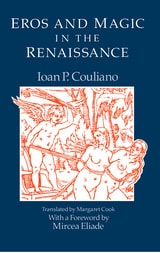
cover of Eros and Magic in the Renaissance

Eros and Magic in the Renaissance

Ioan P. Couliano

University of Chicago Press, 1987

It is a widespread prejudice of modern, scientific society that "magic" is merely a ludicrous amalgam of recipes and methods derived from primitive and erroneous notions about nature. Eros and Magic in the Renaissance challenges this view, providing an in-depth scholarly explanation of the workings of magic and showing that magic continues to exist in an altered form even today.

Renaissance magic, according to Ioan Couliano, was a scientifically plausible attempt to manipulate individuals and groups based on a knowledge of motivations, particularly erotic motivations. Its key principle was that everyone (and in a sense everything) could be influenced by appeal to sexual desire. In addition, the magician relied on a profound knowledge of the art of memory to manipulate the imaginations of his subjects. In these respects, Couliano suggests, magic is the precursor of the modern psychological and sociological sciences, and the magician is the distant ancestor of the psychoanalyst and the advertising and publicity agent.

In the course of his study, Couliano examines in detail the ideas of such writers as Giordano Bruno, Marsilio Ficino, and Pico della Mirandola and illuminates many aspects of Renaissance culture, including heresy, medicine, astrology, alchemy, courtly love, the influence of classical mythology, and even the role of fashion in clothing.

Just as science gives the present age its ruling myth, so magic gave a ruling myth to the Renaissance. Because magic relied upon the use of images, and images were repressed and banned in the Reformation and subsequent history, magic was replaced by exact science and modern technology and eventually forgotten. Couliano's remarkable scholarship helps us to recover much of its original significance and will interest a wide audience in the humanities and social sciences.
[more]
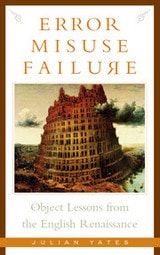
cover of Error, Misuse, Failure: Object Lessons From The English Renaissance

Error, Misuse, Failure

Object Lessons From The English Renaissance

Julian Yates

University of Minnesota Press, 2002
Explores what an object tells us about the culture that created it. If certain objects work well, no one notices them. As with "black boxes," their success may be gauged by their relative invisibility-and this was the indirect goal of the objects that Julian Yates considers here: the portrait miniature, the relic, the privy (flush toilet), the printed text, and the priest-hole (a secret hiding place for Catholic priests in Protestant England). Because each of these contrivances was prone to error, misuse, and sometimes catastrophic failure, they become in Yates's analysis an occasion for recasting the history of the English Renaissance as object lessons-"knowing from the point of view of the known." It is through such lapses-the texts and stories generated to explain away a relic that is too easily faked, a miniature that is too curiously real, the stench of a failing privy, a book that persistently sheds its pages, or the presence of so much "papist trash" in an ostensibly reformed England-that Yates recovers the silent work of "things" in cultural production. Drawing object lessons from failing technological devices, Error, Misuse, Failure plumbs the foundations of Renaissance culture in England, recovering a curious language of mistakes, dirt, and parasitism that associates the failures of these "things" with the figures of Rome, Catholicism, and Sodom. Yates offers a mode of historical inquiry rooted in material culture, sensitive to the way humans induct nonhumans (animals, plants, and manufactured things) into their communities. Historically, the book offers a new set of stories about the rise of printing, the development of domestic architecture, and England's Catholic community-stories that remind readers of the ways in which attending to the history of nonhumans requires a radical rethinking of historical landmarks and boundaries. Julian Yates is associate professor of English at the University of Delaware.
[more]
cover of Europe in the Sixteenth Century

Europe in the Sixteenth Century

H. G. Koenigsberger, George L. Mosse, and G. Q. Bowler

University of Wisconsin Press, 2026
The revised and updated edition of a seminal text, Europe in the Sixteenth Century weaves the distinct histories of the diverse European states into a vivid and complex tapestry. Focusing on similarities of experience across borders, including the centralization of town life and development of market economics, the authors reexamine familiar subjects of the era—from religious upheaval to imperial conflict to artistic revolutions—creating a dynamic, unified narrative of change. This third edition features a new introduction by Magda Teter, tracing the influence of H. G. Koenigsberger, George L. Mosse, and G. Q. Bowler’s work on the historiography of Europe well into the twenty-first century.
[more]
cover of Europe's Steppe Frontier, 1500-1800

Europe's Steppe Frontier, 1500-1800

William H. McNeill

University of Chicago Press, 1964
In Europe’s Steppe Frontier, acclaimed historian William H. McNeill analyzes the process whereby the thinly occupied grasslands of southeastern Europe were incorporated into the bodies-social of three great empires: the Ottoman, the Austrian, and the Russian. McNeill benefits from a New World detachment from the bitter nationality quarrels of the late nineteenth and early twentieth century which inspired but also blinded most of the historians of the region. Moreover, the unique institutional adjustments southeastern Europeans made to the frontier challenge cast indirect light upon the peculiarities of the North American frontier experience.
[more]
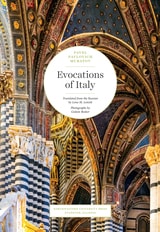
cover of Evocations of Italy

Evocations of Italy

Pavel Pavlovic Muratov and Lena Lencek (Trans.)

Northwestern University Press, 2026

A collector’s edition of a world-historical classic
 
In 1907, Pavel Muratov, a budding littérateur and art connoisseur from Moscow, set off for Italy with his wife, three friends, and a dozen books on the Italian Renaissance. This journey, the first of over a dozen he would make in a decade, inspired an obsession with the country’s art and culture that would produce, in the words of Clive James, “one of the most dazzling books of its type ever written.” First published in Russian between 1911 and 1924, Evocations of Italy(Obrazy Italii) chronicles Muratov’s encounters with the art, myth, and land of Italy. A classic of the Silver Age, it built on the tradition of Italian travelogues by Goethe, Stendhal, John Ruskin, and Henry James and defined the idea of Italy for generations of Russian artists and writers. Finally available in English, this three-volume collector's edition illuminates the personalities, conditions, and dreams that gave us the Italian Renaissance. At once intimate and authoritative, and here richly illustrated with photographs that echo Muratov’s shimmering juxtapositions of image and sensation, Evocations of Italy is as timely and compelling a guide today as it was a hundred years ago.
 
[more]