Results by title
584 books match the query 'Short Stories (single author)' and 15 start with e
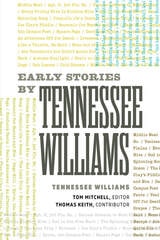
Early Stories by Tennessee Williams
Tennessee Williams
University of Iowa Press, 2025
In notes for each story, additional context is provided regarding locations, occupations, and individuals. All of this enriches a critical understanding of Tennessee Williams’s major works such as The Glass Menagerie, A Streetcar Named Desire, Cat on a Hot Tin Roof, Night of the Iguana, and Suddenly Last Summer.
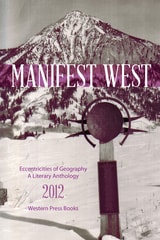
Eccentricities of Geography
Teresa Milbrodt
University Press of Colorado, 2012
These writers reveal that the land is a character: sometimes a mother, sometimes a joker, never an enemy, though one must take care. The space can be refreshing or oppressive, as the paradox of openness is that it tends to control and confine as much as free us. The weather plans your day. Snowstorms don't negotiate.
The West makes people acutely aware of the absurdity of their smallness, and this feeling is the source of much of the humor in the anthology. The sensation of being tiny, that crazed adrenalin rush and the feeling of your heart beating in your throat, has to make you laugh out loud like a roller coaster. The twenty authors in this collection will take you for an interesting ride.
Contributors to the anthology include: Kirstin Abraham, Genevieve Betts, Shirley Brewer, David Coy, Elizabeth Creely, Mary Christine Delea, Jen Edwards, Thea Gavin, John Haggerty, Brad Johnson, Neal Lewing, Robert McBrearty, Margaret Ozemet, Francis Raven, Greg Robillard, Heather Sappenfield, Sam Smith, Laura Snyder, Caroline Sposto, and Scott Starbuck.

Eight Mile High
Jim Ray Daniels
Michigan State University Press, 2014
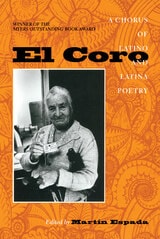
El Coro
A Chorus of Latino and Latina PoetryMartin Espada
University of Massachusetts Press, 1997
Here we find the open expression of anger and grief, self-mocking humor, the music of protest, the quiet assertion of dignity, and the raucous celebration of survival. There are poems about stoop labor and welfare offices and housing projects, but also poems about the Four Horsemen of the Apocalypse and the Minotaur.
Among the poets are former farm workers and gang members, a practicing physician, an ex-tenant lawyer, two professional chefs, and a Vietnam veteran. One poet was a political prisoner for six years; another staged a famous hunger strike; still another was indicted for her work with Central American refugees. In many ways this collection of poets comprises a chorus. Their song humanizes in the face of dehumanization.
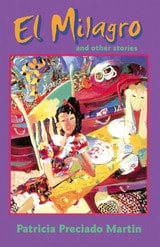
El Milagro and Other Stories
Patricia Preciado Martin
University of Arizona Press, 1996
Reminiscent of Like Water for Chocolate, the book is a rich mix of the simplest ingredients—food, family, tradition. We see Silviana striding to her chicken coop, triggering the "feathered pandemonium" of chickens who smell death in the air. We meet Elena, standing before the mirror in her wedding dress, and Teodoro Sánchez, who sleeps under the sky and smells of “chaparral and mesquite pollen and the stream bottom and the bone dust of generations. There’s the monsignor sitting on the edge of a sofa, sipping Nescafé from a china cup, and here is Sister Francisca "with her warm, minty breath" warning us away from impure thoughts. Be on your best behavior, too, in Tía Petra’s Edwardian parlor—la Doña Petrita, descended from conquistadores, might just deliver a tap on your head with her silver-handled walking stick. Then, with Mamacita, spend a summer afternoon bent over your embroidery with trembling hand and sweaty upper lip, and all the while wondering what in the world it feels like to be kissed.
Intermingled with the author’s stories are collective memories of the barrio, tales halfway between heaven and earth that seem to connect barrio residents to each other and to their past. These cuentos are mystical and dreamy, peopled with ghosts and miracles and Aztec princesses dressed in feathers and gold. Come, sit down and have some salsa and a tortilla—fresh and homemade, it goes without saying; people who buy tortillas at the market "might as well move to Los Angeles, for they have already lost their souls." Then open the pages of this book. Help yourself to another feast of food and flowers, music and dancing, sunshine and moonlight—everything glorious and mundane, serious and humorous, earthly and spiritual, poignant and joyful, in la vida mexicoamericana.
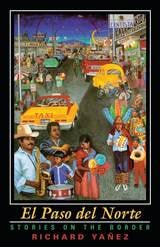
El Paso Del Norte
Stories On The BorderRichard Yañez
University of Nevada Press, 2003
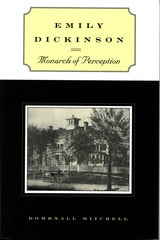
Emily Dickinson
Monarch of PerceptionDomhnall Mitchell
University of Massachusetts Press, 2000
Emily Dickinson has often been pictured as a sensitive but isolated poet—someone who published very little in her lifetime and limited herself to lyrics, considered to be the kind of poems most removed from social and political life. In recent years, scholars have challenged that view, and this book extends the discussion in valuable new directions.
Domhnall Mitchell begins by focusing on three historical phenomena—the railroad, the Dickinson homestead, and horticulture—and argues that poems about trains, home, and flowers engage with their meanings in ways that extend beyond the confines of the aesthetic. He shows how Dickinson's poems and letters reveal the full complexity of her position as a woman situated within a larger social and economic class.
In the second half of the book, Mitchell considers the ideological, textual, and editorial implications of Dickinson's strategic privatization of her art. He relates the particular forms of her manuscripts' appearance, distribution, and collation to aspects of her social as well as her literary consciousness. In a chapter that is certain to provoke debate, he explores what it means to read individual poems and letters in manuscript versions rather than in printed editions. By paying close attention to textual evidence, he makes the case that various features of the manuscripts are actually matters of accident or immediate convenience rather than the visual markers of a new aesthetic principle.
Mitchell closes by using the theories of Mikhail Bakhtin to explore the contradictions of a “private” poetry that engages verbally in multiple areas of nineteenth-century life and discourse. By attending to the contemporaneous particularities of recurrent words and images, he demonstrates that Dickinson could stay at home and still be at home in history, too.
Empty Bed Blues
StoriesStories by George Garrett
University of Missouri Press, 2006
The fifteen stories of George Garrett’s Empty Bed Blues (his eighth book-length collection) are vintage Garrett—no two alike—with each moving, one way and another, in new and daring directions. His stories are deeply concerned with the old verities of love and death and filled with the joys and woes of characters who come to life and command our attention.
Diversity is the key word for Garrett’s short fiction. He works in every known form and invents a few himself. In “A Story Goes with It,” Garrett fondly remembers an old friend while retelling a story the man once told him. Most of it is probably not accurate, as Garrett is quick to admit, but the mixture of fact with fiction makes for an entertaining read. His stories turn like the sharp curves of a mountain road, abruptly changing from a fond trip down memory lane to a sleazy reporter’s quest along the backroads for the ultimate crime story in “Pornographers.”He tops off his collection with “A Short History of the Civil War,” a series of poems written by two participants: one a Confederate, the other a Yankee.
In the marriage of fact and fiction, of comedy and pathos, and the music of many voices, the stories of Empty Bed Blues reconfirm the judgment of novelist and story writer Richard Bausch, who said in 1998: “There is no writer on the American scene with a more versatile, more eclectic, or more restless talent than George Garrett.”
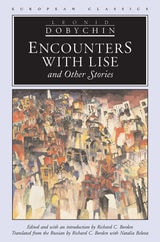
Encounters with Lise and Other Stories
Leonid Dobychin
Northwestern University Press, 2005
For Dobychin early Soviet society was an absurdist wonderland. He was not anti-Soviet but trans-Soviet, practicing realism but looking at reality from jarring angles. A typical day for a Dobychin hero includes participation in character-building sports, witnessing a parade, attending a funeral, and memorial to fallen communists-and finally reflecting at the end of the day that he almost met a pretty young sick-nurse. Dobychin's stories reveal a Brave New World where idealism rubs shoulders with heartless ambition and political denunciation, and ubiquitous acronyms and revolutionary cliché maul the language. But he also describes the absurdities of a place where office girls pray for the arrest of disliked co-workers and prisoner work gangs are made to spell out beautiful but empty platitudes in beds of sand. This collection includes all of the stories published in Dobychin's lifetime, plus two stories that remained unpublished until the late 1980s.

Escape Velocity
A Charles Portis MiscellanyJay Jennings
Butler Center for Arkansas Studies, 2012
Essential Turgenev
Ivan Sergeevich Turgenev
Northwestern University Press, 1994
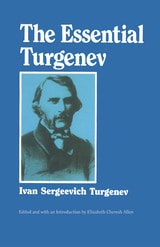
Readers will find complete, exemplary translations of Turgenev's finest novels, Rudin, A Nest of Gentry, and Fathers and Sons, along with the lapidary novella First Love. The volume also includes selections from Sportsman's Sketches, seven of Turgenev's most compelling short stories, and fifteen prose poems. It also contains samples of the author's nonfiction drawn from autobiographical sketches, memoirs, public speeches, plus the influential essay "Hamlet and Don Quixote" and correspondence with Dostoevsky, Tolstoy, and others.

Every Human Love
StoriesJoanna Pearson
Acre Books, 2019
Everything Flirts
Philosophical RomancesSharon Wahl
University of Iowa Press, 2024
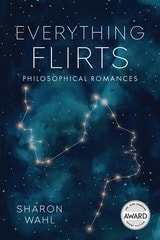
At the heart of the stories in Everything Flirts are some of life’s trickiest questions: Why is it so hard to make the first move on a date? How do we find the person we will love? If you finally find a person to love, how do you convince them to love you back?
With a mixture of humor and reverence, Sharon Wahl hijacks classic works of philosophy and turns their focus to love. The philosopher Wittgenstein helps us consider the limits of language: Does there exist an argument, a logical deduction, that will cause another person to love us? The philosopher Zeno’s laws of motion stipulate that we can only ever cross half of any distance. This principle is applied to a first date, where making a first move becomes more and more impossible because the movie this couple goes to see is a depressing mood-killer. A woman afraid of love applies Bentham’s utilitarian principles to find her perfect match, testing every man she meets until she finds one who aces every one of her tests. Nonetheless, she wonders: Is he right for her? Is she ready to fall in love forever? The sublime and the ridiculous come together to playfully examine why love just might be a topic too hard for philosophers to explain.
Excommunicados
Charles Haverty
University of Iowa Press, 2015
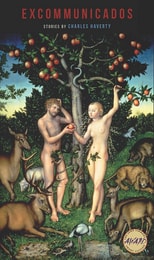
A sixteen-year-old boy unearths grisly evidence of his genteel grandfather’s racist past. At his sister’s booze-soaked destination wedding, a recovering alcoholic English professor is finagled into ghostwriting their unreliable father’s nuptial toast. A small town lawyer’s Edenic existence is jeopardized when his wife’s younger brother is arrested for a rash of local burglaries. In the wake of her daughter’s brush with disaster in the Haiti earthquake, a mother finds herself drawn down a dark neighborhood sidewalk toward what might or might not be a dead body. And in the title story—the first of three linked stories—a pious altar boy confronts the twin mysteries of sex and death through the auspices of a classmate’s divorced mother.
There are secrets at the center of each of these daring and original stories—secrets that separate these characters from one another but grow in the mind and the heart, connecting them with all of us.
Extinction Studies
Vegas StoriesShane Joaquin Jimenez
University of Nevada Press, 2027
Welcome to Las Vegas. Hope you like it here. You aren’t leaving.
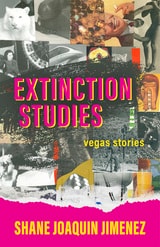
It’s a Las Vegas of outcasts, outsiders, obsessives, and oddballs—a place seen through the eyes of those who call it home in Extinction Studies.
In these stories, a young genius from a troubled home becomes obsessed with solving an infamous atomic-era murder. Twin brothers exploring subterranean tunnels beneath the Strip encounter a stranger who claims he can show them the future. A nonverbal boy devises a daring scheme to revive his punch-drunk prizefighter father’s fading glory. And in the title story, a teenager struggling in the aftermath of a traumatic event finds healing in B monster movies and a TV host who’s a cross between Dracula and Elvis.
Shane Joaquin Jimenez’s short stories deliver you far beyond the glitz and neon of the Strip. Across ten haunting tales, Jimenez takes a whirlwind tour of dark stage magic, macabre murder, moonlit desert graves, and the city’s unknown, unlucky underdogs fighting to the bitter end, no matter the odds.
Told with brutal honesty that is at turns uncanny and unsettling, nightmarish and psychedelic, exhilarating and moving, Extinction Studies uncovers the ineradicable hope at the heart of the strange neon city, shining out in the middle of nowhere.