Results by title
165 books match the query 'Social sciences' and 6 start with e
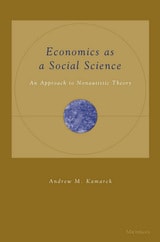
Economics as a Social Science
An Approach to Nonautistic TheoryAndrew M. Kamarck
University of Michigan Press, 2002
Economics as a Social Science is a highly readable critique of economic theory, based on a wide range of research, that endeavors to restore economics to its proper role as a social science. Contrary to conventional economic theory, which assumes that people have no free will, this book instead bases economics on the realistic assumption that human beings can choose; that we are complex beings affected by emotion, custom, habit, and reason; and that our behavior varies with circumstances and times. It embraces the findings of history, psychology, and other social sciences and the insights from great literature on human behavior as opposed to the rigidity set by mathematical axioms that define how economics is understood and practiced today.
Andrew M. Kamarck demonstrates that only rough accuracy is attainable in economic measurement, and that understanding an economy requires knowledge from other disciplines. The canonical hypotheses of economics (perfect rationality, self-interest, equilibrium) are shown to be inadequate (and in the case of "equilibrium" to be counterproductive to understanding the forces that dominate the economy), and more satisfactory assumptions provided. The market is shown to work imperfectly and to require appropriate institutions to perform its function reasonably well. Further, Kamarck argues that self-interest does not always lead to helping the general interest.
Economics as a Social Science examines and revises the fundamental assumptions of economics. Because it avoids jargon and explains terms carefully, it will be of interest to economics majors as well as to graduate students of economics and other social sciences, and social scientists working in government and the private sector.
Andrew M. Kamarck is former Director, Economic Development Institute, the World Bank.
[more]
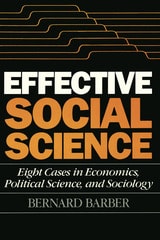
Effective Social Science
Eight Cases in Economics, Political Science, and SociologyBernard Barber
Russell Sage Foundation, 1987
Does social science influence social policy? This is a topic of perennial concern among students of politics, the economy, and other social institutions. In Effective Social Science, eight prominent social researchers offer first-hand descriptions of the impact of their work on government and corporate policy. In their own words, these noted political scientists, economists, and sociologists—among them such influential scholars as James Coleman, Joseph Pechman, and Eliz Ginzberg—tell us what it was like to become involved in the making of social policy. These rich personal narratives, derived from detailed interviews conducted by Bernard Barber (himself a veteran of the biomedical poliy arena), illuminate the role of social science in diverse areas, including school desegregation, comprehensive income taxation, military manpower utilization, transportation deregulation, and the protection of privacy. The patterns traced in this volume indicate that social science can influence policy, but only as part of a pluralistic, political process; effective social research requires advocacy as well as a conducive social and idealogical climate. For anyone curious about the relationship between social knowledge and social action, this book provides striking illustration and fruitful analysis.
[more]
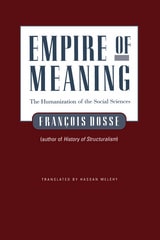
Empire Of Meaning
The Humanization Of The Social SciencesFrancois Dosse
University of Minnesota Press, 1998
After the brilliance of Derrida, Foucault, Barthes--what? By most accounts, the French intellectual scene, poststructuralism, has split in two. On one side, a few select philosophers as media stars are pressed for their opinions on virtually every subject; on the other side, an atomized community of scholars in the social sciences are bound up in technicalities and muffled by the lack of a common language. This great divide, Francois Dosse contends, augurs a tremendous change in the structure and conduct of intellectual life. What this shift means--how it has occurred and what parts various thinkers have played in shaping it--is the subject of Empire of Meaning.
An outgrowth of Dosse's magisterial History of Structuralism, Empire of Meaning is an extended encounter with some of the most influential French intellectuals. Through interviews and readings, Dosse reveals what has become of the intellectuals of the generation of '68 as they have tried to work out the implications of their revolt against structuralism and the problem of Cold War existence. Paul Ricoeur, Bruno Latour, Isabelle Stengers, Roger Chartier, Marcel Gauchet, Dany-Robert Dufour, and Michel Serres are among the many figures whose words and work unfold in these pages.
A thorough and thoroughly engrossing work of intellectual history, Empire of Meaning is a firsthand look at the reshaping of French intellectual life in our time.
"For the reader seeking rich historical detail, including names, places, schools, and research agendas, Empire of Meaning proves a veritable gold mine of information. The territory covered by Dosse is vast and impressive; the detail of his surveillance is overwhelming." --Rhetoric & Public Affairs
"Dosse reveals a new paradigm that might make us forget the great old ones: functionalism, structuralism, and Marxism. . . . Decidedly, this book is full of good news." --Le Nouveau Politis
"The immediate history of ideas is an undertaking as daring as it is risky, and Dosse here forces the relationships of trajectory and thought. . . . This book offers, in a very readable way, an overview of the current research in the social sciences." --Le Monde
Francois Dosse is a historian and author of numerous books, including History of Structuralism, Volume 1 and Volume 2.
Hassan Melehy is assistant professor of French at the University of Connecticut
[more]
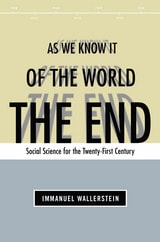
End of the World as We Know It
Social Science for the Twenty-First CenturyImmanuel Wallerstein
University of Minnesota Press, 2001
A respected thinker points the way ahead.
"Immanuel Wallerstein has long conceived of social science grandly. He was an innovator of world systems analysis, which portrays societies, sectors within societies, and the very disciplines of the social science as linked, bound, and analytically inseparable: To parse them is to misconceive them. As recent president of the International Sociological Association (1994 to 1998), Wallerstein continued to develop such grand thinking through numerous addresses on the state of the social sciences, capitalism, political justice, and the world. Here, he offers these collectively. He divides them into two topics-the world of capitalism and the world of knowledge. Toward both grand worlds, his thesis is similar: they are in crisis. . . . The scope of his career's thought is remarkable, his expertise impressively broad." Political Science Quarterly
This book is nothing short of a state-of-the-world address, delivered by a scholar uniquely suited to the task. Immanuel Wallerstein, one of the most prominent social scientists of our time, documents the profound transformations our world is undergoing. With these transformations, he argues, come equally profound changes in how we understand the world.
Wallerstein divides his work between an appraisal of significant recent events and a study of the shifts in thought influenced by those events. The book's first half reviews the major happenings of recent decades--the collapse of the Leninist states, the exhaustion of national liberation movements, the rise of East Asia, the challenges to national sovereignty, the dangers to the environment, the debates about national identity, and the marginalization of migrant populations. Wallerstein places these events and trends in the context of the changing modern world-system as a whole and identifies the historical choices they put before us.
The second half of the book takes up current issues in the world of knowledge--the vanishing faith in rationality, the scattering of knowledge activities, the denunciation of Eurocentrism, the questioning of the division of knowledge into science and humanities, and the relation of the search for the true and the search for the good. Wallerstein explores how these questions have arisen from larger social transformations, and why the traditional ways of framing such debates have become obstacles to resolving them. The End of the World As We Know It concludes with a crucial analysis of the momentous intellectual challenges to social science as we know it and suggests possible responses to them.
Immanuel Wallerstein is Distinguished Professor of Sociology and director of the Fernand Braudel Center at Binghamton University. Among his numerous books are The Modern World-System (1974, 1980, 1989), Unthinking Social Science (1991), and After Liberalism (1995).
[more]
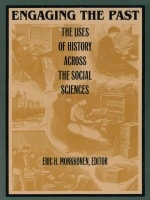
Engaging the Past
The Uses of History Across the Social SciencesEric H. Monkkonen
Duke University Press, 1994
Vigorous historical exploration has increased across the social sciences in the past two decades. Originally published as a series of articles in the journal Social Science History, the essays in this volume provide a guide to historical social science by surveying the use of historical data and methodologies in anthropology, sociology, political science, economics, and geography.
Each essay in Engaging the Past pays close attention to the unique problems and methods associated with its particular social scientific discipline. By exploring questions raised by both contemporary and more established works within each field, the authors show that some of the best and most innovative research in each of the social sciences includes a strong historical component. Thus, as Eric H. Monkkonen’s introduction shows, these essays taken together make it clear that historical research provides a significant key to many of the major issues in the social sciences.
Intended for the growing community of both social scientists and historians interested in reading or researching historically informed social science, Engaging the Past suggests future directions that might be taken by this work. Above all, by providing a set of user’s guides written by respected social scientists, it encourages future boundary crossings between history and each of the social sciences.
Contributors. Andrew Abbott, Richard Dennis, Susan Kellog, Eric H. Monkkonen, David Brian Robertson, Hugh Rockoff
[more]
Evidence
Howard S. Becker
University of Chicago Press, 2017
Howard S. Becker is a master of his discipline. His reputation as a teacher, as well as a sociologist, is supported by his best-selling quartet of sociological guidebooks: Writing for Social Scientists, Tricks of the Trade, Telling About Society, and What About Mozart? What About Murder? It turns out that the master sociologist has yet one more trick up his sleeve—a fifth guidebook, Evidence.
Becker has for seventy years been mulling over the problem of evidence. He argues that social scientists don’t take questions about the usefulness of their data as evidence for their ideas seriously enough. For example, researchers have long used the occupation of a person’s father as evidence of the family’s social class, but studies have shown this to be a flawed measure—for one thing, a lot of people answer that question too vaguely to make the reasoning plausible. The book is filled with examples like this, and Becker uses them to expose a series of errors, suggesting ways to avoid them, or even to turn them into research topics in their own right. He argues strongly that because no data-gathering method produces totally reliable information, a big part of the research job consists of getting rid of error. Readers will find Becker’s newest guidebook a valuable tool, useful for social scientists of every variety.
Becker has for seventy years been mulling over the problem of evidence. He argues that social scientists don’t take questions about the usefulness of their data as evidence for their ideas seriously enough. For example, researchers have long used the occupation of a person’s father as evidence of the family’s social class, but studies have shown this to be a flawed measure—for one thing, a lot of people answer that question too vaguely to make the reasoning plausible. The book is filled with examples like this, and Becker uses them to expose a series of errors, suggesting ways to avoid them, or even to turn them into research topics in their own right. He argues strongly that because no data-gathering method produces totally reliable information, a big part of the research job consists of getting rid of error. Readers will find Becker’s newest guidebook a valuable tool, useful for social scientists of every variety.
[more]