1927 books match the query 'Technology & Engineering' and 121 start with e
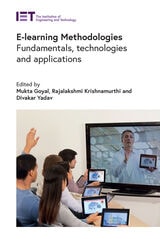
cover of E-learning Methodologies: Fundamentals, technologies and applications

E-learning Methodologies

Fundamentals, technologies and applications

Mukta Goyal

The Institution of Engineering and Technology, 2021

E-learning has become an important part of our educational life with the development of e-learning systems and platforms and the need for online and remote learning. ICT and computational intelligence techniques are being used to design more intelligent and adaptive systems. However, the art of designing good real-time e-learning systems is difficult as different aspects of learning need to be considered including challenges such as learning rates, involvement, knowledge, qualifications, as well as networking and security issues. The earlier concepts of standalone integrated virtual e-learning systems have been greatly enhanced with emerging technologies such as cloud computing, mobile computing, big data, Internet of Things (IoT), AI and machine learning, and AR/VT technologies.
[more]
cover of EEG Signal Processing: Feature extraction, selection and classification methods

EEG Signal Processing

Feature extraction, selection and classification methods

Wai Yie Leong

The Institution of Engineering and Technology, 2019
Electroencephalography (EEG) is an electrophysiological monitoring method used to record the brain activity in brain-computer interface (BCI) systems. It records the electrical activity of the brain, is typically non-invasive with electrodes placed along the scalp, requires relatively simple and inexpensive equipment, and is easier to use than other methods.
[more]
cover of EMC Pocket Guide: Key EMC facts, equations and data

EMC Pocket Guide

Key EMC facts, equations and data

Kenneth Wyatt

The Institution of Engineering and Technology, 2013
Every electric product designed and manufactured worldwide must meet electromagnetic compatibility (EMC) regulations, and yet, EMC compliance staff levels have been cut to the bone in companies large and small. If you are a working engineer or technician, the EMC Pocket Guide: Key EMC facts, equations and data is the first place to look while designing for EMC and your quide to thwarting electromagnetic interference.
[more]
cover of EMC and Functional Safety of Automotive Electronics

EMC and Functional Safety of Automotive Electronics

Kai Borgeest

The Institution of Engineering and Technology, 2018
Electromagnetic compatibility (EMC) deals with the unintentional propagation and reception of electromagnetic energy which may cause disturbances or even physical damage in electronic or electromechanical systems. With the increase in number and density of electronic devices and systems in modern vehicles, EMC has become a substantial concern and a key cause of malfunction of automotive electronics.
[more]
cover of EMC and Functional Safety of Automotive Electronics

EMC and Functional Safety of Automotive Electronics

Kai Borgeest

The Institution of Engineering and Technology, 2026
Electromagnetic compatibility (EMC) deals with the unintentional propagation and reception of electromagnetic energy, which may cause disturbances or even physical damage in electronic or electromechanical systems. With the increase in number and density of electronic devices and systems in modern vehicles, EMC has become a substantial concern and a key cause of malfunction of automotive electronics.
[more]
cover of EMI Troubleshooting Cookbook for Product Designers

EMI Troubleshooting Cookbook for Product Designers

Patrick G. André

The Institution of Engineering and Technology, 2014
EMI Troubleshooting Cookbook for Product Designers provides the 'recipe' for identifying why products fail to meet EMI/EMC regulatory standards. It also outlines techniques for tracking the noise source, and discovering the coupling mechanism, that is causing the undesired effects.
[more]
cover of ESG Innovation for Sustainable Manufacturing Technology: Applications, designs and standards

ESG Innovation for Sustainable Manufacturing Technology

Applications, designs and standards

Wai Yie Leong

The Institution of Engineering and Technology, 2024

In an era defined by unprecedented environmental challenges, social inequalities, and corporate responsibility, the concept of Environmental, Social, and Governance (ESG) has emerged as a transformative force. It is a set of practices used to evaluate the operational performance of a company or industry sector as it relates to social and environmental impact.
[more]
cover of Early Modern Studies after the Digital Turn

Early Modern Studies after the Digital Turn

Edited by Laura Estill, Diane K. Jakacki, Michael Ullyot

Iter Press, 2016
The essays collected in this volume address the digital humanities’ core tensions: fast and slow; surficial and nuanced; quantitative and qualitative. Scholars design algorithms and projects to process, aggregate, encode, and regularize historical texts and artifacts in order to position them for new and further interpretations. Every essay in this book is concerned with the human-machine dynamic, as it bears on early modern research objects and methods. The interpretive work in these pages and in the online projects discussed orients us toward the extensible future of early modern scholarship after the digital turn.
[more]
cover of Earth Observation Data Analytics Using Machine and Deep Learning: Modern tools, applications and challenges

Earth Observation Data Analytics Using Machine and Deep Learning

Modern tools, applications and challenges

Sanjay Garg

The Institution of Engineering and Technology, 2023

Earth Observation Data Analytics Using Machine and Deep Learning: Modern tools, applications and challenges covers the basic properties, features and models for Earth observation (EO) recorded by very high-resolution (VHR) multispectral, hyperspectral, synthetic aperture radar (SAR), and multi-temporal observations.
[more]
cover of Earth Shapers: How We Mapped and Mastered the World, from the Panama Canal to the Baltic Way

Earth Shapers

How We Mapped and Mastered the World, from the Panama Canal to the Baltic Way

Maxim Samson

University of Chicago Press, 2025

The globetrotting story of how humans have harnessed the geographical landscape and written ourselves onto our surroundings.

Mountains, meridians, rivers, and borders—these are some of the features that divide the world on our maps and in our minds. But geography is far less set in stone than we might believe, and, as Maxim Samson’s Earth Shapers contends, in our relatively short time on this planet, humans have become experts at fundamentally reshaping our surroundings.

From the Qhapaq Ñan, the Inca’s “great road,” and Mozambique’s colonial railways to a Saudi Arabian smart city, and from Korea’s sacred Baekdu-daegan mountain range and the Great Green Wall in Africa to the streets of Chicago, Samson explores how we mold the world around us. And how, as we etch our needs onto the natural landscape, we alter the course of history. These fascinating stories of connectivity show that in our desire to make geographical connections, humans have broken through boundaries of all kinds, conquered treacherous terrain, and carved up landscapes. We crave linkages, and though we do not always pay attention to the in-between, these pathways—these ways of “earth shaping,” in Samson’s words—are key to understanding our relationship with the planet we call home.

An immense work of cultural geography touching on ecology, sociology, history, and politics, Earth Shapers argues that, far from being constrained by geography, we are instead its creators.
[more]
cover of Earth Shapers: How We Mapped and Mastered the World, from the Panama Canal to the Baltic Way

Earth Shapers

How We Mapped and Mastered the World, from the Panama Canal to the Baltic Way

Maxim Samson

University of Chicago Press, 2025

The globetrotting story of how humans have harnessed the geographical landscape and written ourselves onto our surroundings.

Mountains, meridians, rivers, and borders—these are some of the features that divide the world on our maps and in our minds. But geography is far less set in stone than we might believe, and, as Maxim Samson’s Earth Shapers contends, in our relatively short time on this planet, humans have become experts at fundamentally reshaping our surroundings.

From the Qhapaq Ñan, the Inca’s “great road,” and Mozambique’s colonial railways to a Saudi Arabian smart city, and from Korea’s sacred Baekdu-daegan mountain range and the Great Green Wall in Africa to the streets of Chicago, Samson explores how we mold the world around us. And how, as we etch our needs onto the natural landscape, we alter the course of history. These fascinating stories of connectivity show that in our desire to make geographical connections, humans have broken through boundaries of all kinds, conquered treacherous terrain, and carved up landscapes. We crave linkages, and though we do not always pay attention to the in-between, these pathways—these ways of “earth shaping,” in Samson’s words—are key to understanding our relationship with the planet we call home.

An immense work of cultural geography touching on ecology, sociology, history, and politics, Earth Shapers argues that, far from being constrained by geography, we are instead its creators.
[more]
cover of Eben Smith: The Dean of Western Mining

Eben Smith

The Dean of Western Mining

David Forsyth

University Press of Colorado, 2021

David Forsyth recounts the life of Eben Smith, an integral but little-known figure in Colorado mining history. Smith was one of the many fortune seekers who traveled to California during the gold rush and one of the few who found what he sought. He moved to Colorado in 1860 with business partner Jerome Chaffee and over the next forty-six years was involved in mining in nearly every major camp in the state, from Central City to Cripple Creek, and in the development of mines such as the Bobtail, Little Jonny, and Victor. He was eulogized by the Denver Post and Denver Times as the “dean of mining in Colorado.”
 
The mining teams Smith formed with Chaffee and with industrialist David Moffat were among the most successful and respected in Colorado, and many in the state held Smith in high regard. Yet despite the credit he received during his lifetime for establishing Colorado’s mining industry, Smith has not received much attention from historians, perhaps because he was content to leave public-facing duties to his partners while he concerned himself with managing mine operations.
 
From Smith’s early years and his labor in the mines to his rise to prominence as an investor and developer, Forsyth shows how Smith used the mining and milling knowledge he acquired in California to become a leader in technological innovation in Colorado’s mining industry.

 
[more]
cover of Eco-Nationalism: Anti-Nuclear Activism and National Identity in Russia, Lithuania, and Ukraine

Eco-Nationalism

Anti-Nuclear Activism and National Identity in Russia, Lithuania, and Ukraine

Jane I. Dawson

Duke University Press, 1996

Eco-nationalism examines the spectacular rise of the anti-nuclear power movement in the former Soviet Union during the early perestroika period, its unexpected successes in the late 1980s, and its substantial decline after 1991. Jane I. Dawson argues that anti-nuclear activism, one of the most dynamic social forces to emerge during these years, was primarily a surrogate for an ever-present nationalism and a means of demanding greater local self-determination under the Soviet system. Rather than representing strongly held environmental and anti-nuclear convictions, this activism was a political effort that reflected widely held anti-Soviet sentiments and a resentment against Moscow’s domination of the region—an effort that largely disappeared with the dissolution of the USSR.
Dawson combines a theoretical framework based on models of social movements with extensive field research to compare the ways in which nationalism, regionalism, and other political demands were incorporated into anti-nuclear movements in Russia, Lithuania, Ukraine, Armenia, Tatarstan, and Crimea. These comparative case studies form the core of the book and trace differences among the various regional movements to the distinctive national identities of groups involved. Reflecting the new opportunities for research that have become available since the late 1980s, these studies draw upon Dawson’s extended on-site observation of local movements through 1995 and her unique access to movement activists and their personal archives.
Analyzing and documenting a development with sobering and potentially devastating implications for nuclear power safety in the former USSR and beyond, Eco-nationalism’s examination of social activism in late and postcommunist societies will interest readers concerned with the politics of global environmentalism and the process of democratization in the post-Soviet world.
[more]
cover of Economic Evaluation of Projects in the Electricity Supply Industry

Economic Evaluation of Projects in the Electricity Supply Industry

Hisham Khatib

The Institution of Engineering and Technology, 2003
In the highly capital-intensive electricity supply industry, it is essential that both engineers and managers understand the methodologies of project evaluation in order to comprehend and analyse investment proposals and decisions. This fully revised and updated edition of Economic Evaluation of Projects in the Electricity Supply Industry (1996) takes a broad introductory approach, covering market and environmental issues, financial analysis and evaluation, and clean environmental technologies and costs. New topics include electricity trading and risk management, evolving electricity utilities and new and future generation technologies in a carbon-constrained world.
[more]
cover of Economic Evaluation of Projects in the Electricity Supply Industry

Economic Evaluation of Projects in the Electricity Supply Industry

Hisham Khatib

The Institution of Engineering and Technology, 2014
In the highly capital-intensive electricity supply industry, it is essential that both engineers and managers understand the methodologies of project evaluation in order to comprehend and analyse investment proposals and decisions. This updated and expanded edition of Economic Evaluation of Projects in the Electricity Supply Industry takes a broad introductory approach, covering planning and investment, financial analysis and evaluation, risk management, electricity trading, and strategies, technologies, national requirements and global agreements for electricity generation in a carbon-constrained world.
[more]
cover of Edge Caching for Mobile Networks

Edge Caching for Mobile Networks

Wei Chen

The Institution of Engineering and Technology, 2022
Caching enables the storage of Internet-based content, including web objects, videos and software updates. When web objects are downloaded from the Internet or across wide-area-network (WAN) links, edge caching stores them at the edge of the network. Content can also be proactively cached at the edge based on its predicted popularity. When subsequent requests come for cached material, the content is quickly delivered from edge caching, without the need to download the data again over the WAN. The result is the ability to help save bandwidth, particularly at times of peak network load, increase content delivery, and provide users with a faster and better network experience.
[more]
cover of Edison: Inventing the Century

Edison

Inventing the Century

Neil Baldwin

University of Chicago Press, 2001
The genius of America's most prolific inventor, Thomas Edison, is widely acknowledged, and Edison himself has become an almost mythic figure. But how much do we really know about the man who considered deriving rubber from a goldenrod plant as opposed to the genius who gave us electric light? Neil Baldwin gives us a complex portrait of the inventor himself—both myth and man—and a multifaceted account of the intellectual climate of the country he worked in and irrevocably changed.
[more]
cover of Effective Team Leadership for Engineers

Effective Team Leadership for Engineers

Pat Wellington

The Institution of Engineering and Technology, 2009
This book is a must for engineers who have just, or will soon, become team leaders. It is also an essential guide for more experienced team and project leaders who wish to brush up their skills and knowledge.
[more]
cover of Eigenstructure Control Algorithms: Applications to aircraft/rotorcraft handling qualities design

Eigenstructure Control Algorithms

Applications to aircraft/rotorcraft handling qualities design

S. Srinathkumar

The Institution of Engineering and Technology, 2011
Eigenstructure control involves modification of both the eigenvalues and eigenvectors of a system using feedback. Based on this key concept, algorithms are derived for the design of control systems using controller structures such as state feedback, output feedback, observer-based dynamic feedback, implicit and explicit modelfollowing, etc. The simple-to-use algorithms are well suited to evolve practical engineering solutions.
[more]
cover of Electric Fuses

Electric Fuses

A. Wright

The Institution of Engineering and Technology, 2004
Wright and Newbery's classic guide to the world of electric fuses has been substantially revised and remains the comprehensive reference work on the subject.
[more]
cover of Electric Fuses: Fundamentals and new applications

Electric Fuses

Fundamentals and new applications

Nigel Nurse

The Institution of Engineering and Technology, 2022
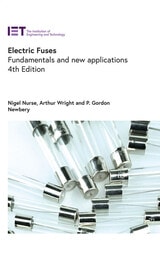
Fuses are designed to operate when over-currents, large and small, occur within electrical equipment; they thus interrupt the flow of current, preventing damage. They are needed for various power electric systems, for stationary and automotive applications, as well as power grid components like PV systems and distribution lines. Different types of equipment and voltages require special fuses, and their behaviour must be understood to guarantee correct choice and safe operation.
[more]
cover of Electric Mountains: Climate, Power, and Justice in an Energy Transition

Electric Mountains

Climate, Power, and Justice in an Energy Transition

Shaun A. Golding

Rutgers University Press, 2021

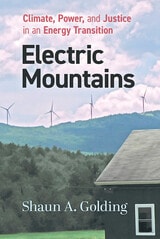
Climate change has shifted from future menace to current event. As eco-conscious electricity consumers, we want to do our part in weening from fossil fuels, but what are we actually a part of?

Committed environmentalists in one of North America’s most progressive regions desperately wanted energy policies that address the climate crisis. For many of them, wind turbines on Northern New England’s iconic ridgelines symbolize the energy transition that they have long hoped to see. For others, however, ridgeline wind takes on a very different meaning. When weighing its costs and benefits locally and globally, some wind opponents now see the graceful structures as symbols of corrupted energy politics.

This book derives from several years of research to make sense of how wind turbines have so starkly split a community of environmentalists, as well as several communities. In doing so, it casts a critical light on the roadmap for energy transition that Northern New England’s ridgeline wind projects demarcate. It outlines how ridgeline wind conforms to antiquated social structures propping up corporate energy interests, to the detriment of the swift de-carbonizing and equitable transformation that climate predictions warrant. It suggests, therefore, that the energy transition of which most of us are a part, is probably not the transition we would have designed ourselves, if we had been asked.
 
[more]
cover of Electric Railways: 1880-1990

Electric Railways

1880-1990

Michael C. Duffy

The Institution of Engineering and Technology, 2003
Electric Railways 1880-1990 explores the history of the integration of both electric and diesel-electric railway systems and identifies the crucial role that diesel-electric traction played in the development of wireless electrification. The evolution of electrical technology and the modern railway produced innovations in engineering that were integral to the development of traction, power and signalling systems. This book presents a thorough survey of electric railway development from the earliest days pf the London Underground to modern electrified main line trains. The distinction between 'enforced electrification' and 'economic electrification' is also discussed and the pioneering role of J.J. Heilmann assessed.
[more]
cover of Electric Vehicle Charge Point Infrastructure: From planning to operation

Electric Vehicle Charge Point Infrastructure

From planning to operation

David Trousdale

The Institution of Engineering and Technology, 2025
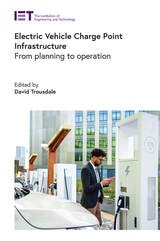
The use of electric vehicles (EVs) is a topic of great importance, given the continued drive towards net zero and the phase out of the sale of new petrol and diesel vehicles. However, a key concern is the need to install enough charge point infrastructure to grow in tandem with increasing EV adoption. Lack of EV charge point infrastructure and range anxiety are often cited as barriers to EV uptake. Therefore, a closer look is needed to understand how to model and build suitable EV charge point infrastructure, and how this can contribute to the broader aim of decarbonising transport.
[more]
cover of Electric Vehicle Components and Charging Technologies: Design, modeling, simulation and control

Electric Vehicle Components and Charging Technologies

Design, modeling, simulation and control

Sanjeev Singh

The Institution of Engineering and Technology, 2024
In order to create a reliable, safe and cost-effective electric vehicle with acceptable range, battery charging time, battery life and driving performance, it is important to design optimised and compatible components and charging systems.
[more]
cover of Electric Vehicle Technologies: Renewable energy for the road

Electric Vehicle Technologies

Renewable energy for the road

John Samuel

The Institution of Engineering and Technology, 2025
Electric Vehicle Technologies: Renewable energy for the road traces electric vehicle technology from its beginnings through the current state-of-the-art and onwards to future possibilities. Bringing together insights from technical and commercial perspectives, this book is collated and written by two experts - one a pioneer in the field of EV whose career spans decades of design and development, the other a highly experienced technical specialist in EV drive system and megawatt rapid charge system design.
[more]
cover of Electrical Capacitance Tomography (ECT): Principles, systems and industrial applications

Electrical Capacitance Tomography (ECT)

Principles, systems and industrial applications

Wuqiang Yang

The Institution of Engineering and Technology, 2026
Electrical capacitance tomography (ECT) is a non-intrusive and non-invasive imaging technique that creates a cross-sectional image of the distribution of dielectric materials inside a pipe or vessel. ECT measures the capacitance between pairs of electrodes mounted on the outside of the pipe, and reconstructs a cross-sectional image using the measured capacitance data and a suitable algorithm, to reflect the inside permittivity distribution. ECT is particularly useful for visualising the multiphase flow of non-conductive substances in industrial processes.
[more]
cover of Electrical Craft Principles, Volume 1

Electrical Craft Principles, Volume 1

John Whitfield

The Institution of Engineering and Technology, 2009
This is the first of a two-volume work covering the electrical principles syllabuses of all of the major examining bodies including the City & Guilds of London Institute's electrical craft courses. It is also suitable for a wide range of other courses, including the first three years of the BTEC electrical series. Great care has been taken to ensure that the text fully covers the content of the syllabuses concerned, both as published and as interpreted by the examiners in the past.
[more]
cover of Electrical Craft Principles, Volume 2

Electrical Craft Principles, Volume 2

John Whitfield

The Institution of Engineering and Technology, 2009

This is the second of a two-volume work covering the electrical principles syllabuses of all of the major examining bodies including the City & Guilds of London Institute's electrical craft courses. It is also suitable for a wide range of other courses, including the first three years of the BTEC electrical series. Great care has been taken to ensure that the text fully covers the content of the syllabuses concerned, both as published and as interpreted by the examiners in the past.
[more]
cover of Electrical Degradation and Breakdown in Polymers

Electrical Degradation and Breakdown in Polymers

L.A. Dissado

The Institution of Engineering and Technology, 1992
Breakdown is fascinating to the scientist and frustrating to the engineer! As well as advancing the scientific and engineering understanding of electrical degradation and breakdown in polymers, this book forms a comprehensive and international review of the state-of-the-art. Topics include: water and electrical treeing; charge transport; 'classical' and filamentary thermal, electromechanical, electronic and partial discharge breakdown models; the stochastic nature of breakdown and statistical characterisation techniques; and engineering considerations for breakdown testing and degradation assessment. The treatment presumes little prior knowledge but develops into an advanced understanding of new concepts such as the fractal-like nature of trees. Although the book is primarily aimed at scientists and engineers practising in the field, a broad introductory section has been included to cater for a wide audience including those new to the subject area. This comprises a description of the nature of the polymers, basic solid-state physics and an introduction to degradation and breakdown.
[more]
cover of Electrical Design for Ocean Wave and Tidal Energy Systems

Electrical Design for Ocean Wave and Tidal Energy Systems

Raymond Alcorn

The Institution of Engineering and Technology, 2013

Renewable energy is expected to play a major part in future energy supplies, both to reduce the impact on the world climate and also to make up for any shortfall in conventional energy sources. Ocean energy has the potential to make a significant contribution to future renewable energy supplies as identified in recent reports from the Intergovernmental Panel for Climate Change and the International Energy Agency. Ocean energy is an emerging industry sector and there are a number of promising developments under way. Significant commercial deployments in the gigawatt range are envisaged over the next 10 to 20 years in Europe, USA, Asia and South America.
[more]
cover of Electrical Installation Design Guide: Calculations for Electricians and Designers

Electrical Installation Design Guide

Calculations for Electricians and Designers

The Institution of Engineering and Technology

The Institution of Engineering and Technology, 2016

The book provides step-by-step guidance on the design of electrical installations, from domestic installation final circuit design to fault level calculations for LV systems.
[more]
cover of Electrical Installation Design Guide: Calculations for Electricians and Designers

Electrical Installation Design Guide

Calculations for Electricians and Designers

The Institution of Engineering and Technology

The Institution of Engineering and Technology, 2019

Electrical Installation Design Guide: Calculations for Electricians and Designers provides step-by-step guidance on the design of electrical installations. The guide will be useful for apprentices and trainees carrying out the calculations necessary for a basic installation and has been fully updated to BS 7671:2018.
[more]
cover of Electrical Installation Design Guide: Calculations for Electricians and Designers

Electrical Installation Design Guide

Calculations for Electricians and Designers

The Institution of Engineering and Technology

The Institution of Engineering and Technology, 2022

Electrical Installation Design Guide: Calculations for Electricians and Designers provides step-by-step guidance on the design of electrical installations. The guide will be useful for apprentices and trainees carrying out the calculations necessary for a basic installation and has been fully updated to BS 7671:2018+A2:2022.
[more]
cover of Electrical Installation Design Guide: Calculations for Electricians and Designers

Electrical Installation Design Guide

Calculations for Electricians and Designers

The Institution of Engineering and Technology

The Institution of Engineering and Technology, 2026
Electrical Installation Design Guide: Calculations for Electricians and Designers provides step-by-step guidance on the design of electrical installations. The guide will be useful to all persons designing electrical installations, also for apprentices and trainees carrying out the calculations necessary for a basic installation and has been fully updated to BS 7671:2018+A4:2026.
[more]
cover of Electrical Operation of Electrostatic Precipitators

Electrical Operation of Electrostatic Precipitators

Ken Parker

The Institution of Engineering and Technology, 2003

The electrostatic precipitator remains one of the most cost-effective means of controlling the emission of particulates from most industrial processes, including pollution from power stations. The author reviews the basic theory and operation of precipitators, the characteristics of gas and particulates that impact on design and operation, and the design of high- and mains-frequency rectification equipment. Chapters also cover performance monitoring and enhancement, and fault detection.
[more]
cover of Electrical Safety: A guide to the causes and prevention of electrical hazards

Electrical Safety

A guide to the causes and prevention of electrical hazards

J. Maxwell Adams

The Institution of Engineering and Technology, 1994
This book explains the hazards associated with electricity in its many forms, including electromagnetic radiation. It describes methods of reducing risks to health and to the environment, giving rules and codes of practice to be followed. Guidelines are also given for the use of electrical equipment in specialised environments (such as locations subject to explosive gases and flammable dusts), the guarding of machine tools and the control of earth currents.
[more]
cover of Electrical Steels for Rotating Machines

Electrical Steels for Rotating Machines

Philip Beckley

The Institution of Engineering and Technology, 2002
Electrical steels are used to form the ferromagnetic cores of motors, generators and transformers. This book provides an insight for the electrical design engineer into what properties may be expected from electrical steels and how these properties may best be exploited in machine design.
[more]
cover of Electrical Steels: Fundamentals and basic concepts, Volume 1

Electrical Steels

Fundamentals and basic concepts, Volume 1

Anthony Moses

The Institution of Engineering and Technology, 2019
Electrical steels are critical components of magnetic cores used in applications ranging from large rotating machines, including energy generating equipment, and transformers to small instrument transformers and harmonic filters. Presented over two volumes, this comprehensive handbook provides full coverage of the state-of-the-art in electrical steels.
[more]
cover of Electrical Steels: Performance and applications, Volume 2

Electrical Steels

Performance and applications, Volume 2

Anthony Moses

The Institution of Engineering and Technology, 2019

Electrical steels are critical components of magnetic cores used in applications ranging from large rotating machines, including energy generating equipment, and transformers to small instrument transformers and harmonic filters. Presented over two volumes, this comprehensive handbook provides full coverage of the state-of-the-art in electrical steels.
[more]
cover of Electrical Steels: Production, characterisation and applications

Electrical Steels

Production, characterisation and applications

Anthony Moses

The Institution of Engineering and Technology, 2019

This comprehensive, must-read reference covers the production, characterisation and applications of electrical steels. A range of uses are discussed, with renewable power generation covered in particular. The authors present the material in a systematic way, covering production, measurements, standards, uses, and a number of other important aspects, making it essential reading for any engineers and scientists working in the electrical generation and distribution sectors.
[more]
cover of Electrician's Guide to Electrical Energy Storage Systems

Electrician's Guide to Electrical Energy Storage Systems

The Institution of Engineering and Technology

The Institution of Engineering and Technology, 2025
This guide provides practical, on-site, hands-on, advice on the installation of domestic electrical energy storage systems specifically looking at:
[more]
cover of Electricity Distribution Network Design

Electricity Distribution Network Design

E. Lakervi

The Institution of Engineering and Technology, 2003

Distribution networks represent a huge capital investment. To make sensible decisions about their investments, electricity utilities need to form clear-cut design policies and adopt the most accurate systemdesign procedures.
[more]
cover of Electricity Economics and Planning

Electricity Economics and Planning

T.W. Berrie

The Institution of Engineering and Technology, 1992

This book is unique in gathering under one over all the elements of electricity economics and planning, both for the traditional approach and for the new developments of the 1990s, e.g. privatisation, competition, deregulation and more efficient markets and pricing. All the fundamental institutional aspects of electricity in the 1990s are also discussed, particularly relevant at a time when the utilities of the developed world are being restructured, those of the ex-centrally planned economies are being profoundly reorganised and those of developing countries have enormous debt problems. The book describes how these challenges of the 1990s are to be understood and met.
[more]
cover of Electrochemical Power Sources: Primary and secondary batteries

Electrochemical Power Sources

Primary and secondary batteries

M. Barak

The Institution of Engineering and Technology, 1980

The variety and scope of primary and secondary battery applications in domestic goods and capital equipment for civilian and military uses has steadily grown over the years. Annual global sales of the battery business are exceeding £4000 million, encouraging a number of books on individual battery systems.
[more]
cover of Electrodynamic Theory of Superconductors

Electrodynamic Theory of Superconductors

Shu-Ang Zhou

The Institution of Engineering and Technology, 1991

Electrodynamic Theory of Superconductors is the first book of its kind. It gives a unified and comprehensive theoretical treatment of electromagnetic, thermal and mechanical phenomena in superconductors. Basic concepts and principles in continuum electrodynamics are introduced, with particular emphasis on methodology. Electrodynamic models are developed to study magnetoelastic and thermoelastic superconductors. The author also introduces phenomenological London theory, Cinzburg-Landau theory, electrodynamic models for superconducting thin films, AC losses and Josephson junctions, and BCS microscopic theory of superconductivity. This book can be used as a post graduate level text and as a reference book for researchers and engineers working in the field of applied superconductivity and related areas.
[more]
cover of Electromagnetic Compatibility (EMC) Pocket Guide: Key EMC facts, equations and data

Electromagnetic Compatibility (EMC) Pocket Guide

Key EMC facts, equations and data

Kenneth Wyatt

The Institution of Engineering and Technology, 2025

Every electrical product designed and manufactured worldwide must meet electromagnetic compatibility (EMC) regulations, and yet, EMC compliance staff levels have been cut in companies large and small. The Electromagnetic Compatibility (EMC) Pocket Guide, Second Edition: Key EMC facts, equations and data is the first place to look while designing for EMC and your guide to thwarting electromagnetic interference.
[more]
cover of Electromagnetic Field Standards and Exposure Systems

Electromagnetic Field Standards and Exposure Systems

Eugeniusz Grudzinski

The Institution of Engineering and Technology, 2014
Electromagnetic Field Standards and Exposure Systems covers the broader fields of measurements in telecommunications, radio navigation, radio astronomy, bioscience, and free ranging EM radiation and helps to develop the following measurement standards;
[more]
cover of Electromagnetic Measurements in the Near Field

Electromagnetic Measurements in the Near Field

Pawel Bienkowski

The Institution of Engineering and Technology, 2012

This book is devoted to the specific problems of electromagnetic field (EMF) measurements in the near field and to the analysis of the main factors which impede accuracy in these measurements. It focuses on careful and accurate design of systems to measure in the near field based on a thorough understanding of the fundamental engineering principles and on an analysis of the likely system errors. Beginning with a short introduction to electromagnetic fields with an emphasis on the near field, it then presents methods of EMF measurements in near field conditions. It details the factors limiting measurement accuracy including internal ones (thermal stability, frequency response, dynamic characteristics, susceptibility) and external ones (field integration, mutual couplings between a probe and primary and secondary EMF sources, directional pattern deformations). It continues with a discussion on how to gauge the parameters declared by an EMF meter manufacturer and simple methods for testing these parameters. It also details how designers of measuring equipment can reconsider the near field when designing and testing, as well as how users can exploit the knowledge within the book to ensure their tests and results contain the most accurate measurements possible. The SciTech Publishing Series on Electromagnetic Compatibility provides a continuously growing body of knowledge in the latest development and best practices in electromagnetic compatibility engineering. This series provides specialist and non-specialist professionals and students practical knowledge that is thoroughly grounded in relevant theory.
[more]
cover of Electromagnetic Mixing Formulas and Applications

Electromagnetic Mixing Formulas and Applications

Ari Sihvola

The Institution of Engineering and Technology, 1999

The book discusses homogenisation principles and mixing rules for the determination of the macroscopic dielectric and magnetic properties of different types of media. The effects of structure and anisotropy are discussed in detail, as well as mixtures involving chiral and nonlinear materials. High frequency scattering phenomena and dispersive properties are also discussed.
[more]