Results by title
660 books match the query 'Texas' and 13 start with e
Eavesdropping on Texas History
Mary L. Scheer
University of North Texas Press, 2016
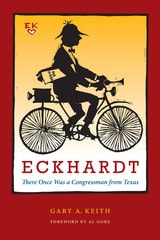
Eckhardt
There Once Was a Congressman from TexasBy Gary A. Keith
University of Texas Press, 2007
Runner-up, Violet Crown Award, Writer's League of Texas, 2008
Renowned for his "brilliant legislative mind" and political oratory—as well as for bicycling to Congress in a rumpled white linen suit and bow tie—U.S. Congressman Bob Eckhardt was a force to reckon with in Texas and national politics from the 1940s until 1980. A liberal Democrat who successfully championed progressive causes, from workers' rights to consumer protection to environmental preservation and energy conservation, Eckhardt won the respect of opponents as well as allies. Columnist Jack Anderson praised him as one of the most effective members of Congress, where Eckhardt was a national leader and mentor to younger congressmen such as Al Gore.
In this biography of Robert Christian Eckhardt (1913-2001), Gary A. Keith tells the story of Eckhardt's colorful life and career within the context of the changing political landscape of Texas and the rise of the New Right and the two-party state. He begins with Eckhardt's German-American family heritage and then traces his progression from labor lawyer, political organizer, and cofounder of the progressive Texas Observer magazine to Texas state legislator and U.S. congressman. Keith describes many of Eckhardt's legislative battles and victories, including the passage of the Open Beaches Act and the creation of the Big Thicket National Preserve, the struggle to limit presidential war-making ability through the War Powers Act, and the hard fight to shape President Carter's energy policy, as well as Eckhardt's work in Texas to tax the oil and gas industry.
The only thorough recounting of the life of a memorable, important, and flamboyant man, Eckhardt also recalls the last great era of progressive politics in the twentieth century and the key players who strove to make Texas and the United States a more just, inclusive society.
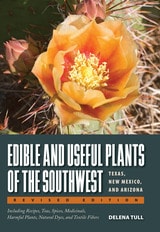
Edible and Useful Plants of the Southwest
Texas, New Mexico, and ArizonaBy Delena Tull
University of Texas Press, 2013
All around us there are wild plants useful for food, medicine, and clothing, but most of us don’t know how to identify or use them. Delena Tull amply supplies that knowledge in this book, which she has now expanded to more thoroughly address plants found in New Mexico and Arizona, as well as Texas.
Extensively illustrated with black-and-white drawings and color photos, this book includes the following special features:
- Recipes for foods made from edible wild plants
- Wild teas and spices
- Wild plant dyes, with instructions for preparing the plants and dying wool, cotton, and other materials
- Instructions for preparing fibers for use in making baskets, textiles, and paper
- Information on wild plants used for making rubber, wax, oil, and soap
- Information on medicinal uses of plants
- Details on hay fever plants and plants that cause rashes
- Instructions for distinguishing edible from poisonous berries
- Detailed information on poisonous plants, including poison ivy, oak, and sumac, as well as herbal treatments for their rashes
Educating Across Borders
The Case of a Dual Language Program on the U.S.-Mexico BorderMaría Teresa de la Piedra, Blanca Araujo, and Alberto Esquinca; Foreword by Concha Delgado Gaitan
University of Arizona Press, 2018
The authors, who themselves live and work on the border, question artificially created cultural and linguistic borders. To explore this issue, they employed participant-observation, focus groups, and individual interviews with teachers, administrators, and staff members to construct rich understandings of the experiences of transfronterizx students. These ethnographic accounts of their daily lives counter entrenched deficit perspectives about transnational learners.
Drawing on border theory, immigration and border studies, funds of knowledge, and multimodal literacies, Educating Across Borders is a critical contribution toward the formation of a theory of physical and metaphorical border crossings that ethnic minoritized students in U.S. schools must make as they traverse the educational system.
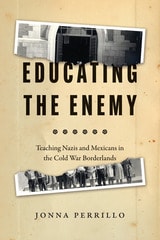
Educating the Enemy
Teaching Nazis and Mexicans in the Cold War BorderlandsJonna Perrillo
University of Chicago Press, 2022
Educating the Enemy begins with the 144 children of Nazi scientists who moved to El Paso, Texas, in 1946 as part of the military program called Operation Paperclip. These German children were bused daily from a military outpost to four El Paso public schools. Though born into a fascist enemy nation, the German children were quickly integrated into the schools and, by proxy, American society. Their rapid assimilation offered evidence that American public schools played a vital role in ensuring the victory of democracy over fascism.
Jonna Perrillo not only tells this fascinating story of Cold War educational policy, but she draws an important contrast with another, much more numerous population of children in the El Paso public schools: Mexican Americans. Like everywhere else in the Southwest, Mexican American children in El Paso were segregated into “Mexican” schools, where the children received a vastly different educational experience. Not only were they penalized for speaking Spanish—the only language all but a few spoke due to segregation—they were tracked for low-wage and low-prestige careers, with limited opportunities for economic success. Educating the Enemy charts what two groups of children—one that might have been considered the enemy, the other that was treated as such—reveal about the ways political assimilation has been treated by schools as an easier, more viable project than racial or ethnic assimilation.
Listen to an interview with the author here and read an interview in Time and a piece based on the book in the Boston Review.
El Paso
Local Frontiers At A Global CrossroadsVictor M. Ortiz-Gonzalez
University of Minnesota Press, 2004
A grounded and instructive analysis of the ways globalization affects a border city
Every marker of social difference can be easily interpreted in the fashionable language of “borderlands”—and if so, as Victor M. Ortiz-Gonzalez reveals, the practical reality of the border region is often grossly misrepresented and its people woefully served. He argues that amid the tantalizing abstractions generated by the sweeping reconfigurations of globalization, people in cities like El Paso and Ciudad Juárez, on the U.S.–Mexican border, are actually living the gritty realities of a new world order.
With descriptions of grassroots initiatives to confront the challenges and opportunities that NAFTA represents for the city, El Paso challenges us to acknowledge and address the conceptual and sociopolitical tasks of a world in which abstract representations and non-local interests override concrete situations. Ortiz-Gonzalez also provides an in-depth analysis of groups such as La Mujer Obrera, Unite El Paso, and the Hispanic Chamber of Commerce and their attempts to give local residents and workers more autonomy and power.Balancing ethnographic detail with precise theoretical insights, El Paso offers a compelling case study and a stirring call to understand both the conceptual challenge and the social urgency of the effects of globalization in local settings.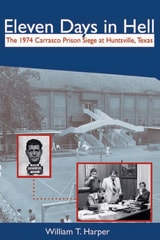
Eleven Days in Hell
The 1974 Carrasco Prison Siege at Huntsville, TexasWilliam T. Harper
University of North Texas Press, 2004
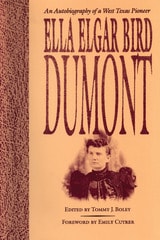
Ella Elgar Bird Dumont
An Autobiography of a West Texas PioneerEdited by Tommy J. Boley
University of Texas Press, 1988
A crack shot, expert skinner and tanner, seamstress, sculptor, and later writer—a list that only hints at her intelligence and abilities—Ella Elgar Bird Dumont was one of those remarkable women who helped tame the Texas frontier. First married at sixteen to a Texas Ranger, she followed her husband to Comanche Indian country in King County, where they lived in a tepee while participating in the final slaughter of the buffalo. Living off the land until the frontier was opened for ranching, Ella and Tom Bird typified the Old West ideals of self-sufficiency and generosity, with a hesitancy to complain about the hard life in the late 1800s.
Yet, in one important way, Ella Dumont was unsuited for life on the frontier. Endowed with an instinctive desire and ability to carve and sculpt, she was largely prevented from pursuing her talents by the responsibilities of marriage and frontier life and later, widowhood with two small children. Even though her second marriage, to Auguste Dumont, made life more comfortable, the realities of her existence still prevented the fulfillment of her artistic longings.
Ella Bird Dumont’s memoir is rich with details of the frontier era in Texas, when Indian depredations were still a danger for isolated settlers, where animals ranged close enough to provide dinner and a new pair of gloves, and where sheer existence depended on skill, luck, and the kindness of strangers. The vividness and poignancy of her life, coupled with the wealth of historical material in the editor’s exhaustive notes, make this Texas pioneer’s autobiography a very special book.
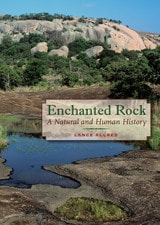
Enchanted Rock
A Natural and Human HistoryBy Lance Allred
University of Texas Press, 2009
With intriguing domes of pinkish granite surrounded by a sea of Hill Country limestone, Enchanted Rock State Natural Area attracts over 300,000 visitors every year who come to the park to hike, rock climb, spelunk, camp, picnic, and observe birds and wildflowers. Geologists from around the world come to Enchanted Rock to examine landforms that were shaped by forces on ancient continents of Earth more than one billion years ago! All of these visitors, however, are only the latest comers in a line of human history that stretches back 13,000 years to early Native Americans and includes Spanish explorers, Mexican and German settlers, and thirteen private and public owners up to the current owner, the state of Texas.
Surprisingly, given the area's wealth of unusual geology, native plants and animals, and human history, no comprehensive guide to Enchanted Rock has been published before now. In Enchanted Rock, you'll find everything you need to fully appreciate this unique place. Lance Allred draws on the work of specialists in many fields to offer a popular account of the park's history, geology, weather, flora, and fauna. Whether you want to know more about how Enchanted Rock was formed, identify a wildflower or butterfly, or learn more about plant communities along the hiking trails, you'll find accurate information here, presented in an inviting style. Over a thousand color photographs illustrate the enjoyable text.
Entre Guadalupe y Malinche
Tejanas in Literature and ArtEdited by Inés Hernández-Ávila and Norma Elia Cantú
University of Texas Press, 2016
Mexican and Mexican American women have written about Texas and their lives in the state since colonial times. Edited by fellow Tejanas Inés Hernández-Ávila and Norma Elia Cantú, Entre Guadalupe y Malinche gathers, for the first time, a representative body of work about the lives and experiences of women who identify as Tejanas in both the literary and visual arts.
The writings of more than fifty authors and the artwork of eight artists manifest the nuanced complexity of what it means to be Tejana and how this identity offers alternative perspectives to contemporary notions of Chicana identity, community, and culture. Considering Texas-Mexican women and their identity formations, subjectivities, and location on the longest border between Mexico and any of the southwestern states acknowledges the profound influence that land and history have on a people and a community, and how Tejana creative traditions have been shaped by historical, geographical, cultural, linguistic, social, and political forces. This representation of Tejana arts and letters brings together the work of rising stars along with well-known figures such as writers Gloria Anzaldúa, Emma Pérez, Alicia Gaspar de Alba, Carmen Tafolla, and Pat Mora, and artists such as Carmen Lomas Garza, Kathy Vargas, Santa Barraza, and more. The collection attests to the rooted presence of the original indigenous peoples of the land now known as Tejas, as well as a strong Chicana/Mexicana feminism that has its precursors in Tejana history itself.
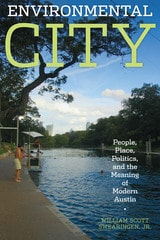
Environmental City
People, Place, Politics, and the Meaning of Modern AustinBy William Scott Swearingen, Jr.
University of Texas Press, 2010
As Austin grew from a college and government town of the 1950s into the sprawling city of 2010, two ideas of Austin as a place came into conflict. Many who promoted the ideology of growth believed Austin would be defined by economic output, money, and wealth. But many others thought Austin was instead defined by its quality of life. Because the natural environment contributed so much to Austin's quality of life, a social movement that wanted to preserve the city's environment became the leading edge of a larger movement that wanted to retain a unique sense of place. The "environmental movement" in Austin became the political and symbolic arm of the more general movement for place.
This is a history of the environmental movement in Austin—how it began; what it did; and how it promoted ideas about the relationships between people, cities, and the environment. It is also about a deeper movement to retain a sense of place that is Austin, and how that deeper movement continues to shape the way Austin is built today. The city it helped to create is now on the forefront of national efforts to rethink how we build our cities, reduce global warming, and find ways that humans and the environment can coexist in a big city.
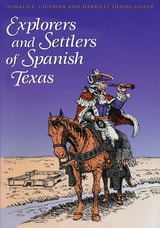
Explorers and Settlers of Spanish Texas
By Donald E. Chipman and Harriett Denise Joseph
University of Texas Press, 2001
In Notable Men and Women of Spanish Texas, Donald Chipman and Harriett Joseph combined dramatic, real-life incidents, biographical sketches, and historical background to reveal the real human beings behind the legendary figures who discovered, explored, and settled Spanish Texas from 1528 to 1821. Drawing from their earlier book and adapting the language and subject matter to the reading level and interests of middle and high school students, the authors here present the men and women of Spanish Texas for young adult readers and their teachers.
These biographies demonstrate how much we have in common with our early forebears. Profiled in this book are:
- Alvar Núñez Cabeza de Vaca: Ragged Castaway
- Francisco Vázquez de Coronado: Golden Conquistador
- María de Agreda: Lady in Blue
- Alonso de León: Texas Pathfinder
- Domingo Terán de los Ríos / Francisco Hidalgo: Angry Governor and Man with a Mission
- Louis St. Denis / Manuela Sánchez: Cavalier and His Bride
- Antonio Margil de Jesús: God's Donkey
- Marqués de San Miguel de Aguayo: Chicken War Redeemer
- Felipe de Rábago y Terán: Sinful Captain
- José de Escandón y Elguera: Father of South Texas
- Athanase de Mézières: Troubled Indian Agent
- Domingo Cabello: Comanche Peacemaker
- Marqués de Rubí / Antonio Gil Ibarvo: Harsh Inspector and Father of East Texas
- Bernardo Gutiérrez de Lara / Joaquín de Arredondo: Rebel Captain and Vengeful Royalist
- Women in Colonial Texas: Pioneer Settlers
- Women and the Law: Rights and Responsibilities
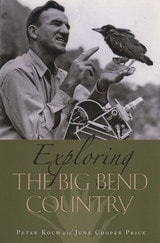
Exploring the Big Bend Country
By Peter Koch and June Cooper Price
University of Texas Press, 2007
Photographer-naturalist Peter Koch first visited the new Big Bend National Park in February, 1945, on assignment to take promotional pictures for the National Park Service. He planned to spend a couple of weeks—and ended up staying for the rest of his life. Koch's magnificent photographs and documentary film-lectures Big Bend, Life in a Desert Wilderness and Desert Gold introduced the park to people across the United States, drawing thousands of visitors to the Big Bend. His photographs and films of the region remain among the best ever produced, and are an invaluable visual record of the first four decades of Big Bend National Park.
In this highly readable book, Koch's daughter June Cooper Price draws on the newspaper columns her father wrote for the Alpine Avalanche, supplemented by his photographs, journal entries, and short pieces by other family members, to present Peter Koch's vision of the Big Bend. The book opens with his first "big adventure," a six-day photographic trip through Santa Elena Canyon on a raft made from agave flower stalks. From there, Koch takes readers hiking on mountain trails and driving the scenic loop around Fort Davis. He also describes "wax smuggling" and other ways of making a living on the Mexican border; ranching in the Big Bend; the prehistory and Native Americans of the region; collaborating with botanist Barton Warnock on books of Trans-Pecos wildflowers; and the history and beauty of Presidio County, the Rio Grande, and the Chihuahuan Desert.
This fascinating blend of firsthand adventures, natural history, and personal musings on anthropology and history creates an unforgettable portrait of both Peter Koch and the Big Bend region he so loved.