Results by title
2285 books match the query 'Women' and 79 start with e
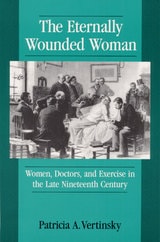
ETERNALLY WOUNDED WOMAN
"WOMEN, DOCTORS, AND EXERCISE IN THE LATPatricia A. Vertinsky
University of Illinois Press, 1994
"A review of thinking is needed in the field of sociohistorical analysis concerning attitudes toward the female body and attempts to regulate female physical activity. Such analyses may generate new insights into the questions of both social control and the unevenness of progress in women's real or perceived opportunities for participating freely and fully in sports and exercise of their choice."
Early Modern Women Journal Volume 12.2
Edited by Mihoko Suzuki
Arizona Center for Medieval and Renaissance Studies, 2018

Early Modern Women Journal v.10.1
Anne J. Cruz
Arizona Center for Medieval and Renaissance Studies, 2000
Early Modern Women Journal v.10.2
Robert E. Bjork
Arizona Center for Medieval and Renaissance Studies, 2000
Early Modern Women Journal v.11.1
Sharonah Frederick
Arizona Center for Medieval and Renaissance Studies, 2000
Early Modern Women Journal v.11.2
Sharonah Frederick
Arizona Center for Medieval and Renaissance Studies, 2000
Early Modern Women Journal v.9.2
Sharonah Frederick
Arizona Center for Medieval and Renaissance Studies, 2000
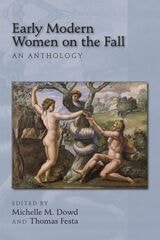
Early Modern Women on the Fall
An AnthologyMichelle M. Dowd
Arizona Center for Medieval and Renaissance Studies, 2012
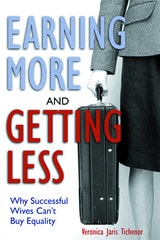
Earning More and Getting Less
Why Successful Wives Can't Buy EqualityVeronica Jaris Tichenor
Rutgers University Press, 2005
In Earning More and Getting Less, sociologist Veronica Jaris Tichenor shows how, historically, men have derived a great deal of power over financial and household decisions by bringing home all (or most) of the family's income. Yet, financial superiority has not been a similar source of power for women. Tichenor demonstrates how wives, instead of using their substantial incomes to negotiate more egalitarian relationships, enable their husbands to perpetuate male dominance within the family.
Weaving personal accounts, in-depth interviews, and compelling narrative, this important study reveals disturbing evidence that the conventional power relations defined by gender are powerful enough to undermine hierarchies defined by money. Earning More and Getting Less is essential reading in sociology, psychology, and family and gender studies.
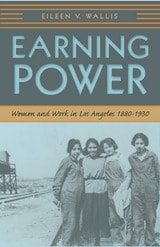
Earning Power
Women and Work in Los Angeles, 1880-1930Eileen Wallis
University of Nevada Press, 2010
The half-century between 1880 and 1930 saw rampant growth in many American cities and an equally rapid movement of women into the work force. In Los Angeles, the city not only grew from a dusty cow town to a major American metropolis but also offered its residents myriad new opportunities and challenges.Earning Power examines the role that women played in this growth as they attempted to make their financial way in a rapidly changing world. Los Angeles during these years was one of the most ethnically diverse and gender-balanced American cities. Moreover, its accelerated urban growth generated a great deal of economic, social, and political instability. In Earning Power, author Eileen V. Wallis examines how women negotiated issues of gender, race, ethnicity, and class to gain access to professions and skilled work in Los Angeles. She also discusses the contributions they made to the region’s history as political and social players, employers and employees, and as members of families. Wallis reveals how the lives of women in the urban West differed in many ways from those of their sisters in more established eastern cities. She finds that the experiences of women workers force us to reconsider many assumptions about the nature of Los Angeles’s economy, as well as about the ways women participated in it. The book also considers how Angelenos responded to the larger national social debate about women’s work and the ways that American society would have to change in order to accommodate working women. Earning Power is a major contribution to our understanding of labor in the urban West during this transformative period and of the crucial role that women played in shaping western cities, economies, society, and politics.
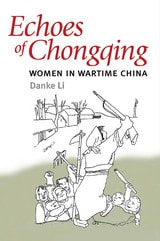
Echoes of Chongqing
Women in Wartime ChinaDanke Li
University of Illinois Press, 2010
This collection of annotated oral histories records the personal stories of twenty Chinese women who lived in the wartime capital of Chongqing during China's War of Resistance against Japan during World War II. By presenting women's remembrances of the war, this study examines the interplay between oral history and traditional historical narrative, public discourse, and private memories. The women interviewed came from differing social, economic, and educational backgrounds and experienced the war in a variety of ways, some of them active in the communist resistance and others trying to support families or pursue educations in the face of wartime upheaval. Their stories demonstrate that the War of Resistance had two faces: one presented by official propaganda and characterized by an upbeat unified front against Japan, the other a record of invisible private stories and a sobering national experience of death and suffering. The accounts of how women coped, worked, and lived during the war years in the Chongqing region recast historical understanding of the roles played by ordinary people in wartime and give women a public voice and face that, until now, have been missing from scholarship on the war.
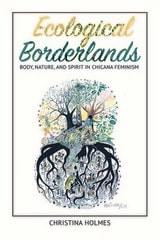
Ecological Borderlands
Body, Nature, and Spirit in Chicana FeminismChristina Holmes
University of Illinois Press, 2016
Holmes revisits key debates to analyze issues surrounding embodiment, women's connections to nature, and spirituality's role in ecofeminist philosophy and practice. By doing so, she challenges Chicanas to escape the narrow frameworks of the past in favor of an inclusive model of environmental feminism that alleviates Western biases. Holmes uses readings of theory, elaborations of ecological narratives in Chicana cultural productions, histories of human and environmental rights struggles in the Southwest, and a description of an activist exemplar to underscore the importance of living with decolonializing feminist commitment in body, nature, and spirit.
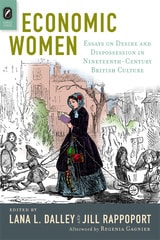
Economic Women
Essays on Desire and Dispossession in Nineteenth-Century British CultureEdited by Lana L. Dalley and Jill Rappoport
The Ohio State University Press, 2013
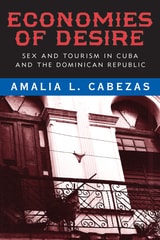
Economies of Desire
Sex and Tourism in Cuba and the Dominican RepublicAmalia L. Cabezas
Temple University Press, 2009
Is a native-born tour guide who has sex with tourists—in exchange for dinner or gifts or cash—merely a prostitute or gigolo? What if the tourist continues to send gifts or money to the tour guide after returning home? As this original and provocative book demonstrates, when it comes to sex—and the effects of capitalism and globalization —nothing is as simple as it might seem.
Based on ten years of research, Economies of Desire is the first ethnographic study to examine the erotic underpinnings of transnational tourism. It offers startling insights into the commingling of sex, intimacy, and market forces in Cuba and the Dominican republic, two nations where tourism has had widespread effects. In her multi-layered analyses, amalia cabezas reconceptualizes our understandings of informal economies (particularly "affective economies"), "sex workers," and “sexual tourism,” and she helps us appreciate how money, sex and love are intertwined within the structure of globalizing capitalism.
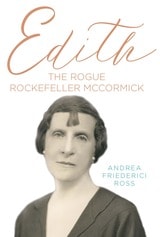
Edith
The Rogue Rockefeller McCormickAndrea Friederici Ross
Southern Illinois University Press, 2021
WINNER, 2021 Chicago Writers Association Book of the Year in Traditional Nonfiction!
Chicago’s quirky patron saint
This thrilling story of a daughter of America’s foremost industrialist, John D. Rockefeller, is complete with sex, money, mental illness, and opera divas—and a woman who strove for the independence to make her own choices. Rejecting the limited gender role carved out for her by her father and society, Edith Rockefeller McCormick forged her own path, despite pushback from her family and ultimate financial ruin.
Young Edith and her siblings had access to the best educators in the world, but the girls were not taught how to handle the family money; that responsibility was reserved for their younger brother. A parsimonious upbringing did little to prepare Edith for life after marriage to Harold McCormick, son of the Reaper King Cyrus McCormick. The rich young couple spent lavishly. They purchased treasures like the jewels of Catherine the Great, entertained in grand style in a Chicago mansion, and contributed to the city’s cultural uplift, founding the Chicago Grand Opera. They supported free health care for the poor, founding and supporting the John R. McCormick Memorial Institute for Infectious Diseases. Later, Edith donated land for what would become Brookfield Zoo.
Though she lived a seemingly enviable life, Edith’s disposition was ill-suited for the mores of the time. Societal and personal issues—not least of which were the deaths of two of her five children—caused Edith to experience phobias and panic attacks. Dissatisfied with rest cures, she ignored her father’s expectations, moved her family to Zurich, and embarked on a journey of education and self-examination. Edith pursued analysis with then-unknown Carl Jung. Her generosity of spirit led Edith to become Jung’s leading patron. She also supported up-and-coming musicians, artists, and writers, including James Joyce as he wrote Ulysses.
While Edith became a Jungian analyst, her husband, Harold, pursued an affair with an opera star. After returning to Chicago and divorcing Harold, Edith continued to deplete her fortune. She hoped to create something of lasting value, such as a utopian community and affordable homes for the middle class. Edith’s goals caused further difficulties in her relationship with her father and are why he and her brother cut her off from the family funds even after the 1929 stock market crash ruined her. Edith’s death from breast cancer three years later was mourned by thousands of Chicagoans.
Respectful and truthful, Andrea Friederici Ross presents the full arc of this amazing woman’s life and expertly helps readers understand Edith’s generosity, intelligence, and fierce determination to change the world
Educated in Romance
Women, Achievement, and College CultureDorothy C. Holland and Margaret A. Eisenhart
University of Chicago Press, 1990
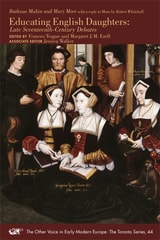
Educating English Daughters
Late Seventeenth-Century DebatesBathsua Makin and Mary More
Iter Press, 2016
This edition offers texts from Bathsua Makin and Mary More, and Robert Whitehall’s response to More’s argument. Makin describes the appropriate education for London merchants’ daughters, arguing that girls should be educated and should aspire to follow learned women in history, and that educated women improve their families and themselves. More argues that women have the right to an education, and that such an education shows that the inequality of married women under English law is a man-made institution. More’s argument drew objections from her Oxford reader, Robert Whitehall, who preserved her manuscript with his own. Makin and More enjoyed a measure of public recognition and esteem, yet after their deaths, they and their texts were largely ignored until the late twentieth century.
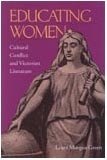
Educating Women
Cultural Conflict and Victorian LiteratureLaura Morgan Green
Ohio University Press, 2001
In 1837, when Queen Victoria came to the throne, no institution of higher education in Britain was open to women. By the end of the century, a quiet revolution had occurred: women had penetrated even the venerable walls of Oxford and Cambridge and could earn degrees at the many new universities founded during Victoria's reign. During the same period, novelists increasingly put intellectually ambitious heroines students, teachers, and frustrated scholars—at the center of their books. Educating Women analyzes the conflict between the higher education movement's emphasis on intellectual and professional achievement and the Victorian novel's continuing dedication to a narrative in which women's success is measured by the achievement of emotional rather than intellectual goals and by the forging of social rather than institutional ties.
Focusing on works by Charlotte Brontë, George Eliot, Anna Leonowens, and Thomas Hardy, Laura Morgan Green demonstrates that those texts are shaped by the need to mediate the conflict between the professionalism and publicity increasingly associated with education, on the one hand, and the Victorian celebration of women as emblems of domesticity, on the other. Educating Women shows that the nineteenth-century “heroines” of both history and fiction were in fact as indebted to domestic ideology as they were eager to transform it.
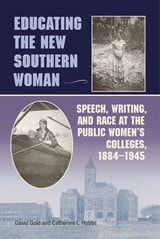
Educating the New Southern Woman
Speech, Writing, and Race at the Public Women's Colleges, 1884-1945David Gold and Catherine L. Hobbs
Southern Illinois University Press, 2014
From the end of Reconstruction through World War II, a network of public colleges for white women flourished throughout the South. Founded primarily as vocational colleges to educate women of modest economic means for life in the emerging “new” South, these schools soon transformed themselves into comprehensive liberal arts–industrial institutions, proving so popular that they became among the largest women’s colleges in the nation. In this illuminating volume, David Gold and Catherine L. Hobbs examine rhetorical education at all eight of these colleges, providing a better understanding of not only how women learned to read, write, and speak in American colleges but also how they used their education in their lives beyond college.
With a collective enrollment and impact rivaling that of the Seven Sisters, the schools examined in this study—Mississippi State College for Women (1884), Georgia State College for Women (1889), North Carolina College for Women (1891), Winthrop College in South Carolina (1891), Alabama College for Women (1896), Texas State College for Women (1901), Florida State College for Women (1905), and Oklahoma College for Women (1908)—served as important centers of women’s education in their states, together educating over a hundred thousand students before World War II and contributing to an emerging professional class of women in the South. After tracing the establishment and evolution of these institutions, Gold and Hobbs explore education in speech arts and public speaking at the colleges and discuss writing instruction, setting faculty and departmental goals and methods against larger institutional, professional, and cultural contexts. In addition to covering the various ways the public women’s colleges prepared women to succeed in available occupations, the authors also consider how women’s education in rhetoric and writing affected their career choices, the role of race at these schools, and the legacy of public women’s colleges in relation to the history of women’s education and contemporary challenges in the teaching of rhetoric and writing.
The experiences of students and educators at these institutions speak to important conversations among scholars in rhetoric, education, women’s studies, and history. By examining these previously unexplored but important institutional sites, Educating the New Southern Woman provides a richer and more complex history of women’s rhetorical education and experiences.
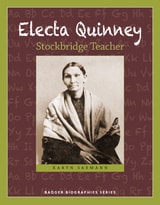
Electa Quinney
Stockbridge TeacherKaryn Saemann
Wisconsin Historical Society Press, 2014
Electa Quinney loved to learn. Growing up in the early 1800s in New York, she went to some of the best boarding schools. There she learned how to read, write, and solve tough math problems—she even learned how to do needlework. Electa decided early on that she wanted to become a teacher so she could pass her knowledge on to others.
But life wasn’t simple. Electa was a Stockbridge Indian, and her tribe was being pressured by the government and white settlers to move out of the state. So in 1828, Electa and others in her tribe moved to Wisconsin. Almost as soon as she arrived, Electa got to work again, teaching in a log building that also served as the local church. In that small school in the woods, Electa became Wisconsin’s very first public school teacher, educating the children of Stockbridge-Munsee Band of the Mohican Indians as well as the sons and daughters of nearby white settlers and missionaries.
Electa’s life provides a detailed window onto pioneer Wisconsin and discusses the challenges and issues faced by American Indians in the nineteenth century. Through it all, Electa’s love of learning stands out, and her legacy as Wisconsin’s first public school teacher makes her an inspiration to students of today.
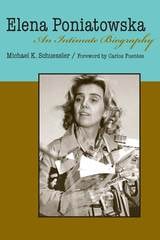
Elena Poniatowska
An Intimate BiographyMichael K. Schuessler; Foreword by Carlos Fuentes
University of Arizona Press, 2007
With his subject’s complete cooperation (she granted him access to fifty years of personal files), Michael Schuessler provides the first critical biography of Poniatowska’s life and work. She is perhaps best known outside of Mexico as the author of Massacre in Mexico (La noche de Tlatelolco) and Here’s to You, Jesusa! (Hasta no verte, Jesús mío). But her body of published books is vast, beginning with the 1954 publication of Lilus Kikus, a collection of short stories. And she is still writing today.
Schuessler, who befriended Poniatowska more than fifteen years ago, is a knowledgeable guide to her engrossing life and equally engaging work. As befits her, his portrait is itself a literary collage, a “living kaleidoscope” that is constantly shifting to include a multiplicity of voices—those of fellow writers, literary critics, her nanny, her mother, and the writer herself—easily accessible to general readers and essential to scholars.
Available in English for the first time, this insightful book includes 40 photographs and drawings and an annotated bibliography of Poniatowska’s works—those that have already been translated into English and those awaiting translation.
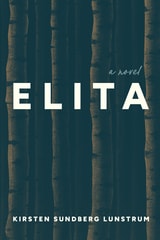
Elita
A NovelKirsten Sundberg Lunstrum
Northwestern University Press, 2025
An American literary take on the Nordic noir genre
Unfolding during the moody Pacific Northwest winter of 1951, we follow Bernadette Baston, scholar of child development and language acquisition, as she travels to a penitentiary on the remote island Elita in the Puget Sound to consult on a curious case: two guards have discovered an animal-like adolescent girl living alone in the cold woods beyond the prison’s walls. There are few answers, but many people who know more than they are saying. According to official reports, the girl, dubbed Atalanta, does not speak. Is her silence protecting someone? The prison warden, court-appointed guardian, and police detective embroil Bernadette in resolving a secret that the tight-knit island community has long held, and her investment in the girl’s case soon becomes more personal than professional. As a mother, wife, and woman bound by mid-twentieth-century expectations, Bernadette strategizes to retain the fragile control she has over her own freedom, identity, and future, which becomes inextricably tied to solving Atalanta’s case.
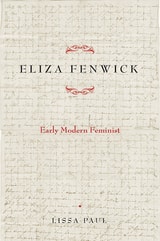
Eliza Fenwick
Early Modern FeministLissa Paul
University of Delaware Press, 2019
Lissa Paul brings to light Fenwick’s letters for the first time to reveal the relationships she developed with many key figures of her era, and to tell Fenwick’s story as depicted by the woman herself. Fenwick began as a writer in the radical London of the 1790s, a member of Mary Wollstonecraft’s circle, and when her marriage crumbled, she became a prolific author of children’s literature to support her family. Eventually Fenwick moved to Barbados, becoming the owner of a school while confronting the reality of slavery in the British colonies. She would go on to establish schools in numerous cities in the United States and Canada, all the while taking care of her daughter and grandchildren and maintaining her friendships through letters that, as presented here, tell the story of her life.
Published by the University of Delaware Press. Distributed worldwide by Rutgers University Press.
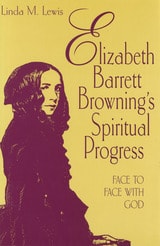
Elizabeth Barrett Browning's Spiritual Progress
Face to Face With GodLinda M. Lewis
University of Missouri Press, 1997
Elizabeth Barrett Browning believed that "Christ's religion is essentially poetry—poetry glorified." In Elizabeth Barrett Browning's Spiritual Progress, Linda M. Lewis studies Browning's religion as poetry, her poetry as religion. The book interprets Browning's literary life as an arduous spiritual quest—the successive stages being a rejection of Promethean pride for Christ-like humility, affirmation of the gospels of suffering and of work, internalization of the doctrine of Apocalypse, and ascent to divine love and truth.
Lewis follows this religious crusade from the poet's childhood to her posthumous Last Poems--including such topics as her Bible reading, her introduction to the Greek church fathers and the English Protestant reformers, the theological debates in which she participated, her quarrel with the theology of Paradise Lost, and her scandalous involvement in mesmerism and Swedenborgianism. Using insights from contemporary feminist thought, Lewis argues that Browning's religious assumptions and insights range from the conventional to the iconoclastic and that women's spirituality is, for Browning as well as for other Victorian women writers, separate from orthodox patriarchy. Lewis demonstrates that Browning's political and social ideology--often labeled inconsistent and illogical—really makes sense in light of this spiritual quest, which leads her to confront her God "face to face."
Elizabeth Barrett Browning's Spiritual Progress examines not only Browning's most admired works, such as Sonnets from the Portuguese and Aurora Leigh, but also her large body of political works and her important early poems—The Seraphim and A Drama of Exile. This intertextual book compares Browning's ideology to that of feminists such as Margaret Fuller, Harriet Martineau, and Florence Nightingale; influential conservatives such as Thomas Carlyle; and those most esteemed of Victorian poets, Alfred Lord Tennyson and Robert Browning.
Concluding with an examination of religion as a central focus of Victorian women poets, Lewis clarifies the ways in which Browning differs from Christina Rossetti, Felicia Hemans, Dora Greenwell, Jean Ingelow, and Mary Howitt. Elizabeth Barrett Browning's Spiritual Progress maintains that Browning's peculiar face-to-face struggle with the patristic and poetic tradition—as well as with God—sets her work apart.
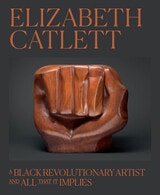
Elizabeth Catlett
A Black Revolutionary Artist and All That It ImpliesEdited by Dalila Scruggs
University of Chicago Press, 2024
Accomplished printmaker and sculptor, avowed feminist, and lifelong activist Elizabeth Catlett (1915–2012) built a remarkable career around intersecting passions for formal rigor and social justice. This book, accompanying a major traveling retrospective, offers a revelatory look at the artist and her nearly century-long life, highlighting overlooked works alongside iconic masterpieces.
Catlett’s activism and artistic expression were deeply connected, and she protested the injustices of her time throughout her life. Her work in printmaking and sculpture draws on organic abstraction, the modernism of the United States and Mexico, and African art to center the experiences of Black and Mexican women. Catlett attended Howard University, studied with the painter Grant Wood, joined the Harlem artistic community, and worked with a leftist graphics workshop in Mexico, where she lived in exile after the US accused her of communism and barred her re-entry into her home country.
The book’s essays address a range of topics, including Catlett’s early development as an artist-activist, the impact of political exile on her work, her pedagogical legacy, her achievement as a social realist printmaker, her work with the arts community of Chicago’s South Side, and the diverse influences that shaped her practice.
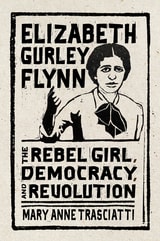
Elizabeth Gurley Flynn
The Rebel Girl, Democracy, and RevolutionMary Anne Trasciatti
Rutgers University Press, 2025
International Labor History Association Honorable Mention Book Award for 2025
Elizabeth Gurley Flynn was involved in almost every major campaign of the U.S. Left in the first two thirds of the twentieth century. An outstanding orator, writer, and tactician, Flynn is one of the most important figures in the history of the American labor movement. Inspired by the Irish freedom struggle and appalled by the exploitation and grinding poverty she saw around her, she devoted her life to the advancement of civil liberties. Here, Mary Anne Trasciatti traces Flynn’s personal and political life to explore the broader social issues of a fraught era.
Born in 1890, Flynn began her activist career by joining the Industrial Workers of the World (IWW) when she was just sixteen, and she ended it as the first female chair of the American Communist Party, a position she held from 1961 until her death in 1964. In the intervening years she organized workers into unions, led strikes, championed women’s rights, supported anti-imperialist movements around the globe, protested deportation, advocated for prison reform, and fought for Black liberation. Above all, she showed absolute devotion to workers and their struggles.
Slandered as an “un-American” in the anticommunist fervor of the 1940s and 1950s, Flynn was eventually ousted from the very organization she helped found, the American Civil Liberties Union, and imprisoned for two years. Though her own movement abandoned her, her commitment to the cause never wavered. This stirring biography illuminates Flynn’s inspiring life and worldview and returns her to her rightful place at the heart of labor and civil liberties history.

Elizabeth I
Autograph Compositions and Foreign Language OriginalsElizabeth I
University of Chicago Press, 2002
The originals selected for inclusion here are compositions that survive in Elizabeth's own handwriting, in English and in foreign languages, as well as her foreign language compositions preserved by other hands or in printed editions. Presented in transcriptions that reproduce the spelling and punctuation of their sixteenth-century sources, these texts convey many of the expressive and significant features of Elizabeth's writing. Through the transcriptions of texts in her own hand, readers can track the queen's language and compositional style-her choices of vocabulary and phrasing; her habits of capitalization, spelling, and punctuation; her often heavy revisions and redraftings; and her insertions of postscripts and second thoughts. The texts in foreign languages, meanwhile, will allow readers to prepare their own English translations from these original sources.
A unique resource for scholars of English literature and the Renaissance, this companion to the Collected Works offers much fuller and more detailed access to Elizabeth and her writings than can be obtained from the modern English versions alone.
Elizabeth Manning Hawthorne
A Life in LettersElizabeth Manning Hawthorne
University of Alabama Press, 2006
An annotated selection of unpublished letters by Nathaniel Hawthorne's sister.
Retrieved from seven different libraries, this corpus of letters was preserved by the Manning family chiefly for their value as records of Nathaniel Hawthorne's life and work; but they ironically also illuminate the life and mind of a fascinating correspondent and citizen of New England with incisive views and commentaries on her contemporaries, her role as a woman writer, Boston and Salem literary culture, and family life in mid-19th-century America.
This book illuminates Elizabeth's early life; the trauma caused for sister and brother by the death of their father; her and her brother's education; and the tensions the two children experienced when they moved in with their mother's family, the welthier Mannings, instead of the poorer though socially more venerable Hawthornes, following their father's death. The letters portray Elizabeth's constrained relationship with Nathaniel's wife Sofia Peabody and counter Sophia's portrayal of her sister-in-law as a recluse, oddity, and “queer scribbler.”
These 118 letters also reveal Elizabeth Hawthorne's tremendous gifts as a thinker, correspondent, and essayist, her interest in astronomy, a lifelong drive toward self-edification in many fields, and her extraordinary relationship with Nathaniel. As a sibling and a fellow author, they were sometimes lovingly codependent and sometimes competitive. Finally, her writing reveals the larger worlds of politics, war, the literary landscape, class, family life, and the freedoms and constraints of a woman's role, all by a heretofore understudied figure.
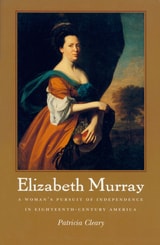
Elizabeth Murray
A Woman's Pursuit of Independence in Eighteenth-Century AmericaPatricia Cleary
University of Massachusetts Press, 2000
One of the most compelling figures in colonial America, Elizabeth Murray (1726–1785) was a Scottish immigrant who settled in Boston in her early twenties and took up shopkeeping. For many years, she practiced her trade successfully while marrying three times, once to a much older man who left her an extremely rich widow. This biography chronicles the life of this extraordinary “ordinary” woman who tried to make a place for herself and other women in the world by asserting her own independence inside and outside of the home.
As an importer and retailer of British goods, Murray conducted business with merchants and manufacturers in England and buyers in the American colonies, even traveling to London to select her own stock. Deeply satisfied by her work and the economic freedom it brought her, she acted as mentor to other women, helping them to establish shops of their own. She also protected her autonomy by demanding prenuptial agreements from her second and third husbands that gave her a measure of control over her property that was rare for a married woman of her day.
The spirit of independence that Murray so valued in herself and nurtured in other women was severely tested by the upheavals of the American Revolution. With strong loyalties to both Britain and America, she was torn by the conflict, especially when close relatives chose opposing sides and her third husband abandoned her, leaving her to defend the family estate alone. Her wartime experiences—wild midnight rides, accusations of being a spy, quartering both royal and rebel troops, and brief imprisonment—vividly capture the turmoil of the Revolution and highlight the range of her political commitments.
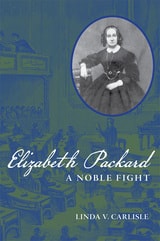
Elizabeth Packard
A Noble FightLinda V. Carlisle
University of Illinois Press, 2010
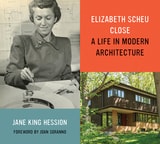
Elizabeth Scheu Close
A Life in Modern ArchitectureJane King Hession
University of Minnesota Press, 2020
An in-depth account of the life and career of Minnesota’s first modern architect
2024 Docomomo US Modernism in America Award of Excellence
2021 Finalist, Minnesota Book Award, Emilie Buchwald Award for Minnesota Nonfiction
Elizabeth “Lisl” Scheu Close (1912–2011) left an indelible mark on Minnesota’s built landscape during her six decades as an architect. In 1938, with her husband, Winston Close, she founded the state’s first architecture firm dedicated to modernism. In addition to designing the first International Style house in Minneapolis, the firm also created more than 250 handsome and efficiently planned modern residences. One of few women who were practicing architects in the mid-twentieth century, she blazed a trail for future generations of women in the profession.
As Jane King Hession shows, the trajectory of Lisl’s architectural career was shaped by the political, economic, and aesthetic upheavals of the twentieth century. Raised in a renowned modern house in Vienna, Austria, Lisl was exposed to revolutionary ideas in art and architecture at a young age. Forced to emigrate to the United States as the Nazis rose to power in Europe, she completed her architectural education at MIT. During the Depression, she struggled to find work and encountered challenges as a young woman in the field. In her pursuit of and devotion to a singular and successful career as a modern architect, she proved herself to be talented, determined, and adept at negotiating obstacles.
Through documentation of Lisl’s projects, this personal and professional biography also explores multiple aspects of modern architecture, including the innovative use of new materials and technologies, the design of prefabricated houses, and the relationship between residential design and changing American lifestyles.
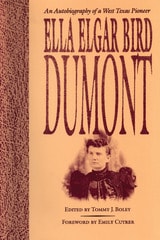
Ella Elgar Bird Dumont
An Autobiography of a West Texas PioneerEdited by Tommy J. Boley
University of Texas Press, 1988
A crack shot, expert skinner and tanner, seamstress, sculptor, and later writer—a list that only hints at her intelligence and abilities—Ella Elgar Bird Dumont was one of those remarkable women who helped tame the Texas frontier. First married at sixteen to a Texas Ranger, she followed her husband to Comanche Indian country in King County, where they lived in a tepee while participating in the final slaughter of the buffalo. Living off the land until the frontier was opened for ranching, Ella and Tom Bird typified the Old West ideals of self-sufficiency and generosity, with a hesitancy to complain about the hard life in the late 1800s.
Yet, in one important way, Ella Dumont was unsuited for life on the frontier. Endowed with an instinctive desire and ability to carve and sculpt, she was largely prevented from pursuing her talents by the responsibilities of marriage and frontier life and later, widowhood with two small children. Even though her second marriage, to Auguste Dumont, made life more comfortable, the realities of her existence still prevented the fulfillment of her artistic longings.
Ella Bird Dumont’s memoir is rich with details of the frontier era in Texas, when Indian depredations were still a danger for isolated settlers, where animals ranged close enough to provide dinner and a new pair of gloves, and where sheer existence depended on skill, luck, and the kindness of strangers. The vividness and poignancy of her life, coupled with the wealth of historical material in the editor’s exhaustive notes, make this Texas pioneer’s autobiography a very special book.
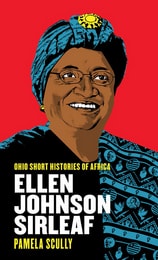
Ellen Johnson Sirleaf
Pamela Scully
Ohio University Press, 2016
In this timely addition to the Ohio Short Histories of Africa series, Pamela Scully takes us from the 1938 birth of Nobel Peace Prize winner and two-time Liberian president Ellen Johnson through the Ebola epidemic of 2014–15. Charting her childhood and adolescence, the book covers Sirleaf’s relationship with her indigenous grandmother and urban parents, her early marriage, her years studying in the United States, and her career in international development and finance, where she developed her skill as a technocrat. The later chapters cover her years in and out of formal Liberian politics, her support for women’s rights, and the Ebola outbreak.
Sirleaf’s story speaks to many of the key themes of the twenty-first century. Among these are the growing power of women in the arenas of international politics and human rights; the ravaging civil wars in which sexual violence is used as a weapon; and the challenges of transitional justice in building postconflict societies. Ellen Johnson Sirleaf is an astute examination of the life of a pioneering feminist politician.
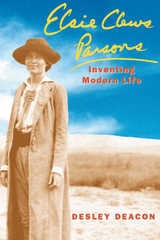
Elsie Clews Parsons
Inventing Modern LifeDesley Deacon
University of Chicago Press, 1997
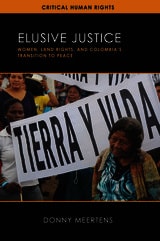
Elusive Justice
Women, Land Rights, and Colombia's Transition to PeaceDonny Meertens
University of Wisconsin Press, 2019
Drawing on decades of research, Elusive Justice demonstrates how these women continue to face numerous adverse circumstances, including geographical isolation, encroaching capitalist enterprises, and a dearth of social and institutional support. Donny Meertens contends that women's advocacy organizations must have a prominent role in overseeing these transitional policies in order to create a more just society. By bringing together the underresearched topic of property repayment and the pursuit of gender justice in peacebuilding, these findings have broad significance elsewhere in the world.
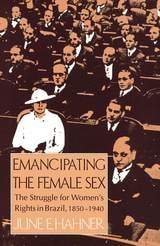
Emancipating the Female Sex
The Struggle for Women's Rights in Brazil, 1850–1940June E. Hahner
Duke University Press, 1990
Hahner traces the history of Brazilian women’s fight for emancipation from its earliest manifestations in the mid-nineteenth century to the successful conclusion of the suffrage campaign in the 1930s. Drawing on interviews with surviving Brazilian suffragists and contemporary feminists as well as manuscripts and printed documents, Hahner explores the strategies and ideological positions of Brazilian feminists. In focusing on urban upper- and middle-class women, from whose ranks the leadership for change arose, she examines the relationship between feminism and social change in Brazil’s complex and highly stratified society.
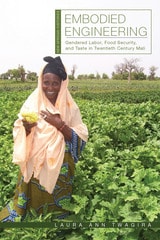
Embodied Engineering
Gendered Labor, Food Security, and Taste in Twentieth-Century MaliLaura Ann Twagira
Ohio University Press, 2021
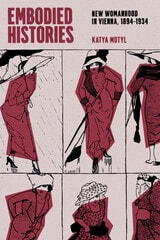
Embodied Histories
New Womanhood in Vienna, 1894–1934Katya Motyl
University of Chicago Press, 2024
In Embodied Histories, historian Katya Motyl explores the everyday acts of defiance that formed the basis for new, unconventional forms of womanhood in early twentieth-century Vienna. The figures Motyl brings back to life defied gender conformity, dressed in new ways, behaved brashly, and expressed themselves freely, overturning assumptions about what it meant to exist as a woman.
Motyl delves into how these women inhabited and reshaped the urban landscape of Vienna, an increasingly modern, cosmopolitan city. Specifically, she focuses on the ways that easily overlooked quotidian practices such as loitering outside cafés and wandering through city streets helped create novel conceptions of gender. Exploring the emergence of a new womanhood, Embodied Histories presents a new account of how gender, the body, and the city merge with and transform each other, showing how our modes of being are radically intertwined with the spaces we inhabit.
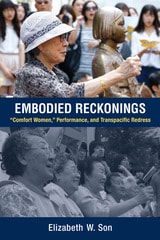
Embodied Reckonings
“Comfort Women,” Performance, and Transpacific RedressElizabeth W. Son
University of Michigan Press, 2018
Based on extensive archival and ethnographic research, the study argues for the central role of performance in how Korean survivors, activists, and artists have redressed the histories—and erasures—of this sexual violence. Merging cultural studies and performance theory with a transnational, feminist analysis, the book illuminates the actions of ordinary people, thus offering ways of reconceptualizing legal and political understandings of redress that tend to concentrate on institutionalized forms of state-based remediation.
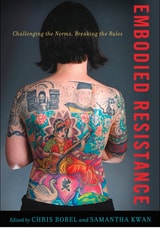
Embodied Resistance
Challenging the Norms, Breaking the RulesChris Bobel
Vanderbilt University Press, 2011
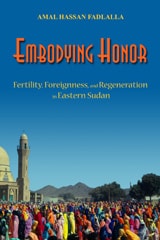
Embodying Honor
Fertility, Foreignness, and Regeneration in Eastern SudanAmal Hassan Fadlalla
University of Wisconsin Press, 2007
In Embodying Honor Amal Hassan Fadlalla finds that the female body is the locus of anxieties about foreign dangers and diseases, threats perceived to be disruptive to morality, feminine identities, and social well-being. As a “northern Sudanese” viewed as an outsider in this region of her native country, Fadlalla presents an intimate portrait and thorough analysis that offers an intriguing commentary on the very notion of what constitutes the “foreign.” Fadlalla shows how Muslim Hadendowa women manage health and reproductive suffering in their quest to become “responsible” mothers and valued members of their communities. Her historically grounded ethnography delves into women’s reproductive histories, personal narratives, and ritual logics to reveal the ways in which women challenge cultural understandings of gender, honor, and reproduction.
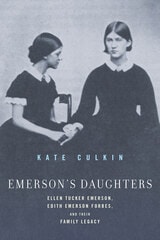
Emerson’s Daughters
Ellen Tucker Emerson, Edith Emerson Forbes, and Their Family LegacyKate Culkin
University of Massachusetts Press, 2025
Longlisted for the 2026 Plutarch Award
Ellen Tucker Emerson and Edith Emerson Forbes, the daughters of Lidian Jackson and Ralph Waldo Emerson, grew up in the heart of Concord, Massachusetts’s famed literary community. In a culture that celebrated self-reliance, Ellen and Edith formed a partnership that only strengthened as their paths diverged, with Ellen remaining in the family home and Edith marrying William Forbes, moving to Milton, Massachusetts, and having eight children. The partnership allowed them to tend to the demands and opportunities created by their father’s career, including serving as his secretaries and editors, and helped them shape his posthumous image. It also enabled them to adapt to historical developments stretching from the Civil War to American imperialism as well as personal ones, including Edith’s growing family and travel and study abroad, and inevitable ones brought on by the aging processes of their parents and themselves.
Emerson’s Daughters is a biography of a sisterhood, the first full-length study of Ellen’s and Edith’s lives. Building on archival research into the extensive correspondence between the sisters, it adds to the growing body of work on women’s contribution to Transcendentalism while opening a window onto the rich, and understudied, family life of the “Sage of Concord.”
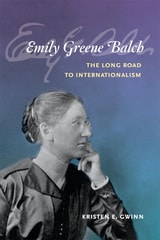
Emily Greene Balch
The Long Road to InternationalismKristen E. Gwinn
University of Illinois Press, 2010
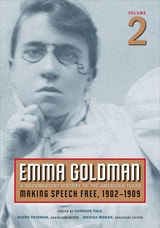
Emma Goldman, Vol. 2
A Documentary History of the American Years, Volume 2: Making Speech Free, 1902-1909Emma Goldman. Edited by Candace Falk; Barry Pateman, Assoc Ed; Jessica Moran, As
University of Illinois Press, 2007
Emma Goldman: A Documentary History of the American Years reconstructs the life of Emma Goldman through significant texts and documents. These volumes collect personal letters, lecture notes, newspaper articles, court transcripts, government surveillance reports, and numerous other documents, many of which appear here in English for the first time. Supplemented with thorough annotations, multiple appendixes, and detailed chronologies, the texts bring to life the memory of this singular, pivotal figure in American and European radical history.
Volume 2: Making Speech Free, 1902-1909 extends many of the themes introduced in the previous volume, including Goldman's evolving attitudes toward political violence and social reform, intensified now by documentary accounts of the fomenting revolution in Russia and the legal opposition toward anarchism and labor organizing in the United States. Always an impassioned defender of free expression, Goldman's launch of her magazine Mother Earth in 1906 signaled a desire to bring radical thought into wider circulation, and its pages brought together modern literary and cultural ideas with a radical social agenda, quickly becoming a platform for her feminist critique, among her many other challenges to the status quo. With abundant examples from her writings and speeches, this volume details Goldman's emergence as one of American history's most fiercely outspoken opponents of hypocrisy and pretension in politics and public life.
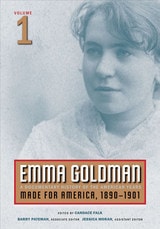
Emma Goldman
A Documentary History of the American Years, Volume 1: Made for America, 1890-1901Emma Goldman. Edited by Candace Falk; Barry Pateman, Assoc Ed; Jessica Moran, A
University of Illinois Press, 2007
Emma Goldman: A Documentary History of the American Years reconstructs the life of Emma Goldman through significant texts and documents. These volumes collect personal letters, lecture notes, newspaper articles, court transcripts, government surveillance reports, and numerous other documents, many of which appear here in English for the first time. Supplemented with thorough annotations, multiple appendixes, and detailed chronologies, the texts bring to life the memory of this singular, pivotal figure in American and European radical history.
Volume 1: Made for America, 1890-1901 introduces readers to the young Emma Goldman as she begins her association with the international anarchist movement and especially with the German, Jewish, and Italian immigrant radicals in New York City. From early on, Goldman's movement through political and intellectual circles is marked by violence, from the attempted murder of industrialist Henry Clay Frick by Goldman's lover, Alexander Berkman, to the assassination of President William McKinley, in which Goldman was falsely implicated. The documents surrounding these events illuminate Goldman's struggle to balance anarchism's positive gains and its destructive costs. This volume introduces many of the themes that would pervade much of Goldman's later writings and speeches: the untold possibilities of anarchism; the transformative power of literature; the interplay of human relationships; and the importance of free speech, education, labor, women's freedom, and radical social reform.
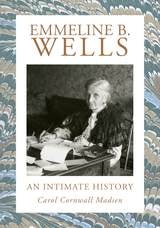
Emmeline B. Wells
An Intimate HistoryCarol Cornwall Madsen
University of Utah Press, 2016
Emmeline B. Wells was the most noted Utah Mormon woman of her time. Lauded nationally for her energetic support of the women’s rights movement of the nineteenth century, she was a self-made woman who channeled her lifelong sense of destiny into ambitious altruism. Her public acclaim and activism belied the introspective, self-appraising, and emotional persona she expressed in the pages of her forty-seven extant diaries. Yet she wrote, “I have risen triumphant,” after reconciling herself to the heartaches of plural marriage, and she pursued a self-directed life in earnest.
This new biography tells the story of the private Emmeline. The unusual circumstances of her marriages, the complicated lives of her five daughters, losses and disappointments interspersed with bright moments and achievements, all engendered the idea that her life was a romance, with all the mysterious, tragic, and sentimental elements of that genre. Her responses to that perception made it so. This volume, drawing heavily on Emmeline Wells’s own words, tells the complicated story of a woman of ambition, strength, tenderness, and faith.
Winner of the Mormon History Association's Best Biography Award.
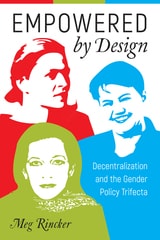
Empowered by Design
Decentralization and the Gender Policy TrifectaMeg Rincker
Temple University Press, 2017
In her probing book, Empowered by Design, Meg Rincker asks, Under what conditions will decentralization lead to women’s empowerment in countries around the globe? Using three case studies—the United Kingdom, Poland, and Pakistan—she shows how decentralization reforms create new institutional offices as power shifts from the national level to a meso-tier level, which is located between the national government and local municipalities. These shifts impact a country’s political, administrative, and fiscal reforms as well as women’s representation.
Rincker argues that this shift should be inclusive of women—or at least lead more women to participate in institutions—but this is not always the case. She indicates that three conditions, “the gender policy trifecta,” need to be met to achieve this: legislative gender quotas, women’s policy agencies, and gender-responsive budgeting at the level of governance in question. Rincker's innovative research uses original comparative data about what women want, quantitative cross-national analyses, and interviews with women’s organization leaders and politicians to show how cross-institutional policymaking can empower women.
Rincker’s fine-grained analysis makes a significant contribution to the study of representation and gendered implications of decentralization, as well as how representatives go about understanding and aggregating our diverse policy preferences.
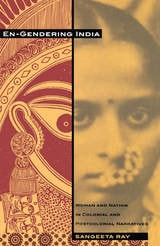
En-Gendering India
Woman and Nation in Colonial and Postcolonial NarrativesSangeeta Ray
Duke University Press, 2000
Through her readings of works by writers including Bankimchandra Chatterjee, Rabindranath Tagore, Harriet Martineau, Flora Annie Steel, Anita Desai, and Bapsi Sidhaa, Ray demonstrates that Indian women were presented as upper class and Hindu, an idealization that paradoxically served the needs of both colonial and nationalist discourses. The Indian nation’s goal of self-rule was expected to enable women’s full participation in private and public life. On the other hand, British colonial officials rendered themselves the protectors of passive Indian women against their “savage” male countrymen. Ray shows how the native woman thus became a symbol for both an incipient Indian nation and a fading British Empire. In addition, she reveals how the figure of the upper-class Hindu woman created divisions with the nationalist movement itself by underscoring caste, communal, and religious differences within the newly emerging state. As such, Ray’s study has important implications for discussions about nationalism, particularly those that address the concepts of identity and nationalism.
Building on recent scholarship in feminism and postcolonial studies, En-Gendering India will be of interest to scholars in those fields as well as to specialists in nationalism and nation-building and in Victorian, colonial, and postcolonial literature and culture.
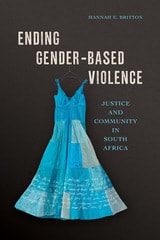
Ending Gender-Based Violence
Justice and Community in South AfricaHannah E. Britton
University of Illinois Press, 2020
Hannah E. Britton examines the reasons gendered violence persists in relationship to social inequalities even after women assume political power. Venturing into South African communities, Britton invites service providers, religious and traditional leaders, police officers, and medical professionals to address gender-based violence in their own words. Britton finds the recent turn toward carceral solutions—with a focus on arrests and prosecutions—fails to address the complexities of the problem and looks at how changing specific community dynamics can defuse interpersonal violence. She also examines how place and space affect the implementation of policy and suggests practical ways policymakers can support street level workers.
Clear-eyed and revealing, Ending Gender-Based Violence offers needed tools for breaking cycles of brutality and inequality around the world.
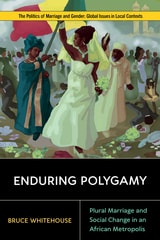
Enduring Polygamy
Plural Marriage and Social Change in an African MetropolisBruce Whitehouse
Rutgers University Press, 2023
Why hasn’t polygamous marriage died out in African cities, as experts once expected it would? Enduring Polygamy considers this question in one of Africa’s fastest-growing cities: Bamako, the capital of Mali, where one in four wives is in a polygamous marriage. Using polygamy as a lens through which to survey sweeping changes in urban life, it offers ethnographic and demographic insights into the customs, gender norms and hierarchies, kinship structures, and laws affecting marriage, and situates polygamy within structures of inequality that shape marital options, especially for young Malian women. Through an approach of cultural relativism, the book offers an open-minded but unflinching perspective on a contested form of marriage. Without shying away from questions of patriarchy and women’s oppression, it presents polygamy from the everyday vantage points of Bamako residents themselves, allowing readers to make informed judgments about it and to appreciate the full spectrum of human cultural diversity.