Results by title
22279 books match the query 'Social Science' and 684 start with e

Evaluating Alternative Cancer Therapies
A Guide to the Science and Politics of an Emerging Medical FieldDavid J. Hess, Ph.D.
Rutgers University Press, 1998
Evaluating Anti-Trafficking Interventions
Critical Reflections and Lessons from the FieldEdited by Ella Cockbain, Aiden Sidebottom, and Sheldon X. Zhang
University College London, 2025
Despite vast investment in anti-trafficking measures worldwide, there is a stark lack of evidence of effective interventions. It is unethical and ineffective to keep throwing money at anti-trafficking efforts without a more nuanced understanding of how they can help and harm. After all, advances in crime prevention and harm reduction both rely heavily on evaluation science. Bringing together contributors from across different perspectives, disciplines, backgrounds, and geographies, Evaluating Anti-Trafficking Interventions focuses on the sharp end of criminal abuses. It offers both practical guidance and critical reflections on the promises and pitfalls of evaluation for anti-trafficking interventions. The book also introduces foundational theory and practice around evaluations (including both qualitative and quantitative evidence), highlights innovative new directions, and draws lessons from real-world case studies. It is designed to function both as a practical companion guide and to stimulate reflection on the tensions and constraints of funding, doing, and assessing evaluations in this domain.
Evaluative Research
Principles and Practice in Public Service and Social Action ProgrEdward Suchman
Russell Sage Foundation, 1968
Evangelical Gotham
Religion and the Making of New York City, 1783–1860Kyle B. Roberts
University of Chicago Press, 2016

Evangelical Identity and Gendered Family Life
Gallagher, Sally K
Rutgers University Press, 2003
Evangelical Identity and Gendered Family Life provides a sociological and historical analysis of gender, family, and work among evangelical Protestants. In this innovative study, Sally Gallagher traces two lines of gender ideals—one of husbands’ authority and leadership, the other of mutuality and partnership in marriage—from the Puritans to the Promise Keepers into the lives of ordinary evangelicals today. Rather than simply reacting against or accommodating themselves to “secular society,” Gallagher argues that both traditional and egalitarian evangelicals draw on longstanding beliefs about gender, human nature, and the person of God.
The author bases her arguments on an analysis of evangelical family advice literature, data from a large national survey and personal interviews with over 300 evangelicals nationwide. No other work in this area draws on such a range of data and methodological resources. Evangelical Identity and Gendered Family Life establishes a standard for future research by locating the sources, strategies, and meaning of gender within evangelical Protestantism.

Evangelicalism
The Coming GenerationJames Davison Hunter
University of Chicago Press, 1987
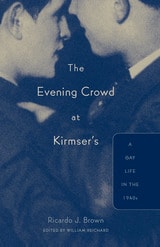
Evening Crowd at Kirmser’s
A Gay Life In The 1940SRicardo J. Brown
University of Minnesota Press, 2003
A surprising and vivid remembrance of gay life in the wake of World War II
It is often difficult to imagine gay gathering places in the decades before the Stonewall riots of the 1960s, and nearly impossible to think of such communities outside the nation’s largest cities. Yet such places did exist, and their histories tell amazing stories of survival and the struggle for acceptance and self-respect.
Kirmser’s was such a place. In the 1940s, this bar in downtown St. Paul was popular with blue-collar customers during the day, then became an unofficial home to working-class gay men and lesbians at night. After Ricardo J. Brown was discharged from the navy for revealing his sexual orientation in 1945, he returned home to Minnesota and discovered in Kirmser’s a space where he could develop his new self-awareness and fulfill his desire to find people like himself.The Evening Crowd at Kirmser’s is Brown’s compelling memoir of his experiences as a young gay man in St. Paul. In an engaging and open writing style, and through stories both humorous and tragic, Brown introduces us to his family, companions, and friends, such as Flaming Youth, a homely, sardonic man who carried the nickname from his youth ironically into middle age; Dale, who suddenly loses his job of six years after an anonymous note informed his employer that he was gay; and Bud York, an attractive and confident man with a fondness for young boys.
Every Day We Live Is the Future
Surviving in a City of DisastersBy Douglas Haynes
University of Texas Press, 2017
When she was only nine, Dayani Baldelomar left her Nicaraguan village with nothing more than a change of clothes. She was among tens of thousands of rural migrants to Managua in the 1980s and 1990s. After years of homelessness, Dayani landed in a shantytown called The Widows, squeezed between a drainage ditch and putrid Lake Managua. Her neighbor, Yadira Castellón, also migrated from the mountains. Driven by hope for a better future for their children, Dayani, Yadira, and their husbands invent jobs in Managua’s spreading markets and dumps, joining the planet’s burgeoning informal economy. But a swelling tide of family crises and environmental calamities threaten to break their toehold in the city.
Dayani’s and Yadira’s struggles reveal one of the world’s biggest challenges: by 2050, almost one-third of all people will likely live in slums without basic services, vulnerable to disasters caused by the convergence of climate change and breakneck urbanization. To tell their stories, Douglas Haynes followed Dayani’s and Yadira’s families for five years, learning firsthand how their lives in the city are a tightrope walk between new opportunities and chronic insecurity. Every Day We Live Is the Future is a gripping, unforgettable account of two women’s herculean efforts to persevere and educate their children. It sounds a powerful call for understanding the growing risks to new urbanites, how to help them prosper, and why their lives matter for us all.
Every Goddamn Day
A Highly Selective, Definitely Opinionated, and Alternatingly Humorous and Heartbreaking Historical Tour of ChicagoNeil Steinberg
University of Chicago Press, 2022
Every day in Chicago is a day to remember. In a city so rich with history, every day is the anniversary of some storied historical or cultural moment, whether it’s the dedication of the Pablo Picasso sculpture downtown on August 15, or the arrest of Rod Blagojevich at his Ravenswood home on December 9, or a fire that possibly involved a cow on October 8.
In Every Goddamn Day, acerbic Chicago Sun-Times columnist Neil Steinberg takes the story of the city, pares away the dull, eat-your-peas parts, and provides 366 captivating daily readings in what makes Chicago Chicago and America America. It calls upon a wide cast of characters, from Oscar Wilde to Muhammad Ali, from Emma Goldman to Teddy Roosevelt, and from Richard M. Daley to Fred Hampton, to create a compelling narrative that can be read at a sitting or in a yearlong series of daily doses.
From New Year’s Day to New Years’ Eve, Steinberg takes us on a vivid and entertaining tour, illuminating the famous, obscure, tragic, and hilarious elements that make each day in Chicago memorable.

Every Home a Fortress
Cold War Fatherhood and the Family Fallout ShelterThomas Bishop
University of Massachusetts Press, 2020
Every Place on the Map Is Disabled
Poems and EssaysCamisha L. Jones, Michael Northen, Naomi Ortiz, and Travis Chi Wing Lau
Northwestern University Press, 2026
An anthology of poems and essays by and celebrating Disabled writers
Declaring that Disabled people exist, innovate, thrive, and persevere, Every Place on the Map Is Disabled imagines the world we deserve. Its contributors spotlight the wisdom Disabled people embody from living within and navigating the economic and medical systems, communities, and families that often oppress their existence. This anthology is an intersectional compass pointing to the creative ways Disabled people build bridges to each other through Disability poetics and perspectives.
The contributing poets write about love, resistance, loss, pain, beauty, and culture. They capture tender and life-affirming moments where one Disabled person recognizes themself in another. The essays illustrate how Disability poetics suggest avenues for embracing the full spectrum of disability experiences. Every Place on the Map Is Disabled offers students, scholars, members of disability communities, and any reader a direction for paving a wider path toward a collective survival.
Every River on Earth
Writing from Appalachian OhioNeil Carpathios
Ohio University Press, 2015
Every River on Earth: Writing from Appalachian Ohio includes some of the best regional poetry, fiction, and creative nonfiction from forty contemporary writers, both established and up-and-coming. The wide range of material from authors such as David Baker, Don Bogen, Michelle Burke, Richard Hague, Donald Ray Pollock, and others, offers the reader a window into daily life in the region. The people, the landscape, the struggles, and the deepest undercurrents of what it means to be from and of a place are revealed in these original, deeply moving, and sometimes shocking pieces.
The book is divided into four sections: Family & Folks, The Land, The Grind, and Home & Away, each of which explores a different aspect of the place that these authors call home. The sections work together beautifully to capture what it means to live, to love, and to die in this particular slice of Appalachia. The writing is accessible and often emotionally raw; Every River on Earth invites all types of readers and conveys a profound appreciation of the region’s character.
The authors also offer personal statements about their writing, allowing the reader an intimate insight into their processes, aesthetics, and inspirations. What is it to be an Appalachian? What is it to be an Appalachian in Ohio? This book vividly paints that picture.
Every River on Earth
David Lee Garrison
I look out the window and see
through the neighbor’s window
to an Amish buggy
where three children are peeping back,
and in their eyes I see the darkness
of plowed earth hiding seed.
Wind pokes the land in winter,
trying to waken it,
and in the melting snow
I see rainbows and in them
every river on earth. I see all the way
to the ocean, where sand and stones
embrace each falling wave
and reach back to gather it in.
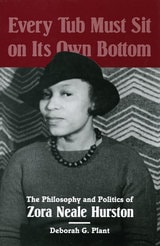
Every Tub Must Sit on Its Own Bottom
The Philosophy and Politics of Zora Neale HurstonDeborah G. Plant
University of Illinois Press, 1995
needed at this point in the evolving critical assessment of Hurston. It
is a paradigm for the study of individual African American women writers."
-- Alice Deck, University of Illinois at Urbana-Champaign
In a ground-breaking study
of Zora Neale Hurston, Deborah Plant takes issue with current notions
of Hurston as a feminist and earlier impressions of her as an intellectual
lightweight who disregarded serious issues of race in American culture.
Instead, Plant calls Hurston a "writer of resistance" who challenged
the politics of domination both in her life and in her work. One of the
great geniuses of the Harlem Renaissance, Hurston stands out as a strong
voice for African-American women. Her anthropological inquiries as well
as her evocative prose provide today's readers with a rich history of
African American folk culture, a folk culture through which Hurston expressed
her personal and political strategy of resistance and self-empowerment.
Through readings of Hurston's
fiction and autobiographical writings, Plant offers one of the first book-length
discussions of Hurston's personal philosophy of individualism and self-preservation.
From a discussion of Hurston's preacher father and influential mother,
whose guiding philosophy is reflected in the title of this book, to the
influence of Spinoza and Nietzsche, Plant puts into perspective the driving
forces behind Hurston's powerful prose.
This fresh look at one of
the most important writers of the twentieth century is sure to shape future
study of Hurston and her work.
Everybody Hurts
Transitions, Endings, and Resurrections in Fan CulturesRebecca Williams
University of Iowa Press, 2018
Have you ever been a fan of a show that was canceled abruptly or that killed off a beloved character unexpectedly? Or perhaps it was rebooted after a long absence and now you’re worried it won’t be as good as the original? Anyone who has ever followed entertainment closely knows firsthand that such transitions can be jarring.
Indeed, for truly loyal fans, the loss can feel very real—even throwing their own identity into question. Examining how fans respond to and cope with transitions, endings, or resurrections in everything from band breakups (R.E.M.) to show cancellations (Hannibal) to closing down popular amusement park rides, this collection brings together an eclectic mix of scholars to analyze the various ways fans respond to change. Essays explore practices such as fan discussion and creating alternative fan fictions, as well as cases where fans abandon their objects of interest completely and move on to new ones. Shedding light on how fans react, both individually and as a community, the contributors also trace the commonalities and differences present in fandoms across a range of media, and they pay close attention to the ways fandom operates across paratexts and transmedia forms including films, comics, and television.
This fascinating approach promises to make an important contribution to the fields of fan, media, and cultural studies, and should appeal widely to students, scholars, and anyone else with a genuine interest in understanding why these transitions can have such a deep impact on fans’ lives.
Contributors: Stuart Bell, Anya Benson, Lucy Bennett, Paul Booth, Joseph Brennan, Kristina Busse, Melissa A. Click, Ruth Deller, Evelyn Deshane, Nichola Dobson, Simone Driessen, Emily Garside, Holly Willson Holladay, Bethan Jones, Nicolle Lamerichs, Kathleen Williams, Rebecca Williams
Everybody Knows
Cynicism in AmericaWilliam Chaloupka
University of Minnesota Press, 2001
A witty take on what’s wrong--and right--with cynicism today, now in paperback!
We are now living in the midst of the most cynical era in American history. Disaffection from government institutions is at an all-time high. Ordinary citizens perceive political leaders to be more manipulative and jaded than ever. Skepticism pervades our cultural and social attitudes and interactions, and is prominently featured in the films we see, the books we read, and the media we experience. In this biting and controversial analysis, William Chaloupka scrutinizes the cynicism that is our common condition, examining both its uses in the politics of backlash and resentment and its surprisingly positive aspects.
Everybody Knows traces cynicism from its classical origins but emphasizes its recent emergence in American culture and politics, following a trajectory from H. L. Mencken to Richard Nixon to Bill Clinton to Fargo. Cutting neatly across ideological divisions, Chaloupka discusses the ways in which cynicism is rooted in all democratic politics and analyzes the role of the media-in particular, television news, political ads and speeches, and books such as E. J. Dionne’s Why Americans Hate Politics and William Bennett’s The Book of Virtues-in dissecting and encouraging cynicism.Chaloupka describes mass cynicism, which permeates popular culture; outsider cynicism, capable of cranky, even violent disruption; and the cynicism of those in power. He argues that those who issue broad pleas for civility or a renewal of community spirit usually misunderstand the cynicism they wish to treat. He also discusses the value of a cheeky, subversive “kynicism” to evoke the lively democratic practice American society must foster.Early reviews call Everybody Knows “original and compelling,” “pithy, engaging, and funny,” and “the best book on American politics in quite a while.” Sure to be widely read and debated, this entertaining book will inspire readers to take a new look at the cynicism prevalent in contemporary American society.
Everybody’s Family Romance
Reading Incest in Neoliberal AmericaGillian Harkins
University of Minnesota Press, 2009
In the 1990s, a boom in autobiographical novels and memoirs about incest emerged, making incest one of the hottest topics to connect daytime TV talk shows, the self-help industry, and the literary publishing circuit. In Everybody's Family Romance, Gillian Harkins places this proliferation of incest literature at the center of transformations in the political and economic climate of the late twentieth century.
Harkins's interdisciplinary approach reveals how women's narratives about incest were co-opted by-and yet retained resistant strains against-the cultural logics of the neoliberal state. Across chapters examining legal cases on recovered memory, popular journalism, and novels and memoirs by Dorothy Allison, Carolivia Herron, Kathryn Harrison, and Sapphire, Harkins demonstrates that incest narratives look backward into the past. In these accounts, images of incest forge links between U.S. chattel slavery and the distributive impasses of the welfare state and between decades-distant childhoods and emergent memories of the present.
In contrast to recent claims that incest narratives eclipse broader frameworks of political and economic power, Harkins argues that their emergence exposes changing structural relations between the family and the nation and, in doing so, transforms the analyses of American familial sexual violence.

Everyday Apocalypse
Art, Empire, and the End of the WorldDavid Dark
Vanderbilt University Press, 2025
This revised edition of the book includes a foreword by Hanif Abdurraqib, an extensive afterword, updates in light of the passage of time since its publication, and new insights from the author, whose outspokenness has placed him outside of circles in which he was once supported and celebrated.
Everyday Conversions
Islam, Domestic Work, and South Asian Migrant Women in KuwaitAttiya Ahmad
Duke University Press, 2017
Everyday Creativity
Singing Goddesses in the Himalayan FoothillsKirin Narayan
University of Chicago Press, 2016
With rare and captivating eloquence, Narayan portrays Kangra songs about difficulties on the lives of goddesses and female saints as a path to well-being. Like the intricate geometries of mandalu patterns drawn in courtyards or the subtle balance of flavors in a meal, well-crafted songs offer a variety of deeply meaningful benefits: as a way of making something of value, as a means of establishing a community of shared pleasure and skill, as a path through hardships and limitations, and as an arena of renewed possibility. Everyday Creativity makes big the small world of Kangra song and opens up new ways of thinking about what creativity is to us and why we are so compelled to engage it.
Everyday Desistance
The Transition to Adulthood Among Formerly Incarcerated YouthAbrams, Laura S.
Rutgers University Press, 2017
In Everyday Desistance, Laura Abrams and Diane J. Terry examine the lives of young people who spent considerable time in and out of correctional institutions as adolescents. These formerly incarcerated youth often struggle with the onset of adult responsibilities at a much earlier age than their more privileged counterparts. In the context of urban Los Angeles, with a large-scale gang culture and diminished employment prospects, further involvement in crime appears almost inevitable. Yet, as Abrams and Terry point out, these formerly imprisoned youth are often quite resilient and can be successful at creating lives for themselves after months or even years of living in institutions run by the juvenile justice system.
This book narrates the day-to-day experiences of these young men and women, focusing on their attempts to surmount the challenges of adulthood, resisting a return to criminal activity, and formulating long-term goals for a secure adult future.
Everyday Dirty Work
Invisibility, Communication, and Immigrant LaborWilfredo Alvarez
The Ohio State University Press, 2022
Winner, 2023 NCA Ethnography Division Best Book Award
Wilfredo Alvarez’s Everyday Dirty Work: Invisibility, Communication, and Immigrant Labor is an exploration into co-cultural communication practices within the workplace. Specifically, Alvarez investigates how Latin American immigrant janitors communicate from their marginalized standpoints in a predominantly White academic organization. He examines how custodial workers perceive, interpret, and thematize routine messages regarding race, ethnicity, social class, immigrant status, and occupation, and how those messages and overall communicative experiences affect both their work and personal lives.
A Latin American immigrant himself, Alvarez relates his own experiences to those of the research participants. His positionality informs and enhances his research as he demonstrates how everyday interpersonal encounters create discursive spaces that welcome or disqualify people based on symbolic and social capital. Alvarez offers valuable insights into the lived experiences of critical––but often undervalued and invisible––organizational members. Through theoretical insights and research data, he provides practical recommendations for organizational leaders to improve how they can relate to and support all stakeholders.

Everyday English 1500-1700
A ReaderBridget Cusack, Editor
University of Michigan Press, 1998
This unique source book of essential documents designed for courses on Early Modern English is designed as a teaching text with full guidance to each text, including glossary, explanatory and background notes, and suggested topics for linguistic evaluation. Everyday English takes an up-to-the-minute approach by focusing on language as it was used and spoken at the time.
This wide-ranging collection for the first time makes available to students a corpus of examples of the ordinary, nonstandard language of the man and woman in the street, coming from areas as diverse as England, Scotland, and America. The emphasis throughout is on providing as much assistance as possible to the reader to aid understanding and appreciation of both the linguistic features and the everyday lifestyles of the time.
"The only book a really conscientious teacher of the history and structure of Early Modern English would use for source texts." --Roger Lass, University of Cape Town
Bridget Cusack was lecturer in English Language, University of Edinburgh.
Everyday Equalities
Making Multicultures in Settler Colonial CitiesRuth Fincher
University of Minnesota Press, 2019
A timely new look at coexisting without assimilating in multicultural cities
If city life is a “being together of strangers,” what forms of being together should we strive for in cities with ethnic and racial diversity? Everyday Equalities seeks evidence of progressive political alternatives to racialized inequality that are emerging from everyday encounters in Los Angeles, Melbourne, Sydney, and Toronto—settler colonial cities that, established through efforts to dispossess and eliminate indigenous societies, have been destinations for waves of immigrants from across the globe ever since.
Everyday Equalities finds such alternatives being developed as people encounter one another in the process of making a home, earning a living, moving around the city, and forming collective actions or communities. Here four leading scholars in critical urban geography come together to deliver a powerful and cohesive message about the meaning of equality in contemporary cities. Drawing on both theoretical reflection and urban ethnographic research, they offer the formulation “being together in difference as equals” as a normative frame to reimagine the meaning and pursuit of equality in today’s urban multicultures.
As the examples in Everyday Equalities indicate, much emotional labor, combined with a willingness to learn from each other, negotiate across differences, and agitate for change goes into constructing environments that foster being together in difference as equals. Importantly, the authors argue, a commitment to equality is not only a hope for a future city but also a way of being together in the present.

Everyday Erotics
Older Chinese Women and Same-Sex DesireDenise Tse-Shang Tang
Duke University Press, 2026
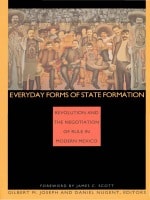
Everyday Forms of State Formation
Revolution and the Negotiation of Rule in Modern MexicoGilbert M. Joseph and Daniel Nugent, eds.
Duke University Press, 1994
Structured in the form of a dialogue between a distinguished array of Mexicanists and comparative social theorists, this volume boldly reassesses past analyses of the Mexican revolution and suggests new directions for future study. Showcasing a wealth of original archival and ethnographic research, this collection provides a new and deeper understanding of Mexico’s revolutionary experience. It also speaks more broadly to a problem of extraordinary contemporary relevance: the manner in which local societies and self-proclaimed "revolutionary" states are articulated historically. The result is a unique collection bridging social history, anthropology, historical sociology, and cultural studies in its formulation of new approaches for rethinking the multifaceted relationship between power, culture, and resistance.
Contributors. Ana María Alonso, Armando Bartra, Marjorie Becker, Barry Carr, Philip Corrigan, Romana Falcón, Gilbert M. Joseph, Alan Knight, Florencia E. Mallon, Daniel Nugent, Elsie Rockwell, William Roseberry, Jan Rus, Derek Sayer, James C. Scott
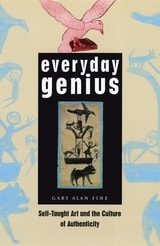
Everyday Genius
Self-Taught Art and the Culture of AuthenticityGary Alan Fine
University of Chicago Press, 2004
Fine considers the differences among folk art, outsider art, and self-taught art, explaining the economics of this distinctive art market and exploring the dimensions of its artistic production and distribution. Interviewing dealers, collectors, curators, and critics and venturing into the backwoods and inner-city homes of numerous self-taught artists, Fine describes how authenticity is central to the system in which artists—often poor, elderly, members of a minority group, or mentally ill—are seen as having an unfettered form of expression highly valued in the art world. Respected dealers, he shows, have a hand in burnishing biographies of the artists, and both dealers and collectors trade in identities as much as objects.
Revealing the inner workings of an elaborate and prestigious world in which money, personalities, and values affect one another, Fine speaks eloquently to both experts and general readers, and provides rare access to a world of creative invention-both by self-taught artists and by those who profit from their work.

Everyday Harm
Domestic Violence, Court Rites, and Cultures of ReconciliationMindie Lazarus-Black
University of Illinois Press, 2007
Exposing the powerful contradictions between empowering rights and legal rites
By investigating the harms routinely experienced by the victims and survivors of domestic violence, both inside and outside of law, Everyday Harm studies the limits of what domestic violence law can--and cannot--accomplish. Combining detailed ethnographic research and theoretical analysis, Mindie Lazarus-Black illustrates the ways persistent cultural norms and ingrained bureaucratic procedures work to unravel laws designed to protect the safety of society’s most vulnerable people.
Lazarus-Black’s fieldwork in Trinidad traces a story with global implications about why and when people gain the right to ask the court for protection from violence, and what happens when they pursue those rights in court. Why is itthat, in spite of laws designed to empower subordinated people, so little results from that legislation? What happens in and around courts that makes it so difficult for people to obtain their legally available rights and protections? In the case of domestic violence law, what can such legislation mean for women’s empowerment, gender equity, and protection? How do cultural norms and practices intercept the law?

Everyday Intimacies of the Middle East
Asli Zengin and Sertaç Sehlikoglu, special issue editors
Duke University Press, 2016
This issue provides an area-studies perspective on intimacy and explores the analytic, theoretical, and political work that intimacy promises as a concept. The contributors explore how multiple domains and forms of intimacies are defined and transformed across the cultural and social worlds of the Middle East, looking in particular at Egypt, Turkey, and Israel. Focusing on everyday constructions of intimacies, the contributors engage with questions about how we should calibrate the evolving nature of intimacy in times of rapid transition, what intimacy means for individual and social lives, and what social, political, and economic possibilities it creates. Topics include physical exercise, Turkish beauty salons, transnational surrogacy arrangements, gender reassignment, and coffee shops as intimate spaces for men outside the family.
Article Contributors: Aymon Kreil, Claudia Liebelt, Sibylle Lustenberger, Sertaç Sehlikoğlu, Aslı Zengin
Review and Third Space Contributors: Dena Al-Adeeb, Adam George Dunn, Rima Dunn, Meral Düzgün, Iklim Goksel, Didem Havlioğlu, Sarah Ihmoud, Sarah Irving, Adi Kuntsman, Shahrzad Mojab, Afsaneh Najmabadi, Rachel Rothendler, Afiya Zia
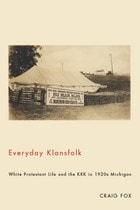
Everyday Klansfolk
White Protestant Life and the KKK in 1920s MichiganCraig Fox
Michigan State University Press, 2011
In 1920s Middle America, the Ku Klux Klan gained popularity not by appealing to the fanatical fringes of society, but by attracting the interest of “average” citizens. During this period, the Klan recruited members through the same unexceptional channels as any other organization or club, becoming for many a respectable public presence, a vehicle for civic activism, or the source of varied social interaction. Its diverse membership included men and women of all ages, occupations, and socio-economic standings. Although surviving membership records of this clandestine organization have proved incredibly rare, Everyday Klansfolk uses newly available documents to reconstruct the life and social context of a single grassroots unit in Newaygo County, Michigan. A fascinating glimpse behind the mask of America’s most notorious secret order, this absorbing study sheds light on KKK activity and membership in Newaygo County, and in Michigan at large, during the brief and remarkable peak years of its mass popular appeal.
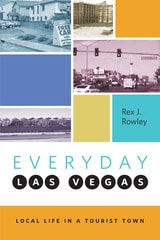
Everyday Las Vegas
Local Life in a Tourist TownRex J. Rowley
University of Nevada Press, 2014
Rowley considers such topics as why people move to Las Vegas, the nature of their work and personal lives, the impact of growth and rapid change, and interaction with the overwhelmingly touristic side of the city. He also considers the benefits and perils of living in a nonstop twenty-four-hour city rich in entertainment options and easy access to gambling, drugs, and other addictions. His examination includes the previously unstudied role of neighborhood casinos patronized by locals rather than tourists and the impact that a very mobile population has on schools, churches, and community life.
Rowley considers the very different ways people perceive a place as insiders or outsiders, a dichotomy that arises when tourism is a mainstay of the local economy. His work offers insights into what Las Vegas can teach us about other cities and American culture in general. It also contributes to our understanding of how people relate to places and how the personality of a place influences the lives of people who live there.
Everyday Law on the Street
City Governance in an Age of DiversityMariana Valverde
University of Chicago Press, 2012
Everyday People and the Stories of Freedom in the Sixties
Craig Werner
University of Massachusetts Press, 2027
Showing that the most important figures of the 1960s were not always the most famous ones
Just weeks back from Vietnam, guitarist Larry Lee stood on stage at Woodstock alongside Jimi Hendrix, but he isn’t given more than a glance in the festival’s documentary. In Selma, Alabama, in March 1965, an eight-year-old girl named Sheyann Webb wrote her own obituary before joining the march across the Edmund Pettus Bridge. She survived Bloody Sunday, swept off the bridge in the arms of Hosea Williams as state troopers on horseback swung bullwhips and clubs. These are just a couple of the regular people at the heart of Craig Werner’s sweeping, mosaic history of the 1960s; it is their stories, not those of the icons, that give the era its deeper meaning.
In Everyday People and the Stories of Freedom in the Sixties, Werner assembles a rich and kaleidoscopic portrait of a decade in which Americans across the entire political spectrum claimed freedom as their cause. Moving beyond familiar myths and simplified narratives, he reveals a period defined by three interlocking realities: everything was open to change, everything seemed to happen at once, and everyone believed their vision of freedom was the one worth fighting for.
Bringing together stories too often told in isolation—the Civil Rights Movement, Vietnam, the global Cold War, the women’s movement, and the intertwined worlds of sex, drugs, and rock 'n' roll—Werner integrates the experiences of African Americans, women, Native Americans, Latinx communities, LGBTQ people, and immigrants into a single, propulsive narrative. Music, film, art, and fashion are not treated as colorful backdrops but as central forces in the making of political and social change. This book illuminates the economic, political, technological, and cultural forces that shaped the 1960s and continue to influence the present. It is a history of a decade told not from the top down, but from the ground up, by the people who lived it.
Supplemental materials for readers, students, and instructors are available on the publisher’s website, including full citations, playlists, images, and thematic sections on the Global Sixties, science and technology, religion, literature, music, film, visual art, and major figures and events.
Everyday Revolutionaries
Gender, Violence, and Disillusionment in Postwar El SalvadorIrina Carlota Silber
Rutgers University Press, 2011
Winner of the 2013 International Latino Book Awards in the Best First Book, Nonfiction category
Everyday Revolutionaries provides a longitudinal and rigorous analysis of the legacies of war in a community racked by political violence. By exploring political processes in one of El Salvador's former war zones-a region known for its peasant revolutionary participation-Irina Carlota Silber offers a searing portrait of the entangled aftermaths of confrontation and displacement, aftermaths that have produced continued deception and marginalization.
Silber provides one of the first rubrics for understanding and contextualizing postwar disillusionment, drawing on her ethnographic fieldwork and research on immigration to the United States by former insurgents. With an eye for gendered experiences, she unmasks how community members are asked, contradictorily and in different contexts, to relinquish their identities as "revolutionaries" and to develop a new sense of themselves as productive yet marginal postwar citizens via the same "participation" that fueled their revolutionary action. Beautifully written and offering rich stories of hope and despair, Everyday Revolutionaries contributes to important debates in public anthropology and the ethics of engaged research practices.
Everyday Ruptures
Children, Youth, and Migration in Global PerspectiveCati Coe
Vanderbilt University Press, 2011
The book is organized around four themes:
• how children's agency is affected by institutions, families, and beliefs
• how families and individuals create and maintain kin ties in conditions of rupture
• how emotion and affect are linked to global divisions and flows
• how the actions of states create ruptures and continuities
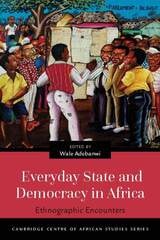
Everyday State and Democracy in Africa
Ethnographic EncountersWale Adebanwi
Ohio University Press, 2022
Bottom-up case studies, drawn from the perspective of ordinary Africans’ experiences with state bureaucracies, structures, and services, reveal how citizens and states define each other.
This volume examines contemporary citizens’ everyday encounters with the state and democratic processes in Africa. The contributions reveal the intricate and complex ways in which quotidian activities and experiences—from getting an identification card (genuine or fake) to sourcing black-market commodities to dealing with unreliable waste collection—both (re)produce and (re)constitute the state and democracy. This approach from below lends gravity to the mundane and recognizes the value of conceiving state governance not in terms of its stated promises and aspirations but rather in accordance with how people experience it.
Both new and established scholars based in Africa, Europe, and North America cover a wide range of examples from across the continent, including
- bureaucratic machinery in South Sudan, Nigeria, and Kenya
- infrastructure and shortages in Chad and Nigeria
- disciplinarity, subjectivity, and violence in Rwanda, South Africa, and Nigeria
- the social life of democracy in the Congo, Cameroon, and Mozambique
- education, welfare, and health in Ethiopia, the Democratic Republic of Congo, and Burkina Faso
Everyday State and Democracy in Africa demonstrates that ordinary citizens’ encounters with state agencies and institutions define the meanings, discourses, practices, and significance of democratic life, as well its distressing realities.
Contributors:
- Daniel Agbiboa
- Victoria Bernal
- Jean Comaroff
- John L. Comaroff
- E. Fouksman
- Fred Ikanda
- Lori Leonard
- Rose Løvgren
- Ferenc Dávid Markó
- Ebenezer Obadare
- Rogers Orock
- Justin Pearce
- Katrien Pype
- Edoardo Quaretta
- Jennifer Riggan
- Helle Samuelsen
- Nicholas Rush Smith
- Eric Trovalla
- Ulrika Trovalla
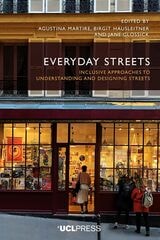
Everyday Streets
Inclusive Approaches to Understanding and Designing StreetsEdited by Agustina Martire, Birgit Hausleitner, and Jane Clossick
University College London, 2023
Everyday streets are both the most used and most undervalued of cities’ public spaces. They are places of social aggregation, bringing together people of different classes, genders, ages, ethnicities, and nationalities. They comprise not just the familiar outdoor spaces that we move through and interact in but also urban blocks, interiors, depths, and hinterlands, which are integral to streets’ nature and contribute to their vitality. Everyday Streets offers an inclusive approach to understanding and designing these streets through an analysis of them as found in cities around the globe. From the regular rectilinear urban blocks of Montreal to the carefully regulated narrow alleyways of Naples, and from the resilient market streets of London to the crammed commercial streets of Chennai, the streets in this book were all conceived with a certain level of control. Everyday Streets is a palimpsest of methods, perspectives, and recommendations that together provide a solid understanding of everyday streets, their degree of inclusiveness, and to what extent they could be more inclusive.
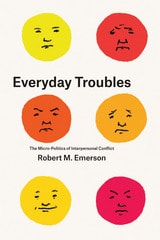
Everyday Troubles
The Micro-Politics of Interpersonal ConflictRobert M. Emerson
University of Chicago Press, 2015
To examine these issues, Emerson draws on interviews with college roommates, diaries documenting a wide range of irritation with others, conversations with people caring for family members suffering from Alzheimer’s, studies of family interactions, neighborly disputes, and other personal accounts. He considers how people respond to everyday troubles: in non-confrontational fashion, by making low-visibility, often secretive, changes in the relationship; more openly by directly complaining to the other person; or by involving a third party, such as friends or family. He then examines how some relational troubles escalate toward extreme and even violent responses, in some cases leading to the involvement of outside authorities like the police or mental health specialists.
By calling attention to the range of possible reactions to conflicts in interpersonal relationships, Emerson also reminds us that extreme, even criminal actions often result when people fail to find ways to deal with trouble in moderate, non-confrontational ways. Innovative and insightful, Everyday Troubles is an illuminating look at how we deal with discord in our relationships.
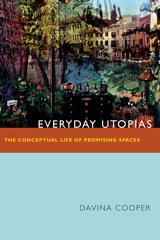
Everyday Utopias
The Conceptual Life of Promising SpacesDavina Cooper
Duke University Press, 2013
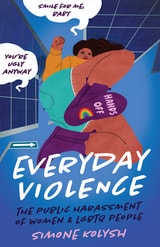
Everyday Violence
The Public Harassment of Women and LGBTQ PeopleSimone Kolysh
Rutgers University Press, 2021
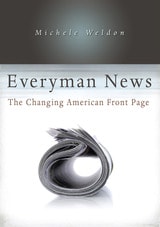
Everyman News
The Changing American Front PageMichele Weldon
University of Missouri Press, 2007
One need only look at the front pages of newspapers over the past few years to see that something has changed. Stories are more personal, more inclusive, less distant from readers’ experiences. Once called the first draft of history, news has become more of an anecdotal companion. The evidence is telling: stories use more unofficial sources than ever before; the “inverted pyramid” form of news writing is barely practiced; and, especially after 9/11, tragedy has become more humanized.
Scanning the crowded media landscape, Michele Weldon—a journalist passionate about her profession—takes a fresh look at how newspapers have carved out a narrative niche that reflects society’s fascination with personal stories and readers’ demands for diversity in content. Comparing some 850 stories, story approaches, and unofficial sourcing in twenty American newspapers for eight dates in 2001 and 2004—a total of 160 front pages—she shows a shift toward features over hard news, along with an increase in anecdotal or humanistic approaches to all stories.
Everyman News offers a provocative look at why American newspapers have become story papers, with their content and style saying as much about our culture as they do about the journalists and the readers. Weldon shows that a variety of forces both inside and outside journalism—blogs, citizen journalism, newsroom diversity, and other factors—have converged to remake the front page, and she unveils the content of “everyman news” as a commodity apart from the mode of delivery. Her assessment also incorporates more than fifty interviews with people connected to journalism about what these changes mean—revealing that not everyone in the industry believes they are for the better.
Is everyman news perhaps right for its time, or is it merely a symptom of what Weldon calls “Chicken Little journalism”? Weighing in on such matters as the New York Times’s “Portraits of Grief” series and the dangers of the blogosphere, she invites readers to make their own calls in this original and important contribution to the study of media. Everyman News is a book that will contribute to our understanding of newspapers in the new century—must reading for professionals and an eye-opener for anyone trying to comprehend the significant shifts in today’s front pages.
Everynight Life
Culture and Dance in Latin/o AmericaCeleste Fraser Delgado and José Esteban Muñoz, eds.
Duke University Press, 1997
This anthology looks at many modes of dance—including salsa, merengue, cumbia, rumba, mambo, tango, samba, and norteño—as models for the interplay of cultural memory and regional conflict. Barbara Browning’s essay on capoeira, for instance, demonstrates how dance has been used as a literal form of resistance, while José Piedra explores the meanings conveyed by women of color dancing the rumba. Pieces such as Gustavo Perez Fírmat’s "I Came, I Saw, I Conga’d" and Jorge Salessi’s "Medics, Crooks, and Tango Queens" illustrate the lively scope of this volume’s subject matter.
Contributors. Barbara Browning, Celeste Fraser Delgado, Jane C. Desmond, Mayra Santos Febres, Juan Carlos Quintero Herencia, Josh Kun, Ana M. López, José Esteban Muñoz, José Piedra, Gustavo Perez Fírmat, Augusto C. Puleo, David Román, Jorge Salessi, Alberto Sandoval
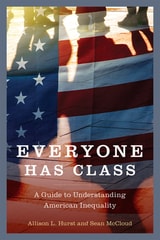
Everyone Has Class
A Guide to Understanding American InequalityAllison L. Hurst
Oregon State University Press, 2026
Social class is a neglected, misunderstood, yet overwhelmingly powerful factor in the United States. In Everyone Has Class Allison L. Hurst and Sean McCloud draw on both personal stories and insights from recent studies to recount the many ways class influences American life. The authors explore the material conditions we live in, the social relationships we develop, and the unconscious and conscious psychological and physical habits we form based on our social class location. Each chapter reveals the profound presence and complex influence of social class—beyond that of money, education, and occupation—providing readers with an understanding of what social class is and how it operates in our everyday lives.
Starting with “what is class?” in chapter one, personal narratives alongside interviews with key researchers and scholars allow entrée for everyone to the meaning of the term class, the impact of class, and the broader applications and perspectives within the study of class. Can one overcome class? Does recognizing its effects allow us to navigate our own social standing? Through twelve stand-alone chapters, Hurst and McCloud show how class shapes and influences both individual and social lives in consequential ways.
Everyone Is NOT Doing It
Abstinence and Personal IdentityJamie L. Mullaney
University of Chicago Press, 2005
Based on interviews with individuals who abstain from habits as diverse as sex, cigarettes, sugar, and technology, Everyone Is NOT Doing It identifies four different types of abstainers: quitters; those who have never done something and never will; those who haven't done something yet, but might in the future; and those who are not doing something temporarily. Mullaney assesses the commonalities that bind abstainers, as well as how perceptions of abstinence change according to social context, age, and historical era. In contrast to such earlier forms of abstinence as social protest, entertainment, or an instrument of social stratification, not doing something now gives people a more secure sense of self by offering a more affordable and manageable identity in a world of ever-expanding options.
Everyone Loves Live Music
A Theory of Performance InstitutionsFabian Holt
University of Chicago Press, 2020
For decades, millions of music fans have gathered every summer in parks and fields to hear their favorite bands at festivals such as Lollapalooza, Coachella, and Glastonbury. How did these and countless other festivals across the globe evolve into glamorous pop culture events, and how are they changing our relationship to music, leisure, and public culture? In Everyone Loves Live Music, Fabian Holt looks beyond the marketing hype to show how festivals and other institutions of musical performance have evolved in recent decades, as sites that were once meaningful sources of community and culture are increasingly subsumed by corporate giants.
Examining a diverse range of cases across Europe and the United States, Holt upends commonly-held ideas of live music and introduces a pioneering theory of performance institutions. He explores the fascinating history of the club and the festival in San Francisco and New York, as well as a number of European cities. This book also explores the social forces shaping live music as small, independent venues become corporatized and as festivals transform to promote mainstream Anglophone culture and its consumerist trappings. The book further provides insight into the broader relationship between culture and community in the twenty-first century. An engaging read for fans, industry professionals, and scholars alike, Everyone Loves Live Music reveals how our contemporary enthusiasm for live music is more fraught than we would like to think.
Everything Is Permitted
On Assassin's CreedCameron Kunzelman
University of Minnesota Press, 2025
An entertaining deep dive into the world, gameplay, and evolution of the hugely successful Assassin’s Creed video game franchise
A hooded figure stands in a bell tower overlooking medieval Jerusalem, surveying his prey. Parkour-style, he leaps down into the square to kill his target before vanishing into the crowd . . .
Released in fall 2007, Assassin’s Creed transformed video gaming. Across more than a dozen franchise entries, players engage with the eternal conflict between the Order of Assassins and the nefarious Templar Order, carrying out missions in a series of painstakingly rendered historical settings, from the Holy Lands during the Third Crusade to Renaissance Italy, the Age of Piracy, the French Revolution, and Victorian London. Everything is Permitted is an analysis of the development, evolution, gameplay, and world-building of this sprawling and distinctive franchise.
Cameron Kunzelman examines key themes and concepts that connect the games in the series. Combining close readings of the games themselves with discussion of the broader landscape of video game franchises since its initial release, he uncovers what it means for a game to be part of the Assassin’s Creed franchise. Kunzelman maps the elements that contribute to the immersiveness and continual playability of the games, showing how historically inflected conspiracies and science fictional premises ground the fantastical stories the games tell on a massive scale.
Diving into the real-world histories and ideas that the game designers used for inspiration, Kunzelman argues that the virtual conflicts between the franchise’s opposing sides offer intriguing insights into actual reality, from ethical dilemmas to the roles of freedom and fate. He demonstrates how, by incorporating themes of means and ends, control and freedom into its gameplay, the franchise engages with profound questions in a sustained, long-form way that is unique among video games. As the Assassins say, “Nothing is true, everything is permitted.”
Retail e-book files for this title are screen-reader friendly with images accompanied by short alt text and/or extended descriptions.
Everything Man
The Form and Function of Paul RobesonShana L. Redmond
Duke University Press, 2020
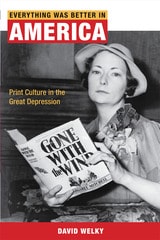
Everything Was Better in America
Print Culture in the Great DepressionDavid Welky
University of Illinois Press, 2007
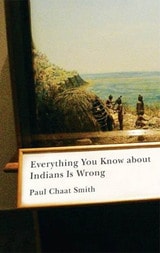
Everything You Know about Indians Is Wrong
Paul Chaat Smith
University of Minnesota Press, 2009
Forceful and eloquent essays on the American Indian in culture and history
In this sweeping work of memoir and commentary, leading cultural critic Paul Chaat Smith illustrates with dry wit and brutal honesty the contradictions of life in “the Indian business.”
Raised in suburban Maryland and Oklahoma, Smith dove head first into the political radicalism of the 1970s, working with the American Indian Movement until it dissolved into dysfunction and infighting. Afterward he lived in New York, the city of choice for political exiles, and eventually arrived in Washington, D.C., at the newly minted National Museum of the American Indian (“a bad idea whose time has come”) as a curator. In his journey from fighting activist to federal employee, Smith tells us he has discovered at least two things: there is no one true representation of the American Indian experience, and even the best intentions sometimes result in catastrophe.
Everything You Know about Indians Is Wrong is a highly entertaining and, at times, searing critique of the deeply disputed role of American Indians in the United States. In “A Place Called Irony,” Smith whizzes through his early life, showing us the ironic pop culture signposts that marked this Native American’s coming of age in suburbia: “We would order Chinese food and slap a favorite video into the machine—the Grammy Awards or a Reagan press conference—and argue about Cyndi Lauper or who should coach the Knicks.” In “Lost in Translation,” Smith explores why American Indians are so often misunderstood and misrepresented in today’s media: “We’re lousy television.” In “Every Picture Tells a Story,” Smith remembers his Comanche grandfather as he muses on the images of American Indians as “a half-remembered presence, both comforting and dangerous, lurking just below the surface.”
Smith walks this tightrope between comforting and dangerous, offering unrepentant skepticism and, ultimately, empathy. “This book is called Everything You Know about Indians Is Wrong, but it’s a book title, folks, not to be taken literally. Of course I don’t mean everything, just most things. And ‘you’ really means we, as in all of us.”
Everything is Police
Tia Trafford
University of Minnesota Press, 2024
How institutional and interpersonal policing have been central to worldmaking
Policing is constitutive of colonial modernity: normalizing, internalizing, and legalizing anti-Black violence as the ongoing condition for white life and freedom. The result, Tia Trafford argues here, is a situation where we cannot practically experience or even imagine worlds free from policing. From the plantation to the prison, global apartheid, and pandemic control, this book examines why and how policing has become the most ingrained, commonsense—and insidious—way of managing our world.
Everywhere and Nowhere
Anonymity and Mediation in Eighteenth-Century BritainMark Vareschi
University of Minnesota Press, 2018
A fascinating analysis of anonymous publication centuries before the digital age
Everywhere and Nowhere considers the ubiquity of anonymity and mediation in the publication and circulation of eighteenth-century British literature—before the Romantic creation of the “author”—and what this means for literary criticism. Anonymous authorship was typical of the time, yet literary scholars and historians have been generally unable to account for it as anything more than a footnote or curiosity.
Mark Vareschi shows the entangled relationship between mediation and anonymity, revealing the nonhuman agency of the printed text. Drawing richly on quantitative analysis and robust archival work, Vareschi brings together philosophy, literary theory, and media theory in a trenchant analysis, uncovering a history of textual engagement and interpretation that does not hinge on the known authorial subject.
In discussing anonymous poetry, drama, and the novel along with anonymously published writers such as Daniel Defoe, Frances Burney, and Walter Scott, he unveils a theory of mediation that renews broader questions about agency and intention. Vareschi argues that textual intentionality is a property of nonhuman, material media rather than human subjects alone, allowing the anonymous literature of the eighteenth century to speak to contemporary questions of meaning in the philosophy of language. Vareschi closes by exploring dubious claims about the death of anonymity and the reexplosion of anonymity with the coming of the digital. Ultimately, Everywhere and Nowhere reveals the long history of print anonymity so central to the risks and benefits of the digital culture.