Results by title
1832 books match the query 'Essays' and 96 start with e
Essays on American Indian and Mormon History
Edited by P. Jane Hafen and Brenden W. Rensink
University of Utah Press, 2019
This collection of essays, many the result of a seminar hosted by the Charles Redd Center for Western Studies at Brigham Young University, explores the historical and cultural complexities of this narrative from a decolonizing perspective. Essays cover the historical construction of the “Lamanite,” settler colonialism and the Book of Mormon, and connections between the Seneca leader Handsome Lake and Joseph Smith. Authors also address American Indian Mormon tribal identities, Navajo and Mormon participation at the dedication of Glen Canyon Dam, the impact of Mormon Polynesian missionaries in Diné Bikéyah, the ISPP, and other topics. Prominent American Indian Mormon voices lend their creative work and personal experiences to the book.
With the aim of avoiding familiar narrative patterns of settler colonialism, contributors seek to make American Indians the subjects rather than the objects of discussion in relation to Mormons, presenting new ways to explore and reframe these relationships.
Essays on Ancient and Modern Judaism
Arnaldo Momigliano
University of Chicago Press, 1994
Momigliano acknowledged that his Judaism was the most fundamental inspiration for his scholarship, and the writings in this collection demonstrate how the ethical experience of the Hebraic tradition informed his other works. Part 1 is devoted entirely to writings on ancient and medieval Judaism. In these essays, Momigliano ranges over such subjects as the stages of rapport between Hellenism and Judaism, the figure of Flavius Josephus, and the salient moments of Maccabean history. Part 2 comprises Momigliano's writings on modern subjects. Here are profiles of Jewish scholars of the classical world (Bernays, Bickerman, and Finley) together with those of eminent representatives of contemporary Jewish thought (Strauss, Scholem, and Benjamin). These essays gain special significance alongside Momigliano's reflections on Italian Jewry and the Weberian interpretation of Judaism.
Silvia Berti's Introduction discusses Momigliano's religious and intellectual formation, the key events of his life, and the influence of Judaism on his mature scholarship. In his Preface, Momigliano offers a personal meditation on his own Judaism and that of his family.
By the time of his death, Momigliano had acquired an international following. This volume will at last give his admirers in the English-speaking world easy access to an important body of his work.
Essays on Archaeological Methods
Edited by James B. Griffin
University of Michigan Press, 1951
Essays on Classical Rhetoric and Modern Discourse
Edited by Robert J. Connors, Lisa S. Ede, and Andrea A. Lunsford
Southern Illinois University Press, 1984
Eighteen essays by leading scholars in English, speech communication, education, and philosophy explore the vitality of the classical rhetorical tradition and its influence on both contemporary discourse studies and the teaching of writing.
Some of the essays investigate theoretical and historical issues. Others show the bearing of classical rhetoric on contemporary problems in composition, thus blending theory and practice. Common to the varied approaches and viewpoints expressed in this volume is one central theme: the 20th-century revival of rhetoric entails a recovery of the classical tradition, with its marriage of a rich and fully articulated theory with an equally efficacious practice. A preface demonstrates the contribution of Edward P. J.Corbett to the 20th-century revival, and a last chapter includes a bibliography of his works.
Essays on Economics and Economists
R. H. Coase
University of Chicago Press, 1994
In fifteen essays, Coase evaluates the contributions of a number of outstanding figures, including Adam Smith, Alfred Marshall, Arnold Plant, Duncan Black, and George Stigler, as well as economists at the London School of Economics in the 1930s.
Ronald H. Coase was awarded the Nobel Prize in Economic Science in 1991.
Essays on Economics and Economists
R. H. Coase
University of Chicago Press, 1994
How do economists decide what questions to address and how to choose their theories? How do they tackle the problems of the economic system and give advice on public policy? With these broad questions, Nobel laureate R. H. Coase, widely recognized for his seminal work on transaction costs, reflects on some of the most fundamental concerns of economists over the past two centuries.
In fifteen essays, Coase evaluates the contributions of a number of outstanding figures, including Adam Smith, Alfred Marshall, Arnold Plant, Duncan Black, and George Stigler, as well as economists at the London School of Economics in the 1930s.
Ronald H. Coase was awarded the Nobel Prize in Economic Science in 1991.
Essays on Genocide and Humanitarian Intervention
Guenter Lewy
University of Utah Press, 2012
The essays in this book, written over a span of some twenty years but updated for this publication, discuss episodes of mass murder that are often considered instances of genocide: the large-scale killing of Armenians in Ottoman Turkey during World War I, the near-extinction of North America’s Indian population, the vicious persecution of the “Roma” or Gypsies under the Nazi regime. But in line with Article II of the Genocide Convention of 1948, Lewy stresses the crucial importance of looking closely at the intent of the perpetrators. In contrast to the Holocaust, the killers in the atrocities mentioned above did not seek to destroy an entire people, and so, these three large-scale killings do not deserve the label of genocide.
Lewy argues that affirming the distinctiveness of the Holocaust does not deny, downgrade, or trivialize the suffering of other people. The crimes against the Ottoman Armenians, the American Indians, and the Gypsies—even if they did not reach the threshold of genocide—involved horrendous suffering and a massive loss of life. The genocides of Cambodia and Rwanda that took place in the second half of the twentieth century remind us that man’s inhumanity to man can take many forms and is not the special prerogative of any particular group. The last essay of the collection deals with the complications of humanitarian intervention to prevent genocide. As the recent support of the Libyan rebels by NATO demonstrates, the issues raised here remain topical and controversial.
Essays on Gogol
Logos and the Russian WordSusanne Fusso and Priscilla Meyer
Northwestern University Press, 1994
Essays on Individualism
Modern Ideology in Anthropological PerspectiveLouis Dumont
University of Chicago Press, 1986

Essays on Kant's Political Philosophy
Edited by Howard Lloyd Williams
University of Chicago Press, 1992
overshadowed by his compatriots Hegel and Marx. With his
strong defense of the rights of the person and his deep
insight into the strengths and weaknesses of modern society
Kant, possibly more than any other political thinker,
anticipated the problems of the late twentieth century.
Kant's political philosophy, wedded as it is to rights,
reform and gradual progress, is emerging from the shadows
cast by Hegelian and Marxist thinking about the state.
In this volume, thirteen distinguished contributors from the
United States, Canada, Britain, and Germany cast light on
important aspects of Kant's liberal thinking. Key topics
covered include Kant's liberal reformism, his relation with
Hegel, his attitude to women, the use of reason, revolution,
Kant's optimism and his moral and legal rigorism.
Howard Williams is a reader in political theory in the
Department of International Politics, University College of
Wales, Aberystwyth. His previous publications include
Kant's Political Philosophy, Concepts of
Ideology, and Hegel, Heraclitus, and Marx's
Dialectic.

Essays on Karolina Pavlova
Susanne Fusso and Alexander Lehrman
Northwestern University Press, 2001
Essays on Liberalism and the Economy, Volume 18
F. A. Hayek
University of Chicago Press, 2022
Across seventeen volumes to date, the University of Chicago Press’s Collected Works of F. A. Hayek series has anthologized the diverse and prolific writings of the Austrian economist synonymous with classical liberalism. Essays on Liberalism and the Economy traces the author’s long and evolving writings on the cluster of beliefs he championed most: liberalism, its core tenets, and how its tradition represents the best hope for Western civilization.
This volume contains material from almost the entire span of Hayek’s career, the earliest from 1931 and the last from 1984. The works were written for a variety of purposes and audiences, and they include—along with conventional academic papers—encyclopedia entries, after-dinner addresses, a lecture for graduate students, a book review, newspaper articles, and letters to the editors of national newspapers. While many are available elsewhere, two have never appeared in print, and two others have not been published in English.
The varied formats collected here are enriched by Hayek’s changing voice at different stages of his life. Some of the pieces resonate as high-minded and noble; some are meant as cuts to “intellectuals” (a pejorative term when used by Hayek) like Keynes and Galbraith. All serve to distill important threads of his worldview.
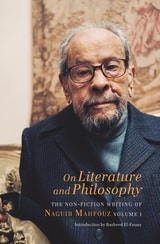
Essays on Literature and Philosophy
The Non-Fiction of Naguib Mahfouz: Volume INaguib Mahfouz
Gingko, 2025
The first Arabic language writer to win the Nobel Prize for Literature, Naguib Mahfouz, helped bring Arabic writing to an international readership. This collection of his early writing, from his time as a philosophy student, reveals the intellectual ferment of the young author, grappling with two millennia of philosophers and writers and establishing his own voice among them.
Available in English for the first time, these essays tackle a vast array of subjects, from Presocratic Philosophy to love and the sexual impulse. The intellectual development demonstrated here forms the foundation of Mahfouz’s literary work, granting insight into the mind behind such famed works as the Cairo Trilogy and Children of The Alley.
Essays on Logic, Ethics, and Universal Grammar
Edited by Philip Schofield
University College London, 2025
Best known as the founder of the ethical theory of utilitarianism, Bentham’s philosophical contributions spanned political economy, judicial administration, prison reform, policing, religion, and many more fields. This new addition to The Collected Works of Jeremy Bentham deals with his ideas about logic, language, ethics, and grammar. Distributed across four essays written between 1814 and 1816 and an appendix, it includes discussions of methodization, ontology, real and fictitious entities, and propositions as the fundamental components of language. In addition to constituting a major contribution to the history of logic and language, this collection establishes the philosophical basis for classical utilitarianism and Chrestomathia, Bentham’s major work outlining his materialist theory of language.
Essays on Music and History in Africa
Edited by Klaus P. Wachsmann
Northwestern University Press, 1971
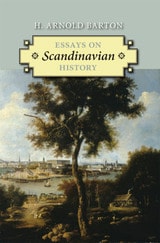
Essays on Scandinavian History
H. Arnold Barton
Southern Illinois University Press, 2008
Essays on Scandinavian History examines important aspects of the history of Sweden and its Nordic neighbors between the later eighteenth and the beginning of the twenty-first century. Historian H. Arnold Barton has selected thirteen of the numerous essays he has published over the past forty years on the history of Scandinavia.
This is a companion volume to Barton's The Old Country and the New, an essay collection on Swedish emigration and the Swedes in America. Included here are studies of the special significance of the eighteenth century in Sweden's history and culture, the relationship of King Gustaf III to the eighteenth-century Enlightenment, the impact of the American Revolution in Sweden, and Gustaf III's ambitions in the East Baltic region. Also detailed are the king's early reaction to the French Revolution and his efforts to organize a European coalition to crush it, a reassessment of the reign and internal reforms of Gustaf IV Adolf, and the Swedish succession crises of 1809 and 1810.
In addition, Barton examines the increasing tension between the Pan-Scandinavian movement and the rising Finnish national movement. He deals with the historians of the Danish Agrarian Reforms of 1784-1814, parallel developments in Finland and Norway between 1808 and 1917, the discovery of Norway abroad, Swedish national romanticism, and Sweden's transition from a warfare state to a welfare state, now exemplifying the rational and humane ideals of the twentieth century.
Essays on Scandinavian History highlights important topics in the history of the Scandinavian region, which has remained all too little known outside the Nordic lands themselves, while also offering broader perspectives on Europe since the mid-eighteenth century. Twelve keyed-to-text illustrations, a bibliography of Barton's publications on Scandinavian history, essay endnotes, and an index augment this work.
Essays on Sex Equality
John Stuart Mill and Harriet Taylor Mill
University of Chicago Press, 1970
Also contained in this volume is a major interpretative essay by Alice S. Rossi on Mill and Harriet Taylor which describes and analyzes their long personal and intellectual relationship.
Essays on Some Maladies of Angola (1799)
José Pinto De Azeredo
Tagus Press, 2016
This first English-language edition of Essays on Some Maladies of Angola was translated by Stewart Lloyd-Jones (University of Stirling) and includes scholarly essays by Timothy Walker (University of Massachusetts Dartmouth), Adelino Cardoso (Universidade Nova de Lisboa), António Braz de Oliveira (Biblioteca Nacional de Portugal) and Manuel Silvério Marques (Universidade de Lisboa).
Essays on Twentieth-Century History
Edited by Michael Adas for the American Historical Association
Temple University Press, 2010
In the sub-field of world history, there has been a surprising paucity of thinking and writing about how to approach and conceptualize the long twentieth century from the 1870s through the early 2000s. The historiographic essays collected in Essays on Twentieth Century History will go a long way to filling that lacuna.
Each contribution covers a key theme and one or more critical sub-fields in twentieth century global history. Chapters address migration patterns, the impact of world wars, transformations in gender and urbanization, as well as environmental transitions. All are written by leading historians in each of the sub-fields represented, and each is intended to provide an introduction to the literature, key themes, and debates that have proliferated around the more recent historical experience of humanity.
Essays on the History of Transportation and Technology
EMORY L. KEMP
West Virginia University Press, 2014
Emory Kemp is the founder and director of the Institute for the History of Technology and Industrial Archaeology at West Virginia University, where he also served as a chair and professor of civil engineering and a professor of history. This collection of essays encompasses over fifty years of his research in the field of the history of technology.
Within these twelve essays, Kemp describes and analyzes nineteenth century improvements in building materials such as iron, steel, and cement; roads and bridges, especially the evolution of the suspension bridge; canals and navigable rivers, including the Ohio River and its tributaries; and water supply systems. As one of the few practicing American engineers who also researches and writes as an academic, Kemp adds an important historical context to his work by focusing not only on the construction of a structure but also on the analytical science that heralds a structure’s design and development.
Essays on the Modern Japanese Church
Christianity in Meiji JapanYamaji Aizan; Translated by Graham Squires, with Introductory Essays by Graham Squires and A. Hamish Ion
University of Michigan Press, 2000
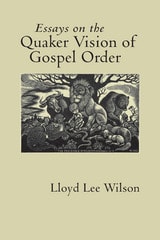
Essays on the Quaker Vision of Gospel Order
Lloyd Lee Wilson
QuakerPress, 1993

Estado Vegetal
Performance and Plant-ThinkingGiovanni Aloi
University of Minnesota Press, 2023
Interdisciplinary essays on Manuela Infante’s award-winning play explore the relationship between critical plant studies and performance art in the Anthropocene
Since its first staging in 2016, Estado Vegetal, Manuela Infante’s riveting piece of experimental performance art, has expanded philosophical thinking into a fully-fledged artistic inquiry of nonanthropocentric being. Through Infante’s polyvocal monologue, acted with impetus by Marcela Salinas, plants are charged with an agency capable of uprooting culturally grounded conceptions of the world in the face of incommensurable trauma and loss.
This first book dedicated to Infante’s plant-focused performance features eight essays by scholars, poets, and artists whose practices draw from research fields as disparate as new materialism, anthropogenic feminism, queer studies, and speculative realism. Including an interview with Infante, the full playscript, and stills from the performance, Estado Vegetal: Performance and Plant-Thinking reveals the roles that plants in art can play in productively reconfiguring human–nonhuman relations within current anthropogenic perspectives.
Infante’s performance is a perfect case study and reference point for anyone interested in exploring the complexities of plant-thinking through alternative and experimental avenues. Furthermore, this book is at once a critical plant studies primer and an artistic problematization of the philosophical questions that have been central to the latest multidisciplinary discussions on plant-being.
Contributors: Maaike Bleeker, Utrecht U; Lucy Cotter, Portland State U; Prudence Gibson, UNSW Sydney; Michael Marder, U of the Basque Country; Dawn Sanders, U of Gothenburg; Catriona Sandilands, York U; Sibila Sotomayor Van Rysseghem, colectivo LASTESIS; Mandy-Suzanne Wong.
Ethics and Personality
Essays in Moral PsychologyEdited by John Deigh
University of Chicago Press, 1992
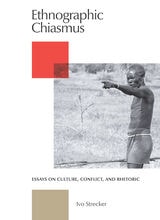
Ethnographic Chiasmus
Essays on Culture, Conflict and RhetoricIvo Strecker
Michigan State University Press, 2011
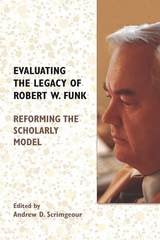
Evaluating the Legacy of Robert W. Funk
Reforming the Scholarly ModelAndrew D. Scrimgeour
SBL Press, 2018
Enter the world of an academic trailblazer
Robert W. Funk, professor of New Testament, former Executive Secretary of the Society of Biblical Literature, and founder of Scholars Press and the Jesus Seminar, was one of the most gifted, controversial figures in modern biblical scholarship. The volume includes nineteen of his essays, correspondences, interviews, and administrative papers pertaining to the Society of Biblical Literature and Scholars Press. Colleagues introduce each section with reflections on the life and contributions of Funk.
Features:
- Evaluation of the changes to scholarly societies and to scholarly research that Funk advocated
- Exploration of the shift in the interpretation of Jesus’s parables initiated by Funk
- Previously unpublished writings
Even the Rhinos Were Nymphos
Best NonfictionBruce Jay Friedman
University of Chicago Press, 2000
A butler school in Houston, a livestock auction in Little Rock, a home for "frozen guys" in California, JFK's humidor in Manhattan—all are jumping off points for Friedman's baleful and sharply satirical scrutiny of American life and behavior in the second half of the twentieth century. Travel with Friedman from Harlem to Hollywood, from Port-au-Prince to Etta's Eat Shop in Chicago. In these pieces, which were published in literary and mass-circulation magazines from the 1960s to the 1990s, you'll meet such luminaries as Castro and Clinton, Natalie Wood and Clint Eastwood, and even Friedman's friends Irwin Shaw, Nelson Algren, and Mario Puzo. Friedman is a master of the essay, whether the subject is crime reporting ("Lessons of the Street"), Hollywood shenanigans ("My Life among the Stars"), or his outrageous adventures as the editor of pulp magazines (the classic "Even the Rhinos Were Nymphos"). We could sing his praises as a journalist, humorist, and social critic. But, as Buckley tells us, being Bruce Jay Friedman is enough.
Bruce Jay Friedman is the author of seven novels (including The Dick, Stern, and A Mother's Kisses), four collections of short stories, four full-length plays (including Scuba Duba and Steambath), and the screenplays for the movies Splash and Stir Crazy.
Evenings with the Orchestra
Hector Berlioz
University of Chicago Press, 1999
Ever New Earths
Columns from the Magazine of Fantasy & Science FictionSallis, James
University of Iowa Press, 2026
Ever New Earths gathers twenty-five years of book columns written by legendary writer James Sallis and published in The Magazine of Fantasy & Science Fiction to offer an exceptional overview of developments in contemporary science fiction, fully appreciating the genre’s traditions while recognizing its reach, its potential. This is a rare view of the genre from the inside, written toward outsiders with reason to learn and understand more: critics, historians, writers, editors.
Every Farm Tells a Story
A Tale of Family ValuesJerry Apps
Wisconsin Historical Society Press, 2018
“Do your chores without complaining. Show up on time. Do every job well. Always try to do better. Never stop learning. Next year will be better. Care for others, especially those who have less than you. Accept those who are different from you. Love the land.”
In this paperback edition of a beloved Jerry Apps classic, the rural historian captures the heart and soul of life in rural America. Inspired by his mother’s farm account books—in which she meticulously recorded every farm purchase—Jerry chronicles life on a small farm during and after World War II. Featuring a new introduction exclusive to this 2nd edition, Every Farm Tells a Story reminds us that, while our family farms are shrinking in number, the values learned there remain deeply woven in our cultural heritage.
Every Goddamn Day
A Highly Selective, Definitely Opinionated, and Alternatingly Humorous and Heartbreaking Historical Tour of ChicagoNeil Steinberg
University of Chicago Press, 2022
Every day in Chicago is a day to remember. In a city so rich with history, every day is the anniversary of some storied historical or cultural moment, whether it’s the dedication of the Pablo Picasso sculpture downtown on August 15, or the arrest of Rod Blagojevich at his Ravenswood home on December 9, or a fire that possibly involved a cow on October 8.
In Every Goddamn Day, acerbic Chicago Sun-Times columnist Neil Steinberg takes the story of the city, pares away the dull, eat-your-peas parts, and provides 366 captivating daily readings in what makes Chicago Chicago and America America. It calls upon a wide cast of characters, from Oscar Wilde to Muhammad Ali, from Emma Goldman to Teddy Roosevelt, and from Richard M. Daley to Fred Hampton, to create a compelling narrative that can be read at a sitting or in a yearlong series of daily doses.
From New Year’s Day to New Years’ Eve, Steinberg takes us on a vivid and entertaining tour, illuminating the famous, obscure, tragic, and hilarious elements that make each day in Chicago memorable.
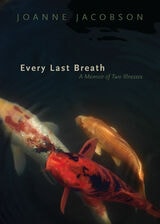
Every Last Breath
A Memoir of Two IllnessesJoanne Jacobson
University of Utah Press, 2020
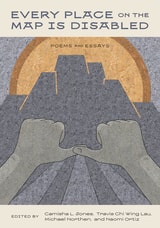
Every Place on the Map Is Disabled
Poems and EssaysCamisha L. Jones, Michael Northen, Naomi Ortiz, and Travis Chi Wing Lau
Northwestern University Press, 2026
An anthology of poems and essays by and celebrating Disabled writers
Declaring that Disabled people exist, innovate, thrive, and persevere, Every Place on the Map Is Disabled imagines the world we deserve. Its contributors spotlight the wisdom Disabled people embody from living within and navigating the economic and medical systems, communities, and families that often oppress their existence. This anthology is an intersectional compass pointing to the creative ways Disabled people build bridges to each other through Disability poetics and perspectives.
The contributing poets write about love, resistance, loss, pain, beauty, and culture. They capture tender and life-affirming moments where one Disabled person recognizes themself in another. The essays illustrate how Disability poetics suggest avenues for embracing the full spectrum of disability experiences. Every Place on the Map Is Disabled offers students, scholars, members of disability communities, and any reader a direction for paving a wider path toward a collective survival.
Everyman's Constitution
Historical Essays on the Fourteenth Amendment, the "Conspiracy Theory," and American ConstitutionalismHoward Jay Graham
Wisconsin Historical Society Press, 1968
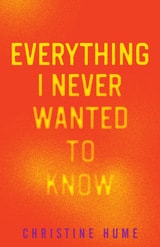
Everything I Never Wanted to Know
Christine Hume
The Ohio State University Press, 2023
In Everything I Never Wanted to Know, Christine Hume confronts the stigma and vulnerability of women’s bodies in the US. She explores bodily autonomy and sexual assault alongside the National Sex Offender Registry in order to invoke not solutions but a willingness to complicate our ideas of justice and defend every human’s right to be treated like a member of the community. Feminist autobiography threads into historical narrative and cultural criticism about the Victorian-era Frozen Charlotte doll; the Nylon Riots of the 1940s; the movie Halloween; Larry Nassar, who practiced in Hume’s home state of Michigan; and other material. In these reflections on sexuality, gender, criminality, and violence, Hume asks readers to reconsider what we have collectively normalized and how we are each complicit, writing through the darkness of what we don’t want to see, what we’d rather not believe, and what some of us have long tried to forget.
Excellence in First-Year Writing 2016/2017
Dana Nichols, editor
Michigan Publishing Services, 2017
Every day, students at the University of Michigan work hard to develop their skills as writers. Every winter, we have a chance to sample the fruits of this labor as we select winners for the first-year writing prize. The English Department Writing Program and the Sweetland Center for Writing established a first-year writing prize in 2010. With generous support from the Sweetland Center for Writing, Andrew Feinberg and Stacia Smith (both of whom earned English degrees from the University of Michigan), and the Granader Family, we have developed a tradition of honoring students who produce writing of exceptional quality.
In this collection, we share the writing of prize-winning students so that other writers may learn from, and feel inspired by, their examples. The featured essays illustrate how writers formulate compelling questions, engage in dialogue with other thinkers, incorporate persuasive and illuminating evidence, express powerful and poetic insights, and participate in meaningful conversations.
We are equally grateful to the many students who submitted essays for these writing prizes and the many instructors who encouraged and supported them. As writing teachers, we relish the opportunity to learn from the challenging questions, intellectual energy, creativity, and dedication that our students and their teachers bring to our classrooms. We hope that you will gain as much pleasure as we have from reading the writing contained in this volume.

Excellence in First-Year Writing 2017/2018
Edited by Dana Nichols
Michigan Publishing Services, 2018
Every day, students at the University of Michigan work hard to develop their skills as writers. Every winter, we have a chance to sample the fruits of this labor as we select winners for the first-year writing prize. The English Department Writing Program and the Sweetland Center for Writing established a first-year writing prize in 2010. With generous support from the Sweetland Center for Writing, Andrew Feinberg and Stacia Smith (both of whom earned English degrees from the University of Michigan), and the Granader Family, we have developed a tradition of honoring students who produce writing of exceptional quality.
In this collection, we share the writing of prize-winning students so that other writers may learn from, and feel inspired by, their examples. The featured essays illustrate how writers formulate compelling questions, engage in dialogue with other thinkers, incorporate persuasive and illuminating evidence, express powerful and poetic insights, and participate in meaningful conversations.
We are equally grateful to the many students who submitted essays for these writing prizes and the many instructors who encouraged and supported them. As writing teachers, we relish the opportunity to learn from the challenging questions, intellectual energy, creativity, and dedication that our students and their teachers bring to our classrooms. We hope that you will gain as much pleasure as we have from reading the writing contained in this volume.
Excellence in First-Year Writing 2018/2019
Dana Nichols
Michigan Publishing Services, 2019
Excellence in Upper-Level Writing 2016/2017
Dana Nichols, editor
Michigan Publishing Services, 2017
Ask any professional, business person, or employer about one of the most important qualifications for college-educated workers, and the answer will be nearly universal: the ability to write well. The Upper-Level Writing Requirement (ULWR) was established to enable undergraduates in the College of Literature, Science, and the Arts to develop their capacities as writers. Originally designed in 1978 to help students “understand and communicate effectively the central concepts, approaches, and materials of their discipline,” the ULWR supports a slightly different goal in today’s more interdisciplinary context. A significant percentage of students now have more than one major or fulfill the ULWR outside of their majors. Likewise, many faculty members are increasingly concerned with preparing students to write for various professional and public audiences as well as for discipline-based ones. However, whether students fulfill the ULWR within or outside of their majors or write for audiences within or outside of the academy, they are held to the same standards of effective writing.
This collection demonstrates the continuing value of the ULWR. Courses like the ones in which students produced these essays create contexts where students meet the expectations of the ULWR and can push beyond them to an even more impressive level of accomplishment. While the specifics of what counts as evidence and how one makes a convincing argument vary across the essays included here, each one embodies qualities that mark effective writing. The authors deal with a wide variety of topics, but in every case they combine deep understanding of a specific area with excellent prose. They take risks and adhere to conventions; they synthesize complex ideas and provide rich detail; they exert intellectual independence and respect disciplinary conventions, from creative nonfiction in the humanities to empirical research in the sciences.
We have been honoring students for outstanding writing in ULWR courses since 2010, but since 2014, thanks to a generous gift from the Granader Family, the prizes are more substantial. We are grateful to the Granaders for choosing to recognize student writing in this way. This collection is another form of recognition for the award-winning students. By publishing this student writing both online and in hard copy we make it available as a model and as a source of inspiration for others.
Talented and committed as they are, these students represented here did not become award-winners entirely on their own. Each of them benefited from well-designed assignments, careful reading, and suggestions for revision from the instructors who nominated them. The instructors’ introductions for each selection provide a window into student learning as well as into the specific dimensions of each student’s achievements.
Excellence in Upper-Level Writing 2017/2018
Edited by Dana Nichols
Michigan Publishing Services, 2018
Ask any professional, business person, or employer about one of the most important qualifications for college-educated workers, and the answer will be nearly universal: the ability to write well. The Upper-Level Writing Requirement (ULWR) was established to enable undergraduates in the College of Literature, Science, and the Arts to develop their capacities as writers. Originally designed in 1978 to help students "understand and communicate effectively the central concepts, approaches, and materials of their discipline," the ULWR supports a slightly different goal in today's more interdisciplinary context. A significant percentage of students now have more than one major or fulfill the ULWR outside of their majors. Likewise, many faculty members are increasingly concerned with preparing students to write for various professional and public audiences as well as for discipline-based ones. However, whether students fulfill the ULWR within or outside of their majors or write for audiences within or outside of the academy, they are held to the same standards of effective writing.
This collection demonstrates the continuing value of the ULWR. Courses like the ones in which students produced these essays create contexts where students meet the expectations of the ULWR and can push beyond them to an even more impressive level of accomplishment. While the specifics of what counts as evidence and how one makes a convincing argument vary across the essays included here, each one embodies qualities that mark effective writing. The authors deal with a wide variety of topics, but in every case they combine deep understanding of a specific area with excellent prose. They take risks and adhere to conventions; they synthesize complex ideas and provide rich detail; they exert intellectual independence and respect disciplinary conventions, from creative nonfiction in the humanities to empirical research in the sciences.
We have been honoring students for outstanding writing in ULWR courses since 2010, but since 2014, thanks to a generous gift from the Granader Family, the prizes are more substantial. We are grateful to the Granaders for choosing to recognize student writing in this way. This collection is another form of recognition for the award-winning students. By publishing this student writing both online and in hard copy we make it available as a model and as a source of inspiration for others.
Talented and committed as they are, these students represented here did not become award-winners entirely on their own. Each of them benefited from well-designed assignments, careful reading, and suggestions for revision from the instructors who nominated them. The instructors' introductions for each selection provide a window into student learning as well as into the specific dimensions of each student's achievements.
Excellence in Upper-Level Writing 2018/2019
Dana Nichols
Michigan Publishing Services, 2019
Exceptional Creativity in Science and Technology
Individuals, Institutions, and InnovationsAndrew Robinson
Templeton Press, 2013
Exercises in the Elements
Essays, Speeches, NotesJosef Pieper
St. Augustine's Press, 2016
A fundamental issue for Pieper is “createdness.” He sees this as the fundamental truth of our being – all being – and the fundamental virtue we can practise is the striving to live according to our perception of real truth in any given situation.
The strength and attraction of Pieper’s writing is its direct and intuitive character which is independent of abstract systematization. He advocates staying in touch with the “real” as we experience it deep within ourselves. Openness to the totality of being – in no matter what context being reveals itself – and the affirmation of all that is founded in this totality are central pillars of all his thinking. Given the “simplicity” of this stance, it is no surprise that much of it is communicated – and successfully – through his gift for illustration by anecdote. Like Plato, this philosopher is a story-teller and, like him, very readable.
Experience and Value
Essays on John Dewey & Pragmatic NaturalismS. Morris Eames. Edited by Elizabeth R. Eames and Richard W. Field
Southern Illinois University Press, 2002
Experience and Value: Essays on John Dewey and Pragmatic Naturalism brings together twelve philosophical essays spanning the career of noted Dewey scholar, S. Morris Eames. The volume includes both critiques and interpretations of important issues in John Dewey’s value theory as well as the application of Eames’s pragmatic naturalism in addressing contemporary problems in social theory, education, and religion.
The collection begins with a discussion of the underlying principles of Dewey’s pragmatic naturalism, including the concepts of nature, experience, and philosophic method. Essays “Experience and Philosophical Method in John Dewey” and “Primary Experience in the Philosophy of John Dewey” develop what Eames believed to be a central theme in Dewey’s thought and provide a theoretical framework for subsequent discussion.
The volume continues with specific applications of this framework in the areas of value theory, moral theory, social philosophy, and the philosophy of religion. Eames’s analysis of value exposes the connection between the immediately felt values of experience and the more sophisticated judgments of value that are the product of reflection. From this basis in moral theory, Eames considers the derivation of judgments of obligation from judgments of fact. This discussion provides a grounding for a consideration of contemporary social issues directed by naturalistic and scientific principles.
In the third section, with regard to educational theory, Eames considers possible resolutions of the current dichotomy between the factual worldview of science and the humanistic worldview of the liberal arts. The comprehensive article, “Dewey’s Views of Truth, Beauty, and Goodness,” connects the essays of the first and second sections and explores the placement of Dewey’s value theory with respect to morals and aesthetics. With “Creativity and Democracy,” in the fourth section, Eames also considers the concept of democracy from the standpoint of current and historical issues faced by society. This article hints at a major project of Eames’s intellectual life—the theory of democracy.
The volume concludes with a discussion of the difficulty of maintaining the values of religious experience in a scientifically and technologically sophisticated world, the very topic that first brought Eames to philosophy—the meaning of religion and the religious life. Suggested solutions are offered in “The Lost Individual and Religious Unity.”
Experience and Value: Essays on John Dewey and Pragmatic Naturalism illuminates Eames’ life of inquiry, a life that included moral, social, aesthetic, and religious dimensions of value—all suffused with the influence of John Dewey.
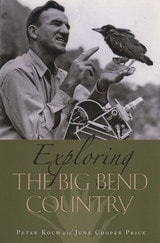
Exploring the Big Bend Country
By Peter Koch and June Cooper Price
University of Texas Press, 2007
Photographer-naturalist Peter Koch first visited the new Big Bend National Park in February, 1945, on assignment to take promotional pictures for the National Park Service. He planned to spend a couple of weeks—and ended up staying for the rest of his life. Koch's magnificent photographs and documentary film-lectures Big Bend, Life in a Desert Wilderness and Desert Gold introduced the park to people across the United States, drawing thousands of visitors to the Big Bend. His photographs and films of the region remain among the best ever produced, and are an invaluable visual record of the first four decades of Big Bend National Park.
In this highly readable book, Koch's daughter June Cooper Price draws on the newspaper columns her father wrote for the Alpine Avalanche, supplemented by his photographs, journal entries, and short pieces by other family members, to present Peter Koch's vision of the Big Bend. The book opens with his first "big adventure," a six-day photographic trip through Santa Elena Canyon on a raft made from agave flower stalks. From there, Koch takes readers hiking on mountain trails and driving the scenic loop around Fort Davis. He also describes "wax smuggling" and other ways of making a living on the Mexican border; ranching in the Big Bend; the prehistory and Native Americans of the region; collaborating with botanist Barton Warnock on books of Trans-Pecos wildflowers; and the history and beauty of Presidio County, the Rio Grande, and the Chihuahuan Desert.
This fascinating blend of firsthand adventures, natural history, and personal musings on anthropology and history creates an unforgettable portrait of both Peter Koch and the Big Bend region he so loved.
Extending the Borders of Russian History
Essays in Honor of Alfred J. RieberMarsha Siefert
Central European University Press, 2003
The borders of Russian history, whether chronological, geographical, political or intellectual, have always been patrolled, have sometimes been evaded, but have never been invisible. This volume attempts to extend those borders in several ways. The articles stress continuity rather than ruptures and their organization emphasizes persistent factors over time, particularly across the 1917 divide. Geographical dimensions are explored not through conquest but through regional responses to the center: local variants of eighteenth- and nineteenth-century colonial policies in the Caucasus and Turkestan are complemented by Central Asian petitions for citizenship in the 1930s and Siberian healing in the 1990s. Ukrainian aspirations take a special focus, from Kyivan Rus’ to Ruthenian dreams.
Politically, of course, Marxist–Leninist ideology attempted to extend its own frontiers of Russian history. Several studies here attempt to assess the meaning of the Soviet period in terms of ideology, practices, processes and memory. It is fitting too that the now accepted boundaries of the Soviet era—the revolutionary decade and the first decade of transition—are subject to detailed attention and analysis. The intellectual borders of Russian and Soviet history, long policed from within and without, have been breached by the creative and wide-ranging use of newly accessible archival sources that form the basis for these articles. The sense of community exhibited by this collection, however, is not artificial nor is it wholly imagined. It derives from the honoree, whose scholarly life has exhibited the blurring of traditional boundaries, whether disciplinary, generational, or national, that is represented by the contributors to this volume.