Results by title
4917 books match the query 'Philosophy' and 231 start with e
Equality of Permission
The Politics of Feasible LiberalismDeirdre Nansen McCloskey
University of Chicago Press, 2026
From a revered public intellectual, an essential argument for the political preconditions of a liberal society.
Liberalism has always suffered from messaging challenges. It simultaneously implies a pursuit of individual liberty and social equality, two projects often regarded as at odds. Or: Liberal means the opposite of conservative. Except when it doesn’t. The list goes on.
Liberal bard Deirdre Nansen McCloskey understands these rhetorical troubles. Equality of Permission is her stirring and career-defining intervention on this essentially contested yet critical topic—a forceful case for liberalism as our best hope, and an essential vision of the political conditions necessary for its survival. McCloskey prescribes a liberalism built around liberty from the bottom up: “equality before the law and equality of political and economic permissions,” lightly administered.
The state, McCloskey argues, is increasingly the source of our discontents—an illiberal institution, hindered by a quixotic fixation on pursuing equality of wealth or opportunity. Equality of Permission evangelizes for a better, and earlier, version of liberalism—that of John Locke, Adam Smith, Mary Wollstonecraft, and Henry David Thoreau—as against a top-down quest for an unattainable utopia. McCloskey shows that statism in pursuit of a chimerical general will, even when well-intentioned, leads to tyranny.
Brimming with energy and erudition, drawing on wisdoms from Alexis de Tocqueville to Mae West, Equality of Permission is McCloskey at the peak of her powers—brilliant, lacerating, garrulous, funny, worldly, and warm. Amid intense debate over the use and abuse of government institutions, McCloskey shares her singular vision for a true democracy, one grounded in respect and conducive to universal human flourishing.
Equality of Permission
The Politics of Feasible LiberalismDeirdre Nansen McCloskey
University of Chicago Press, 2026
From a revered public intellectual, an essential argument for the political preconditions of a liberal society.
Liberalism has always suffered from messaging challenges. It simultaneously implies a pursuit of individual liberty and social equality, two projects often regarded as at odds. Or: Liberal means the opposite of conservative. Except when it doesn’t. The list goes on.
Liberal bard Deirdre Nansen McCloskey understands these rhetorical troubles. Equality of Permission is her stirring and career-defining intervention on this essentially contested yet critical topic—a forceful case for liberalism as our best hope, and an essential vision of the political conditions necessary for its survival. McCloskey prescribes a liberalism built around liberty from the bottom up: “equality before the law and equality of political and economic permissions,” lightly administered.
The state, McCloskey argues, is increasingly the source of our discontents—an illiberal institution, hindered by a quixotic fixation on pursuing equality of wealth or opportunity. Equality of Permission evangelizes for a better, and earlier, version of liberalism—that of John Locke, Adam Smith, Mary Wollstonecraft, and Henry David Thoreau—as against a top-down quest for an unattainable utopia. McCloskey shows that statism in pursuit of a chimerical general will, even when well-intentioned, leads to tyranny.
Brimming with energy and erudition, drawing on wisdoms from Alexis de Tocqueville to Mae West, Equality of Permission is McCloskey at the peak of her powers—brilliant, lacerating, garrulous, funny, worldly, and warm. Amid intense debate over the use and abuse of government institutions, McCloskey shares her singular vision for a true democracy, one grounded in respect and conducive to universal human flourishing.
Erasurism
Louis Armand and Michel Delville
Bridwell Press, 2026
Erasurism traces how erasure shapes art and thought across history, exposing the political and poetic forces behind creative acts. The book explores erasure as a radical aesthetic and philosophical force shaping avant-garde, modernist, and postmodern practices across literature, art, media, and theory. From ancient cave marks to biopoetry, the volume traces a history of erasure that challenges authorship, ideology, and representation—uncovering the hidden politics and poetics beneath every act of writing.
Eric Voegelin and the Continental Tradition
Explorations in Modern Political ThoughtEdited by Lee Trepanier & Steven F. McGuire
University of Missouri Press, 2011
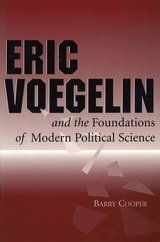
Eric Voegelin and the Foundations of Modern Political Science
Barry Cooper
University of Missouri Press, 1999
This important new work is a major analysis of the foundation of Eric Voegelin's political science. Barry Cooper maintains that the writings Voegelin undertook in the 1940s provide the groundwork for the brilliant book that is one of his best known, The New Science of Politics. At the time of that book's publication, however, few were aware of the enormous knowledge and accomplished scholarship that lay behind its illuminating, although sometimes baffling, formulations.
By focusing on several of the key chapters in Voegelin's eight- volume History of Political Ideas, especially the studies of Bodin, Vico, and Schelling, Cooper shows how those studies provide the basis for Voegelin's thought. Investigating Voegelin's study of Oriental influences on Western political "ideas," especially Mongol constitutional law, and his study of Toynbee, Cooper seeks to demonstrate the vast range of materials Voegelin used.
Cooper contends that, as with other great thinkers, political crisis, specifically the world war of 1939-1945, stimulated Voegelin's intellectual and spiritual achievement. He provides an analysis of Voegelin's immediate concern with the course of World War II, his ability to understand those dramatic events in a large context, and his ability to provide an insightful account of the causes, the significance, and the consequences of the spiritual and political disorder that was evident all around him.
In Eric Voegelin and the Foundations of Modern Political Science, Cooper makes the connection between Voegelin's political writings of the 1940s and the meditative interpretations that began to appear with the publication of Anamnesis and with the later volumes of Order and History much more intelligible than does any existing discussion of Voegelin. Scholars in intellectual history and political science will benefit enormously from this valuable new addition to Voegelin studies.
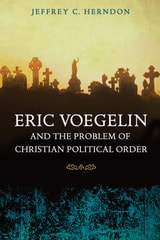
Eric Voegelin and the Problem of Christian Political Order
Jeffrey C. Herndon
University of Missouri Press, 2007
Although some critics of Eric Voegelin’s later work have faulted his failure to deal with the historical Jesus and to address the implications of Christianity for social and political life, the recent publication of Voegelin’s History of Political Ideas has allowed a more complete assessment of his position regarding the Christian political order. This book addresses that criticism through an analysis of Voegelin’s early work.
In Eric Voegelin and the Problem of Christian Political Order, Jeffrey C. Herndon analyzes the development of Voegelin’s thought regarding the origins of Christianity in the person of Jesus, the development of the church in the works of Paul, and the relationship between an immanent institutional order symbolizing the divine presence and the struggle for social and political order. Focusing on the tension between a spiritual phenomenon based on Pauline faith and the institutionalization of that experience in the church, Herndon offers one of the first examinations of the relationship of the History of Political Ideas to Voegelin’s larger body of work.
In his wide-ranging study, Herndon explores Voegelin’s examination of the problem of Christian political order from the inception of Christianity through the Great Reformation. He also presents a clarification of Voegelin’s theory of civilizational foundation and of Voegelin’s philosophy of history with regard to Christianity and Western political order.
Herndon addresses not only the nagging problem in Voegelin scholarship regarding his relationship with the historical Jesus but also the “Pauline compromises with the world” that enabled Christianity to become the instrument by which the West was civilized. He also shows that Voegelin’s interpretation of the historical pressures released by the Great Reformation is important to an understanding of his later work regarding the negative effect of Christian symbols in the creation of ideological disorder.
Eric Voegelin and the Problem of Christian Political Order clarifies issues in Voegelin studies regarding the intersection between political theory and Christian concerns, addressing the relation of religious experience to the public sphere of political life in the West and helping to explain Voegelin’s contention that the death of the spirit is the price of progress. It offers scholars a perspective heretofore lacking in Voegelin scholarship and a clearer view of Voegelin’s understanding of the Christian dispensation and its influence on the course of Western development, history, and philosophy.
Eric Voegelin's Dialogue with the Postmoderns
Searching for FoundationsEdited & Intro by Peter A. Petrakis & Cecil L. Eubanks
University of Missouri Press, 2004
This collection of essays endeavors to generate a dialogue between Eric Voegelin and other prominent twentieth-century thinkers and explore some of the more perplexing issues in contemporary political theory. Each essay rests on the underlying question: is it possible or desirable to construct or discover political foundations without resorting to metaphysical or essentialist constructs? The introduction focuses on the two nineteenth-century thinkers, Nietzsche and Husserl, who have framed the debate about modernity and postmodernity; thereafter, the book examines Voegelin's ideas as compared to those of other twentieth-century thinkers.
Discussed within the volume are Levinas and the precedence of ethics, Ricoeur's theory of narrative representation, Deleuze and the philosophy of immanence, Voegelin's relationship to a speech- dimension theory of human behavior, and Patocka's theory of pre- metaphysical transcendence in Socrates. What will impress scholars most about this collection is the provocative dialogue created between Voegelin and other major thinkers of postmodernism that addresses the issue of establishing foundations without foundationalism.
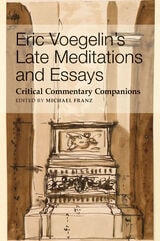
Eric Voegelin's Late Meditations and Essays
Critical Commentary CompanionsMichael Franz
St. Augustine's Press, 2023
Voegelin’s books gave rise to a vast secondary literature that continues to grow, yet the exceptionally impactful late essays and meditative works have never received the scholarly commentaries they deserve because they were published originally as journal articles or chapters in edited collections. This volume remedies that shortcoming with 14 critical analyses that elucidate the late essays while also addressing their implications for the entirety of Voegelin’s thought. The commentaries will prove invaluable to students and scholars in political science, philosophy, history, theology, and other disciplines, serving as a companion piece to the singularly important Vol. 12 of Voegelin’s Collected Works, Published Essays 1966–1985.

Erich Fromm and Critical Criminology
Beyond the Punitive SocietyEdited by Kevin Anderson and Richard Quinney
University of Illinois Press, 2000
Linking the writings of the great humanist psychologist Erich Fromm to criminology, this collection shows how viewing crime patterns and the criminal justice system from Fromm's humanist perspective opens a path to more effective and more humane ways of understanding and dealing with crime and criminals.
Contributors to Erich Fromm and Critical Criminology draw on Fromm's writings on alienation, sadomasochism, and patriarchal/matriarchal values to assess the kinds of crimes being committed and the kinds of people committing them. They explore the spiritual and intellectual sources of Fromm's thought--including Jewish theology, Freudian psychoanalysis, Marxism, and Buddhism--and demonstrate how his socialist humanism points toward a society free of crime and violence. This volume also includes translations of two of Fromm's early articles on criminal justice, never before available in English, in which he develops a psychoanalytic Marxist critique of the role of criminal justice in a class society.
At a time when American society seems bent, to an unprecedented degree, on imprisonment, executions, and other violent responses to the problem of crime, Fromm's humanist critique offers a unique vantage point from which to renew and develop a critical criminology.
Eros, Wisdom, and Silence
Plato's Erotic DialoguesJames M. Rhodes
University of Missouri Press, 2003
Erotikon
Essays on Eros, Ancient and ModernEdited by Shadi Bartsch and Thomas Bartscherer
University of Chicago Press, 2005
An idea charged with paradox, eros has always defied categorization, and yet it cannot—it will not—be ignored. Erotikon aims to raise the difficult question of what, if anything, unifies the erotic manifold. How is eros in a sculpture like eros in a poem? Does the ancient story of Cupid and Psyche still speak meaningfully to modern readers, and if so, why? Is Plato's eros the same as Freud's? Or Proust's? And what is the erotic dimension in Nietzsche's thought? While each essay takes on a specific issue, together they constitute a wide-ranging conversation in which these broader questions are at play. A compilation of the latest, best efforts to reckon with eros, Erotikon will appeal not just to scholars and educators, but also to artists and critics, to the curious and the disillusioned, to the prurient and the prudent.
Erring
A Postmodern A/theologyMark C. Taylor
University of Chicago Press, 1984
"Many have felt the need for a study which would explicate in coherent and accessible fashion the principal tenets of deconstruction, with particular attention to their theological implications. This need the author has addressed in a most impressive manner. The book's effect upon contemporary discussion is apt to be, and deserves to be, far-reaching."—Walter Lowe, Journal of Religion
Error and the Growth of Experimental Knowledge
Deborah G. Mayo
University of Chicago Press, 1996
Mayo has long argued for an account of learning from error that goes far beyond detecting logical inconsistencies. In this book, she presents her complete program for how we learn about the world by being "shrewd inquisitors of error, white gloves off." Her tough, practical approach will be important to philosophers, historians, and sociologists of science, and will be welcomed by researchers in the physical, biological, and social sciences whose work depends upon statistical analysis.
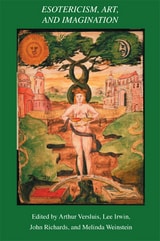
Esotericism, Art and Imagination
Arthur Versluis
Michigan State University Press, 2008
Esotericism, Art, and Imagination is a uniquely wide-ranging collection of articles by scholars in the field of Western esotericism, focusing on themes of poetry, drama, film, literature, and art. Included here are articles illuminating such diverse topics as the Gnostic fiction of Philip Pullman, alchemical images, the Tarot, surrealism, esoteric films, and much more. This collection reveals the richness and complexity of the intersections between esotericism, artistic creators, and their works. Authors include Joscelyn Godwin, Cathy Gutierrez, M. E. Warlick, Eric Wilson, and many others.
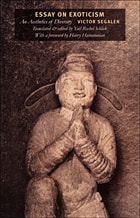
Essay on Exoticism
An Aesthetics of DiversityVictor Segalen
Duke University Press, 2002
Written over the course of fourteen years between 1904 and 1918, at the height of the age of imperialism, Essay on Exoticism encompasses Segalen’s attempts to define “true Exoticism.” This concept, he hoped, would not only replace nineteenth-century notions of exoticism that he considered tawdry and romantic, but also redirect his contemporaries’ propensity to reduce the exotic to the “colonial.” His critique envisions a mechanism that appreciates cultural difference—which it posits as an aesthetic and ontological value—rather than assimilating it: “Exoticism’s power is nothing other than the ability to conceive otherwise,” he writes.
Segalen’s pioneering work on otherness anticipates and informs much of the current postcolonial critique of colonial discourse. As such Essay on Exoticism is essential reading for both cultural theorists or those with an interest in the politics of difference and diversity.

Essay on the Origin of Languages and Writings Related to Music
Jean Jacques Rousseau
Dartmouth College Press, 2009
Essays Critical And Clinical
Gilles Deleuze
University of Minnesota Press, 1997
The final work of this essential thinker.
Essays Critical and Clinical is the final work of the late Gilles Deleuze, one of the most important and vital figures in contemporary philosophy. It includes essays, all newly revised or published here for the first time, on such diverse literary figures as Herman Melville, Walt Whitman, D. H. Lawrence, T. E. Lawrence, Samuel Beckett, Leopold von Sacher-Masoch, Alfred Jarry, and Lewis Carroll, as well as philosophers such as Plato, Spinoza, Kant, Nietzsche, and Heidegger.
For Deleuze, every literary work implies a way of living, a form of life, and must be evaluated not only critically but also clinically. As Proust said, great writers invent a new language within language, but in such a way that language in its entirety is pushed to its limit or its own “outside.” This outside of language is made up of affects and precepts that are not linguistic, but which language alone nonetheless makes possible. In Essays Critical and Clinical, Deleuze is concerned with the delirium-the process of Life-that lies behind this invention, as well as the loss that occurs, the silence that follows, when this delirium becomes a clinical state. Taken together, these eighteen essays present a profoundly new approach to literature by one of the greatest twentieth-century philosophers.

Essays in Ancient Philosophy
Michael Frede
University of Minnesota Press, 1987
Essays in Ancient Philosophy was first published in 1987. Minnesota Archive Editions uses digital technology to make long-unavailable books once again accessible, and are published unaltered from the original University of Minnesota Press editions.
To understand ancient philosophy "in its concrete, complex detail," Michael Frede says, "one has also to look at all the other histories to which it is tied by an intricate web of casual connections which run both ways." Frede's distinctive approach to the history of ancient philosophy is closely tied to his specific interests within the field - the Hellenistic philosophers and those of late antiquity, who are the primary subjects of this book. Long ignored or even maligned, the Stoics and Skeptics, medical philosophers, and grammarians are extremely interesting once their actual views are reconstructed and it is possible to recognize their ties to earlier and later philosophical thought. Refusing to study them as paradigms of achievement, or to seek purely philosophical explanations for their views, Frede draws instead upon those "other histories"—of religion, social structure, law and politics—to illuminate their work and to show how it was interpreted and transformed by succeeding generations.
Essays in Jewish Thought
Nahum Glatzer
University of Alabama Press, 2009
An exploration of the ideas that have shaped Jewish faith, culture, and identity.
In Essays in Jewish Thought, renowned scholar Nahum N. Glatzer offers a thoughtful and illuminating exploration of the intellectual, spiritual, and cultural traditions that have shaped Judaism across centuries. Drawing upon his deep knowledge of Jewish history, philosophy, theology, and literature, Glatzer examines the ideas, texts, and personalities that have influenced Jewish religious life and identity from antiquity to the modern era.
Through a collection of insightful essays, readers encounter enduring questions concerning faith, ethics, revelation, community, and the relationship between tradition and modernity. Glatzer's scholarship highlights the richness and diversity of Jewish thought while demonstrating how Jewish thinkers have engaged with changing historical circumstances and universal human concerns. His clear and accessible writing makes complex philosophical and theological concepts approachable without sacrificing intellectual depth.
Essays in Jewish Thought provides a valuable introduction to key themes in Jewish intellectual history and offers fresh perspectives for both newcomers and seasoned students of Judaism. The volume serves as a meaningful resource for understanding the foundations of Jewish belief, practice, and cultural continuity. Ideal for courses in Jewish studies, religious studies, theology, and philosophy, this collection remains an important contribution to the study of one of the world's most enduring religious and intellectual traditions.

Essays on Kant's Political Philosophy
Edited by Howard Lloyd Williams
University of Chicago Press, 1992
overshadowed by his compatriots Hegel and Marx. With his
strong defense of the rights of the person and his deep
insight into the strengths and weaknesses of modern society
Kant, possibly more than any other political thinker,
anticipated the problems of the late twentieth century.
Kant's political philosophy, wedded as it is to rights,
reform and gradual progress, is emerging from the shadows
cast by Hegelian and Marxist thinking about the state.
In this volume, thirteen distinguished contributors from the
United States, Canada, Britain, and Germany cast light on
important aspects of Kant's liberal thinking. Key topics
covered include Kant's liberal reformism, his relation with
Hegel, his attitude to women, the use of reason, revolution,
Kant's optimism and his moral and legal rigorism.
Howard Williams is a reader in political theory in the
Department of International Politics, University College of
Wales, Aberystwyth. His previous publications include
Kant's Political Philosophy, Concepts of
Ideology, and Hegel, Heraclitus, and Marx's
Dialectic.
Essays on Liberalism and the Economy, Volume 18
F. A. Hayek
University of Chicago Press, 2022
Across seventeen volumes to date, the University of Chicago Press’s Collected Works of F. A. Hayek series has anthologized the diverse and prolific writings of the Austrian economist synonymous with classical liberalism. Essays on Liberalism and the Economy traces the author’s long and evolving writings on the cluster of beliefs he championed most: liberalism, its core tenets, and how its tradition represents the best hope for Western civilization.
This volume contains material from almost the entire span of Hayek’s career, the earliest from 1931 and the last from 1984. The works were written for a variety of purposes and audiences, and they include—along with conventional academic papers—encyclopedia entries, after-dinner addresses, a lecture for graduate students, a book review, newspaper articles, and letters to the editors of national newspapers. While many are available elsewhere, two have never appeared in print, and two others have not been published in English.
The varied formats collected here are enriched by Hayek’s changing voice at different stages of his life. Some of the pieces resonate as high-minded and noble; some are meant as cuts to “intellectuals” (a pejorative term when used by Hayek) like Keynes and Galbraith. All serve to distill important threads of his worldview.
Essays on Literature and Philosophy
The Non-Fiction of Naguib Mahfouz: Volume INaguib Mahfouz
Gingko, 2025
The first Arabic language writer to win the Nobel Prize for Literature, Naguib Mahfouz, helped bring Arabic writing to an international readership. This collection of his early writing, from his time as a philosophy student, reveals the intellectual ferment of the young author, grappling with two millennia of philosophers and writers and establishing his own voice among them.
Available in English for the first time, these essays tackle a vast array of subjects, from Presocratic Philosophy to love and the sexual impulse. The intellectual development demonstrated here forms the foundation of Mahfouz’s literary work, granting insight into the mind behind such famed works as the Cairo Trilogy and Children of The Alley.
Essays on Logic, Ethics, and Universal Grammar
Edited by Philip Schofield
University College London, 2025
Best known as the founder of the ethical theory of utilitarianism, Bentham’s philosophical contributions spanned political economy, judicial administration, prison reform, policing, religion, and many more fields. This new addition to The Collected Works of Jeremy Bentham deals with his ideas about logic, language, ethics, and grammar. Distributed across four essays written between 1814 and 1816 and an appendix, it includes discussions of methodization, ontology, real and fictitious entities, and propositions as the fundamental components of language. In addition to constituting a major contribution to the history of logic and language, this collection establishes the philosophical basis for classical utilitarianism and Chrestomathia, Bentham’s major work outlining his materialist theory of language.
Essays on Sex Equality
John Stuart Mill and Harriet Taylor Mill
University of Chicago Press, 1970
Also contained in this volume is a major interpretative essay by Alice S. Rossi on Mill and Harriet Taylor which describes and analyzes their long personal and intellectual relationship.
Essential Film History
The Evolution of Movie StorytellingCharles Ramírez Berg and John Bruns
University of Texas Press, 2026
A guide to the fundamentals of understanding film history, filmmaking, and film appreciation.
Film is not just a medium; it is also a language—and a global one at that. Essential Film History describes how this language emerged and how it has matured over the course of more than 125 years. Beginning with the experiments of the late nineteenth century, and tracking the development of cinematic storytelling, commercial distribution, and audience reception into the era of digital recording, Charles Ramírez Berg and John Bruns offer a comprehensive course in both the history and artistry of film.
Essential Film History breaks cinematic language into three core components: image, sound, and narrative. Between the 1890s and 1940s, this audiovisual language both consolidated and spread, becoming comprehensible worldwide. Since then, filmmakers have adapted and extended the language of cinema to suit an ever-growing range of aesthetic and narrative projects, from documentaries and full-length animation to avant-garde and made-for-TV movies. Covering major figures, studios, and events as well as key technological and sociopolitical developments, Essential Film History is an indispensable guide to the evolution of cinematic style.
Essential History
Jacques Derrida and the Development of DeconstructionJoshua Kates
Northwestern University Press, 2005
A fundamental reinterpretation of Derrida's project and the works for which he is best known, Kates's study fashions a new manner of working with the French thinker that respects the radical singularity of his thought as well as the often different aims of those he reads. Such a view is in fact "essential" if Derrida studies are to remain a vital field of scholarly inquiry, and if the humanities, more generally, are to have access to a replenishing source of living theoretical concerns.
Essential Vulnerabilities
Plato and Levinas on Relations to the OtherDeborah Achtenberg
Northwestern University Press, 2014

Estado Vegetal
Performance and Plant-ThinkingGiovanni Aloi
University of Minnesota Press, 2023
Interdisciplinary essays on Manuela Infante’s award-winning play explore the relationship between critical plant studies and performance art in the Anthropocene
Since its first staging in 2016, Estado Vegetal, Manuela Infante’s riveting piece of experimental performance art, has expanded philosophical thinking into a fully-fledged artistic inquiry of nonanthropocentric being. Through Infante’s polyvocal monologue, acted with impetus by Marcela Salinas, plants are charged with an agency capable of uprooting culturally grounded conceptions of the world in the face of incommensurable trauma and loss.
This first book dedicated to Infante’s plant-focused performance features eight essays by scholars, poets, and artists whose practices draw from research fields as disparate as new materialism, anthropogenic feminism, queer studies, and speculative realism. Including an interview with Infante, the full playscript, and stills from the performance, Estado Vegetal: Performance and Plant-Thinking reveals the roles that plants in art can play in productively reconfiguring human–nonhuman relations within current anthropogenic perspectives.
Infante’s performance is a perfect case study and reference point for anyone interested in exploring the complexities of plant-thinking through alternative and experimental avenues. Furthermore, this book is at once a critical plant studies primer and an artistic problematization of the philosophical questions that have been central to the latest multidisciplinary discussions on plant-being.
Contributors: Maaike Bleeker, Utrecht U; Lucy Cotter, Portland State U; Prudence Gibson, UNSW Sydney; Michael Marder, U of the Basque Country; Dawn Sanders, U of Gothenburg; Catriona Sandilands, York U; Sibila Sotomayor Van Rysseghem, colectivo LASTESIS; Mandy-Suzanne Wong.
Eternal Life and Human Happiness in Heaven
Philosophical Problems, Thomistic SolutionsChristopher M. Brown
Catholic University of America Press, 2021
Eternal Possibilities
A Neutral Ground for Meaning and ExistenceDavid Weissman
Southern Illinois University Press, 1977
Eternal Possibilities: A Neutral Ground for Meaning and Existence builds on David Weissman's earlier Dispositional Properties and makes a signal contribution to the study of metaphysics. Here, broadening and enriching the point of view adopted in his earlier work, Weissman cites and criticizes a large number of theories proposed by authors from Plato to Wittgenstein and others exploring language theory and metaphysics.
Students of Wittgenstein will be especially interested in Mr. Weissman's critical examination of Wittgenstein's claim in the Tractatus that possibilities are the facts for logic. Weissman proposes a modal theory of properties: they exist in the first instance as possibilities. He argues that a sentence is meaningful if it signifies a property or complex of properties existing as a possible, and true if that possible is instantiated. The status of possibilities and their relation to actual states of affairs are considered in detail.
Ethica Thomistica
The Moral Philosophy of Thomas AquinasRalph McInerny
Catholic University of America Press, 1997
Chapters: Morality and Human Life; The Good for Man; Ultimate End and Moral Principles; The Structure of the Human Act; Good and Evil Action; Character and Decision; Prudence and Conscience; Religion and Morality ABOUT THE AUTHOR:
Ralph McInerny is Michael P. Grace Professor of Medieval Studies and director of the Jacques Maritain Center at the University of Notre Dame, where he has taught since 1955. He is founder and publisher of Catholic Dossier magazine; cofounder of Crisis magazine; and author of several books published by CUA Press, including Aquinas on Human Action (1992), The Question of Christian Ethics (1993), and Aquinas and Analogy (1996).
PRAISE FOR THE BOOK:
"Remarkable for its moderation and common sense. . . . [McInerny] rapidly sketches selected themes from Thomistic moral thinking: what distinguishes the moral activities of man, what is distinctive of moral goodness (in Aristotle and in Aquinas), an analysis of practical reason in relation to natural law, the bases for judging good and evil moral actions, the roles of intellect and will in voluntary activity, the work of virtues as components of moral character, the functions of prudence and conscience, and finally the relation of ethics to religious belief. . . . For the person who desires a quick and understandable introduction to this subject, this little book can be recommended as readable and reliable."—Vernon J. Bourke, Speculum "An important contribution both to moral philosophy and to its teaching. . . . [McInerny] has put us all in his debt by writing it."—Alasdair MacIntyre, Teaching Philosophy "A clear, thorough and readable introduction to the thought of one of the intellectual giants of the Catholic moral tradition."—National Catholic Register
Ethical Communication
Moral Stances in Human DialogueClifford G. Christians and John C. Merrill
University of Missouri Press, 2009
Ethical Excellence
Philosophers, Psychologists, and Real-Life Exemplars Show Us How to Achieve ItHeidi M. Giebel
Catholic University of America Press, 2021
Ethical Issues for a New Millennium
Edited by John Howie
Southern Illinois University Press, 2002
Modern advances in science and medicine bring with them an array of complex ethical dilemmas. In Ethical Issues for a New Millennium editor John Howie addresses contemporary ethical problems with eight essays from top thinkers in the field. This collection offers new and comprehensive overviews of some very tough ethical issues that will remain foremost in our minds in the years ahead. Each essay is written by a recognized authority within his or her specific field, and brings to light ethical questions rooted in ongoing philosophical debates in arenas such as human rights, the welfare state, women’s rights, genetic and gender equality, genetic equity, cloning, organ transplants, environmental ethics, insurrectionist ethics, and the erosion of moral sensibility.
These lectures where originally presented at Southern Illinois University as part of the Wayne Leys Memorial Lectures series. This collection represents the fourth volume in the series.
Ethical Issues in Contemporary Society
John Howie
Southern Illinois University Press, 1995
In this volume of Leys Lectures, the third collection of Wayne Leys Memorial Lectures, six distinguished essayists demonstrate the relevance of ethics to contemporary concerns by constructively exploring major ethical issues deeply embedded in our society.
The essays, written by noted scholars Tom Regan, Carol C. Gould, James Rachels, James P. Sterba, Louis P. Pojman, and David L. Norton, focus on issues of feminism, the exploitation of animals, economic injustice, racial prejudice, naive moral relativism, and the failure of public education.
Tom Regan and Louis P. Pojman both address the issue of animal rights. Regan directs his attention to an ethic-of-care feminism, which contends that the ideology of male superiority—not only to women but to all creatures—must be destroyed. By means of a "consistency argument," he extends ethic-of-care feminism to the treatment of animals, insisting that we must not permit to be done to animals "in the name of science" what we would not allow to be done to human beings. Pojman, on the other hand, addresses the question of animal rights through a critical analysis of seven theories of the moral status of animals, arguing that while animals have no natural "rights" since they are unable to enter into contracts, they do deserve to be treated kindly. In his view, much animal research could be abandoned without significant loss.
What rethinking of democracy in terms of freedom and equality is required by economic justice? Carol C. Gould offers an answer to this question by arguing that economic justice requires that workers control the production process as well as the distribution process. Such justice would provide the basis of "positive freedom" as self-development without ignoring the importance of the absence of constraints.
Taking racial prejudice as his paradigm, James Rachels explores the deeper meaning of prejudice and what equality of treatment involves. Noting the subtlety of prejudicial reasoning, he examines how stereotypes, unconscious bias, and the human tendency toward rationalization make it difficult even for people of good will to prevent prejudice from influencing their actions.
James P. Sterba invites the reader to consider a different and more general problem of how to persuade people to act for moral reasons. To accomplish this aim he shows morality to be a requirement of rationality and "the welfare liberal ideal" (the right to welfare and the right to equal opportunity) to be a fusion of the practical ends of five ideals—liberty, fairness, common good, androgyny, and equality.
For David L. Norton, one of our most pressing problems is the failure of our educational system. The system fails to enable students to make wise "life-shaping" choices involving vocation, marriage, children, and friendship. In order to make good choices, human beings must live and work in an environment that provides experiences that authenticate "personal truths" indispensable to worthy living. These personal truths include direct acquaintance with vocational alternatives and participation in actual service to others.
Collectively, these essays bring into sharp focus the urgent moral issues confronting our society and the need for ongoing discussion and examination of these issues in order to gain deeper understanding of and possible solutions to the problems they present.

Ethical Principles and Practice
John Howie
Southern Illinois University Press, 1987
The second volume in applied ethics based on the distinguished Wayne Leys Memorial Lectureship Series.
With guidelines from legal reasoning, Michael D. Bayles examines “Moral Theory and Application.” Abraham Edel questions “Ethics Applied Or Conduct Enlightened?” The late Warner A. Wick shows in “The Good Person and the Good Society: Some Ideals Foolish and Otherwise” that devotion to ideals need not be either fanaticism or foolishness. John Lachs contends that many public gains are purchased at the cost of individuals being manipulated in “Public Benefit, Private Costs.” James E. Childress in “Gift of Life…” considers ethical issues in obtaining and distributing human organs. Carl Wellman in “Terrorism and Moral Rights” argues that there can be no “rights-based justification” for anti-abortion terrorism.
Ethical Principles for Social Policy
John Howie
Southern Illinois University Press, 1983
Abortion, euthanasia, racism, sexism, paternalism, the rights of children, the population explosion, and the dynamics of economic growth are examined in the light of ethical principles by leading philosophers in order to suggest reasonable judgments.
Originally prepared for the distinguished Wayne Leys Memorial Lecture Series at Southern Illinois University, Carbondale, the essayists have addressed themselves to the most pressing ethical questions being asked today. William K. Frankena, Professor Emeritus, University of Michigan, in “The Ethics of Respect for Life” argues for a qualified view of moral respect for human personality. From his viewpoint it is always prima facie wrong to shorten or prevent human life, but not always actually wrong as other moral conditions may counter the presumed wrong. The late William T. Blackstone in “Zero Population Growth and Zero Economic Growth” contends that justice will require the production of the maximal level of goods to fulfill basic human needs compatible with the avoidance of ecological catastrophe.
Richard Wasserstrom, Professor of Philosophy at the University of California, Santa Cruz, proposes an assimilationist ideal in “Racism, Sexism, and Preferential Treatment.” Gerald Dworkin, Professor of Philosophy at the University of Illinois, Chicago Circle, dares to ask “Is More Choice Better than Less?” Joel Feinberg, Professor of Philosophy at the University of Arizona, in “The Child’s Right to an Open Future,” offers a defense of “rights-in-trust” of children. Tom L. Beauchamp, Professor of Philosophy and Senior Research Scholar at the Kennedy Institute-Center for Bioethics of Georgetown University, considers the paternalism used to justify social policies in the practice of medicine and insists that it invariably involves a conflict between the ethical principles of beneficence and autonomy.
Ethics and Aesthetics of Translation
Exploring the Works of Atxaga, Kundera and SemprúnHarriet Hulme
University College London, 2018
Ethics and Its Sources in Nature and Revelation
Karol Wojtyla
Catholic University of America Press, 2026
Ethics and Morality in Sport Management
Fourth EditionJoy T. DeSensi
FiT Publishing, 2020
Ethics and morality are generally viewed as critical areas in contemporary sport and need not be limited to such topics as sportsmanship, the use of performance-enhancing drugs, violence and cheating. Those in sport management are responsible for addressing ethical and moral questions pertaining to professionalism, equity, legal and financial management, personnel concerns, governance and policies, league and franchise issues, and matters of social justice associated with all aspects of sport. Sport managers must also be aware of and approach these queries logically, rationally and with sensitivity to ensure the integrity of sport, the sport community and society at large.
Ethics & Morality in Sport Management, 4th edition, presents concepts and theories in ethics and morality and demonstrates their applicability in sport management. While addressed primarily to undergraduate and graduate students interested in the organization and administration of sport, this text is also a practical guide and reference for professionals already in the field, as well as athletes, coaches, franchise owners, journalists, spectators, governmental agencies and others associated with sport. Sport managers must be aware of and concerned about their own obligations, rights and responsibilities, as well as those they influence. As such, nothing short of sound ethical and moral reasoning must inform their managerial decisions and actions. This text aims to make clear the nature of ethics and morality, introducing readers to several major ethical theories, and discussing and analyzing the practical ramifications of these precepts in several sport management contexts.
Ethics and Personality
Essays in Moral PsychologyEdited by John Deigh
University of Chicago Press, 1992
Ethics and the Orator
The Ciceronian Tradition of Political MoralityGary A. Remer
University of Chicago Press, 2017
Remer’s study is distinct from other works on political morality in that it turns to Cicero, not Aristotle, as the progenitor of an ethical rhetorical perspective. Contrary to many, if not most, studies of Cicero since the mid-nineteenth century, which have either attacked him as morally indifferent or have only taken his persuasive ends seriously (setting his moral concerns to the side), Ethics and the Orator demonstrates how Cicero presents his ideal orator as exemplary not only in his ability to persuade, but in his capacity as an ethical person. Remer makes a compelling case that Ciceronian values—balancing the moral and the useful, prudential reasoning, and decorum—are not particular only to the philosopher himself, but are distinctive of a broader Ciceronian rhetorical tradition that runs through the history of Western political thought post-Cicero, including the writings of Quintilian, John of Salisbury, Justus Lipsius, Edmund Burke, the authors of The Federalist, and John Stuart Mill.
Ethics at Work
Creating Virtue at an American CorporationDaniel Terris
Brandeis University Press, 2013
Ethics for Beginners
Big Ideas from 32 Great MindsPeter Kreeft
St. Augustine's Press, 2019
Most ethics textbooks are anthologies of articles by contemporary philosophers, or a whole book by one contemporary philosopher, about ethical puzzles to be solved by logical analysis. This is good mental exercise but it will not change your life, and you will not remember it ten years from now. You will not remember a hundred bright little ideas, you will remember only a few Big Ideas, the ones that changed your life. This book is about 52 of them..
And it is by 32 great philosophers. They are all dead. (Philosophers die, but philosophy does not; it buries all its undertakers.) Living philosophers who write ethics textbooks are usually very bright, but they do not include any name we know will live for centuries. Why apprentice yourself to second rate scribblers like me when you can apprentice yourself to the greatest minds in history? Why not learn from Socrates, Buddha, Confucius, Plato, Aristotle, Kant, Kierkegaard, and Nietzsche? Why prefer little minds to big ones?
They disagree with each other, to be sure, but all of them will help you, not least those who contradict you and challenge you, and stretch you by forcing you to reply to them, and fight with them. I am appalled by the fact that 90% of the best philosophy students at the best universities, which say they cultivate "diversity," have exactly the same politically correct opinions, whether of the Left or the Right.
When you were a child your mother probably reminded you before you went out not to forget something like your lunch box or your umbrella. Ethics today is usually treated that way: as an afterthought: check with an ethicist before doing the really important things like business or law or medicine or diplomacy. But ethics is not a P.S. to life. It is about the most fundamental things in life: values, good and evil. Socrates said that a good person does not worry much about little things like whether he lives or dies, but only about big things like whether he is a good person or a bad one.
Ethics from a Theocentric Perspective, Volume 1
Theology and EthicsJames M. Gustafson
University of Chicago Press, 1983
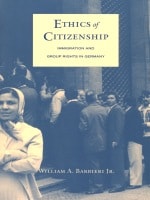
Ethics of Citizenship
Immigration and Group Rights in GermanyWilliam A. Barbieri Jr.
Duke University Press, 1998
Although some of Germany’s foreign workers have gradually attained a degree of social and economic legitimacy, Barbieri explains how they remain effectively excluded from true German citizenship. Describing how this exclusion has occurred and assessing current attitudes toward political membership in Germany, he argues for a just and democratic policy toward the tax-paying, migrant worker minority, one that would combine the extension of the individual rights of citizenship with the establishment of certain group rights. Through a dissection of ongoing public “membership debates” over issues such as suffrage, dual citizenship, and immigration and refugee policy, Barbieri identifies a range of competing responses to the question of who “belongs” in Germany. After critiquing these views, he proposes an alternative ethic of membership rooted in an account of domination and human rights that seeks to balance individual and group rights within the context of a commitment to democracy and equal citizenship.
Indispensable for scholars of German studies, Ethics of Citizenship also raises questions that will attract moral philosophers, constitutional scholars, and those interested in the continuing, global problems associated with migration.
Ethics of Liberation
In the Age of Globalization and ExclusionEnrique Dussel
Duke University Press, 2012
Throughout his career, Dussel has sought to open a space for articulating new possibilities for humanity out of, and in light of, the suffering, dignity, and creative drive of those who have been excluded from Western Modernity and neoliberal rationalism. Grounded in engagement with the oppressed, his thinking has figured prominently in philosophy, political theory, and liberation movements around the world.
In Ethics of Liberation, Dussel provides a comprehensive world history of ethics, demonstrating that our most fundamental moral and ethical traditions did not emerge in ancient Greece and develop through modern European and North American thought. The obscured and ignored origins of Modernity lie outside the Western tradition. Ethics of Liberation is a monumental rethinking of the history, origins, and aims of ethics. It is a critical reorientation of ethical theory.
Ethics of Maimonides
Hermann Cohen, Translated by Almut Sh. Bruckstein
University of Wisconsin Press, 2004
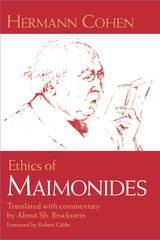
Hermann Cohen’s essay on Maimonides’ ethics is one of the most fundamental texts of twentieth-century Jewish philosophy, correlating Platonic, prophetic, Maimonidean, and Kantian traditions. Almut Sh. Bruckstein provides the first English translation and her own extensive commentary on this landmark 1908 work, which inspired readings of medieval and rabbinic sources by Leo Strauss, Franz Rosenzweig, and Emmanuel Levinas.
Cohen rejects the notion that we should try to understand texts of the past solely in the context of their own historical era. Subverting the historical order, he interprets the ethical meanings of texts in the light of a future yet to be realized. He commits the entire Jewish tradition to a universal socialism prophetically inspired by ideals of humanity, peace, and universal justice.
Through her own probing commentary on Cohen’s text, like the margin notes of a medieval treatise, Bruckstein performs the hermeneutical act that lies at the core of Cohen’s argument: she reads Jewish sources from a perspective that recognizes the interpretive act of commentary itself.
Ethics through Literature
Ascetic and Aesthetic Reading in Western CultureBrian Stock
Brandeis University Press, 2008
Ethics, Life and Institutions
An Attempt at Practical PhilosophyJan Sokol
Karolinum Press, 2017
With few exceptions, moral philosophy considers the acting person to be an autonomous, independent individual pursuing his or her own happiness. But in the context of social institutions—for example, in workplaces—it is often an organization’s goals, not an individual’s, that take precedence. In complex networks of organizations, morals take a different shape. Divided into three parts, this book begins by exploring basic notions such as freedom, life, responsibility, and justice, and their relationship to practical philosophy; looks to the main schools of Western thought in the search for a common moral foundation; and reintroduces the forgotten idea of biological and cultural heritage—an idea that could prove fundamental in addressing our responsibility not only to human lives, but also to the natural world. In a closing analysis, Sokol brings all of these moral concepts to bear on problems connected to the growing complexity of institutions, offering hope for a practical philosophy for the modern world.